4 751 résultats
4to. 32 pp. Illustrated wrappers. The Arabic Superman issue of the Aramco World Magazine, with a charming illustration of Superman on the front and Batman and Robin on the back. An included article explains the history of these Arabic counterparts of these American superheroes. In 1964 the Arabic Superman was introduced into the Middle East operating under the guise of Nabil Fawzi instead of Clark Kent, followed a year later by Sobhi (Batman) and Zakkour (Robin). The comics of course read from right to left, as does the "S" on the costume of Superman. The article seems to be an important source on these Arabic comics. Other articles cover David Roberts, Cotton Castle, the history of Aramco and the journey of father Abd al-Masih. - In good condition.
New English Paperback. Pbo. Demy 8vo. (21 x 13.5 cm). [xii], 74 p. Yezidism and born of Yezidism based on Arabic sources. Arap kaynaklarina göre Yezidiler ve Yezidiligin dogusu. Translator from Ottoman: Eyüp Tanriverdi; Edited by: Ahmet Tasgin.
Fine English Paperback. Pbo. Cr. 8vo. (20 x 14 cm). In Turkish. 110 p. Arap poetikasi. Konferanslar [= Es-s'iriyye el-Arabiyye]. Translated by Emrullah Isler. a study on poetica of Arabic poetry.
Fine English Paperback. Pbo. Roy. 8vo. (23 x 16 cm). In Turkish. 722 p. Arap-Islâm kültürünün akil yapisi. Arap-Islam kültüründeki bilgi sistemlerinin elestirel bir analizi. [= Bünyetü'l-akli'l-Arabî (Nakdu'l-akli'l-Arabî, 2.].
Fine English Paperback., Fine., 20 x 11 cm., 357 p., "Araplarin gözüyle Haçli Seferleri.=[Les Croisades vues par les Arabes].", Amin Maalouf, Telos Yayincilik, Ist., 1997.
Scale 1:4,000,000. Equal-area conic projection (ravnougol'naia konicheskaia proektsiia). Relief shown by gradient tints, shading, and spot heights. Depths shown by gradient tints and soundings. 77 x 65.5 cm. Index printed on verso. Stored in original printed sleeve. Re-issued third edition of the Soviet 1:4,000,000 reference map of the Arabian Peninsula, edited by N. I. Arep'ev with O. L. Kuznechov and K. D. Volkov. Includes insets (in 1:15,000,000 scale): "Ekonomicheskaia karta", "Karta plotnosti naseleniia i razmeshcheniia arabskikh plemen". - Old reference label "2" pasted to sleeve's cover. In excellent condition. Rare.
193038319Chez l'auteur | Marrakech s. d. [circa 1930] | 16 x 24 cm | agrafé
Folio (260 x 366 mm). (4), 9-462, (2) pp. Title-page printed in red and black, with the Medici arms. With 149 text woodcuts by L. N. Parassole after Antonio Tempesta. Contemporary Italian flexible boards with ms. title to spine. The rare first re-issue, with new preliminary matter only, of the first Gospel printing in the interlinear Arabic and Latin version, prepared at the same time and printed by the same press as the first Arabic-only Gospel. These were the first works ever produced by Ferdinando de' Medici's "Medicea" press, founded by Pope Gregory XIII to spread the word of Christ in the Orient. Supervised by the able scholar Giovambattista Raimondi (1536-1614), its strength lay in oriental, especially Arabic, printing. After Raimondi's death, the press relocated to Florence. - The Arabic text is printed in Robert Granjon's famous large fount, generally considered the first satisfactory Arabic printing type; as all early printed editions of the Arabic Gospels, it is based on the Alexandrian Vulgate (cf. Darlow/M. 1636). The Latin version is by Leonardo Sionita. As issued in 1591, the work began with page 9, without a title page or any preliminary matter at all: "the intended prefatory matter was apparently never published" (Darlow/M.). The 1619 re-issue contains 4 pages of preliminary matter (title page and a note "typographus lectori"); there exist copies with two additional leaves of dedications not present here. Another re-issue, much more common, was released in 1774. - Occasional browning; a good, untrimmed and hence wide-margined copy in its original temporary binding. Darlow/Moule 1643. Mortimer 64 (note). Streit XVI, p. 866, no. 5138.
606111Aix-en-Provence, Edisud, 1995. In-4, rel. pleine-toile noire éd. sous jaquette ill. en coul.; 333 pp., très nb. ill. photogr. en n/b. et en coul. in et h.-t., nb. plans, fig., croquis in.-t., bibliographie, glossaire des principaux termes arabes ou étrangers, index des noms de personnes et d'ethnies, index des termes géographiques.
194643951946 Paris, Albin Michel (Collection "Sciences d'Aujourd'hui") 1946, in 8 broché, 541 pages
(32), 545, (44) pp. With engraved title-page by Wingendorp. Contemporary sheepskin parchment. One of the two first editions published simultaneously of a historical work written by the German historian Georgius Hornius (1620-70). "In the dusk of his life, he moved to universal history, an endeavor that culminated with his Arca Noae, which comprised the chronicles of Europe, alongside descriptions of the cultures of China, Egypt, Assyria, ancient Greece, Rome, and pre-Columbian America, and surveys of their religion, art and literature" (Kowner). Entitled "Noah's Ark", it contains the history of the world starting at its creation up to the 17th century. It successively deals with all the great empires and kingdoms and their important founders and rulers. It contains narratives about the founding of Damascus, the founding of Arab kingdoms by Ishmael and Isaac, the caliphates, and the Turks. Beside sections dealing with the Middle East, the book deals with Chinese and American history as well, struggling with sources that predated the biblical sources. Hornius identified biblical figures with characters mentioned in early Chinese annals, suggesting that Cain's offspring had settled in China. Nevertheless, he rejected the possibility that some Chinese sources predated the flood for which Noah built his ark. - Born in Germany, Hornius later became a professor of history at Leiden University, the Netherlands. He mainly dealt with the topic of chronology, discussing how (world) history was to be divided into periods. Among others the compared the difference in biblical, classical and oriental chronologies, and wrote many works on history, theology, geography, and chronology. - With old shelfmark on spine and library stamp on flyleaf. Browned with some small spots throughout, engraved title-page slightly thumbed, a waterstain on leaf *2 and a small tear in leaf *3, and frequent wormholes, slightly affecting the text near the end of the book. Book block only loosely attached to binding. Otherwise a good copy. Sabin 33013. European Americana 666/75. R. Kowner, From white to yellow (2014), 9.
Folio (305 x 190 mm). 2 parts in 1 volume. (4), 31, (1), 64 pp. With 12 (instead of 16) plates containing 24 copper engravings. Modern boards. Fascinating, little-received chronographical study focusing on the history of the Eastern Mediterranean and Asia Minor, then under Ottoman rule. The anonymous late 17th-century German author hides behind the name of "Philo Chronographus" and is evidently identical with the "Philo Cosmographus" who produced the similarly themed geographical work, "Trinum Marinum", which is announced on the title page and was often issued together with this, though produced by a different publisher and catalogued separately. The first part of the work contains a general introduction which relates the 24 hours of the day to the time from Creation to the year 1800 (which is conceived of as the end of the world, leaving another mere 107 years of history to come!). The second part features a chronicle of the "Rule of the Ottoman Porte", from Sultan Osman to Suleyman II. - Numerous pages of plates (each page containing two copper engravings) depict costumes, animals and plants, maps and views of towns (Sultan Osman, the Ottoman Residence and a view of Constantinople, dolphins and cranes, Turkish ladies in their various garments, a cypress and a mastix tree, etc.). - The number of plates, and indeed even the arrangement of engravings on a single page, varies from copy to copy, but this wants 4 plates as compared to the table of plates. Well-preserved. VD 17, 12:645730N. Weller, Pseud. 439.
Collana diretta da Jean Marcad?, professore alla Facolt? di Lettere di Bordeaux - Versione italiana a cura del Prof. Giuseppe Tucci, Professore emerito dell'Universit? di Roma, Presidente dell'Istituto Italiano per il Medio e l'Estremo Oriente, Roma - Traduzioni di: Grazia Maria Bulgarelli Piperno - Lina Castelnuovo e Barbara Tosi - Vol.I: Prefazione - Introduzione - I problemi - I metodi - I risultati - Conclusioni - Tavole cronologiche - Bibliografia - Lista delle illustrazioni - Vol. II: Avvertenza - Ringraziamenti - Prefazione - Parte I. Dall'et? del medio Bronzo al periodo classico (220 a.C.-332 d.C.) - Introduzione - L'Et? del Medio Bronzo - L'et? del Tardo Bronzo -L'Et? del ferro - - Il periodo persiano - Conclusioni - Tavola cronologica - Parte II.:Dall'Epoca di Alessandro il Grande alla fine del periodo romano (332 a.C.-324 d.C.) - Introduzione - L'indagine Archeologica - I Monumenti - Le forme dell'arte - Conclusioni - Tavola cronologica - Bibliografia - Illustrazioni in copertina: Vol. I. Ossuario a forma di casa. Azor. Civilt? di Beersheba.3500 ca a.C. - Vol. II. Ritone filisteo in forma di cinghiale da Tell-Quasileh sec. XII a:C. 2 23x15,5 cm., legatura in similpelle, titoli in oro sul dorso, sopraccoperta illustrata a colori, mappe alle sguardie, pp. 189 (3), 45 tavole a colori, 73 illustrazioni in nero; pp. 212 (4), 21 tavole a colori, 64 illustrazioni in nero, prima edizione italiana, leggeri segni d'uso e tempo, buon esemplare.
Hand-coloured lithograph. 380 x 555 mm. Fine image of a Rough-Legged Buzzard, from John Gould's monumental "Birds of Great Britain" (London, 1862-1873, 5 vols.). Joseph Wolf (1820-99) "was the first bird artist to understand and use the new freedom of style that lithography allowed [...] He introduced natural settings and a feeling of motion into his paintings. Early training in lithography and art [...] opened the door to Wolf's development into one of the first and finest true bird artists. He breathed life into the stiff 'bird on a perch' portrayals so characteristic of bird art of the day. Wolf liked especially to paint birds of prey and game birds, with their subtle browns and grays" (Cornell University Library). Fine Bird Books 102. Nissen IVB 372. Sauer 23. Wood 365. Zimmer 261.
Autograph document in Arabic. 8vo. 1 p. Accompanied by the first published account of Slatin's escape: 3 consecutive issues of the Pall Mall Gazette, 23-25 April 1895 (42 x 37 cm each). Wrapped as a parcel within a bifolium of the Times, inscribed "Slatin Bey's Escape" by Sir Reginald Wingate. An archive of first-hand contemporary documents concerning the escape of Slatin Pasha (Major-General Rudolf Anton Carl Freiherr von Slatin, 1857-1932), who was held prisoner for eleven long years by the Mahdi Muhammad Ahmad and his successor. The material was assembled by General Sir Reginald Wingate of the Egyptian Intelligence Department, who facilitated the escape and assisted on the perilous three-week, thousand-kilometre journey across the Nubian desert to Aswan, Egypt. "Probably the most famous European in the history of the Sudan, this Austrian survived as a captive of the Mahdi from 1883 until his escape to Egypt in 1895. His knowledge of the Sudan and its people was unrivalled and after the re-conquest he was appointed Inspector-General, second in authority only to the Governor-General, Reginald Wingate, of whom he was a great personal friend" (H. Keown-Boyd, Soldiers of the Nile [1996], p. 174). - The archive includes an Arabic document presumed to be written by Slatin Pasha (1 p. on thick handmade paper, 16 x 25 cm). Any writing by Slatin Pasha in Arabic is exceedingly scarce. Also, Slatin Pasha's first published account of his captivity and escape in Sudan, in three consecutive "Special Edition" issues of London's Pall Mall Gazette newspapers, preceding his book "Fire and Sword in the Sudan" by an entire year. Dated 23, 24, 25 April 1895 respectively, each contains 1 of 3 parts of Slatin's account entitled "The Story of My Flight". Each issue measures 42 x 37 cm. Wear to extremities and folds, otherwise very good. A scarce contemporary report, complete and in original condition. - Wrapped together within contemporary leaves of the Times, forming a parcel and inscribed by Sir Reginald Wingate "Slatin Bey's Escape", addressed in his secretary's hand to "Miss Campbell, Cawley Priory" - evidently a close friend or relative of Slatin's who Wingate thought would appreciate knowledge of his safety as soon as possible.
Comprising Lt. Ralph Smith's diary for 1918; his manuscript account fund book for "No. 3 Mule Column" (1917-20); his letterbook (Mesopotamia, May 1919 - June, 1920), with related telegrams, photographs, and ephemera; small group of official correspondence relating to Gunner Harry Dryburgh of the Remount Depot, Baghdad (mostly relating to travel permissions), ca. 1918-19; three programmes for theatrical performances held at the M.T. Depot Theatre (1918-19), and cinema programme for the Olympia Cinema, 31 May - 4 June 1919. Diary disbound, others in original bindings. Ephemera loose, the theatrical programmes printed on coloured paper, various sizes. Archive relating to the British transport corps ("Remount Depot", and "Mule Column") centred at Baghdad. An evocative diary kept by Lt. Smith captures both the horror and beauty of his daily life: "Never shall I forget the pain & terror in that poor little thing's face. I had nothing to help it & they were miles from any habitation [...] without food and medicine" (13 May, near Qara Tappah). The diary was written whilst he was serving with the No. 3 Mule Column, a section of the Transport Corps stationed in Mesopotamia, to which he was assigned in June 1917. It includes mentions of Qara Tappah, Baguba, Abu Jisra, Hillah (March 3, visiting "the house built by the German excavators who have done so much here" and the Babylonian remains, which Gertrude Bell had visited in January), Abu Saida (31 March, "I killed 1000 flies in my tent"; April 5, "Changed into my light underwear"; April 17, "Saw streams of Kurds & Arabs on the road [...] on the trek with camels"; April 23, "held a court martial [...] of Hazzat Shah [...] for theft from a mail bag, found him guilty & sentenced him to 30 lashes"), Table Mountain (trip with his orderly, Mohammed Qasim, whose photograph is included), Kifri and environs of Baghdad (29 April, "Tuz Khurmatli [Khurma] was taken today and nearly the whole of the Turkish force killed or taken prisoners"; 2 May, "Passed the 2 lots of Turkish prisoners [...] one prisoner of the first lot died on the way [...] they are evidently hungry and tired"). - The majority of Smith's letter book correspondence relates to his ordering books on India from Mudie's Select Library, Higginbotham in Madras (from where he purchased his Lett's Diary) and elsewhere, or selling others (12 April 1920, placing an advert in the Baghdad Times, "For Sale. Palmer's Arabic Grammar"). Smith's record of the No. 3 Mule Column Fund records Receipts ("Sale of a consignment of cigarettes for the column", "Proceeds of the sale of parts of two Turkish carts") and Expenditure ("Football, 2 bladders & one tube cement", "Sweets for the the Peace celebrations"). The entertainment programmes include pantomimes ("Red Riding Hood", "A Gipsy Romance" by the Advaxeliers at the Baghdad Depot Theatre), and an Olympia Cinema listing printed by the Dangor Press, Baghdad. - A unique ensemble, well preserved.
556383Washington, US Gov. Printing Office ,1973. In-8 reliure pleine toile verte, titre doré au dos et plat sup., XVI-415 pp., cartes dépliantes et tableaux dans le texte, blio., glossaire, index.
19770085291977. Hardcover. Good. Publisher: FAS of The American University 1977 Good HB 448 pp foxing. hardcover
Folio (ca. 490 x 610 mm). (86 + 88 =) 174 large black-and-white photographs (14 ca. 95 x 120 mm, the rest ca. 250 x 300 mm). Mounted on cardboard leaves on cloth tabs. Handwritten English captions throughout. Bound for the photographer in two monumental full red morocco albums with giltstamped titles to upper covers. All edges gilt. Two monumental albums with photographs from travels undertaken to Bashan, Argob, Moab and Gilead, presently Jordanian and Syrian territories, in the years 1894-95. Mounted on the album leaves are 174 photographs taken by the British officer Algernon Heber-Percy (1845-1911), recording two of his expeditions to the Levant. Most of the photographs show archaeological sites, ancient ruins, structures, Druze and Bedouin villages and the residents of the villages that Heber-Percy visited in the course of his travels. - The first album, entitled "Argob and Bashan", contains 86 photographs of sites that are today in Syrian territory, specifically Trachonitis, Bashan and Jabal al-Druze, which the photographer visited together with his spouse and two sons in 1894. The sites include villages in the Trachonitis region (the Lajat) as well as in the cities of Qanawat, As-Suwayda, Bosra and other cities, and the road from Damascus to Beirut. The album also includes photographs of the region's Druze inhabitants. - The second album, entitled "Moab and Gilead", contains 88 photographs from sites that are today in Jordanian territory, visited by the photographer in 1895, including Beth Ba'al Ma'on, Dhiban, Umm ar-Rasas, Amman, Salt (Al-Salt) and Jerash. The album also includes photographs of the region's Bedouin inhabitants and three photographs showing a travelling circus of trained animals (a monkey, a goat and a bear) encountered by the photographer in the Madaba area. Heber-Percy also published on the expeditions recorded in these photographs: his account of his travels appeared in two books, "A Visit to Bashan and Argob" (London, 1895) and "Moab Ammon and Gilead" (1896), and some of the photographs in the albums were reproduced in these books. - Bound for the owner by Bennion & Horne, Market Drayton (their label to pastedown). Some foxing, mainly confined to flyleaves; occasional slight edge flaws. Bindings slightly scuffed at the extremeties, but in all a finely preserved, impressive set.
Large 4to. 201, (1) pp. (including errata). With a folding engraved plate and a folding letterpress table. Contemporary carta rustica binding. First edition thus. A highly interesting work comparing the different numerical systems used by various languages and cultures: Arabic, Hebrew, Persian, North and South American Indian cultures, Chinese, Japanese, Tamil, Coptic, Maori, etc. Separate chapters investigate the European adoption of the Arabic system of numerals. The engraved plate shows the shape of numerals throughout the world, while the folding table compares the pronunciation of the word for the number "6" in a wealth of languages. - The Spanish-born Jesuit Lorenzo Hervás y Panduro (1735-1809) counts as one of the most important authors of the Spanish Universalist School of the 18th century, an enlightened, global, comparative approach to historic and scientific theory. This work also appeared as volume 19 of the author's monumental 21-volume cosmographical treatise "Idea dell' Universo" (1778-87), being one of five volumes of the series to be issued separately. - Front inner hinge loosened. Untrimmed in the original carta rustica. An early and little-received work of comparative linguistics, pre-dating by many decades the works of Bopp and Schleicher. De Backer/S. IV, 319f., 2.XIX. Not in Riccardi.
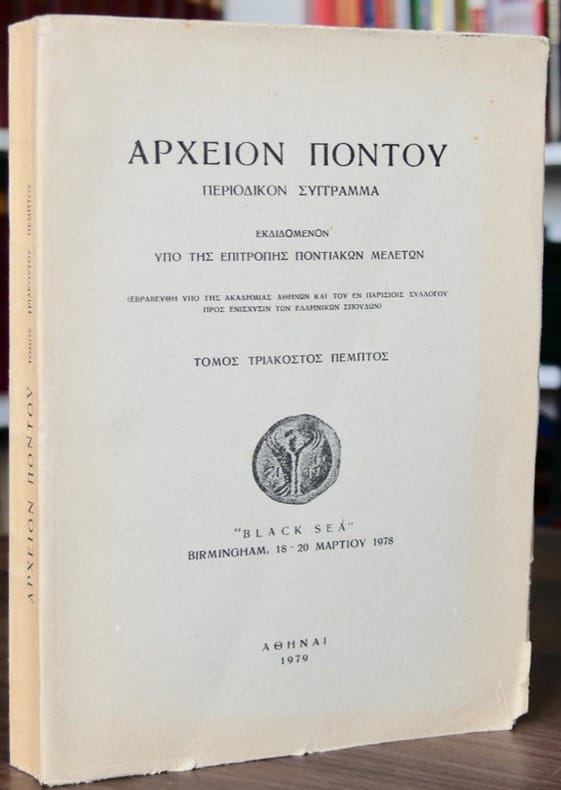
557390"Black Sea", Birmingham, 18-20 Mars 1979, Aphnai, 1979. Great in-8, paperback, 480pp, 34 fig. h.-t.
557030Washington, Assembly of Turkish American Associations, 1986. In-4, broché, 139 pp., cartes en noir dans le texte.
556786Richmond, Curzon Press, 1997. In-8 cartonnage bleu marine éditeur, titre doré au dos et au plat sup., X-436 pp., index, 36 contributions. (Caucasus World).
556795Cambridge, Harvard University Press, 1945. In-8 reliure éditeur pleine toile verte, titre argenté au dos, XXI-148 pp., 32 pl. en noir, 1 carte à pleine page, bibliogr., chronol., index.
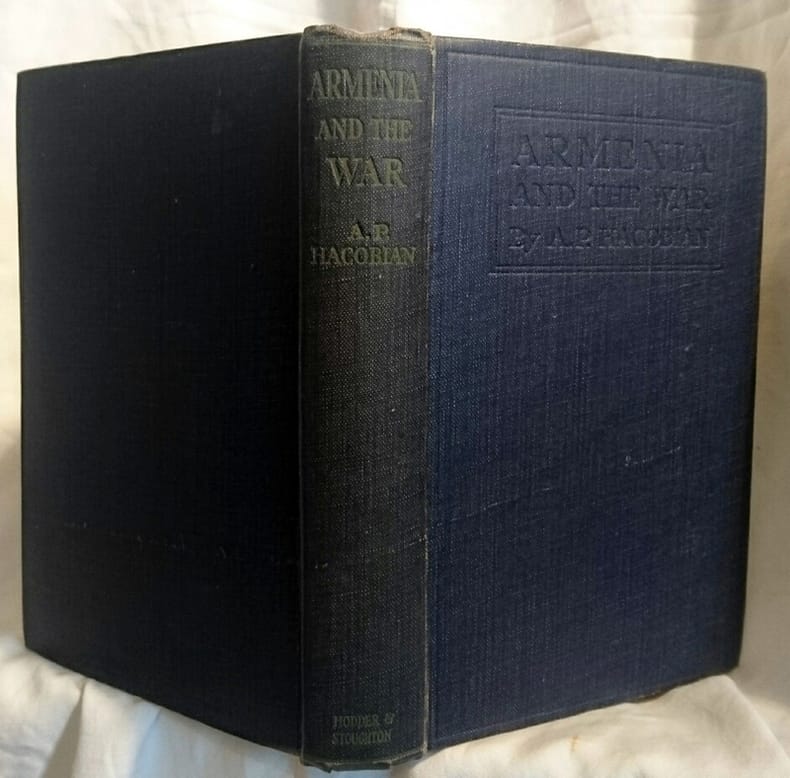
556186London, Hodder & Stoughton, 1917. In-12, rel. d'éditeur percaline bleue, XVII-200 pp., texte anglais. Rare édition originale.