CHATELAIN (Henry Abraham).Livre Rare Book
1 365 résultats
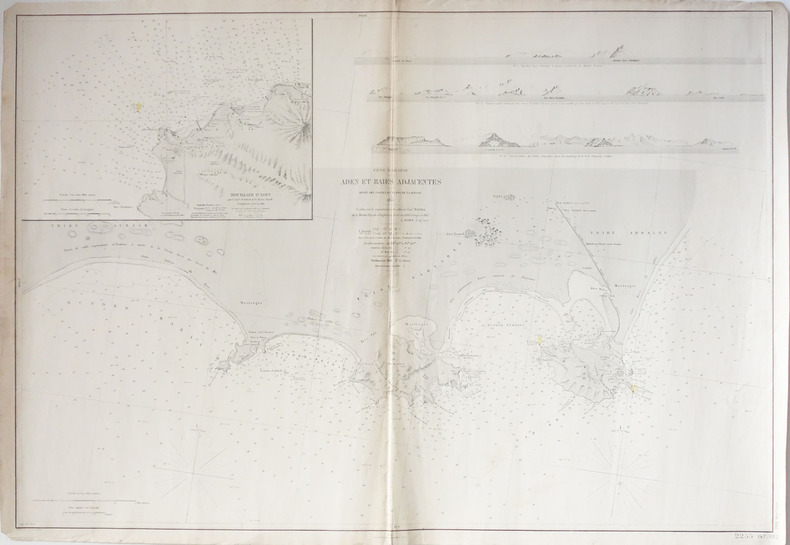
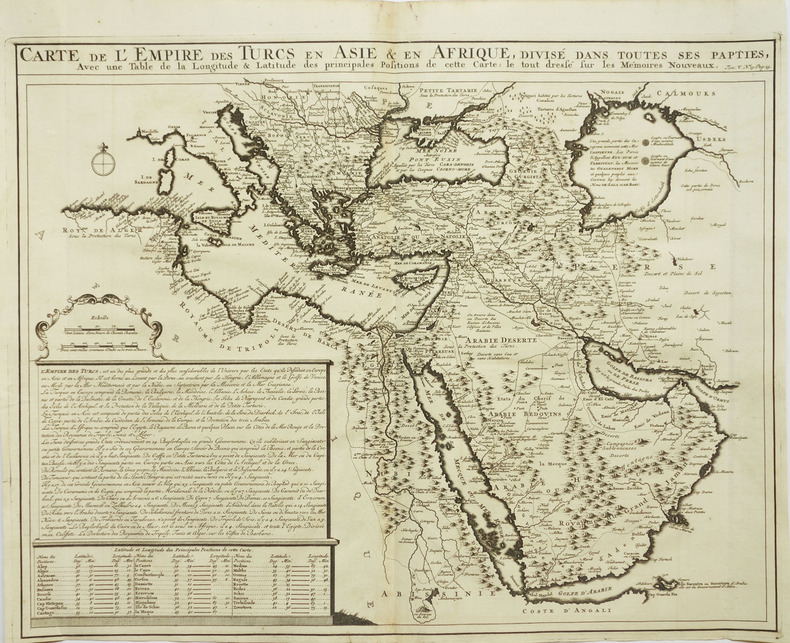
1720LBW-2043Amsterdam, circa 1720. 400 x 512 mm.
1872LBW-2421Paris, 1872. 611 x 892 mm.
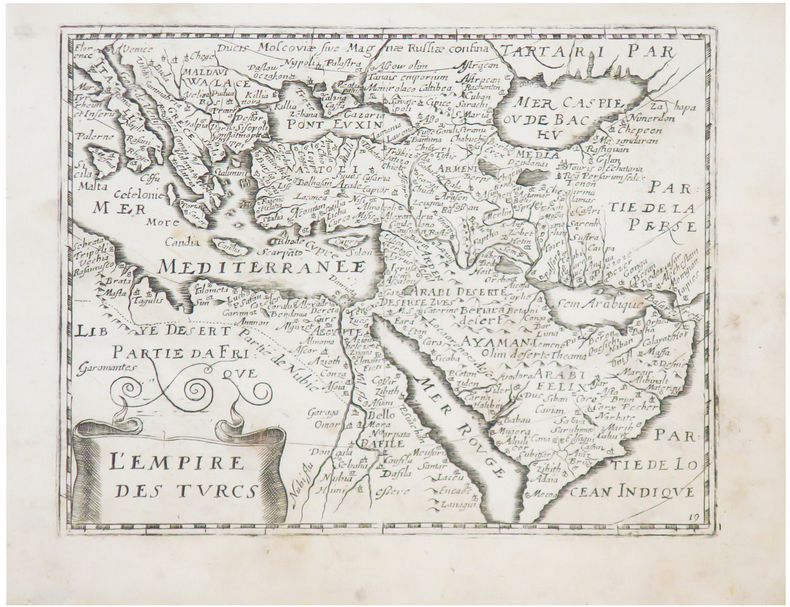
1667LBW-6505[Paris, Jollain, 1667]. 134 x 172 mm.
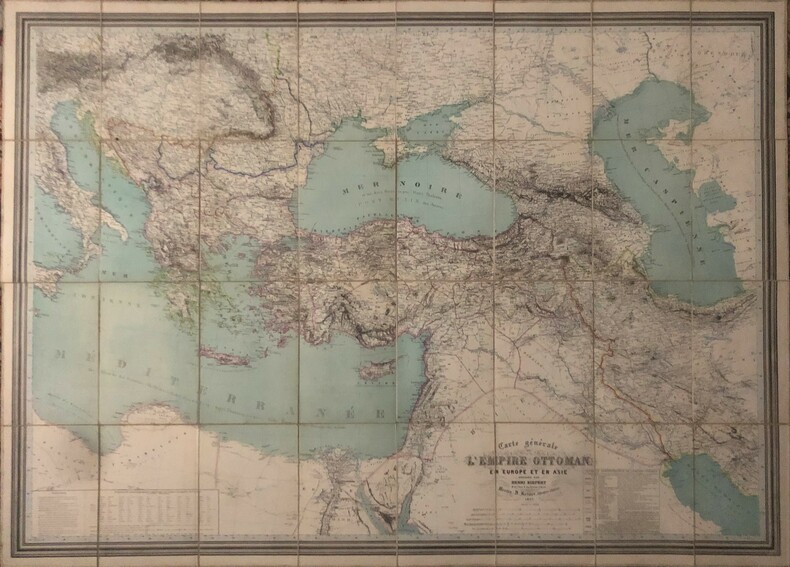
1867PHO-611Carte générale de l'Empire Ottoman en Europe et en Asie. Berlin, D. Reimer, 1867. Carte gravée (93x129 cm) aux contours rehaussés de couleurs, repliée au format in-8, en feuilles entoilées, sous emboîtage (240x170mm)emboîtage fendu avec petit manque ,titre sur la tranche.
In-8 gr., tela editoriale (lieviss. aloni ai piatti), decoraz. oro al piatto, pp. 672, con numer. tavv. f.t. che riproducono ritratti dei più importanti personaggi arabi e inglesi (a matita, a penna, a pastello, ecc.), e 4 carte geografiche ripieg. "Prima edizione ufficiale". “Nel 1919, durante la conferenza di Parigi, aveva scritto il suo grande libro sulla rivolta araba, "The seven pillars of Wisdom": il primo manoscritto venne smarrito da L. in treno. Il volume, pubblicato in numero assai limitato di copie, apparve nel 1921 e poi ancora nel 1926 con molti rimaneggiamenti proposti da G.B. Shaw, amico dello scrittore; alcuni giudizi su persone ancora vive e su azioni di guerra furono soppressi. Solo nel 1935 apparve l’edizione per il pubblico. Uomo dalla straordinaria personalità di condottiero e nello stesso tempo di artista, L. ha creato, con "The Seven pillars", un’opera affascinante nella quale la pagina di cronaca si mescola con l’ispirazione poetico-letteraria, l’ufficiale in missione si alterna col viaggiatore e l’archeologo... “Monumento” che rimane a testimonianza delle sue imprese, "The Seven Pillars", ha un eccezionale valore artistico e rimane fra i capolavori più singolari della letteratura moderna” (Cfr. Diz. Univers. della Letteratura contemporanea, Mondadori,III, p. 73). Solo qualche rara e lieviss. fioritura, altrimenti testo ben conservato, con barbe.
027517Paris, Brunet, 1779 0 un volume in-4° (252 x 190mm), [4] ff. 56 pp. (préface) 252 pp. Reliure en basane fauve marbrée, dos lisse richement orné, roulette dorée sur les coupes, tranches mouchetées (reliure époque). (charnières légèrement fendillées, frottis sur les coins, petit travail de ver en marge extérieure sans incidence sur le texte sur la plupart des feuillets, présence de rousseurs faibles dans l'ensemble sauf sur une dizaine de feuillets où elles sont plus soutenues, rares salissures marginales, présence d'une petite cerne angulaire sur quelques feuillets). Ce volume contient un bandeau gravé de MARILLIER et 15 planches hors-texte dont 2 dépliantes. Édition originale de cette traduction, peu courante, et seconde en français après celle de Mourier (Copenhague, 1773 ; puis 1774) qui avait été jugée incorrecte au point de vue du texte (fautes grossières et erreurs dans la langue arabe) et des planches. Niebuhr resta six années au Yémen (1761-1767), pays inviolé appelé alors l'Arabie heureuse. Il relata ses observations sur tous les aspects de la civilisation arabe avec un souci d'impartialité et d'exactitude qui lui font honneur. Son texte, très précis, comprend pour de nombreux lieux, objets, etc. le nom phonétique en arabe, et aussi l'écriture en arabe. Quant à la cartographie, elle est extrêmement précis, première à faire mention du Koweit. Il est aussi le premier à appeler YEMEN cette partie de l'Arabie. TOME 1 SEUL (sur 2 parus).
In 12° grande (18×9,1 cm); 5 tomi: 270 pp., 268 pp., 277, (1) pp., 282 pp., 308, (2) pp. Le prime pagine del volme portano spesso numerazione romana. Completo. Le pagine bianche in fondo al volume sono applicate alle bellissime carte marmorizzate di sguardia. Bellissime legature coeve in piena pelle marmorizzata con titolo, numero del volume e ricchissimi fregi in oro al dorso. Qualche lieve difetto. Una leggerissima brunitura al margine esterno bianco delle prime due carte del quarto volume. Tagli rossi. Testatine, finalini ed iniziali ornate. Nuova edizione rara (come tutte le edizioni precedenti) di questa celeberrima traduzione del celebre letterato ed orientalista francese, figlio dell’interprete arabo alla corte di Francia e a sua volta interprete ufficiale della corona, François Petis de la Croix (1653-1713). Inviato per formarsi da Colbert in giovane età in Siria, Persia e la Turchia venne a contatto con numeroso materiale letterario che poi avrebbe ripreso e studiato nel corso di tutta la vita. Dopo un periodo di studio ad Aleppo, arrivò nel 1674 a Isfahan, dove rimase fino al giugno del 1676. Da una breve descrizione di questo suo soggiorno si apprende del suo profondo interesse per i costumi dei “dervisci” tanto che si crede che de la Croix sia stato uno delle più importanti fonti sul “Sufismo” nell’Occidente del XVII° e XVIII° secolo. Fra lesue opere principali troviamo proprio questa raccolta di favole che molto deve al Sufismo. De la Croix sostenne che l’opera fosse la traduzione di un opera dal titolo persiano Hazar u yek Ruz (alla lettera “Le mille ed un giorno”), che l’orientalista acquisì da un’ Dervish Mocles ‘o’ Moklas ‘a Isfahan nel 1675. Non è chiaro quanto questo sia vero. Molti sostengono che la gran parte dei racconti è stato effettivamente inventato da Petis de la Croix stesso. Sicuramente all’epoca in cui l’opera venne pubblicata e per tutto il settecento, il clima di caccia alle streghe verso diverse forme di eresia e dottrine orientali, potrebbe aver suggerito a De la Croix di dare ad altri la paternità dell’opera. Il fatto che due altri grandi orientalisti Antoine Galland e Barthélemy d’Herbelot de Molainville che frequentavano De la Corix, non abbiano lascito nei loro scritti nessun riferimento importante alle pratiche del “Sufismo” può suggerire l’idea che nonostante l’argomento sia stato a più riprese trattato nei loro dialoghi, sia stato però ritenuto dagli orientalisti, troppo pericoloso da trattare in forma scritta. Effetivamente alcune pratiche del Sufismo conossciute e descritte da De la Croix erano simili ad alcune pratiche ritenute all’epoca come “stregoneria” e vivamente condannate dall’Inquisizione. Probabilmente de la Croix cercò di tramandare alcune delle conoscenze che aveva appreso in oriente in forma di racconto fantastico per non incorrere nella censura. Opera in ogni caso assai rara ed ancor più rara a trovarsi completa.
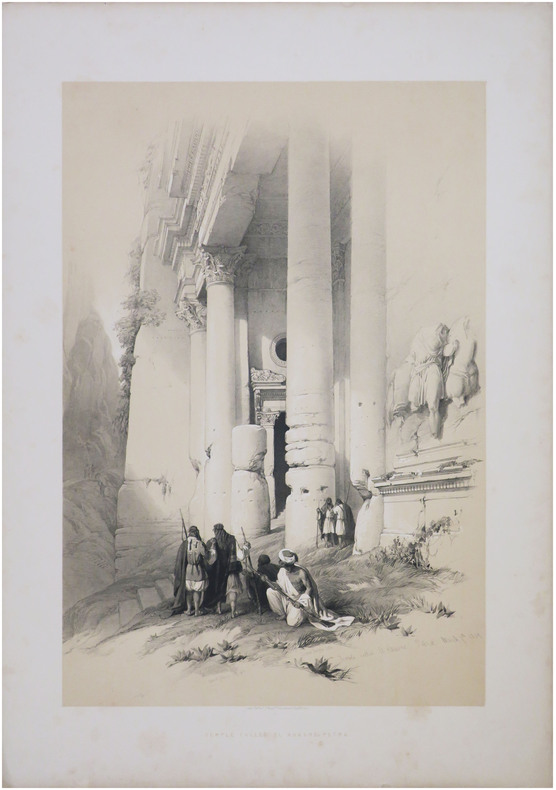
1842LBW-8857London, F.G. Moon, 1842. 513 x 335 mm.
1842j2p3c10xbvkHalle, Verlag der Buchhandlung des Waisenhauses, 1842. XIV S. (inkl. Titelblatt), bandübergreifend nummerierte Seiten (479)-1.116 (1); 5 (teils groß-)ausfaltbare geographische Tafeln. - Etwas späterer grüner Halbleineneinband mit schwarzen Buchdeckeln, dezenter Rückenvergoldung und goldgeprägtem Rückentitel; 8vo.(ca. 20,5 x 13 x 3,5 cm).
8vo., First Edition, with frontispiece, 103 plates on 60 and 3 maps (one double-page) in the text; handsomely bound in dark red full morocco, sides with gilt frame border, back with raised bands, second and fourth compartments ruled and lettered in gilt, all other compartments tooled in gilt, gilt top, a most attractive copy ideal as a gift or for presentation. The Marsh Arabs occupy the region around the junction of the Tigris and Euphrates in southern Iraq. This classic account, recording eight years spent living among them, is a worthy sequel to his masterpiece 'Arabian Sands'.
4 volumi in due tomi di cm. 13x9; pp. 199, 198, (2); 200, (2), 211, (1). Legatura coeva in piena tela, titoli in oro al dorso, piatti inquadrati entro cornicetta impressa a secco, risguardi in carta decorata, segnalibri conservati. Rara prima edizione. (321/P) 411/32
Binding rubbed and worn, torn along spine, inner hinges strained and starting to crack. Dampstaining to margins of some plates and pages, else contents sound & tight. Endpapers browned. Spine cover browned. Some browning to boards. Some loss to spine cover ends. 1 corner edgeworn. ; Pp263-555 + pls CX-CLXIX, many text figures. Most of this volume concerns the history of cartography and is very nicely illustrated. ; Volume 2 Only; Vol. 2; Folio - over 12" - 15" tall
Volume one of a projected three volume set, volume two having been published in 2003. One of 45 copies bound in quarter brown goatskin. Top edge gilt. Slipcase; Small 4to 9" - 11" tall; 227 pages
1932Egypt Exploration Society-Humphrey Milford, London, 1932, grand in-4 (285x225mm), XI-502pp. et 74 planches hors-texte, figures in texte, portrait de Griffith en frontispice, reliure toile bleue de l'éditeur, titre doré, jaquette imprimée (défraîchie avec quelques manques).
182662065Accompagnée d'un Essai historique et statistique sur ce royaume, d'un aperçu géographique, sur les divisions politiques actuelles des pays compris entre l'Inde anglaise, l'Empire chinois et les limites orientales de l'Europe et de l'Afrique, et suivi d'un Tableau Statistique du Royaume de Perse, comparé aux principaux Etats du sud-ouest de l'Asie, 1 carte entoilée dépliante sous chemise et étui cartonné, décembre 1826, Planche 27 de l'Atlas Universel, Chez Brué, rue des Francs-Maçons, Paris, décembre 1826, 71,3 x 53 cm
Accompagnée d'un Essai historique et statistique sur ce royaume, d'un aperçu géographique, sur les divisions politiques actuelles des pays compris entre l'Inde anglaise, l'Empire chinois et les limites orientales de l'Europe et de l'Afrique, et suivi d'un Tableau Statistique du Royaume de Perse, comparé aux principaux Etats du sud-ouest de l'Asie, 1 carte entoilée dépliante sous chemise et étui cartonné, décembre 1826, Planche 27 de l'Atlas Universel, Chez Brué, rue des Francs-Maçons, Paris, décembre 1826, 71,3 x 53 cm Jolie carte couvrant de l'Egypte et de l'Anatolie à l'Indoustan et aux contreforts de l'Himalaya, avec une belle vue de la Péninsule arabique de la Perse (Iran), du Beloutchistan et de l'Hindoustan (partie du Pakistan moderne), de l'Afghanistan, etc... Etat très satisfaisant (petite tache, double petit accroc marginal affectant lég. le texte en haut de feuille, fort accroc à l'étui, bon état par ailleurs) pour cette carte de très grand intérêt. Français
1896G56338Leiden, Brill 1896-1914 2 volumes: viii,255 + xiii,304pp., with illustrations & plans in text + 1 portrait out-of-text, 25cm., softcover (cover of first volume is in copy), most pages still uncut, [Some editor's copies of volume 2 contain a map out-of-text (1 page) while others don't. Our copy, which is absolutely in its original condition and complete as it when it was bound, this copy does not contain the original map but yet a copy of it]
2 volumes: viii,255 + xiii,304pp., with illustrations & plans in text + 1 portrait out-of-text, 25cm., softcover (cover of first volume is in copy), most pages still uncut, [Some editor's copies of volume 2 contain a map out-of-text (1 page) while others don't. Our copy, which is absolutely in its original condition and complete as it when it was bound, this copy does not contain the original map but yet a copy of it]
HIST5046M1750, Chez la veuve Estienne, Desaint & Saillant, Jean-Thomas Hérissant, Paris. 4vol. in-12, reliure d'époque plein veau marbré et glacé, dos lisse orné, pièce de titre et de tomaison, filet sur chasses. T.I : (4)-LIV-(6)-460pp. T.II : (4)-535pp. T.III : (4)-504pp-(19). T.IV : (4)-479pp.-(4). Intérieur agréable et complet. Papiers frais. Coiffes légèrement arasées. Mors usés parfois superficiellement ouverts. Déchirure sur coiffe de tête T. IV. Usure normale. Bel ensemble de cette somme aussi riche qu'estimée.
In-8, 2 volumi, tela editoriale con scritte in arabo al piatto, taglio super. dorato, pp. XV,302,(2); VII,287; con 2 tavole fotografiche in b.n. ai due frontespizi, protette da velina con didascalia e 8 piante e mappe f.t., alc. a doppia pagina, relative a: “Mekka - The road between Mekka and ‘Arafa - The Haram of Mekka - Roads connecting Mekka with Et-Taif - Et-Taif - El Medina - The Haram of El Medina - Arabia, showing author’s route”. "Prima edizione" di quest’opera di Rutter, definita dal "Bulletin of the School of Oriental and African Studies" come la migliore introduzione sull'Arabia mai scritta. Esemplare ben conservato.
IN 16°, P. 549+4. PERGAMENA COEVA. EDIZIONE FIGURATA DA 3 CARTE GEOGRAFICHE PIU' VOLTE RIPIEGATE E DA 20 TAVOLE F.T.
4 vols., 8vo., First Edition, with numerous plates, facsimiles, pedigrees and maps throughout, previous owners' neat inscriptions; original cloth (red/blue/green/black respectively), gilt backs, a very good, bright, clean set in dustwrapper (one wrapper price-clipped), the latter lightly frayed and creased at edges. FINAL VOLUME SIGNED AND DATED BY THE AUTHOR ON HALF-TITLE. Glubb Pasha'a masterly tetralogy comprises The Great Arab Conquests [630-680] (1963), Empire of the Arabs [680-860] (1963), The Course of Empire [860 onwards] (1966) and The Lost Centuries [1145-1453] (1967). COMPLETE SETS ARE SCARCE, ESPECIALLY IN THIS CONDITION
1935059996London: Oxford University Press / Humphrey Milford 1935. First British Edition 1st Printing. Hardcover. Fine/Near Fine. Vii 327 Pp. Blue Cloth Gilt Top Edge Gilt Foredge Deckled. The 28Th English Rendering Of The Odyssey First Published In A Limited Edition In Great Britain By Emery Walker And In A Limited Edition In The Us Both In 1932 This Is The First Uk Trade Edition 1935 Stated Lacking The Map Endpapers And Introduction By Findlay Present In The American Issue. Book Is Fine Bright Clean No Wear Or Marks. Dj Is Bright Clean Very Slight Spine Fading And Browning Shallow Chipping Across Top Of Spine 1/2" X 3/16" Triangular Chip At Center Of Bottom Edge Of Rear Panel 3/4" To 2' Closed Tears At Corners Of Front Panel Each With Internal Clear Tape Repairs. <br/> <br/> Oxford University Press / Humphrey Milford hardcover
Contenant 4 chromo-lithographies, 7 gravures tirées à part, 53 dans le texte, et une carte en couleurs, 1 vol. in-4 reliure demi-toile grise, couvertures conservées, Typographie et Lithographie Adolphe Jourdan, Alger, 1897, 576 pp. et 3 ff. Bon exemplaire bien relié de cet important ouvrage qui s'ouvre sur un coup d'oeil rétrospectif, évoque ensuite le soufisme, l'organisation des confréries, leur système financier et leur rôle politique, puis détaille la confrérie mère des Qadria, l'école des Khelouatia, l'Ecole des Chadelia, la confrérie-mère des Naqechabendia, celle des Saharouardia, puis les Khadiria, détaillant pour chacune leurs confréries dérivées. Français
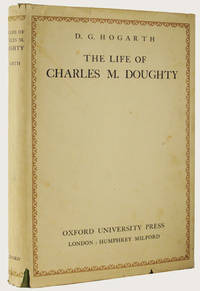
192833452Oxford: Oxford University Press. London: Humphrey Milford 1928. First edition. With a frontispiece portrait from the Simson bronze medallion nine plates of portraits sketches letters etc. and a fold-out map. 4to in the publisher's original green cloth lettered in gilt on the spine in the rare printed dustjacket. viii 4 216 pp. A very pleasing copy of this elusive work the text quite fine the cloth also in excellent condition with virtually none of the usual fading the rare dustjacket complete and with only minor rubbing to the extremities. An unusually fine survival. A SCARCE WORK OF INTEREST TO BOTH DOUGHTY AND T. E. LAWRENCE COLLECTORS. The author David G. Hogarth who died before the book came to publication was the noted archaeologist and scholar associated with both Lawrence and Doughty. He led the Carchemish archeological work in Syria where he employed Lawrence and was also professionally associated with Sir Mark Sykes. Professor Hogarth was appointed the acting director of the Arab Bureau for a time during 1916 when Sir Sykes went back to London. Close with T. E. Lawrence he worked with Lawrence to plan the great Arab Revolt against the Ottoman Turks and Germans. Hogarth introduced Lawrence to Doughty and Lawrence wrote the famous introduction to the 1921 edition of Doughty's TRAVELS IN ARABIA DESERTA.<br> T.E. Lawrence in his introduction to the 1921 edition describes this 'not like other books.a bible of its kind'. In referring to Doughty's own impressions of his effort Lawrence states: 'He calls his book the seeing of a hungry man the telling of a most weary man."<br> ARABIA DESERTA is one of the best-known classics of exploration and travel. Few writers of any genre have worked such magic or mischief on the English language as Doughty. He disapproved of Victorian prose style and mingled his own with Chaucerian and Elizabethan English and Arabic.<br> But whatever the style the result is perhaps the finest book on Arabia ever written. Another Arabist T.E. Lawrence speaks on Doughty: "I have talked the book over with many travellers and we are agreed that here you have all the desert its hills and plains the lava fields the villages the tents the men and animals. They are told of the life with words and phrases fitted to them so perfectly that one cannot dissociate them in memory. It is the true Arabia the land with its smells and dirt as well as its nobility and freedom. There is no sentiment nothing merely picturesque that most common failing of oriental travel-books. Doughty's completeness is devastating. There is nothing we would take away little we could add. He took all Arabia for his province and has left to his successors only the poor part of specialists. We may write books on parts of the desert or some of the history of it; but there can never be another picture of the whole in our time because here it is all said." - from the Introduction.<br> Hogarth's son William made the final revisions needed to his father's long-compiled manuscripts after the elder Hogarth passed in 1927. With the help of Mrs. Doughty Edward Garnett and Sydney Cockerell he was finally able to finish his father's labor of love and bring the work to publication. Oxford University Press. London: Humphrey Milford hardcover