1 365 résultats
26206P., Pensée Moderne, 1971, in 8°, cartonnage de l'éditeur, jaquette illustrée en couleurs, 174pp.
Foxing to textblock. Pencil underlining to some pages. Minor shelfwear to book and DJ. Rubbing to DJ. DJ spine sunned. ; Republished by Readers Union Group of book Clubs. ; 239 pages
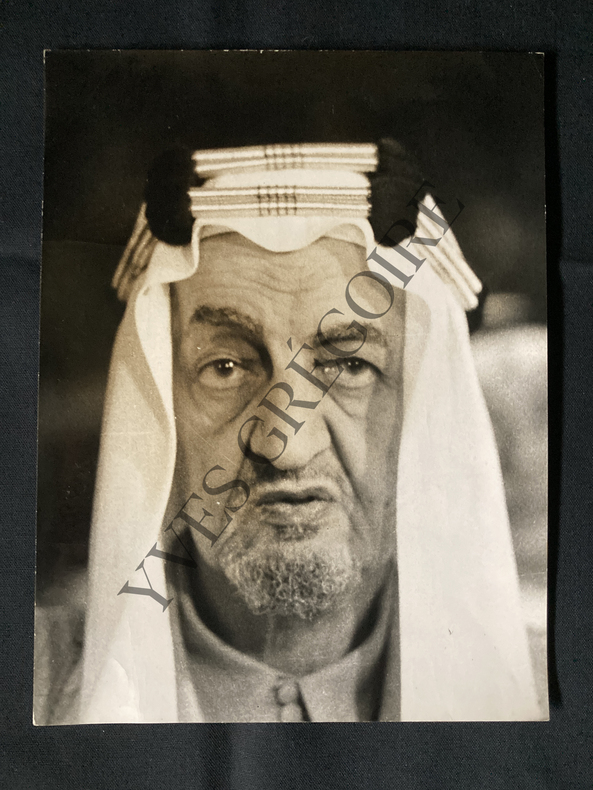
ABE-10074670868TIRAGE ARGENTIQUE NOIR ET BLANC-18 CM X 23,5 CM-CACHETS AGENCE FRANCE PRESSE AU DOS-LEGENDE SUR PAPIER COLLE EN FRANCAIS ET EN ANGLAIS "RIYAD LE ROI FAICAL A ETE ASSASSINE MARDI MATIN; SELON L'AGENCE EGYPTIENNE M.E.N., LE MEURTRIER SERAIT LE NEVEU DU ROI, LE PRINCE FAICAL IBN ABDUL AZIZ, CONNU POUR SA FAIBLESSE MENTALE. LE PRINCE KHALED IBN ABDUL AZIZ A ETE PROCLAME ROI PEU APRES. 25 03 1975" (CP8)
Fine French Paperback. Demy 8vo. (22 x 14 cm). In French. 188, [4] p., b/w plates. Faycal d'Arabie. Les dix and d'un regne. Au hasard de la traversee du Royaume d'Arabie Seoudite, l'auteur de ce livre a interroge des saoudiens de toute condition sociale. Il s'est rendu compte de i'empreinte laissee par le Roi Fayçal dans l'esprit du public. Ce souverain, qui exerçait ses fonctions comme un apostolat, qui apparaissait a d'aucuns comme un figure biblique etait aussi l'homme qui s'est rendu aux raisons du progres, tout en sachant prevenir les risques de degradation morale.
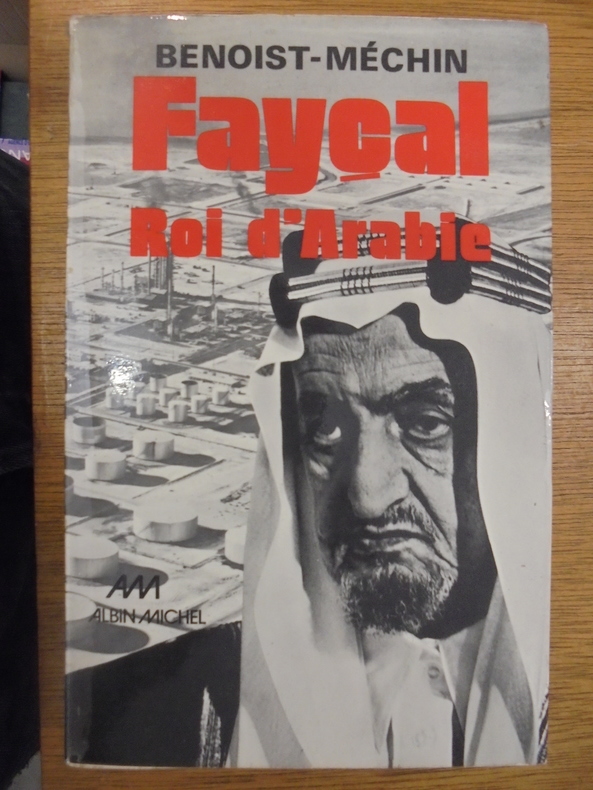
10855broché - 12.5x20 -302pp - 1975- éditions Albin MICHEL
HIS3131C172GARALBIN MICHEL. 302 pages. Couverture rempliée. 1ère et 4ème de couverture illustrées en noir et blanc. L'homme, le souverain, sa place dans le monde. 1906-1975. In-8 Broché.
17956Paris, Albin Michel, 1975. 13 x 20, 302 pp., broché + jaquette, bon état.
44103P., Albin Michel, 1975, petit in 8° broché, 302 pages ; couverture illustrée.
1917192206Calcutta: Superintendent Government Printing India 1917. With the loosely inserted index Second edition significantly expanded and revised from the first of 1915 including updated sections on Al Hasa and Nejd and the rule of the Saud dynasty as well as 22 additional route descriptions in the final section. The 20-page index tucked into the end band was issued only with a subset of copies. The first edition issued in March 1915 went through three small printings in a year but the outbreak of the Arab Revolt and the upswing in the Mesopotamian Campaign necessitated its revision. Chapters discuss history geography populations resources maritime issues and administration while also providing British intelligence on the Ottoman forces. On the "fighting qualities of local Arabs of Mesopotamia" the compilers observe that "for several years the Arabs have been very friendly towards the British and on several occasions prominent chiefs have come forward with suggestions of a British Protectorate" p. 90. The routes draw on a variety of sources including Lorimer reports by captains Shakespear and Leachman the Danish explorer Barclay Raunkiaer Lieutenant Arnold Wilson and recent intelligence supplied by Lieutenant-Colonel L. S. Newmarch Resident and Consul-General at Baghdad. In a reflection of the region's changing geopolitics the list of important personages is reduced from 25 in the first edition to only 11. Octavo. Folding heliozincographed map of Lower Mesopotamia in front pocket 3 folding tables errata slip tipped in facing p. 34; tables in text. With 20-page separate index loosely inserted in rear band. Original green diagonal-grain cloth wallet binding spine and front cover lettered in black. Title page with contemporary pencil ownership inscription of Lieutenant-Colonel Austin Romauld O'Flaherty officer commanding 33 British General Hospital Mesopotamia. General signs of use spine sunned small tidemarks internally short split along fold of map; index volume re-sewn: very good. hardcover
1988PHO-676Paris, 1988, in-4, bas. rouge, dos lisse, insolé, couv. conserv. Ill.
14478BERREBY J.J. Le golfe persique. Mer de légende - Réservoir de Pétrole: Iran Irak Arabie Saoudite Koweit Bahrein Qatar Côte des Pirates Mascate et Oman. Paris Payot 1959; First Edition. Bibliotheque Historique. 8 vo. 8 vo 228 pp; French text; Illustrated cover with paperback binding including 4 maps 11 b/w photographs Preface de Jacques Vernant. Some yellowing to the spine and covers with remnants of a price sticker on back cover. In good condition. unknown books
Very Good English Paperback. Pbo. Roy. 8vo. (24 x 17 cm). Papers in English, Turkish, French, and Arabic. [vii], 398 p. First International Symposium on Islamic studies.= Uluslararasi Birinci Islam Arastirmalari Sempozyumu. Teblig ve müzakereler. 16-18, September, 1985.
Beirut, Damascus, Hama, Bhamdoun: 28 February 1900 - June 1901. Lot of 5 manuscript letters written and signed by Harvard anthropologist Henry Minor Huxley, concerning anthropological work performed for the Howard Crosby Butler Archaeological Expedition to the Middle East, as well as a noteworthy archaeological discovery of an ancient and curious stone inscription, its location guarded with secrecy by the few expedition members having this knowledge. 8vo. double-leafs varying in size. 24 pages combined, each letter signed in the original. Two letters are on hotel stationery. Occasional light creasing, otherwise in very good condition, clean and bright, a fascinating and candid primary source account. Writing to a trusted source, his mother, Huxley's reveals the discovery of an ancient inscription carved into an overturned stone, in a language possibly not yet identified, stating that he took the first photograph of it, and that only a select few expedition members are privy to knowing its location. His commentary on experiences with the local civilians and officials are straightforward and occasionally blunt. Henry Minor Huxley, A.M. accepted the offer to join the American Archaeological Expedition led by American archaeologist Howard Crosby Butler. The first part of the archaeological work took place from mid-October to mid-December 1899, and a second trip was made for continued work from March to June, 1900. In the summer of 1900, he was devoted to acquiring a working knowledge of the vernacular Arabic. Huxley's work, however, involved a broader scope. During this second trip, he was also tasked with the study of physical anthropology, as is apparent in the present correspondence. This work proved so valuable that Huxley, owing to the patronage of New York businessman and archeological enthusiast B.T. Babbitt Hyde, remained for another year to further these anthropological observations, independently. What does not appear to be officially documented in publications, but is highly fascinating, is what Huxley writes in his last letter of the present lot. That is, in June 1901, just prior to returning to America, he alone returned to the site of a stone inscription discovered during the earlier part of the expedition (presumably in 1899), to copy it, photograph it, and turn it back face down so that no others would see it. This would increase the likelihood that he and one other would have a better chance of being the first to decipher it.
1988747391988 Paris, Souffles, 1988, in 4°, cartonnage bleu de l'éditeur, jaquette illustrée en couleurs, 189 pages.
1907X74434Leipzig, Hinrichs'sche Buchhandlung 1907 34pp.with 4 ills. and 3 maps, 23cm., in the periodical "Der alte Orient" 8. Jahrgang Heft 4, softcover, few foxing, good condition, [text printed in Gothic German], X74434
34pp.with 4 ills. and 3 maps, 23cm., in the periodical "Der alte Orient" 8. Jahrgang Heft 4, softcover, few foxing, good condition, [text printed in Gothic German], X74434
195033150Couverture souple. Numéro complet. Petit manque en marge.
195033149Couverture souple. Numéro complet.
Biography of the writer/traveller ; B&W Photographs; 12mo 7" - 7½" tall; 144 pages
Small tear to spine covering. Spine faded. Previous owner's name to front free endpaper. Slight wear to extremities; A detailed account of a trip through the Middle East under the auspices of Unesco. With 66 photographs taken by the author; B&W & Color Photographs; 8vo; 310 pages
Stated first edition; 8vo; 525 pages
Title: From Oqair to the Ruins of Salwa. Author: Captain R. E. Cheesman Publisher: London: Edward Stanford, Royal Geographical Society, 1923. Item is in Original Condition, with Blue Wrappers - As Issued, Complete with All the Ads! Notes & Condition: On a uniquely motivated expedition, for ornithological and archaeological research, in 1921 Cheesman ventured to the coastline near Bahrain, south of Oqair, which forms the Gulf of Salwa. In addition to the investigation of birds' migratory habits, Cheesman visited the area's extensive ruins and there made some important discoveries. An engaging account of the journey commence with those of the camel party itself, and vivid descriptions the city of Bahrain with its fresh water springs, ancient mounds and volcanic hills, an audience with the local important Sheik Isa and local date groves. Further commentary describes local fauna discovered on the difficult road to Salwa: Agama, sedge warblers, grasshopper warblers, a grey wagtail and mole rats (Nesokia). Aboard the "Baghala", the seascape was invaded, Cheesman reports, by thousands of small black Socotra Cormorant and once ashore, a pale example of the Desert lark was seen feeding, together with the Common Bee Eater, Pallid Harrier, Crested Lark, Blue-headed Wagtail as well as the Red-throated Pitpit, Yellow Wagtail, Crag Martins, Chiff Chaff and Sand Martins. Cheesman was a corresponding member of the Zoological Society of London, and this expedition into an unexplored tract of Arabia was first and foremost a pursuit of zoological knowledge in the area. Cheesman was the first European to travel across some of the desert areas (Murra, Jabrin) and his travels preceded those of Philby. He was also the first to map the Arabian coast from Uqair to the head of the Gulf of Salwa. Here he recounts the journey, lands untrodden by his European counterparts, and fascinating Arabian customs. [Subsequently, in 1923-24 he spent three months at Hufuf. Having fixed its position, he then mapped 150 miles of desert, he identified the site of the ancient Gerra, and corrected some serious mistakes relating to the wadi system. For this he was awarded the Gill Memorial Award by The Royal Geographical Society]. Having finally arrived at Salwa, however, Cheesman was directed to the ruins where some pieces of pottery, alabaster and similar relics were uncovered. On his two visits to the Salwa Bight, he made archaeological discoveries which showed that the site of the Gerra emporium was to be found in the immediate vicinity of the port of Oqair, and not at the head of Salwa Bay as was formerly supposed. Estimates suggested that the settlement may have originated from the Kindi epoch, around the 6th century AD. 8vo. 15 pages, plus a full page sketch map and photographic plates for illustration. Original condition with blue wrappers, titles to front, and containing all the ads. This is a complete issue, seldom found in such good and original condition. Major Robert Ernest Cheesman CBE (1878-1962) was a military officer, explorer and ornithologist. He was Private Secretary to Sir Percy Cox during his tenure as High Commissioner in Iraq. In 1923, during a journey into the Arabian Peninsula, Cheesman collected over 300 specimens from the Hasa oasis, several of them previously unknown to science. These specimens are currently in the British Museum. He is credited with discovering Cheesman's Gerbil (Gerbillus cheesmani). Cheesman was the first man to map the Arabian coast from the Gulf of Salwah to Uqair. In 1924 he fixed the position of Hofuf and identified the site of ancient Gerrha. He presented his findings to Ibn Sa'ud at his court in Hofuf. He was later given the Gill Memorial Award for this work by the Royal Geographical Society. In 1936 he was awarded the Patron's Gold Medal of the society for his explorations and surveys of the Blue Nile and Lake Tana.
Very Good English In original cloth bdg. with a new full leather spine in traditional style. Cr. 8vo. (19 x 13 cm). In German. 150, [2] p. Five lectures on Islam: 1. Vorgeschichte - Mohammed - Die ersten Kalifen. - 2. Der Koran und die Lehre Mohammeds. - 3. Die Glanzzeit des Kalifats und der Verfall. - 4. Die islamischen Staatensysteme bis zur Neuzeit. - 5. Der gegenwärtige Zustand der Islamwelt. Martin Hartmann, 1851-1918, was an Orientalist and specialist on Arabic and Islamic world. Fünf vortrage über den Islam.
Binding could be tighter; Ribbon bookmark. No date, circa 1920s. In German ; B&W Photographs; 8vo; 195 pages