852 résultats
183 p., 495 fig. n/b et coul. En français et néerlandais. Catalogue d'exposition, Bruxelles, Banque Bruxelles-Lamrt, 3 février-26 mars 199. Inv. Th 62
259 p., très nbr. ill. coul. Inv. 17332
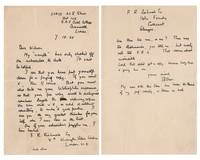
19250088521925. Letter. This 7 September 1925 autograph letter from T. E. Lawrence "of Arabia" to John G. Wilson "the most famous English bookseller of his time" a critical supporter of the legendary 1926 Subscriber's edition of Seven Pillars of Wisdom and one of the select few to receive a complimentary copy from Lawrence. The letter is noteworthy not only for the association but for timing and content as Lawrence was struggling to fill subscriptions for his magnum opus. <br /> <br /> your free copy shall be distinguished somehow beyond the ordinary copies I owe you the very greatest thanks for your help <br /> <br />The letter is addressed and dated at the top right of the first panel "338171 AC II Shaw Hut 105 R.A.F. Cadet College Cranwell Lincs. 7. IX. 25". Following Lawrence's salutation "Dear Wilson" the letter reads: <br />"My "sample" has only choked off one subscriber to date. It can't be helped. I see you have put yourself down for a paying copy. But you must also lend me your bibliophilic experience so that your free copy shall be distinguished somehow beyond the ordinary copies. We can write in it or add or subtract something to make it quite peculiar. I owe you the very greatest thanks for your help when I was low in the list. One of your subscribers puzzles me. I have booked <br />F. R. Richmond Esq. <br />8A Kensington Palace Gardens <br />London W. 8. <br />and also <br />F. R. Richmond Esq. <br />Holm Foundry <br />Cathcart <br />Glasgow. <br />Are these two men or one There were two Richmonds you told me: but surely not to F. R.'s. That seems almost incredible. Lord Bute didn't get a copy: because Lady Bute is giving him one:" <br />Following his valediction "yours sincerely" and signature "T E Shaw." there is a postscript: "My move to the Air Force has broken the thread of my proof-correcting & thrown me back." <br /> <br />Condition <br /> <br />The letter is written in black ink on a single sheet of laid watermarked "ORIGINAL BLACKFRIARS MILL" paper measuring 8.875 x 6.9375 inches folded once to form four 4.375 x 6.9375 inches panels. Lawrence wrote on the first and third of these panels. Condition is very good. The paper is complete with no loss tears or appreciable wear other than an additional horizontal fold from original posting. The paper shows light overall soiling to the first and fourth outer panels and perhaps a faint hint of spotting to the lower front panel. Lawrence's ink remains clear and unfaded. The letter is protected within a clear removable archival sleeve housed within a rigid crimson cloth folder. <br /> <br />Lawrence of Arabia <br /> <br />During the First World War Thomas Edward T. E. Lawrence 1888-1935 experienced a transformative odyssey as instigator organizer hero and tragic figure of the Arab Revolt against the Ottoman Empire which he began as an eccentric junior intelligence officer and ended as "Lawrence of Arabia. He spent the rest of his famously short life struggling to variously reconcile reject share and repress this indelible experience which was eventually recounted in his magnum opus Seven Pillars of Wisdom. <br /> <br />Hiding and writing in the R.A.F. <br /> <br />As part of his effort to evade his celebrity in August 1922 Lawrence enlisted in the Royal Air Force first under the name John Hume Ross and later Thomas Edward Shaw a name he used until his death. Hence from that time forward he seldom signed with his original surname. By December 1922 Lawrence had with a close circle of friends decided to produce 100 copies of the Seven Pillars at thirty guineas a copy if so many subscribers can be found. So September 1925 found Lawrence officially Aircraftsman Shaw residing in Hut 105 of the R. A. F. Cadet College at Cranwell trying to both duck and recount the events that had made him so uncomfortably famous. By the time Lawrence wrote this letter to Wilson in 9 September 1925 he was well into the elaborate preparation of and corresponding expenses for his famous Subscribers edition of Seven Pillars of Wisdom. Subscribers were fewer than had been hoped and Wilson was to prove of material help. <br /> <br />John Gideon Wilson <br /> <br />John Gideon Wilson 1876-1963 was manager of Bumpus bookshop "the most famous English bookseller of his time" and a significant even critical supporter of the famous 1926 Subscriber's edition of Seven Pillars of Wisdom. "Described as 'massively wise and unassumedly learned' this lovable man was endowed with a rare simplicity. In his shop Wilson might be found conversing with the poet laureate or wrapping up the purchase of a schoolboy. His assessment of authors and their books was quick and sure and his advice always valid was freely given to authors publishers and his fellow booksellers." Given his literate and approachable character and his commercial stature it seems no surprise that he and Lawrence found opportunity to collaborate. <br /> <br />More than just a friend and subscriber <br /> <br />Today when Subscriber's editions of Lawrence's magnum opus routinely command $six-figure sums it is almost prohibitively difficult to imagine any challenge in securing subscribers for the mere 202 copies eventually issued. But at the time Lawrence's expenses in producing the edition to his exacting and lavish specifications were extravagant and for much of 1925 he was genuinely concerned by a lack of anticipated subscriber commitments. It was to Wilson that Lawrence had turned earlier in the year when facing the prospect "that the plans for a thirty-guinea subscription edition had been over optimistic. By mid-March three months after the start of the project only twenty-six subscribers had been found" while estimated costs to produce the edition were proving higher than anticipated. Lawrence wrote to Wilson who was both manager of Bumpus bookshop in London and bookseller to the King asking if Wilson "would like to place twenty copies at the thirty guineas price." Six worrisome months later prospects had improved - due in no small part to Wilson. "By the middle of September" a week after Lawrence wrote this letter to him "Wilson had added a block of subscriptions and the total suddenly jumped to eighty." <br /> <br />Bookseller to the King <br /> <br />Indeed when completed by the binders in November 1926 Lawrence sent "the very first of these" to the Royal Library at Windsor which "had taken out a subscription" having placed the order through J. G. Wilson. For this copy Lawrence returned the advance cheque writing in advance explanation to Wilson ".it seems improper that Kings should buy and sell among their subjects." <br /> <br />Wilson was clearly a trusted figure; in 1928 when Lawrence was collaborating with Bruce Rogers on their famous rendering of Homer's Odyssey Wilson was one of the few trusted early with the knowledge that Lawrence was to be the translator. Following Lawrence's death in 1935 Wilson had a hand in the disposal of Lawrence's personal library from his beloved Clouds Hill cottage. <br /> <br />A doubly privileged recipient <br /> <br />Ultimately there were only 211 copies of the Subscriber's Edition of which 170 were complete copies 32 incomplete and 9 spoils. No two copies are identical. In addition to various differences in inclusion and placement of the many illustrations each copy was bound differently. Wilson would have a hand in selling an appreciable percentage of the 170 available for sale to subscribers. Speaking to his importance to the edition and as substantiated by this letter Wilson would personally receive not only one of the 32 incomplete copies that Lawrence gifted to friends and comrades from the Arab Revolt but also one of the 170 complete copies. <br /> <br />References: Wilson Lawrence of Arabia; ODNB; Richard Knowles Rickaro Books <br/><br/> unknown
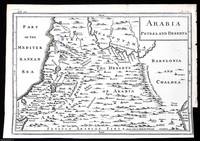
1748372049Printed for T. Osborne in Gray's Inn; A. Miller in the Strand; and J. Osborn in Paternoster Row London 1748. Unframed Print. Very Good Condition. This 1748 engraved map provides a detailed representation of Arabia Petraea the region covering parts of modern-day Jordan Sinai and northwestern Saudi Arabia and Arabia Deserta the vast desert lands of the Arabian Peninsula. It highlights key geographical features ancient trade routes and settlements reflecting the European understanding of the region at the time. The engraving was printed in London by T. Osborne A. Miller and J. Osborn.1 folding plate. Close cropped at the right margin. Size: 20 x 30 cms. Category: Universal History; PRINTS : Antiquarian Interest; Printed before 1800; Special Features. This item may require more postage than the rates shown for delivery outside the UK. If extra postage is required we will contact you before processing your order and you will be given the details and option to decline the extra cost. Printed for T. Osborne, in Gray's Inn; A. Miller, in the Strand; and J. Osborn, in Paternoster Row unknown
196496057Bonn: [Knauth], 1964. 112 S. MIt zahlr. s/w Abb. (= Kulturzentrum der Vereinigten Arabischen Republik in Bonn, 6). 22 cm. OBrosch.
DJ lighly chipped ; 8vo; 128 pages
Aav, Marianne & Eeva ViljIn Pristine Condition. unknown
4 vol. in-4 br., couv. ill. couleurs, nombr. photos couleurs, Ader Société de Ventes Volontaires, Hôtel Drouot, Paris, 2012, 2013 et 2014, 95 pp., 109 pp. 107 pp. et 107 pp., pour 176, 251, 211 et 278 pièces proposées. Rappel de la liste des catalogues : Arts d'Orient, collection de M. et Mme X. et à divers, dont un salon syrien daté 1232H./1815 (8 octobre 2012) ; Arts de l'Islam et de l'Inde (31 mai 2013) ; Arts de l'Islam et de l'Inde (25 novembre 2013) ; Arts de l'Orient et de l'Inde (28 mai 2014) Très bon état pour ces catalogues aux belles illustrations couleurs. Prix pour l'ensemble. Français
6 vol. in-4 br., couv. ill. couleurs, PIASA Paris, Drouot-Richelieu, 2002 à 2007, env. 60 à 80 pp. et de 250 à 330 réf. par catalogue. Rappel de la liste des catalogues : Orientalisme, art d'orient (28 novembre 2002) ; Archéologie, orientalisme, arts d'orient, Océanie, Haute époque (13 juin 2003) ; Archéologie, orientalisme, arts d'orient, Océanie, Haute époque (7 juin 2004) ; Art islamique, Antiques, Icônes, Haute époque (22 avril 2005) ; Archéologie, arts d'orient, Haute époque (2 juin 2006) ; Archéologie, Art d'Orient (13 juin 2007) Très bon état pour ce lot de beaux catalogues. Prix pour l'ensemble Français
Very Good Turkish, Ottoman (1500-1928) In contemporary fine black 1/3 leather bdg. Decorated gilt to spine. Roy. 8vo. (23 x 16 cm). In Ottoman script (Old Turkish with Arabic letters). 112 p. Extremely rare first edition of this Nabi's first-hand account of Mecca, Medina and the Hejaz during his pilgrimage in the late 17th century. This is the most celebrated literary pilgrimage narrative written in Ottoman Turkish. Nabi (1642-1712) was one of the prominent Ottoman poets and is considered a foremost exponent of the didactic trend (hikem-i tarz) in Ottoman Turkish literature. Nabi, whose given name was Yusuf, was born in Urfa (then known as Ruha) in 1052/1642. In 1082/1671 he took part in the Ottoman military campaign in Poland, in the retinue of Müsahib Pasha, (1640-1686). Having spent thirteen years in Istanbul, Nabi desired to go on a pilgrimage to Mecca. He was personally ready to undertake a journey to the Hijaz and to set down an eloquent account of his journey, the experience of his lifetime. Accordingly, having achieved a position of good standing with his patrons, Müsahib Mustafa Pasha and Mehmed IV, Nabi revived his longstanding desire to perform the hajj. In 1089/1678, at around 37 years of age, he set out in a small private caravan from Istanbul, passing through Konya, Urfa, Damascus, Jerusalem and Cairo, where he joined the main Egyptian pilgrimage caravan. The work, which is one of the most successful examples of Ottoman insa (artistic prose), includes historical, sociological, geographical and autobiographical information. In his preliminary remarks, Nabi indicates that he had received governmental help for his journey. He relates that he first obtained leave for the hajj from his patron Musahib Mustafa Pasha, and then submitted a qasida to Mehmed IV, describing the sacred places. The sultan provided Nabi a letter of recommendation addressed to Abdurrahman Pasha (d. 1691), governor of Egypt, ordering him to enable Nabi to make a comfortable journey. Nabi traveled in a small private caravan, since the caravan extended its route to Nabi's homeland, Urfa, and spent about fifty days there. It appears that he generally followed the usual route of the pilgrimage caravan from Istanbul to Damascus, passing through Scutari, Kartal, Gebze, Hersek, Iznik, Eskisehir, Seyitgazi, Aksehir, Ilgin, Ladik, Konia, Eregli, Adana, Misis bridge, Payas, Antioche, Aleppo (with a long detour to Urfa (Edessa) and back to Aleppo via Aintab), Hama, Hims and the Kuteyfe strait. He was fascinated with the splendid architecture of the buildings, the bazaars and the mosques built side by side by Kurdish and Circassian rulers and the Nile when he arrived in Cairo. Nabi gives a general description of the city of Cairo, the Nile, the two reservoirs of the city, parklands, the Ahram hills and the immediate neighborhood of the city. In Mecca, Nabi visited the sacred sites enthusiastically and performed the hajj on 77 January 1679. He gives a moving account of his experience as a pious emotional pilgrim. It appears that Nabi stayed in Mecca for more than twenty days. Immediately after 1 Muharrem 1090/12 February 1679, he set out for Medina, presumably in the Damascus caravan. While in Medina, Nabi served at the tomb of the Prophet by lighting the candles since his name was on the honorary list of attendants who were determined by the central government to serve the sanctuaries in Mecca and Medina. Nabi regards these services as a testimony to the legitimacy of Ottoman rule. He summarizes his journey of return from Medina to Damascus and to Istanbul in a few general words. Özege 21267.; Not in OCLC.
Very Good Turkish, Ottoman (1500-1928) Paperback. With a pictorial cover. Large roy. 8vo. (23 x 18 cm). In Ottoman script [and French on the cover]. 355-442 pp., ills. Bilingual cover is written 'Medeniyet Ordusu Yemen çöllerinde' and 'L!Armee dans le Desert de Yemen' bilingual in Turkish with Arabic script and in French. [i.e. The Ottoman civilized army in the desert of Yemen]. Extremely rare.
Very Good Turkish, Ottoman (1500-1928) Contemporary 1/3 leather bdg. with cloth spine. Leather boards. Restored. Demy 8vo. (22 x 15 cm). In Arabic. [138] p. Slightly chipped extremities of papers. Occasionally stained on pages, wear on binding. Text is fine. Including 'kataba'. The routine, predictable, yet exhaustive nature of the journey Ottoman pilgrims endured may have discouraged them from recording their journeys. The route was relatively well-defined, and the caravan orderly and well-protected. Moreover, Ottoman pilgrims, unlike Christian travelers, were traveling across the lands of the same state, thus seeing people of the same Muslim culture, without needing to speak different languages, use different currencies, or negotiate borders between states. The uniqueness and peculiarity of a journey would motivate the traveler to record it and the result would be of interest to an audience. As for the Ottomans, if the texts which were composed to help future pilgrims with practical information are excluded, the majority of known narratives, are written by those authors such as Ahmed Fakih, Fevri, Evliya Çelebi, Nabi, and Shaikh Sinan er-Rûmî who undertook at least some parts of their journeys independently of the official caravan. Texts which seem to have been intended simply to provide practical information either on the stations or on the rites of the hajj or on both are defined as guidebooks. These texts appear not to be based on a particular pilgrimage journey, regardless of the fact that their authors might have performed the hajj. This manuscript starts with 'Bayân al-Menâzil Beyt Al-Sam wa al-Qabah' [i.e. Descriptions and stations from Damascus to Mecca] including a very detailed routes' list with their times hour by hour. 40 routes and hours probably by mounts and/or walking between Damascus and Mecca, Qaba. Other chapters of the text include rites and routes like "Farziyyat of Hajj, Ihram, Mukhrima, entry to Mecca-i Muqarrama, tawaf, Sa'y between Safa and Marwa, Arafat in Mecca, Muzdalifa from Arafat, Ef'al in Mina, Umra, Taawaf al-Vedâ, Qabr-i Sharif in Medina al-Munawwara, etc. Sheikh Sinan Al-Roumi's manasik al-hajj is one of the most important and famous ones in the hajj literature of the Islamic world. It was a mostly used reference book among Muslim pilgrims, especially in the Ottoman world. Calligrapher and copied by Ahmed b. Muhammed b. Suleyman. Text in black ink and important headings in red ink on paper with 'ahar'. A fine paper suitable for calligraphy. A very good example from the first half of the 18th century.
Very Good Turkish, Ottoman (1500-1928) Original quarter leather bdg. Slight wear on spine. Otherwise a very good copy. Cr. 8vo. (20 x 15 cm). In Ottoman script (Old Turkish with Arabic letters). 143 p. Extremely rare first Turkish edition of the legend of Hatem of Tai tribe, or "the tale of Hatemtai, or qissa-e Hatem-Tai" which was very popular in the Indian subcontinent, as well as the earliest printed separate form from the Arabian nights [Alf laila wa laila] in the Middle East. In Turkish literature, this story was printed nine times separately from the Arabian nights (1840, 1856, 1867, 1871, 1874, 1879, 1885, 1891, 1925). This is the very first edition of this book. Hatim al-Tai (?âtim bin Abd Allâh bin Sa'ad a't-Tâ'iyy; Hatim of the Tayy tribe; deceased 578), was the ruling prince and poet of the Tayy tribe of Arabia. Stories about his extreme generosity have made him an icon among Arabs up until today, as evident in the proverbial phrase "more generous than Hatim". His son was Adi ibn Hatim, who was a companion of the Islamic prophet Muhammad. Al-Tai lived in Ha'il in present-day Saudi Arabia and was mentioned in some Hadiths by Muhammad. He died in 578 AD and was buried in Tuwarin, Ha'il. His tomb is described in the Arabian Nights. He lived in the sixth century CE and was also mentioned in the Arabian Nights stories. The celebrated Persian poet Saadi, in his work Gulistan (1259 CE) wrote: "Hatim Tai no longer exists but his exalted name will remain famous for virtue to eternity. Distribute the tithe of your wealth in alms; for when the husbandman lops off the exuberant branches from the vine, it produces an increase of grapes". He is also mentioned in Saadi's Bostan (1257). According to legends in various books and stories, he was a famous personality in the region of Ta'i (present-day Ha'il) and is also a well-known figure in the rest of the Middle East as well as the Indian subcontinent, featuring in many books, films, and TV series in Arabic, Persian, Urdu, Turkish, Hindi and various other languages. The books on the story usually consist of a short introduction describing his ancestry and character and tell the seven episodes based on seven riddles, asked by a beautiful and rich woman named Husn Banu, who will marry only the person who is able to obtain answers to all seven of them. A king, who falls in love with her but is unable to find answers, tells the generous Hatemtai, whom he meets by chance, all about it. Hatim undertakes the quest to find the answers and help the king marry her. Özege 3639.; TBTK 8155.; Only one copy in the Library of Congress according to OCLC 951465696.
Very Good Turkish, Ottoman (1500-1928) Original Ottoman cloth bdg. Cr. 8vo. (20 x 14 cm). In Ottoman script (Old Turkish with Arabic letters). 293 p., 17 b/w plates and 1 folding map, and 1 folding linguistic table (including alphabets used in India such as Sanskrit, Brahmi, Devanagari and their pronunciations in Latin and Arabic alphabets). Slightly loosed spine, skillfully repaired a part of the spine, fading and chipped on the board's extremities, slight stains on the plates. Overall a good copy. Extremely rare (with a map and the plate at the end of the book) first edition of this eye-witness travel account of the Indo-Islamic culture during the British Raj in the late 19th century, by the Hamidian period Turkish ambassador and scholar Sirvanî (1831-1890), who had written and translated three geographical books as well. Sirvânî completed his travel memoirs on his return from India to Constantinople, where he was sent as an ambassador by Sultan Abdulhamid II between 1877-1879. The narrative of his journey begins with the landing in India from Constantinople by ferry. He describes the splendid and fascinating British Indian cities, regions, and buildings such as Bombay, Poona, Dakkan, Udaipur, Baroda, Ajmer, Jaipur, Amber Fortress, Allahabad, Benares, Calcutta, Jaipur, Lucknow, Agra, Alexandre, Delhi, Nepal, Racputana, Indor, Sind, Bundelkhand, Datia, Chatarpur, Bina, Mihr, Bihar, Bengal, Ceylon, Aligarh, Sirhind, Lahore, Kashmir, Dekkan, Orissa, Avrang, Bijapur, Malia, Khandesh, Gujarat, Hugli, Madras, Maisur, Jehlam, Sialkot, Rawalpindi, Nevshar, Mardan, Swat (now in Pakistan), Beloojistan, Peshawar, Afghanistan, Kabul, Ghazna, Kandahar, Herat, Badakhshan, etc. This first-hand travel account offers an invaluable insight into the customs of Indian peoples living in the region as well as the onomastics and ethnography of India and Afghanistan. He met Sayyid Ahmed Khan, who was the founder of the Aligarh University which was famous as the Aligarh School (founded in 1877) among the Indian people. The Aligarh Movement was the push to establish a modern system of education for the Muslim population of British India, during the later decades of the 19th century. The work includes a large chapter of Mecca, where Sirvânî stayed for a long time. He gives detailed information on the Islamic pilgrimage (Haj) and the Arabian Peninsula in this chapter. OCLC 19769728, 1030091889 (Six copies worldwide).; Ihsanoglu, pp. 269-270.; Özege 7654.; Karatay I, 268.; TBTK 1438.
Very Good Arabic Paperback. A slight chipping on spine, uncut. A very good copy. 4to. (28 x 20 cm). Text in Arabic with only bilingual title in English and Arabic on cover. 394, [2] p. Muhammad Abd-Allah Inan, (1896-1986), was an Egyptian historian known for his works on Andalusian history. Although Muhammed Abdullah Inan was one of the founders of the Socialist Party in 1921, he gave up his socialist views in the following years. He defended Arab nationalism in his early works and wrote articles criticizing the Ottoman administration in Egypt.
Very Good Turkish, Ottoman (1500-1928) Original full leather bdg. in Islamic style with a flap. Demy 8vo. (22 15 cm). In Ottoman script (Old Turkish with Arabic letters). 285 p. Rebacked to spine, slight wear on binding. Overall a good copy. Early Turkish edition of the book of parrot (or the book of Humayun), which is a 14th-century series of 52 stories, originally written in Persian, translated by Sari Abdullah Efendi (1584-1660), who was an Ottoman mystic poet and scholar. The adventure stories narrated by a parrot, night after night, for 52 successive nights, are moralistic stories to persuade his female owner Khojasta not to commit any adulterous act with any lover, in the absence of her husband. She is always on the point of leaving the house to meet her lover until the loyal parrot detains her with a fascinating story. The authorship of the text of the Tutinama is credited to Ziya'al-Din Nakhshabi or just Nakhshabi, an ethnic Persian physician and a Sufi saint who had migrated to Badayun, Uttar Pradesh in India in the 14th century, and wrote in the Persian language. He had translated and/or edited a classical Sanskrit version of the stories similar to Tutinama into Persian, around 1335 AD. It is conjectured that this small book of short stories, moralistic in theme, influenced Akbar during his formative years. It is also inferred that since Akbar had a harem (of women siblings, wives, and women servants), the moralistic stories had a specific orientation towards the control of women. The main narrator of the 52 stories of Tutinama is a parrot, who tells stories to his owner, a woman called Khojasta, in order to prevent her from committing any illicit affair while her husband (a merchant by the name Maimunis) is away on business. The merchant had gone on his business trip leaving behind his wife in the company of a mynah and a parrot. The wife strangles the mynah for advising her not to indulge in illicit affairs. The parrot, realizing the gravity of the situation, adopts a more indirect approach of narrating fascinating stories over the next fifty-two nights. The stories are narrated every successive night as an entertaining episode to keep Khojasta's attention and distract her from going out. The Persian text used was redacted in the 14th century AD from an earlier anthology 'Seventy Tales of the Parrot'in Sanskrit compiled under the title Sukasaptati (a part of katha literature) dated to the 12th century AD. In India, parrots (in light of their purported conversational abilities) are popular as storytellers in works of fiction. (Source: Wikipedia). Özege 21353., OCLC 165609299.
Very Good Turkish, Ottoman (1500-1928) Original wrappers. Foolscap 8vo. (17 x 12 cm). In Ottoman script (Old Turkish with Arabic letters). 152 p. Roumi: 1324 = Gregorian: 1906. Taken from a volume including multiple books. Spine is restored. A very good copy. First and only edition of this early and extensively rare book including a first-hand account of the topography and descriptions of Hejaz, Mecca, and other parts of Arabian Peninsula such as Taif and Yemen by Sadiq Sherif, who was the first person to take photographs of Mecca, Medina, and the Hajj in 1880 and 1881 as well. Sadiq Sherif was the grandson of Serif Abdulmuttalib, the Emîr of Mecca. This book written by Sherif was dedicated to 'the Progress and Union Society' [i.e. Ittihad ve Terakki Cemiyeti]. The book describes the way of administration and territorial division of Hejaz after giving some information of its geography, borders, tribes and natives, mountains, rivers, crops and products, and animals of this Ottoman 'vilâyat' [i.e. province]. Sherif gives detailed information on how and when the Ottoman Empire ruled Hejaz, the location of Mecca city, its borders, physical and social geography, crops in Mecca and around, its flora, fauna, demographic structure, 'nahiyes', Kâba's construction, and its history, sacred places around, Masjid-i Haram and other masjids, cemeteries, mountains, gifts by Ottoman caliphs to Kaba, 'Taif' area, people who were 'Emîr' of Mecca from the period of Mohammad, Wahhabism and its birth, etc. At the last, Sherif gives place to his personal letter (layihâ) including 49 articles. The letter was about the reforms that Hejaz needs and it was sent to the Ottoman 'sadâret' [i.e. prime ministry]. (Source: History of geographical literature during the Ottoman Empire, Edited by Ihsanoglu). Muhammad Sadiq Sherif Bey was the first person to take photographs of Mecca, Medina, and the Hajj in 1880 and 1881. Sadiq Bey trained as a military engineer after completing his studies in Cairo and at the École Polytechnique in Paris. It is not known when, or from whom, Sadiq Bey learned to take photographs but it was most probably through one of the resident photographers in Egypt. In 1861, prompted by the need to carry out more extensive military land surveys of the area between Wajh and Medina, Sadiq Bey made his first journey to Arabia. He took a camera along with his surveying equipment and took his very first photographs of Medina. In a series of articles published in the Egyptian Military Gazette in 1877, he refers to his early photography at Medina describing the use of a 'photographia'. Sadly, however, none of the photographs from this first journey has survived. In 1880 he was appointed as the treasurer of the Mahmal, the ornate cloth to cover the Ka'ba brought each year on a special litter to Mecca. He accompanied the Mahmal to Medina and Mecca from September 1880 until January 1881. Again equipped with his camera, he succeeded in producing the series of photographs that are now considered some of the earliest known photographs of the region, those of the Ka'ba, taken under great secrecy. Sadiq Bey published various accounts of his travels in Arabia in military journals, through the Emiry Grand Press in Cairo, but the 1880/81 series of photographs appear to have been issued separately for wider distribution through the Société Khédiviale de Géographie. The society's secretary, Dr. Frederic Bonola, advertised sets of photographs for sale. In January and April 1880 Sadiq Bey gave a talk and report to the society on his earlier 1861 expedition, and on 20 May 1881 he presented a report on his recent journey to Mecca; detailed accounts were published in the society's bulletins, numbers 9/10 and 12. (Source: Christie's). Özege 11888.; Karatay, TM II: 695.; MKAHTBK, II: 991.; OCLC 248374684 / 4082352.
Steel-engraved map on ivory stock measuring 12.25 x 15.5 ins (approx. 31.25 x 39.0 cms) with engraved surface 8.75 x 11.75 ins (approx. 22.0 x 30.0 cms), coloured in outline; four coloured vignettes of Arab Women, Arab Men with horse, Camel and Palm, and Mount Sinai (illustrations by H. Warren; engraving by J. Rogers); decorative scroll frame incorporating title cartouche, a fine copy. Mounted ready for framing in double card mount (ivory over blue) with gilt frame border. Rapkin's map for Tallis was first issued c. 1856 and contains significantly more detail that that produced for the 'Illustrated Atlas' of 1851. Areas covered include Babylon, Basra, Cairo, Jerusalem, Oman, Persian Gulf, Red Sea and Suez. This high-quality facsimile accurately reflects thetones of the contemporary hand colouring and makes a most attractive map at a fraction of the cost of the original.
Very Good Arabic Paperback. Small 4to. (26 x 18 cm). Text is entirely in Arabic with bilingual title in English and Arabic on cover. 16 p. [Off-print] Research report on urbanism in Islam (Monograph Series No. 3):1) The social forces in the Arab-Syrian cities in the 19th century: The latest period of the Ottoman rule. 2) Stages in formation and development of the social forces in the Syrian cities in the present period. [COMPLETELY ARABIC]. Abdullah Hanna was born in the Syrian village of Deir Attiyah in 1932, and earned a PhD in history from the University of Leipzig in 1965. Blocked from Syrian academia due to his political leanings, Hanna instead became an instructor in Syrian secondary schools. He became a specialist on agrarian history and labour movements in Syria. His works, published in Arabic, include books on intellectual trends in Syria and Lebanon; the Syrian and Lebanese labour movements; anti-fascism in Syria and Lebanon; the agrarian question in Syria and Lebanon; and obstacles to the transition to capitalism. (Arab Center for Research & Policy Studies). Delivered at the Seminar Research Group D: Cities andstructures of power, October 15, 1988. Institute of Oriental and Occidental Studies, Kansai University.
Limited to 100 copies, [x], [28] pages, one of 9 signed copies, bound in hunter green cloth with gold blocking on front board, with a colour frontispiece of Richard F. Burton shortly after returning from India in the 1850's. This Bibliography examines and cites Burton's writings to various newspapers in India while he was stationed there in the 1840's. The author painstakingly examined Indian Newspapers from that time period and located over 100 articles written by Burton. Very little is known about Burton's formative years and his time in India, which makes this Bibliography very useful for the Burton Collector and scholar. A tremendous effort and welcome addition to the Burton genre.
34 pages. Plus photographic plates and a large fold-out colour map, measuring approximately 16 x 21 inches (40 x 53cm). Original condition with blue wrappers, titles to front, and containing all the ads. This is a complete issue, seldom found in such good and original condition. This is a fascinating expedition report on the author's explorations in Arabia, which Predate his All-Important Book - Arabia Felix; Across the Empty Quarter of Arabia, published in 1931. Accompanied by a vivid and descriptive map, this narrative is an outstanding early report into the harsh savage regions of Arabia. Thomas undertook the exploration of the magnificent Rub' Al Khali in three journeys. The first camel journey of 600 miles through the south-eastern borderlands was made in the winter of 1927-1928, the second, travelling nortwards 200 miles from the central south to the edge of the sands, were undertaken under his own initiative, a part of his plan to explore the unkown south and also as a preliminary reconnaissance for a final desert crossing. The realization of that journey is the subject of this report. In order to make the journeys, Thomas grew a beard, donned Arab clothing, and lived as one of the Badus themselves. On completion of his second journey he entered into a secret arrangement, sealed with only 20 Pounds Sterling, with a member of his party, an influential member of the Rashid tribe, to bring him in the following winter, by caravan to a point in the desert where occasionally Murra tribesmen would come from the north, and that from there he would make his way by being passed from tribe to tribe! The author's captivating story of his third and successful pioneering exploration, includes notes on the tribes, geography, and extensive appendices on the natural history collections. The writer of this book was one of the most talented of the younger political officers in Mesopotamia during and after the War, and served in a similar capacity in Trans-Jordan, before being selected to fill the responsible post of Financial Advisor and Wazir to His Highness the Sultan of Muscat and Oman. He showed courage and resource in circumstances of much difficulty and great danger during and after the war in Mesopotamia. He performed two remarkable journeys over territory hitherto completely unknown. The first was along the Southeastern Borderlands of the Rub 'al Khali from near Ras al Had to Dhufar, the second from Dhufar for a distance of some two hundred miles inland. The two journeys, taken together, constitute the most important and most extensive piece of geographical exploration undertaken in any part of the world since the War.
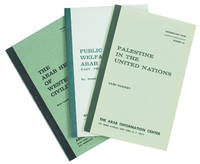
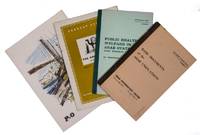
1951ABC_45233New York & London: The Arab Information Center 1951. 2 booklets a magazine and a menu all in original publishers wrappers. 8vo. Comprising:1 EL-KHATIB M. Fatallah foreword. Basic Documents of the Arab Unifications. New York Arab Information Center June 1958.2 OMRAN Abdel-Rahim. Public Health & Welfare in the Arab States: Past Present and Future. New York Arab Information Center November 1959. The booklet opens with a history of the Arab contributions to medicine followed by modern statistics.3 WRIGHT Esmond. The Arab World. Current Affairs no. 125. London Bureau of Current Affairs 3 February 1951.4 MENU. P&O menu. On board the S.S. Arcadia Sunday 25 March 1962. Set of four publications two of which by the Arab Information Center in New York. Together with other Arab information centers in various cities in the Americas Europe and Asia the New York office belonged to the Press and information department of the League of Arab states. As well as the monthly newspaper Arab World the office published numerous research reports on various aspects of the individual member states and the Arab world at large. Ad 1: The most important documents concerning the unification of Arab states. These documents include: the Proclamation of the United Arab Republic the Proclamation of the Arab Union the Provisional Constitution of the United Arab Republic the Charter of the United Arab States and the Constitution of the Arab Union.Ad 2: An overview of both the history of Arab medicine and the current state in 1958 of the demographics and healthcare in various states of the League.Ad 3: A short overview of the Arab world.Ad 4: Menu offered during a cruise in the Gulf on board the S.S. Arcadia.The staples in ad 1 somewhat rusted and ad 2 with an owners stamp. All in very good condition.l MacDonald The league of Arab states pp. 135-138. The Arab Information Center, unknown
1951L95CCFTRZTEWNew York & London 1951. 3 booklets and a menu. 1 EL-KHATIB M. Fatallah foreword. Basic documents of the Arab unifications.New York Arab Information Center June 1958. 8vo. 43 pp. includes: the Proclamation of the United Arab republic the Proclamation of the Arab Union the Provisional constitution of the United Arab republic the Charter of the United Arab States and the Constitution of the Arab Union.2 OMRAN Abdel-Rahim. Public health & welfare in the Arab states past- present and future.New York Arab Information Center November 1959. 8vo. 32 pp. The booklet opens with a history of the Arab contributions to medicine followed by modern statistics.3 WRIGHT Esmond. The Arab World. Current affairs number 125.London Bureau of current affairs 3 February 1951. 8vo. 19 1 pp. Short overview of the Arab World.4 MENU. P&O menu.On board the S.S. Arcadia Sunday 25 March 1962. 8vo. Menu with on front a coloured illustration of a Dhow in the Arabian Sea. Probably offered during a cruise in the Gulf. unknown
br. L'idea della "forma-dizionario" me l'ha suggerita involontariamente mio figlio. Capitava di guardare insieme il telegiornale, e se dicevano: "bombardamenti su Sana'a oppure "combattimenti a Sirte", lui immancabilmente chiedeva: "Papà, dov'è Sana'a?" oppure "dove si trova Sirte?". Mi sono accorto che le conoscevo tutte, quelle città. In alcune ci avevo vissuto, di altre conservavo un ricordo impresso in un frangente di solo poche ore. Assai umilmente, ho cercato sempre di seguire due stelle comete: Jack Kerouac e Ibn Battuta, due caratteri e due approcci diametralmente opposti. Per Jack Kerouac la meta del viaggio era la strada stessa. Ho visto coi miei occhi il manoscritto del suo capolavoro srotolato in una enorme sala. È il tracciato di un cammino di cui non ha senso cercare di individuare la meta. Ardentemente, Ibn Battuta desiderava invece raggiungere "quella" città o "quel" mausoleo, fino a quando non ci aveva messo piede. Per me il viaggio è entrambe le cose: l'atto stesso di spostarsi e l'anelito di toccare con le proprie mani proprio quella cosa e non altro. Lo stridore fra l'intimo ricordo e gli scenari tragici che avvolgono oggi molti di questi luoghi è in animo mio ciò che dolorosamente mette insieme tutto ciò.