SACY, Silvestre de.Livre Rare Book
4 538 résultats
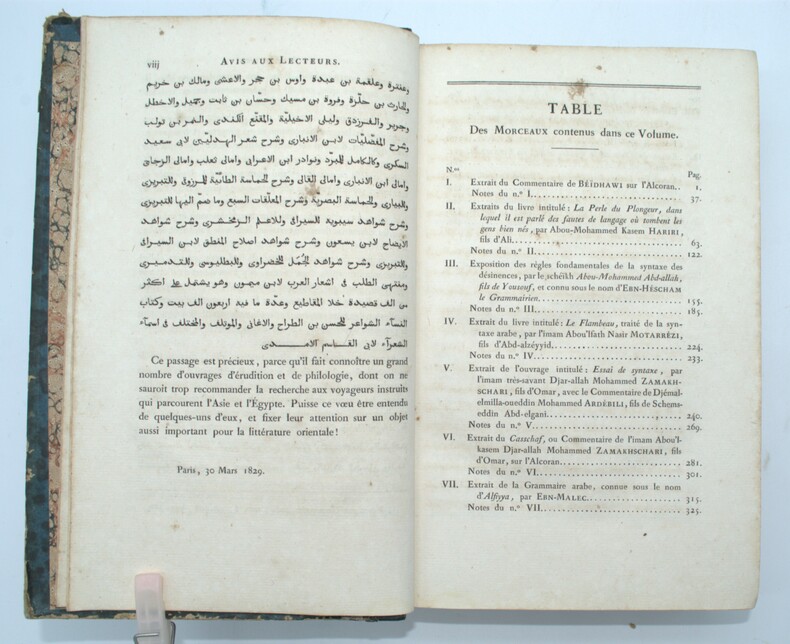
1829PHO-1340Paris, 1829 , imprimerie Royale , in-8 , X-519 pp.-164 pp. ,catalogue in fine, relié demi cuir époque , dos lisse avec auteur et titre , initiales en pied , coins et coupes usés , frottements aux plats , quelques rousseurs , pages de garde bruni.
1811PHO-2107Paris, Le Normant, 1811. Folio (51 x 34 cm), f. de faux-titre, frontispice, f. de titre et 82 planches sur 64 feuilles dont la grande carte par Lapie. Relié demi veau, dos lisse avec titre, coiffes usés, coins usés, début de fente, papiers des plats défraichis, mouillures.
1711PHO-2422Amsterdam, Jean Louis de Lorme, 1711, 10 volumes in 12° (161 x 93 mm.), relié basane époque, dos à nerfs orné avec tomaison et pièce de titre rouge, tranches rouges. Petits frottements, accrocs au dos tome 6 & 8, petite mouillure sans gravité, quelques déchirures aux plis, une planche déchirée, une autre volante, 2 planches avec mauvais n° et 2 sans n°, 1 planche mal montée. Titre noir et rouge, illustré d’un portrait en frontispice, une carte et 78 planches dont certaines en panorama I/ (15) ff. avec le privilège, 254 pp., 1 portrait de l’auteur gravé par Tomassin, 1 carte dépliante, 1 planche hors texte ;II/ 334 pp., 9 planches dépliantes ;III/ 285 pp., 7 pl. dépl.;IV/ 280 pp., 6 pl. dépl.;V/ 312 pp., 4 pl. dépl. et 6 tableaux dépliants ;VI/ 328 pp., 4 pl. dépl.;VII/ 448 pp. ;VIII/ 255 pp., 16 pl. dépl.; IX/ (Volume de texte) 308 pp. / (Volume de planches) 29 pl. dépl. ;X/ 220 pp., (41) ff. de table.
165978854( 1659]. 39,5 x 53,5, Blattgröße 41 x 55,5. Unter weißem Passepartout mit schwarzer Linieneinfassung.
1969q5r1030b81969. Ca. 180 orig. s/w Vintage auf Barytpapier, ca. 17, 6 x 23,2 cm und ca. 80 orig. Farb-Abzüge, ca. 13 x 18 cm . Die Aufnahmen wurden mit einer Leica-Mittelformat-Kamera gemacht und enstanden während einer Studienreise März-April 1969 durch die Gebiete des heutigen Irak und Iran. Der Photograph ist unbekannt. Alle Photos sind mittels Photoecken auf Photo-Karton befestigt. Die Pappen sind in vier Ringbücher abgeheftet. Die Photos sind sauber und unbeschädigt und können getrost als wichtige Dokumente der Kunst- und Kulturgeschichte des Mittleren Ostens bezeichnet werden. Sehr guter Zustand. ca. 1800 gr. Aus dem gleichen Bestand wird separat eine Serie angeboten, die wahrschscheinlich für eine Ausstellung vorbereitet war. Weitere Informationen auf Anfrage. Bildrechte beim Verlag IL. 4° [7 Warenabbildungen] Ringbuchheftung
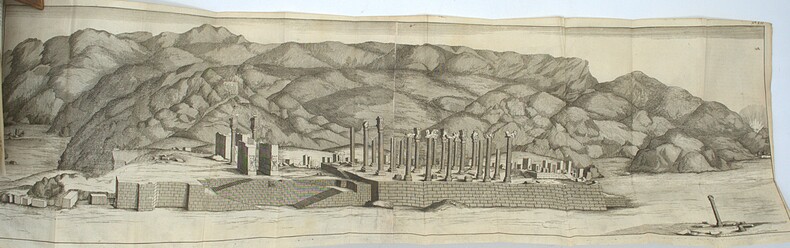
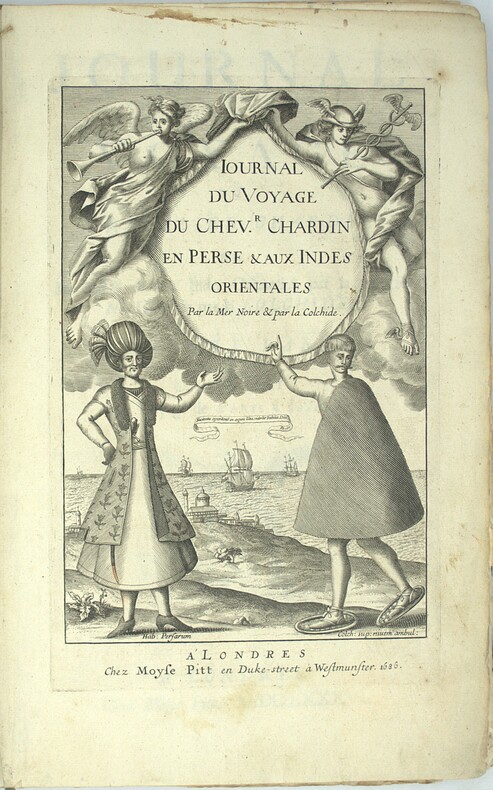
1686PHO-2117Londres, chez PITT, 1686, in-folio (32x21cm), 8ff. - 349pp.-3ff., illustré de 17 gravures, la plupart dépliantes, manque le portrait de l’auteur, relié plein cuir époque, défauts de reliure avec manque de matière mais corps solide, 2 planches détachées, déchirures sans manque, manque en marge à la carte, traces de réparation à quelques planches, traces d’oxydation (adhésif).
191245497Jena; Diederichs, 1912. 315 S., 10 Tafeln von F. H. E. Schneidler. Gr.-8°(=22,5-25cm); Blauer Original-Maroquin-Ledereinband mit reicher Goldprägung. Kopfschnitt in Gold.
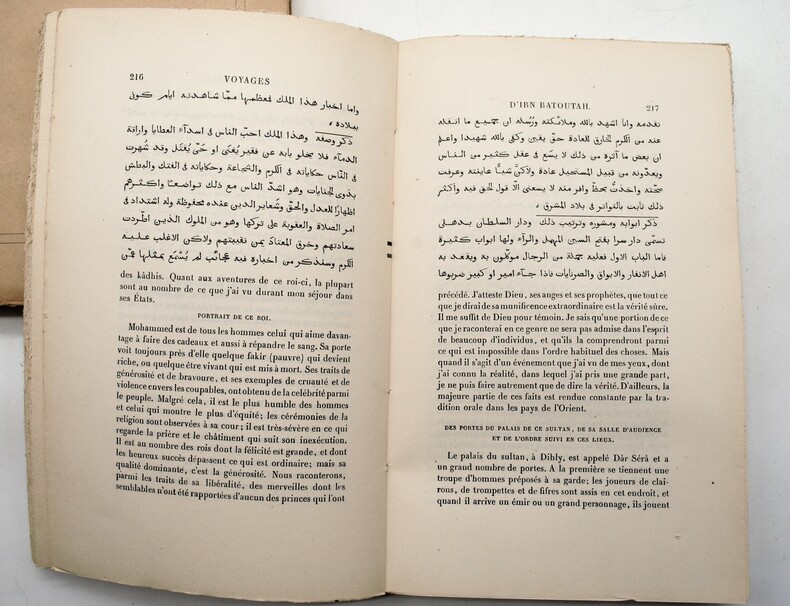
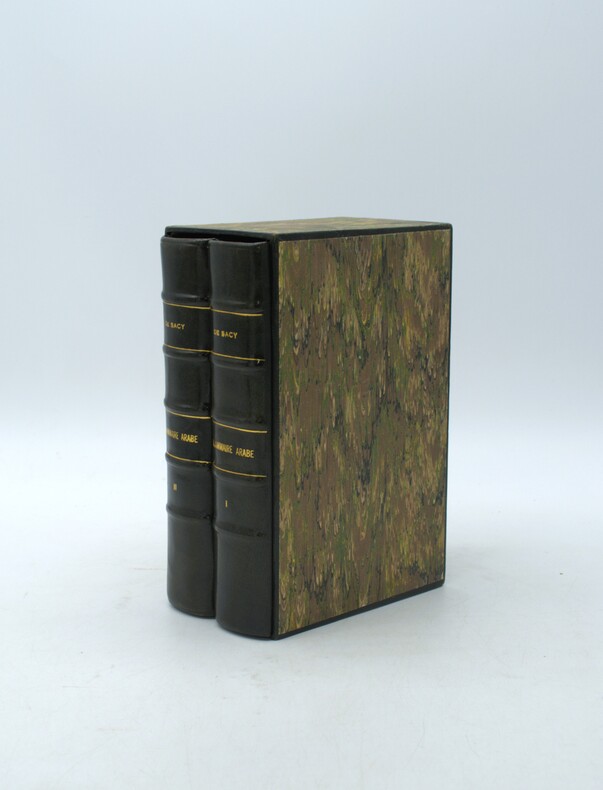
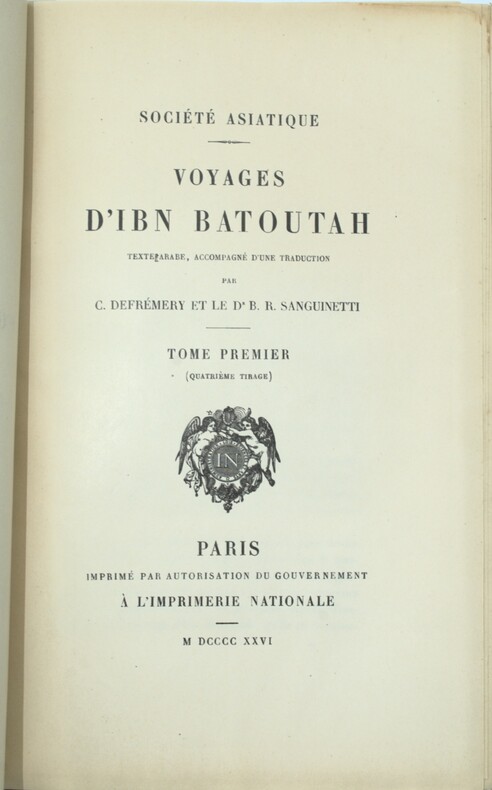
1922PHO-1091A l'Imprimerie Nationale, Paris, Ernest Leroux et Paul Geuthner Éditeur, 1922-1949. . Édition bilingue: Texte arabe avec traduction française en regard. 5 volumes In-8° de: Tome I (4e tirage,1927) 2ff-XLVI & 443pp. Tome II (5e tirage,1949), XIV & 465 pp. Tome III (5e tirage, 1949), XXVI & 476 pp. Tome IV (4e tirage, 1922), 479 pp. Le Tome V, constitue l'index ,(3e tirage , 1927) 91 pp.. Broché avec couverture éditeur .
10556N.R.F. 1924. In-4°, reliure demi-percaline rouge, étui assorti, couvertures conservées. Non paginé [56 pages]. E.O. 1/550 sur vergé baroque. [15 Whatman / 62 vergé de Navarre / 550 vergé baroque].
1377158Amsterdam: Aux dépens de la Compagnie, 1720 3 vol in-12, t. 1: frontispice (manque minime de papier dans la marge), page de titre, (8)-308-(7) pages, 5 planches ( la planche p. 158 mal pliée et déchirée sans manque); t. 2: page de titre, 278-(9) pages, 8 planches, 1 carte; t. 3: page de titre, 176-(2) pages, 15 planches. Reliure plein veau d'époque, dos à 5 nerfs, caissons à fleurons dorés, roulette dorée sur les coupes, coins usés, petit manque de cuir à la coiffe sup. du t.3, petit manque de cuir au dos et au mors du 2ème plat du t.2, sinon bon exemplaire, complet du frontispice, des 28 planches (plusieurs se dépliant) et de la carte dépliante. STRUYS, JAN JANSZOON est un voyageur et navigateur hollandais du 17e siècle.
1810PHO-2229Paris, Imprimerie impériale, 1810, 2 volumes in-8 (22,5x15,5cm), xxvi-434pp.-1f (catalogue), x-473pp.-1f (catalogue suite). Demi chagrin et coins moderne dans un coffret, dos à nerfs avec auteur, titre et tomaison, brunissures sur les premières et dernières pages, travail de vers sur les 3 premiers feuillets de chaque tome renforcé, petit travail de ver en pied. Complet de ses 10 tableaux dont 9 dépliants, manque les 8 gravures de lettres arabes
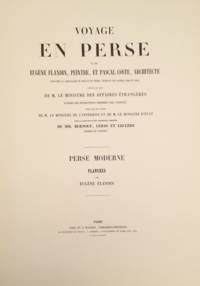
145801976. Flandin Eugène. Voyage en Perse. Perse Moderne Planches documents the architecture cities and landscapes of nineteenth century Iran through the drawings produced during a French archaeological and artistic expedition to the region in 1840. French artist Eugène Flandin traveled to Iran with architect Pascal Coste as part of a diplomatic mission supported by the Académie des Beaux Arts in Paris. During two years of travel across western and southern Iran the expedition produced extensive drawings of monuments urban centers and archaeological sites associated with the Qajar period. These images later formed the basis of Perse Moderne one of the most significant illustrated records of nineteenth century Iran produced by European artists.<br /> <br /> Flandin Eugène. Voyage en Perse. Perse Moderne Planches. London: Burness Faridany Limited 1976. Limited facsimile edition issued to commemorate the centennial of Flandin's death. Elephant folio measuring approximately 17 x 24 inches. The volume contains one hundred tinted lithographic plates reproducing the illustrations from the original nineteenth century publication. The plates depict architectural monuments and landscapes including royal mosques and palaces the city and ports of Tehran the ruins of Persepolis the tomb of Saadi and other locations recorded during Flandin's expedition.<br /> <br /> The original Perse Moderne was published in 1854 as part of a large multi volume series documenting the results of Flandin and Coste's travels through Iran. The expedition provided one of the earliest systematic visual surveys of Persian architecture and urban landscapes available to European scholars and artists. Flandin's drawings preserved detailed views of monuments and settlements during the Qajar period and have been widely cited by historians of Persian art and architecture as a major documentary source for nineteenth century Iran. The 1976 edition reproduces these images in a limited printing of six hundred copies allowing modern readers access to the visual material of a work that is otherwise difficult to obtain in its original form. One elephant folio volume with one hundred tinted lithographic plates housed in the original box. Minor handling wear to the box while the volume and plates remain well preserved. Overall condition very good. unknown
Very Good Turkish Original artwork in watercolor, Indian ink, and dry paint. 11,5x9,5 cm. This rare original artwork of Mary and Jesus comes along an exceptional provenance of Turkish cartoonist Semih Balcioglu (1928-2006), with his handwritten note on verso "Cemal Nadir'in bir kompozisyonudur" [i.e. It's composed by Cemal Nadir]. Signed on right lower as "C. N". Unpublished work. Cemal Nadir was a Turkish cartoonist. He was born in Bursa, Ottoman Empire on 13 July 1902. His father Sevket was a calligrapher (Turkish: Hattat) employed in courts. After finishing high school, he began working as a sign painter in Bursa. He also created cartoons, and his first cartoon appeared in Diken (literally: "The Thorn") periodical. Although he moved to Istanbul and tried to be a full-time cartoonist, he could not make it and he returned to Bursa. The Alphabet reform of 1929 gave Cemal Nadir a second chance to show his talent. When Turkey adopted the Latin alphabet replacing the Ottoman Turkish alphabet in Arabic script, all sign boards were necessarily changed, and he worked hard to meet the demand. The same year, he moved once more to Istanbul to work for the daily Aksam. Later, he also drew for the newspaper Son Posta, as well as for satirical magazines such as Akbaba. He also contributed to Yedigün. During this period, he published the satirical magazine Amcabey. During World War II, he drew anti-Nazism cartoons in the daily Cumhuriyet. In 1946, Republican People's Party (CHP) invited him to run for a seat in the parliament. However, he refused the invitation, he said that with political affiliation he would not be able to create cartoons.
Very Good Persian Original decorative dark brown full leather bdg. 44 p. Printed on a special paper with an early 18th century watermark. The Advice by Attâr includes 901 couplet in Persian. Attar Persian poet, Sufi, theoretician of mysticism, and hagiographer, born ca. 540/1145-46 at Nisapur, and died there in 618/1221. His name was Abû ?âmed Mo?ammad b. Abî Bakr Ebrâhîm or, according to Ebn al-Fowatî, b. Sa'd b. Yûsof. ?Attâr and Farîd-al-dîn were his pen-names. It seems that 'Attâr was not well known as a poet in his own lifetime, except at Nisâpûr. 'Awfî, who traveled widely, may have heard about him while staying there , or perhaps from Majd-al-dîn Bagdâdî if this Majd-al-dîn was their common Sufi mentor, though Awfî appears to have only known about Attâr's lyric poetry. Farid al-din 'Attar is one of the most famous spiritual poets of Persia. His works were the inspiration of Rumi and many other mystical poets. 'Attar, along with Sana'i were two of the greatest influences on Rumi in his Sufi views. Rumi has mentioned both of them with the highest esteem several times in his poetry. Rumi praises 'Attar as follows: "Attar roamed the seven cities of love... we are still just in one alley." 'Attar reached an age of well over 80 and died a violent death in the massacre which the Mongols inflicted on Nishapour in April 1221. The world depicted in 'Attar's works reflects the whole evolution of the Sufi movement. The starting point is the idea that the body-bound soul's awaited release and return to its source in the other world can be experienced during the present life in mystic union attainable through inward purification. In explaining his thoughts, 'Attar uses material not only from specifically Sufi sources but also from older ascetic legacies. Apart from his two famous epic masnavi poems 'The Conference of the Birds' and 'The Book of God' he composed a Divan full of powerful, enlightened ghazals and ruba'is. The Pand-nama is a small book of wise, moral advice in short poems in rhyming couplets that is practical and spiritual... (Encyclopedia Iranica & Pand-nama : (Book of Wisdom) Selections Introduction). [EARLY FIRST PERSIAN EDITION of the ADVICE by ATTAR PRINITED in the OTTOMAN EMPIRE] Pend-i Attar. Published by Fâkîr Seyhzâde Es-Seyyid Mehmed Es'ad. Only two printed copies of this edition in OCLC: 819123862.; Türkiye'de basilmis Farsça eserler çeviriler ve Iran'la ilgili yayinlar bibliyografyasi [= Bibliography of the Persian books, their translations and books on Iran published in Turkey] 721.; Mushar -.
Very Good Turkish, Ottoman (1500-1928) Original leather bdg. with traditional decorative embossing and gilt lettering of the title on boards. Roy. 8vo. (24 x 15 cm). In Ottoman script (Old Turkish with Arabic letters) and Persian. 480 p. Traditionally framed text. First volume, all published. Early edition of this exceedingly rare Persian-Turkish lexicon, which was one of the earliest Persian dictionaries in the Islamic world, written by Hasan Suuri Efendi from Aleppo, one of the finance officers of the Ottoman Empire. First edition was printed in 1742 and was the last book in two volumes of the first Islamic printing house founded by Ibrahim Müteferrika. This copy is the second edition. All published. Özege 5625.; 780172767, 39832974 (Seven printed copies in American libraries: Concordia Theological Seminary, Virginia Tech, Butler University Libraries, Concordia College Library, Morningside University, Dallas Theological Seminary, and Princeton University Library).
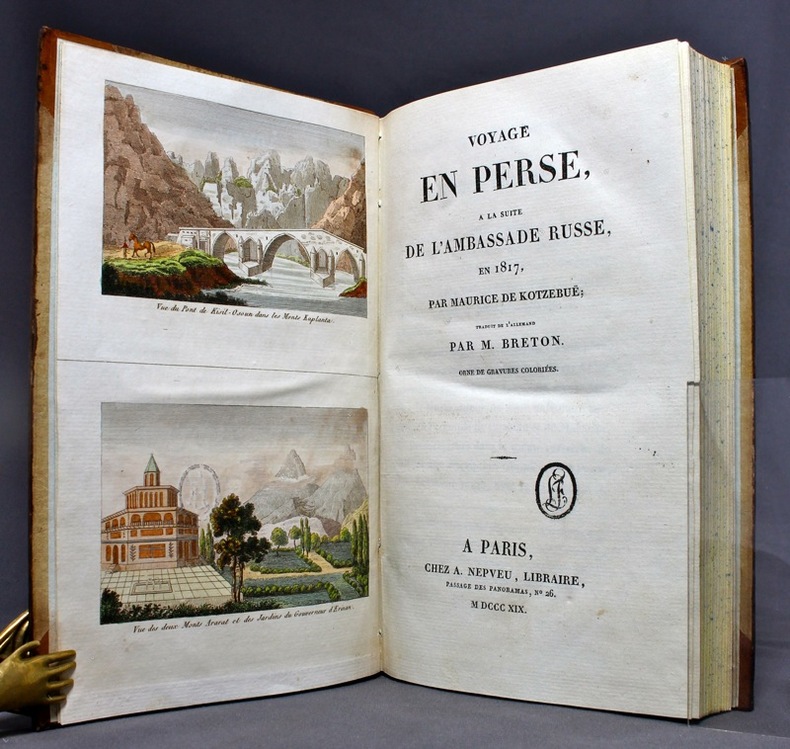
181912492A Paris, chez Nepveu, 1819. In-8 de [4]-II-285 pages, demi-veau moucheté à coins, dos lisse orné de filets, roulettes et titre dorés, pièce de tomaison bordeaux, tranches jaunes mouchetées. Dans un remarquable état de fraîcheur.
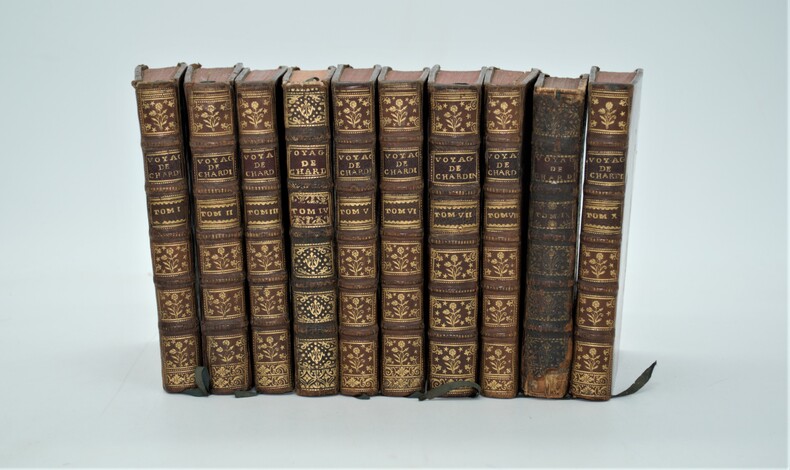
1723PHO-9451723, à Paris chez Denys Horthemels , 10 vol., in-12, veau blond de l'époque , dos à 5 nerfs orné avec pièces de tire et tomaison, caissons fleuronnés dorés, tranches rouge , 32p-254, 334, 285, 280, 312, 328, 10 p.-448, 255, 308, 220-(82) pp. , (T 4 et 9 reliure légèrement différente, T4-plats frottés,page de titre réparée ,T 9- imprimé à Rouen,petites rousseurs , manque la page de garde, manque au dos,charnière fendue , plats frottés , coins usés , cachets répétés)
1922PHO-1362A l'Imprimerie Nationale, Paris, Ernest Leroux et Paul Geuthner Éditeur, 1922-1949. . Édition bilingue: Texte arabe avec traduction française en regard. 5 volumes In-8° de: Tome I (4e tirage,1927) 2ff-XLVI & 443pp. Tome II (4e tirage,1914), XIV & 465 pp. Tome III (4e tirage, 1914), XXVI & 476 pp. Tome IV (4e tirage, 1922), 479 pp. Le Tome V, constitue l'index ,(3e tirage , 1927) 91 pp.. Broché avec couverture éditeur ,tome 1,4 et annexe non coupé , étiquettes au dos et cachets (tome 2 et 3) , manque au dos tome 3.
1679PHO-1446Paris , 1679 , 3 vol. in-12, plein veau sous emboîtage, dos orné , filet sur les plats , 19ffn.-780pp.-4ff. , 6ff.-616pp. , 5ff.-564pp.4ff. , charnières faibles , 1 plat détaché , coupes , coins usés, coiffes sup. tome 2 et 3 abimées, réparation au titre tome 2 , manque de papier à l’épître tome 3 , une carte avec manque , déchirure au pli à la carte du Tunquin , trace de réparation avec adhésif sur une planche coupée court .
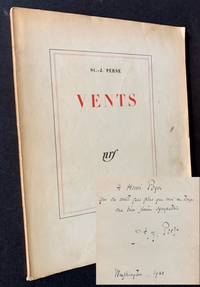
194619265Paris: Librairie Gallimard 1946. Original wraps. Very Good . WARMLY INSCRIBED BY ST.-JOHN PERSE TO PRE-EMINENT LITERARY SCHOLAR AND YALE PROFESSOR HENRI PEYRE on the front free endpaper. A solid very presentable copy to boot of the 1946 1st edition. #2236 of 2350 copies "sur papier de chataignier". Bright and VG in its off-white wrappers with very light soiling to the front panel and mild offsetting creasing and soiling at the rear panel. Very small paper cuts along the fore-edges of the preliminaries otherwise clean as could be internally with no writing or markings to speak of. Tall quarto one of the Nobel Prize winner's long poems written during his American "exile Librairie Gallimard unknown
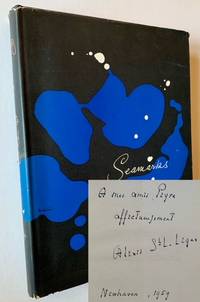
195819209New York: Pantheon Books The Bollingen Series 1958. Decorative Cloth. Near Fine/Near Fine. WARMLY INSCRIBED BY SAINT JOHN PERSE USING HIS REAL NAME "ALEXIS SAINT LEGER" TO PRE-EMINENT LITERARY SCHOLAR AND YALE PROFESSOR HENRI PEYRE on the front free endpaper. A very sharp copy to boot of the 1958 1st American edition. Clean and Near Fine just a touch of light offsetting at the front inner hinge in a crisp price-intact Near Fine dustjacket with very mild chipping along the spine ends and the top-edges. Tall quarto wonderful dustjacket design by Paul Rand. Translated from its original French by Wallace Fowlie part of the formidable Bollingen Series in this case LXVII. Pantheon Books (The Bollingen Series) unknown
194619265Paris: Librairie Gallimard 1946. Original wraps. Very Good . WARMLY INSCRIBED BY ST.-JOHN PERSE TO PRE-EMINENT LITERARY SCHOLAR AND YALE PROFESSOR HENRI PEYRE on the front free endpaper. A solid very presentable copy to boot of the 1946 1st edition. #2236 of 2350 copies "sur papier de chataignier". Bright and VG in its off-white wrappers with very light soiling to the front panel and mild offsetting creasing and soiling at the rear panel. Very small paper cuts along the fore-edges of the preliminaries otherwise clean as could be internally with no writing or markings to speak of. Tall quarto one of the Nobel Prize winner's long poems written during his American "exile" <br/><br/> Librairie Gallimard paperback books
195819209New York: Pantheon Books The Bollingen Series 1958. Decorative Cloth. Near Fine/Near Fine. WARMLY INSCRIBED BY SAINT JOHN PERSE USING HIS REAL NAME "ALEXIS SAINT LEGER" TO PRE-EMINENT LITERARY SCHOLAR AND YALE PROFESSOR HENRI PEYRE on the front free endpaper. A very sharp copy to boot of the 1958 1st American edition. Clean and Near Fine just a touch of light offsetting at the front inner hinge in a crisp price-intact Near Fine dustjacket with very mild chipping along the spine ends and the top-edges. Tall quarto wonderful dustjacket design by Paul Rand. Translated from its original French by Wallace Fowlie part of the formidable Bollingen Series in this case LXVII. <br/><br/> Pantheon Books (The Bollingen Series) hardcover books
189613722Stuttgart, Kohlhamer, 1896 (recte 1886 - 1896). 3 Bde. und Prolegomena in 1 Bd. 4°. HLwd. des 20. Jahrhunderts mit Rückenschild (kl. Gebrssprn.).
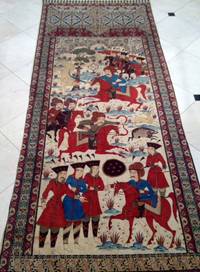
1890146641890. Hand painted Persian textile depicting Shah Abbas I nineteenth century a monumental example of Qajar period revivalist visual culture that reinterprets Safavid imperial iconography to articulate Persian kingship martial virtue and historical memory. Centered on one of the most mythologized rulers in Iranian history the composition presents a continuous figural narrative in which Shah Abbas I appears mounted on horseback in a royal hunt sword drawn as he confronts a lion while turbaned cavalry attendants bearing spears observe. A secondary vignette shows the Shah pursuing a wild boar reinforcing long standing Persian associations between sovereignty mastery over nature and military prowess. Rendered in a frontal highly legible style with flattened perspective and rhythmic repetition the imagery translates the visual language of Persian manuscript illustration into large scale textile form reflecting nineteenth century Qajar engagement with earlier Safavid models of centralized authority and dynastic legitimacy.<br /> <br /> Hand painted Persian figural textile. Qajar period nineteenth century. Approximately 117.5 x 51 inches 9.8 x 4.25 feet.<br /> <br /> The upper register introduces a martial tableau of Persian warriors confronting Indian soldiers mounted on elephants imagery that evokes enduring visual memory of imperial expansion and recalls narratives associated with Nader Shah's eighteenth century campaigns against the Mughal Empire. In the Qajar period particularly in the later nineteenth century Safavid rulers such as Shah Abbas were repeatedly invoked across painting lacquer and textile production as symbols of national continuity and restored sovereignty. This textile operates within that historicist framework layering Safavid royal imagery with later martial memory to construct a composite vision of Persian power across centuries. Minor edge tears including one approximately 1 inch and three approximately 3 inches within the border and along the edge not affecting the central figural imagery; colors remain bold and composition visually strong. Overall condition: very good. unknown