CEMAL NADIR [GÜLER], (1902-1947).MareMagnum
NOLIN (Jean-Baptiste);Livre Rare Book
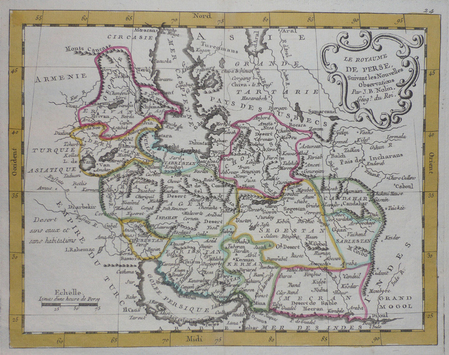
[PERSE] Le royaume de Perse.
LBW0251acirca 1780 202 x 261 mm.
Librairie Le Bail · Paris, France100,00 €
4 538 résultats
Very Good Turkish Original artwork in watercolor, Indian ink, and dry paint. 11,5x9,5 cm. This rare original artwork of Mary and Jesus comes along an exceptional provenance of Turkish cartoonist Semih Balcioglu (1928-2006), with his handwritten note on verso "Cemal Nadir'in bir kompozisyonudur" [i.e. It's composed by Cemal Nadir]. Signed on right lower as "C. N". Unpublished work. Cemal Nadir was a Turkish cartoonist. He was born in Bursa, Ottoman Empire on 13 July 1902. His father Sevket was a calligrapher (Turkish: Hattat) employed in courts. After finishing high school, he began working as a sign painter in Bursa. He also created cartoons, and his first cartoon appeared in Diken (literally: "The Thorn") periodical. Although he moved to Istanbul and tried to be a full-time cartoonist, he could not make it and he returned to Bursa. The Alphabet reform of 1929 gave Cemal Nadir a second chance to show his talent. When Turkey adopted the Latin alphabet replacing the Ottoman Turkish alphabet in Arabic script, all sign boards were necessarily changed, and he worked hard to meet the demand. The same year, he moved once more to Istanbul to work for the daily Aksam. Later, he also drew for the newspaper Son Posta, as well as for satirical magazines such as Akbaba. He also contributed to Yedigün. During this period, he published the satirical magazine Amcabey. During World War II, he drew anti-Nazism cartoons in the daily Cumhuriyet. In 1946, Republican People's Party (CHP) invited him to run for a seat in the parliament. However, he refused the invitation, he said that with political affiliation he would not be able to create cartoons.
New New Persian Original bdg. Dust wrapper. Roy. 8vo. (24 x 17 cm). Text in Persian wih bilingual title in German and Persian on the cover. 570 p., ills. and maps. [Partherreich und seine Zeugnisse].= Imparâtûri-yi Ashkânî va asnâd va manâbi'-i ân: Majû'ah-i maqâlât.
1652LBW0418a1652 192 x 242 mm.
LBW0251acirca 1780 202 x 261 mm.
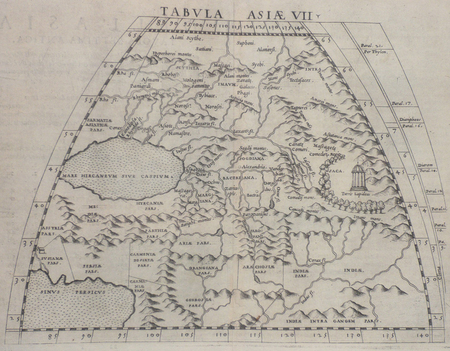
1561LBW0251d[Venise, 1561]. 183 x 246 mm.
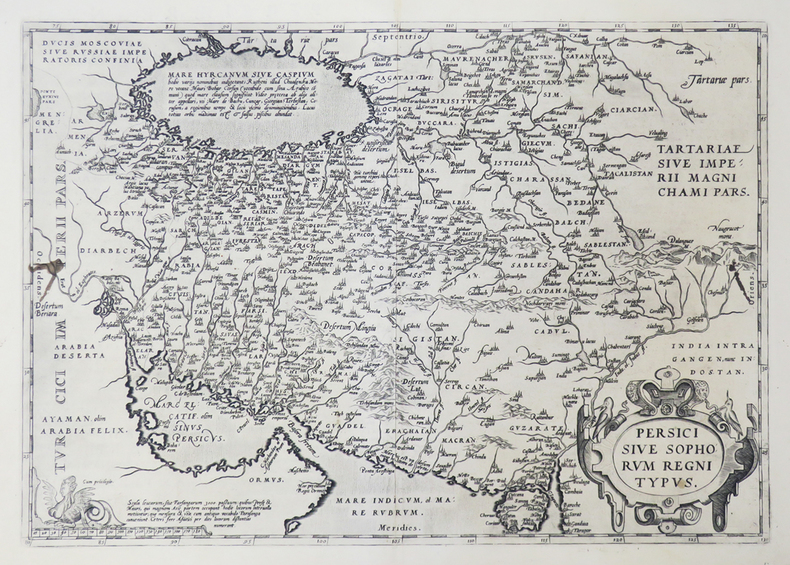
1592LBW0251e[Anvers, 1592]. 349 x 496 mm.
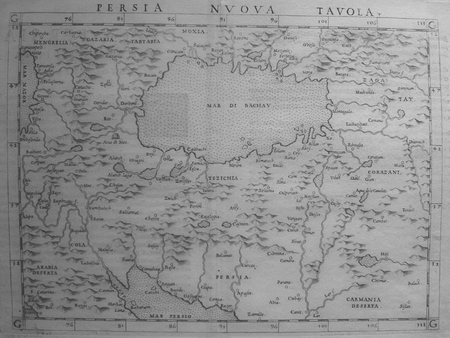
1561LBW02516[Venise, 1561]. 185 x 247 mm.
New Persian Paperback. Roy. 8vo. (24 x 17 cm). Text in Persian with a bilingual title in English and Persian on cover. 279, [1] p., color and b/w ills. [Persian painting (Treasures of Asia)]. Translated into Persian Arabali Sherveh.
1371774Paris: Musée de l'Homme, Museum National d'Histoire Naturelle, 1971 in-4, 180 pages, nombreuses illustrations. Broché, cachet, très bon état. Sommaire : J. Millot : "Avant-propos", T. Battesti : "Iran, "hommes du vent, gens de terre"", Dj. Benham : "Note sur les tendances de la recherche ethnologique en Iran", I. Benham : "La région méridionale de la Mer Caspienne", M. Honari : "Importance du palmier-dattier dans la vie des habitants de Xor", M. Rouholamini : "Systèmes d'irrigation traditionnels dans la région de Kermân", Fr. Bémont : "Bazars et caravansérails", H. Semsar : "L'apparition du narghileh et de la chibouque en Iran", A. Tual : "Variations et usages du voile dans deux villes d'Iran", J.-P. Digard : "La parure chez les Baxtyâri", A. Bouloukbachi : "La cérémonie du Qâli Shuyân", M. Kalantari : "Le Livre des Rois et les peintures des maisons de thé", M.J. Mahdjoub : "Le conteur en Iran", A. Vahdati : "Académies shiites". Second fascicule : Catalogue de l'exposition "Iran, Hommes du vent, Gens de terre" présentée au Musée de l'Homme. Introductions de R. Gessain et de J. Millot, T. Battesti : "Iran "hommes du vent, gens de terre"", Dj. Benham : "Note sur les tendances de la recherche ethnologique en Iran".
1373118Paris: Musée de l'Homme, Museum National d'Histoire Naturelle, 1974 in-4, nombreuses illustrations. Broché, très bon état. Sommaire: Christian BROMBERGER, Habitations du Gîlan. - Marie-Claire BATAILLE, Sculptures funéraires de Bornéo. - Mireille SIMONI-ABBAT, "Art maya du Mexique".
1370394Paris: Musée de l'Homme, Museum National d'Histoire Naturelle, 1977 in-4, nombreuses illustrations. Agrafé, cachet, très bon état. Sommaire: L. KUCZYNSKI. La vie paysanne dans un village du Nord-Yémen. _ H. TALIBI. Cérémonies traditionnelles du naxl à Natanz. - S. TASSINARI. La fabrication des bracelets en bronze à Bobo-Dioulasso (Haute-Volta). - F. TREINEN-CLAUSTRE. Quatre vases peints protohistoriques du Nord-Tchad.
1373584Paris: Musée de l'Homme, Museum National d'Histoire Naturelle, 1969 in-4, nombreuses illustrations. Broché, très bon état. Sommaire: Teresa BATTESTI, La musique traditionnelle iranienne. Aspects socio-historiques. - Jacques MILLOT, Le pays de Kutch et ses paradoxes. - L'exposition "Népal, hommes et dieux". - Ethnomusicologie. - Jacqueline DELANGE et Francine N'DIAYE, Premier festival panafricain à Alger.
Very Good Turkish, Ottoman (1500-1928) Original fine 1/4 leather bound in Ottoman lettered gilt. Demy 8vo. (22 x 14 cm). In Ottoman script (Old Turkish with Arabic letters). 174 p. Hegira: 1277 = Gregorian: 1860. Rare early (second) edition of this eye witness and first-hand account, and one of the most important chronicles describing the history of late Safavid Iran in the 18th century, the Iranian invasion of Afghanistan and the siege and the fall of Isfahan in 1722 written by Kruzinski who was a Polish Jesuit missionary served in the Persia in the early 18th century. In 1720 he was nominated advocate general of the mission in Persia and became the secretary to the Bishop of Isfahan. Krusinski himself, however, claimed later on that he is not only the author but also the translator of this work. As a chronicle, this is a history of Iran under the Safavids from 1499 up to 1727 with a special focus on the 1722 Afghan invasion that terminated the Safavid dynasty. "His account of the conditions and events preceding and during the siege and the subsequent demise of the Safavids is unique. It also offers key insights into the workings of the late Safavid state and government as well as the functions of the royal harem." (Bloomsbury). Translated and expanded by Ibrahim Müteferrika of Kruzinski's Latin manuscript written in 1726 in Istanbul and entitled "Historia revolutionis monarchia Persica". The book was first published in Italian, French, and English translations, in Rome (1727), Paris (1728), and London (1728). The founder of the legendary first printing house in the Islamic world, Ibrahim Müteferrika (1674-1745), was the editor of this book. Ceridehâne [i.e. Journal House] Printing House is the successor of the Müteferrika Press in the early 19th century. "The book is a Turkish translation of the history of Iran written in Latin by the Jesuit missionary Judas (Jan) Tadeusz Krusinski (1675-1751). The work, whose title can be translated as 'A voyager's description on the apparition of the Afghans and on the reasons of the Safavid Empire being undermined', focuses on the Afghan invasion of 1722 which led to the fall of the Safavid dynasty, but also offers an overview on the historical processes of early 18th-century Safavid Iran. The publication of this work was made actual not only by the vicinity of Iran to the Ottoman Empire but also by the historical turn reorganizing the relations of power in the region and triggering the intervention of the Ottomans as well. This may have been the reason that among the first Turkish incunabula this was the work published in the highest number of copies. This publication also offers an early example of copyright disputes, as Krusinski considered the Turkish translation as his own work, while Müteferrika, who does not mention his name in the printed version, suggests himself to be the translator". (Source: The Mysterious Printer Ibrahim Muteferrika and the Beginnings of Turkish Book Printing: Library of Hungarian Academy of Sciences Online). Özege: 19897.
Very Good Persian First Edition of this extremely rare bilingual tractate including Prince Reza Khan's thoughts on Anglo-Persian agreement in1919. Mirza Reza Khan also known as Prince Rezâ Arfa', was a diplomat and poet of the late Qajar period who serviced in Constantinople. During his years of service abroad Reza became acquainted with a number of European political leaders. He was reported to entertain Russian sympathies and was certainly instrumental in negotiating the first Russian government loan to Persia, in 1317 / 1900. Nevertheless, he also appears to have supported the Anglo-Persian Agreement of 1919. In 1332 / 1914 he served as minister of justice (wazîr-e 'adlîya) in Tehran for about a year. This agreement in 1919 was a provisional agreement made between the British and the Persian governments which, if ratified, would have granted the British a paramount position of control over the financial and military affairs of Iran. From the days when Napoleon conceived the idea of invading India with the help of Alexander I, the Tsar of Russia, Great Britain contemplated with apprehension the invasion of India by Russia via Persia and Afghanistan. Under the Anglo-Russian Convention of 1907 (q.v.), which divided Persia into rival spheres of influence, southern Persia was assigned to Britain while Russia controlled the northern portion. Later, according to the terms of "The Secret Treaties of Constantinople" of 18 March 1915, Constantinople was promised to Russia, and England was allowed to incorporate within her sphere of influence the neutral zone of Persia. (Source: Encyclopedia Iranica). Original wrappers. Slightly chipped on extremities and occasionally foxing on cover. Otherwise a very good copy. Roy. 8vo. (23 x 16 cm). Bilingual in Persian and Ottoman script. [34] p., 7-18 pp. text in Persian, 19-34 pp. translation to Ottoman Turkish, a portrait of Prince Mirza Riza Han with a printed signature and inscription, and facsimile litho page of his manuscript poem in his calligraphy. Turkish chapter is in nashkh, Persian chapter is in taliq script. Lithography. Not in OCLC.; Özege 25155.; TBTK 8061. First Edition. Extremely rare.
Very Good Turkish, Ottoman (1500-1928) Contemporary fine quarter leather binding. Five raised bands to spine, second gilt title as "Tarih-i seyyâh", others gilt decorations. Brown boards are embossed decoratively. Demy 8vo. (21 x 15 cm). In Ottoman script (Old Turkish with Arabic letters). [12], 194 p. Hegira: 1142 = Gregorian: 1729. Slightly wear on colophon and the first page. Otherwise a good copy. Extremely uncommon first Ottoman edition printed in the first printing house of the Islamic world as the third Islamic incunabula, of this eye witness and first-hand account, and one of the most important chronicles describing the history of late Safavid Iran in the 18th century, the Iranian invasion of Afghanistan and the siege and the fall of Isfahan in 1722 written by Kruzinski who was a Polish Jesuit missionary served in the Persia in the early 18th century. In 1720 he was nominated advocate general of the mission in Persia and became the secretary to the Bishop of Isfahan. Krusinski himself, however, claimed later on that he is not only the author but also the translator of this work. As a chronicle, this is a history of Iran under the Safavids from 1499 up to 1727 with a special focus on the 1722 Afghan invasion that terminated the Safavid dynasty. "His account of the conditions and events preceding and during the siege and the subsequent demise of the Safavids is unique. It also offers key insights into the workings of the late Safavid state and government as well as the functions of the royal harem." (Bloomsbury). Translated and expanded by Ibrahim Müteferrika of Kruzinski's Latin manuscript written in 1726 in Istanbul and entitled "Historia revolutionis monarchia Persica". The book was first published in Italian, French, and English translations, in Rome (1727), Paris (1728), and London (1728). The founder of the legendary first printing house in the Islamic world, Ibrahim Müteferrika (1674-1745), was the editor and translator of this book. Ceridehâne [i.e. Journal House] Printing House is the successor of the Müteferrika Press in the early 19th century. "The book is a Turkish translation of the history of Iran written in Latin by the Jesuit missionary Judas (Jan) Tadeusz Krusinski (1675-1751). The work, whose title can be translated as 'A voyager's description on the apparition of the Afghans and on the reasons of the Safavid Empire being undermined', focuses on the Afghan invasion of 1722 which led to the fall of the Safavid dynasty, but also offers an overview on the historical processes of early 18th-century Safavid Iran. The publication of this work was made actual not only by the vicinity of Iran to the Ottoman Empire but also by the historical turn reorganizing the relations of power in the region and triggering the intervention of the Ottomans as well. This may have been the reason that among the first Turkish incunabula this was the work published in the highest number of copies. This publication also offers an early example of copyright disputes, as Krusinski considered the Turkish translation as his own work, while Müteferrika, who does not mention his name in the printed version, suggests himself to be the translator". (Source: The Mysterious Printer Ibrahim Muteferrika and the Beginnings of Turkish Book Printing: Library of Hungarian Academy of Sciences Online). The workshop of Müteferrika began its historical mission in 1728. They published 17 works in 22 volumes. The printing house served as a means to the long-term goal of Müteferrika, his efforts to broaden the horizon and modernize the knowledge of Ottoman society and Islamic civilization. This is evidenced by the subjects of the books selected for publishing, the motivations put forth in the publisher's introductions, as well as by the documents illuminating the background of the publication of each book, also published in print. One of 1200 copies. OCLC: 312516053 (For printed copies: Two copies).; Özege: 19897.
New New Persian Original bdg. Dust wrapper. Roy. 8vo. (24 x 17 cm). In Persian. 252 p., ills. [Xerxes unsuccessful Achaemenid conqueror].= Khashâyârshâ jahân'gushâ-yi nâkâm-i Hakhâmanishî. A study on Xerxes, King of Persia; Achaemenid dynasty.
1872LBW-2421Paris, 1872. 611 x 892 mm.
1843LBW-2412Paris, 1843. 427 x 577 mm.
One of the standard bibliographies. Thousands of items described. 8vo, original cloth. Fine.
89061aafTehran, 1964, in-8vo, ca. 300 S., (persian-arabic printing) Original-Pappband.
196329569Marseille Cahiers du Sud 1963 1 vol. Broché plaquette in-8, agrafée, couverture imprimée, 4 pp. Tiré à part du dernier numéro des Cahiers du Sud (septembre-novembre 1963) limité à 100 exemplaires hors commerce numérotés sur pur fil Lafuma.
196329569Marseille Cahiers du Sud 1963 1 vol. Broché plaquette in-8, agrafée, couverture imprimée, 4 pp. Tiré à part du dernier numéro des Cahiers du Sud (septembre-novembre 1963) limité à 100 exemplaires hors commerce numérotés sur pur fil Lafuma.
1939R118393London, Eyre & Spottiswoode 1939 xxxii + 720pp. + some bl/w plates out of text, 26cm., publisher's hardcover in blue cloth, ex-libris stamp on first title page, text is clean and bright, weight: 2.3 kg., R118393
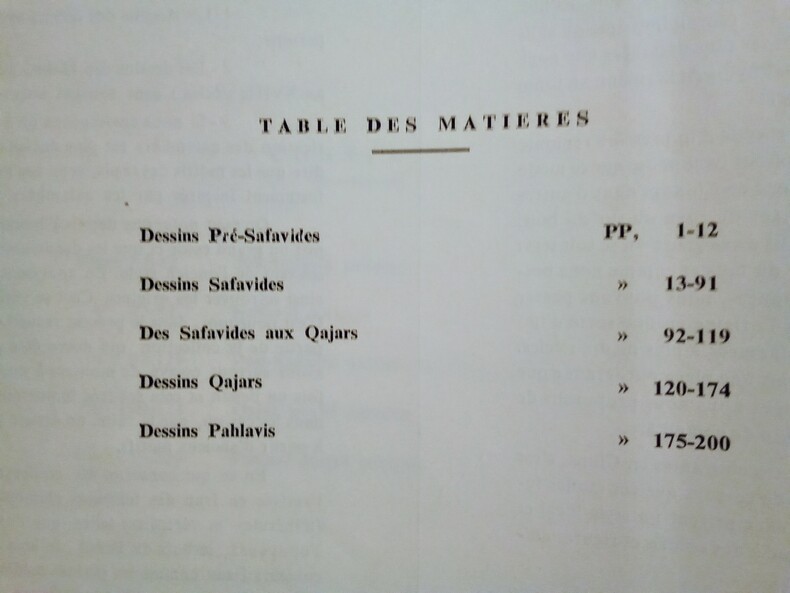
1971WOC-1717200 feuilles: Chiefly Col – 26x41cm. Notes: En persan, en anglais et en français. Sujets: Peinture sur textiles – Iran, Impressions sur textiles – Iran, Décorations et ornements islamiques – Iran, Art collections [Pré-Patters saffavide, Saffavide Paterns, Post-modèles saffavide up ou début de la période Qajar, periode Qajar modèles, période Pahlavi schémas, 200 modèles de plein motifs taille de la page d'exemples, anglais, français et languages Persain]. Publié par the Central Council, Célébration de l'anniversaire de la fondation de l'empire Perse par Cyrus le Grand Septembre, recueillies par Abdolhosseyn Ehsani. Imprimé par la Banque Melli Iran Press, Téhéran, Shuara-yi Markazi Jashn-I-I-I, Shahanshahi Iran, 1350 (1971). In-4 (25,7x2x41cm) à l'italienne, percaline éditeur personnalisé. Ouvrage qui ne tient compte du numéro de la planche et non du recto, 200 planches (400 pages) + 4 pages d'Introductions et Tables en Anglais et Français.
New English Original bdg. HC. Roy. 8vo. (24x 17 cm). In English and Persian. [x], 424 p., color ills. A colour atlas of Iranian fossils: The visual guide to over 500 fossil genera from around Iran.