358 résultats
53162aaf
New English Paperback. Roy. 8vo. (24 x 17 cm). Papers in Turkish and Arabic. 430 p. Uluslararasi Dördüncü Orta Dogu Semineri: Ilkçaglardan Islâmiyetin dogusuna kadar Orta Dogu. Elazig 29-31 Mayis 2009. Bildiriler. Papers of the fourth international seminar on the Middle East. pp.271-335 in Arabic. 500 copies were printed.
New English Original bdg. Small 4to. 184, 564, 216 p. A heavy volume. Ills. In Arabic. This is a facsimile edition of the copy (Mushaf) of the Holy Quran which is attributed to the time of Ali b. Abi Talib and located in Sana'a, Yemen. It comes out as a third publication in IRCICA's series of editions of oldest copies of the Quran. Earlier IRCICA had published editions, accompanied by descriptive and comparative studies, of two Quran copies that are attributed to the time of Othman b. Affan namely the copies of Topkapi, Istanbul and al-Mashhad al-Husayni, Cairo. The other copies attributed to the same period are in the following cities: Istanbul (the Museum of Turkish and Islamic Arts, edition published by ISAM, Istanbul, 2008); London; Paris; St. Petersburg, and Tashkent. There are other editions of Quran copies that IRCICA published outside this series. One of them is the copy dated 582 H/1186 and known as the Fazil Pasha (Sherifovic) Mushaf, which is located in Gazi Husrevbegova Library, Sarajevo. Another edition, supervised by IRCICA, is the reprint of the Mushaf of Kazan dated 1803 which is known to be the first copy printed in the Muslim world; it was reprinted in cooperation with Kazan Municipality in the year 2005 corresponding to the millennium of Kazan city. By publishing these editions, with studies in the case of the former ones, IRCICA aims to contribute in preserving them and making them known and accessible to all. The Sana'a copy is located at the Grand Mosque of Sana'a. The elaborate Introduction to the edition is a study by Dr. Tayyar Altikulaç, specialist of the history of copies of the Quran and ex-Head of Religious Affairs in Turkey. The study is a concise history of the dissemination of the Holy Quran through its copies and of the developments relating to script, orthography, punctuation, locations, etc. of the copies. It examines, describes and analyses the characteristics of the Sana'a copy as to script, orthography, binding, etc. It also describes the other copies attributed to the period of Othman b. Affan as well as the copy printed by the King Fahd Complex for the Printing of the Holy Quran, Medina, which is known to be in conformity with the orthography of the time of Othman b. Affan. IRCICA planned to publish this edition during the 2010-2011 period which, at the suggestion of IRCICA, was designated by the 2010 meeting of the OIC's Council of Foreign Ministers as the "1400th Year of the Revelation of the Holy Quran". The Council had invited all OIC member countries and Muslims' associations and institutions world-wide to commemorate this anniversary of the beginning of the revelation with cultural and scholarly activities that would contribute in diffusing a correct and deeper understanding of the Holy Quran. IRCICA for its part is honoured to have been able to record this publication among its activities related to the said Year.
New English Paperback. Roy. 8vo. (24 x 17 cm). In Turkish. 271 p. Besinci Uluslararasi Orta Dogu Semineri: Islamiyet'in dogusundan Osmanli idaresine kadar Orta Dogu. (Sam 2-4 Kasim 2010.) Bildiriler.
New English Paperback. 4to. (28 x 20 cm). In English and Turkish. 167, [1] p., color ills. Coffee, pleasures hidden in a bean.= Tanede sakli keyif, kahve. [Exhibition catalogue].
New English Paperback. Cr. 8vo. (20 x 14 cm). In Turkish. [6], 126 sayfa, no date and other publishing details. Yemen'de 40 Mehmet, 40'lar kulübü. MIDDLE EAST History Yemen.
New Turkish Paperback. Roy. 8vo. (24 x 17 cm). In Turkish with English abstract. . [xvi], 152 p., 1 map. Amurrular: Araplar'in en eski atalari (Tarih Subesi Yayinlari No. 19).= History of Amorites, early ancestors of the Arabs.
Very Good Turkish Paperback. Cr. 8vo. (20 x 14 cm). In Turkish. 160 p. Siradaki kaymakam.
Very Good Turkish Paperback. Cr. 8vo. (20 x 14 cm). In Turkish. 272 p. Kafa tutan günler: "68 güncesi".
Very Good English Modern full leather each volumes in traditional Ottoman style. Roy. 8vo. (25 x 17 cm). In Ottoman script. Last 2 volumes are in Modern Turkish. 10 volumes set: ([23], 674, [10] p.; 479, [5] p.; 534, [5] p.; 432, [4] p.; 602, [6] p.; [4], 554, [5] p.; [21], 912 p.; [1], [5], 786, [4] p.; 892 p.; 1112 p)., folding maps, b/w plates. 1896 - 1938. Their contents are: Vol. 1: Description of Contantinople and environs, as of 1631. Vol. 2: Journey to Brousse and Nicomedia, 1640, Pontus, Caucasus and Crimea, 1640-44.i expedition to Crete, 1645; journey to Erzerum and Caucasus, 1648. Vol. 3: Syria, Kurdistan, Armenia, 1650; Roumelia, Bulgaria and Dobrudja, 1655-56. Vol. 4: Persia and Iraq, 1655-56. Vol. 5: Journey to Moldavia and expeditions to Transylvania and Russia, 1658; to Anatolia, then across the Dardanelles to Adrianople, 1659; expeditions to Moldavia and Dalmatia, 1660. Vol. 6: Expedition to Transylvania and journey to Albania, 1661-62; expeditions to Hungary, Montenegro and Croatia, 1663-64. Vol. 7: Austria, Crimea, Daghestan, Caucasus, Astrakhan. Vol. 8: Crimea, Crete, Salonica, Roumelia (Greece). Vol. 9: Pilgrimage to Mecca and Medina. Vol. 10: Egypt. Evliya Çelebi was son of the chief court jeweler, he was educated in a madrasah (Islamic college) and a Qur?an school in Constantinople; and, excelling as a Qur'ân reciter, he was shown favour by the reigning sultan, Murad IV. Entering the Ottoman palace school, he developed skills in Arabic, calligraphy, and music. Under the patronage of the court he began the journeys that took him from Belgrade to Baghdad and from Crimea to Cairo, sometimes as an official representative of the government and sometimes on his own. The result of these travels was his masterwork, the Seyahatname (1898-1939; 'Book of Travels'). This work is also referred to as the Tarih-i seyyah ('Chronicle of a Traveler'). Evliya possessed a vivid imagination, occasionally mixing fact and fantasy; he described places he could not possibly have visited. Noted for his fascinating anecdotes and charming style, he wrote about the ethnography, history, and geography of the Ottoman Empire and neighbouring lands and about the inner workings of the Ottoman government during the 17th century. (Source: Britannica). Currently there is no English translation of the entire Seyahatname, although there are translations of various parts. The longest single English translation was published in 1834 by Joseph von Hammer-Purgstall, an Austrian orientalist: it may be found under the name "Evliya Efendi." Von Hammer-Purgstall's work covers the first two volumes (Istanbul and Anatolia) but its language is antiquated. Other translations include Erich Prokosch's nearly complete translation into German of the tenth volume, the 2004 introductory work entitled The World of Evliya Çelebi: An Ottoman Mentality written by University of Chicago professor Robert Dankoff, and Dankoff and Sooyong Kim's 2010 translation of select excerpts of the ten volumes, An Ottoman Traveller: Selections from the Book of Travels of Evliya Çelebi. Evliya is noted for having collected specimens of the languages in each region he traveled in. There are some 30 Turkic dialects and languages cataloged in the Seyâhatnâme. Çelebi notes the similarities between several words from the German and Persian, though he denies any common Indo-European heritage. The Seyâhatnâme also contains the first transcriptions of many languages of the Caucasus and Tsakonian, and the only extant specimens of written Ubykh outside the linguistic literature. First Printed Set of Evliya Chalabi's book(s) of travels. Voyages and Travels in Greece, the Near East and adjacent regions made previous to the year 1801; being a part of a larger catalogue of work on geography, cartography, voyages and travels, in the Gennadius Library in Athens, compl. by Shirley Howard Weber, Vol. II: 1631.; TBTK 10360.; Özege .; Only 2 copies located in OCLC as set: 80395042. Rare as set.
In-4 (cm. 34.50), tela editoriale con fregio al piatto e titolo al dorso sempre in oro, custodia in mezza tela illustrata, pp. (2), 223, (1), con numerose illustrazioni a colori nel testo. Fioriture alla prima ed ultima carta, minime abrasioni alla custodia, peraltro volume in buono stato (good copy).
1982G56448Mainz am Rhein, Philipp von Zabern 1982 pp.171-175 + 3 plates out-of-text, 31cm., offprint from "Archäologische Berichte aus dem Yemen, Band I (1982)", VG
pp.171-175 + 3 plates out-of-text, 31cm., offprint from "Archäologische Berichte aus dem Yemen, Band I (1982)", VG
Fioretti, Susanna Involontaria. Avventure umane e umanistiche. Torino - Cles (Trento), Giulio Einaudi editore s.p.a. - Mondadori Printing S.p.a., Stabilimento N. S. M. (stampa) 2011 italian, in ottavo pp. (8)+292+(4)=304 I ed.: settembre 2011. Collana Passaggi Einaudi. VIII/(8)+292+(4)=304/brossura satinata con risvolti (In copertina: Alighiero Boetti, Aerei, 1977, matita si carta intelata, 1977, particolare. Los Angeles, The Museum of Contemporary Art. © Alighiero Boetty by SIAE 2011. Courtesy Fondazione Alighiero Boetti, Roma). Stato buono (copertina leggermente polverosa e leggermente brunita).
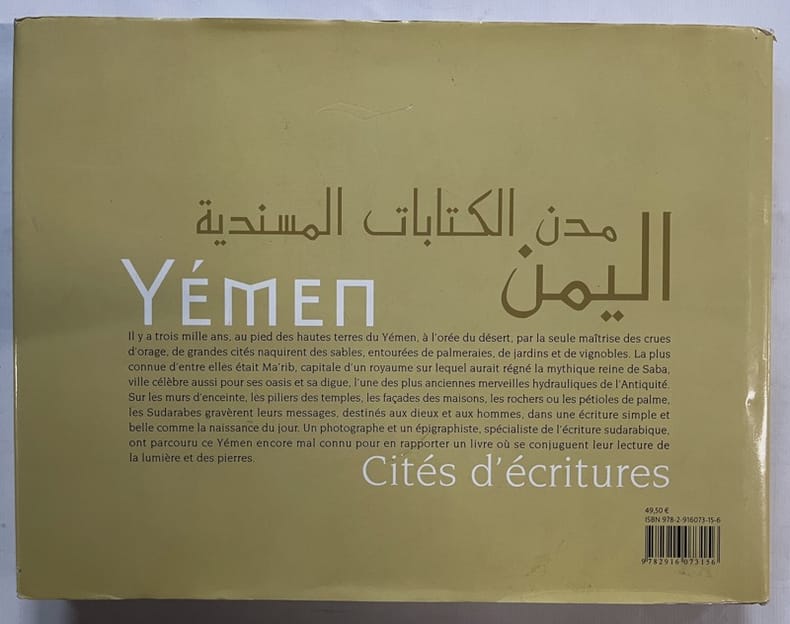
2006139456Manosque, le Bec en l'air 2006 In-4 à l’italienne, cartonnage éditeur illustré en couleurs, sous jaquette à l’identique, 242 pp., 100 illustrations, sommaire, chronologie, bibliographie. Texte en français, introduction en arabe.
Stampa antica ed originale con testo al retro
45194Paris, Seuil, 1997. 27 x 31, 98 pp., 104 illustrations en couleurs, reliure d'édition carton + jaquette, très bon état.
199715746Seuil 1997 In -4 cartonnage sous jaquette, 97 pp, illustrations en couleurs
20041222166(CEFAS; Sanaa), (2003 / 2004). Ca. 250 Seiten; A4-Kopien; 30 cm; rückengoldgepr. Leinenband.
Milano, 1955, stralcio con copertina posticcia muta, pp. 1169/1182 con una cartina e numerose fotografie. - !! ATTENZIONE !!: Con il termine estratto (o stralcio) intendiamo riferirci ad un fascicolo contenente un articolo di rivista, sia che esso sia stato stampato a parte utilizzando la stessa composizione sia che provenga direttamente da una rivista. Le pagine sono indicate come "da/a", ad esempio: 229/231 significa che il testo è composto da tre pagine. Quando la rivista di provenienza non viene indicata é perchè ci è sconosciuta. - !! ATTENTION !!: : NOT A BOOK : “estratto” or “stralcio” means simply a few pages, original nonetheless, printed in a magazine. Pages are indicated as in "from” “to", for example: 229/231 means the text comprises three pages (229, 230 and 231). If the magazine that contained the pages is not mentioned, it is because it is unknown to us.
Fine French Original decorative imitation full leather bdg. Demy 8vo. (22 x 14cm). In French. [Lxv], 632, [7] p. Le Coran. Traduction intégrale et notes de Muhammad Hamidullah. Préface de Louis Massignon. Avec la collaboration de Michel Leturmy. Hamidllah, (1908-2002), D. Phil., D. Litt., HI, was a Muhaddith, Faqih, scholar of Islamic law and an academic author with over 250 books. A prolific writer, his extensive works on Islamic science, history and culture have been published in several languages and many thousands of articles in learned journals. His scholarship is regarded by many as unparalleled in the last century. A double doctorate (D.Phil. and D.Litt.) and a polymath, he was fluent in 22 languages including Urdu (his mother tongue), Persian, Arabic, French, English, German, Italian, Greek, Turkish, Russian etc. He learned Thai at the age of 84. Hamidullah is known for contributions to the research of Hadith history, translations of the Qur'an into multiple languages and in particular into French (first by a Muslim scholar) and for the monumental biography of the Islamic prophet Muhammad in French. He is also famous for discovering a missing work on the Prophet Muhammad regarded as one of his great contributions to the Hadith literature. The earliest Hadith manuscript still extant today, Sahifa Hammam bin Munabbah, was discovered in a Damascus library. Hammam bin Munabbah being a disciple of Sayyidina Abu Huraira, one of the Sahaba. Massignon, (1883-1962), was a Catholic scholar of Islam and a pioneer of Catholic-Muslim mutual understanding (Krokus 2012, p. 525). He was an influential figure in the twentieth century with regard to the Catholic church's relationship with Islam. He focused increasingly on the work of Mahatma Gandhi, whom he considered a saint. He also played a role in Islam being accepted as an Abrahamic Faith among Catholics. Some scholars maintain that his research, esteem for Islam and Muslims, and cultivation of key students in Islamic studies largely prepared the way for the positive vision of Islam articulated in the Lumen gentium and the Nostra aetate at the Second Vatican Council (Krokus 2012, p. 525). Although a Catholic himself, he tried to understand Islam from within and thus had a great influence on the way Islam was seen in the West; among other things, he paved the way for a greater openness inside the Catholic Church towards Islam as it was documented in the pastoral Vatican II declaration Nostra aetate. "This non-trade edition is reserved exclusively for members of the French Book Club. It includes ten thousand copies numbered from 1 to 10,000.". This is no. 9499. 9499/10000.
141043Roland Klöpfer Verlag 1.Auflage 2016. 227 Seiten. Mit zahlreichen teils farbigen Abbildungen. Illustrierter Original-Leinwand-Einband. (Geringe Gebrauchsspuren). 21x15 cm
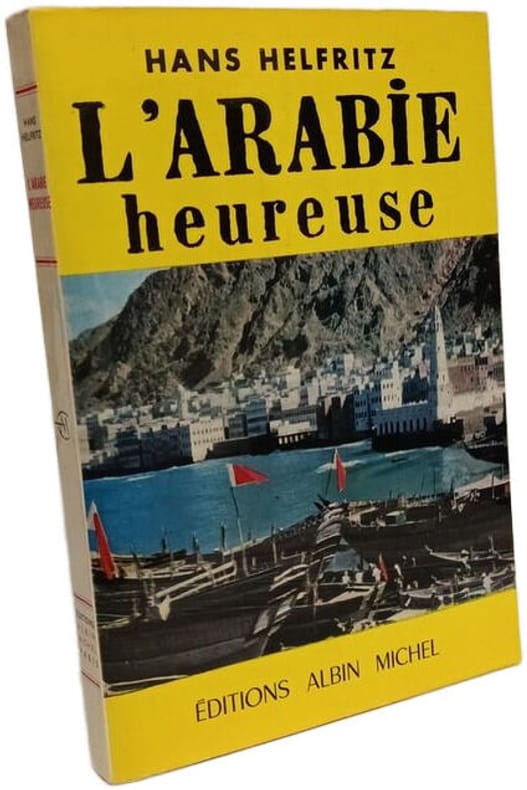
1961100144715Éditions Albin Michel 1961 in8. 1961. Broché. Récit de l'explorateur Hans Helfritz l'un des premiers étrangers à avoir pénétré au cœur du Yémen décrivant ses pérégrinations et les découvertes qu'il a faites dans cette région appelée "Arabie Heureuse"