HIROSHIGE, Ichiryusai IIIBiblio.com

6 121 résultats
99001601Edo 1891. A brocade silk covered album Oban size all edge gilt with a total of 65 fine color prints including 2 title pages one dedication printbook size 24.5 x 35.5 cm. 4.15 cm. thick. A stunning group famous sights. R A R E ! . . . A STUNNING EXAMPLE WITH A SIXTY-FIVE . . . COLOR WOODBLOCK BLOCK PRINTS . . . BY THE MASTER OF JAPANESE LANDSCAPE . . Hiroshige II 1826-1869 and III 1843-1894: Were one in the same a pupil of the most famous and great master of landscape & composition Ando Hiroshige I. . Using his master's name plus his old name Ichiryusai he was the adopted son of Hiroshige I and was a very skilled painter who actually painted alongside & with the master until his master's death in 1858. . After that Ichiryusai specialized in Japan's modernization railroad prints depicting these new innovations recently imported from the West around Yokohama as well as issuing many series of beautiful landscape views and scenery. . In his later years he executed a most beautiful and exquisite set of his own interpretation of his master's most well-known series of prints showing Mt. Fuji and the celebrated places around Edo. This was not done to merely copy the master's works but rather as a sincere Confucian tribute to his adopted father & now father-in-law and master. He married his master's daughter. . He took each of the master's views & repainted them in pastel colors with great control & precision. Some of the more delicate places such as rainbows and clouds behind a flock of birds were actually brushed on by hand a technique rarely ever done. The woodblocks used were of the highest quality a majority of which were center cuts & these have left a most beautiful wood-pattern in the print. This example shows 28 prints from the Fuji Sanju Rokkei and 35 from the Edo Yonju Hakkei series with the title page from each present. . There is a dedication & memorial print to Hiroshige I from his faithful son and pupil. This print is most similar to one found as the frontispiece to the book by E. F. Strange: THE COLOR PRINTS OF HIROSHIGE London 1925. . It's clear that this print by Kunisada who is Toyokuni I was used as a model by Ichiryusai as it differs in what the master is holding. Kunisada shows him holding his rosary beads while Ichiryusai shows the master with his Fude brush pen and paper in hand. Ichiryusai and Kunisada had collaborated to issue a series of 36 prints: EDO JIMAN or THIRTY-SIX PLACES OF WHICH YEDO IS PROUD. . Ichiryusai has taken much care to represent the most wonderful views of Mt. Fuji & Edo with great skill. A majority of these prints are certainly well-known to the art world at large as well as by Japanese print collectors. . Many of these prints show up in the usual reference books. Some of the more famous Edo views are showing a falcon in winter rain on the river bridge storks cat view in Asakusa busy street scenes Asakusa temple & lantern in snow river scenes &c. . Some Mt. Fuji views show many snow scenes seasonal views cherry blossoms a majority show water and mountains a very charming set of prints. . Alternate title is MEISHO EDO HYAKKEI. . THE BINDING: This stunning album is beautifully bound in traditional silk-gilt brocade with prints on both sides of an accordion folded album. . Color photos are posted to our website. . REFERENCES: . L. Roberts: A DICTIONARY OF JAPANESE PRINTS ARTISTS p.44-45 for background on Hiroshige III & III. E. F. Strange: THE COLOR PRINTS OF HIROSHIGE R. Lane: IMAGES FROM THE FLOATING WORLD p.232-254 most all of the prints in this album are listed under Hiroshige I's series: MEISHO EDO HYAKKEI: ONE HUNDRED FAMOUS VIEWS OF EDO. . . unknown
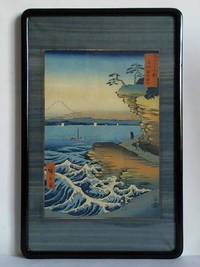
6a375Tsutaya Kichizo Japan 1858. Maße: ca. 192 x 278 cm mit Stempel unten rechts im Motiv auf colorierten Stoff gezogen hinter Glas in schwarzer Holzleiste mit abgerundeten Ecken Leiste gering berieben/rückseitig zwei Papierschilder. - Japanische Kunst - unknown
32072801Edo 1841-42 Takenouchi. Color Oban woodblock printsigned in block 34.2 x 21.8 cm. edges trimmed five small verso old mends now solid excellent impression & registry a bit dusty very good reprint example sold "as is." . . . . . HAKONE KOSUI NO ZU: HAKONE -VIEW OF THE LAKE . . . ONE OF THE MOST ICONIC & FAMOUS VIEWS OF THE SERIES . . . THE FIFTY-THREE STAGES OF THE TOKAIDO HIGHWAY . . This is one of the most famous and iconic prints of the series showing great composition and excellent use of multiple colors. The mountain which faces Mt. Fuji showing "respect" as well as "pointing" to the most" Sacred" mountain of Japan. The blue lake to the left of the mountain completes a classic view. This is print number 11 of the series. Per Forrer this print is the exact print discussed and illustrated with the exact three cinnabar Hanko seals/chops. It was published by Takenouchi Magohachi Hoeido ca. 1831-4 Signed Hiroshige Ga with censor seal Kiwame. See Forrer below. . We believe this is a later but undated reprint of the above example. . CONDITION: The print surface is soiled dusty with four mends on the verso corners plus a few other mends. Some usual but minor color toning with trimmed margins sold "as is." Nevertheless this still remains a very famous and stunning woodblock color print. . TERMS OF SALE: This print is sold "as is" and is NOT returnable. By ordering this item you agree to the above terms. Please view color photos posted to our website prior to ordering. . REFERENCES: . LANE Richard.: IMAGES FROM THE FLOATING WORLD: THE JAPANESE PRINT INCLUDING AN ILLUSTRATED DICTIONARY OF UKIYO-E pp.229 172-184231-233 #80 showing Hiroshige signature as ca. 1832 in this print. FORRER Matthi. et al.: HIROSHIGE: PRINTS AND DRAWINGS see #18 & opposite page color print our exact example published by Takenouchi Magohachi Hoeido ca. 1831-34 with Kiwame censor seal. . This work is cited in several of the standard bibliographies. . . unknown
198137620Metropolitan Museum of Art. Very Good in Very Good dust jacket. 1981. Hardcover. 0870992376 . The overall condition of the book is excellent. The binding is an accordion facsimile bound in red cloth boards. The fold-out pages are in great condition. The pages are clean and unmarked apart from a gift inscription on the first page. The cover is in very good condition with minor blemishes and shelving wear. The slip case is in excellent condition with minor shelving wear. Please support an independent bookstore. ; 10.60 x 7.60 x .75 "; 0 pages . Metropolitan Museum of Art hardcover
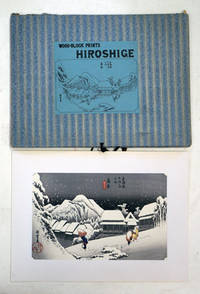
6rampKyoto Hanga-In. Hardcover. Very Good/No Jacket. Set of 6 woodblock prints each mounted in a cream overlay. Housed in a brown rice papered card stock string-tied portfolio. Includes explanations of each print in English and Japanese. Titles include: 1. Snow of Kambara at Night; 2. Hakone; 3. One Hundred Scenes of Edo Atagoshita Yabukoji; 4. Mt. Haruna in Kozuke Province; 5. Moon at Irozaki Point; 6. Beautiful Woman in Snow. // No date or edition stated. The cardboard covering is a little shelf rubbed and a tear along the spine. Our orders are shipped using tracked courier delivery services. Kyoto Hanga-In hardcover
106705o. Angaben o. Vlg. . 38 x 28 cm 6 lose Blätter 22 x 32 cm unter Passepartout 1 gefalzt. Textblatt. Flügelmappe m Schnurrverschluss m. losen Blättern unter Passepartout Mappe a. Rücken lädiert etwas berieben Blätter tadell. Text: engl./ jap.- Ando Hiroshige 1797–1858 war ein berühmter japanischer Ukiyo-e-Holzschnittkünstler bekannt für seine atmosphärischen Landschaftsdrucke die oft das tägliche Leben und berühmte Orte Japans darstellten insbesondere mit Serien wie den "53 Stationen des T kaid " und den "100 berühmten Ansichten von Edo" die auch den europäischen Impressionismus stark beeinflussten. Sein korrekter Name war Utagawa Hiroshige da er Schüler der Utagawa-Schule war aber "And Hiroshige" ist gebräuchlich.- Set of 6 woodblock prints each mounted in a cream overlay. Housed in a brown rice papered card stock string-tied portfolio. Includes explanations of each print in English and Japanese. Titles include: 1. Snowfall of Kambara; 2. Sudden shower at Shono; 3. Moon light by river Tama; 4. Stage-Town Nagakubo; 5.Asakusa Kinryuzan Temple; 6. Sudden Rain-Storm at Atake. 010 o. Angaben, o. Vlg., unknown
SBS26604NEW. NEW. Enviamos a todo el mundo por USPS. UPS o DHL. 100% garantia en su compra. We ship worldwide. unknown
2014111804Marsilio Editori. New. 2014. Paperback. 8831720120 . FREE UPGRADE to Courier/Priority Shipping Upon Request - IN STOCK AND IMMEDIATELY AVAILABLE FOR SHIPMENT - Flawless copy brand new pristine never opened - Text in Italian. -- with a bonus offer-- . Marsilio Editori paperback
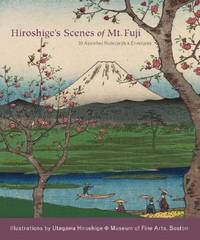
2012104138Museum; Et Al. New. 2012. Hardcover. 2353401449 . FREE UPGRADE to Courier/Priority Shipping Upon Request - IN STOCK AND IMMEDIATELY AVAILABLE FOR SHIPMENT - Flawless copy brand new pristine never opened -- Text in French. 176 pages; many color illustrations. -- with a bonus offer-- . Museum; Et Al hardcover
1981436Metropolitan Museum of Art 1981. Hardcover. Near Fine. red hardcover in Near Fine condition with slipcase in Near Fine condition Metropolitan Museum of Art hardcover
0811848507.Gpaperback. Good. Access codes and supplements are not guaranteed with used items. May be an ex-library book. paperback
1959blb04114Rutland VT: Charles Tuttle & Co. 1959. 1st. Softcover. Near Fine/Near Fine. Illustrated cloth boards with binding secured by string. Booklet is tight square sharp-cornered and free of flaws or markings inside and out. All of the beautiful full color woodcuts are present - tipped in to text next to poems. Very thin wood veneer affixed to endpapers. Near Fine. Illustrated slipcase also near fined with just one spot of mild rubbing. A ""tokaido"" or trip in English from Tokyo to Kyota taken by Ichiryusai Hiroshige in 1832. The trip comprised of 53 stopping spots along the way each a day apart during which Hiroshige sketched. These paintings are the tipped in woodcuts. First edition Third Printing. Charles Tuttle & Co. paperback
0870992376New. New. Satisfaction Guaranteed or your money back. unknown
0870992376.Ghardcover. Good. Access codes and supplements are not guaranteed with used items. May be an ex-library book. hardcover
1981Q-0870992376Metropolitan Museum of Art 1981-06-01. Hardcover. New. In shrink wrap. Looks like an interesting title! Metropolitan Museum of Art hardcover
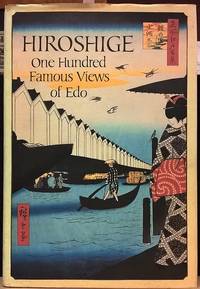
1986369104New York: George Braziller Incorporated 1986. 1st. Hardcover. Fair/Good. 256 pages. Hardcover with dust jacket. Clean tight copy. Color pictures throughout. landscapes. Hiroshige's One Hundred Famous Views of Edo actually composed of 118 splendid woodblock landscape and genre scenes of mid-nineteenth century Tokyo is one of the greatest achievements of Japanese art. The series contains many of Hiroshige's best-loved and most extraordinary prints. Like Venice and Florence in the 14th and 15th centuries or Paris in the age of the Impressionists the city of Edo with its superb landmarks and its festive display of elegant urban life exerts a special and compelling fascination. Hiroshige revealed the panorama of his city's activities with subtle and vivid visual anecdotes: fireworks seen from the river fashionable geishas on parade the kabuki district at night intimate moments in the gardens and teahouses. It is a tour de force of artistic vision and printmaking craftsmanship. This edition has been reproduced from an exceptionally fine first-edition set in the Brooklyn Museum of Art to insure maximum fidelity to the original prints. Henry Smith ex-plains the world of Edo in its twilight before the Meiji Restoration and the beginnings of a modern urban society. Each plate is accompanied by a commentary that discusses its artistic and cultural interest in detail. For anyone interested in Japan the One Hundred Famous Views of Edo is perhaps the finest guide and one of the greatest legacies imaginable. Record # 369104 George Braziller Incorporated hardcover
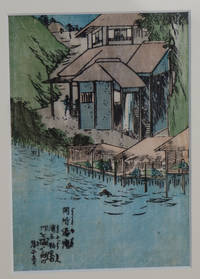
X14<p>HIROSHIGE Ando 1797-1858. Relaxing by the Water. Original woodblock from the series "Ehon Edo Miyage" published by Kikuya Kozaburo Volume 3 printed in Japan 1850-68. 295 x 210mm. This original print is delivered to you in its <strong>unframed</strong> state carefully protected in a solid cardboard tube.</p><p>Utagawa Hiroshige born AndÅ TokutarŠ安藤 徳太郎; 1797 – 12 October 1858 was a Japanese ukiyo-e artist considered the last great master of that tradition.<br />Hiroshige is best known for his horizontal-format landscape series The Fifty-three Stations of the TÅkaidÅ and for his vertical-format landscape series One Hundred Famous Views of Edo. The subjects of his work were atypical of the ukiyo-e genre whose typical focus was on beautiful women popular actors and other scenes of the urban pleasure districts of Japan's Edo period 1603–1868. The popular series Thirty-six Views of Mount Fuji by Hokusai was a strong influence on Hiroshige's choice of subject though Hiroshige's approach was more poetic and ambient than Hokusai's bolder more formal prints. Subtle use of color was essential in Hiroshige's prints often printed with multiple impressions in the same area and with extensive use of bokashi color gradation both of which were rather labor-intensive techniques.<br />For scholars and collectors Hiroshige's death marked the beginning of a rapid decline in the ukiyo-e genre especially in the face of the westernization that followed the Meiji Restoration of 1868. Hiroshige's work came to have a marked influence on western European painting towards the close of the 19th century as a part of the trend in Japonism. Western European artists such as Manet and Monet collected and closely studied Hiroshige's compositions: Vincent van Gogh for instance painted copies of some Hiroshige prints.</p><p><br />Japanese woodblock prints known as ukiyo-e<br />Produced in their many thousands and hugely popular during the Edo period 1615 – 1868 these colourful woodblock prints known as ukiyo-e depicted scenes from everyday Japan. Ukiyo-e literally means 'pictures of the floating world'. The 'floating world' referred to the licensed brothel and theatre districts of Japan's major cities during the Edo period. Inhabited by prostitutes and Kabuki actors Kabuki is a traditional Japanese form of theatre these were the playgrounds of the newly wealthy merchant class. Despite their low status in the strict social hierarchy of the time actors and courtesans became the style icons of their day and their fashions spread to the general population via inexpensive woodblock prints.<br />The ukiyo-e style was developed in 1765 and remained popular until the closing decades of the Meiji period 1868 – 1912. While only the wealthy could afford paintings by the artists of the day ukiyo-e prints were enjoyed by a wide audience because they could be produced quite cheaply and in large numbers.<br />The production process<br />The earliest woodblock prints were simple black and white prints taken from a single block. Sometimes they were coloured by hand but this process was expensive. In the 1740s additional woodblocks were used to print the colours pink and green but it wasn't until 1765 that the technique of using multiple colour woodblocks was perfected. The glorious full-colour prints that resulted were known as nishiki-e or 'brocade pictures'.<br />The team involved in the production of ukiyo-e was known as the 'ukiyo-e quartet'. It comprised the publisher who usually had overall control of the process the designer/artist the block cutter and the printer.<br />The artist would draw the design on paper. Once complete an exact copy was made and placed face-down on a cherry wood block. Cherry wood was favoured due to the fine even grain and consistent density. The block cutter then carved directly through the copy to produce what is known as the 'key-block'.<br />The printer used the key-block to produce a number of black and white prints from which further blocks could be made for each colour needed in the final print. Known as 'key-block proofs' these prints feature registration marks: small rectangles outside the area of the picture. When the colour blocks were carved these marks were used to create stops so that the printer could line up the separate colours precisely.</p>
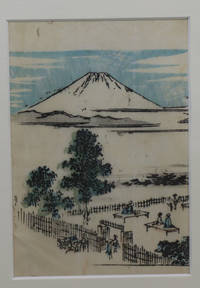
X16<p>Sipping Tea Viewing Mount Fuji. Original woodblock from the series "Ehon Edo Miyage" published by Kikuya Kozaburo Volume 3 printed in Japan 1850-68. 295 x 210 mm. This original print is delivered to you in its <strong>unframed</strong> state carefully protected in a solid cardboard tube.</p><p>Utagawa Hiroshige born AndÅ TokutarŠ安藤 徳太郎; 1797 – 12 October 1858 was a Japanese ukiyo-e artist considered the last great master of that tradition.</p><p>Hiroshige is best known for his horizontal-format landscape series The Fifty-three Stations of the TÅkaidÅ and for his vertical-format landscape series One Hundred Famous Views of Edo. The subjects of his work were atypical of the ukiyo-e genre whose typical focus was on beautiful women popular actors and other scenes of the urban pleasure districts of Japan's Edo period 1603–1868. The popular series Thirty-six Views of Mount Fuji by Hokusai was a strong influence on Hiroshige's choice of subject though Hiroshige's approach was more poetic and ambient than Hokusai's bolder more formal prints. Subtle use of color was essential in Hiroshige's prints often printed with multiple impressions in the same area and with extensive use of bokashi color gradation both of which were rather labor-intensive techniques.</p><p>For scholars and collectors Hiroshige's death marked the beginning of a rapid decline in the ukiyo-e genre especially in the face of the westernization that followed the Meiji Restoration of 1868. Hiroshige's work came to have a marked influence on western European painting towards the close of the 19th century as a part of the trend in Japonism. Western European artists such as Manet and Monet collected and closely studied Hiroshige's compositions: Vincent van Gogh for instance painted copies of some Hiroshige prints.</p><p>Japanese woodblock prints known as ukiyo-e</p><p>Produced in their many thousands and hugely popular during the Edo period 1615 – 1868 these colourful woodblock prints known as ukiyo-e depicted scenes from everyday Japan. Ukiyo-e literally means 'pictures of the floating world'. The 'floating world' referred to the licensed brothel and theatre districts of Japan's major cities during the Edo period. Inhabited by prostitutes and Kabuki actors Kabuki is a traditional Japanese form of theatre these were the playgrounds of the newly wealthy merchant class. Despite their low status in the strict social hierarchy of the time actors and courtesans became the style icons of their day and their fashions spread to the general population via inexpensive woodblock prints.</p><p>The ukiyo-e style was developed in 1765 and remained popular until the closing decades of the Meiji period 1868 – 1912. While only the wealthy could afford paintings by the artists of the day ukiyo-e prints were enjoyed by a wide audience because they could be produced quite cheaply and in large numbers.</p><p>The production process</p><p>The earliest woodblock prints were simple black and white prints taken from a single block. Sometimes they were coloured by hand but this process was expensive. In the 1740s additional woodblocks were used to print the colours pink and green but it wasn't until 1765 that the technique of using multiple colour woodblocks was perfected. The glorious full-colour prints that resulted were known as nishiki-e or 'brocade pictures'.</p><p>The team involved in the production of ukiyo-e was known as the 'ukiyo-e quartet'. It comprised the publisher who usually had overall control of the process the designer/artist the block cutter and the printer.</p><p>The artist would draw the design on paper. Once complete an exact copy was made and placed face-down on a cherry wood block. Cherry wood was favoured due to the fine even grain and consistent density. The block cutter then carved directly through the copy to produce what is known as the 'key-block'.</p><p>The printer used the key-block to produce a number of black and white prints from which further blocks could be made for each colour needed in the final print. Known as 'key-block proofs' these prints feature registration marks: small rectangles outside the area of the picture. When the colour blocks were carved these marks were used to create stops so that the printer could line up the separate colours precisely.</p>
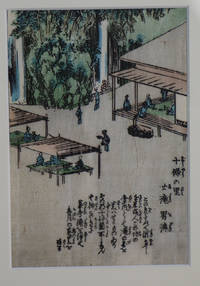
X13<p>HIROSHIGE Ando J 797-1858. Waterfall at Jujyo No Sato. Original woodblock from the series "Ehon Edo Miyage" published by Kikuya Kozaburo Volume 3 printed in Japan 1850-68. 295 x 210 mm.</p><p>This original print is delivered to you in its <strong>unframed</strong> state carefully protected in a solid cardboard tube.</p><p>Utagawa Hiroshige born AndÅ TokutarŠ安藤 徳太郎; 1797 – 12 October 1858 was a Japanese ukiyo-e artist considered the last great master of that tradition.</p><p>Hiroshige is best known for his horizontal-format landscape series The Fifty-three Stations of the TÅkaidÅ and for his vertical-format landscape series One Hundred Famous Views of Edo. The subjects of his work were atypical of the ukiyo-e genre whose typical focus was on beautiful women popular actors and other scenes of the urban pleasure districts of Japan's Edo period 1603–1868. The popular series Thirty-six Views of Mount Fuji by Hokusai was a strong influence on Hiroshige's choice of subject though Hiroshige's approach was more poetic and ambient than Hokusai's bolder more formal prints. Subtle use of color was essential in Hiroshige's prints often printed with multiple impressions in the same area and with extensive use of bokashi color gradation both of which were rather labor-intensive techniques.</p><p>For scholars and collectors Hiroshige's death marked the beginning of a rapid decline in the ukiyo-e genre especially in the face of the westernization that followed the Meiji Restoration of 1868. Hiroshige's work came to have a marked influence on western European painting towards the close of the 19th century as a part of the trend in Japonism. Western European artists such as Manet and Monet collected and closely studied Hiroshige's compositions: Vincent van Gogh for instance painted copies of some Hiroshige prints.</p><p>Japanese woodblock print known as <strong>ukiyo-e</strong> were produced in their many thousands and hugely popular during the Edo period 1615 – 1868</p><p>These colourful woodblock prints depicted scenes from everyday Japan. Ukiyo-e literally means 'pictures of the floating world'. The 'floating world' referred to the licensed brothel and theatre districts of Japan's major cities during the Edo period. Inhabited by prostitutes and Kabuki actors Kabuki is a traditional Japanese form of theatre these were the playgrounds of the newly wealthy merchant class. Despite their low status in the strict social hierarchy of the time actors and courtesans became the style icons of their day and their fashions spread to the general population via inexpensive woodblock prints.</p><p>The ukiyo-e style was developed in 1765 and remained popular until the closing decades of the Meiji period 1868 – 1912. While only the wealthy could afford paintings by the artists of the day ukiyo-e prints were enjoyed by a wide audience because they could be produced quite cheaply and in large numbers.</p><p>The production process</p><p>The earliest woodblock prints were simple black and white prints taken from a single block. Sometimes they were coloured by hand but this process was expensive. In the 1740s additional woodblocks were used to print the colours pink and green but it wasn't until 1765 that the technique of using multiple colour woodblocks was perfected. The glorious full-colour prints that resulted were known as nishiki-e or 'brocade pictures'.</p><p>The team involved in the production of ukiyo-e was known as the 'ukiyo-e quartet'. It comprised the publisher who usually had overall control of the process the designer/artist the block cutter and the printer.</p><p>The artist would draw the design on paper. Once complete an exact copy was made and placed face-down on a cherry wood block. Cherry wood was favoured due to the fine even grain and consistent density. The block cutter then carved directly through the copy to produce what is known as the 'key-block'.</p><p>The printer used the key-block to produce a number of black and white prints from which further blocks could be made for each colour needed in the final print. Known as 'key-block proofs' these prints feature registration marks: small rectangles outside the area of the picture. When the colour blocks were carved these marks were used to create stops so that the printer could line up the separate colours precisely.</p>
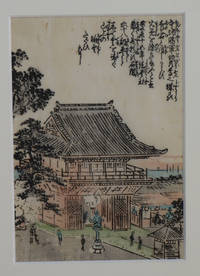
X15<p>HIROSHIGE Ando 1797-1858. Visiting the Temple. Original woodblock from the series "Ehon Edo Miyage" published by Kikuya Kozaburo Volume 3 printed in Japan 1850-68. 295 x 210 mm. This original print is delivered to you in its <strong>unframed</strong> state carefully protected in a solid cardboard tube.</p><p>Utagawa Hiroshige born AndÅ TokutarŠ安藤 徳太郎; 1797 – 12 October 1858 was a Japanese ukiyo-e artist considered the last great master of that tradition.<br />Hiroshige is best known for his horizontal-format landscape series The Fifty-three Stations of the TÅkaidÅ and for his vertical-format landscape series One Hundred Famous Views of Edo. The subjects of his work were atypical of the ukiyo-e genre whose typical focus was on beautiful women popular actors and other scenes of the urban pleasure districts of Japan's Edo period 1603–1868. The popular series Thirty-six Views of Mount Fuji by Hokusai was a strong influence on Hiroshige's choice of subject though Hiroshige's approach was more poetic and ambient than Hokusai's bolder more formal prints. Subtle use of color was essential in Hiroshige's prints often printed with multiple impressions in the same area and with extensive use of bokashi color gradation both of which were rather labor-intensive techniques.<br />For scholars and collectors Hiroshige's death marked the beginning of a rapid decline in the ukiyo-e genre especially in the face of the westernization that followed the Meiji Restoration of 1868. Hiroshige's work came to have a marked influence on western European painting towards the close of the 19th century as a part of the trend in Japonism. Western European artists such as Manet and Monet collected and closely studied Hiroshige's compositions: Vincent van Gogh for instance painted copies of some Hiroshige prints.</p><p>Japanese woodblock prints known as <strong>ukiyo-e</strong> were<br />produced in their many thousands and hugely popular during the Edo period 1615 – 1868 these colourful woodblock prints known as ukiyo-e depicted scenes from everyday Japan. Ukiyo-e literally means 'pictures of the floating world'. The 'floating world' referred to the licensed brothel and theatre districts of Japan's major cities during the Edo period. Inhabited by prostitutes and Kabuki actors Kabuki is a traditional Japanese form of theatre these were the playgrounds of the newly wealthy merchant class. Despite their low status in the strict social hierarchy of the time actors and courtesans became the style icons of their day and their fashions spread to the general population via inexpensive woodblock prints.<br />The ukiyo-e style was developed in 1765 and remained popular until the closing decades of the Meiji period 1868 – 1912. While only the wealthy could afford paintings by the artists of the day ukiyo-e prints were enjoyed by a wide audience because they could be produced quite cheaply and in large numbers.<br />The production process<br />The earliest woodblock prints were simple black and white prints taken from a single block. Sometimes they were coloured by hand but this process was expensive. In the 1740s additional woodblocks were used to print the colours pink and green but it wasn't until 1765 that the technique of using multiple colour woodblocks was perfected. The glorious full-colour prints that resulted were known as nishiki-e or 'brocade pictures'.<br />The team involved in the production of ukiyo-e was known as the 'ukiyo-e quartet'. It comprised the publisher who usually had overall control of the process the designer/artist the block cutter and the printer.<br />The artist would draw the design on paper. Once complete an exact copy was made and placed face-down on a cherry wood block. Cherry wood was favoured due to the fine even grain and consistent density. The block cutter then carved directly through the copy to produce what is known as the 'key-block'.<br />The printer used the key-block to produce a number of black and white prints from which further blocks could be made for each colour needed in the final print. Known as 'key-block proofs' these prints feature registration marks: small rectangles outside the area of the picture. When the colour blocks were carved these marks were used to create stops so that the printer could line up the separate colours precisely.</p>
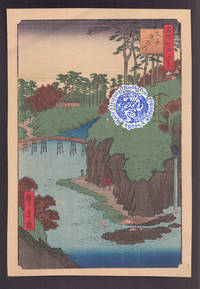
44025601Tokyo n.d. ca 1920's.A color Oban woodblock print sheet: 20.6 x 30 cm. print: 18.4 x 28 cm. multi-colors excellent impression and registry UNUSED old fine exaple reprint. RARE ORIGINAL COLOR WOODBLOCK PRINT . . . MEISHO EDO HYAKKEI: ONE HUNDRED FAMOUS VIEWS OF EDO. . . . A PRINT FROM THE SERIES OF 119 VIEWS . . . A SUPERB VIEW OF TAKINOGAWA IN OJI # 88 IN THE SERIES . . A bright view of the Takinogawa river hills & forests Matsubashi foot bridge cliffs waterfall bathers tea house Kongoji temple & Benten Shinto shrine. All located in Kita Oji north Oji. Edo is the old name of Tokyo. . The red title cartouche in upper right corner reads: MEISHO EDO HYAKKEI HYAKKEI. . Left to that is an orange series title: "Takinogawa in Oji." In block signed inside the red cartouche in lower left corner: "HIROSHIGE GA" i.e. "drawn by Hiroshige." Originally issued in 1856. . The scene is in the colors of autumn the original orange color has turned brownish-black due to oxidation over time. . The series was depicted using major landmarks that appear in the print listed in order of increasing distance from the viewer. . THE ARTIST: UTAGAWA Hiroshige 1797-1858: He was a Japanese Ukiyo-e artist considered the last great master of that tradition. . The orignal series was published from 1856-1858. This being a 20th century high-quality original color woodblock printed reprint edition. No date or publisher's seal as usual. . Color photos are posted to our website. . CONDITION: . The print is in superb UNUSED condition brilliantly colored with superb impression & registry. By and lager about as good as it can get. . Ready for framing and display. . REFERENCE: . See Wikipedia for comprehensive info on Hiroshige and One Hundred Famous Views of Edo. . . unknown
39040901Tokyo circa 1920-30's. Oban color woodblock print a bit dusty artist signature and red seal in block sheet: 36.7 x 24.3 cm print: 23 x 34.8 excellent registry & impression pastel colors print #1 of the series corner mended. . . . A REPRINT OF THE MID-19TH CENTURY FAMOUS SERIES . .TOKAIDO GOJU SAN TSUGI: THE 53 STAGES OF THE TOKAIDO HIGHWA . . PRINT NUMBER 1 THE START OF THE HIGHWAY . . AT NIHON BASHI OLD EDO TOKYO . . A COLOR WOODBLOCK PRINT This is a very good color woodblock reprint of the original series. Colors are in pastels nicely executed with scene title and the artist's signature and red cinnabar Hanko in the lower right corner. . The lively scene is the first stage on the famous THE FIFTY-THREE STAGES OF THE TOKAIDO HIGHWAY the Nihon Bashi bridge. . It shows a large group of all manner of people animals coolies. pilgrims merchants haulers beggars children women and the devout people either coming or going on the Tokaido Eastern Highway. A Lord's procession is just visible at the top of the bride with two large Pompom bearers at the very top. . The busy scene is typical of the Edo period when "Shanks Mare" was the usual method of travel for commoners. . This was one of Hiroshige's most famous series consisting of 55 prints in all covering the 53 stations of the highway. Each day's walk ended at a new 'station' where people rested overnight then proceeded the next day. Usually it took a person 53 days to walk from Edo to Kyoto. . CONDITION: The work is with excellent registry and impression. There is some of the usual minor rubbing to the front and back sides. There is a mend in the upper right corner margin this does not affect the print whatsoever and can be matted out easily. . Otherwise the print is firm and solid ready for matting and display. . Please review photos posted to our website. . NOTE: Color scans are posted to our website. . . unknown
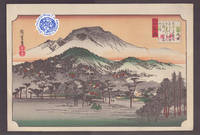
44026301Tokyo n.d. ca. 1920's. Horizontal Oban color woodblock print sheet: 37.4 x 25.5 cm.; print: 35 x 23.5 cm. a very brightcleanUNUSED example pristine registry & impression about as good as it can get. RARE & SUPERB EXAMPLE . . . A STUNNING VIEW OF MIIDERA TEMPLE . . . BUILT IN THE 8TH CENTURY . . . DAWN SEEN AS THE SUN RISES OVER THE MOUNTAINS & VALLEY . Miidera temple was built in the 8th century. Its bell is one of the "Three bells of Japan" . This is a superb view of the sunrise over the tall mountains forest and hidden temple & shrines. . Color photos are posted to our website. . CONDITION: This is a superb example pristine condition stunning impression & registry no issues UNUSED example. Verso likewise clean without issues. About as goos as it can get. . RARE example seldom found if ever even more so in such superb condition. . . unknown
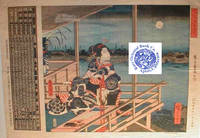
23016901Tokyo 1927 Asahi. Large Kawaraban broadside a Dai-Oban color woodblock print sheet:45.4 x 39.4 cm.;print: 51.6 cm. 3 old folds now flat 4 tiny corner pin holes mendec small scuff to upper left corner else clean solid. RARE EXAPLE . . . MOON-GAZING AT TANABATA FESTIVAL ON THE TAMAGAWA RIVER . . . AUGUST DREAM OF A LOST LOVER . . . A NOSTALGIC VIEW OF THE MOON . . . A JOINT COLLABORATION OF THE TWO MASTER ARTISTS . . . HIROSHIGE DREW THE LANDSCAPE TOYOKUNI DREW THE WOMAN . . . A RARE EXAMPLE THE FIRST ONE WE HAVE SEEN SINCE 1967 ! . This is the Tanabata festival also known as the "Star Festival." It is a Japanese festival originating from the Chinese Qixi Festival. It celebrates the meeting of the deities Orihime and Hikobosh. It is celebrated by lovers longing for their separated partners. . According to legend the Milky Way separates these lovers and they are allowed to meet only once a year on the seventh day of the seventh lunar month of the luni-solar calendar. The date of Tanabata varies by region of the country but the first festivities begin on 7 July. The celebration is observed between July and August. . THE PRINT TITLE: The title is found at the top right of the print in a red cartouche box alas it is unread. However the title most likely would be something like "Otsuki-mi" "Moon Watching". . The work was printed by NIHON MOKUHAN INSATSU in Tabata To yo. . THE RARE DOUBLE-OBAN WOODBLOCK COLOR PRINT FORMAT: . This unusual format Deluxe print size was seldom executed as it was extremely hard to find cherry wood with such wide ad large dimensions. Also such large woodblocks were easily warped and checked rendering prints of poor quality. . This double or Dai-Oban print was probably an insert in the Asahi morning newspaper "KALANDA" "CALENDAR" it has a chart listing all of the year's holidays at the left margin. . The scene is of a typical Edo period Bijin Japanese beauty on a veranda the Tamagawa river wearing a summer cotton Kimono gazing at the moon & stars. She longs for her distant lover. . . Her poetry paper bamboo brush pen & Sumi ink are placed is on her desk awaiting inspiration to write a poem or letter to her lover. There is a blue paper-covered book and another open to double-text as inspiration. . This is an excellent Shin Hanga Deluxe print. Produced in 1927 long after the two artist's death nevertheless a nostalgic look at the fond past and a revisit to the superb art work of two great masters of the Edo epoch. . Color photos are posted to our website. . CONDITION: . This is an original color woodblock printed example from Showa 2nd. year 1927. . It is contained in a modern black mat with a Mylar dust protector. The mat is merely a good protector and has wear to the edges mostly on the lower edge. We leave the print inside the matted folder to keep it flat. . The print has been well-preserved and the three old mild vertical folds have been pressed out and fully opened flat for decades. . It was issued with tree vertical folds ca. 14 x 39 cm. to fit into a newspaper in the distant past. The old mild folds still remain but are now greatly reduced and quite flat. . SHIPPING OPTIONS: . The buyer has two shipping options: a. We refold the print back to its original size which accompanied the Asahi Morning newspaper. It folds down to be ca. 27 x 39.5 cm. . b. We ship it in the mat which is overall ca. 60 x 46 cm. opened flat in its current state therefore additional shipping packing costs will apply. . . unknown
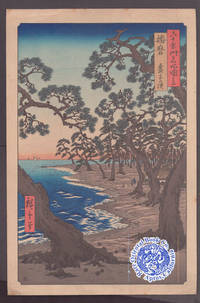
44026201Tokyo n.d. ca 9120's. Vertical color woodblock print in very bright condition superb impression & registry sheet: 25.2x 37.8 cm.; print: 22.4 x 35.5 cm. Watanabe square seal in lower left corner also there is a small bump. RARE . . . STUNNING SUNSET ON THE BAY FROM THE PINE FOREST . . . VIEW OF HARIMA AT MAIKO NO HAMA: MAIKO BEACH . . This is an excellent example. It shows the shore of the bay with the tide coming in. The view is of the sunset three tiny sailing vessels are on the horizon. The view is from the thick pine forest along the shoreline with three people and a teahouse in the mid-ground. A classic view by Japan's master of landscape scenery. . THE SERIES: ROKUJUYOSHU MEISHO ZUE is a series of Ukiyo-e color woodblock prints by the eminent Japanese master landscape artist Hiroshige 1797-1858: . The series consists of a 70 prints of famous views from each of the 68 provinces of Japan plus a print of Edo the capital and a contents page for a total of 70 prints. The prints were first published in serialized form by Koshimuraya Heisuke in 1853-56. . This charming example represents one of the best from that series. It is printed on an oversized large Oban size sheet . Color photos are posted to our website. . THE PUBLISHER: This print was published by Takemura a woodblock printing & publishing house in Tokyo of the period. . CONDITION: In excellent condition superb impression & registry strong colors no fading. Verso blank with two tiny old glassing hinges at top edge. Lower left & right corners mildly bumped now pressed flat very minor impression. . There are two tiny paper defects in the lower margin They are so small that our scanner could not pick them up they can be matted out when framed very minor issue. . . unknown