[BRITISH EAST INDIA COMPANY] - John CANNING (c 1756-1804) and Capt Michael HOGAN (1766-1833)Biblio.com

128 résultats
1796398421796. The archive comprises: 1. Autograph letter signed "John Canning." Bifolium 13 x 8 1/4 inches 21 lines in fine Malay Jawi with Arabic opening formula docketed "Calcutta 10 Dec 1796"; octagonal red-wax armorial seal of the Canning family. Letter requests that local rulers receive Capt. Hogan "as our agent. to conclude a treaty advantageous to both sides" dated 22 Jumada II 1211 / 10 Dec 1796. 2. to 5. 4 Paper wrappers. English addresses in a copperplate hand & parallel Jawi headings each with intact Canning seal. Addressed to the Sultan of Magindanao King of Mempawah Borneo King of Bali Sultan of Borneo. 6. to 8. 3 Yellow-silk diplomatic covers. Golden satin sleeves with paper address bands in two languages; two remain unopened and sealed. Addressed to the Sultan of Johor unopened King of Sumbawa unopened Sultan of Sulu wrapper only. An exceptional archive uniting British Malay and Islamic manuscript traditions that captures the East India Company’s first concerted overtures to the island-states of Southeast Asia.<br/> <br/> Drafted in the wake of the Dutch East India Company's collapse and the French Revolutionary Wars this archive documents the East India Company's first concerted diplomatic overtures to the maritime courts of the Malay world. With Dutch control unraveling after the 1795 Batavian Revolution Britain saw a strategic opportunity to enter the lucrative Spice Island trade. Lacking on-the-ground alliances the Company turned to private initiative: Captain Michael Hogan an Irish-American merchant and former convict transport captain was enlisted as unofficial envoy aboard his ship Marquis Cornwallis. The diplomatic texts were composed by Captain John Goodall Canning then Harbour-Master of the port in refined court Malay using Jawi script the Islamic-inflected lingua franca of diplomacy from Aceh to Sulu. In keeping with regional tradition the letters open with Islamic invocation and florid honorifics followed by carefully phrased expressions of friendship and commercial intent. The surviving autograph letter fixes the date of the mission and declares its purpose: "to plant affection and concord and if Your Highness deem it good to enter with us into a compact benefiting both realms." After disembarking convicts in Port Jackson Sydney in February 1796 the Marquis Cornwallis passed northward through Torres Strait calling at New Guinea the Moluccas and ports across the Java Sea almost certainly delivering these and parallel documents en route. The silk wrappers signal the elevated diplomatic status of the messages which were meant to be presented in person by Hogan and opened only in the presence of the addressee. The present archive offers a rare and vivid glimpse into the hybrid ceremonial linguistic and political world of early modern Southeast Asia and into the improvisational diplomacy of the Company at the edge of empire. unknown
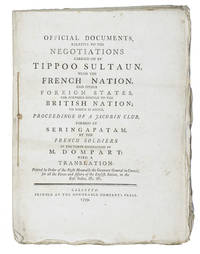
1799ABC_45147Calcutta: Honorable Companys Press 1799. Never bound but side stitched through 3 holes. Super Royal 4to 33.5 x 25 cm. A British propaganda publication printed in Calcutta transcribing secret documents that the British supposedly found in the palace of Seringapatam: primarily Tipu Sultans correspondence with the French considered a betrayal of the British. Tipu Sultan 1750-1799 ruler of the Kingdom of Mysore in southern India took part in a long-standing military feud with the British but made peace with them in 1792. When the French under Napoleon made a push for India in 1798 the British attacked Tipus forces once again starting the Fourth Anglo-Mysore War and eventually killing Tipu Sultan in the attack on Seringapatam. He had a fearsome reputation as the Tiger of Mysore and the present publication attempts to discredit him as a traitor. His supposed affiliation with the French Jacobin Club would have especially concerned British readers. Most of the correspondence between Tipu Sultan the French and their allies including Zaman Shah Durrani ruler of what was to become Afghanistan is printed in parallel columns in English and French. Also included is the text of a letter from Tipu Sultan printed letterpress in Persian in the nastaliq script: 9 lines of type apparently set in the nastaliq type cut under the direction of Charles Wilkins 1749-1836 who served the East India Company in India and became their leading orientalist. It was first used at Calcutta in 1781. The only earlier type for the script that has been clearly documented is thought to have been cut in the 1590s for the Propaganda Fide in Rome who used it around 1633. Neil Benjamin Edmonstone translated the Persian and G.G. Keble the French. Although the book is a true very large quarto point holes along the fold at the head and deckles at the foot and fore-edge the chainlines are vertical though one would not expect sheets this large to be made in double moulds the usual reason for chainlines parallel to the long axis of the sheet.In good condition. Wholly untrimmed and with most bolts unopened and the point holes present.l Shaw Printing in Calcutta 359; Shaw SABREB sab00086; not in Cat. East-India Comp. Honorable Companys Press, unknown
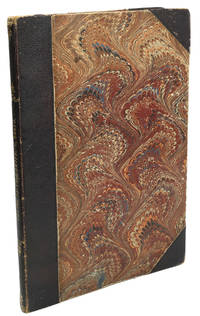
1796ABC_49403Various places including Saudi Arabia and Yemen 1796. Contemporary or slightly later half black morocco marbled boards. Small folio ca. 19 x 30.5 cm. English manuscript on watermarked paper. With a loosely inserted manuscript map titled A Chart shewing the Track of HMS Ship Myrtle of the Bay of Biscay and Portugal and a hand-coloured manuscript signal chart. A detailed description of the voyage of the East India company vessel the Swift from 1794-1795 featuring visits to both Saudi Arabia and Yemen. Twelve pages of observations are dedicated to Jeddah alone witnessed at the height of the influx of pilgrims during the Hajj followed by a description of Mocha also Mokha in Yemen. Other ports visited include those of Brazil South Africa India the Nicobar Islands Malaysia and Sri Lanka.Jeddah the author says "has a very pleasant appearance as you approach it from the sea . The houses are all of stone of the coral kind." However as the Swift had arrived in the midst of the Hajj and its crew found provisions difficult to acquire as thousands of pilgrims poured into Jeddah: "It is astonishing the number of Mahometans arriving from all parts of the world to attend the yearly ceremony at Mecca called Hadgi from thence to Medina." Several accounts are given of particular Muslim practices through occasionally somewhat confused British eyes: "When near Geddah all the Pilgrims going their first journey altered their dress assuming what is called the Ihhram a piece of linnen ! which is wrapped round the loins leaving the rest of the body naked in this state they proceed through the rest of the pilgrimage till they have visited the Kaaba at Mecca; the other garment they are then suffered to wear is a cloth of linen over their shoulders. . Some of them carry a trade of muslins and some other little articles which if they are not robbed by the Bedouins wild Arabs they make out tolerably well . The landing of the pilgrims with their wives and household utensils would have been an excellent view for the inimitable Hogarth."The Swift appears to be one of the ships which accompanied the Suffolk a 64-gun ship to escort a convoy to India under the command of Captain Peter Rainier 1741-1808 later Admiral of the Blue and namesake of Mount Rainier. This particular voyage was in itself notable as a trial for the implementation of a citrus diet for sailors to ward off scurvy which was ultimately successful and became Admiralty policy the following year. On the first page of the account we find the following: "The beer being expended ordered the Company to be served wine mixed with 1oz of sugar and oz of lemon juice to every pint it was very nice tipple."The boards show mild traces of use. With a few small smudges on some of the leaves. Otherwise in excellent condition. hardcover