113 résultats
86443Havana: El Siglo XX. First Edition. hardcover. very good. 9 volumes in one. Very thick 4to 1/2 polished green calf stiff original printed wrappers bound in. Habana: El Siglo XX 1924-1932. Very good .<br/><br/> DIHIGO Y MESTRE Juan Miguel et al.<br/><br/> El Siglo XX unknown books
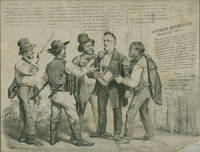
1856WRCAM53452New York: Nathaniel Currier 1856. Broadside 10 x 13 inches. Foxed bottom right corner chipped. Lower margin trimmed costing the title. Good only. Framed under glass. A scarce political cartoon regarding the controversial Ostend Manifesto the initially- secret attempt by the United States to purchase Spanish-controlled Cuba. Earlier President Franklin Pierce had instructed Pierre Soulé upon his appointment as minister to Spain in April 1853 to negotiate to buy Cuba. Three American foreign ministers serving in Europe - James Buchanan John Y. Mason and Soulé - met secretly at Ostend Belgium in late 1854 to draft a plan to either buy Cuba from Spain or force Spain to give up Cuba by inciting a Cuban revolution. The plan met with overwhelming opposition once it was made public in America. <br> <br> In the present political cartoon Buchanan is attacked for his role in the Ostend controversy. He is surrounded by four armed ruffians seeking to rob him of his coat hat watch and money a particularly sharp turn- about on the American minister to Great Britain. The muggers' demands include quotations from the manifesto which is pasted to the fence at right. Buchanan calls out: "Why! Why! This is rank robbery! Help! Help! All honest men!" <br> <br> The fallout from the Ostend controversy was widespread. President Pierce's Democratic Party split asunder after he refused to continue any discussions of the plan or any other expansionist ideas; Soulé understandably resigned; and the international community saw it as a threat to Spanish sovereignty in the region. Oddly enough James Buchanan was not too hurt by the controversy; he was easily elected president in 1856 and still harbored hope for Cuban annexation. He was smart enough however to table the Cuba question for the foreseeable future after meeting with both popular opposition and increasingly bitter sectional conflict the latter only spurred on by incidents such as the Ostend controversy. CURRIER & IVES: CATALOGUE RAISONNÉ 5021. NEVINS & WEITENKAMPF p.72-73. Nathaniel Currier unknown books
18841574Habana 1884. Good plus. 2496 i.e. 498pp. Quarto. Contemporary calf gilt a.e.g.; rebacked with original spine laid down. Corners repaired with later black buckram; boards scuffed spine chipped. Hinges cracked repaired with later cloth and renewed endpapers. Minor scattered foxing and toning to text. Accomplished in a neat highly legible hand. A very attractive manuscript translation into Spanish of Pierre Larousse's well-known work on eminent and historical personages Fleurs Historiques des Dames et des Gens du Monde in a contemporary Cuban gilt goatskin binding. The manuscript connects three figures in the upper social echelons of Cuban society. José Fernandez Pellon the scribe of this volume is recorded as the Grand Master of Cuba's freemasons lodge the Gran Logia Unida de Colón y la Isla de Cuba. The translator Aurelio Almeida helped to found the organization in 1875 and at this time served as the Lodge Secretary. The initials E.D. gilt at the foot of the spine and the dedicatory inscription "A Eugenia Desvernine" refer to Eugenia Desvernine y Galdós b. 1865 daughter of the famous Cuban pianist Pablo Desvernine and Carolina Galdós y Echániz. She was also the niece of Benito Pérez Galdós the Spanish realist novelist who some authorities consider only second in stature to Cervantes. A contemporary social register remarks that Eugenia was one of the most beautiful women in Cuba perhaps an inspiration for the painstaking production of this manuscript. The original work by Larousse was a loose collection of religious parables classical myths biographies of ancient and modern historical figures. The title of the manuscript advises that is an extract and in the brief introduction Almeida explains his selection process writing that "He suprimido algunos artÃculos sobre cosas muy sabidas de la historia sagrada; y otros sobre la de Francia que mencionan frases ó personas casi ninca citadas ó citades solamente por las escritores francesas." He also notes several alterations and additions more relevant to Spanish history saying "En Cambio he agregado algunos artÃculos sobre historia de España que no están en el original y he tomado unos pocos de otra obra del mismo Mr. Larousse y de libros diversos." The result is an original amalgam of biographies historical episodes and religious parables. Interestingly we find no recorded printed editions of Larousse's work in Spanish so that the present manuscript is also an entirely original work of translation. A fascinating product of the cultural interests and mores of Cuban high society near the end of the Spanish colonial period. unknown books
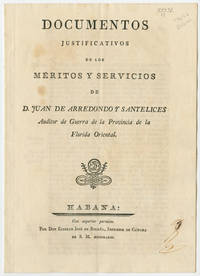
1815WRCAM49642Havana: Esteban José de Boloña 1815. 19pp. Gathered signatures stitched. Stitching mostly perished. Light fold lines minimal foxing ink marginal notations contemporary ink inscription after the text. Very good. An early Cuban imprint printed by Esteban José de Boloña the first printer in Cuba after the 1776 ban on printing. Juan de Arrondo y Santilices was an official in Spanish Florida the Auditor of War of East Florida during the early 19th century. This is a work detailing the deeds of Arrondo y Santilices likely an attempt to secure a pension. Rare with one copy located by OCLC at the John Carter Brown Library. Esteban José de Boloña unknown books
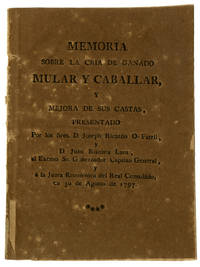
1799WRCAM51487Havana: Imprenta de la CapitanÃÂa 1799. 212pp. Dbd. Loose sheets. Heavily tanned outer leaves slightly chipped. Good. A short tract on equine husbandry with its own titlepage but published as a part of a royal decree entitled "Gracia concedida por S.M. àlos habitantes de esta isla para la introduccion de caballos frisones de ambos sexôs desde las provincias del Norte de América" which approved the importation of horses to Cuba. Initially presented to government officials in 1797 the report by Joseph Ricardo O'Farril and Juan Bautista Lanz laments poor breeding practices in Cuba that have led to weaknesses in the horse stock and recommends the introduction of North American horses and different breeding methods. Until the suggestions of this work were implemented by the decree in 1798 horses were not allowed to be imported from other sources in greater numbers than they were from Spain. According to Trelles this is the first Cuban imprint to address issues related to livestock and animal husbandry. Very rare with OCLC recording only five copies. SABIN 56747. MEDINA HABANA 162. TRELLES pp.177-78. OCLC 19860506. Imprenta de la CapitanÃÂa unknown books
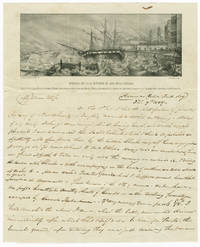
1847WRCAM56260Havana Cuba and onboard ship to New Orleans 1847. 11pp. in black or blue ink on two different Cuban pictorial letter sheets plus a folded sheet of plain paper the latter also used as the enclosure for the entire letter addressed on verso of last page of enclosure. Minor soiling old folds with a few short fold separations and a longer separation in last folded sheet. Last sheet with small abrasion from removed wax seal most of which remains. Overall good plus condition. A lengthy and interesting letter from a Pennsylvania businessman named M.L. Dawson to his "dear wife" back in Philadelphia written over the course of a few weeks during his time in Havana and onboard a ship traveling from Cuba to New Orleans in the spring of 1847. Being written over the course of several entries the letter also acts as a kind of brief diary of Dawson's time in Cuba and the Gulf of Mexico and contains much information on the people and places he saw in and around Havana and much on the ship's activities on the way to Louisiana. Two- thirds of the letter is written on two separate Cuban letter sheets that are themselves rare and desirable printed ephemeral items from mid-19th century Cuba. <br> <br> The eleven-page letter covers Dawson's stay in Havana and his voyage to New Orleans. He writes that he had previously arrived in Havana from Philadelphia. His letter begins on March 7 and Dawson details trips on horseback to the Cuban countryside which he finds beautiful. He comments on odd Cuban funerary practices Cuban agricultural products seeing the home where Santa Anna spent his exile and gives firsthand observations on the effects of slavery. He witnesses a scene in Havana where slaves are chained and forced to make repairs while being overseen by men with whips and muskets. Dawson comments that despite the beauty of the countryside "the evidence of Slavery is every where apparent." Also apparent are "the ravages of the awful storm of the 10th month last" a reference to the devastating October 11 1846 hurricane the effect of which is depicted in each of the letter sheets here. Dawson also reports on being invited to breakfast by a Cuban nobleman but was so taken aback by the food and the experience that he vows never to repeat the experience. <br> <br> After departing Havana for New Orleans on May 9 on the Brig P. Soule Dawson reports on various shipboard activities a disagreeable cursing captain slow progress boredom and seasickness. He comments on claret as the typical drink for breakfast. The letter ends on April 1 when Dawson's ship anchors in New Orleans Road. He closes with a promise to write again soon after he lands in New Orleans and sends kisses and love to his children and relatives. <br> <br> The Cuban letter sheets Dawson employs for more than two-thirds of his letter are interesting and attractive printed items in their own right. The first titled HURACAN DEL 11 DE OCTUBRE DE 1846 EN LA HABANA shows a lithographed scene of various ships in an angry sea being tossed against a breakwater in Havana harbor during the October 11 1846 hurricane. One passenger is being rescued with a breeches buoy while other ships flounder in the distance. The second letter sheet is titled TEATRO PRINCIPAL DE LA HABANA. The scene at the head of this sheet shows further destruction of the October 11 hurricane centered on the damaged ruins of the Teatro Principal Main Theater near the harbor. Two men in top hats survey the damage while an African-American man stands at left center holding long boards. Havana harbor is visible in the background showing two paddlewheel steamers and other ships damaged or sunken in the harbor. <br> <br> Mordecai L. Dawson was the proprietor of M.L. Dawson & Co. a brewery in Philadelphia. Here Dawson addresses the letter to his company noting the letter is specifically intended "for E Dawson" his wife. The Dawson brewery opened in 1820 at 79 Chestnut Street then moved to the corner of 10th and Filbert Streets in 1830 after the company purchased the old Farmers' Brewery in 1829. Dawson apparently closed his brewery in 1849 not long after penning this letter home. Though he does not state it explicitly in his letter Dawson may have been traveling to Cuba to establish an import business. Philadelphia was a pipeline for numerous imports into Cuba in the mid-19th century including beer. <br> <br> An interesting record of one man's sojourn to Cuba in the 1840s with notable observations on slavery and the Cuban situation in the wake of the October 11 1846 hurricane written mostly on two attractive and rare Cuban letter sheets that also memorialize the hurricane. hardcover books
18842025Matanzas 1884. Still very good. 3 leaves plus 4pp. pamphlet in original plain wrappers string tied. Light wear at edges. A few very small worm holes. Contemporary ink stamps. Light tanning and foxing. The Spanish Cortes approved a gradual manumission law in 1880 for slaves in Cuba that provided for an eight-year period of patronato tutelage for all slaves liberated according to the law which essentially amounted to indentured servitude. The transition to the patronato system was overseen by a provincial network of government agencies called Juntas de Patronato. Most of the workings of the slave system were preserved but patrocinados as former slaves came to be known received a minimal set of legal rights and were to be paid a token wage. <br/><br/>This fascinating set of Cuban manumission documents from the Junta de Patronato of Matanzas records this process and contains a rare cedula de patrocinado an identification booklet stating a slave is now a freedman with a supporting sponsor. The cedula completed in manuscript states that "Moreno Luis Morejon Natural de Africa.Vecino del Potrero Miraflores.Patrocinado de Da Josefa Morejon de Rodriguez" is "Gratis Sin Enmienda" as of September 15 1881. The second leaf of the pamphlet prints the rights of the freedman and the responsibilities of the sponsor such as the provision of food clothing and nominal salary. <br/><br/>The second document present here is a contemporaneous manuscript letter from Josefa Morejon de Rodriguez confirming that she will act as sponsor for the freedman and the final document dated January 28 1884 and signed by Rodriguez and the relevant local magistrates states that the sponsorship has been completed and is now legally concluded. With the ink stamp of the Matanzas Junta Provincial on first page and the contemporary stamps of several other relevant authorities. An outstanding record of the process of gradual manumission in Cuba during the last years of legal slavery on the island with a rare surviving freedman's identification book. unknown books
1865974Santiago de Cuba 1865. Very good. 10 leaves. Removed from a larger volume and restitched. Minor wear and one small area of worming at edges. Light tanning and foxing. Accomplished in several legible hands. A fantastic set of manuscript records for a slave auction house the General Slave Depository in Santiago de Cuba dating to January 1865. Santiago along with Havana and Cienfuegos was one of three major sites for slave sales on the island during the 19th century. The first leaf of the document provides a statement that the documents were assembled in accordance with the rules established for slave auctions which had been updated and approved at the end of the previous year. The second two documents lay out mortgage agreements and financial obligations between the slave house and the Real Sociedad Economica de Amigos de Pais of the city in which the auction owners acknowledge debts and forthcoming payments on the order of several thousand pesos. Following these are two leaves containing a "Relacion de los esclavos ecsistentes en el deposito de esta Ciudad en el dia de la fecha" that is a list of slaves at the depository on the day of the auction and their owners and renters which perhaps were a part of the collateral for securing the loan. A total of twenty-nine slaves are listed and the leaf that follows certifies that the list is correct according the to the director and the auctioneer of the depository. The final two leaves provide official recognition of the loan from two distinct government offices. All documents are signed by the relevant parties and government officials involved in the agreement. In all the present group of documents provides a detailed assessment of debts and human assets of the slave auction house in Santiago de Cuba in the mid-1860s and is a fascinating and valuable document of the bureaucracy and regulation surrounding the financial realities of selling slaves in Cuba during this period. unknown books
1864981Havana: Viuda de Barcina y Comp 1864. Good. Twenty-three issues each approximately 32pp. No. 11 with folding chart lacks pp.25-32. No. 13 lacking last few leaves. With title page and half title at start of each volume. Original quarter calf and boards spine gilt. Spine ends chipped and worn some crude glue residue; hinges solid. Boards heavily worn. Light toning and wear to text light scattered worming throughout. A rare run of the first two years of the first Cuban pharmacological magazine and one of the island's earliest medical periodicals. La Emulacion was published from 1863 through 1867 with the present sammelband containing all issues published in 1863 and 1864 a total of twenty-three issues. Their mission statement that heads the first issue here reads in part: "Animados del deseo de ser útiles al pais -- en cuanto nuestras fuerzas lo permitan-- hemos resuelto dar à luz en esta ciudad un periódico que ocupándose preferentemente de todo lo relativo à la Farmacia no descuide por eso la quÃmica é historia natural médicas y la toxicologÃa ciencias de que no pueden prescindir ni los Médicos ni los Farmacéuticos y cuya importancia en el dia pocos podrán desconocer. Procurarémos pues que en nuestro periódico hallen cabida las producciones originales de los que en Cuba cultivan la Farmacia la quÃmica é historia natural médicas y la toxicologÃa; mas no olvidarémos por eso que léjos de nuestro suelo existen los mas célebres y laboriosos de los cultivadores de esas ciencias y que La Emulacion no llenarÃa la mision que nos proponemos si no hiciéramos figurar en ella lo que se dé à luz en Europa y merezca la sancion de las personas ilustradas." The resulting publication contains numerous original articles by Cuban pharmacists doctors and scientists as well as important work published outside of Cuba. Additionally the issues include biographies of significant figures in the field accounts of local scientific societies including the Real Academica de Ciencias de la Habana and publication of new pharmacological formulas discovered in Cuba or "adapted for the needs of the country." As a result the periodical forms an important record of medical and pharmacological developments and thought on the island in the mid-19th century. We locate only one run of this pioneering periodical at the National Library of Cuba with only the present set of issues appearing in auction records. Bound between Volumes I and II is a pamphlet by Fernando Paez "Manual de farmacia practica" Havana 1864 possibly incomplete at 8 pages; no examples of this pamphlet appear in OCLC. Viuda de Barcina y Comp unknown books
20189560San Francisco CA: Cuba 2018. Unique. Hardcover. Fine. Minor edge wear else tight bright and unmarred. Loosely bound sheets. 8vo. np. Illus. colored plates. Unique copy. Signed by the artist. <br/><br/>Acrylic paint marker drawings on paper. Artist' shop-book used to test/design work and color schemes. A unique books of acrylic paint marker drawings of graffiti murals most of which have been executed on walls throughout the San Francisco Bay area from 2009– 2012. <br />This is an amazingly beautiful example of urban art and valuable primary research materials for African American studies calligraphy type design urban studies art history and visual art. This an unusual work as he seldom does 'women' focused typically on more political issues. Here he blends women and politics with style and flare. Also unusually he includes a small self portrait. <br />Cuba is one of the grandfathers of the San Francisco Mission School supplying both the aesthetic styles and the radical leftist politics that formed what may be the only coherent new school of American art since the Punk/graf rock art scene of the 1980s. “It was a lot of punk rock shows and stuff like that. There was always graffiti in these places and I was just like "Who is this guy I keep on seeing this guy." There was this one guy Cuba he wrote "Cuba" and it was at all the same hardcore shows in the bathroom on the door and on the street. And then I was like "What who's doing this" It was different than my idea of what graffiti was before that.” - Barry McGee in PBS’s Art of this Century 2005 <br />"We want to flex our skills and make the community look better" says the 41-year-old painter known as Cuba who has been working on walls with and without permission for more than 25 years. "It's our own form of urban renewal." -San Francisco Chronicle Monday March 7 2005 Cuba hardcover books
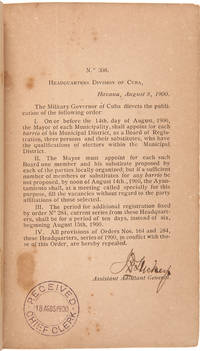
1900WRCAM51843Havana 1900. Approximately 520; 600pp. including several folding charts. Over 200 separate imprints. Original half leather and brown cloth boards spine gilt. Corners and edges worn spine rubbed boards scuffed. Initial leaves of first volume torn away but present. Several other leaves chipped and torn throughout. With many official signatures and docketing stamps. Good. Two volumes of orders promulgated in 1889 and 1900 by the American military government of Cuba after the cessation of hostilities in the Spanish-American War. Under the terms of the Teller Amendment to the Congressional Joint Resolution for war with Spain in 1898 the United States denied the intention of using the conflict as a pretext for the annexation of Cuba and promised to leave the island following the termination of the war. The American military therefore oversaw the creation of the new independent Cuban government before departing in 1902. The documents contained in this collection consist of over two hundred orders in both English and Spanish from the Headquarters Division of Cuba that helped to shape the emerging civilian government. They include instructions for the running of elections the organization of the courts and school system the appointments for various government offices provisions for tax regulations and many other critical issues facing Cuba at its independence. The directives cover two periods from January to July in 1899 and from July to September in 1901. Many of the orders are signed in manuscript by the assistants to the military governor for the island Gen. Leonard Wood including assistant adjutant generals J.B. Hickey and L.W.V. Kennon and Brig. Gen. Chief of Staff Adna R. Chaffee. An interesting documentation of the first American occupation of Cuba. hardcover books
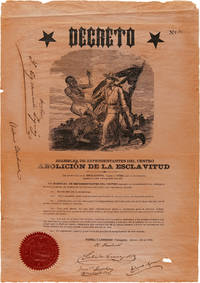
1869WRCAM56566Camagüey Cuba 1869. Pictorial letterpress broadside 18 1/2 x 13 inches. Numbered "54" in manuscript bearing the embossed red seal of the Republica Cubana and signed in ink by Salvador Cisneros y Betancourt Eduardo Agramonte Ignacio Agramonte Loyn áz Francisco Sánchez y Betancourt and Antonio Zambrana. Old horizontal folds minor creasing handful of small edge chips. Small hole in bottom margin just touching one ink signature. Very good condition. A rare and significant pictorial Cuban decree from the provisional rebel government abolishing slavery on the part of the island they controlled issued by the radical faction of the Cuban nationalists fighting against Spanish rule in the first months of the Ten Years' War. <br> <br> This proclamation is illustrated with a dramatic woodcut signed "LFR" depicting an ill-clad but exultant freed slave and a rebel celebrating in front of the Cuban flag. This decree stipulated freedom for all the enslaved people of Cuba in hopes that they would join the revolutionary struggle. The decree also provided for eventual compensation to slaveholders and ordered that freed individuals must serve the revolution either through military service or by continuing with their previous work. Among the important leaders who signed the present document were Salvador Cisneros y Betancourt as president just below the printed text and Ignacio Agramonte y Loynáz as secretary to the left of the engraving. <br> <br> The practical effect of this decree was modest as the rebels only controlled limited territory before their ultimate defeat and their territory was generally under the control of more conservative military commanders but such a proclamation joined a growing chorus of abolitionist sentiment in Cuba which finally realized the end of slavery in 1886. A powerful statement of anti-slavery policy in mid-19th century Cuba with a striking illustration of a jubilant slave celebrating his short-lived freedom. Rare with no copies recorded in OCLC. unknown books
1875WRCAM56107Cuba 1875. Twenty-two partially-printed forms on folio sheets completed in manuscript in a variety of hands. Most printed and accomplished on the recto only though a few with print or manuscript on the verso as well. Some with old folds chipping and small tears to edges of most documents one document with the upper right corner cut away. Occasional foxing tanning and ink offsetting and bleedthrough. Several documents with additional manuscript annotations. About very good overall. An important collection of contracts documenting Chinese indentured servitude in Cuba two signed in Chinese. All but one are from various municipalities in the Matanzas Province usually attested to with an ink or blind stamp from a local official one with paper tax stamps affixed. Each contract stipulates the term of service for the "colono" - one or two years along with wages to be paid food and clothing issued duties and hours to be worked and so forth. The laborers are identified in the contracts by their assigned Spanish names with no surnames though some forms have a section for their "nombre nacional" and place of origin as well. There are provisions for what happens if the servant cannot complete their term of service due to illness pending agreement with the "patrono" and a section on options for contract renewal. The latest of these contracts dated May 24 1875 bears the laborer's signature in Chinese. He is described as "al asiatico José" aged 30 of Macao and is contracted to work for Ignacio de Cardenas for six years. Another contract from Bejucal in the Mayabeque Province is also signed in Chinese this one by "Antonio" "natural del pueblo de Leo Chao en China." This is also the only document in the collection with a signature area labeled: "Firma del interpréte ó de dos personas de confianza del colono ó dos testigos." <br> <br> Formal slavery continued in Cuba until it was abolished by Spanish royal decree in 1886; it was accompanied however by a significant population working in indentured servitude. As sugar exports rose in the mid to late 18th century there was a dramatic increase in the need for enslaved workers. "One of the explicit goals of Spanish reformist policy in the last third of the eighteenth century became the need to emulate other European nations' success with slave plantation development in the Caribbean. Partly because of this slave-based coffee and sugar estates sprang up in increasing numbers in portions of Cuba especially around Havana Santo Domingo and Puerto Rico. An expanded slave trade was a necessary condition of such growth. In Cuba alone approximately seventy thousand slaves were imported between 1763 and 1792 and another three hundred twenty-five thousand were brought in between 1790 and 1820.For the entire nineteenth century imports to Cuba amounted to about seven hundred thousand persons." - Drescher. <br> <br> The abolition of slavery in the British West Indies however meant that from the 1830s onward a new source of labor was necessary. It is this gap that indentured servitude filled. Unlike the earlier waves of European immigrants who travelled to the New World as indentured servants Asia was now the primary source. Between 1848 and 1874 125000 Chinese indentured servants arrived in Cuba alone - a figure outstripped only by the number who indentured themselves in California. "Some contemporaries and later historians.have condemned the servitude of the Asians as a thinly disguised revival of slavery. These critics have pointed to a variety of abuses to which the Asians were subjected both legally - with severe laws governing absenteeism vagrancy and insufficient work - and illegally in the form of harassment by vicious masters. Yet other observers have defended the system as a boon to the Asian workers. Voluntary reindenture at the end of their terms was common among the migrants suggesting that many Asians judged the system to be beneficial to them" - Drescher. <br> <br> Voluntary or not a large number of Chinese migrants were laboring in Cuba in the 19th century; for most of them these contracts are the only existing records of their work if not of their lives. Seymour Drescher & Stanley L. Engerman editors A HISTORICAL GUIDE TO WORLD SLAVERY New York 1998 pp.140-42 239-42. hardcover books