113 résultats
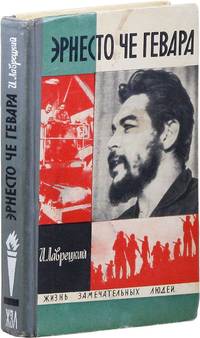
197232549Moscow 1972. First Edition. Octavo. Cloth-backed pictorial paper-covered boards; 348 3pp; portraits plates. Slight external rubbing and shelfwear; corners nudged; still a solid Very Good copy. Apparently the first full-length Soviet biography of the Argentinian revolutionary martyr and hero of the Cuban Revolution well-illustrated with photographic portraits and plates. <br/><br/>According to Costa Rican investigative journalist Marjorie Ross "Lavretsky" was a pseudonym for Soviet master-spy Iosif Grigulevich who got his start as a hired hit-man against Trotskyist and Anarchist factions in the Spanish Civil War. She pegs him as the never-identied "third man" in the assassination of Leon Trotsky; and during the Cold War posing as an international coffee expert Grigulevich reputedly penetrated the highest levels of government and culture in Costa Rica Chile and Mexico during which time he was also the Kremlin's "handler" for Chilean poet Pablo Neruda and Mexican painter José Siqueiros see Marjorie Ross El secreto encanto de la KGB/ The Secret Charm of the KGB: Las cinco vidas de Iosif Grigulievich/ The Five Lives of Iosif Grigulevich. San José: 2006. <br/><br/>Apparently an uncommon work at least in Western institutions; OCLC locates just one copy British Library; KVK and European Library Meta Catalog find three more Nat. Lib. Lithuania; BNF; Staatsbibliothek Berlin. unknown books
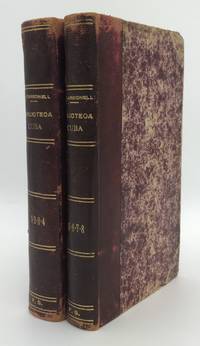
19161505Havana 1916. Good plus. Eight parts in two volumes. Original half calf and marbled boards spine gilt. Calf scuffed at spine ends; light wear to corners and edges; boards rubbed. Rear board with a dime-sized chip at lower fore-edge. Slightly later pencil ownership inscriptions to initial title pages of each volume. Small chip at fore-edge of first title page. Light tanning. The first eight issues of this scarce Cuban literary periodical which published twice monthly during 1916. The editor of the series Nestor Carbonell y Rivera grew up in the United States before returning to Cuba and obtaining his doctorate from the University of Havana; he was active in several prominent intellectual and literary society of Cuba and later served as ambassador to Argentina and Peru. Each issue of the periodical comprises one previously unpublished work by Cuban author including José Martà Manuel Sanguily and Máximo Gómez. We locate runs of the series at seven institutions as well as scattered holdings of individual issues. This set clearly bound by a contemporary Cuban subscriber one F. Gamboa. unknown books
1996148583Culver City CA: TriStar 1996. Shooting Script for the 1997 film. SIGNED on the title page by director-screenwriter James L. Brooks.<br/><br/>A misanthropic novelist uses sarcasm and animosity to mask his extreme obsessive-compulsive disorder but finds his highly regimented world begins to unravel when he is forced to dog-sit for his neighbor following a violent robbery. Nominated for seven Academy Awards and winning two for Best Actor and Best Actress for Jack Nicholson and Helen Hunt respectively.<br/><br/>Set in New York City and Baltimore shot on location in New York New Jersey and California.<br/><br/>Navy generic Tri-Star Pictures wrappers. Title page present dated 7/29/96 noted as Shooting Script with credits for screenwriters James L. Brooks and Mark Andrus. 164 leaves with last page of text numbered 136. Xerographic duplication with white revision pages throughout dated variously between 9-24-96 and 6-12-97. Pages Near Fine wrapper Near Fine bound internally with two gold brads. TriStar unknown books
18732024Cuba 1873. About very good. 3 folio leaves. Light wear at edges a couple of small chips at lower left edge of each leaf. Light tanning and foxing. Accomplished in a neat legible script. Scarce manuscript listing of slaves and indentured servants from a Cuban sugar plantation. The present list was made in January 1873 on the Ingenio Tartesio east of Havana near the small village of Las Pozas. On two separate sheets nine Chinese and twenty-eight African or Criollo men are listed as rented to the farm; on a third sheet eighteen slave births for 1873 and 1874 are recorded giving names mothers and dates of birth. The Chinese men are identified simply by first name and owner; the African and other slaves are listed with additional details such as nationality age owner. A section for additional observations notes which slaves have run away and at least one death. A fascinating document of slave hires on an isolated Cuban plantation during the 1870s. unknown books
18772027Havana 1877. Very good. 1p. on a bifolium. Removed from a a bound volume with unobtrusive stabholes at gutter margin. Light wear at edges; light dust soiling and damp staining. Remarkable bidsheet submitted by a Cuban business in response to a newspaper advertisement for an auction of slaves for hire held in Havana during November 1877. The firm Jado Sarasúa y Compañia writes that "Enterada del anuncio publicado en la Gaceta fecha 9 del corriente para el arrendamineto en publica subasta de los esclavos existentes en el Asilo de San Jose pertenecientesa Bienes Embargados y sujentadose en un todo al pliego de Condiciones inserto en la misma Gaceta hace la siguente proposicion." Below is a list of fourteen slaves mostly women and the prices that the company is willing to offer for the slaves being rented ranging from ten to seventeen pesos per month. Signed and dated at the bottom "Habana Noviembre 14 de 1877. unknown books
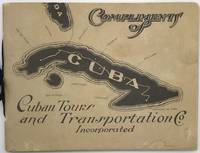
19281489Havana 1928. Very good. 60pp. Oblong 12mo. Original printed pictorial wrappers stapled and tied with ribbon. Minor wear and soiling contemporary ink stamp on rear cover. Internally clean. A handsome promotional booklet for the island of Cuba provided by the Cuban Tours and Transportation Company and extensively illustrated. After the opening leaf of text each page features a full-page photographic half-tone illustration with caption highlighting tourism spots and attractions on the island. These include an aerial view of the capitol which includes a biplane flying at camera-level; the Malecon driveway; a view of Paseo de Marti; San Francisco Machina and the Santa Clara wharves; countryside scenes depicting sugar production and agriculture; a view of the jockey club and grand stands at Oriental Park; street scenes and more. Leading hotels in Havana are shown on the last few leaves. A wonderful illustrated souvenir guide. No copies located in OCLC. unknown books
185487325Havana: Imprenta de la Real Audiencia Pretorial por S.M. 1854. First Edition. hardcover. very good. 3 folding tables. 2 vols. in one. 8vo 1/2 contemporary black morocco; tear in a table with no loss of text. Habana: Imprenta de la Real Audiencia Pretorial por S.M. 1847 1854. Very good .<br/><br/> Imprenta de la Real Audiencia Pretorial por S.M. unknown books
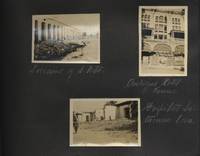
193250120Santiago de Cuba 1932. A unique album of 19 leaves of heavy black stock 7 x 5 1/2 inches with 67 mounted b&w silver photographs of varying sizes 1 3/4 x 2 1/2 inches - 3 1/2 x 5 7/8 inches all captioned in white ink. The album is titled and decorated in gilt on the upper cover "PHOTOGRAPHS: SOUVENIR OF SANTIAGO CUBA and tied with a cloth lace. Very good. An earthquake of 6.7 magnitude struck the city of Santiago de Cuba at dawn on 3 February 1932. Over half the buildings were destroyed or damaged and reports of the deaths range to 1500. These photographs show the destruction to the commercial and residential buildings and the Cathedral and the tents set up as temporary shelters. A few of the photographs were made by local commercial photographers just after the quake and the remainder within days. All captions in Spanish. <br/><br/> hardcover books
1910WRCAM55308Havana: American Photo Co. 1910. Panoramic photograph image 7 1/4 x 47 1/4 inches on sheet 10 x 49 inches. Printed caption title below image. Publisher and date written in negative at lower right corner; in the lower left corner is written: "#5 2d Regiment U.S. Atlantic Fleet Deer Point Camp Guantanamo Bay Feb. 13 1910. 'Minnesota' 'New Hampshire' 'Mississippi' 'Idaho.'" "Printed in Germany" printed below image at lower left. Some light soiling minor fading to right side of photo some rumpling from previous rolling. Very good. An impressive view of sailors and marines from the United States' Atlantic Fleet assembled on the parade grounds of Deer Point Camp Guantanamo Bay. Well over five hundred officers seamen and marines are in formation with encampments on both sides of the grounds. In the background looking out into the harbor nineteen ships are visible in the water including the four listed on the photo: MINNESOTA NEW HAMPSHIRE MISSISSIPPI and IDAHO. One camp building with a wide veranda is behind and to the left of the sailors. <br> <br> U.S. forces with their Cuban allies first occupied Guantanamo Bay in 1898 during the Spanish American War creating a forward- operating base in their effort to wrest Spanish control of the island. In 1903 the U.S. leased forty-five square miles of land and water at Guantanamo Bay from the newly- independent Cuban government and built the Deer Point Camp to support naval operations in the Caribbean. The American facilities at Guantanamo Bay are in use to this day. The American Photo Company advertised itself as "the best equipped commercial photographers in Cuba." It established a commercial network in Havana that distributed images of Cuba on a worldwide scale. <br> <br> This photo is rare. We found no records of it at auction and no copies in OCLC however the Naval History and Heritage Command lists a copy in their collections. "US Naval Station Guantanamo Bay Cuba" UA 571.45 copy of this image Washington Navy Yard D.C.: Naval History and Heritage Command Naval Heritage Foundation accessed online. American Photo Co. unknown books
1894106465<p>1894. Pamphlet format 70 pp. Illustrations; map. 14.3x11.8 cm 5½x4½" pictorial wrappers. Some light staining and wear to wrappers spine a little worn very good overall. Rare tourists' guide book produced under the auspices of the Grand Hotel Macotte with much on Havana transportation options sights to see including bull fights prices a Spanish vocabulary etc. with numerous advertisements for Cuban and some Florida businesses and other hotels. One advertisement features cigar maker La Corona. They even include an illustration of Christopher Columbus. OCLC/WorldCat lists only one copy at the California State Library Sutro Branch. </p><p><br /></p> J. Carbonell and P. Montero, Proprietors. books
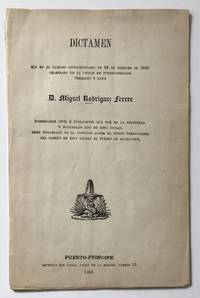
18611229Puerto-Principe: Imprenta del Fanal 1861. Good. 17pp. Leaves loose. Light wear one ink correction to text. A rare Cuban work printed outside of Havana outlining the necessity of a railroad between Puerto-Principe modern Camaguey and Santa Cruz. The many benefits of the plan are detailed herein with numerous charts. Miguel Rodriguez Ferrer 1815-1889 was a Spanish author and administrator but is best known for his work on the nature and culture of Cuba particularly his "Naturaleza y Civilizacion de la Grandiosa Isla de Cuba." He served in a number of civil administrator positions including mayor of San Antonio de los Baños and advisor to Puerto Principe. We locate a single copy at the National Library of Spain. Imprenta del Fanal unknown books
38527Washington: Government Printing Office n. d. 1st edition presumed. ca. 1901. Black leather boards gilt stamped lettering to spine. Boards stamped in blind. Glossy marbled endpapers. All boards and spines rubbed chipped and soiled. Vol IX missing boards and spine Vol XI & I boards and spine detached from textblock Vol II boards & spine detaching. Spines and hinges loose. A few leaves and 2 unfolding maps detached soiled or chipped library "Property of Michigan Commandery Loyal Legion" blue stamping throughout volumes. A Good set. Individual volumes divers paginations within each volume. Many inserted plates of b/w images fold-out maps and charts / tables & portraits housed within all volumes. 9-5/8" x 7" <br/><br/>OCLC records 7 institutional holdings of this set. Contents as stated in front pages of Vol. I: Vol I: Personal Report of General Wood Report of Lieutenant McCoy Aide-de-Camp Financial Exhibits accompanying same. Vol II: Civil Orders and Circulars issued during 1900. Vol III: Report of the Secretary of State and Government Reports of the various Civil Governors. Vol IV: Report of the Chief Sanitary Officer Report of the Chief Surgeon of the Department Report ofthe Superintendent Department of Charities. Vol V: Report of the Secretary of Finance Report of the Treasurer of Cuba Report of the Auditor for Cuba Report of the Chief of Customs Service Report of the Director General of Posts. Vol IX: Report of the Secretary of Public Works. Vol X: Report of the Secretary of Public Works continued Report of the Special Commissioner of Railroads Report of the Chief of the Light-House Board Report of the Captain of the Port Havana. Vol XI: Report of the Chief Engineer for the Fiscal Year ending June 30 1900. Vol XII: Report of the Chief Engineer for the six months ending Dec. 31 1900. Wood born on October 9 1860 in Winchester New Hampshire graduated Harvard Medical School in 1884. After working in private practice in Boston for two years he secured a job as army assistant surgeon with the rank of first lieutenant in January 1886. Routine successes and close relationships with political giants Wood formed a close friendship with Theodore Roosevelt and helped Roosevelt organize the 1st Volunteer Calvary Regiment for service in the Spanish-American War in May 1898 allowed for a quick advancement in his military service which eventually aroused some controversy. "Promoted to brigadier general and in December of that year he was promoted again to major general of volunteers and named military governor of Cuba. During his term in that post great strides were taken in improving internal conditions notably through the sanitation work of Maj. William C. Gorgas. Modern school police transportation and communications systems were established and a new constitution and body of laws were drawn up." Webster's American Military Biographies p. 488. In May of 1902 Wood stepped down from his executive position in order for the popularly elected President Tomas Estrada Palma to take over. "Aggressive ambitious and self-righteous Wood was not an easy man to work with; his change from medical doctor to fighting soldier and his rise from captain to brigadier general in the space of five years 1898-1903 aroused considerable distrust and hostility in and out of the army. his single-inded advocacy of the Plattsburgh Idea later to resurface as the ROTC contributed greatly to US readiness in World War I; unquestionably one of the greatest U.S. soldiers." -The Harper Encyclopedia of Military Biography p.807. (Government Printing Office) hardcover books
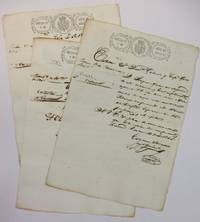
184537320Havana 1845. Each document 8-1/2" x 12-1/2" entirely in ink manuscript with decorative official printed ornamentation at head of each and signature "O'Donnell" in the left margins. Some toning and a few holes not affecting text. Good. <br/><br/> Leopoldo O'Donnell y Jorris 1st Duke of Tetuán 1809-1867 was a Spaniard of Irish ancestry from Tenerife. He went to Cuba as Captain General in 1843 and later served three separate stints as prime minister of Spain. He approved each of these requests for travel. The named Cuban Slaves are of "Lucumi" ancestry originally from the Yoruba tribes of Benin and Nigeria. The documents all dated in October 1845 refer to the slaves Joaquin Garcia de Angarica and Florentino Armenteroy Regidor.<br/> These requests were made to transfer the slave from one hacienda to another for work purposes the terms of work engagement frequently stated here. unknown books
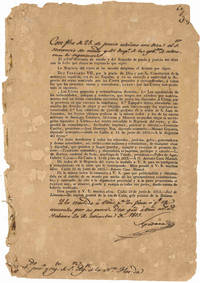
1813WRCAM46892Havana 1813. 1p. plus integral blank. Folio. Old fold lines. Moderately chipped and worn at edges. Lightly and evenly toned. Contemporary manuscript notations. Good. A rare printed decree from Cuba at the beginning of the 19th century as Spanish power in the world was waning but Spain's grip on Cuba was still quite firm. This decree issued by the King on June 14 1813 and printed on September 20 announces new laws regarding the rights to vote and to be elected to hold government positions for professors and scholars from certain universities collegiums and seminars. The decree forbade these rights to the Knights of Justice of the Order of St. John of Jerusalem as well as members of the four military orders of Santiago Calatrava Alcantara and Montesa. It is endorsed in manuscript with the imprint and header also written in by hand. Early Caribbean imprints are rare. unknown books
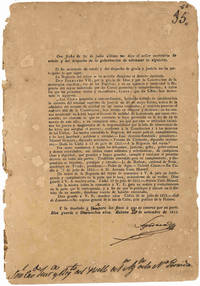
1813WRCAM46891Havana 1813. 1p. plus integral blank. Folio. Old fold lines. Moderately chipped and worn at edges. Evenly tonned. Contemporary manuscript notations. Good. A rare Havana imprint. As Spanish power in the New World was waning its grip on Cuba was threatened by domestic and foreign intruders. This decree issued by Fernando VII on June 17 1813 and printed on September 20 orders the annulment of all criminal cases. This amnesty policy extended to other areas of New Spain as well sought to placate opposition forces. It calls on all levels of government to announce and enforce the decree. It is endorsed in manuscript. unknown books
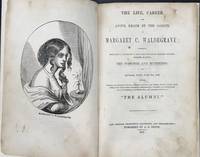
185257744New Orleans Charleston Baltimore and Philadelphia: A.R. Orton 1852. the original wrapper was dated 1853 apparently accounting for that date being used in each of the three OCLC listings. First edition of this rather primitively printed pamphlet. 8vo. 2 11-36 pp. Portrait frontispiece three wood-engraved plates. OCLC: "Sensational and presumably fictitious account of the criminal career of Margaret C. Waldegrave probably written by the publishers" the author of several similar lurid tales in the early 1850s. Contemporary pencil inscription on verso of frontispiece "Allow one vol. / plain binding / leather back." Not in Wright "American Fiction" McDade "Annals of Murder" or Jumonville "New Orleans Imprints." OCLC locates four copies American Antiquarian Soc. New York Historical Soc. Juniata British Library; AAS also holds a prospectus broadside for the work. Some interior foxing and soiling corner of one leaf renewed not affecting text. Recent plain gray wrappers. #4698. <br/><br/> A.R. Orton hardcover books
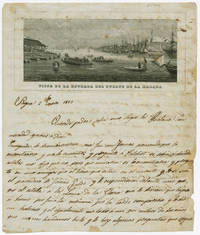
1853WRCAM54601Havana 1853. 4pp. on a bifolium. Previously folded. Some chipping at fore- edge slightly affecting text. Light dampstaining and tanning. About very good. An attractive Cuban pictorial letter sheet with a neatly executed third-page lithograph illustration of the port of Havana. The image depicts several small boats rowing barrels to and from a loading dock. In another small boat a plantation owner or some form of dignitary is being rowed to shore by a crew of men. On the right side of the image several larger ships lie at anchor and in the background on the shore is the fort guarding the mouth of the harbor the Morro Castle. <br> <br> The sheet is filled out by a man named Juan Fabre writing to his parents on Jan. 2 1853 advising them of his safe arrival in Havana. He talks about meeting up with a relative that he had not seen in two years and working at a shoe shop with another relative who adds a brief post script on the verso of the second leaf. Pictorial letter sheets of Cuba are quite rare on the market. unknown books
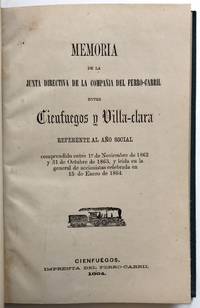
18641312Cienfuegos: Imprenta del Ferro-Carril 1864. About very good. 20pp. plus seven tables two folding. Original green cloth blind stamped and gilt lettered. Light wear at edges and spine ends; minor rubbing to boards. Manuscript letter laid in. Separation along fold and short closed tear at gutter of one plate. Light tanning. A rare annual report on the railroad that connected Cienfuegos to Santa Clara in the central portion of Cuba during the mid-1860s. The text gives details of the company's revenue and shipping totals passenger services work and improvements undertaken and levels of employment including discussion of indentured Chinese labor. The tables at the rear provide more complete statistics on the amount of products shipped number of passengers carried types of repairs carried out and the number of accidents and hospitalizations amongst employees and laborers. This copy was presented to a Señor Enrique Gatke likely a Havana investor in the company with his named lettered in gilt on the front board and with a letter from the company secretary Pedro Fernandez de Castro laid in. A scarce and detailed account of railroad operations in central Cuba during the mid-19th century. We locate only one example of any edition of these reports outside of the National Library of Cuba a copy of the 1862 report at the New York Public Library. Imprenta del Ferro-Carril unknown books
18562026Remedios 1856. About very good. 4pp. on a large bifolium. Printed form completed in manuscript. Separated at fold repaired with tissue. Light wear at edges. Light tanning and foxing. Rare Cuban population census form listing the number of residents in and around the town of Remedios located on the northern central coast of Cuba in 1856. The present document completed in manuscript lists the population according to various categories such as ethnicity and race age range occupations marital status location of residence and several others. The census includes slaves of African origin newly arrived Chinese indentured servants "colonos Asiaticos" immigrant laborers from Yucatan freedmen and free white residents "Blancos". In all there are just over 2000 people living in and around Remedios at this time comprising just over 1300 free whites over 300 free people of color 460 slaves and 19 Chinese laborers. One of the most interesting sections records the population by place of residence which shows that the great majority people in the area lived on estancias with a good part of the remaining population living on livestock farms and sugar plantations. On the final page are two additional sections which enumerate the types of property farms and other enterprises in the regions and provide statistics on agricultural and industrial production and land usage along with some manuscript notes with the signatures of the census takers or local magistrates. An interesting document of slavery agriculture and population in rural Cuba during the mid-19th century. unknown books
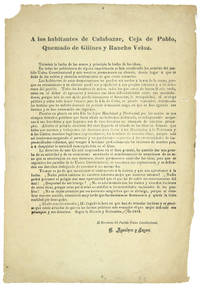
1878WRCAM38237Cuba 1878. Broadside 12 1/2 x 8 3/4 inches. Chip at upper left corner not affecting text. Small tears in all edges several repaired by tape on verso. Good. A rare and fascinating Cuban political broadside calling for an end to armed struggle but a beginning to a "struggle for ideas" at the conclusion of Cuba's "Ten Years' War" the battle for independence from Spain in 1868 to 1878. The broadside is addressed to the residents of the region around the north-central coast of Cuba some 150 miles east of Havana. The text of the broadside is signed in print by Gabriel Aguilera y Zayas Secretary of the Partido Union Constitucional PUC one of the two main political parties that developed out of the Ten Years' War. The PUC which was a conservative pro-Spanish party led by prominent Creoles sought a measure of local political autonomy while favoring continued Spanish control over Cuba. The text exhorts Cubans to partake in the ideological struggle that would succeed the armed rebellion and urges them not to fall into lethargy but to continue the battle of ideas against radicals seeking independence from Spanish colonial rule. <br> <br> Due to their ephemeral nature as well as the climate of the Caribbean any such Cuban broadsides are scarce. No copies of this broadside are located in OCLC. Important evidence of the political factionalism and the strength of pro-Spanish sentiment in Cuba in the late 19th century. Rare and possibly unique. unknown books
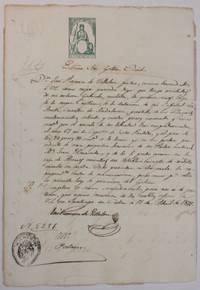
37208Each document a single manuscript page 8-1/2" x 12-1/2." Each with official stamp one also has a decorative illustrated green stamp at the head. Light wear and toning Good.<br/><br/> Each document names the slaveholder and the enslaved person granted "libertad" and the cost in escudos or pesetas of that liberty. The slaves liberated here are Saturnia "morenita criolla" age 14; Gabriela "esclava mulata" age 15; and Dolores "parda criolla" age 16. unknown books
1940442581940. Very good with some foxing soiling to the edges and some fading at the corners. 1 sheet. 9 1/4 inches by 50 inches. Mounted to card stock. Built in 1939 to resemble an old Spanish fortress and now part of a UNESCO World Heritage site the Police headquarters and the Radio Patrol had just been outfitted with the latest two-way FM radio system when this image was taken. This new communication technology only adopted by its first police department the Connecticut State Police that same year was invented by an American radio engineer Fred Link 1905-1998 who appears as the white clad figure at the center of this panorama of the fortress fronted by dozens of police cars and officers. Signed by six important Cuban officials including President Federico Laredo Brú 1875-1946 and police chief Bernardo Garcia who has warmly inscribed it Garcia would be ousted by Batista who became president in October less than a year later. Dated Havana 18 June 1940. The picture had hung in Link's office See Dan Bishop "Fred M. Link Goodwill Ambassador" in Proceedings of the Radio Club of America 72:3 Fall 1998 pages 8-13. Original frame available. unknown books
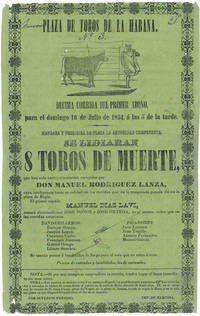
1854WRCAM46994Havana 1854. Broadside 12 1/2 x 8 inches. Printed on green paper. Old fold lines. Light wear and soiling minor separation at some folds. A few contemporary notations. Very good. Cuban broadside advertising a bullfight featuring matador Don Manuel Rodriguez Lanza and the "8 toros de muerte." The top of the sheet features a woodcut of a matador holding his cape out to a bull. The first swordsman for the fight is Manuel Diaz Lavi with two alternates listed. The names of the Banderilleros and Picadores for the fight are also noted. Bullfighting was a popular entertainment in Cuba during the Spanish colonial period though it was done away with after Cuban independence at the beginning of the 20th century. unknown books
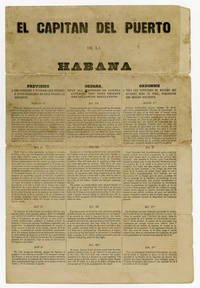
1850WRCAM51706Havana 1850. 4pp. on a bifolium 15 3/4 x 10 1/2 inches. Printed in three columns. Previously folded with some short separations along fold lines and a closed tear to top edge. Somewhat tanned with some dust soiling in upper portion of first leaf recto. Good plus. Bifolium printing of twenty-four directives intended to govern the operation of vessels in the port of Havana. They include provisions for the arrival and departure of ships their docking and mooring the storage of gunpowder while in port fire prevention and penalties for carrying firearms or other deadly weapons ashore. The document is printed in three columns which provide versions of the regulations in Spanish English and French. Daniel Warren mentioned here as the port officer in charge of preventing desertions and illegal transfers of men from ship to ship is also named as Havana shipping master in an 1858 letter from the American Consul Thomas Savage to the Governor of Havana included in a contemporary United States Senate report on foreign trade. "As early as 1828 Irish migrant Daniel Warren established 'a deposit for foreign sailors and artisans' in Havana providing an initial place for them to stay while looking for work"- Curry-Machado. A very rare piece of Cuban maritime ephemera with OCLC noting only one copy at the Harvard Law Library. OCLC 81408661. Curry-Machado CUBAN SUGAR INDUSTRY p.74. unknown books
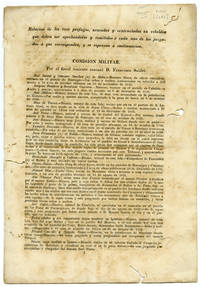
1832WRCAM51901Havana 1832. 18pp. Folio. Loose leaves. Heavy worming mostly marginal but somewhat affecting text in places. Light dampstaining and foxing. Good. An extensive list of fugitives from Cuban courts that covers the period from 1822 to 1832. Each section comprises a catalogue of men tried before a specific court and individual entries provide names brief descriptions mostly of skin color birthplaces likely places of residence and crimes committed together with the sentences handed down. Many men are condemned to the gallows or are facing long sentences in African or other overseas prison camps. This list was also printed as a part of the Oct. 9 1832 issue of DIARIO DE LA HABANA but a separate printing as in the present example is not found in OCLC or the relevant bibliographies. unknown books