Cuba. SlaveryABAA

137 résultats
1865974Santiago de Cuba 1865. Very good. 10 leaves. Removed from a larger volume and restitched. Minor wear and one small area of worming at edges. Light tanning and foxing. Accomplished in several legible hands. A fantastic set of manuscript records for a slave auction house the General Slave Depository in Santiago de Cuba dating to January 1865. Santiago along with Havana and Cienfuegos was one of three major sites for slave sales on the island during the 19th century. The first leaf of the document provides a statement that the documents were assembled in accordance with the rules established for slave auctions which had been updated and approved at the end of the previous year. The second two documents lay out mortgage agreements and financial obligations between the slave house and the Real Sociedad Economica de Amigos de Pais of the city in which the auction owners acknowledge debts and forthcoming payments on the order of several thousand pesos. Following these are two leaves containing a "Relacion de los esclavos ecsistentes en el deposito de esta Ciudad en el dia de la fecha" that is a list of slaves at the depository on the day of the auction and their owners and renters which perhaps were a part of the collateral for securing the loan. A total of twenty-nine slaves are listed and the leaf that follows certifies that the list is correct according the to the director and the auctioneer of the depository. The final two leaves provide official recognition of the loan from two distinct government offices. All documents are signed by the relevant parties and government officials involved in the agreement. In all the present group of documents provides a detailed assessment of debts and human assets of the slave auction house in Santiago de Cuba in the mid-1860s and is a fascinating and valuable document of the bureaucracy and regulation surrounding the financial realities of selling slaves in Cuba during this period. unknown books
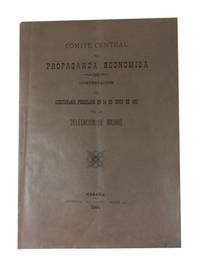
189144433Habana: Imprenta "La Razon" 1891. Paperback. Very Good. table 35p. Wrapper. 22cm. Slight vertical crease and slight wrinkling throughout. Cuban institutional stamp on title-page. Spanish text. Tariffs and taxes on Cuban export commodities mainly sugar and tobacco. <br/><br/> Imprenta "La Razon" paperback books
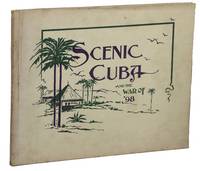
189800009833Chicago: Belford Middlebrook & Co 1898. First edition. Hardcover. Very Good. 4to. Unpaginated. White cloth with decorations in purple and green on the front board. Illustrated with numerous black and white photographs and maps. With introduction and descriptive text. Photographs showcase the beautiful sights of Cuba along with military points of interest and several U.S. Navy ships. A Very Good book with a touch of rubbing to the corners and a bit of soiling to the cloth. Belford, Middlebrook & Co hardcover
1851018700Paris Imprimerie Nationale 1851 fort in-8°, (4) XX 594 pp. Demi-basane époque, dos lisse orné de l'auteur, du titre, de filets dorés. (reliure un peu frottée, rousseurs). Figures (tableaux). Tableau sur double page (tableau graphique des résultats numériques que présente le relevé comparatif précédent des importations de farine à l'île de Cuba).
18996930ABielefeld, Velhagen und Klasing, 1899. 4°. 116 S. Mit 96 Abb. und 1 farbigen Karte. Gepr. OLn.bd. mit DeckelVg. im OSchuber. Land und Leute. Monographien zur Erdkunde Band 2.
189954590Bielefeldund Leipzig Velhagen & Klasing 1899. 116 Seiten, Mit 96 Abb. Nach photographischen Aufnahmen und Kartenskizzen, sowie einer farbigen Karte. Okart., Eigentümersignatur auf Vorsatzblatt Softcover/Paperback, Rückenpartie ausgeblichen, sonst Exemplar in gutem Erhaltungszustand
18997726Bielefeldund Leipzig Velhagen & Klasing 1899. 116 Seiten, Mit 96 Abb. Nach photographischen Aufnahmen und Kartenskizzen, sowie einer farbigen Karte. Okart., Eigentümersignatur auf Vorsatzblatt gebundene Ausgabe, Leineneinband, Kopfgoldschnitt, leichte Gebrauchsspuren am Einband, sonst guter Zustand
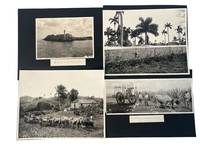
1900202981900. Photographers unknown. Cuban rural photographs early 20th century. This group documents agricultural labor family life and rural landscapes in Cuba prior to the Cuban Revolution recording work practices and domestic environments tied to farming economies that shaped the island's social structure. The images show ox-driven cultivation tobacco production and multi-generational presence within agricultural settings providing visual evidence of how rural Cuban communities organized labor and daily life before the political and economic transformations of the mid-twentieth century. Inclusion of a Havana harbor view further situates these rural scenes within a broader geographic context connecting countryside production with national infrastructure.<br /> <br /> Four original black-and-white silver gelatin photographs mounted on black mats with manuscript captions measuring approximately 4.75 x 6.75 inches to 7.5 x 10 inches. Images include oxen tilling soil in tropical farmland with workers riding wooden-wheeled wagons while family members stand near a thatched dwelling surrounded by palm trees. One photograph shows six children standing atop an ox cart drawn by two animals with hemp fields extending into the background and adult workers and dogs in the foreground. Another image depicts a laborer standing before a large tobacco crop covered with protective cloth with palm trees and huts visible behind. A landscape view of Castillo del Morro overlooks the entrance to Havana Harbor connecting agricultural life with a major coastal landmark.<br /> <br /> These photographs align with the structure of rural Cuban economies in the early twentieth century when agriculture particularly tobacco and related crops relied on manual labor and animal power within plantation and smallholder systems. Visual documentation of fieldwork transport methods and domestic settings provides primary evidence for the study of labor organization family roles and environmental conditions in pre-revolutionary Cuba. The combination of agricultural scenes and a Havana harbor landmark situates local labor within wider economic and geographic networks. Minor surface wear; mounts and photographs remain intact with clear imagery and legible captions. Overall very good condition. unknown
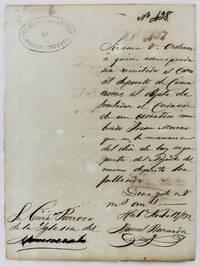
18723066Havana 1872. Very good. Manuscript form approximately 8.5 x 6.25 inches. Minor wear at edges; a few small worm holes. Contemporary ink stamp. Light tanning and offsetting. This 1872 manuscript form from a Havana jail the Celaduria de la Punta notes the death there of an "Asiatico" a Chinese indentured servant with the given name of Juan Macao and orders the transfer of the body to the mortuary for cremation. Indentured servants found themselves jailed for several reasons including suspicion of theft and other crimes recapture following runaway or mere suspicion of abandoning a contract. unknown
186012907Paris Librairie Hachette [Imp. de Ch. Lahure et Cie] 1860 in-12 br., couv. jaune impr., non rogné, couv. lég. us. avec petits manques, qq. pâles rouss
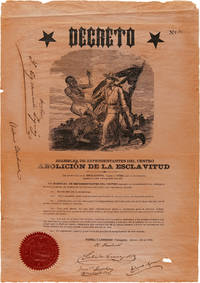
1869WRCAM56566Camagüey Cuba 1869. Pictorial letterpress broadside 18 1/2 x 13 inches. Numbered "54" in manuscript bearing the embossed red seal of the Republica Cubana and signed in ink by Salvador Cisneros y Betancourt Eduardo Agramonte Ignacio Agramonte Loyn áz Francisco Sánchez y Betancourt and Antonio Zambrana. Old horizontal folds minor creasing handful of small edge chips. Small hole in bottom margin just touching one ink signature. Very good condition. A rare and significant pictorial Cuban decree from the provisional rebel government abolishing slavery on the part of the island they controlled issued by the radical faction of the Cuban nationalists fighting against Spanish rule in the first months of the Ten Years' War. <br> <br> This proclamation is illustrated with a dramatic woodcut signed "LFR" depicting an ill-clad but exultant freed slave and a rebel celebrating in front of the Cuban flag. This decree stipulated freedom for all the enslaved people of Cuba in hopes that they would join the revolutionary struggle. The decree also provided for eventual compensation to slaveholders and ordered that freed individuals must serve the revolution either through military service or by continuing with their previous work. Among the important leaders who signed the present document were Salvador Cisneros y Betancourt as president just below the printed text and Ignacio Agramonte y Loynáz as secretary to the left of the engraving. <br> <br> The practical effect of this decree was modest as the rebels only controlled limited territory before their ultimate defeat and their territory was generally under the control of more conservative military commanders but such a proclamation joined a growing chorus of abolitionist sentiment in Cuba which finally realized the end of slavery in 1886. A powerful statement of anti-slavery policy in mid-19th century Cuba with a striking illustration of a jubilant slave celebrating his short-lived freedom. Rare with no copies recorded in OCLC. unknown books
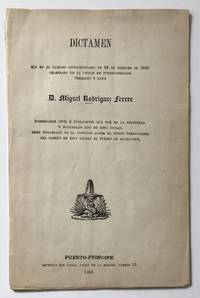
18611229Puerto-Principe: Imprenta del Fanal 1861. Good. 17pp. Leaves loose. Light wear one ink correction to text. A rare Cuban work printed outside of Havana outlining the necessity of a railroad between Puerto-Principe modern Camaguey and Santa Cruz. The many benefits of the plan are detailed herein with numerous charts. Miguel Rodriguez Ferrer 1815-1889 was a Spanish author and administrator but is best known for his work on the nature and culture of Cuba particularly his "Naturaleza y Civilizacion de la Grandiosa Isla de Cuba." He served in a number of civil administrator positions including mayor of San Antonio de los Baños and advisor to Puerto Principe. We locate a single copy at the National Library of Spain. Imprenta del Fanal unknown books
1834WRCAM51022Havana 1834. 2pp. plus blank integral leaf. Bifolium. Minor edgewear and toning. Offsetting. Good. Manuscript document written by John Morland acting consul in Cuba relaying the details of the voyage of the ship "Hunter" travelling from New York to New Orleans. The ship ran into trouble partway through the voyage with seven passengers saved from the "disastrous" situation. The letter does not detail how many if any perished. The seven passengers continued their journey on two other ships one being a Spanish vessel. unknown books
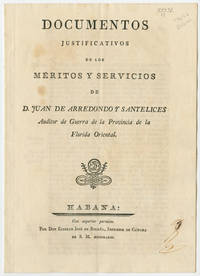
1815WRCAM49642Havana: Esteban José de Boloña 1815. 19pp. Gathered signatures stitched. Stitching mostly perished. Light fold lines minimal foxing ink marginal notations contemporary ink inscription after the text. Very good. An early Cuban imprint printed by Esteban José de Boloña the first printer in Cuba after the 1776 ban on printing. Juan de Arrondo y Santilices was an official in Spanish Florida the Auditor of War of East Florida during the early 19th century. This is a work detailing the deeds of Arrondo y Santilices likely an attempt to secure a pension. Rare with one copy located by OCLC at the John Carter Brown Library. Esteban José de Boloña unknown books
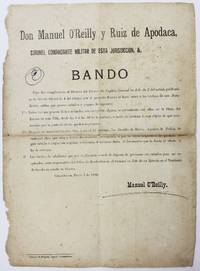
18963188Guanabacoa: Imprenta el Progreso 1896. About very good. Broadside approximately 17 x 12.5 inches. Previously folded. Some biopredation at left edge not affecting text. Otherwise faint foxing light tanning and dust soiling. Two contemporary manuscript rubrics. Unrecorded broadside that orders the presentation of privately-owned horses and pack animals in the town square of Guanabacoa for requisition by the Spanish army in January 1896 at the outset of the Cuban uprising that would eventually lead to the end of Spanish colonial rule. This bando states first that "Todos los que posean dichos animales sin excepción alguna se presentarán con ellos en la Plaza del Recreo de esta Villa desde las 8 á las 10 de la mañana á partir de mañana 8 con objeto de que reconocidos por la junta al efecto queden requisados." Following these initial voluntary presentations inspections would be made of homes and farms and those found not to have handed over usable animals would be guilty disobeying army orders during a time of war. At this point Spain had 100000 troops on the island and another two years of fighting the insurrection incited by José Marti would pass before the intervention of the United States. Not in OCLC. Imprenta el Progreso unknown
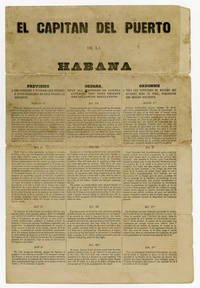
1850WRCAM51706Havana 1850. 4pp. on a bifolium 15 3/4 x 10 1/2 inches. Printed in three columns. Previously folded with some short separations along fold lines and a closed tear to top edge. Somewhat tanned with some dust soiling in upper portion of first leaf recto. Good plus. Bifolium printing of twenty-four directives intended to govern the operation of vessels in the port of Havana. They include provisions for the arrival and departure of ships their docking and mooring the storage of gunpowder while in port fire prevention and penalties for carrying firearms or other deadly weapons ashore. The document is printed in three columns which provide versions of the regulations in Spanish English and French. Daniel Warren mentioned here as the port officer in charge of preventing desertions and illegal transfers of men from ship to ship is also named as Havana shipping master in an 1858 letter from the American Consul Thomas Savage to the Governor of Havana included in a contemporary United States Senate report on foreign trade. "As early as 1828 Irish migrant Daniel Warren established 'a deposit for foreign sailors and artisans' in Havana providing an initial place for them to stay while looking for work"- Curry-Machado. A very rare piece of Cuban maritime ephemera with OCLC noting only one copy at the Harvard Law Library. OCLC 81408661. Curry-Machado CUBAN SUGAR INDUSTRY p.74. unknown books
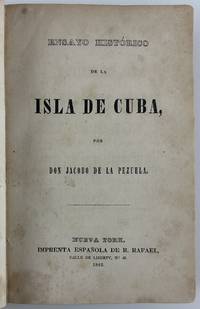
184213073Nueva York: Imprenta Espanola de R. Rafael 1842. viii631pp. Contemporary quarter calf over marbled-paper boards spine gilt gilt leather label. Substantial scuffing and wear to spine and extremities spine ends frayed rubbing to boards. Hinges somewhat tender but holding strong varying degrees of toning and foxing throughout. Good condition. A scarce historical work on Cuba by a Cuban-born Spain-and-France-educated soldier and historian. Jacobo de la Pezuela 1812-1884 was born in Havana went to school in Valladolid and Montpellier then returned to Cuba in his thirties to serve at various army posts and also record the history of his native country. He published several works and later became a member of Spain's esteemed Real Academia de la Historia. In the present work which translates to Historical Essay on the Island of Cuba Pezuela begins at the beginning with Columbus's arrival on the island and continues to almost the present moment concluding with an appraisal of the governorship of Miguel Tacon. In the last chapter Pezuela also includes a section on "Negros emancipados" "Emancipated Blacks". A dense history of Cuba by a Cuban-born historian published in Spanish in New York in 1842.<br /> <br /> Sabin 61329. Imprenta Espanola de R. Rafael unknown
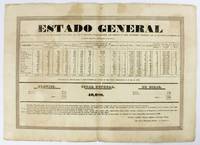
18385957Sancti Spiritus 1838. Good plus. Broadside measuring 12.5 x 17.5 inches. Previously folded. Light wear to edges and along old fold lines with a few small chips at edges. Moderate toning and soiling. An unrecorded broadside that prints statistics relating to agricultural production for the region of Sancti Spiritus in central Cuba during the late 1830s. For each municipality the broadside prints the number of property owners; ranches; land-grant farms; slaves; white employees; animals including mules donkeys cows and sheep; distances to transport and shipping hubs; and several other figures. In the bottom third of the broadside are printed the census figures from 1836 with the population totaling just over 40000 people and split into Black and white groups. Rather pointedly the figures for the white population are divided by gender while the figures for the Black population are divided by status free or slave. A very interesting statistical snapshot of a smaller rural region in colonial Cuba in 1838. Not in OCLC. unknown
18841574Habana 1884. Good plus. 2496 i.e. 498pp. Quarto. Contemporary calf gilt a.e.g.; rebacked with original spine laid down. Corners repaired with later black buckram; boards scuffed spine chipped. Hinges cracked repaired with later cloth and renewed endpapers. Minor scattered foxing and toning to text. Accomplished in a neat highly legible hand. A very attractive manuscript translation into Spanish of Pierre Larousse's well-known work on eminent and historical personages Fleurs Historiques des Dames et des Gens du Monde in a contemporary Cuban gilt goatskin binding. The manuscript connects three figures in the upper social echelons of Cuban society. José Fernandez Pellon the scribe of this volume is recorded as the Grand Master of Cuba's freemasons lodge the Gran Logia Unida de Colón y la Isla de Cuba. The translator Aurelio Almeida helped to found the organization in 1875 and at this time served as the Lodge Secretary. The initials E.D. gilt at the foot of the spine and the dedicatory inscription "A Eugenia Desvernine" refer to Eugenia Desvernine y Galdós b. 1865 daughter of the famous Cuban pianist Pablo Desvernine and Carolina Galdós y Echániz. She was also the niece of Benito Pérez Galdós the Spanish realist novelist who some authorities consider only second in stature to Cervantes. A contemporary social register remarks that Eugenia was one of the most beautiful women in Cuba perhaps an inspiration for the painstaking production of this manuscript.<br /> <br /> The original work by Larousse was a loose collection of religious parables classical myths biographies of ancient and modern historical figures. The title of the manuscript advises that is an extract and in the brief introduction Almeida explains his selection process writing that "He suprimido algunos artículos sobre cosas muy sabidas de la historia sagrada; y otros sobre la de Francia que mencionan frases ó personas casi ninca citadas ó citades solamente por las escritores francesas." He also notes several alterations and additions more relevant to Spanish history saying "En Cambio he agregado algunos artículos sobre historia de España que no están en el original y he tomado unos pocos de otra obra del mismo Mr. Larousse y de libros diversos." The result is an original amalgam of biographies historical episodes and religious parables. Interestingly we find no recorded printed editions of Larousse's work in Spanish so that the present manuscript is also an entirely original work of translation. A fascinating product of the cultural interests and mores of Cuban high society near the end of the Spanish colonial period. unknown
18841574Habana 1884. Good plus. 2496 i.e. 498pp. Quarto. Contemporary calf gilt a.e.g.; rebacked with original spine laid down. Corners repaired with later black buckram; boards scuffed spine chipped. Hinges cracked repaired with later cloth and renewed endpapers. Minor scattered foxing and toning to text. Accomplished in a neat highly legible hand. A very attractive manuscript translation into Spanish of Pierre Larousse's well-known work on eminent and historical personages Fleurs Historiques des Dames et des Gens du Monde in a contemporary Cuban gilt goatskin binding. The manuscript connects three figures in the upper social echelons of Cuban society. José Fernandez Pellon the scribe of this volume is recorded as the Grand Master of Cuba's freemasons lodge the Gran Logia Unida de Colón y la Isla de Cuba. The translator Aurelio Almeida helped to found the organization in 1875 and at this time served as the Lodge Secretary. The initials E.D. gilt at the foot of the spine and the dedicatory inscription "A Eugenia Desvernine" refer to Eugenia Desvernine y Galdós b. 1865 daughter of the famous Cuban pianist Pablo Desvernine and Carolina Galdós y Echániz. She was also the niece of Benito Pérez Galdós the Spanish realist novelist who some authorities consider only second in stature to Cervantes. A contemporary social register remarks that Eugenia was one of the most beautiful women in Cuba perhaps an inspiration for the painstaking production of this manuscript. The original work by Larousse was a loose collection of religious parables classical myths biographies of ancient and modern historical figures. The title of the manuscript advises that is an extract and in the brief introduction Almeida explains his selection process writing that "He suprimido algunos artÃculos sobre cosas muy sabidas de la historia sagrada; y otros sobre la de Francia que mencionan frases ó personas casi ninca citadas ó citades solamente por las escritores francesas." He also notes several alterations and additions more relevant to Spanish history saying "En Cambio he agregado algunos artÃculos sobre historia de España que no están en el original y he tomado unos pocos de otra obra del mismo Mr. Larousse y de libros diversos." The result is an original amalgam of biographies historical episodes and religious parables. Interestingly we find no recorded printed editions of Larousse's work in Spanish so that the present manuscript is also an entirely original work of translation. A fascinating product of the cultural interests and mores of Cuban high society near the end of the Spanish colonial period. unknown books
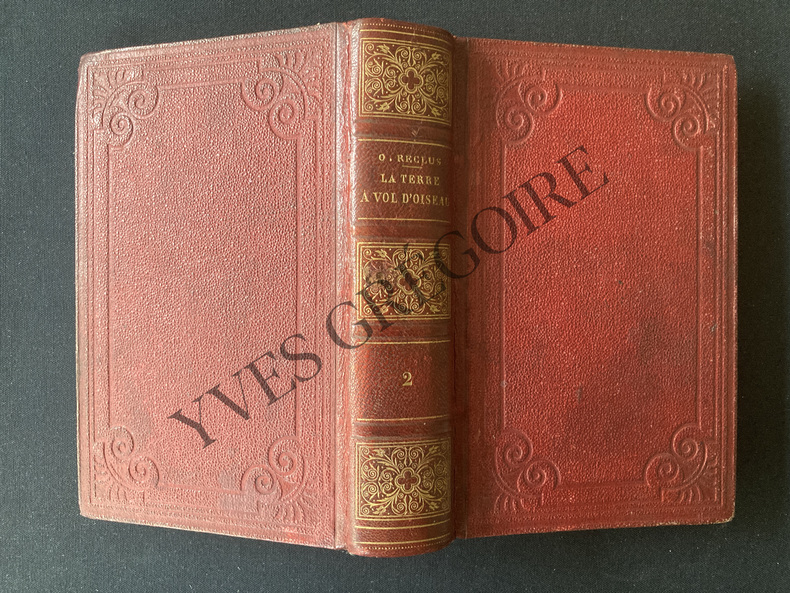
1889ABE-1597873415144674 PAGES-12 CM X 18 CM-QUATRIEME EDITION-ILLUSTREE DE 190 GRAVURES SUR BOIS-AFRIQUE-ILES D'AFRIQUE-AMERIQUES-OCEANIE-RELIURE BORDEAUX-DOS CUIR A 4 FAUX NERFS-3 CAISSONS A FLEURONS DORES-TITRES DORES-PLATS PERCALINE BORDEAUX-3 TRANCHES DOREES-3 PETITES DECHIRURES SANS MANQUE EN MARGE INF-LEGER ACCROC EN CAISSON CENTRAL-(ETACA)
1889V39836Stuttgart (J.G.Cotta'sche Buchhandlung ) 1889 (= Erste Auflage). 8°, 12 Bände in 9 Büchern in rotem Leinen der Zeit mit goldgeprägtem Rücken, marmoriertem Schnitt und Exlibris (Hardcover), 1 Portrait 1
1853163187Leipzig, Costenoble, 1853. X, 210 Seiten. 14 cm. Halbleinenband der Zeit mit marmorierten Deckel und Rückenvergoldung.
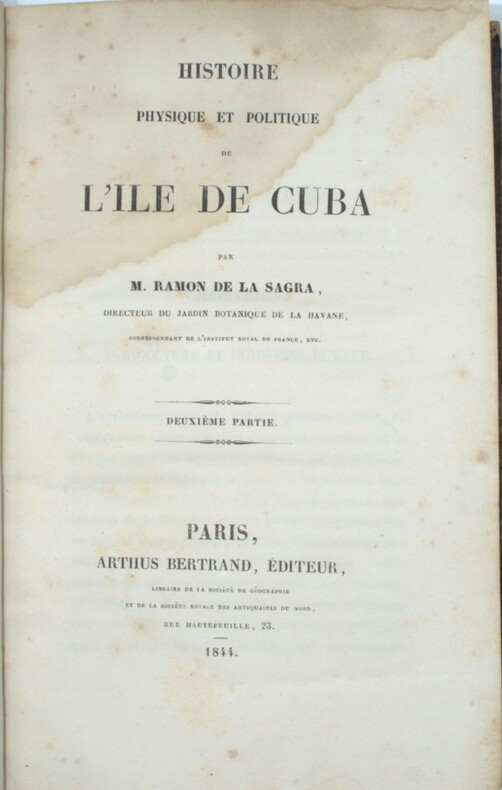
1844PHO-1491Paris, Arthus Bertrand, 1844, in-8, 2 volumes, LXXI-771-[2] pp. en numérotation continue, 20 diagrammes hors texte, demi-chagrin rouge, dos à faux nerfs, monogramme "J.M.C." doré en pied des dos, Rousseurs, quelques auréoles, l'une assez large en tête du second tome.
1838170201838. 8pp disbound. Minor spotting. Good. unknown books