Jaffrey, George (signer)Biblio.com
38 résultats
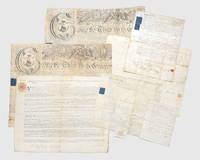
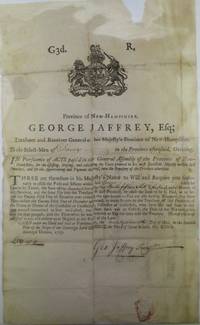
1767020556Portsmouth: No Publisher 1767. Unbound. Good. Single sheet printed on a single side only. 12 ¼ by 7 ½ inches. Armorial ornament of King George III at the top of the sheet followed by printed text asserting that in pursuance of the Acts passed in the General Assembly of the Province of New Hampshire the town named Dover New Hampshire was required to pay the stated sum of taxes as well as naming the constables or collectors who collected the sums. Signed by George Jaffrey at the bottom with the remains of a wax seal present. George Jaffrey Esquire was part of a prominent New Hampshire family who essentially held an oligarchy in the province. They and a few others sought to separate New Hampshire from the province of Massachusetts and through various machinations and political maneuverings did so. George Jaffrey eventually became treasurer of New Hampshire. In the run up to and during the American Revolutionary War Jaffrey was a staunch Loyalist asserting that it was just a few people causing the turmoil and that eventually the colonies would remain with England. Despite his beliefs and the danger it caused him he held his post and remained in Portsmouth New Hampshire during the war. GOOD condition. Horizontal and vertical fold creases present with a few small tears along the folds. A 1 inch triangular area torn off from the upper edge. Uneven toning. Handwriting on the reverse clerical in nature. Many small old paper repairs present along the center fold. No Publisher unknown
1796133528c.1796-97. Where gain is the object bring into harbour all the loaded merchantmen you can An outstanding and unusually comprehensive archive documenting the British-built armed brig Swallow a Liverpool privateer operating in the Caribbean under the experienced prize-master John McIver. The papers trace in exceptional detail the purchase fitting out commissioning and deployment of a late 18th-century privateering vessel anchored by impressive original Letters of Marque. Privateering was in essence a form of licensed warfare. As the Oxford Companion to Ships and the Sea defines it a privateer was "a privately owned vessel armed with guns commissioned by letters of marque which licensed them to take prizes in time of war" 1979 p. 670. This archive shows the process in action. The owners' letters to McIver convey both urgency and anxiety as they navigate the risks of long-distance operations during wartime revealing the network of merchants agents and seamen supporting the Swallow. Early letters make clear that McIver was the driving force: his kinsmen purchased the vessel "solely with the View to make a profitt by a Resale" yet were "well pleased you have taken the Command." The brig was refitted with 10 new iron cannon and furnished with Letters of Marque against French Dutch and later Spanish vessels. In late 1796 the Liverpool partners press McIver to sail immediately for Caribbean waters "in search of Spanish Prizes" while repeatedly stressing the need for constant intelligence. Their concerns deepen over slow remittances from their agent in Jamaica and uncertainty over whether to continue privateering or sell the ship. Built at East Cowes and bought on the stocks by the Royal Navy in 1781 the Swallow was sold in 1795 to a Liverpool consortium including Samuel McDowall the Twemlow family and the McIvers with McIver himself later taking a one-third share. At his urging the vessel was strengthened rearmed and commissioned. Her first Letter of Marque 12 July 1796 authorized cruising against the French and Dutch; a second January 1797 targeted Spanish shipping prompting an increase to 20 guns and a crew of 80. As Gomer Williams notes the Swallow "was not an ordinary privateer but an armed vessel specially hired by Government." McIver enjoyed some success: off Léogâne he sent into Port-au-Prince a large brig and schooner with French property aboard took other vessels and saved the Fame of Liverpool from capture. The letters also record his ancillary government work transporting governors and army officers. By 1797 however the quasi-peace following Leoben and Campo Formio curtailed her privateering activities. The archive also preserves McIver's account of capturing a small American merchantman in 1793 - a case serious enough to draw the attention of Thomas Jefferson and the British envoy George Hammond. The later history of the McIver/MacIver family forms a notable coda: their descendants became central figures in the creation of the Cunard Line partnering with Samuel Cunard and Robert Napier in the 1830s and 1840s to establish what became the British and North American Royal Steam Packet Company. This archive offers a superlative and unusually granular record of British privateering at a moment when European conflict fuelled an upsurge of activity in the Caribbean - a milieu in which as N. A. M. Rodger observes "the letter of marque was often a slender cover for piracy." A full listing with commentary is available on request. Overall in remarkably good condition. N. A. M. Rodgers The Wooden World 1986; Gomer Williams History of the Liverpool Privateers and Letters of Marque with an Account of the Liverpool Slave Trade 1897; Rif Winfield British Warships in the Age of Sail 1714-1792: Design Construction Careers and Fates 2007 p. 314. unknown
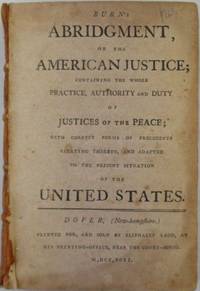
1792021030Dover NH: Printed for and Sold by Eliphalet Ladd 1792. Leather. Poor. Full calf leather at one point at least. Now missing both covers. Viii 484 1 pp. A legal treatise by British legal scholar Richard Burns adapted to laws in the United States especially pertaining to justices of the peace. This includes sections on homocide rape riots prison escapes etc. POOR condition. MISSING both covers. Heavy scuffing flaking and wear to the leather along the spine. Rear blank endpaper almost detached from the text block. All front endpaper up to the title page MISSING. Heavy browning to the text block with minor scattered soiling foxing and spotting. Printed for and Sold by Eliphalet Ladd unknown
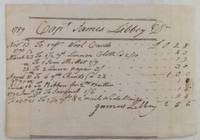
1792020796No Place: No publisher 1792. Unbound. Very Good. Includes wool cards linen cloth paper etc. Captain James Libbey led a company of men from New Hampshire in Colonel Evans' Regiment in 1777 during the Revolutionary War where they marched and joined the Northern Continental Army at Saratoga. VERY GOOD. Minor toning and foxing with a few wrinkles. No publisher unknown
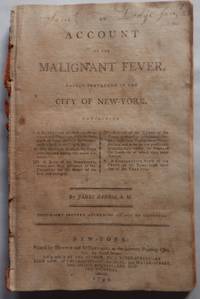
1799004114New York: Printed by Hurtin and McFarlane at the Literary Printing Office No. 20 Gold-Street 1799. First Edition. Disbound. Good. Disbound pamphlet. 139 pp plus 9 unnumbered pages and one blank endpaper in the rear. Contains as given on the title page: I. A narrative of its rise progress and decline with opinions of some medical gentlemen with respect to its origin. II. The manners in which the poor were relieved. III. A list of donations for relief of the sick and indigent. IV. A list of the names of the dead with occupations. This list also states if the deceased was African-American. V. A comparative view of the fever in the year 1798 with that of 1795. The nine unnumbered pages contain tables of information relating to the fever and its affliction of various groups of people. Contains letters from Dr. Samuel Mitchill and Richardson Underhill in regard to the origin of the fever. In GOOD condition. Remains of leather binding on the spine. The signature of a Samuel Dodge present at the top of the title page with a handwritten list in pencil of phrases on the rear blank endpaper. Page 85 with a number in ink with two numbers in faint pencil. Faint pen squiggle in the margin of page 97. Moderate toning to the paper with minor spotting and foxing scattered throughout. Rear endpaper with a few minor chips along its fore edge as well as bearing a diagonal crease. This crease affects the previous leaf as well. Sabin 30314. Printed by Hurtin and McFarlane, at the Literary Printing Office, No. 20 Gold-Street unknown
17971022408vo modern calf 407 pp. Lacks half title ex-library stamps on both sides of title front endpaper chipped on top expert repair to last page a little soiling normal aging and foxing; otherwise very good in a very nice modern binding. Before James Monroe 1758-1831 became president of the United States his political apprenticeship included serving as Minister to France. He was appointed by George Washington in 1794 to this post which proved disastrous from a political standpoint. He was recalled in 1796 and while he was an enthusiastic supporter of the French Revolution he was openly critical of the Jay Treaty with Britain which antagonized Washington's pro -British cabinet. This work was Monroe's attempt to justify his position. New Book of Knowledge. Evans 32491. Sabin 50020. Howes M727. Benj. Franklin Bache,
1797102241<p>8vo contemporary calf spine and tips rebacked with original spine label laid down new endpapers includes half title 407 pp. Signature on front endpaper and title ink and pencil numbers on back of title extremity wear to binding corner mended dampstaining to the bottom third of book some soiling foxing and aging; otherwise in very good condition overall. Before James Monroe 1758-1831 became president of the United States his political apprenticeship included serving as Minister to France. He was appointed by George Washington in 1794 to this post which proved disastrous from a political standpoint. He was recalled in 1796 and while he was an enthusiastic supporter of the French Revolution he was openly critical of the Jay Treaty with Britain which antagonized Washington's pro-British cabinet. This work was Monroe's attempt to justify his position. New Book of Knowledge. Evans 32491. Sabin 50020. Howes M727.</p> Benj. Franklin Bache,
1777000205No Publisher Given 1777. Hard Cover. Very Good/No Jacket. A Parliamentary Chronicle: or accounts of the proceedings and debates of the House of Commons upon the opening of the present sessions. This spans from October 30 1776 to February 25 1777. No author. These proceedings open with an address by King George to parliament regarding the American Revolution. It begins "Nothing could have afforded me so much satisfaction as to have been able to inform you at the opening of this session that the troubles which have so long distracted my colonies in North America were at an end; and that my unhappy people recovered from their delusion had delivered themselves from the oppression of their leaders and returned to their duty .". After this address various members of parliament respond some with support for the war and others advocating granting America its independence. Some of these speeches go into detail in regard to troops morale conduct propaganda in the US press especially propaganda by General Gage. Also discussed within are Britainn's defenses against Spain and France Jamaica and many other interesting topics. The debates over the war with America are amazing historical references serving to frame the Revolutionary War through the eyes of the British. This book has been re-bound in blue cloth with the title in gilt in a small strip of leather on the spine. VERY GOOD condition with light soiling light fading and moderate scuffing mostly noticeable to the top and bottom of the spine. Light bumping and edgewear. Pages clean and solid but browning. Still very readable. The last page of the text seems to end mid sentence as if this was excerpted from a larger text. A very scarce historical record of the beginnings of the Revolutionary War in VERY GOOD condition. No Publisher Given unknown
1800007304Providence: John Carter Printer 1800. First Edition. Pamphlet. Good. Pamphlet lacking any wraps that may have been issued. Disbound from a larger work. First edition. 26 pp. A speech reflecting on the life and legacy of George Washington containing several lengthy quotes from Washington regarding his role as general of the American Army as well as president. With several passages of historical detail on the American Revolution including brief mention of Yorktown and Valley Forge. A footnote also contains a short genealogy of the Washington family. This speech was given to the freemason members of the Mount-Vernon Lodge as well as to St. John's Church in Providence Rhode Island on February 22nd 1800 5800. GOOD condition. Mostly minor scattered foxing minor staining and soiling. Remains of leather along the spine. Minor wrinkling. Light browning and some ghosting to the text. Evans 37189. John Carter, Printer unknown