XenophonBiblio.com
2 316 résultats
1165812339.Gpaperback. Good. Access codes and supplements are not guaranteed with used items. May be an ex-library book. paperback
1165790564.Gpaperback. Good. Access codes and supplements are not guaranteed with used items. May be an ex-library book. paperback
116720302X.Gpaperback. Good. Access codes and supplements are not guaranteed with used items. May be an ex-library book. paperback
1167228286.Gpaperback. Good. Access codes and supplements are not guaranteed with used items. May be an ex-library book. paperback
1247130959.Gpaperback. Good. Access codes and supplements are not guaranteed with used items. May be an ex-library book. paperback
1247134997.Gpaperback. Good. Access codes and supplements are not guaranteed with used items. May be an ex-library book. paperback
1357116667.Ghardcover. Good. Access codes and supplements are not guaranteed with used items. May be an ex-library book. hardcover
1356903789.Ghardcover. Good. Access codes and supplements are not guaranteed with used items. May be an ex-library book. hardcover
1358268266.Ghardcover. Good. Access codes and supplements are not guaranteed with used items. May be an ex-library book. hardcover
1437009565.Ghardcover. Good. Access codes and supplements are not guaranteed with used items. May be an ex-library book. hardcover
1016496796.Ghardcover. Good. Access codes and supplements are not guaranteed with used items. May be an ex-library book. hardcover
1120004748.Gpaperback. Good. Access codes and supplements are not guaranteed with used items. May be an ex-library book. paperback
1120055849.Gpaperback. Good. Access codes and supplements are not guaranteed with used items. May be an ex-library book. paperback
1120055857.Gpaperback. Good. Access codes and supplements are not guaranteed with used items. May be an ex-library book. paperback
1145487467.Gpaperback. Good. Access codes and supplements are not guaranteed with used items. May be an ex-library book. paperback
3011-13Wien Blumauer 1796. Recensuit supplevit emendavit latine vertit. indicibus instruxit Aloys Emeric. Libe Baro Locella. gr.-8°. XXVIII 303 1 S. HLdr. d. Zt. m. Rückengoldpräg. 2 gest. Wappen-Exlibris a. d. Innendeckel. Leicht berieb. EA Griechisch-lateinische Parallelausgabe. Mit ausführl. Kommentar u. Index. Wien, Blumauer 1796. unknown
175065590Oxonii:: E Typographeo Clarendoniano Impensis Ricardi Clements 1750. old full speckled calf; gilt spine. Old ink ownership signature; front joint cracked but cords still holding. Text block fine. 8vo. E Typographeo Clarendoniano, Impensis Ricardi Clements, unknown
DADAX019814556XOXFORD UNIVERSITY PRESS 0000-00-00. hardcover. New. 0.73x7.56x5.06. Buy with confidence. Excellent Customer Service & Return policy. OXFORD UNIVERSITY PRESS hardcover
2009DADAX1104533901Kessinger Publishing 2009-05-10. paperback. New. 8.25x1.34x11.00. Buy with confidence. Excellent Customer Service & Return policy. Kessinger Publishing paperback
1759000395Oxford: E Theatro Sheldoniano. Impensis Jacobi Fletcher Bibliopol. Oxon. Et J. Rivington & J. Fletcher London 1759. Hardcover. See Description. Third Oxford Edition. 8vo. pp. 16 401 31. With frontispiece of Socrates. Title page is printed in red and black. Greek text with the Latin version of J. Leunclavis. Pages are clean and crisp with occasional faint spots of marginal foxing. Inscription written in a miniscule old hand on verso of front free end paper. Period fine binding in full deep red morocco - smooth spine gilt in five compartments with a fer à l' oiseau center stamp and arabesque corner pieces. Front and rear covers framed with a simple triple line gilt fillet border. The interior contains inner dentelles and blue paste-paper end sheets. Tiffany bookplate of Michigan business man and avid book collector Albert May Todd known as "the Peppermint King" on the inside front cover. The binding is in an excellent state of preservation with some rubbing on the outer corner tips of the boards. All edges are gilt. An ownership note dated 1814 is written in a miniscule old hand on the verso of the front fly-leaf; a later penciled inscription bellow apparently notes that the book was in a Sotheby's auction Dec. 5-9 1927. Xenophon 428-354 b.c.e. Athenian aristocrat soldier and historian. His Memorabilia in four books records the reminiscences of Socrates with the intent of defending the sage against charges of impiety towards the gods. The discussions also focus on education and management of state. ESTC T145020; Schweiger I p.338. <br/> <br/> E Theatro Sheldoniano. Impensis Jacobi Fletcher, Bibliopol. Oxon. Et J. Rivington & J. Fletcher, London hardcover
1806076<p><strong>FIRST EDITION. Full contemporary sheepskin binding. Published Philadelphia: Wm. Poyntell 1806 8vo. 5 1/2" x 8 3/4" i547pp. Text in Greek and Latin. Based on the London edition of Thomas Hutchinson's text with much correction this is the first printing of Xenophon in America and the first book printed in Greek type that was cast in America. Type fonts were cast by Binny and Ronaldson under the direction of John Watts. An attractive copy considering the often dismal state which sheepskin bindings from this period are often found.</strong></p> Wm. Poyntell hardcover
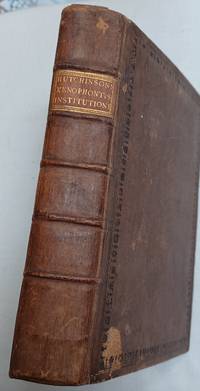
175628390London: B. Barker et al. 1756. contemporary full calf with some mild scuffing five raised bands on spine title label reads 'Hutchinsons Xenophontis Institutione' leather spine hinges quite sound paper endpaper hinges cracking but binding overall is sound and tight no foxing throughout Title page in red and black 547 pages map towards front showing extent of Persian empire text in Greek with footnotes in Latin addenda also in Latin unusuallly well-preserved copy. Fifth Edition. Full-Leather. Very Good/No Jacket. 8vo - over 7¾" - 9¾" tall. B. Barker et al. Hardcover
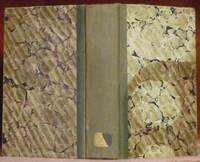
182859863Gothae et Erfordiae : Guil. Hennings 1828. 210x120mm. LXVIII- reliure demi-toile. Plats papier marbr. Dos et plats muets. Trace dÕune tiquette de cotation au dos. Quelques rousseurs. Bon tat. 565 Guil. Hennings unknown
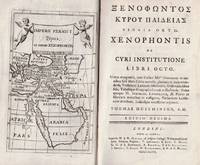
179732384AB1797. Edition Decima Bilingual in Greek and Latin. London Impensis W.&W.Ginger ad insignia Collegii Westmonasteriensis juxta Scholam Regiam 1797. Octavo. Frontispiece-Map 2 548 pages. Hardcover / Original full leather with gilt lettering on spine and boards. In protective Mylar. Very good condition with only minor signs of wear. From the library of Daniel Conner Connerville / Manch House with his Exlibris / Bookplate to pastedown. Xenophon of Athens c. 430 355/354 BC was a Greek military leader philosopher and historian. At the age of 30 he was elected as one of the leaders of the retreating Greek mercenaries the Ten Thousand who had been part of Cyrus the Younger's attempt to seize control of the Achaemenid Empire. As the military historian Theodore Ayrault Dodge wrote "the centuries since have devised nothing to surpass the genius of this warrior". For at least two millennia it has been debated whether Xenophon was first and foremost a general historian or philosopher. For the majority of time in the past two millennia Xenophon was recognised as a philosopher. Quintilian in The Orator's Education discusses the most prominent historians orators and philosophers as examples of eloquence and recognises Xenophon's historical work but ultimately places Xenophon next to Plato as a philosopher. Today Xenophon is recognised as one of the greatest writers of antiquity. Xenophon's works span multiple genres and are written in plain Attic Greek which is why they have often been used in translation exercises for contemporary students of the Ancient Greek language. In the Lives and Opinions of Eminent Philosophers Diogenes Laërtius observed that Xenophon was known as the "Attic Muse" because of the sweetness of his diction. Despite being born an Athenian citizen Xenophon came to be associated with Sparta the traditional opponent of Athens. Much of what is known today about the Spartan society comes from Xenophon's royal biography of the Spartan king Agesilaus and the Constitution of the Lacedaemonians. The sub-satrap Mania is primarily known through Xenophon's writings. Xenophon's Anabasis recounts his adventures with the Ten Thousand while in the service of Cyrus the Younger Cyrus's failed campaign to claim the Persian throne from Artaxerxes II of Persia and the return of Greek mercenaries after Cyrus's death in the Battle of Cunaxa. Xenophon wrote Cyropaedia outlining both military and political methods used by Cyrus the Great to conquer the Neo-Babylonian Empire in 539 BC. Anabasis and Cyropaedia inspired Alexander the Great and other Greeks to conquer Babylon and the Achaemenid Empire in 331 BC. The Hellenica continues directly from the final sentence of Thucydides' History of the Peloponnesian War covering the last seven years of the Peloponnesian War 431404 BC and the subsequent forty-two years 404362 BC ending with the Second Battle of Mantinea. Xenophon's writings on military strategies remain influential and are believed to be among the first to utilise and describe flanking manoeuvres and feints in military tactics. Wikipedia hardcover
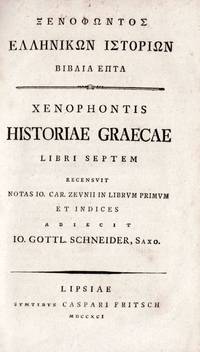
179132385AB1791. Bilingual in Greek and Latin. Leipzig Caspar Fritsch 1791. Octavo. XX 474 pages plus 28 unnumbered pages of an Index. Hardcover / Binding expertly restored by using the original full leather with gilt lettering on spine and boards. In protective Mylar. Very good condition with only minor signs of wear. Some pages unopened. From the library of Daniel Conner Connerville / Manch House with his Exlibris / Bookplate to pastedown. Xenophon of Athens c. 430 355/354 BC was a Greek military leader philosopher and historian. At the age of 30 he was elected as one of the leaders of the retreating Greek mercenaries the Ten Thousand who had been part of Cyrus the Younger's attempt to seize control of the Achaemenid Empire. As the military historian Theodore Ayrault Dodge wrote "the centuries since have devised nothing to surpass the genius of this warrior". For at least two millennia it has been debated whether Xenophon was first and foremost a general historian or philosopher. For the majority of time in the past two millennia Xenophon was recognised as a philosopher. Quintilian in The Orator's Education discusses the most prominent historians orators and philosophers as examples of eloquence and recognises Xenophon's historical work but ultimately places Xenophon next to Plato as a philosopher. Today Xenophon is recognised as one of the greatest writers of antiquity. Xenophon's works span multiple genres and are written in plain Attic Greek which is why they have often been used in translation exercises for contemporary students of the Ancient Greek language. In the Lives and Opinions of Eminent Philosophers Diogenes Laërtius observed that Xenophon was known as the "Attic Muse" because of the sweetness of his diction. Despite being born an Athenian citizen Xenophon came to be associated with Sparta the traditional opponent of Athens. Much of what is known today about the Spartan society comes from Xenophon's royal biography of the Spartan king Agesilaus and the Constitution of the Lacedaemonians. The sub-satrap Mania is primarily known through Xenophon's writings. Xenophon's Anabasis recounts his adventures with the Ten Thousand while in the service of Cyrus the Younger Cyrus's failed campaign to claim the Persian throne from Artaxerxes II of Persia and the return of Greek mercenaries after Cyrus's death in the Battle of Cunaxa. Xenophon wrote Cyropaedia outlining both military and political methods used by Cyrus the Great to conquer the Neo-Babylonian Empire in 539 BC. Anabasis and Cyropaedia inspired Alexander the Great and other Greeks to conquer Babylon and the Achaemenid Empire in 331 BC. The Hellenica continues directly from the final sentence of Thucydides' History of the Peloponnesian War covering the last seven years of the Peloponnesian War 431404 BC and the subsequent forty-two years 404362 BC ending with the Second Battle of Mantinea. Xenophon's writings on military strategies remain influential and are believed to be among the first to utilise and describe flanking manoeuvres and feints in military tactics. Wikipedia hardcover