MareMagnum

34 054 résultats
In-8 gr. Di questa fondamentale rivista di storia locale lombarda offriamo una "raccolta completa" di 139 annate - dal 1874 (Anno I) al 2014. La collezione è per lo più rilegata in elegante mz. pelle rossa, mentre alcune annate sono in brossura editoriale e 12 annate in cartonato moderno. Dal 1874 al 1947 l'"Archivio Storico Lombardo" si pubblicò annualmente in 4 fascicoli. Dal 1948/49 - Serie Ottava - solo in un volume all’anno. Tracce d’uso alle prime 4 annate in brossura e ai volumi in cartonato, ben conservati i volumi in mz. pelle: di certo complessivamente un buon esemplare.
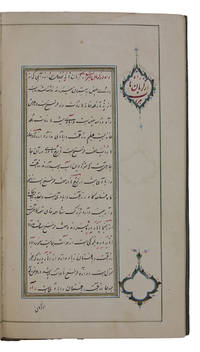
1850ABC_47715Qajar Iran 1850. Contemporary limp leather and woven floral-patterned cloth. 8vo 12.5 x 22 cm. Persian manuscript on polished paper. Black nasta'liq script in 15 lines per page ruled in green and blue with rubricated chapter headings and marginal medallions. A beautifully presented Persian manuscript comprising a unique guide to the barren crossing from Kerman to Kandahar in mid-19th century Qajar Persia. The guide perhaps actually used by two Russian owners whose inscriptions are extant on the front free endpaper in fact covers several routes through what is today south-eastern Iran and western Afghanistan providing reliable information on distances water sources and other relevant data. For instance a reader is told the number of houses in the most populated villages - and consequently the odds of spending the night sheltered indoors at a host's home. - The journey begins in the town of Kerman originally founded as a Sasanian outpost and proceeds to explain one's options to travel to the ancient city of Kandahar; also included are several other routes. The distances daily destinations and road options are all covered in detail for each journey. Apart from these practicalities a traveller also receives tips on the shrines or other tourist spots one might visit on a given day of travel.With two inscriptions in pre-reform Russian cursive on the front free endpaper dated 1855 and 1917. The first inscription appears to be a translation for the benefit of a Minister of the Russian Empire. The second mentions a journey across Afghanistan and Baluchistan possibly with the aid of this very manuscript or perhaps it was a souvenir. Certainly an interesting piece of travel writing and one designed not solely for the armchair traveller. Light wear to cloth though it is remarkably unfaded. Aside from one minor dampstain interior is bright and clean. hardcover
In-4, [12] ll. (incl. frontispiece), 689 pp., [9] ll., engraved title-page, full-page coat of arms of the dedicatee on the verso of the title, 12 copper-engraved plates; contemporary vellum, ms. title stamp, one clasp remaining, blue edges (tiny stain touching some margins, very rare sporadic browning, small cover defects). Genuine beautiful copy.
1978mon0000032636TV Guide 1978T. single_issue_magazine. Very Good. in x in x in. Robert Urich of Vegas photo cover. NO mailing label. Evansville-Paducah edition. TV Guide unknown
15244376Lyon: Claude Nourry 1524. Small 8vo 131 x 93 mm.  16 leaves. Collation: A-B8 A1r title A1v blank A2r text B8r explicit Explicit iste liber gemmis qui charior extat B8v blank. Title in two lines Cura clericalis in very large type / Lege relege in the larger of the two text types title woodcut of a scribe at his pulpit 54 x 70 mm. break in left border; the cut worn or poorly printed. Rounded French gothic types in two sizes. Text type G76 27 lines and headline. One 5-line white on black floral initial. Printing flaw on B4v obscuring a couple of letters; traces of adhesion on same page opening else in fine condition. 19th-century dark blue morocco by Cuzin sides and spine blind-paneled with gilt fleurons spine lettered in gilt turn-ins gilt gilt edges ribbon marker. Provenance: Fernand Gaulthier armorial bookplate.<br /> <br /> A rare Lyonese edition of a popular pocket guidebook for priests.<br /> <br /> A succinct survey of every aspect of the priesthood the text opens with the meaning of sacerdos priest a definition of the job: the care and salvation of human souls and the requirements for fulfilling this office: basic literacy and the ability to express oneself correctly. From abstract concepts to practical applications the fundamental tenets of the Christian Church are methodically reviewed: the articles of faith seven deadly sins cardinal and theological virtues three keys of the church three parts of penitence etc. as are the different kinds of sacraments the materials used for them and their meanings and the various clerical offices. The telegraphically short entries with abundant use in this small format edition of abbreviations permitted the inclusion of a vast amount of indispensable knowledge for the practicing priest. The last third of the text is devoted to an equally condensed introduction to the Computus with headline Abbreviatio compoti the all-important calculation of time based on the yearly date of Easter; it includes mnemonic verses and syllables. <br /> <br /> “The Cura clericalis reflecting the received wisdom on the subject defined four rules for the priest. He was to be a celebrant of Masses and so needed to understand the basic texts and to be able to pronounce the Latin grammatically and clearly. He must be a minister of the other sacraments and so needed to know what and how many they were to grasp the essential matter of the sacrament and be able to distinguish it from the peripheral features and to know the proper mode of administration. He was to be a confessor and so must above all be able to distinguish venial from deadly sin . Finally he was to be a ‘plebis doctor’ the teacher of his people able to instruct them in the articles of faith and the other precepts of God†E. Duffy The Stripping of the Altars: Traditional Religion in England 1400–1580 New Haven 2005 p. 57. <br /> <br /> Dozens of editions are recorded most surviving in one or two copies and some with no currently known locations. ISTC records nine incunable editions printed from ca. 1492-4 to 1500 all but one undated of which 8 from Germany and one printed in Paris. In the next century the earliest editions appeared in the northern Rhine and France and later in England and Italy. Pettegree and Walsby list 30 editions printed in France from ca. 1511 to 1580 French Books III & IV: Books Published in France Before 1601 in Latin and Languages Other Than French 2011 637490-63778. <br /> <br /> The anonymous printer of this edition of which one other copy is known Besançon Municipal Library was Claude Nourry as recently identified by Dr. Helwi Blom whom we thank for her kind assistance. Much of Nourry’s output was published without his name and he printed many editions without the place or date of printing. He issued another edition with full colophon in 1524 Baudrier 12 129; Gültlingen 1 86: 113; USTC 130305 but no present locations for that edition are known. The title woodblock was used in other Nourry editions including his 1523 Beroaldo Carmen lugubre de dominicae Passionis die USTC 130303 and the initial C on A2r appeared in editions from 1520.<br /> <br /> Not in Baudrier Gültlingen or USTC. Helwi Blom “Le Profil du Prince: Tendances et évolutions dans la production imprimée de Claude Nourry d’après un nouveau recensement bibliographique†in H. Blom M. Clément F. Montorsi editors Du Calendrier des bergers au Pantagruel Geneva: Droz 2024 p. 53 no. 27. Claude Nourry unknown
In-folio, 57 ll., 1bl.; engraved title and 51 full-page engraved plates, giving geodetic and cosmographic instruments and measurements; woodcut ornate initials and tailpieces, large Aldus anchor woodcut device at the end. Bound in contemporary cartonnage (reliure d'attente), with weak hinges; occasional light foxing, light dampstain at the bottom of the last leaves. Despite the title the work includes 50 full-page engravings, of which the last 7 are a supplement by Scala and are especially devoted to architecture and perspective.
Fine Turkish, Ottoman (1500-1928) Modern light brown cloth bdg. gilt lettering on the front board. [1], 99 p., 36 numbered maps printed in black and red ink, 5 numbered folded plates. A fine copy. First and only edition of this extremely rare atlas in user guide form including the instructions and descriptions of the routes of vessels by an advisor of the British naval officer and German prince related to the British royal family, Prince Louis Alexander of Battenberg (1854-1921), who was the first Marquess of Milford Haven, commanded the Atlantic Fleet from 1908 to 1910 and became first sea lord in 1912. This book was translated by Nusret, who was a lieutenant in the Ottoman Naval Forces in its period and prepared only for use of Turkish naval officers. The plates include the maneuver plate of an officer named "Martin", who is not able to be recognized. Every map and plate depending on the current position of the ship has its own descriptive text. Özege 12270.; Not in OCLC and Library Hub.
182312774Madrid: Imprenta Nacional 1823. 146x97mm. 5¾x3¾". Madrid Imprenta Nacional 1823. 2 obras en un volumen. En 8º 146 x 97mm. -I: 2 retratos portada grabada 141 pp. 1 bl. -II: Portada grabada 227 pp. 1 gran mapa plegado. MagnÃfica encuadernación heráldica española de la época estilo Neoclásico en marroquén rojo ricamente decorada con grecas hierros y ruedas doradas en los planos anagrama real en el centro "F A" con la corona real arriba lomera con ruedas hierros dorados y tejuelo en marroquén verde cantos con rueda dorada contracantos ricamente decorados con ruedas y hierros dorados en el centro muaré azul con rueda a los lados. Atribuida a Antonio Suárez. Primera edición de esta bellÃsima GuÃa de Forasteros de Madrid y GuÃa Militar de España de procedencia real de la Biblioteca de Palacio vendida como duplicado según sello en tinta al verso de la guarda. Publicación de periodicidad anual fundada en 1722 por Luis Félix de Miraval y SpÃnola y que hasta 1734 se titula Kalendario particular. A partir de 1725 su impresor será Juan Sanz; después lo serán sus herederos y desde 1730 Antonio Sanz su sobrino que en 1769 cederá los derechos a la Corona española a cambio de una pensión vitalicia. Se trata de una guÃa completÃsima de la Administración del Estado. Desde 1768 le acompañará el Estado militar de España con portada propia con los nombres de los capitanes y tenientes generales del Ejército de Su Magestad mariscales de campo brigadieres y oficiales de Marina etc. En la edición de 1767 comienza a incluir grabados como los de Carlos III los PrÃncipes de Asturias o el del Palacio de Aranjuez y después los de Carlos IV y la reina Maria Luisa para en el siglo XIX incluir los de Fernando VII y los de su hija la joven reina Isabel II. Asimismo llegará a estampar una docena de mapas de España y planos de Tomás López y sus hijos. Durante la invasión del ejército napoleónico el kalendario no aparecerá en 1809 ni en 1810 y para 1811 saldrá de la Imprenta de D. Miguel Segovia impresor de la Real Marina desde la Real Isla de León en Cádiz y se titulará GuÃa patriótica de España. Las de 1812 y 1813 se titularán GuÃa polÃtica de las Españas y es también impresa en Cádiz la primera en la oficina de la viuda de Comes y la segunda en la Imprenta Nacional. Al regreso de Fernando VII retornará de nuevo a su tÃtulo anterior y a prácticamente a los mismos contenidos que publicaba durante el antiguo régimen hasta que durante el trienio liberal modifica otra vez su cabecera y algunos de sus contenidos al incluir de nuevo la relación de diputados a Cortes y las nuevas instituciones administrativas que el incipiente Estado liberal comienza a crear. En 1821 se titula GuÃa de forasteros en Madrid y en 1822 y 1823 GuÃa polÃtica y militar estampándose en la denominada Imprenta Nacional antes Imprenta Real. Por su parte el Estado militar de España que venÃa publicándose conjuntamente con el<em> kalendario</em> en 1821 1822 y 1823 se titulará Estado de los ejércitos de la monarquÃa española. Excelente ejemplar muy bien encuadernado y de procedencia real. Encuadernación atribuida a Antonio Suárez. Imprenta Nacional unknown
In-4 p. (mm. 292x214), mz. pelle coeva, fregi e tit. oro al dorso (lievi abras.), pp. (4),430,(2), molto ben illustrato f.t. (come da Indice) da 54 pregevoli tavole di vedute, litografate su fondo paglierino, tutte dettagliatam. descritte; ai monumenti antichi fanno seguito quelli del medio evo, quindi i moderni. L'opera è stata pubblicata a fascicoli, con cadenza settimanale. Il testo, curato da Giacinto Longoni, è racchiuso in delicata cornice con angoli floreali. E' questo uno dei libri più ricercati dell'Ottocento sia per le notizie sui monumenti di Milano sia per le animate incisioni, spesso di luoghi poco rappresentati fino allora. Cfr. Villa “Bibl. delle Guide di Milano”,236 - Predari, p. 14. Con fiorit. più o meno lievi, altrim. ben conservato.
<p>in 8°, (19x13) cm, rilegatura coeva in piena pergamena, titolo in oro incorniciato al dorso; p. (16), 672. Complessivamente 70 tavole di cui: antiporta, 3 grandi carte geografiche più volte ripiegate e 66 belle incisioni di vedute di città ripiegate più volte fuori testo. Bell'esemplare raro da trovarsi completo di tutte le tavole</p>
Very Good Russian Original dark green cloth bdg. Oblong folio. (28 x 36 cm). Eight languages of the title on the colophon, the text is completely Russian. [6], [ii], 108 p., [36] maps in various sizes, some of folded: (62x47 cm, 52,5x45,5 cm, 49,5x27 cm [x3], 61x47 cm; other maps are 36x28 cm). Four unnumbered leaves with half-title and contents for each section. Two small millimetric cuttings on two text pages. Ex-owner's name is on the title page. Markings on the index. Otherwise a very good and clean copy. Rare complete and the first atlas including a fine collection of 36 attractive chromo-lithograph maps mostly with tissue papers of the Soviet Union, edited by the Central Executive Committee and Enukidze (1877-1937), who was a prominent Georgian "Old Bolshevik". One of 11000 copies. Being published only 10 years after the USSR was established, this is the earliest atlas of the country. It seems to have been published with a wider audience in mind, with a title page in various European languages. The borders of many areas -including not just administrative regions throughout the USSR, but also entire autonomous republics (especially in Central Asia)- were in a state of flux; as such, the borders in this Atlas (including the wax-paper overlays meant to update various maps with changes made between when they were drawn and when the Atlas was published) often don't look anything like the borders they were set at the end of the Soviet Union and have continued on to modern times. Since the boundaries were often ideologically- (sometimes ethnically-, less so economically-) motivated, this offers an interesting insight into the mindset of the administration that was making these changes. Map list: World map, General USSR, USSR in Europe, Asia and USSR, Karelian Autonomous Soviet Socialist Republic, Komi-Zyryan Autonomous Oblast, Avt, Votskaya Oblast, Maryinskaya, Cherepovetsky District, Vologda Oblast, Avt. Chuvashskaya SSR (Chuvashia), Avt. Tatarskaya SSR (Tatarstan), Avt. Bashkirskaya SSR (Bashkiria), ASSR Nemchev Povoljiya, Kalmykia (Kalmykia), Krimskaya SSR (Crimea), Adigeiskaya (Tscherkeskaya) Obl. (Cherkesia), Kabardino-Balkarskaya Avt. Obl. (Kabardino-Balkarian Rep.), Karachayskaya Avt. Obl. & Tscherkesskiy Nation. Okrug (Karachay-Cherkessia), Chechenskaya Avt. Obl. (Chechnya), Ingushetiya, Severo-Osetiya, Avt. Daghestanskaya SSR, Avt. Kazakskaya SSR, Kyrgyzkaya ASSR, Avt. Oiuratskaya Oblast, Burito - Mongolskaya SSR (Kazakhstan), Avt. Yakustkaya SSR (Yakutia), Beloruskaya SSR (Belarus), Ukrainskaya, SSR (Ukraine), Moldavskaya SSR (Moldovia), Zakavkazkaya SSR (Abkhazia), Azerbaijanskaya SSR (Azerbaijan), Arminskaya SSR (Armenia), SSR Gruzii (Georgia), Central Asian SSR (Karakalpakstan, Kyrgyzstan, Turkmenistan, Uzbekistan), Uzbekistan, Turkmenistan. OCLC shows copies in twenty-three libraries worldwide: 7852120, 968755133, and 822577467.
<p>in 8°, (18x11,5 cm), antica rilegatura in pergamena, titolo manoscritto al dorso; 1 c.b, pp. xii, 419 (1); incisione allegorica all'antiporta, vignetta incisa al frontespizio, 26 tavole ripiegate fuori testo (aperte 17,5x22 cm). Le carte rappresentano nell'ordine: Roma, carta geografica del'Italia, Trento, Venezia, Padova, Vicenza, Verona, Brescia, Milano, Parma, Bologna, Firenze, Lucca, Livorno, Siena, Civitavecchia, Genova, Mantova, Ferrara, Urbino, Ancona, Loreto, Napoli, Pozzuoli, Bacoli, Cuma</p>
In 8° (mm 160x110); 8 cc. nn (manca l'antiporta), 343 pp., 4 cc. nn. Bella veduta a volo d'uccello di Venezia su doppia pagina fuori elenco e 70 vedute della città su 42 tavole f.t., di cui 25 a doppia pagina, finemente incise in rame da Francesco Zucchi. Piacevole legatura di inizio Ottocento in mezza pelle con filetti, titolo e piccoli fregi al dorso, piatti in carta marmorizzata, dorso a quattro scomparti, tagli a spruzzo. Edizione originale rara e ricercata di questa nota guida storico-artistica, in seguito ristampata piu' volte. Le vedute raffigurano tutti i più importanti monumenti e scorci della città con fascino e ricchezza di particolari: palazzi, chiese, piazze animate da figure, il ponte di Rialto, la laguna con velieri e gondole. Il testo descrive minuziosamente la città. Mancano rispetto all'elenco originale due tavole a foglio singolo con la stampa 12 "Veduta dell'orologio" e 13 "Chiesa di S. Ziminiano", 29 "Ospitale dei mendicanti" e 31 "Ospitale dei SS. Gio. e Paolo", sostituite da altre 2 tavole, doppie, fuori elenco, ognuna con due vedute, su carta leggermente più spessa: "Veduta dell'orologio nella piazza di S.Marco", "Chiesa di S. Geminiano", "Chiesa di S. Nicolò di Castello e Seminario Ducale", "Monastero dell cappuccine e chiesa di S. Antonio…". Ottimo esemplare con la veduta di Venezia come al solito con margini brevi e pieghe editoriali. Schlosser, p. 563: "Specialmente notevole...". Morazzoni, pag. 230 e 64-65: "La guida che tutte le altre supera per praticita" di notizie e soprattutto per la ricchezza delle tavole...". Fossati-Bellani 2277. Cicogna, 4479. <BR>
Z1-C-023-01793APA Publications Pte Ltd. Used - Good. Ships from UK in 48 hours or less usually same day. Your purchase helps support Sri Lankan Children's Charity 'The Rainbow Centre'. Ex-library so some stamps and wear but in good overall condition. May contain underlining and/or highlighting. 100% money back guarantee. We are a world class secondhand bookstore based in Hertfordshire United Kingdom and specialize in high quality textbooks across an enormous variety of subjects. We aim to provide a vast range of textbooks rare and collectible books at a great price. Our donations to The Rainbow Centre have helped provide an education and a safe haven to hundreds of children who live in appalling conditions. We provide a 100% money back guarantee and are dedicated to providing our customers with the highest standards of service in the bookselling industry. APA Publications Pte Ltd unknown
In-8°; pp. (16), 215, cc. (8), 64. Con due frontespizi con marca tipografica. Legatura in piena pergamena molle coeva, tracce di usura. E’ la prima edizione con le due opere insieme, e la prima della Dichiaratione. La prima opera è una guida artistica e storica della città di Venezia, concepita sotto forma di dialogo tra un Veneziano e un Forestiero; Schlosser, p. 321: “In questo periodo Venezia è già da lungo tempi la città dei forestieri per eccellenza...Il libretot veramente tascabile deve fornire tutte le cognizioni necessarie al forestiero; è redatto nella forma dialogata che ritornerà anche in seguito nella letteratrua delle guide... Un particolare valore di fonte ha la descrizione delle pitture del palazzo Ducale distrutte dal fuoco nel 1577, tanto più che Sansovino stesso ne aveva fatto una parte del programma letterario... Spiegazioni che riguardano solamente il puro contenuto ci dà un altro scrittore, pure di origine fiorentina, Girolamo Bardi, delle storie dipinte (1587) nella Sala del Gran Consiglio al Palazzo Ducale dopo l’incendio del 1577” (p. 321). La seconda opera qui unita in edizione originale descrive le pitture della Sala dello Scrutinio e del Gran Consiglio nel Palazzo Ducale, compresa un’opera del Tintoretto. Francesco Sansovino (1521-1586), nato a Roma, fu uomo di lettere, erudito e storico, la cui fama è legata anche alle descrizioni di Venezia, e alla divulgazione storica che attuò anche attraverso queste opere. Cicognara 4338; Lozzi 5895; Schlosser, 1935, pp. 330, 486. Alcune carte leggermente brunite.
Volume in 8vo, comprendente due parti in unico tomo (opera completa). Parte Prima (contiene i primi cinque libri). In Venetia, presso Gio. Batt. Pulciani Sanese, 1625. Front. con marca tipografica (stemma mediceo a sei palle sormontato da corona e con quattro figure allegoriche), dedicataria al Serenissimo Don Ferdinando Secondo de Medici Gran Duca di Toscana, scritta dalla seconda consorte del Fu Tommasi, signora Livia Cinuzzi, datata 10 agosto 1625, e in cui si spiega la volontà di offrire il lavoro del marito, prematuramente scomparso, prima di aver compiuta l'opera (al verso un sonetto scritto all'Autore, in Persona della Signora Livia Cinuzzi sua Consorte, "Sonetto del Signor Giulio Piccolomini Accademico Filomato"), antip. con bel ritratto finemente inciso a piena pagina del Tommasi (con monogramma VS), pp. 12 n. n. con la "Tavola delle Cose più Notabili", pp. 338 (segnatura A - X5); Parte seconda (contiene il libri dal sesto al decimo). In Venetia, presso Gio. Batt. Pulciani Sanese, 1626. Front. con marca tipografica (stemma mediceo a sei palle sormontato da corona e con quattro figure allegoriche), dedicataria al Serenissimo Don Ferdinando Secondo de Medici Gran Duca di Toscana, scritta dalla consorte del Fu Tommasi, signora Livia Cinuzzi, datata 20 dicembre 1626 e in cui si offre questa seconda parte delle Historie sperando che, animata dal favore, prenderà animo di presentare ancora la terza (al verso un sonetto scritto dall'Autore Alla Signora Livia Cinuzzi, in persona dell'Autore suo Marito, "Sonetto del Signor Giulio Piccolomini Accademico Filomato") antip. con bel ritratto finemente inciso a piena pagina del Tommasi (con monogramma VS), pp. 12 n. n. con la "Tavola delle Cose più Notabili, Errori e Correzioni", pp. 340 + (3) ("Lo Stampatore a' benigni Lettori - Errori e correzioni) (segnatura A – X5). Legatura originale in piena pergamena floscia con titolo manoscritto al dorso e riportato al taglio inferiore. L'opera contiene, cosa assai rara, entrambi i ritratti in calcografia (Cfr. Lozzi, II, 5128; Moreni, II, 399; Piantanida, 3734 per il secondo volume). La stesura delle "Historie" occupò gli ultimi anni della sua vita e la ricostruzione dell’attività di ricerca documentale ci mostra la sua presenza in archivio per il decennio che va dal febbraio del 1592 a tutto il dicembre del 1602 (Lisini, 1896). La morte lo colse prima della rifinitura dell’opera, e in particolare della sua seconda deca, e cadde in una fase di perdita di vitalità dell’editoria senese. La prima deca, che tratta la storia della città dalle origini al 1355, fu pubblicata a Venezia dal tipografo senese Giovanni Battista Pulciani in due volumi nel 1625 e nel 1626. Entrambi sono dedicati dalla vedova, la seconda moglie Livia Cinuzzi, al granduca Ferdinando II, con le date 10 agosto 1625 e 20 dicembre 1626. Nella seconda dedica la vedova prometteva al granduca: «animata dal suo favore, prenderò l’animo di presentarle ancora la terza, quando dalle mie deboli forze ciò mi sia conceduto». E, in effetti, fu la morte, il 28 maggio 1628, a impedire il completamento del progetto. La seconda deca delle "Historie", che tratta del periodo 1355 - 53, ha visto la luce a stampa, a cura di Mario De Gregorio, suddivisa in quattro volumi (2002 - 2007). Prima ancora della pubblicazione, postuma, e fino ai contributi storiografici più recenti (Ascheri, 2000), la Storia di Tommasi è stata messa in parallelo, e a confronto, con quella di Orlando Malavolti, in considerazione della opposta affiliazione delle due famiglie al Monte dei nove e al Monte dei grandi, e della comprensibile, opposta partigianeria dei due storici. A dare avvio a questo filone interpretativo, proseguito fino al presente, è stata la ricostruzione della stessa genesi dell’opera di Tommasi da parte di Ugurgieri Azzolini (1649): «Havendo egli letto l’Istoria di Siena stampata dal Malvolti, e parendogli, che egli attribuisse troppo d’honore alle famiglie Grandi, e che havesse abbassato l’altre, ed in particolare quelle del Monde de’ Nove, delle quali è la consorteria de’ Tommasi...» (p. 636). Per quanto Tommasi non citi mai l’opera di Malavolti, non nasconde certo le proprie simpatie "novesche" che emergono fin dalle prime righe della seconda deca, riferite al violento cambio politico del 1355: "Così variò il governo, e lo stato di Siena né passò dalla servitù alla libertà, come il minuto populo s’era persuaso, e s’andava vantando, ma dal governo di pochi (tal’era divenuto il reggimento de’ Nove) alla licenza della plebe condotta la prima volta dall’ambizione de’ Grandi al governo della Repubblica" (Dell’historie di Siena..., a cura di M. De Gregorio, 2002 -2007, I, p. 1). La struttura annalistica, l’inaffidabilità di alcune fonti per le epoche più antiche già rilevata da Giovanni Niccolò Bandiera, il ricorso a una documentazione archivistica meno ampia di quella di Malavolti e senza riferimenti puntuali (Cammarosano, 1988) se non rendono le "Historie di Siena " di Tommasi un’opera metodologicamente innovativa non cancellano però il suo interesse e la sua utilità per la riflessione moderna sulla storia della città (Bibliogr. "Treccani" on line). Un piccolo lavoro di tarlo, a circa sette cm dal basso, interessa i primi tre fogli (front. e dedicataria) facendo mancare solo poche sillabe, alcune antiche annotazioni e cancellature al front., ritratti ottimamente impressi, ben impresso anche tutto il testo che presenta solo alcune pagine leggermente più schiarite, leg. in parte allentata ma distesa e ben conservata. Nell'insieme un bell'esemplare.
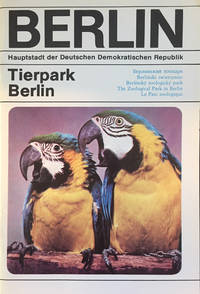
16299A group of 35 zoo guides showcasing the animals and environments of various zoos around the world over the past century. It is quite amazing to see the evolution of the zoo especially the balance between protection and care of its animals on the one hand and the interests of the paying public over the years. A wonderful collection. <br /> <br /> NEW YORK<br /> HORNADAY William. Popular official guide to the New York Zoological Park. New York Zoological Society 1923.<br /> HORNADAY William. Official guide book to the New York Zoological Park. New York Zoological Society 1927.<br /> <br /> BERLIN<br /> Berlin Zoo Guides 1914-1941. HED L. Führer durch den Berliner zoologischen Garten. Verlag des zoologischen Gartens zu Berlin 1914.<br /> bound with<br /> Wegweiser durch den zoologischen Garten Berlin. Actien-Verein des zoologischen Gartens zu Berlin 1925; 1936; 1937; 1939; 1941. Six works bound together.<br /> Ansichten aus dem Zoologischen Garten zu Berlin. Berlin: Julius Sittinfeld n.d. Colored illustrations of the Berlin Zoological Gardens between 1873-1900.<br /> Der Zoologische Garten in Berlin. ca. 1915. Album of 20 tipped-in photographs.<br /> DATHE Heinrich. Tierpark Berlin 1975.<br /> Der Tierpark Berlin. Leipzig: Andersen Nexö 1985.<br /> Wegweiser durch den Zoologischen Garten Berlin und sein Aquarium. Lange 2004.<br /> LANGE Jürgen. Der Begleiter durch den Zoo Berlin und sein Aquarium 2007. <br /> <br /> LONDON<br /> MITCHELL P. Chalmers. Guide to the zoological gardens Regent’s Park. London: Zoological Society of London 1906. <br /> MITCHELL P. Chalmers. Official guide to the gardens of the zoological society of London. London: Offices of the Zoological Society of London 1921. <br /> bound with<br /> Illustrated official guide to the London Zoological Society’s gardens in Regent’s Park 1926.<br /> <br /> LEIPZIG<br /> SCHNEIDER Karl Max. Vom Leipziger Zoo aus der Entwicklung einer Volksbildungsstatte. Leipzig: Geest & Portig 1953.<br /> <br /> AUSTRALIA<br /> HEDLEY Charles. Wild animals of the World being a popular guide to Taronga zoological park. Sydney: William Brooks n.d.<br /> <br /> CINCINNATI<br /> Studies in zoology. Cincinnati Zoological Gardens 1900.<br /> STEPHAN Sol A. Cincinnati zoo guide. All information on animals and birds. Cincinnati Zoological Park Association 1928. <br /> Album of the zoological garden of Cincinnati. Cincinnati: Krebs lithography company.<br /> <br /> VIENNA<br /> ANTONIUS Otto. Führer durch dem Schönbrunner Tiergarten Wien. Hilfswerk f.d. Schonbrunner Tiergarten. <br /> <br /> SAN DIEGO<br /> SQUIER; BRANSBY. Whose zoo in San Diego 1933 .<br /> Official Guide Book of the San Diego Zoo. Third ed. San Diego: Zoological Society 1947. <br /> Official Guide Book of the San Diego Zoo. Fifth ed. San Diego: Zoological Society 1947. <br /> Official Guide Book of the San Diego Zoo. Sixth ed. San Diego: Zoological Society 1947.<br /> Visitor’s map San Diego Zoo & Balboa Park 1962.<br /> <br /> MÜNICH<br /> HECK H. Führer durch den Tierpark Hellabrunn Geo-Zoo München. München<br /> <br /> SOUTH AFRICA<br /> BIGALKE Rudolph. The National Zoological Gardens of South Africa. South Africa: central news agency 1954. <br /> <br /> FRANKFURT<br /> PRIEMEL Kurt. Ein Rundgang durcch den Frankfurter Zoo. Frankfurt am Main: Zoo Verlag: 1934.<br /> <br /> HAMBURG<br /> Führer durch Carl Hagenbecks Tierpark. Hamburg: Carl Hagenbecks Eigentum und Verlag 1929.<br /> <br /> AMSTERDAM<br /> Koninklijk Zoölogisch Genootschap Natura Artis Magistra. Amsterdam 1910. <br /> Koninklijk Zoölogisch Genootschap Natura Artis Magistra. 1910. <br /> <br /> KRONBERG<br /> Unsere Tiere. Ein Führer durch das Georg von Opel-Freigehege für Tierforschung in Kronberg. unknown
Very Good Turkish, Ottoman (1500-1928) Original bdg. 4to. (28 x 24 cm). In Ottoman script (Old Turkish with Arabic letters). 24 p. First and only edition of this scarce atlas printed in Leipzig for the Ottoman market before the proclamation of the Republic, distributed by Jewish agent A. M. Karmi of this atlas located in Dersaadet (Constantinople), including beautiful and attractive 34 chromo-lithographed maps of Africa, Australia, Americas, Europe, Turkey, Asia, and a celestial map. Özege 8803.; Only two copies in OCLC: 632952950, 949536147 (the Bogaziçi University of Turkey and Universitätsbibliothek Bamberg of Germany).
5 volumi in-8° (cm. 16,3), legatura coeva in m. pelle con titolo e decorazioni in oro ai dorsi, piatti marmorizzati, tagli spruzzati; carte in ottimo stato e fresche come da bibliografia; con 47 tavole f.t. incise da Johann Georg Seiller, anch'esse in stato ottimale, con la sola assenza del prospetto/indice delle tavole (presente la grande pianta della città); alcune silografie n.t.. Prima edizione di questa celebre storia di Milano corredata da un ricco apparato iconografico dovuto al Ferroni. «Libro il più pregevole del diciottesimo secolo per la copiosità delle notizie, l'esattezza, i buoni riferimenti estetici e lo stile familiare e chiaro» [Villa 36]. Cicognara 4242; Predari 13; Fossati-Bellani II, 1938. Ottimo esemplare.
Very Good French Original handsome leather bindings. Demy 8vo. (22 x 14 cm). In French and Ottoman script. 4 volumes set: ([vi], [2], 784, 125 p., [vi], 1372 p.; [xxx], [2], 1097 p., [vi], 1320 p.). Slight foxing on pages, faded on boards, otherwise a very good set. Ex-libris of Izzet Gündag Kayaoglu. First edition of the complete set of this early dictionary from French to Turkish and from Turkish to French, published in Paris, in London Oriental Translations Committee Printer. Bianchi visited Istanbul at the beginning of the 19th century and prepared dictionary and phrasebooks in Turkish after he had returned to his country. One of his most significant works occurs to be this dictionary. What makes this dictionary noteworthy among other his works is the fact that Turkish words are written together in both Arabic and Latin characters. Turkish words with Arabic letters are written as to stereotyped pronunciation in the work. Therefore, they do not indicate the changes in the language. Bianchi reflects the pronunciation of writing in Turkish letters with Latin characters; and thus, the differences between spelling and pronunciation are highlighted. Thomas-Xavier de Bianchi (1783-1864), born in Paris on June 25, 1783, was the younger brother of the Austrian Field Marshal de Bianchi, Duke of Casalanza. He studied at the Central School of the department of Seine-et-Marne and followed, in Paris, oriental language courses at the College de France and at the Imperial Library under Sylvestre de Sacy. In 1807, he was appointed a pupil at the French school of young people of language in Constantinople, then directed by the scholar Ducaurroy and completed his improvement in Arabic, Persian and Turkish. Sent to Izmir in 1811, he was second there, and then the first dragoman of the Consulate General, and was noted for his dedication during the plague epidemic of 1812. In 1816, he was appointed assistant to the King's secretary-interpreters in Paris and was in charge to accompany the Persian envoy to Louis XVIII in 1819. In 1829, he was sent on a mission to the last day of Algiers, Hussein-pasha. The following year, France intervened in Algeria. He was appointed secretary-interpreter in the title and served as professor of Turkish at the School of Oriental Languages until 1842. After his retirement, he devoted himself to lexicographical and bibliographical work. He was an officer of the Legion of Honor, decorated with the Nichan-Iftikhar, as a member of the Imperial Academy of Constantinople. Tout exemplaire de ce Dictionnaire qui ne serait pas revetu de la signature de l'un des auteurs et editeurs sera repute contrefaçon, et poursuivi cmme tel, en vertu de la loi du 19 juillet 1793. [i.e. Any copy of this Dictionary which does not bear the signature of one of the authors and publishers will be deemed to be counterfeit, and prosecuted as such, under the law of July 19, 1793].
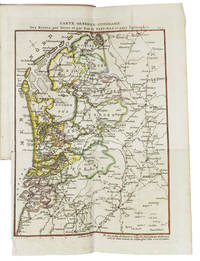
1815ABC_46389Amsterdam 1815. 12mo. Evert Maaskamp Original publisher's blue paper wrappers over boards. With an engraved title page including a vignette showing the Amsterdam publishing house of Evert Maaskamp 3 folding maps 1 folding plate showing coins 16 double-page maps and 2 full-page plates; all coloured by a contemporary hand. 2 380 XXII 10 pp. Very rare first edition of a rare early interesting and charming travel guide for The Netherlands containing three folding maps: a Carte generale itineraire. des routes du Pays Bas a Carte des routes entre Paris Londres et Amsterdam and a Carte generale de la Hollande 16 double-page maps and plans including a Carte itineraire des environs d'Amsterdam Carte itineraire d'Amsterdam à Haarlem et Leiden Les environs de Haarlem and a Plan itineraire d'Amsterdam Carte itinéraire dAnvers a Breda etc. all including the roads waterways and distances. The text starts with a Table des distances and the descriptions of 29 different routes mostly to and from places within the Netherlands but no. 29 is a description of a route from Amsterdam to Paris all including the number of postes indicated pp. 1-31. Manière de voyager follows on pp. 32-41 with interesting details on distances prices ways of travelling by diligence post coach horse-drawn canal barge etc. Pp. 42-380 contain accounts of the money industries agriculture products schools and universities dress customs societies cafés colleges and everything else you might wish to know. Further descriptions of the cities and villages followed by a Table de matières and Table des cartes etc. on pp. i-xxii. With the bookplate of John Murison on the front paste-down. Binding worn and shaved especially around the spine. Otherwise in good condition and untrimmed.l Cf. Koeman Atlantes Neerl. II p. 271 Maa 1-2. hardcover
Very Good Turkish, Ottoman (1500-1928) Original b/w map from Kitab-i Cihannuma which is one of the most important Turkish incunabula. Oblong large 4to. (31 x 37 cm). In Ottoman script. It shows Venice and Venetian Bay and Algerian shores at North Africa (Maghrib). Toponyms are in Turkish with Arabic letters. Written directions (Simal, Cenûb, Sark and Garb) on corners of the map, and decorative compass on Mediterranean Sea. Scale can be seen at left upper side (El-mikyas: Mil-i Islâmiyân Mil-i Frençe, and Mil-i Italiya]. It's one of the thirteen maps and plates from the book of Cihannuma. The story of Cihannuma can be considered as an effort to keep up with the speed that knowledge spread around the world at a time when literacy was highly limited. Kâtip Çelebi began to rewrite Cihannuma in 1654. During the next six years, he added to his books the knowledge he gained from the books he read. Kâtip Çelebi was vastly influenced by nonreligious positive knowledge, especially by the Atlas and later the Atlas Minor of Gerardus Mercator. He had the book translated from Latin to Turkish by a French recruit andenriched his own book with the new information. He brought together in Cihannuma the knowledge of geography and astronomy existing in Western sources (1654). Cihannüma has 13 charts and 27 maps. Mercator's maps are distinguished by their distinct properties. However, there are such maps which depict Istanbul, Anatolia, the Caucasus and the Orient that have to have been borrowed from other sources and there are those with relatively less detail that might have been prepared by Muslim geographers. Sources cite Ahmed El Kirimî (Ahmed the Crimean) and Galatali Migirdich as mapmakers for Cihannüma. Their names are placed on the maps. Another name that is mentioned is Tophaneli Ibrahim. Researchers agree on the fact that he is Ibrahim Müteferrika. Perhaps he wished to hasten the printing of the book. Perhaps he enjoyed making this contribution to a book he half owned. There is one map in Cihannüma which definitely does not belong to Mercator. Nor is there any information that it was originally charted by Müteferrika's team. Historians state that the 'invertedness' can be found in other maps made by Muslim cartographers. Since it is amap of Turkey, the difference can easily be perceived. The Mediterranean coasts of Turkey are at the top of the map while the Black Sea coasts are at the bottom. The compass on the map correctly indicates the North. The map seems to be inverted but it is not considered scientifically wrong to draw maps in this fashion...". (Source: Boyut; Kitab-i Cihannuma). Extremely rare.
In-8° antico (173x120mm), pp. (6), 191, (1), cartonatura coeva alla rustica con titolo manoscritto in antico al dorso. 7 tavole ripiegate f.t. disegnate e incise su rame da Beltramo Antonio Re raffiguranti, nell'ordine, una pianta generale di Torino, il Duomo, il Palazzo Reale, Palazzo Madama, Palazzo Carignano, l'antica Torre Civica, il Palazzo di Città e la piazza antistante (per una più dettagliata descrizione delle singole piante rimandiamo alla Peyrot). Errata finale. Qualche leggera fioritura. Bellissimo esemplare. Prima edizione e seconda tiratura della "prima guida stampata, che si conosca, della città di Torino" (Peyrot). La guida fu redatta in occasione delle celebrazioni del terzo centenario del Miracolo del SS. Sacramento, in previsione del grande concorso di forestieri che sarebbe affluito in città. Nel medesimo anno furono fatte due tirature, di cui la prima contiene 9 tavole, mentre la seconda, quella del nostro esemplare, ne reca 7 (non sono presenti il Collegio dei Nobili e il Palazzo del Seminario) e presenta alcune lievi difformità testuali. Nelle prime pagine della guida l'autore sottolinea la necessità di tale opera, in particolare in quegli anni in cui Torino era "Metropoli del Regno", residenza del Sovrano e, quindi, meta di molti "Nobili Forestieri". La guida è pensata come un viatico di viaggio che conduce il visitatore nei differenti luoghi che si incontrano in un ideale percorso a partire dalla Cattedrale. Inoltre, si descrive Torino nei suoi contorni, ripartendo lo scritto in quattro giornate, come le quattro Porte della Citta' che si aprono verso le "delizie" dei sovrani e le altre particolarita' che si possono scorgere nelle zone limitrofe alla citta'. Al termine dell'opera sono posti ampi indici tematici. Peyrot, Torino nei Secoli, I, 181. Collezione Simeom, G 1. Cicognara, 4345. Schlosser, 552. Manca al Lozzi e al Manno. Italiano