1 815 résultats
Very Good Turkish, Ottoman (1500-1928) A fine half leather bdg. with marbled boards. Two volumes in one. Cr. 8vo. (20 x 14 cm). The text in Ottoman script (Old Turkish with Arabic letters) with bilingual titles in Ottoman Turkish and French on frontispieces and title pages. 2 volumes set: (248 p.; 270, [1] p., the first volume has Columbus' engraved portrait frontispiece, the second has Amerigo Vespucci's portrait). Hegira: 1310 = Gregorian: 1893. First and only edition of this very rare book, which is the first Turkish original work on the history of the discovery of America printed for the Quadricentennial of the Discovery. With this book, Christopher Columbus and Amerigo Vespucci quickly became popular among Ottoman readers (soon after Iranian readers with a translation of the first volume only), and immediately among other Middle Eastern readers, and thus the first comprehensive and original text describing Colombus and the discovery of America appeared in the Middle East and Islamic world. It's been published in Istanbul under the title "The history of the discovery and conquest of America". The first volume is on Christopher Columbus, and the second volume is on Amerigo Vespucci, their lives and travels. Andreas Kopassis Efendy (1856-1912) was one of the few Ottoman Greeks proficient in the Ottoman literary language. Cretan Kopassis is an intriguing figure who made a remarkable career serving the Ottoman state. At the time of the publication, he was a member of the State Council (Sura-yi Devlet). He displayed quite an extraordinary interest in scholarly research and he seems to have been one of the first to have studied Ottoman "tahrir defterleri" [i.e. Ottoman tax registers]. This could be called a translation in a sense. Kopassis makes no reference to preceding translations, nor does he refer to Robertson's history of America. His main source was a more recent equally "classic" work on Christopher Columbus, Washington Irving's "History of the life and voyages of Christopher Columbus" (first published in 1828). Another source referred to by Kopassis is J. H. Campe's "Entdeckung von Amerika" (first published in 1781). His educational background is evident particularly in the introductory chapter where ample references are made to Pliny, Ptolemy, and Plato's Timaios which contain allusions to Atlantis. In his takri (Introduction) to this work, Kemalpasazade Said Bey (1848-1921) praised the author for his elegant prose. Sultan Abdülhamid awarded the order of merit (liyâkât) in gold to the author. In the same year (1315=1895), an aide-de-camp at the Iranian Ministry of War, Muhibb-i 'Âli Khan, translated the first volume into Persian. At the turn of the century, Christopher Columbus had become a very popular figure for Ottoman readers of all ages...". (Source: STRAUS, JOHANN: Nineteenth-century Ottoman Americana.; "Frontiers of the Ottoman Imagination: Studies in Honour of Rhoads Murphey."). Only one copy in OCLC 777274675 (Leiden University Library). Not in American libraries.; Özege 19857.
1723P2-5A-4WHELER G. Voyage de Dalmatie, de Grèce et du levant. La Haye, Rutgert Albers, 1723. 2 volumes in-12 (170x100mm), reliés plein veau époque, dos à 5 nerfs ornés de caissons dorés, pièce de titre en maroquin rouge, tranches rouges, titre imprimé en rouge et noir, de la bibliothèque de J.C. Dezauche. XII + 358 pp. + 332pp. Illustré de 82 gravures hors-texte. Bel exemplaire. In-12, 358 & 332 pp. Illustrated with 82 engraved plates of which 8 are double page. 2 frontispieces, 5 plates of inscription and 12 pages of numismatics. Title printed in red and black, contemporary calf, red label, nice copy. From the library of J.V. Dezauche the geographer.
Volume I only. xxxiv, 740 pages. 25 plates - some in colour, 5 maps including 1 fold-out. Library binding. Nine-inch opening to fold-out map now bound opposite page 1. Minimal library markings. Gift greetings - dated 1866. Faint signature atop title page. Above-average external wear. Contents and binding sound. Arctic Bibliography 14866. Book
Very Good Turkish, Ottoman (1500-1928) Original wrappers. No bdg. Wear spine, dispersed pages. Roy. 8vo. (24 x 17 cm). In Ottoman script (Old Turkish with Arabic letters). 197, 6 p., 5 panoramic folded huge b/w plates (Including the photographic plts.; 1-) Turkish Convention May, 13, 1923, Detroit, Mich by Photo Craft Byallen -23x39 cm-; 2-) [Among the Young Turks in Detroit, -23x106 cm-; 3-) In the White House with the President, -23x106 cm-; 4-) Islamic Society in the US, -32x40 cm-; 5-) Among the Young Turkish people in Chicago, -23x26 cm-). First and only edition of this exceedingly rare travel account of America by Dr. Mehmed Fuad [Umay], (1885-1963), who was a Turkish doctor and the founder of Himâye-i Etfâl [i.e. Society for the Protection of Orphans], a society that was established in 1921 to provide orphanages to children of the deceased soldiers in the Turkish War of Independence; began visiting many of the Turkish colonies in the US, giving lectures and raising a considerable amount of money for the establishment of these orphanages in Turkey. On 21 March 1923, Fuad Bey was granted permission from the Grand National Assembly of Turkey to go to the US in order to raise funds among the Ottoman immigrants for immediate war relief. Thus, for the first time, humanitarian action became an organized effort by fostering diaspora mobilization. Fuad Bey arrived in Ellis Island on 6 April 1923 on a ship named SS Aquitania and headed to the Ottoman Welfare Association at 35 Rivington Street. In the first meeting held by the Ottoman Welfare Association for the benefit of Turkish Orphan Society, Fuad Bey notes that a total of USD 17,500 was raised in just six hours. To those who donated over USD 1,000, a personally autographed picture of Mustafa Kemal was given by Fuad Bey. He visited the Turkish colonies in Wisconsin, Illinois, Michigan, New York, New Jersey, Massachusetts and Rhode Island. He lectured about the Turkish War of Independence (1919-1922) and the success of the struggle, and many Turkish and Kurdish workers residing in these cities donated their life savings to support the construction of orphanages and the reconstruction of the entire country. Fuad's visit to Peabody, Massachusetts aroused exceptional excitement among the Turkish and Kurdish immigrants. It was the first chance for the Muslim Anatolian immigrants to manifest their national pride and attachment to the homeland. At the same time, their socioeconomic achievement was evidenced with the arrival of Fuad Bey in Peabody in an auto decorated with a large American flag and followed by a dozen autos filled with Turks, the machines decorated with American and Turkish flags.". A day before his arrival, the Turks refrained from work and "went around with badges in honor of his coming. Mehmed Fuad noted that there were around 600 Turks when he visited Peabody in 1923. Despite their small number, they had established Kizilay [i.e. Turkish Red Crescent] society. After being shown some of the tanneries in Peabody and Salem, Fuad gave an address to the Turks and Kurds at the Peabody Institute. The scene was described as: "All the Turks in town were present. They made a spectacle of the doctor's visit, many of them taking a day off. They wore badges in his honor and displayed in front of the Institute the American and Turkish flags. Great enthusiasm was shown. Baskets of roses were carried down the aisles and the flowers were bought at any price, bunches of money being put in the baskets. It was said that USD 8,000 was raised among the Turks of this city for Dr. Fuad Bey to take back with him.". Fuad Bey visited Peabody for a second time on 14 August 1925, as he came for the National Conference of Social Workers held in Denver, Colorado in June, 1925. When he arrived in Massachusetts, he was met by a delegation of Turkish people from [.]". (Source: Ottoman Immigrants and the Formation of Turkish Red Crescent Societies in the United States). No printed copy in OCLC.; Özege 727.; TBTK 11126.
Good Turkish, Ottoman (1500-1928) Original wrappers. Roy. 8vo. (23 x 16 cm). In Ottoman script (Old Turkish with Arabic letters. 120 p., several tables of zones and routes. Slight foxing on cover, fading on pages, chippings on extremities of cover and some pages, repaired spine. Otherwise a good copy. First and only Turkish edition of this rare description of the Black Sea, including the historical geography of the western shores of the region, written in a travelogue style, by Bulgarian admiral Ivanov when he was the head of the Naval School in Varna (1928-1931) where he lectured on meteorology, oceanography and naval aviation for officers and conducted the seamanship course for the civil navy. Ivanov was a Bulgarian officer and admiral and a freemason, who was a member of the "Black Sea Friends" Lodge. He is a descendant of Kolyo Ficheto. In 1910, he graduated from the Military School in Sofia, and in 1914, he also completed a naval cadet course in St. Petersburg. From 1912 to 1913 he served in the Port Company of the Navy. During the period March 30, 1913 - September 1, 1913, he was the chief of the ship "Druzki". In the same year, he also served on the ship "Nadezhda". From 1914 he was adjutant of the Mobile Defense and flag officer of the destroyer detachment. He participated in World War I. Özege 10186.; Six copies can be traced in OCLC: 977483558.; 949487717.; 67339656.; 1030754762.
Very Good Arabic Original manuscript without binding. 12mo. (16 x 11 cm). In Arabic. [40] p., drawings, and tables. Marginal texts additionally. A linear wormhole on the bottom from beginning to the end, the thread in the spine is broken hence two separate parts. Otherwise a good copy. Rare manuscript compiled from works related to astronomical instruments written by probably Sibtu'l-Mardînî, copied anonymously in the early 19th century on the paper with 'ahar' with four marginal drawings and tables. The copier of this manuscript is not described. An 'Ebced' notes on the last blank page. The manuscript starts with a calendar in the Islamic system which is prepared with red and black inks and annotated info around the table. The first part includes how to use an almucantar, directions on the sphere, location of the stars in the sky. On the last two pages, the author describes the preparation of an almucantar. The second part is titled "Hadhâ risâle-i cenûb tarafi" [i.e. Tractate on the South direction], and the third and last part titled " Hadhâ risâle-i cenûb taraf, Hadha mukharrar latashich al-shaat fî taraf al-cayb min al-rub'u' mu'âl-ihtizâr", includes some 'sinus mathematics' with two impressive tables on the opposite page. Sibt al-Maridini, the full name Muhammad ibn Muhammad ibn Ahmad ibn Muhammad ibn al-Ghazal (1423-1493), was an Egyptian-born astronomer and mathematician. His father came from Damascus. The word "Sibt al-Maridini" means "the son of Al-Mardini's daughter". His maternal grandfather, Abdullah al-Mardini, was a reputed astronomer of the eighth century AH. He was a disciple of the astronomer Ibn al-Majdi (d. 850/1506). Sibt al-Mardini taught mathematics and astronomy in the Great Mosque of al-Azhar, Cairo. He was also a timekeeper (muwaqqit) of the mosque. He wrote no fewer than fifty treatises in astronomy (sine quadrants, sundials, astronomical tables, and prayer times) and wrote at least twenty-three mathematics textbooks. Al-Sakhawy counted two hundred books that were written by Sibt al-Mardini, on Islamic law, astronomy, and mathematics. Libraries that specialize in ancient manuscripts, all over the world, have transcripts of his works. Sibt al-Mardini's declared that "the opinion of the muezzins (those who call people to prayer) is less correct than that of the legal scholars and it is the latter that should be used as the basis for the determination of prayer time". (Wikipedia). Sib? al-Maridini was a prolific author of astronomical texts, which were still being used and studied into the 19th century. Little is known with certainty about his life. It is thought that he grew up in Damascus, where his maternal grandfather, Abd Allâh ibn Khalîl ibn Yûsuf Jamâl al-Dîn al-Mâridînî (died: 1406), was the muwaqqit (timekeeper) in charge of regulating the daily rituals of the Islamic community) of the Umayyad Mosque. Later he traveled to Cairo, where tradition places him as a student of Ibn al-Majdî. Sib? al-Mâridînî wrote extensively on mathematics and mathematical astronomy. Like his grandfather, he was especially interested in astronomical instruments. The bio-bibliographical sources list some 25 treatises, many of which exist today in multiple copies. According to the historian al-Jabarti (died: 1822), Sib? al-Mâridînî's works on mîqât (ritual timekeeping) and astronomical instruments were still being studied in the curriculum of Cairo's al-Azhar, one of the preeminent educational institutions in the Islamic world, at about the beginning of the 19th century. (Biographical encyclopedia of astronomers, 2007).
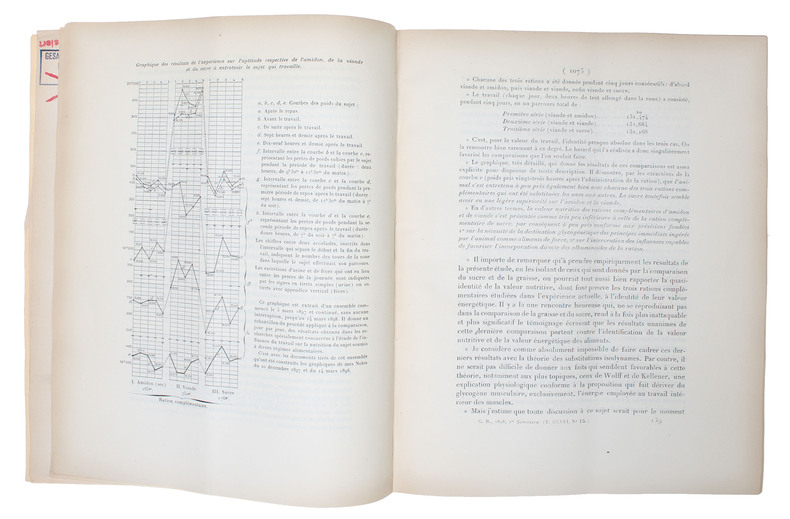
189846852Paris, Gauthier-Villars, 1898. 4to. No wrappers. In: ""Comptes Rendus Hebdomadaires des Séances de L'Academie des Sciences"", Tome 126, No 15). Entire issue offered. With htitle and titlepage to vol. 126. Pp. 1059-1110. Curie's paper: pp. 1101-1103.
183547003Philadelphia, Fraklin Institute, 1835. 8vo. Later full green cloth. Tome-and titlelabels in leather with gilt lettering on spine. In: ""Journal of the Franklin Institute of the State of Pennsylvania... Edited by Thomas P. Jones"", Vol. XV. New series. Engraved frontisp. (2),446 pp., 2 folded engraved plates and 2 folded engraved maps. (Entire volume offered). Henry's announcement: pp. 169-70. A stamp to verso of frontispiece (Library of Congress duplicate stamp).
183645406Berlin, G. Eichler, 1836. In ""Archiv für Anatomie, Physiologie und Wissenschaftliches Medicin Herausgegeben von Johannes Müller"". Jahrgang 1836. Pp. 66-89 a. pp. 90-139. The entire volume offered in its 6 parts (in 5), all 5 issues uncut with orig. printed warppers. (2),CCXXIV,390 pp. and 15 engraved plates. The 2 first issues with a faint dampstain to lower part of leaves and plates.
186153357(Paris, Mallet-Bachelier), 1861. 4to. No wrappers. In: ""Comptes Rendus Hebdomadaires des Séances de L'Academie des Sciences"", Tome 52, No 8. Pp. (321-) 368. (Entire issues offered). Pasteur's paper: pp. 344-347. Minor marginal brownspots.
185943325Leipzig, Johann Ambrosius Barth, 1859. Without wrappers as issued in ""Annalen der Physik und Chemie. Hrsg.von Poggendorff"", Bd. 107, Viertes Stück.(= Heft No. 8 of 1859). (The entire issue offered (Heft 4 of vol. 107 with titlepage to vol. 107). Pp. 497-660. - Plücker's papers: pp. 497-539 a. 638-643. Clean and fine.
189846852Paris Gauthier-Villars 1898. 4to. No wrappers. In: "Comptes Rendus Hebdomadaires des Séances de L'Academie des Sciences" Tome 126 No 15. Entire issue offered. With htitle and titlepage to vol. 126. Pp. 1059-1110. Curie's paper: pp. 1101-1103. <br/><br/><em>First printing of this milestone paper being the first "Note" from Marie Curie about "radioactivity". This same "Note" contains a the fundamental observation: "Two uranium ores. are much more active than uranium itself. This fact. leads one to believe that these ores may contain an element much more active than uranium." This paper gives the first proof of the fact that radiation is an atomic property."Henri Becquerel discovered 1896 that uranium salts shielded from light for several months spontaneously emit rays related in their effects to Roentgen rays. Mme. Curie became enthusiastic about this subject filled with the unknown and as she later acknowledged involving no bibliographic research.The first step in the research was to determine whether there existed other elements capable like uranium of emitting radiation. Abandoning the idea of hyperfluorescence couldn’t one calculate by electrical measurement the effects on the conductivity of air that were revealed by the gold-leaf electroscope Pierre Curie and his brother Jacques had constructed an extremely sensitive apparatus to measure weak currents; Mme. Curie employed it in testing both pure substances and various ores. In her first "Note" in the Comptes rendus"de l Académie des sciences 12 April 1898 she described the method that she followed throughout her life the method that enabled her to make comparisons through time and crosschecks with other techniques:"I employed. a plate condenser one of the plates being covered with a uniform layer of uranium or of another finely pulverized substance diameter of the plates eight centimeters; distance between them three centimeters. A potential difference of 100 volts was established between the plates. The current that traversed the condenser was measured in absolute value by means of an electrometer and a piezoelectric quartz. In general she preferred the zero method in which the operator compensates for the current created by the active material by manipulating the quartz. All of her students followed this procedure."DSB.The first results came in 1898: the measurements varied between 83 × 10-12 amperes for pitch blende to less than 0.3 × 10⁻¹² for almost inactive salts passing through 53 × 10-12 for thorium oxide and for chalcolite double phosphate of uranium and copper. Thorium would thus be "radioactive" the term is Mme. Curie’s; its radioactive properties were discovered at the same time independently by Schmidt in Germany. </em> unknown
183547003Philadelphia Fraklin Institute 1835. 8vo. Later full green cloth. Tome-and titlelabels in leather with gilt lettering on spine. In: "Journal of the Franklin Institute of the State of Pennsylvania. Edited by Thomas P. Jones" Vol. XV. New series. Engraved frontisp. 2446 pp. 2 folded engraved plates and 2 folded engraved maps. Entire volume offered. Henry's announcement: pp. 169-70. A stamp to verso of frontispiece Library of Congress duplicate stamp. <br/><br/><em>First printing of this importent paper the first to describe in detail how the phenomena of Self-Induction was discovered. Henry discovered the induction phenomena - how an electric current in one coil may set up a current in the other through the development of the magnetic field - independently of Faraday but Faraday was first to publish on electromagnetic induction. Henry's experiments with induction led him to his importent discovery of SELF-INDUCTION which is the phenomenon in which a change in electric current in a coil produces an induced emf in the coil itself. This phenomenon was also discovered inependently by Faraday but this time Henry had published first. The basic unit of inductance was to be called "the Henry". Relevant to the controversy between Faraday and Henry is the following statement by A D Bache Secretary of the American Philosophical Society introducing an abstract of Henry in J Franklyn Inst. 1835 pp. 169-70 H. Norman 1053 and the paper offerd: "A memoir on this subject has been since submitted to the Society containing an extension of the subject the primary fact in relation to which was observed by Professor Henry as early as 1832 and announced by him in the American Journal of Science. Mr. Faraday having recently entered upon a similar train of observations the immediate publication of the accompanying is important that the prior claims of our fellow countryman may not be overlooked."Spark Museum.Magee "Source Book in Physics" p. 515. </em> hardcover
183645406Berlin G. Eichler 1836. In "Archiv für Anatomie Physiologie und Wissenschaftliches Medicin Herausgegeben von Johannes Müller". Jahrgang 1836. Pp. 66-89 a. pp. 90-139. The entire volume offered in its 6 parts in 5 all 5 issues uncut with orig. printed warppers. 2CCXXIV390 pp. and 15 engraved plates. The 2 first issues with a faint dampstain to lower part of leaves and plates. <br/><br/><em>First appearance of an importent paper in the history of biology in which Schwann describes his discovery and isolation of pepsin the substance in the stomach that aids digestion of eggwhite. It is the FIRST KNOWN ANIMAL ENZYME. The paper appeared at the same time in "Annalen der Physik und Chemie. Hrsg. von J.C. Poggendorff".Theodor Schwann 1810-1882 was a great German physiologist pathologist and experimenter. One of the founders of the cell doctrine and of the idea of the living nature of yeast. Born at Neuss near Düsseldorff. A catholic educated in the Jesuit Gymnasium in Cologne. Intended for the church but took to medicine. He was a pupil of Johannes Müller and a collegueand lifelong friend of J. Henle the anatomist. In Berlin Schwann was Johannes Müller's assistent for five years and it was then that he discovered pepsin in 1836 the paper offered.Parkinson "Breakthroughs" 1836 B. - Garrison & Morton no. 991.The first paper offered written together with Johannes Müller records the preliminary investigaions leading to the discovery of Pepsin. - Garrison & Morton no. 990.The volume also contains another famous paper by ROBERT REMAK "Vorläufige Mittheilung microscopischer Beobachtungen über den innern Bau der Cerebrospinalnerven und über die Entwicklung ihrer Formenelemente. Hierzu Tafel IV. Pp. 145-161. This paper contains the first announcement of his DISCOVERY OF "FIBRES OF REMAK" the non-medullated nerve-fibres. Garrison & Morton no. 1260. </em> unknown
186153357Paris Mallet-Bachelier 1861. 4to. No wrappers. In: "Comptes Rendus Hebdomadaires des Séances de L'Academie des Sciences" Tome 52 No 8. Pp. 321- 368. Entire issues offered. Pasteur's paper: pp. 344-347. Minor marginal brownspots. <br/><br/><em>First printing of a milestone paper in microbiology being the paper in which Pasteur disclosed his discovery of organisms that lived without oxygen. Two years later he named them anaerobic or zymics contrasting to aerobic which only lived in the presence of free oxygen."In 1861 he turned his attention to the butyric fermentation and made another importent discovery viz. that this fermentation proceeds in the absence of oxygen. In the fermented material he found cylindrical rods which he showed were the cause of the fermentation. Following the nomenclature and ideas of the time he regarded them as animal in character and named them Vibrio." Bullock "The History of Bacteriology" p. 61. </em> unknown
185943325Leipzig Johann Ambrosius Barth 1859. Without wrappers as issued in "Annalen der Physik und Chemie. Hrsg.von Poggendorff" Bd. 107 Viertes Stück.= Heft No. 8 of 1859. The entire issue offered Heft 4 of vol. 107 with titlepage to vol. 107. Pp. 497-660. - Plücker's papers: pp. 497-539 a. 638-643. Clean and fine. <br/><br/><em>First printing of this milestone paper describing Plückers first observations on Cathode Rays which he called "the beautiful and mysterious green glow" and produced by discharges in tubes exhausted by means of the Geissler pump. These importent observations lead directly to Röntgens discovery of the Röntgen Rays."Cathode rays were first observed by Julius Plücker in 1859 the paper offered. They are rays which are found in the neighbourhood of the point of exit of an electrical current passing through a Geissler tube. These rays stimulated intense interest and experiment. William Crookes greatly improved these discharge tubes and intensified the degree of rarification of gases within them. The tubes in this form is known as Crookes tube. Crookes declared his conciction that the cathode rays represented matter in a fourth hitherto unobserved form.It was reserved for J.J. Thomson in 1908 to discover the true nature of the cathode rays."PMM no 386. </em> unknown
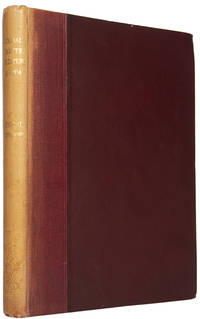
115668London Royal Society 1908. . First edition; 4to; 2 coloured maps 1 folding 21 plates including 8 lithographs photographic plates including a folding panorama; original red buckram-backed boards spine faded a very good copy; v 192 pp.<br /> From the library of Professor Otto Nordenskjöld 1869-1928 the distinguished Swedish Antarctic explorer and scientist. Nordenskjöld was on the Swedish scientific expedition to the Antarctic 1901-1903 and would have had a particular interest in the results of the Discovery expedition.<br /><br />Physical Observations is notable for the series of eight lithographs of aurora observations including seven of aurora effects on thick brown paper.<br /> Rosove 288-8.A1; Spence 839; Taurus 47. London, Royal Society, 1908. hardcover
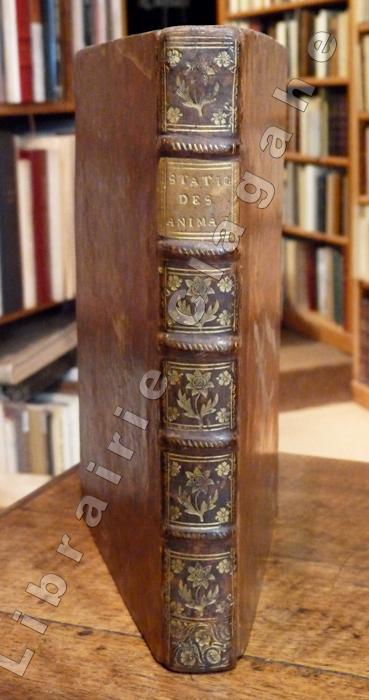
17449470Genève, Herit. Cramer et Frères Philibert, 1744 ; in-4 ; plein veau fauve marbré, dos à nerfs décoré et doré, pièce de titre havane, tranches rouges (reliure de l'époque) ; XXII pp., (1) f. bl., 348 pp., 1 planche dépliante ; les 2 dernières pages sont un catalogue de livres du libraire.
17811099761781 Un volume In-16 (9,5 x 16cm environ), reliure pleine peau, filets, et fleurons dorés au dos, tranche marbrées en couleurs, reprenant le motif des gardes - Cinq ouvrages reliés en un volume intitulé "Recueil II" à l'aide d'une pièce de titre au dos, répartis comme suit : (1) A Amsterdam; et se trouve à Paris, Chez Méquignon l'aîné, Librairie, rue des Cordeliers - M. DCC. LXXIX. 1779 - 46 pages - (2) A Berlin, et se trouve, à Paris, Chez l'Auteur , Barrière de Reuilly; Fauxbourg Saint-Antoine. Et Chez Belin, Librairie, rue Saint-Jacques - M DCC LXXIX. 1779 - 35 pages - (3) A Paris, Chez l'Auteur, rue Croix des Petits-Champs, Maison de M. Bourdet, Chirurgien-Dentiste du Roi. et Chez Blaizot, Librire du Roi, rue Satory, à Versailles - Avec Approbation et Permission - M. DCC. LXXXI. 1781- 139 pages - Cul-de-lampe - (4) A Amsterdam; et se trouve à Paris, Chez Bastien, Libraire, rue du Petit-Lion, Fauxbourg Saint-Germain - M. DCC. LXXIV. 1774 - 56 pages - (5) A Paris, Chez Saugrain, Libraire, Quai des Augustins, près de la rue Pavée - M. DCC. LXXXI. 1781 - 116 pages
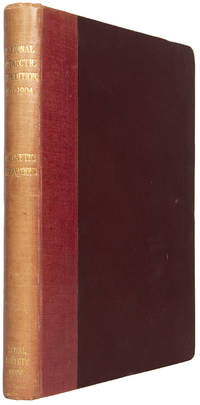
115667London Royal Society 1909. . First edition; 4to; 43 plates original red buckram-backed boards spine fade small stamps to foot of title a very good copy; vii 274 pp.<br /> From the library of Professor Otto Nordenskjöld 1869-1928 the distinguished Swedish Antarctic explorer and scientist. Nordenskjöld was on the Swedish scientific expedition to the Antarctic 1901-1903 and would have had a particular interest in the results of the Discovery expedition. The volume includes an appendix comparing magnetic observations in the Antarctic and the Arctic.<br /> Rosove 288-11.A1; Spence 841; Taurus 48. London, Royal Society, 1909. hardcover
189542221(London, Harrison and Sons, 1895). 4to. No wrappers as extracted from ""Philosophical Transactions"", Vol. 186 - I, Series A. Pp. 187-241 a. 8 textillustrations (apparatus). Fine and clean.
189542221London Harrison and Sons 1895. 4to. No wrappers as extracted from "Philosophical Transactions" Vol. 186 - I Series A. Pp. 187-241 a. 8 textillustrations apparatus. Fine and clean. <br/><br/><em>First printing of this importent paper in the history of chemistry Lord Rayleigh's most famous discovery announcing the discovery of this new gas the first finding of one of the rare gases inert gases having unusual properties and forming a distinct group in the periodic table and all with zero valency."The original paper in the "Philosophical Transactions" will undoubtly rank as a classic the investigation having been a particularly brilliant ine." Ernst von Meyer in History of Chemistry. For this discovery Lord Rayleigh and W. Ramsay received the Nobel Prize 1904.After having made several measuring of the densities of gases "Rayleigh came across a curious puzzle. With oxygen he always obtained the same density regardless of how the oxygen might be produced whether from one particular compound from a second compound or from the air. The situation was different with nitrogen. The nitrogen he obtained from air constantly showed a slightly higher density than the nitrogen he obtained from any of various compounds. Rayleigh could think of several ways in which the nitrogen obtained from air might be contaminated but none of the possibilities checked out experimentally. He was so frustrated that he went so far as to write to the journal "Nature" asking for suggestions. Ramsay a brilliant Scottish chemist asked permission to tackle the problem and received it. The upshot was that a new gas somewhat denser that nitrogen was discovered to exist in the atmosphere. It was named argon and it was the first of a series of rare gases of unusual properties whose existence had never been suspected."Asimow.Dibner Heralds of Science No. 50 - Neville Historical Chemical Library vol. II p.358. </em> unknown
pp. xliv, 479, (6) [Genealogies] + 18 Facsimiles, plates and maps. The frontis and engraved title may not have been issued with this large paper first edition. First fly leaves damp stained. Plates and some other leaves at end are also damped. The bulk of the text is brilliant white with extra wide margins. Large paper copy. Top edge gold gilt. Deckle edges. Early inked ownership of R. H. Lanerned(?). Early manuscript margin notations, and translation. Folio. Original full embossed morocco leather binding. Spine gold lettered with raised bands. Hardbound. "The pioneer and fundamental work on the Norse voyages to America, on which most of the subsequent literature has been based. This large folio contains the original text of the sagas in old Icelandic and translations into Danish and Latin, followed by critical discussions in Latin; extracts from ancient Icelandic geographical writings, descriptions of European relics in Greenland; descriptions and discussions of supposed Norse relics in New England and an elaborate identification of localities. A summary of the evidence and conclusions is given in English. Rafn was an enthusiast on this subject, and his enthusiasm make him over hasty and credulous in accepting the various alleged relics of the Northman." - Larned #750. "It is one of the most important contributions ever made to the study of the history and geography of our continent." (North American Review, No. xcviii, pp. 161-62.)." - Sabin 67470; Howes R13. First Edition of a landmark book. Our original price was $1250.00 **PRICE MUCH REDUCED! VOYAGES BOX 1
183149604Paris, Crochard, 1831. Contemp. hcloth. Some scattered brownspots. ""Annales de Chimie et de Physique"", 2. Series, Tome 48. 448 pp., 1 engraved plate. (Entire volume offered). Soubeiran's paper: pp. 113-157. Scattered brownspots.
183149604Paris Crochard 1831. Contemp. hcloth. Some scattered brownspots. "Annales de Chimie et de Physique" 2. Series Tome 48. 448 pp. 1 engraved plate. Entire volume offered. Soubeiran's paper: pp. 113-157. Scattered brownspots. <br/><br/><em>First appearance of an importent paper in chemistry and medicine as it for the first time relates the finding of Chloroform which some years later was proved to have anaesthetic effects and was introduced in chirurgy in 1848 by Simpson.Justus von Liebig Souberain and Guthrie independently discovered Chloroform in 1831 but Souberain was the first to publish his results. Garrison & Morton No. 1851. - Gedeon "Science and Technology in Medicine" 36.7.The volume contains other notable papers by LIEBIG DUMAS DUTROCHET WÖHLER LECANU BECQUEREL etc. </em> hardcover