289 résultats
193447071Paris Gauthier-Villars 1934. 4to. No wrappers. In: "Comptes Rendus Hebdomadaires des Séances de L'Academie des Sciences" Tome 198 No 3. Titlepage to vol. 198. Pp. 213- 292. Entire issue offered. The joint paper: pp. 254-256 a. 1 photographic illustration in the text. Titlepage with a stamp on verso 2 small tears and a tiny bit of upper right corner gone. Titlepage a bit browned. <br/><br/><em>First appearance of this seminal paper in which artificial radioactivity was announced for the first time. Curie and Joliot were awarded the Nobel Prize in Chemistry 1935 "in recognition of their synthesis of new radioactive elements"."Until this date 1934 atomic nuclei emitting radiation were found in nature: it was called the natural radioactivity. It had been known since Rutherford that this natural radioactivity changed a nucleus into an other one: for instance radium becomes finally lead after many radioactive decays. We could say that lead does not become gold but gold becomes lead! But. this change of matter was not under control. It was not possible to construct the desired chemical element as the alchemist dreamed. But Irene and Frederic Joliot-Curie made the dream become almost reality.""Another very important development in the early 1934 by the Joliot-Curies in connection with irradiation of aluminum by alpha particles. The two French scientists detected the production of the recently discovered positrons. . However they soon realized that the positron activity continued after the alpha source was removed and that they had in fact discovered positive beta radioactivity. The importance of the discovery of artificial radioactivity was immediately recognized and resulted in a Nobel Prize in chemistry to the Joliot-Curies in 1935. The new phenomenon immediately became widely employed in nuclear physics chemistry biology and medicine." Kragh Quantum Generations p. 187"These elegant experiments which provided the first chemical proof of induced transmutations and showed the possibility of artificially creating radioisotopes of known stable elements were repeated and extended in the major nuclear physics laboratories of various countries " DSB.Born on 12 September 1897 in Paris Irène Curie was the daughter of Pierre and Marie Curie. "During World War I she worked as a nurse helping her mother operate radiography equipment and then studied physics and mathematics at the Sorbonne gaining a doctorate for studying the range of alpha particles. She then went to work for her mother at the Radium Institute. There she met Frédéric Joliot whom she married in 1926. Frédéric Joliot was born on 19 March 1900 in Paris - He joined the Radium Institute in 1925 and obtained his PhD in 1930. Together the Joliot-Curies worked on radioactivity and the transmutation of the elements. Twice they just missed major discoveries: in 1932 when Chadwick beat them to the neutron and in 1933 when Anderson discovered the positron. However in 1934 whilst bombarding light elements with alpha particles the Joliot-Curies noticed that although proton production stopped when the alpha particle bombardment stopped another form of radiation continued. The alpha particles had produced an isotope of phosphorus not found in nature. This isotope was radioactive and was decaying through beta-decay" DSB. </em> unknown
178053319Paris Théophile Barrois 1780. 8vo. Fine cont. full mottled calf richly gilt spine and gilt titlelabel in red leather. Edges gilt. LXVIII3333 pp. and 1 folded engraved plate showing his experimental apparatus. Light browning to margins of title-page otherwise clean and with broad margins. A fine copy. <br/><br/><em>First French edition of perhaps the most important work in plant physiology. It is in this work that Ingen-Housz for the first time expounds the ideas and experiments that lead to his discovery of Photosynthesis in plant life and as such it is of fundamental importance in the economy of living things. "His Experiments upon vegetables was published in the autumn of 1779 and was at once recognized as a very important advance. In brief he showed that oxygen evolution by plant is absolutely dependent on light and that it only occurs from those parts which are green.The proof that light and green tissues are both essential for oxygen production finally cleared up the apparent contradictions and variable results of earlier experiments. Priestly was "much pleased" with Ingen-Housz's experiments and pointed immediately to the salient facts that he had established." A.G. Morton: History of Botanical Science. p. 332. Dibner: Heralds of Science No. 29. - Garrison & Morton No. 103. - Horblit No. 55. All the English edition of 1779. </em> hardcover
187844231Paris G. Masson 1878. 8vo. Contemp. hcalf raised bands gilt spine. Light wear along edges. Small stamps on verso of titlepage. In: "Annales de Chimie et de Physique" 4e Series - Tome 15. 512 pp. a. 3 folded engraved plates. The entire volume offered. Janssen's memoir: pp. 414-426. <br/><br/><em>First appearance of this milestone paper in chemistry physics and astronomy announcing the discovery of the helium lines in the spectrum of the sun. It was Lockyer in the same year that named it 'helium' for Helios the Greek God of the Sun. Helium was not discovered on the earth before 1895 by William Ramsay and it was Crookes who established its identity with the helium Janssen and Lockyer observed in the spectrum of the sun."He Janssen met immortality by travelling to India in 1868 to study the total eclipse. It was then that he observed the helium line and forwarded the spectral data to ockyer. He also noted the size of the solar prominences. The day after the eclipse he attempted to take their spectra again and succeeded despite the absence of the obscuring moon. he then announced jubilantly that it was the day after the eclipse that was the real eclipse day for him. Lockyer also reported this method of studying prominences without an eclipse.Like Lockyer he lived to see his observation of the helium line vindicated by Ramsay's discovery of that element on earth."Asimov."This the discovery of helium lines in the sun by Lockyer was announced on the same day by the French astronomer Janssen who was in India observing a total eclipse. As a result the French government some ten years later struck a medallion showing the heads of both scientists.By that time the two men had made a much more dramatic discovery at the same time this time in cooperation. Janssen studying the spectrum ofthe sun during the eclipse had noted a fine line he did not recognize. he send a report on this to Lockyer an acknowledges expert on solar spectra. Lockyer compared the reported position of the line with lines of known elements concluding that it must belong to a yeat unknown element possibly not even existing on the earth. He named the element from the Greek word for the sun."Asimov.Parkinson "Breakthroughs" 1868 A. - The volume contains other notable papers by Dumas Berthelot et al. </em> hardcover
184245440Kjöbenhavn Bianco Luno 1842 a. 1845. 4to. Bound in one contemp. halfcalf spine gilt. A small tear to backhinge at lower compartment of spine. IV76 pp. and 3 double-page folded lithographed plates with many figs. XIV88 pp. and 2 double-apge lithographed plates with many figs. Light browning to the last leaves of the second work. <br/><br/><em>The scarce first edition of the work in which Steenstrup describes his discovery of the principle of 'ALTERNATION OF GENERATIONS'' sexual and asexual in plants and animals. "Steenstrup showed that certain animals produce offspring which never resemble them but which on the other hand bring forth progeny which return in form and nature to their grandparents or more distant ancestors." Garrison & Morton No 217. A German translation was published the same year and an English in 1845. Norman 2009 German translation. "The second major publication - the first dealing with geology - of 1842 was "Om Forplantning og Udvikling gjennem vexlende Generationsrækker." the work offered Steenstrup's comprehensive presentation of the form of reproduction that he called 'alternation of generations' that is the alternation of asexual and sexual reproduction or metagenesis. This phenomenon had previously been described by Chamisso but Steenstrup included a greater number of observations based on a significantly wider range of subjects and provided an importent chapter on its meaning. Steenstrup's growing reputation won him an appointment as professor of zoology at the University of Copenhagen where he tought from 1846 until 1885."DSB XII p. 9. </em> unknown
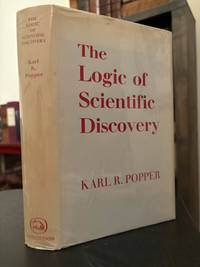
1959508<p><strong>Large Octavo. Publisher's cloth & dustwrapper. First edition first printing of one of the most significant works on the philosophy of science. The Logic of Scientific Discovery was originally published in Germany in 1934 and Popper rewrote and republished it in English in 1959 with the New York edition preceding this much rarer UK edition. A fine copy in an unclipped slightly worn and faded very good dust wrapper. Small inscription on the front pastedown of David Keyt 1930-2025 Professor Emeritus of Philosophy at Washington University Seattle. The book is mostly unopened and looks mostly unread. A very nice copy. Popper argues that science should adopt a methodology based on falsifiability because no number of experiments can ever prove a theory but a reproducible experiment or observation can refute one. According to Popper: "non-reproducible single occurrences are of no significance to science. Thus a few stray basic statements contradicting a theory will hardly induce us to reject it as falsified. We shall take it as falsified only if we discover a reproducible effect which refutes the theory". Popper argues that science should adopt a methodology based on "an asymmetry verifiability and falsifiability; an asymmetry which results from the logical form of universal statements. For these are never derivable from singular statements but can be contradicted by singular statements".</strong></p> Hutchinson hardcover
189846852Paris Gauthier-Villars 1898. 4to. No wrappers. In: "Comptes Rendus Hebdomadaires des Séances de L'Academie des Sciences" Tome 126 No 15. Entire issue offered. With htitle and titlepage to vol. 126. Pp. 1059-1110. Curie's paper: pp. 1101-1103. <br/><br/><em>First printing of this milestone paper being the first "Note" from Marie Curie about "radioactivity". This same "Note" contains a the fundamental observation: "Two uranium ores. are much more active than uranium itself. This fact. leads one to believe that these ores may contain an element much more active than uranium." This paper gives the first proof of the fact that radiation is an atomic property."Henri Becquerel discovered 1896 that uranium salts shielded from light for several months spontaneously emit rays related in their effects to Roentgen rays. Mme. Curie became enthusiastic about this subject filled with the unknown and as she later acknowledged involving no bibliographic research.The first step in the research was to determine whether there existed other elements capable like uranium of emitting radiation. Abandoning the idea of hyperfluorescence couldn’t one calculate by electrical measurement the effects on the conductivity of air that were revealed by the gold-leaf electroscope Pierre Curie and his brother Jacques had constructed an extremely sensitive apparatus to measure weak currents; Mme. Curie employed it in testing both pure substances and various ores. In her first "Note" in the Comptes rendus"de l Académie des sciences 12 April 1898 she described the method that she followed throughout her life the method that enabled her to make comparisons through time and crosschecks with other techniques:"I employed. a plate condenser one of the plates being covered with a uniform layer of uranium or of another finely pulverized substance diameter of the plates eight centimeters; distance between them three centimeters. A potential difference of 100 volts was established between the plates. The current that traversed the condenser was measured in absolute value by means of an electrometer and a piezoelectric quartz. In general she preferred the zero method in which the operator compensates for the current created by the active material by manipulating the quartz. All of her students followed this procedure."DSB.The first results came in 1898: the measurements varied between 83 × 10-12 amperes for pitch blende to less than 0.3 × 10⁻¹² for almost inactive salts passing through 53 × 10-12 for thorium oxide and for chalcolite double phosphate of uranium and copper. Thorium would thus be "radioactive" the term is Mme. Curie’s; its radioactive properties were discovered at the same time independently by Schmidt in Germany. </em> unknown
183547003Philadelphia Fraklin Institute 1835. 8vo. Later full green cloth. Tome-and titlelabels in leather with gilt lettering on spine. In: "Journal of the Franklin Institute of the State of Pennsylvania. Edited by Thomas P. Jones" Vol. XV. New series. Engraved frontisp. 2446 pp. 2 folded engraved plates and 2 folded engraved maps. Entire volume offered. Henry's announcement: pp. 169-70. A stamp to verso of frontispiece Library of Congress duplicate stamp. <br/><br/><em>First printing of this importent paper the first to describe in detail how the phenomena of Self-Induction was discovered. Henry discovered the induction phenomena - how an electric current in one coil may set up a current in the other through the development of the magnetic field - independently of Faraday but Faraday was first to publish on electromagnetic induction. Henry's experiments with induction led him to his importent discovery of SELF-INDUCTION which is the phenomenon in which a change in electric current in a coil produces an induced emf in the coil itself. This phenomenon was also discovered inependently by Faraday but this time Henry had published first. The basic unit of inductance was to be called "the Henry". Relevant to the controversy between Faraday and Henry is the following statement by A D Bache Secretary of the American Philosophical Society introducing an abstract of Henry in J Franklyn Inst. 1835 pp. 169-70 H. Norman 1053 and the paper offerd: "A memoir on this subject has been since submitted to the Society containing an extension of the subject the primary fact in relation to which was observed by Professor Henry as early as 1832 and announced by him in the American Journal of Science. Mr. Faraday having recently entered upon a similar train of observations the immediate publication of the accompanying is important that the prior claims of our fellow countryman may not be overlooked."Spark Museum.Magee "Source Book in Physics" p. 515. </em> hardcover
183645406Berlin G. Eichler 1836. In "Archiv für Anatomie Physiologie und Wissenschaftliches Medicin Herausgegeben von Johannes Müller". Jahrgang 1836. Pp. 66-89 a. pp. 90-139. The entire volume offered in its 6 parts in 5 all 5 issues uncut with orig. printed warppers. 2CCXXIV390 pp. and 15 engraved plates. The 2 first issues with a faint dampstain to lower part of leaves and plates. <br/><br/><em>First appearance of an importent paper in the history of biology in which Schwann describes his discovery and isolation of pepsin the substance in the stomach that aids digestion of eggwhite. It is the FIRST KNOWN ANIMAL ENZYME. The paper appeared at the same time in "Annalen der Physik und Chemie. Hrsg. von J.C. Poggendorff".Theodor Schwann 1810-1882 was a great German physiologist pathologist and experimenter. One of the founders of the cell doctrine and of the idea of the living nature of yeast. Born at Neuss near Düsseldorff. A catholic educated in the Jesuit Gymnasium in Cologne. Intended for the church but took to medicine. He was a pupil of Johannes Müller and a collegueand lifelong friend of J. Henle the anatomist. In Berlin Schwann was Johannes Müller's assistent for five years and it was then that he discovered pepsin in 1836 the paper offered.Parkinson "Breakthroughs" 1836 B. - Garrison & Morton no. 991.The first paper offered written together with Johannes Müller records the preliminary investigaions leading to the discovery of Pepsin. - Garrison & Morton no. 990.The volume also contains another famous paper by ROBERT REMAK "Vorläufige Mittheilung microscopischer Beobachtungen über den innern Bau der Cerebrospinalnerven und über die Entwicklung ihrer Formenelemente. Hierzu Tafel IV. Pp. 145-161. This paper contains the first announcement of his DISCOVERY OF "FIBRES OF REMAK" the non-medullated nerve-fibres. Garrison & Morton no. 1260. </em> unknown
186153357Paris Mallet-Bachelier 1861. 4to. No wrappers. In: "Comptes Rendus Hebdomadaires des Séances de L'Academie des Sciences" Tome 52 No 8. Pp. 321- 368. Entire issues offered. Pasteur's paper: pp. 344-347. Minor marginal brownspots. <br/><br/><em>First printing of a milestone paper in microbiology being the paper in which Pasteur disclosed his discovery of organisms that lived without oxygen. Two years later he named them anaerobic or zymics contrasting to aerobic which only lived in the presence of free oxygen."In 1861 he turned his attention to the butyric fermentation and made another importent discovery viz. that this fermentation proceeds in the absence of oxygen. In the fermented material he found cylindrical rods which he showed were the cause of the fermentation. Following the nomenclature and ideas of the time he regarded them as animal in character and named them Vibrio." Bullock "The History of Bacteriology" p. 61. </em> unknown
185943325Leipzig Johann Ambrosius Barth 1859. Without wrappers as issued in "Annalen der Physik und Chemie. Hrsg.von Poggendorff" Bd. 107 Viertes Stück.= Heft No. 8 of 1859. The entire issue offered Heft 4 of vol. 107 with titlepage to vol. 107. Pp. 497-660. - Plücker's papers: pp. 497-539 a. 638-643. Clean and fine. <br/><br/><em>First printing of this milestone paper describing Plückers first observations on Cathode Rays which he called "the beautiful and mysterious green glow" and produced by discharges in tubes exhausted by means of the Geissler pump. These importent observations lead directly to Röntgens discovery of the Röntgen Rays."Cathode rays were first observed by Julius Plücker in 1859 the paper offered. They are rays which are found in the neighbourhood of the point of exit of an electrical current passing through a Geissler tube. These rays stimulated intense interest and experiment. William Crookes greatly improved these discharge tubes and intensified the degree of rarification of gases within them. The tubes in this form is known as Crookes tube. Crookes declared his conciction that the cathode rays represented matter in a fourth hitherto unobserved form.It was reserved for J.J. Thomson in 1908 to discover the true nature of the cathode rays."PMM no 386. </em> unknown
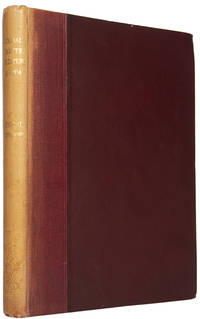
115668London Royal Society 1908. . First edition; 4to; 2 coloured maps 1 folding 21 plates including 8 lithographs photographic plates including a folding panorama; original red buckram-backed boards spine faded a very good copy; v 192 pp.<br /> From the library of Professor Otto Nordenskjöld 1869-1928 the distinguished Swedish Antarctic explorer and scientist. Nordenskjöld was on the Swedish scientific expedition to the Antarctic 1901-1903 and would have had a particular interest in the results of the Discovery expedition.<br /><br />Physical Observations is notable for the series of eight lithographs of aurora observations including seven of aurora effects on thick brown paper.<br /> Rosove 288-8.A1; Spence 839; Taurus 47. London, Royal Society, 1908. hardcover
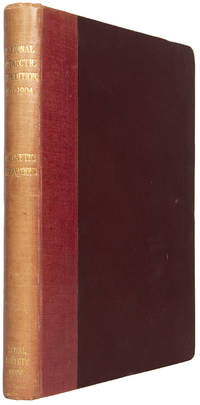
115667London Royal Society 1909. . First edition; 4to; 43 plates original red buckram-backed boards spine fade small stamps to foot of title a very good copy; vii 274 pp.<br /> From the library of Professor Otto Nordenskjöld 1869-1928 the distinguished Swedish Antarctic explorer and scientist. Nordenskjöld was on the Swedish scientific expedition to the Antarctic 1901-1903 and would have had a particular interest in the results of the Discovery expedition. The volume includes an appendix comparing magnetic observations in the Antarctic and the Arctic.<br /> Rosove 288-11.A1; Spence 841; Taurus 48. London, Royal Society, 1909. hardcover
189542221London Harrison and Sons 1895. 4to. No wrappers as extracted from "Philosophical Transactions" Vol. 186 - I Series A. Pp. 187-241 a. 8 textillustrations apparatus. Fine and clean. <br/><br/><em>First printing of this importent paper in the history of chemistry Lord Rayleigh's most famous discovery announcing the discovery of this new gas the first finding of one of the rare gases inert gases having unusual properties and forming a distinct group in the periodic table and all with zero valency."The original paper in the "Philosophical Transactions" will undoubtly rank as a classic the investigation having been a particularly brilliant ine." Ernst von Meyer in History of Chemistry. For this discovery Lord Rayleigh and W. Ramsay received the Nobel Prize 1904.After having made several measuring of the densities of gases "Rayleigh came across a curious puzzle. With oxygen he always obtained the same density regardless of how the oxygen might be produced whether from one particular compound from a second compound or from the air. The situation was different with nitrogen. The nitrogen he obtained from air constantly showed a slightly higher density than the nitrogen he obtained from any of various compounds. Rayleigh could think of several ways in which the nitrogen obtained from air might be contaminated but none of the possibilities checked out experimentally. He was so frustrated that he went so far as to write to the journal "Nature" asking for suggestions. Ramsay a brilliant Scottish chemist asked permission to tackle the problem and received it. The upshot was that a new gas somewhat denser that nitrogen was discovered to exist in the atmosphere. It was named argon and it was the first of a series of rare gases of unusual properties whose existence had never been suspected."Asimow.Dibner Heralds of Science No. 50 - Neville Historical Chemical Library vol. II p.358. </em> unknown
183149604Paris Crochard 1831. Contemp. hcloth. Some scattered brownspots. "Annales de Chimie et de Physique" 2. Series Tome 48. 448 pp. 1 engraved plate. Entire volume offered. Soubeiran's paper: pp. 113-157. Scattered brownspots. <br/><br/><em>First appearance of an importent paper in chemistry and medicine as it for the first time relates the finding of Chloroform which some years later was proved to have anaesthetic effects and was introduced in chirurgy in 1848 by Simpson.Justus von Liebig Souberain and Guthrie independently discovered Chloroform in 1831 but Souberain was the first to publish his results. Garrison & Morton No. 1851. - Gedeon "Science and Technology in Medicine" 36.7.The volume contains other notable papers by LIEBIG DUMAS DUTROCHET WÖHLER LECANU BECQUEREL etc. </em> hardcover
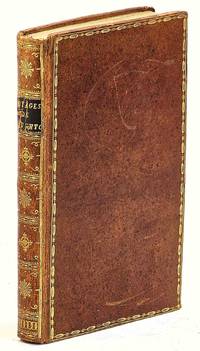
1797105650Paris: Chez Tavernier. 1797. 1st ed. An VI. Octavo full-leather binding with gilt-stamped decorations bands and title to spine gilt dec border to boards contemporary marbled endpapers pp viii 243 last page misprinted as 343. Three large folding engraved maps drawn up by Major James Rennell the leading British geographer of his time when Mungo Park returned from West Africa: all in very good condition. Spine rubbed minor scuffs to boards front free endpaper just starting to detach. Very good condition. First edition. Published in Paris in the revolutionary "An VI" 1797. Describes the explorations in the interior of Africa of Daniel Houghton 1740 - 1791 and Mungo Park 1771 - 1806. Daniel Houghton was sent by the African Association the Association for Promoting the Discovery of the Interior Parts of Africa; his instructions were to sail to the mouth of the Gambia navigate the river to the Barra Kunda falls and then to travel overland to the Hausa lands to the east. He was one of the first European explorers in the interior of Africa but after a successful visit in Bambouk territory he disappeared somewhere on his journey to Timbuctoo his last despatch being in July 1791. Mungo Park was then sent by the African Association and travelled more extensively in West Africa. He published the book "Travels in the interior districts of Africa" in 1799 i.e. this book precedes Park's publication. Uncommon. 1st Edition. Leather. Chez Tavernier hardcover
185547110Paris Mallet-Bachelier 1855 a. 1857. 4to. No wrappers. In: "Comptes Rendus Hebdomadaires des Séances de L'Academie des Sciences" Tome 41 No 13 and Tome 44 No 12 a. No. 26. Pp. 461-500 pp. 578-640 a. pp. 1293-1363 3 entire issues offered. Bernard's papers: pp. 461-469 pp. 578-586 a. pp. 1325-1331. Some scattered brownspots to the first paper. <br/><br/><em>First printing of these two milestone-papers in physiology in which Bernard discovers and isolates glycogen from the liver shows that it is converted into blood glucose and discovers the process of gluconeogenesis. He further creates the concepts "experimental determination" and "local interieur"Bernard undertook the task of tracing out the various transformations of food stuffs within the animal organism beginning with the carbohydrates; and he not only found contrary to the accepted view that sugar was formed in the liver but he was also able to isolate a substance from the hepatic tissue which though not sugar was converted by fermentation into dextrose. He made a special study of its properties and called it "glycogen"."The culmination of Bernard's work on the glycogenic function of the liver. He invented the term "internal secretion" and can be said to have started the scientific investigation of the internal secretions although for 30 years the significance of his work was not generally realized. By his research on glycogene Bernard showed that the body not only can break down but can also build up complex chemical substances."Garrison & Morton .Claude Bernard 1813-78 was a key figure in French nineteenth-century science and one of the world's great physiologists. With good reason he has been called the ‘father of experimental medicine’.Garrison & Morton No. 1000 a. 999.1 </em> unknown
185048830Paris Bachelier1850. 4to. No wrappers. In: "Comptes Rendus Hebdomadaires des Séances de L'Academie des Sciences" Tome XXXI No. 17. With titlepage to vol. 31. Pp. 561- 592. Entire issue offered. Bernard's paper: pp. 571-574. Titlepage with a faint stamp to top and a stamp in lower margin. <br/><br/><em>First appearance of the first exposition of the glycogenic function of the liver - one of the greatest physiological discoveries of the 19th century. Bernard showed that the liver builds up complex substances including glycogen from the nutriment brought to it by the blood and that these are subsequently modified for distribution to the body.Dibner "Heralds of Science" No 131 - Horblit "One Hundred Books famous in Science" No. 11a here listing "Nouvelle Fonction du Foie" from 1853 but with the remark "The work appeared earlier in abbreviated form in the "Comptes rendus" the paper offered. - Exhibition of First Editions of Epochal Achievements in the History of Science Berkeley 1934. No 107. </em> unknown
192146992London Taylor and Francis 1921. Blank wrapper. In: "The London Edinburgh and Dublin Philosophical Magazine and Journal of Science" Sixth Series Vol.42 No. 252 December 1921. Pp. 873-1024 textillustr. a. 1 plate. Entire issue offered. Chadwick & Bieler's paper: pp. 923-940 textillustr. <br/><br/><em>First printingof this milestone paper in which the strong nuclear forces are mentioned for the first time."It was only in 1921 that Chadwick had first shown that at very small distances the interactions of alpha particles with the atomic nucleus did not follow exactly the inverse square law predicted from the repulsion of their positive electrical scharges. Chadwick concluded that his experiments showed that these nuclear forces are of "very great intensity". According to Pais this is THE FIRST PUBLISHED STATEMENT ABOUT THE EXISTENCE OF A STRONG NUCLEAR FORCE. This 'new force' interpretation was disputed untill well into 1920s."Hey & Walters."In any event Chadwick and Bieler's final conclusion avoid all reference to a possible electromagnetic cause for the deviations from the simple theory: "The present experiments do not seem to throw any light on the nature of the law of variation of the forces at the seat of an electric charge but merely show that the forces are of very great intensity. It is our task to find some field of force which will reproduce these effects." I consider this statement made in 1921 as marking the birth of the strong interaction."Pais in "Inward Bound" p. 240. </em> unknown
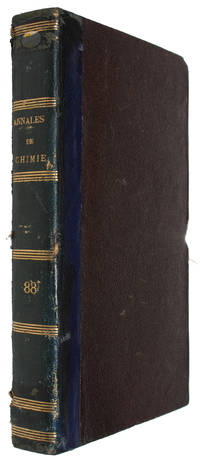
181343081Paris J. Klostermann 1813. Contemp. hcalf. Spine gilt. A few scratches to binding. In: "Annales de Chimie ou Recueil de Mémoires concernant la Chemie" Tome 88. - 336 pp. the entire volume offered. Pp. 304-310 311-318 319-321 a. 322-329. Scattered brownspots. <br/><br/><em>First printing of this paper announcing the discovery of Iodine. Courtois found this substance which he suspected to be a new element while burning algae in order to obtain sodium and potassium compounds. Although Courtois discovered the element in 1811 the announcement of it was not made until two years later after he had turned it over to Charles Desormés and Nicolas Clément."The first publication on iodine are somewhat confusing. Courtois's research is found in a paper attributed to him the paper offered but actually the work of Clément. was followed by an anonymous article the second paper offered. Gay-Lussac. who repeated and extended Courtios's work was responsible for this paper. Courtois himself published nothing. These two articles were immediately followed by short contributions of Gay-Lussac and Humphry Davy on the new element third and fourth paper offered. Gay-Lussacs views none too flattering to Davy on the history ofthe discovery of iodine appeared in his "Mémoire sur l'iode" 1814."DSB III p. 455. - Weeks "Discovery of the Elements" pp. 257-262.The volume contains further importent papers in chemistry Guyton de Morveau "Sur la chaux maigre" "Sur le dissolvant des pierres biliaires" an importent paper by Chevreul on animal fats "Recherches chimiques sur plusieurs corps gras et particulierement sur leurs combinaisons avec les alcalis" Berzelius's papers "Mémoires sur la compositions des fluides animaux" first edition in French Suite first edition Parmentier etc. etc. </em> unknown
188047008Paris Gauthier-Villars 1880. 4to. No wrappers. In: "Comptes Rendus Hebdomadaires des Séances de L'Academie des Sciences" Tome 91 No 5 entire issue offered. Pp. 251-310. The Curie's paper: pp. 294-295. <br/><br/><em>First apperance of the paper in which the two brothers announced their discovery of the Piezoelectric Effect as they observed how an electric potential appeared across crystals of quartza and of Rochelle salt when pressure was applied to them. The potential varied directly with the pressure and they named the phenomenon Piezoelectricity meaning "to press" Greek. Crystals with piezoelectric properties form an essential portion of sound-electronics devices such as microphones and record-players."The applications of piezoelectric crystals are innumerable; one of the most important is their use in frequency stabilization of oscillating electromagnetic cirasciots for radio broadcasting stations. They are used in most piezometers for measuring with great precision either very strong pressure variations such as those of a cannon at the moment of firing or very weak ones such as artery pulsations. These applications have led to the creation of a new industry the manufacture of large "mono" such as quartz obtained hydrothermally around 500°C. under high water pressures or crystals such as Rochelle salt obtained from aqueous solutions. These two substances were mentioned in the Curie brothers’ report announcing the discovery of piezoelectricity." DSB."The first experimental demonstration of a connection between macroscopic piezoelectric phenomena and crystallographic structure was published in 1880 by Pierre and Jacques Curie. Their experiment consisted of a conclusive measurement of surface charges appearing on specially prepared crystals tourmaline quartz topaz cane sugar and Rochelle salt among them which were subjected to mechanical stress. These results were a credit to the Curies' imagination and perseverance considering that they were obtained with nothing more than tinfoil glue wire magnets and a jeweler's saw." Piezo Systems Inc.Magee "A Source Book in Physics" p. 547 ff. </em> unknown
180950198Paris Mad. Ve Barnard 1809. Contemp. hcalf. Spine gilt. Wear to top of spine. A few scratches to binding. Small stamps on verso of titlepage.In: "Annales de Chimie ou Recueil de Mémoires concernant la Chemie" Tome 70. 336 pp. Entire volume offered. Davy's paper: pp. 189-254. <br/><br/><em>First edition in French the first English 1808 of this importent historical paper in chemistry in which Davy shows that electricity is capable of decomposing some alkalies isolating two new substances and discovering potassium and sodium. Neville in his Historical Chemical Library vol. I p.340 writes about this paper "ONE OF THE GREAT CLASSIC RESEARCHES IN CHEMISTRY in which Davy announced in this his second Bakterian lecture the isloation of metallic potassium and sodium by the electrolytic decomposition of their fused oxides.""He Davy began his own electrical experiments.The results were spectacular. On October 6 1807 the current passing through molten potash liberated a metal which Davy called potassium. The little globules of shining metal tore the water molecule apart as it eagerly recombined with oxygen and the liberated hydrogen burst into lavender flame. Davy danced about in a delirium of joy. A week later he isolated sodium from soda."Asimow. The paper offered here describes these discoveries."Humphry Davy was one of the most brilliant chemists of the early nineteenth century. His early study of nitrous oxide brought him his first reputation but his later and most importent investigations were devoted to electrochemistry. Following Galvani's experiments and the discovery of the voltaic pile interest in galvanic electricity had become widespread. The first electrolysis by means of the pile was carried out in 1800 by Nicholson and Carisle who obtained oxygen and hydrogen from water. Davy began to examine the chemical effects of electricity in 1800 and his numerous discoveries were presented in his Bakerian lecture to the Royal Society on November 20 1806. A Source Book in Chemistry p. 243. </em> unknown
181042219London W. Bulmer and Co. 1810. 4to. No wrappers as extracted from "Philosophical Transactions" 1810 - Part I. Pp. 16-74 and 2 engraved plates showing Davy's electrochemical apparatus for decomposing substances. The plates dampstained. Text fine and clean. <br/><br/><em>First appearence of this historical chemical paper Davy' fifth Bakerian Lecture in which he announced his discovery of hydrogen telluride."Mr. Davy having from the commencement of his electro-chemical researches communicated the several steps of his progress to the Society The Royal Society takes the present opportunity of reporting the results of his further inquiries under four principal heads. First on the nature of the metals of the fixed alkalis. Second on the nature of Hydrogen and composition of ammonia. Thirdly on the metals of the earth; and Fourthly he makes a comparison between the antiphlogistic doctrine and a modified phlogistic hypothesis."Abstract. He further gives arguments for considering potassium and sodium which he discovered in 1808 as a element."Humphry Davy was one of the most brilliant chemists of the early nineteenth century. His early study of nitrous oxide brought him his first reputation but his later and most importent investigations were devoted to electrochemistry. Following Galvani's experiments and the discovery of the voltaic pile interest in galvanic electricity had become widespread. The first electrolysis by means of the pile was carried out in 1800 by Nicholson and Carisle who obtained oxygen and hydrogen from water. Davy began to examine the chemical effects of electricity in 1800 and his numerous discoveries were presented in his Bakerian lectures." - Wheeler Gift: 2518. </em> unknown
181045887London W. Bulmer and Co. 1810. 4to. No wrappers as extracted from "Philosophical Transactions" 1810 - Part I. Pp. 16-74 and 2 engraved plates showing Davy's electrochemical apparatus for decomposing substances Davy's versions of the Voltaic-pile. Plates a bit brownspotted otherwise clean and fine wide-margined. <br/><br/><em>First appearence of this historical chemical paper Davy' fifth Bakerian Lecture in which he announced his discovery of hydrogen telluride."Mr. Davy having from the commencement of his electro-chemical researches communicated the several steps of his progress to the Society The Royal Society takes the present opportunity of reporting the results of his further inquiries under four principal heads. First on the nature of the metals of the fixed alkalis. Second on the nature of Hydrogen and composition of ammonia. Thirdly on the metals of the earth; and Fourthly he makes a comparison between the antiphlogistic doctrine and a modified phlogistic hypothesis."Abstract. He further gives arguments for considering potassium and sodium which he discovered in 1808 as a element."Humphry Davy was one of the most brilliant chemists of the early nineteenth century. His early study of nitrous oxide brought him his first reputation but his later and most importent investigations were devoted to electrochemistry. Following Galvani's experiments and the discovery of the voltaic pile interest in galvanic electricity had become widespread. The first electrolysis by means of the pile was carried out in 1800 by Nicholson and Carisle who obtained oxygen and hydrogen from water. Davy began to examine the chemical effects of electricity in 1800 and his numerous discoveries were presented in his Bakerian lectures." - Wheeler Gift: 2518.Also with William Hyde Wollaston "The Croonian Lecture. Read November 16 1809.On Muscular Action - On Sea-Sickness - On the salutary Effects of Riding and other Modes of Gestation. Pp. 1-15. </em> unknown
182543119London W. Nicol 1825. 4to. No wrappers as extracted from "Philosophical Transactions" 1825 - Part II. Pp. 440-466. Clean and fine. <br/><br/><em>First appearance of this remarkable paper in which Faraday announces his discovery of Benzene. Berzelius described this research as "without doubt one of the most importent which has enriched chemistry during 1825.""The first public announcement of the discovery of benzene the greatest chemical discovery made by Faraday. Originally named by him "bicaburet of hydrogen" benzene is the parent substance of all aromatic compounds. It constitutes the basis of thousands of organic compounds dyes perfumes and medicinal products as well as many polymers and structural materials. The discovery of benzene led to the creation of numerous chemical companies and the manufacture of materials previously unknown. This paper is a thourough study of the physical and chemical properties of benzene."Neville I p. 443. - Parkinson "Breakthrough" 1825 C. </em> unknown
184242843London Richard and John E. Taylor 1842. 4to. No wrappers as extracted from "Philosophical Transactions" 1842 - Part II. Pp. 181-214 and one double-page folded engraved plate. <br/><br/><em>First appearance of a pioneer-paper in the history of early photography in which Herschel announced some of his importent discoveries of the photographic printing processes the process of photographic contact-printing in Prussian blue brought to light just three years after Louis Daguerre and Henry Talbot had announced their independent inventions of photography in silver using metal and paper substrates respectively. and the photographic properties of red ferro sesquicyanuret of potassium."This is the first recorded observation of Prussian blue being formed for a photographic purpose by the action of light on potassium ferricyanide so it represents the moment of discovery of the first cyanotype process although this name still lay in the future. The significance of this observation impressed Herschel sufficiently to mention it also in his general diary entry for 23 April 1842."Mike Ware in "John Herschel's Cyanotype. Invention or discovery ". </em> unknown