1 815 résultats
182949248Leipzig Johann Ambrosius Barth 1829. Without wrappers as issued in "Annalen der Physik und Chemie. Hrsg.von Poggendorff" Bd. 16 Siebentes Stück. 2 pp. 1 folded engraved plate. Entire issue offered with titlepage to volume 16. Berzelius's paper: pp. 387-415. Clean and fine. <br/><br/><em>First German printing - printed simultaneously with the English and Swedish version - of the paper in which Berzelius described his discovery of Thorium the first element after Uranium to be identified as such. In 1829 Jöns Jakob Berzelius of the Royal Karolinska Institute Stockholm extracted thorium from a rock specimen sent to him by an amateur mineralogist who had discovered it near Brevig and realised that it had not previously been reported. The mineral turned out to be thorium silicate and it is now known as thorite. Berzelius even produced a sample of metallic thorium by heating thorium fluoride with potassium and confirmed it as a new metal. He called the black mineral thorite in honor of the Scandinavian god Thor.Parkinson "Breakthroughs" 1829 C. </em> unknown
183248329Paris Crochard 1832. No wrappers. In: "Annales de Chimie et de Physique" 2e Series vol. 51 Cahier 4. Pp. 337-444 Entire issue offered. Faraday's letter: pp. 404-434 a. 1 engraved plate. Some brownspots. <br/><br/><em>First printing of Faraday's famous letter to Gay-Lussac in which he claim to be the discoverer of electro-magnetic induction analysed the results of the Italian philosophers pointing out their errors and defending himself from what he regarded as imputations on his character. The style of this letter is unexceptionable for Faraday could not write otherwise than as a gentleman; but the letter shows that had he willed it he could have hit hard. The letter was later translated into English and published in "Philosophical Magazine" in 1840 under the title "On Magneto-electric Induction"."In 1831 seemingly out of nowhere came the discovery of electromagnetic induction and the beginning of the experimental researches in electricity which were to lead Faraday to the discovery of the laws of electrochemistry specific inductive capacity the Faraday effect and the foundations of classical field theory." DSB. </em> unknown
177746614London W. Bowyer and J. Nichols 1777. 4to. Extracted from "Philosophical Transactions" Year 1777. Vol. 67 - Part I. Pp. 260-265. Clean and fine broadmargined. <br/><br/><em>First apperarance of this paper constituting the first reliable account of colour blindness.Usually Goethe or John Dalton - Huddart's case was cited in Dalton's paper of 1794 - is supposed to have discovered colourblindness. However the English oculist Joseph Huddart was the discoverer of this phenomenon. The first physiological explanation of it does come from Goethe.Garrison & Morton: 5832. </em> unknown
187947275Paris Gauthier-Villars 1879. 4to. No wrappers. In: "Comptes Rendus Hebdomadaires des Séances de L'Academie des Sciences" Tome 88 No 7. Pp. 313- 352. Entire issue offered. Boisbaudran's paper: pp. 322-324. <br/><br/><em>First apperance of the paper in which Boisbaudran revealed his discovery of a new earth that precipitated had a unique spectrum. De Boisbaudran named it samaria after the mineral from which it was derived. The mineral samarskite is named for a Russian mining engineer and Chief of Staff - Corps of Mining Engineers Colonel Vasili Evgrafovich Samarsky-Bykhovets."Samarium was discovered by French chemist Paul Émile Lecoq de Boisbaudran in 1879. He noticed in his research that impure didymium praseodymium and neodymium with other impurities seemed to contain more than just didymium based on spectroscopic work on various rare-earth minerals. When Lecoq de Boisbaudran added ammonium hydroxide to a concentrate prepared from the mineral samarskite he observed a precipitate that formed before the didymium Weeks and Leicester 1968 p. 685. Partington "Breakthroughs" 1879 C. </em> unknown
187848210Paris Gauthier-Villars 1878. 4to. No wrappers. In: "Comptes Rendus Hebdomadaires des Séances de L'Academie des Sciences" Tome 87 No 17. Pp. 570- 616. Entire issue offered. Marignac's paper: pp. 578-581. <br/><br/><em>First apperance of the paper relating Marignac's discovery of the rare earth Ytterbium Ytterbia."He began his study of the rare earths in 1840 when he was barely twenty-three years old. According to P.T. Cleve "Marignac's work on the rare earths is undoubtedly the most importent in this particular department of chemistry". In 1878 marignac heated some erbium nitrate obtained from gadolinite until it decomposed. When he extracted the resulting mass with water he obtained two oxides: a red one for which he retained the name Erbia and a colorless one which he named Ytterbia." Weeks "The Discovery of the Elements".Parkinson "Breakthroughs" 1878 C </em> unknown
183351493Paris Crochard 1833. Contemp. hcalf. Raised bands gilt spine with gilt lettering. A few scratches to spine. Stamps to verso of titlepage. In: "Annales de Chimie et de Physique Par MM. Gay-Lussac et Arago." Series 2 tome 53. Entire volume offered. 448 pp. Payen & Persoz's paper: pp. 73-92. Clean and fine. <br/><br/><em>First printing of a pioneering paper in industrial chemistry and microbiology being the discovery of the first Enzyme Diastase. It catalyses the breakdown of starch into maltose. </em> hardcover
5525ouvrage traduit de l’italien avec l’autorisation de l’auteur par Mme COLOMB.Petit in 4 pleine toile rouge d’éditeur titre et caissons dorés,titre doré sur le premier plat encadré d’un filet et d’une frise décorative.Faux-titre,portrait de l’auteur d’après RONJAT,titre en noir et rouge 452 pages,tranches dorées, 183 illustrations dans et hors-texte d’après les dessins pris sur nature par C. BISEO.Hachette & Cie 1883,rousseurs éparses plus ou moins fortes à certaines pages, ainsi qu'en début et fin de volume habituelles
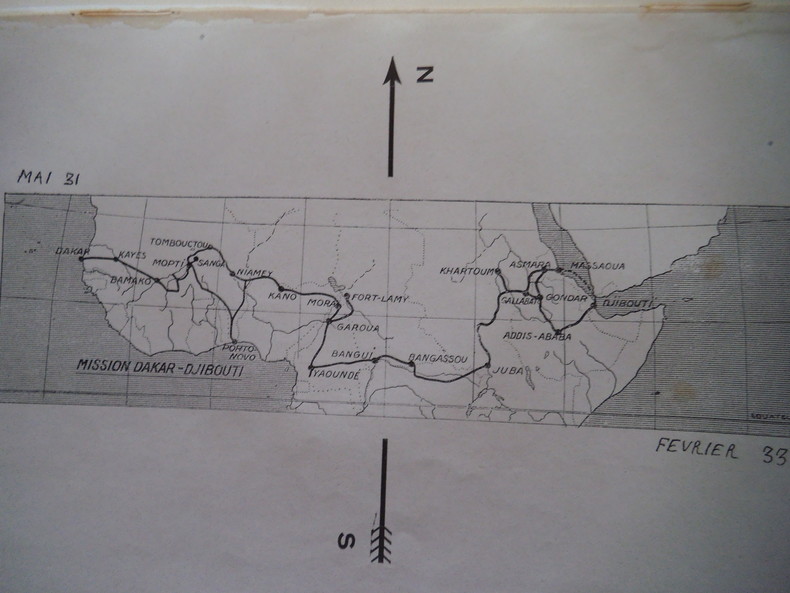
11290de Dakar à Djibouti In 8 broché, faux-titre, titre, une carte, 525 pages, 2 pages de table des illustrations, 2 planches photographiques hors-texte sur papier couché. Librairie Gallimard Janvier 1934. Les documents bleus notre temps. Mention fictive de 3ème édition. Edition originale. Très bon état. L’auteur y dénonce les abus du colonialisme, l’ouvrage a été condamné à la destruction par décret en 1941. Pas de grand papier.
1793373234J. Dodsley London 1793. 5th Edition. Hardcover. Very Good Condition. 21 pages. This 1765 article published in The Annual Register provides a detailed account of John Harrison's groundbreaking work in solving the longitude problem at sea through the use of artificial time-keepers. Harrison an English clockmaker developed the marine chronometer a device that allowed sailors to accurately determine their longitude while at sea. His invention was crucial for safe navigation reducing the risk of ships becoming lost or wrecked due to miscalculations. The article outlines the proceedings and debates surrounding Harrison's work including his struggles with the Longitude Board which was reluctant to grant him the full 20000 prize promised under the 1714 Longitude Act. Despite proving the accuracy of his time-keepers Harrison faced political opposition and bureaucratic delays before finally receiving recognition for his achievements. Published at around the same time that Harrison's book of a similar title was published this contemporary 21 page account quotes Harrison extensively and represents the opinions and ideas regarding navigation from the perspective of the time. The whole volume extends to around 600 pages. Bound in modern but not recent brown buckram with a contrasting black leather lettering piece gilt title. Library label to the endpapers stamp on first blank and label to reverse of the title page. The first blank has a hand note stating "Given by Lt.Col. A.R. Hurst". Hurst has served with the Royal Field Artillery in the First World War. The whole volume is very clean with bright pages very firmly bound and in attractive condition. Size: 13.5 x 21 cms. Category: Antiquarian & Rare; Featured Items; Printed before 1800; Special Features. This item may require more postage than the rates shown for delivery outside the UK. If extra postage is required we will contact you before processing your order and you will be given the details and option to decline the extra cost. J. Dodsley hardcover
97524aafLondon / Leipsic, T. Fisher Unwin, 1912, lg. in-8vo, frontispiece + 4 ff. + 247 p., illustrated with 58 b/w plates + 6 in colours + 2 maps (1 folding), small legacy stamp ‘Guggisberg’, original publisher’s brown pictorial clothbound. Fine copy.
4to., First Edition, with a coloured portrait frontispiece, and very numerous coloured and monochrome illustrations by the author; black cloth, gilt back, a very good, clean in the dustwrapper. First published in 1966. Very scarce, especially in this condition. Spence 1030
Paris, Imprimerie C. Courtois 1925. Petit in-4 (19 x 28 cm), demi-basane, dos lisse auteur et titres en lettres dorées, VI-375 pp. Avec une table nominative des poiçons et une deuxième table des poinçons particuliers à chaque ville. Les dessins des poinçons en regard du texte le sont par similitude d'image, en subdivisant cette classification en deux parties : symboles divers et Lettres ''. Bel exemplaire.
26595Paris, Imprimerie C. Courtois 1925. Petit in-4 (19 x 28 cm), demi-basane, dos lisse auteur et titres en lettres dorées, VI-375 pp. Avec une table nominative des poiçons et une deuxième table des poinçons particuliers à chaque ville.
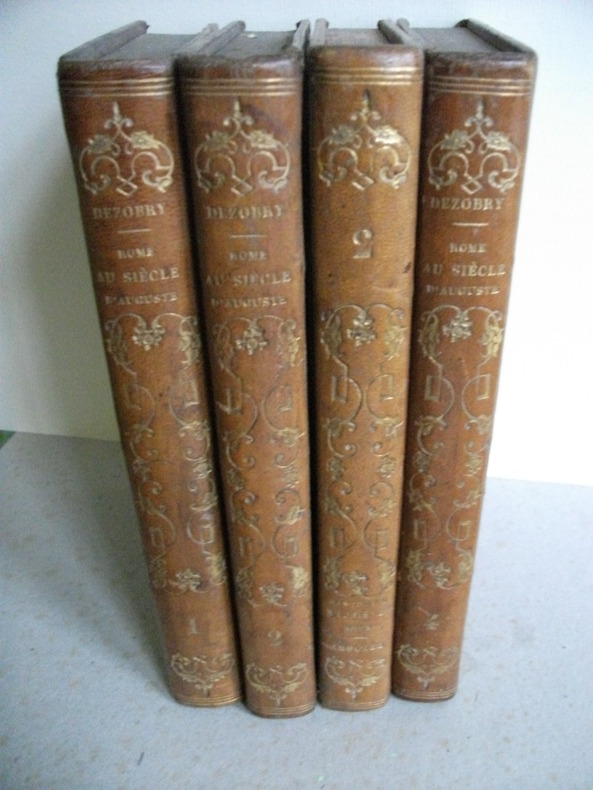
6234ou voyage d’un gaulois à Rome,à l’époque du règne d’Auguste et pendant une partie du règne de Tibère.4 tomes en 4 volumes in 8 reliure d’époque plein cuir fauve,titre, tomaison,fers en long,roulette dorés,plaque à froid sur les plat,filet doré en encadrement,roulette dorée sur coupes, Collège de Bar le Duc,Prix 2 septembre 1843, doré, sur le premier plat.Tome 1 faux-titre,titre,470 pages,1 feuillet d’errata Bien complet des 3 planches dépliantes.Tome 2 faux-titre,titre,454 pages 1 feuillet d’errata.Tome 3 faux-titre,titre,416 pages,1 feuillet d’errata,tome 4 faux-titre,titre,446 pages,1 feuillet de table.Tranches marbrées.Librairie classique élémentaire Hachette 1835 Edition originale rare ,bien relié
551Partie Septentrionale. Grand in 8 demi-chagrin à nerfs et à caissons dorés.Faux- titre,frontispice gravé(vue de Florence)titre illustré,VIII,536 pages et 32 illustrations Hors-Texte gravées sur acier(avec le frontispice)de ROUARGUE Frères. Dont 6 en couleurs Morizot 1864,rousseurs éparses habituelles 280€
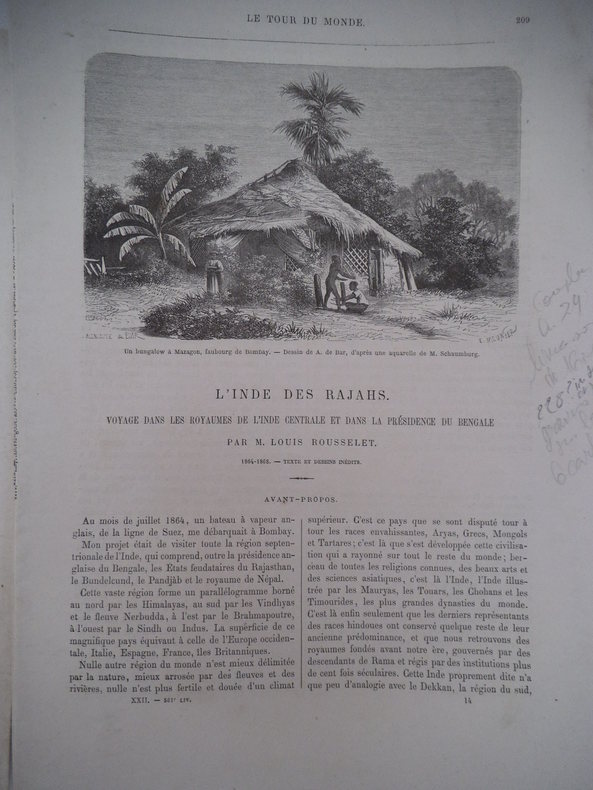
9633Voyage dans l’Inde Centrale et dans les résidences de Bombay et du Bengale. Ouvrage à livraisons de la Revue Le Tour du monde d’Edouard CHARTON. Complet des 29 livraisons de 16 pages chacune, texte sur 2 colonnes avec une erreur au chapitre XXXIX indiqué XXIX, plus de 200 gravures sur bois dans le texte et à pleine page par les meilleurs artistes, A de BAR, Emile BAYARD, CATENACCI, A de NEUVILLE, PHILIPPOTEAUX, CLERGET, THEROND etc. d’après les photographies et les croquis de l’auteur. et six cartes dans le texte- Détail des livraisons : Tome XXII livraisons 561 562 563 564 565 Tome XXVIII livraisons 585 586 587 588 589 Tome XXIV livraisons : 609 610 611 612 613 Tome XXV livraison 635 636 637. Tome XXVI livraisons 669 670 671 672 673. Tome XXVII livraisons 682 683 684 685 686 687 et dernière(une pâle mouillure angle supérieur gauche) On joint une page de faux-titre et de titre semblables à celles de l’édition parue l’année suivante avec des variantes dans les gravures , une couverture de livraisons en papier mince bleu (11ème année livraison 561 ) Ces livraisons ne sont pas sorties de volumes reliés. Elles n’ont jamais été reliées. Ouvrage en édition pré-originale. Bon exemplaire, peu courant.
New English Original very decorative full leather bdg. with mystical sun gilded. Folio. (33 x 24 cm). In English, Turkish and Ottoman Turkish. 1 atlas (40 pages; 426 leaves, that is, 852 pages) color illustrations, color maps. Piri Reis's Kitab-i Bahriyye. Facsimile, Topkapi Palace Museum Library, Treasury Collection, number 642.= Kitab-i Bahriyye. Topkapi Sarayi Müzesi Kütüphanes Hazine Koleksiyonu. Printed to 2000 copies.
189843857Berlin, J.A. Barth, 1898. No wrappers. In ""Annalen der Physik"", Neue Folge Band 65, No 5. Pp. 1-240.. (Entire issue offered, No.5). Titlepage to vol. 65. Stamp on titlepage. Schmidt's paper: pp. 141-151, textillustr. A tear to inner lower corners of pp. 24-32. (not affecting Schmidt's paper). Clean and fine.
189843857Berlin J.A. Barth 1898. No wrappers. In "Annalen der Physik" Neue Folge Band 65 No 5. Pp. 1-240. Entire issue offered No.5. Titlepage to vol. 65. Stamp on titlepage. Schmidt's paper: pp. 141-151 textillustr. A tear to inner lower corners of pp. 24-32. not affecting Schmidt's paper. Clean and fine. <br/><br/><em>First printing of Schmidt's full exposition in which he describes his discovery of the radioactivity of Thorium. Schmidt and Marie Curie independently demonstrated the radioactive quality but Schmidt's demonstration took place a few months before Curie's. The discovery was announced but not described in full in a short message published in "Verhandl. d. Phys. Gesellsch. zu Berlin 1898."Schmidt made his discovery while examining "many elements and compounds" in an effeort to determine whether any of the rays that were emitted bore a resemblance to those that Henri becquerel had found emerging from uranium and uranium compounds. He located only one such element thorium and immediately conducted absorption ionization reflection refradction and poklarization studies to determine the characteristics of its rays. Having combined a misinterpretation of Becquerel's with one of his own Schmidt concluded that thorium rays most resembled Röntgen rays - a conclusion that soon required revisoln in view of the researches of Marie Curie and Ernest Rutherford."DSB XII p. 191. </em> unknown
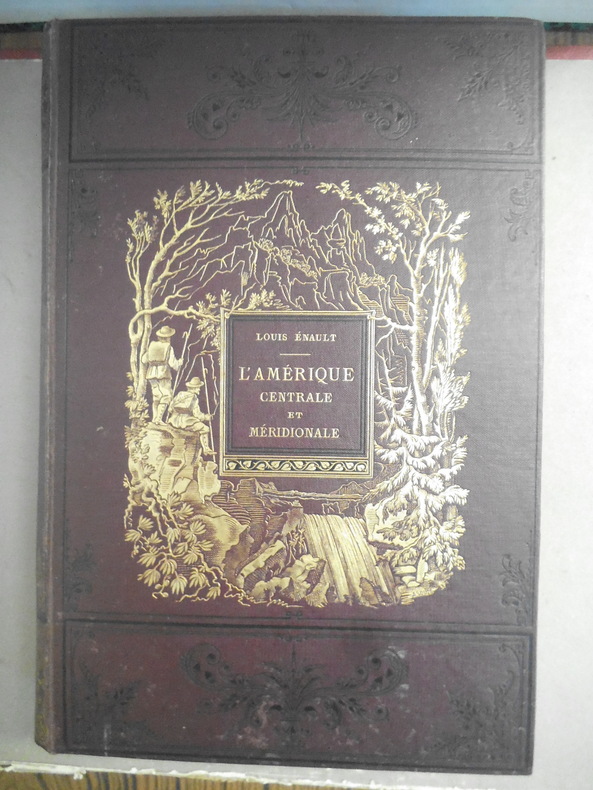
14530Grand in 8 reliure éditeur pleine toile lie de vin, plaque avec titre dorés dans cartouche, reliure de SOUZE. 190270MM, .Faux-titre, frontispice (chasse au lasso),titre, XXXVI, 444 pages, tranches dorées,20 gravures sur acier hors texte sous serpentes, par MM.Jules NOEL, LEBRETON, Gustave JANET, gravées par MM Willmann, Outhwaite, Naigrot, Delannoy et Aubert. Ancienne maison Morizot, F de P. Mellado & Cie successeus sans date..Rousseurs sur serpentes en début et fin de volume, sinon bon exemplaire,belles vues de La Havane ,Buenos-Ayres, Veracruz et...
xx, [13]-509 p. front., 27 pl., 2 fold. maps 25 cm. Hardcover Very good condition, spine ends worn
96077aafLondon, Hurst and Blackett, 1861, gr. in-8vo, colored front. + XIII + 570 p., with 1 map and numerous illustrations, small legacy stamp on first flyleaf ‘Guggisberg’, original half-leather, with large corners, spine on 5 bands gilt. Fine copy.
Adamson, Glenn, Meyers, ZIn Pristine Condition. unknown
182044807(Paris, Crochard, 1820). No wrappers as extracted fron 'Annales de Chimie et de Physique', Volume 15 (2e Series). Pp. 93-102.