1 815 résultats
40 pages. Features: Dramatic cover photo of a Pacific LCI firing rockets; This is the Army We Have to Defeat - a picture of the Japanese soldier and of the organization of which he is the core; The Aircraft Carrier - lethal sea weapon and powder keg, too; Col. Howard A. Rusk explains the returning soldier's emotional problems and offers a solution; The Mediterranean will become a highway for all nations; Greatest Education Project in History - set up by our Army in Europe, it will have more than a million GI students; Claude R. Wickard explores Rural Electrification (RE); They Do a Sailor's Job - Six photos of female Waves at work in the U.S. Navy; Man of Science and of Penicillin - Sir Alexander Fleming talks of his discovery and its future promise; Nice color one-page ad for Virginia Rounds cigarettes; Good Words for Insects; Four photos of famous art pieces being returned to the Louvre from their provincial hiding places; Two pages of fashion photos of autumn suits for ladies; Nice color-photo back page Macy's ad features three ladies in winged-look raincoats; and more. Moderate external soiling and wear. Unmarked. Moderate age-toning to paper. A sound copy of this vintage WWII issue. Book
64 pages. Features: Nice colour RCAF ad inside front cover; Dispute Still Surrounds Duff Cooper; More Canadians than Jobs; Lovely colour full-page ad for 1954 DeSoto automobiles; The Seven Living Ghosts of Nuremberg - an uncensored first-hand report from behind the bars of Spandau where Rudolf Hess, Karl Doenitz, Baldur Von Schirach, Walther Funk, Erich Raeder, Albert Speer and Baron Konstantin Von Neurath - top Nazis - imprisoned for crimes against humanity wait out the tortuous years while the world forgets they exist - with photos; Athabaska's Atom Boom - Albert Zeemel's discovery of Uranium sparks the development of Uranium City, Saskatchewan - great article with many photos; The Maps that Charted our History - a famous collection, published here for the first time, show the slow evolution of Europe's knowledge about Canada; How Early Map Makers Saw the Great Lakes; The Brainiest School in the Country - Dalhousie Law School - article with photos; How Papa Masella Made His Boys Make Music - Frank Masella of Montreal and his eight musical sons; In the Lost World of the Cypress Hills - this strange mountain on the prairies harbors tropical scorpions, petrified figs, fourteen kinds of orchid and a lawless past that sparked the formation of the Mounties; Are People Monkees? - fiction by James McNamee; Ford colour V-8 ad; 1954 Plymouth ad; Colour Buick ad; Chevrolet truck ad; and more. Average wear. Couple of small chips from covers. Unmarked. A quality copy. Book
155Deux tomes en deux volumes in 8 brochés,papier gris d'attente, étiquettes de titre imprimée.Tome premier: Faux-titretitre,XIV, 350 pages Tome deuxième: faux-titre,titre,359 pages. non rognés.Une carte gravée, dépliante, de la partie Nord de l'Amérique Septentrionale a été ajoutée.Traduit de l'anglais sur la seconde édition par J.T PARISOT.Bon exemplaire à grandes marges.
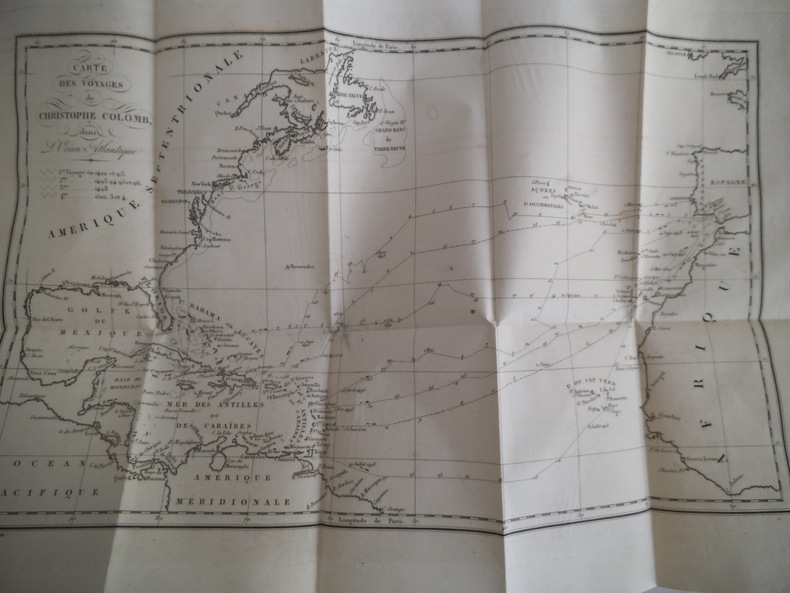
10537traduit de l’anglais par E.A. DEFAUCOMPRET Fils Deuxième édition revue et corrigée, ornée d’une carte dépliante en noir. 4 tomes en 4 volume in 8 brochés, Tome premier : faux-titre, titre, XVI, 381 pages. Tome second faux-titre, titre, VIII, 406 pages. Tome troisième faux-titre, titre VIII 364 pages. Tome quatrième faux-titre, titre, 422 pages, une grande carte dépliante en noir (et non en couleurs comme annoncée sur la couverture) Paris Librairie Charles GOSSELIN 1836 sous couverture à la date de 1843. Quelques petits défauts d’usage, sinon bon exemplaire à grande marges tel que paru
1782106474BBParis, Pissot, pere & fils et Laporte, 1782. 8°. X, 508 S. mit gestoch. gefalt. Frontispiz u. 1 gefalt. gestoch. Karte. Kalbslederband der Zeit mit goldgepr. Rückenschild und floraler Rückenvergoldung. [4 Warenabbildungen]
1888CCC-223amb.edition Librairie D'Education A. Hatier 1888, avec carte en couleur,tres bon etat, photo possible
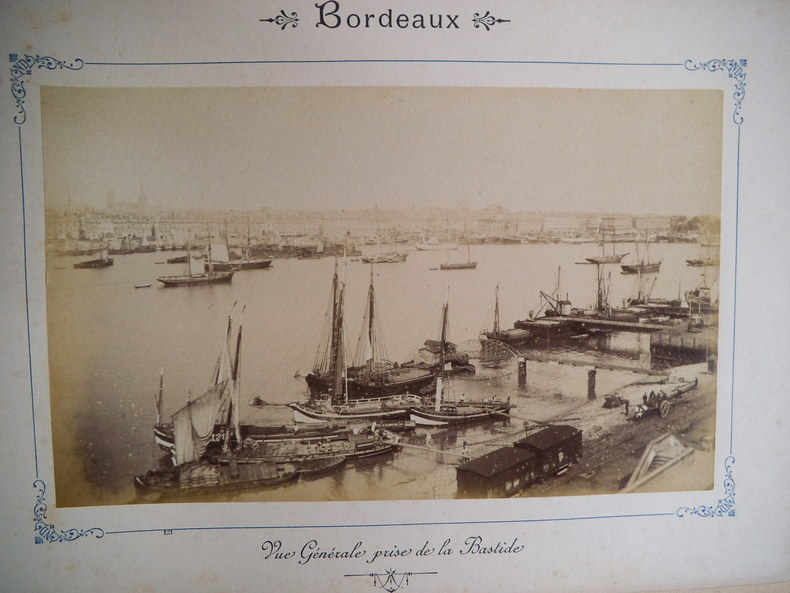
6889album constitué de 24 photograhies,24 épreuve, montées sur carton fort avec légende et filets en encadrement,bleus.240x175 mm et 190x120mm,l’ensemble monté sur onglets dans une reliure demi-chagrin rouge à nerfs,titre et caissons dorés,plats percaline rouge avec titre dans cartouche, dorés sur le premier. Double filet doré sur les plats, tranches dorées, charnières intérieures toilées. 1) vue générale prise de la tour Saint Michel. 2) Le quai de Bourgogne et le port 3) Perspective du quai de la douane et de Bourgogne 4) La place de la Bourse 5) Le Hall du Palais de la Bourse 6) vue générale prise de la Bastide 7) Porte du Palais 8) porte de la grosse cloche 9) La colonne Rostrale et le Quinconce 10 ) le grand Théâtre 11) fontaine de Allée de Tourny 12) escalier d’honneur du grand Théâtre 13) allée de Tourny 14) perspective du cour de l’intendance 15) pont rustique du jardin public 16) église sainte croix 17 portail méridional de l’église Saint –André 18) intérieur de la cathédrale 19) La tour Pey-Berlon et l’église Saint-André 20) La tour Saint Michel 11) église Saint Sernin 22) l’hôtel de ville 23) le pont reliant le chemin de fer d’Orléans et du Midi 21) Saint André de Cubzac pont sur la Dordogne l’ensemble en très bon état
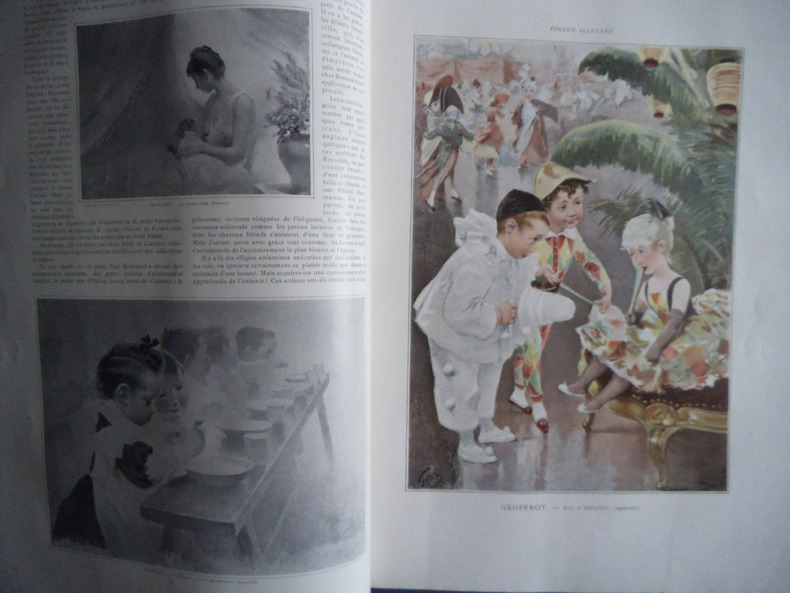
9209année 1901 complète, publication mensuelle, in folio, couverture illustrée en couleurs, texte sur 2 colonnes Année complète 12 n° janvier à décembre. En un volume demi-chagrin marron à nerfs et à coins, titre doré. Filet à froid sur les plats. Non rogné, tête dorée. JANVIER : l’Espagne à l’exposition par Antonin PROUST. La tapisserie et la couronne d’Espagne par Raymond KOECHLIN. Les beaux-arts la section espagnole du grand palais par Arsène ALEXANDRE illustrations en noir et en couleurs dans le texte, à pleine page et hors-texte ; FEVRIER : déguisements et bals masqué carnavals du XIXème siècle –Au temps de Bonaparte par Frédéric MASSON. Le dernier bal costumé du XIXème siècle par Gaston JOLLIVET –Carnavals romantiques par Henri BOUCHOT- Les contemporains par René MAIZEROY illustrations en noir et en couleurs dans le texte, à pleine page et hors-texte. MARS : les accroissements du musée du Louvre par Raymond KOECHLIN. L’art français pendant un siècle par Roger MARX illustrations en noir dans le texte. AVRIL : jolie couverture de Firmin BOUISSET. Œufs de Pâques- Jean Charles CAZIN par THIEBAULT-SISSON. Enfants et fleurs le peintre Firmin BOUISSET par Henri FRANTZ Jolies illustrations en noir et en couleurs de Firmin BOUISSET dont fleurs animées, à pleine page et hors-texte. Société nouvelle de peintres et de sculpteurs par Gabriel MOUREY, illustrations. MAI : Numéro spécial les enfants par THIEBAULT-SISSON GEOFFROY le peintre des enfants. Par Henri FRANTZ. Illustrations. JUIN : le musée de l’enfance La section d’art et d’histoire par René VILLANDRY illustrations en noir et en couleurs dans le texte et hors-texte. JUILLET : J.L GEROME peintre de l’Orient illustrations en noir et en couleurs dans le texte et à pleine page. AOUT les Pyrénées par Henry SPONT illustrations. SEPTEMBRE : Yachting couverture en couleur de HELLEU. 34 illustrations en noir et en couleurs dans le texte, pleine page et Hors-texte, une déchirure en marge extérieure à une page. OCTOBRE : COMPIEGNE jadis par Frédéric MASSON- DUNKERQUE et REIMS par Emile BERR NOVEMBRE : le salon de photographies, illustrations. DECEMBRE Numéro de NOEL Aventure par René MAIZEROY, le jour de l’An d’une parisienne, texte et illustrations d’Albert GUILLAUME, voyage de J.H ROSNY illustrations de CHALON, le docteur PERLINPINPIN comédie en un acte pour enfants par Paul BIHAUD illustrations en couleurs de GEOFFROY. La nymphe du lac par J DAUTREVILLE illustrations de C.H DUFAU, année avec des suppléments hors-texte en couleurs, complet des couvertures en couleurs.
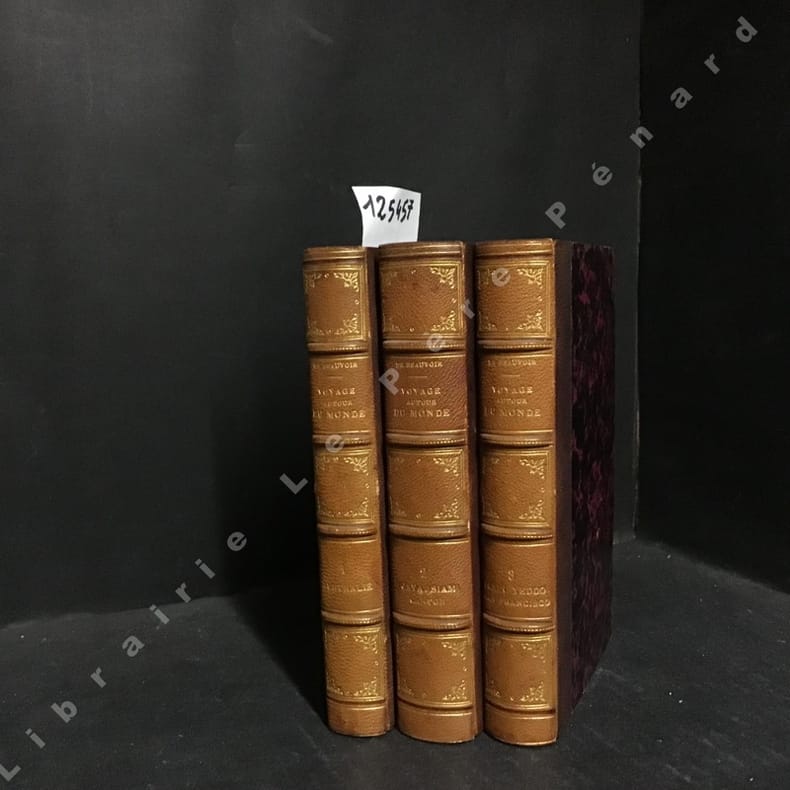
18691254571869/1872 Paris, Henri-Plon, Imprimeur-Editeur - 1869 pour le tome I et II, 1872 pour le tome III - 3 volumes in-12 (12x18cm environ); reliure demi-chagrin; dos à 4 nerfs avec titres et caissons ornés de fleurons en doré, frontispice collé - 363 + 451 + 359 pages - Ouvrage richement illustré de gravures-photographies en N&B hors texte et en page dépliante avec également des cartes en couleur sur deux pages et dépliantes
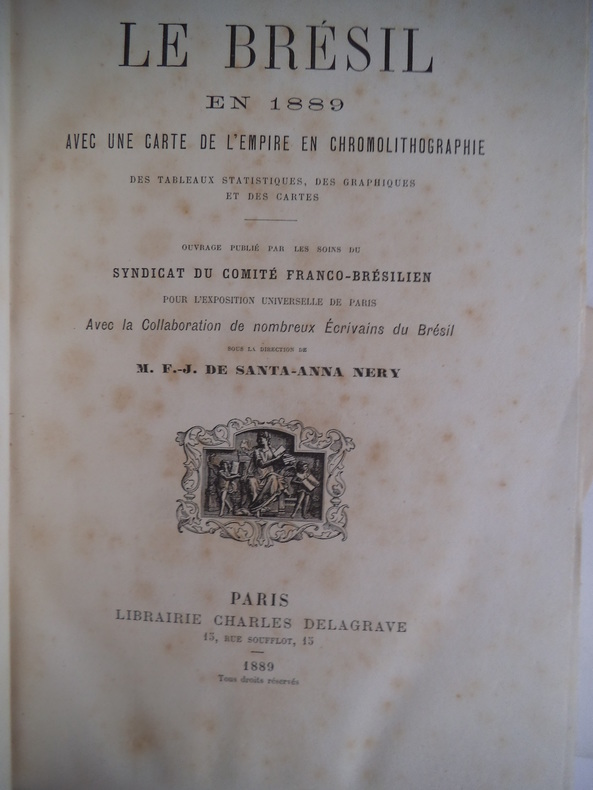
9654avec une carte de l’Empire en chromolithographie, des tableaux statistiques, des graphiques et des cartes. Ouvrage publié par les soins du syndicat du comité Franco Brésilien pour l’exposition universelle de Paris. Avec la collaboration de nombreux écrivains du Brésil. In 8 demi-chagrin rouge à nerfs et à coins titre doré, filet à froid sur les plats. Faux-titre, titre XIX 691 pages, tête dorée, non rogné. Paris Librairie Charles Delagrave 1889. Edition originale, rousseurs en début et fin de volume
Frost, OrcuttIn Pristine Condition. unknown
New New Turkish Original bdg. HC. In special publisher's box. 4to. (36 x 36 cm). In Turkish. 321, [2] p., color ills. Kutuplar atlasi. Translated by Kivanç Sezer.
Very Good German Paperback. Small 4to. (26 x 18 cm). In German. [xLviii], 88 p., 4 numerous b/w plates (Tafeln). Piri Re'îs [sic. Pirî Reis] Bahrîje. Das türkische Segelhandbuch für das Mittellandische Meer vom Jahre 1521. Band II: Übersetzung. 1. Lieferung, Kapitel 1-28. First Edition.
313p., illus. Hardcover Very good condition, in red cloth, black & gilt decoration Cover title: Au Pole Nord Voyages au pays des glaces par F. von Hellwald . . .
182643853(Paris, Crochard, 1826). Without wrappers. In: ""Annales de Chimie et de Physique, par Gay-Lussac et Arago"", tome 32, Sec. Series, Cahier 4. Pp. 337-443 a. 1 fodled engraved plate. (The entire issue offerd). Balard's paper: pp. 337-84.
179944095Halle, Rengerschen Buchhandlung, 1799, 1800. Without wrappers extracted from ""Annalen der Physik. Herausgegeben von Ludwig Wilhelm Gilbert"", Bd. 2. p. 483 (one page). and Bd. 6, pp. 105-115. Some scattered brownspots.
189844238(London, Taylor and Francis, 1898) No wrappers. In ""Proceedings of the Royal Society of London."", Vol.63, Nos. 399-400 (both issues offered).. Pp. 373-480 a. 5 plates. Ransay & Travers' paper: pp. 405-408.
180442469(London, Bulwer and Co., 1804). 4to. Without wrappers as extracted from ""Philosophical Transactions of the Royal Society of London."" Year 1804-Part II. Pp. 419-430. Clean and fine.
182643853Paris Crochard 1826. Without wrappers. In: "Annales de Chimie et de Physique par Gay-Lussac et Arago" tome 32 Sec. Series Cahier 4. Pp. 337-443 a. 1 fodled engraved plate. The entire issue offerd. Balard's paper: pp. 337-84. <br/><br/><em>First printing of Balard's famous memoire in which he records his discovery of the new element Bromine le brôme. While he was studying the flora of a salt marsh he notized a deposit of sodium saulfate which had crystallized out in a pan containing mother liquer from common salts. "In an attempt to find a use for the waste liquers he performed a number of experiments and notized that when certain reagents were added the mother liquer bacame brown. His investigation of this phenomenon.ked to the remarkable discovery.Weeks p. 264."The discovery of a new chemical element by a young and obscure provincial pharmacist caused a sensation in Paris. Balard's achievemnt was recognized by the Academie des Sciences and he was awarded a medal by the Royal Society of London."DSB I p. 416."The discovery of bromine is a very importent acquisition to chemistry and gives M. Balrad honorable rank inthe career of the sciences. We are of the opinion that this young chemist is every way worthy of the encouragement of the Academy and we have the honour to propose that his memoir shall be printed in the "Recueil des Savants Étrangers" The report from the French Academy signed by Vaugelin Thenard and Gay-Lussac. </em> unknown
179944095Halle Rengerschen Buchhandlung 1799 1800. Without wrappers extracted from "Annalen der Physik. Herausgegeben von Ludwig Wilhelm Gilbert" Bd. 2. p. 483 one page. and Bd. 6 pp. 105-115. Some scattered brownspots. <br/><br/><em>First German translation of Davy's announcement the announcement on 1 page of his discovery of the unusual anaesthetic effects of nitrous oxide which on being inhaled gave rise to a giddy intoxicated feeling. On announcing his discovery he says that he will publish a paper discribing the experiments with the gas later. This is the paper offered here also in the first German version. Both the announcement and the paper were issued in the "Annalen" the same year as they appeared in Nicholson's Journal.The gas was first synthesized by English natural philosopher and chemist Joseph Priestley in 1772 who called it phlogisticated nitrous air."Following Priestley's discovery Humphry Davy of the Pneumatic Institute in Bristol England experimented with the physiological properties of the gas such as its effects upon respiration. He even administered the gas to visitors to the institute and after watching the amusing effects on people who inhaled it coined the term 'laughing gas'! Davy even noted the anaesthetic effects of the gas: "As nitrous oxide in its extensive operation appears capable of destroying physical pain it may probably be used with advantage during surgical operations in which no great effusion of blood takes place".Wikipedia."Davy discovered the anaesthetic properties of nitrous oxide and suggested its use during surgiical operations a suggestion which was not turned to useful account until 1844."Garrison & Morton 5646 not mentioning the announcing of its discovery in 1799. </em> unknown
189844238London Taylor and Francis 1898 No wrappers. In "Proceedings of the Royal Society of London." Vol.63 Nos. 399-400 both issues offered. Pp. 373-480 a. 5 plates. Ransay & Travers' paper: pp. 405-408. <br/><br/><em>First appearance of the paper in which Ramsay and Travers announced their discovery of a new element which they named "krypton" meaning hidden."Dr. William Hampson presented them Ransay & Travers with about a liter of liquid air which they used not for liquefying the argon but for obstaining sufficient skill in manipulation so that they would not risk loosing their precious fifteen liter of argon.The residue left after most of the liquid air had boliled away consisted largly of oxygen and nitrogen which Ramsay and Travers temoved with red-hot copper and magnesium. .they then examined the twenty-five cibic centimeters of residual gas and when they found it to be inerst they immediately placedit in a Pl'ucker tube connected to and induction coil and observed its spectrum. There was a bright yelælow line with a greener tint than that of the helium line and a brilliant green line that did nor coincide with any line of argon helium mercury or hydrogen. They discoverede this gas on 30 May 1898 and named it 'krypton'.they found that it belonged between bromine and rubidium in the periodic table and so great was their excitement that the younger chemist almost forgot about his examination for doctor of sciwence which had been schedules for the next day."Weeks p. 267.Parkinson "Breakthroughs" 1898 C. </em> unknown
180545516Paris, Chez Bernard, AN XIII (1805). No wrappers. In: ""Annales de Chimie ou Recueil de Mémoires.."" Vol. 55, Cahier 2 (30 Thermidor an XIII). Pp. 113-224 (entire issue offered). Htitle to vol. 55 present. Robiquet's paper: pp. 152-171.
180545516Paris Chez Bernard AN XIII 1805. No wrappers. In: "Annales de Chimie ou Recueil de Mémoires." Vol. 55 Cahier 2 30 Thermidor an XIII. Pp. 113-224 entire issue offered. Htitle to vol. 55 present. Robiquet's paper: pp. 152-171. <br/><br/><em>First appearance of Robiquet's first chemical paper in which he relates his discovery of asparagine by analysis of asparagus juice the first amino acid to be discovered. The following year he made the first isolation of this amino acid together with Vaguelin. Pierre Jean Robiquet was a French chemist who laid founding work in identifying amino acids the fundamental bricks of proteins through recognizing the first of them asparagin in 1806 in the take up of the industry of industrial dyes with the identification of alizarin in 1826 and in the emergence of modern medications through the identification of codeine in 1832 a powerful molecule today of widespread use with analgesic and antidiarrheal properties. </em> unknown
180442469London Bulwer and Co. 1804. 4to. Without wrappers as extracted from "Philosophical Transactions of the Royal Society of London." Year 1804-Part II. Pp. 419-430. Clean and fine. <br/><br/><em>First appearance of the paper in which Wollaston announced his discovery of the metallic element Rhodium."Dr. Wollaston dissolved a portion of crude platinum in qgua regia and neutralized the excess acid with caustic soda. He then added salammoniac to precipitate the platinum as ammonium chloroplatinate and mercurous cyanide to precipitate the palladium as palladium cyanide. After filteringoff the precipitate he decomposed the excess mercurous cyanide inthe filtarate by adding hydrochloric acid and evaporating to dryness. When he washed the residue with alcohol everything dissolved except a beautiful dark red powder which proved to be a double chloride of sodium and a new metal which because of the rose color of its salts Dr. Wollaston named 'Rhodium'. He found that the sodium rhodium chloride could be easely reduced by heating it in a current of hydrogen and that after the sodium chloride had been washed out the rhodium remained as a metallic powder. he also succeeded in obtaining a rhodium button."Weeks: Discovery of the Elements. p. 104-05. </em> unknown
19946946Sao Paulo: Fundacao Quadrilátero do Descobrimento 1994. 1st ed. Paperback. Used; Like New. Small Folio bds 239 pp.dust jacket semi glossy stock maps color plates facsimiles bibl. Fundacao Quadrilátero do Descobrimento paperback