289 résultats
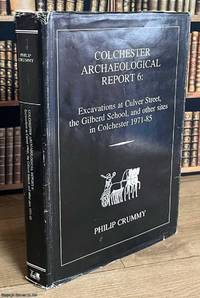
1992520298Colchester Archaeological Trust Colchester 1992. Hardcover. Very Good Condition/Good Condition. 426 pages illustrated throughout 4 large folding plates in a slip case. Includes several microfiche. Original black cloth gilt lettered. With a very worn dustwrapper. Signed by Paul Bidwell British archaeologist to front endpaper. Contents clean and bright throughout. The book details the discovery and analysis of Roman medieval and later remains with particular emphasis on Colchester’s Roman town layout buildings industrial activity and artefacts. The report includes specialist studies drawings site plans and finds catalogues making it a foundational reference for understanding the archaeology of one of Britain’s most important Roman towns. Size: 21.5 x 30.5 cms. Category: Varied Books; Archaeology; Hardback Books; ISBN: 095037279X. ISBN/EAN: 9780950372792. This item may require more postage than the rates shown for delivery outside the UK. If extra postage is required we will contact you before processing your order and you will be given the details and option to decline the extra cost. 9780950372792 Colchester Archaeological Trust hardcover
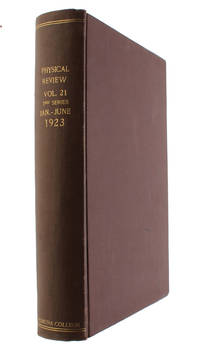
192347061Lancaster The Physical Review 1923. Royal8vo. Contemp. full buckram. In:"The Physical Review" Series II vol. 21. 4736 pp. Plates and textillustr. Entire volume offered. A perforated stamp in upper margin on a few leaves. Compton's paper: pp. 483- 501. <br/><br/><em>First printing of this milestone paper in quantum physics in which Compton verifies Planck's quantum postulate and found that some of the X-rays had in scattering lenghtened their wavelenght. This phenomena was called the "Compton Effect" in his honour. For this discovery Compton received the Nobel prize in physics in 1927."Compton was able to account for this lenghtening of wavelenght by presuming that a photon of light struch an electron which recoiled subtracting some energy from the photon and therefore increasing its wavelenght. This made it seem that a photon acted as a particle: thus after more than a century the particulate natuer of light as evolved by Newton was revived. What itamounted to was that Compton brought to fruition the view that electromagnetic radiation had both a wave aspect and a particle aspect and that the aspect which was most evident depended on how the radiation was tested. De Broglie was at the same time showing that this held true also for ordinary particles such as electrons." AsimovParkinson "Breakthroughs" 1923 P. - Sigmund Brandt "The Harvest of as Century" Episode 31. </em> hardcover
0259275611.Gpaperback. Good. Access codes and supplements are not guaranteed with used items. May be an ex-library book. paperback
025937248X.Gpaperback. Good. Access codes and supplements are not guaranteed with used items. May be an ex-library book. paperback
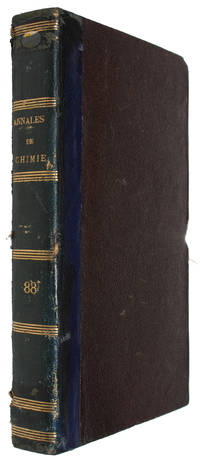
181343081Paris J. Klostermann 1813. Contemp. hcalf. Spine gilt. A few scratches to binding. In: "Annales de Chimie ou Recueil de Mémoires concernant la Chemie" Tome 88. - 336 pp. the entire volume offered. Pp. 304-310 311-318 319-321 a. 322-329. Scattered brownspots. <br/><br/><em>First printing of this paper announcing the discovery of Iodine. Courtois found this substance which he suspected to be a new element while burning algae in order to obtain sodium and potassium compounds. Although Courtois discovered the element in 1811 the announcement of it was not made until two years later after he had turned it over to Charles Desormés and Nicolas Clément."The first publication on iodine are somewhat confusing. Courtois's research is found in a paper attributed to him the paper offered but actually the work of Clément. was followed by an anonymous article the second paper offered. Gay-Lussac. who repeated and extended Courtios's work was responsible for this paper. Courtois himself published nothing. These two articles were immediately followed by short contributions of Gay-Lussac and Humphry Davy on the new element third and fourth paper offered. Gay-Lussacs views none too flattering to Davy on the history ofthe discovery of iodine appeared in his "Mémoire sur l'iode" 1814."DSB III p. 455. - Weeks "Discovery of the Elements" pp. 257-262.The volume contains further importent papers in chemistry Guyton de Morveau "Sur la chaux maigre" "Sur le dissolvant des pierres biliaires" an importent paper by Chevreul on animal fats "Recherches chimiques sur plusieurs corps gras et particulierement sur leurs combinaisons avec les alcalis" Berzelius's papers "Mémoires sur la compositions des fluides animaux" first edition in French Suite first edition Parmentier etc. etc. </em> unknown
189846852Paris Gauthier-Villars 1898. 4to. No wrappers. In: "Comptes Rendus Hebdomadaires des Séances de L'Academie des Sciences" Tome 126 No 15. Entire issue offered. With htitle and titlepage to vol. 126. Pp. 1059-1110. Curie's paper: pp. 1101-1103. <br/><br/><em>First printing of this milestone paper being the first "Note" from Marie Curie about "radioactivity". This same "Note" contains a the fundamental observation: "Two uranium ores. are much more active than uranium itself. This fact. leads one to believe that these ores may contain an element much more active than uranium." This paper gives the first proof of the fact that radiation is an atomic property."Henri Becquerel discovered 1896 that uranium salts shielded from light for several months spontaneously emit rays related in their effects to Roentgen rays. Mme. Curie became enthusiastic about this subject filled with the unknown and as she later acknowledged involving no bibliographic research.The first step in the research was to determine whether there existed other elements capable like uranium of emitting radiation. Abandoning the idea of hyperfluorescence couldn’t one calculate by electrical measurement the effects on the conductivity of air that were revealed by the gold-leaf electroscope Pierre Curie and his brother Jacques had constructed an extremely sensitive apparatus to measure weak currents; Mme. Curie employed it in testing both pure substances and various ores. In her first "Note" in the Comptes rendus"de l Académie des sciences 12 April 1898 she described the method that she followed throughout her life the method that enabled her to make comparisons through time and crosschecks with other techniques:"I employed. a plate condenser one of the plates being covered with a uniform layer of uranium or of another finely pulverized substance diameter of the plates eight centimeters; distance between them three centimeters. A potential difference of 100 volts was established between the plates. The current that traversed the condenser was measured in absolute value by means of an electrometer and a piezoelectric quartz. In general she preferred the zero method in which the operator compensates for the current created by the active material by manipulating the quartz. All of her students followed this procedure."DSB.The first results came in 1898: the measurements varied between 83 × 10-12 amperes for pitch blende to less than 0.3 × 10⁻¹² for almost inactive salts passing through 53 × 10-12 for thorium oxide and for chalcolite double phosphate of uranium and copper. Thorium would thus be "radioactive" the term is Mme. Curie’s; its radioactive properties were discovered at the same time independently by Schmidt in Germany. </em> unknown
193447071Paris Gauthier-Villars 1934. 4to. No wrappers. In: "Comptes Rendus Hebdomadaires des Séances de L'Academie des Sciences" Tome 198 No 3. Titlepage to vol. 198. Pp. 213- 292. Entire issue offered. The joint paper: pp. 254-256 a. 1 photographic illustration in the text. Titlepage with a stamp on verso 2 small tears and a tiny bit of upper right corner gone. Titlepage a bit browned. <br/><br/><em>First appearance of this seminal paper in which artificial radioactivity was announced for the first time. Curie and Joliot were awarded the Nobel Prize in Chemistry 1935 "in recognition of their synthesis of new radioactive elements"."Until this date 1934 atomic nuclei emitting radiation were found in nature: it was called the natural radioactivity. It had been known since Rutherford that this natural radioactivity changed a nucleus into an other one: for instance radium becomes finally lead after many radioactive decays. We could say that lead does not become gold but gold becomes lead! But. this change of matter was not under control. It was not possible to construct the desired chemical element as the alchemist dreamed. But Irene and Frederic Joliot-Curie made the dream become almost reality.""Another very important development in the early 1934 by the Joliot-Curies in connection with irradiation of aluminum by alpha particles. The two French scientists detected the production of the recently discovered positrons. . However they soon realized that the positron activity continued after the alpha source was removed and that they had in fact discovered positive beta radioactivity. The importance of the discovery of artificial radioactivity was immediately recognized and resulted in a Nobel Prize in chemistry to the Joliot-Curies in 1935. The new phenomenon immediately became widely employed in nuclear physics chemistry biology and medicine." Kragh Quantum Generations p. 187"These elegant experiments which provided the first chemical proof of induced transmutations and showed the possibility of artificially creating radioisotopes of known stable elements were repeated and extended in the major nuclear physics laboratories of various countries " DSB.Born on 12 September 1897 in Paris Irène Curie was the daughter of Pierre and Marie Curie. "During World War I she worked as a nurse helping her mother operate radiography equipment and then studied physics and mathematics at the Sorbonne gaining a doctorate for studying the range of alpha particles. She then went to work for her mother at the Radium Institute. There she met Frédéric Joliot whom she married in 1926. Frédéric Joliot was born on 19 March 1900 in Paris - He joined the Radium Institute in 1925 and obtained his PhD in 1930. Together the Joliot-Curies worked on radioactivity and the transmutation of the elements. Twice they just missed major discoveries: in 1932 when Chadwick beat them to the neutron and in 1933 when Anderson discovered the positron. However in 1934 whilst bombarding light elements with alpha particles the Joliot-Curies noticed that although proton production stopped when the alpha particle bombardment stopped another form of radiation continued. The alpha particles had produced an isotope of phosphorus not found in nature. This isotope was radioactive and was decaying through beta-decay" DSB. </em> unknown
188047008Paris Gauthier-Villars 1880. 4to. No wrappers. In: "Comptes Rendus Hebdomadaires des Séances de L'Academie des Sciences" Tome 91 No 5 entire issue offered. Pp. 251-310. The Curie's paper: pp. 294-295. <br/><br/><em>First apperance of the paper in which the two brothers announced their discovery of the Piezoelectric Effect as they observed how an electric potential appeared across crystals of quartza and of Rochelle salt when pressure was applied to them. The potential varied directly with the pressure and they named the phenomenon Piezoelectricity meaning "to press" Greek. Crystals with piezoelectric properties form an essential portion of sound-electronics devices such as microphones and record-players."The applications of piezoelectric crystals are innumerable; one of the most important is their use in frequency stabilization of oscillating electromagnetic cirasciots for radio broadcasting stations. They are used in most piezometers for measuring with great precision either very strong pressure variations such as those of a cannon at the moment of firing or very weak ones such as artery pulsations. These applications have led to the creation of a new industry the manufacture of large "mono" such as quartz obtained hydrothermally around 500°C. under high water pressures or crystals such as Rochelle salt obtained from aqueous solutions. These two substances were mentioned in the Curie brothers’ report announcing the discovery of piezoelectricity." DSB."The first experimental demonstration of a connection between macroscopic piezoelectric phenomena and crystallographic structure was published in 1880 by Pierre and Jacques Curie. Their experiment consisted of a conclusive measurement of surface charges appearing on specially prepared crystals tourmaline quartz topaz cane sugar and Rochelle salt among them which were subjected to mechanical stress. These results were a credit to the Curies' imagination and perseverance considering that they were obtained with nothing more than tinfoil glue wire magnets and a jeweler's saw." Piezo Systems Inc.Magee "A Source Book in Physics" p. 547 ff. </em> unknown
179944095Halle Rengerschen Buchhandlung 1799 1800. Without wrappers extracted from "Annalen der Physik. Herausgegeben von Ludwig Wilhelm Gilbert" Bd. 2. p. 483 one page. and Bd. 6 pp. 105-115. Some scattered brownspots. <br/><br/><em>First German translation of Davy's announcement the announcement on 1 page of his discovery of the unusual anaesthetic effects of nitrous oxide which on being inhaled gave rise to a giddy intoxicated feeling. On announcing his discovery he says that he will publish a paper discribing the experiments with the gas later. This is the paper offered here also in the first German version. Both the announcement and the paper were issued in the "Annalen" the same year as they appeared in Nicholson's Journal.The gas was first synthesized by English natural philosopher and chemist Joseph Priestley in 1772 who called it phlogisticated nitrous air."Following Priestley's discovery Humphry Davy of the Pneumatic Institute in Bristol England experimented with the physiological properties of the gas such as its effects upon respiration. He even administered the gas to visitors to the institute and after watching the amusing effects on people who inhaled it coined the term 'laughing gas'! Davy even noted the anaesthetic effects of the gas: "As nitrous oxide in its extensive operation appears capable of destroying physical pain it may probably be used with advantage during surgical operations in which no great effusion of blood takes place".Wikipedia."Davy discovered the anaesthetic properties of nitrous oxide and suggested its use during surgiical operations a suggestion which was not turned to useful account until 1844."Garrison & Morton 5646 not mentioning the announcing of its discovery in 1799. </em> unknown
181046377Paris J. Klostermann 1810. Contemp. hcalf. Spine gilt. Slightly rubbed. A few scratches to binding. Small stamps on verso of titlepage.In: "Annales de Chimie ou Recueil de Mémoires concernant la Chemie" Tome 75. 336 pp. a. 2 folded engraved plates. Some scattered brownspots. The papers: pp. 27-77 129-175 256-263 264-273 274-289 a. 290-316. <br/><br/><em>First French version of Davy's "The Bakerian Lecture for 1809. On some new Electrochemical Researches on various Objects particularly the metallic Bodies from the Alkalies and Earth and on some Combinations of Hydrogene. Read November 16 1809." together with the controversy papers by Davy and Gay-Lussac & Thenard."Mr. Davy having from the commencement of his electro-chemical researches communicated the several steps of his progress to the Society The Royal Society takes the present opportunity of reporting the results of his further inquiries under four principal heads. First on the nature of the metals of the fixed alkalis. Second on the nature of Hydrogen and composition of ammonia. Thirdly on the metals of the earth; and Fourthly he makes a comparison between the antiphlogistic doctrine and a modified phlogistic hypothesis."Abstract. He further gives arguments for considering potassium and sodium which he discovered in 1808 as a element.""Gay-Lussac had a slight rivalry between himself and the creation scientist Sir Humphry Davy. Davy was chemically preparing Potassium and Sodium through an electrical current and this made Gay-Lussac and Thénard envious of his success. They too decided to perform the same task but they had no battery at their disposal as Davy had so they had to form another way to chemically prepare the two elements. In 1808 they used a red-hot iron fused to potash the water-soluble form of a manufactured salt containing potassium to perform this task a method that Davy admitted had its advantageous qualities. Gay-Lussac and Thénard were successful in preparing Potassium and continued to make a full analysis of its chemical properties and began to use it for their own experiments. In 1809 Davy performed the same task using it to reduce Boron in Boracic acid." </em> unknown
180950198Paris Mad. Ve Barnard 1809. Contemp. hcalf. Spine gilt. Wear to top of spine. A few scratches to binding. Small stamps on verso of titlepage.In: "Annales de Chimie ou Recueil de Mémoires concernant la Chemie" Tome 70. 336 pp. Entire volume offered. Davy's paper: pp. 189-254. <br/><br/><em>First edition in French the first English 1808 of this importent historical paper in chemistry in which Davy shows that electricity is capable of decomposing some alkalies isolating two new substances and discovering potassium and sodium. Neville in his Historical Chemical Library vol. I p.340 writes about this paper "ONE OF THE GREAT CLASSIC RESEARCHES IN CHEMISTRY in which Davy announced in this his second Bakterian lecture the isloation of metallic potassium and sodium by the electrolytic decomposition of their fused oxides.""He Davy began his own electrical experiments.The results were spectacular. On October 6 1807 the current passing through molten potash liberated a metal which Davy called potassium. The little globules of shining metal tore the water molecule apart as it eagerly recombined with oxygen and the liberated hydrogen burst into lavender flame. Davy danced about in a delirium of joy. A week later he isolated sodium from soda."Asimow. The paper offered here describes these discoveries."Humphry Davy was one of the most brilliant chemists of the early nineteenth century. His early study of nitrous oxide brought him his first reputation but his later and most importent investigations were devoted to electrochemistry. Following Galvani's experiments and the discovery of the voltaic pile interest in galvanic electricity had become widespread. The first electrolysis by means of the pile was carried out in 1800 by Nicholson and Carisle who obtained oxygen and hydrogen from water. Davy began to examine the chemical effects of electricity in 1800 and his numerous discoveries were presented in his Bakerian lecture to the Royal Society on November 20 1806. A Source Book in Chemistry p. 243. </em> unknown
181545715London W. Bulmer and Co. 1815. 4to. No wrappers as extracted from "Philosophical Transactions" 1815 - Part II. Pp. 203-213 a. pp. 214-219. <br/><br/><em>First appearance of two importent papers by davy. In the second paper offered he relates his discovery of chlorine dioxyd."By explosion over mercury he found that 2 vols. give from 2.7 to 2.9 of gas and this would probably be 3 vols. if no chlorine had been absorbed by the mercury. This gas contains 2 vols. of oxygen and the remainder chlorine hence the compound consists of 'two in volume of oxygen and one of chlorine condensed into the space of two volumes' ClO2. He found it to explode at about 100 deg. with more viollence than euchlorine."Partington III p. 57.Together with ROBERT PORRETT "Further analytical experiments relative to the constitution of the prussic; of the ferruretted chyazic and of the sulphuretted chyazic acids; and of their salts; together with the application of the atomic theory to the analysis of these bodies." pp. 220-230 a. 2 tables one folding. </em> unknown
181042219London W. Bulmer and Co. 1810. 4to. No wrappers as extracted from "Philosophical Transactions" 1810 - Part I. Pp. 16-74 and 2 engraved plates showing Davy's electrochemical apparatus for decomposing substances. The plates dampstained. Text fine and clean. <br/><br/><em>First appearence of this historical chemical paper Davy' fifth Bakerian Lecture in which he announced his discovery of hydrogen telluride."Mr. Davy having from the commencement of his electro-chemical researches communicated the several steps of his progress to the Society The Royal Society takes the present opportunity of reporting the results of his further inquiries under four principal heads. First on the nature of the metals of the fixed alkalis. Second on the nature of Hydrogen and composition of ammonia. Thirdly on the metals of the earth; and Fourthly he makes a comparison between the antiphlogistic doctrine and a modified phlogistic hypothesis."Abstract. He further gives arguments for considering potassium and sodium which he discovered in 1808 as a element."Humphry Davy was one of the most brilliant chemists of the early nineteenth century. His early study of nitrous oxide brought him his first reputation but his later and most importent investigations were devoted to electrochemistry. Following Galvani's experiments and the discovery of the voltaic pile interest in galvanic electricity had become widespread. The first electrolysis by means of the pile was carried out in 1800 by Nicholson and Carisle who obtained oxygen and hydrogen from water. Davy began to examine the chemical effects of electricity in 1800 and his numerous discoveries were presented in his Bakerian lectures." - Wheeler Gift: 2518. </em> unknown
180842218London W. Bulmer and Co. 1808. 4to. No wrappers as extracted from "Philosophical Transactions" 1808 - Part I. Pp. 1-44. <br/><br/><em>First printing of this importent historical paper in chemistry in which Davy shows that electricity is capable of decomposing some alkalies isolating two new substances and discovering potassium and sodium. Neville in his Historical Chemical Library vol. I p.340 writes about this paper "ONE OF THE GREAT CLASSIC RESEARCHES IN CHEMISTRY in which Davy announced in this his second Bakterian lecture the isloation of metallic potassium and sodium by the electrolytic decomposition of their fused oxides.""He Davy began his own electrical experiments.The results were spectacular. On October 6 1807 the current passing through molten potash liberated a metal which Davy called potassium. The little globules of shining metal tore the water molecule apart as it eagerly recombined with oxygen and the liberated hydrogen burst into lavender flame. Davy danced about in a delirium of joy. A week later he isolated sodium from soda."Asimow. The paper offered here describes these discoveries."Humphry Davy was one of the most brilliant chemists of the early nineteenth century. His early study of nitrous oxide brought him his first reputation but his later and most importent investigations were devoted to electrochemistry. Following Galvani's experiments and the discovery of the voltaic pile interest in galvanic electricity had become widespread. The first electrolysis by means of the pile was carried out in 1800 by Nicholson and Carisle who obtained oxygen and hydrogen from water. Davy began to examine the chemical effects of electricity in 1800 and his numerous discoveries were presented in his Bakerian lecture to the Royal Society on November 20 1806.A Source Book in Chemistry p. 243. - Wheeler Gift: 2514. </em> unknown
180845884London W. Bulmer and Co. 1808. 4to. No wrappers as extracted from "Philosophical Transactions" 1808 - Part I. Pp. 1-44. Clean and fine wide-margined. <br/><br/><em>First printing of this importent historical paper in chemistry in which Davy shows that electricity is capable of decomposing some alkalies isolating two new substances and discovering potassium and sodium. Neville in his Historical Chemical Library vol. I p.340 writes about this paper "ONE OF THE GREAT CLASSIC RESEARCHES IN CHEMISTRY in which Davy announced in this his second Bakterian lecture the isloation of metallic potassium and sodium by the electrolytic decomposition of their fused oxides.""He Davy began his own electrical experiments.The results were spectacular. On October 6 1807 the current passing through molten potash liberated a metal which Davy called potassium. The little globules of shining metal tore the water molecule apart as it eagerly recombined with oxygen and the liberated hydrogen burst into lavender flame. Davy danced about in a delirium of joy. A week later he isolated sodium from soda."Asimow. The paper offered here describes these discoveries."Humphry Davy was one of the most brilliant chemists of the early nineteenth century. His early study of nitrous oxide brought him his first reputation but his later and most importent investigations were devoted to electrochemistry. Following Galvani's experiments and the discovery of the voltaic pile interest in galvanic electricity had become widespread. The first electrolysis by means of the pile was carried out in 1800 by Nicholson and Carisle who obtained oxygen and hydrogen from water. Davy began to examine the chemical effects of electricity in 1800 and his numerous discoveries were presented in his Bakerian lecture to the Royal Society on November 20 1806.A Source Book in Chemistry p. 243. - Wheeler Gift: 2514. </em> unknown
181045887London W. Bulmer and Co. 1810. 4to. No wrappers as extracted from "Philosophical Transactions" 1810 - Part I. Pp. 16-74 and 2 engraved plates showing Davy's electrochemical apparatus for decomposing substances Davy's versions of the Voltaic-pile. Plates a bit brownspotted otherwise clean and fine wide-margined. <br/><br/><em>First appearence of this historical chemical paper Davy' fifth Bakerian Lecture in which he announced his discovery of hydrogen telluride."Mr. Davy having from the commencement of his electro-chemical researches communicated the several steps of his progress to the Society The Royal Society takes the present opportunity of reporting the results of his further inquiries under four principal heads. First on the nature of the metals of the fixed alkalis. Second on the nature of Hydrogen and composition of ammonia. Thirdly on the metals of the earth; and Fourthly he makes a comparison between the antiphlogistic doctrine and a modified phlogistic hypothesis."Abstract. He further gives arguments for considering potassium and sodium which he discovered in 1808 as a element."Humphry Davy was one of the most brilliant chemists of the early nineteenth century. His early study of nitrous oxide brought him his first reputation but his later and most importent investigations were devoted to electrochemistry. Following Galvani's experiments and the discovery of the voltaic pile interest in galvanic electricity had become widespread. The first electrolysis by means of the pile was carried out in 1800 by Nicholson and Carisle who obtained oxygen and hydrogen from water. Davy began to examine the chemical effects of electricity in 1800 and his numerous discoveries were presented in his Bakerian lectures." - Wheeler Gift: 2518.Also with William Hyde Wollaston "The Croonian Lecture. Read November 16 1809.On Muscular Action - On Sea-Sickness - On the salutary Effects of Riding and other Modes of Gestation. Pp. 1-15. </em> unknown
189847409Paris Gauthier-Villars 1898. 4to. No wrappers. In: "Comptes Rendus Hebdomadaires des Séances de L'Academie des Sciences" Tome 129 No 16. Pp. 567- 626. Entire issue offered. Debierne's paper: pp. 593-595. Paperquality rather poor a bit fragile. <br/><br/><em>First appearance of the paper in which Debierne announced his discovery of a new radioactive element found in uranium residues."In 1906 Professor Hahn discovered radioactinium between actinium an actinium X. Actinium emanation or "action" like radon is an inert gas was discovered independently by F. Giesel and André Debierne." Weeks "Discovery of the Elements" p. 307.Parkinson "Breakthroughs" 1899 C. </em> unknown
6331264like new. unknown
0578011735.Gpaperback. Good. Access codes and supplements are not guaranteed with used items. May be an ex-library book. paperback
1332648231.Gpaperback. Good. Access codes and supplements are not guaranteed with used items. May be an ex-library book. paperback
0259376558.Gpaperback. Good. Access codes and supplements are not guaranteed with used items. May be an ex-library book. paperback
DADAX1250308461Feiwel & Friends 2018-09-11. hardcover. New. 8.85x0.67x11.19. Buy with confidence. Excellent Customer Service & Return policy. Feiwel & Friends hardcover
DADAX1250097770Feiwel & Friends 2016-05-17. Media tie-in. hardcover. New. 9.25x0.75x11.50. Buy with confidence. Excellent Customer Service & Return policy. Feiwel & Friends hardcover
1682206521-NDiscovery. hardcover. New. 0x0x0. BOOK IS IN NEW CONDITION. Discovery hardcover
2019mon0003456527Discovery 2019T. hardcover. Very Good. 0.8268 11.2992 8.7402. Discovery hardcover