BELIN-DE LAUNAY J.Livre Rare Book
Dernier journal du Dr. David Livingstone. Abrégé.
1879100302Couverture souple. Broché. 300 pages. Défraîchi.

Librairie et Cætera · Belin-Beliet, France22,50 €
232 résultats
184259217Paris Bachelier 1842. 4to. No wrappers. In: "Comptes Rendus Hebdomadaires des Séances de L'Academie des Sciences" Tome 14 No. 10. Pp. 349- 378. Entire issue offered. Donné's paper: pp. 366-368. <br/><br/><em>First printing of the paper announcing the discovery of blood-platelets THE THIRD CORPUSCLES OF THE BLOOD. Platelets or thrombocytes or yellow blood cells are very small irregularly shaped clear cell fragments i.e. cells that do not have a nucleus containing DNA 2-3 µm in diameter which derive from fragmentation of precursor megakaryocytes. The average lifespan of a platelet is normally just 5 to 9 days. Platelets are a natural source of growth factors. They circulate in the blood of mammals and are involved in hemostasis leading to the formation of blood clots. Platelets release thread-like fibers to form these clots.Garrison & Morton 864. </em> unknown
184259217(Paris, Bachelier), 1842. 4to. No wrappers. In: ""Comptes Rendus Hebdomadaires des Séances de L'Academie des Sciences"", Tome 14, No. 10. Pp. (349-) 378. (Entire issue offered). Donné's paper: pp. 366-368.
19002111181591900-01-01. Paperback. New. From the Cincinnati Museum center Nov 2012 - April 2013 paperback
1867VOEK0219cBln., Hempel 1867. Lex.-8°, XII, 552 S., mit 1 Titelbild und 326 Holzschnitten, HLdr. d. Zt., marmor. Schnitt, berieben, Ecken etwas bestoß., Leder beschabt,, neue Vorsätze., im vord. Bereich etw. wasserrandig, vereinzelt Text gebräunt. (= Der Erdball un d seine Naturwunder. 2. Bd.).
1879100302Couverture souple. Broché. 300 pages. Défraîchi.
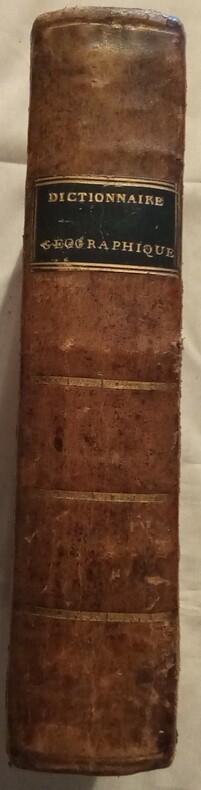
1810WOC-1373ou description des quatre parties du monde, par Vosgien. Nouvelle édition augmentée et entièrement refondue, renfermant les changements survenus par suite des différents traités, jusques et y compris celui de Vienne, du mois d'octobre 1809 par Giraud. Cet ouvrage est orné de six Cartes géographiques, et suivi de Tableau de réduction des francs en livres tournois, et des livres tournois en francs. Lyon, Chez Tournachon-Molin, Libraire, 1810. Fort in-8 (21x5x13cm) relié demi veau marron, dos orné de filets dorés, titre doré sur cuir noir, coins légèrement écornés, et manque dans le coin supérieur de 4 pages. 788pp. 80€
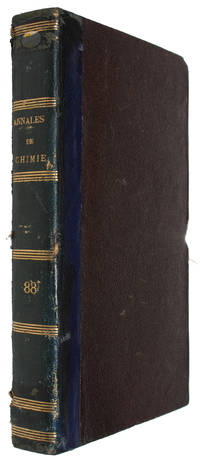
181343081Paris J. Klostermann 1813. Contemp. hcalf. Spine gilt. A few scratches to binding. In: "Annales de Chimie ou Recueil de Mémoires concernant la Chemie" Tome 88. - 336 pp. the entire volume offered. Pp. 304-310 311-318 319-321 a. 322-329. Scattered brownspots. <br/><br/><em>First printing of this paper announcing the discovery of Iodine. Courtois found this substance which he suspected to be a new element while burning algae in order to obtain sodium and potassium compounds. Although Courtois discovered the element in 1811 the announcement of it was not made until two years later after he had turned it over to Charles Desormés and Nicolas Clément."The first publication on iodine are somewhat confusing. Courtois's research is found in a paper attributed to him the paper offered but actually the work of Clément. was followed by an anonymous article the second paper offered. Gay-Lussac. who repeated and extended Courtios's work was responsible for this paper. Courtois himself published nothing. These two articles were immediately followed by short contributions of Gay-Lussac and Humphry Davy on the new element third and fourth paper offered. Gay-Lussacs views none too flattering to Davy on the history ofthe discovery of iodine appeared in his "Mémoire sur l'iode" 1814."DSB III p. 455. - Weeks "Discovery of the Elements" pp. 257-262.The volume contains further importent papers in chemistry Guyton de Morveau "Sur la chaux maigre" "Sur le dissolvant des pierres biliaires" an importent paper by Chevreul on animal fats "Recherches chimiques sur plusieurs corps gras et particulierement sur leurs combinaisons avec les alcalis" Berzelius's papers "Mémoires sur la compositions des fluides animaux" first edition in French Suite first edition Parmentier etc. etc. </em> unknown
181343081Paris, J. Klostermann, 1813. Contemp. hcalf. Spine gilt. A few scratches to binding. In: ""Annales de Chimie, ou Recueil de Mémoires concernant la Chemie"" Tome 88. - 336 pp. (the entire volume offered). Pp. 304-310, 311-318, 319-321 a. 322-329. Scattered brownspots.
182111960(Bourg), (Janinet), (1821) ; in-8, broché ; 38 pp., texte encadré d’un double filet noir.
188047008Paris Gauthier-Villars 1880. 4to. No wrappers. In: "Comptes Rendus Hebdomadaires des Séances de L'Academie des Sciences" Tome 91 No 5 entire issue offered. Pp. 251-310. The Curie's paper: pp. 294-295. <br/><br/><em>First apperance of the paper in which the two brothers announced their discovery of the Piezoelectric Effect as they observed how an electric potential appeared across crystals of quartza and of Rochelle salt when pressure was applied to them. The potential varied directly with the pressure and they named the phenomenon Piezoelectricity meaning "to press" Greek. Crystals with piezoelectric properties form an essential portion of sound-electronics devices such as microphones and record-players."The applications of piezoelectric crystals are innumerable; one of the most important is their use in frequency stabilization of oscillating electromagnetic cirasciots for radio broadcasting stations. They are used in most piezometers for measuring with great precision either very strong pressure variations such as those of a cannon at the moment of firing or very weak ones such as artery pulsations. These applications have led to the creation of a new industry the manufacture of large "mono" such as quartz obtained hydrothermally around 500°C. under high water pressures or crystals such as Rochelle salt obtained from aqueous solutions. These two substances were mentioned in the Curie brothers’ report announcing the discovery of piezoelectricity." DSB."The first experimental demonstration of a connection between macroscopic piezoelectric phenomena and crystallographic structure was published in 1880 by Pierre and Jacques Curie. Their experiment consisted of a conclusive measurement of surface charges appearing on specially prepared crystals tourmaline quartz topaz cane sugar and Rochelle salt among them which were subjected to mechanical stress. These results were a credit to the Curies' imagination and perseverance considering that they were obtained with nothing more than tinfoil glue wire magnets and a jeweler's saw." Piezo Systems Inc.Magee "A Source Book in Physics" p. 547 ff. </em> unknown
188047008Paris, Gauthier-Villars, 1880. 4to. No wrappers. In: ""Comptes Rendus Hebdomadaires des Séances de L'Academie des Sciences"", Tome 91, No 5 (entire issue offered). Pp. 251-310. The Curie's paper: pp. 294-295.
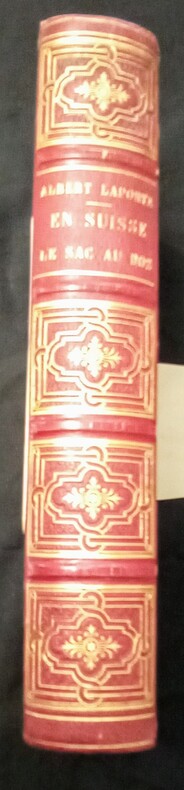
1881WOC-1816Ouvrage orné de 23 gravures hors-texte et de nombreuses gravures dans le texte et de têtes de chapitres, par Rouargue, A. de Bar, K. Girardet et G. Jund. Paris, Théodore Lefèvre, Libraire-Éditeur, sans date (vers 1881). Grand in-8 (25x4x16,5cm) relié demi chagrin, dos à petits nerfs et orné de caissons dorés et fleurons dorés et titre, tanches dorées, et plat de percaline rouge et encadrement. 2 ff. (1 f. blanche + faux-titre) +400pp.
180545516Paris Chez Bernard AN XIII 1805. No wrappers. In: "Annales de Chimie ou Recueil de Mémoires." Vol. 55 Cahier 2 30 Thermidor an XIII. Pp. 113-224 entire issue offered. Htitle to vol. 55 present. Robiquet's paper: pp. 152-171. <br/><br/><em>First appearance of Robiquet's first chemical paper in which he relates his discovery of asparagine by analysis of asparagus juice the first amino acid to be discovered. The following year he made the first isolation of this amino acid together with Vaguelin. Pierre Jean Robiquet was a French chemist who laid founding work in identifying amino acids the fundamental bricks of proteins through recognizing the first of them asparagin in 1806 in the take up of the industry of industrial dyes with the identification of alizarin in 1826 and in the emergence of modern medications through the identification of codeine in 1832 a powerful molecule today of widespread use with analgesic and antidiarrheal properties. </em> unknown
180545516Paris, Chez Bernard, AN XIII (1805). No wrappers. In: ""Annales de Chimie ou Recueil de Mémoires.."" Vol. 55, Cahier 2 (30 Thermidor an XIII). Pp. 113-224 (entire issue offered). Htitle to vol. 55 present. Robiquet's paper: pp. 152-171.
183244146Leipzig Johann Ambrosius Barth 1832. Contemp. hcalf. raised bands gilt spine. Light wear along edges. In "Annalen der Physik und Chemie. Hrsg. von J.C. Poggendorff" Band 25. Entire volume offered. VIII648 pp. and 6 folded engraved plates. Small stamps on verso of titlepage and plates. Faraday's papers: pp. 91-142 a. pp. 142-186. with 3 folded engraved plates. Clean and fine. <br/><br/><em>First German editions of the 2 first memoirs of Faradays groundbreaking researches on electricity constituting the first 2 papers of his "Experimental Researches in Electricity" and containing his fundamental discovery of electromagnetic induction THE FOUNDATION OF NEARLY ALL THE ELECTRICITY IN USE TODAY. In 1820 Oersted had generated magnetism from electricity Faraday here finds the opposite effect generating electricity by magnetism. He also described the first electrical generator second paper. THESE PAPERS ARE SOME OF THE GREAT CLASSICS OF CHEMISTRY AND PHYSICS."Faraday demonstrated this theory involving the lines of force.by inserting a magnet into a coil of wire attached to a galvanometer. While the magnet was being inserted or removd current flowed through the wire. If the magnet was held stationary and the coil moved over it one way or the other there was current in the wire. In either case the magnetic lines of force about the magnet were cut by the wire.If the magnet and coil were both held motionless whether the magnet was within the coil or not there was no current.Faraday hd thus discovered electricalinduction.It was to lead to great things but this was not apparent."Asimov."Although his discovery of the electric motor and the dynamo was almost entirely identical to his theoretical discoveries it laid the foundation of the modern electrical industry - electric light and power teælephony wireless telegraphy televison etc. - by providing for the production of continous mechanical motion from an electrical source and vice versa." PMM 308.Horblit 29 - Milestones 62. - Dibner 64. - PMM 308.The volume contains further notable papers. Elie de Beaumont "Zweiter geologischer Brief.an A.v. Humboldt über die relative Alter der Gebirgszüge" pp. 1-58 a. 2 plates one handcoloured papers by Döbereiner E. Lenz Moser Mitscherlich de Saussure J. Dumas F.E. Neumann Gay-Lussac Johannes Müller "Beobachtungen zur Analyse der Lymphe des Bluts und des Chylus" pp. 513-590. </em> hardcover
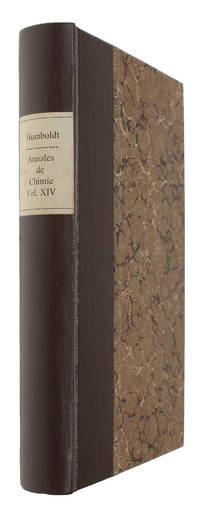
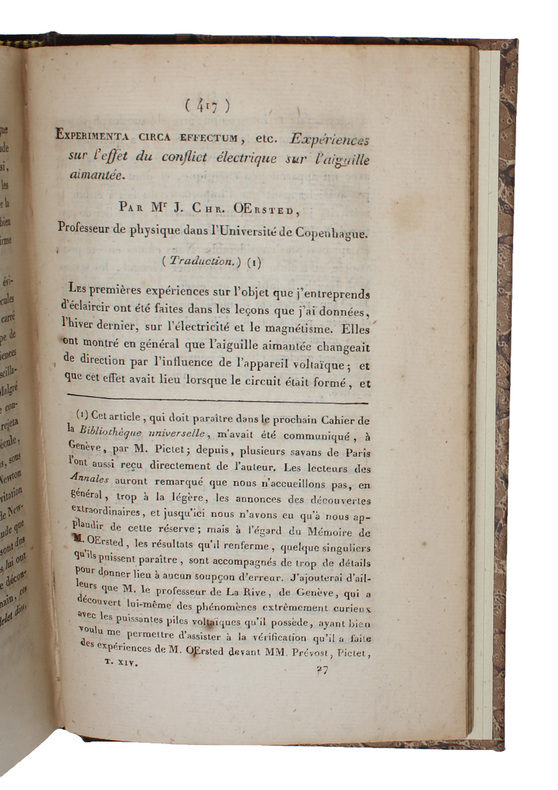
182046026Paris Crochard 1820. No wrappers. In "Annales". In "Annales de Chimie et de Physique Par MM. Gay-Lussac et Arago" Tome XIV Cahier 4 Titlepage to vol. 14 pp. 337-442. Entire issue offered. Ørsted's paper: pp. 417-25. A few scattered brownspots. <br/><br/><em>First French translation and the first translation of Oersted's epoch-making announcement in his Latin pamphlet "Extperimenta circa effectum conflictus electrici in acun magneticam. Hafniæ 1820" privately printed in a very small number and only distributed to colleques in Europe. This discovery and confirmation of the connection between 2 forces electricity and magnetism must be considered one of the happiest events in the history of science both with regard to scientific and practical results. - "From the moment that Ørsted's discovery became known it created an enormous sensation. The results communicated were so astounding that they were received with a certain distrust but they were stated with such accuracy that it could hardly be permitted to entertain any doubts. In the course of a short time the treatise was translated into all the chief languages." Kirstine Meyer. - Dibner:61 - PMM: 282 - Horblitt: 3 b. - Sparrow: 152. </em> unknown
182035260Paris Crochard 1820. Recent hcloth. Some repairs to inner margin of titlepage to "Annales". In "Annales de Chimie et de Physique Par MM. Gay-Lussac et Arago" Tome XIV pp. 417-25. The whole volume present: 448 pp. and 3 folded engraved plates. <br/><br/><em>First French translation and the first translation of Oersted's epoch-making announcement in his Latin pamphlet "Extperimenta circa effectum conflictus electrici in acun magneticam. Hafniæ 1820" privately printed in a very small number and only distributed to colleques in Europe. This discovery and confirmation of the connection between 2 forces electricity and magnetism must be considered one of the happiest events in the history of science both with regard to scientific and practical results. - "From the moment that Ørsted's discovery became known it created an enormous sensation. The results communicated were so astounding that they were received with a certain distrust but they were stated with such accuracy that it could hardly be permitted to entertain any doubts. In the course of a short time the treatise was translated into all the chief languages." Kirstine Meyer. - Dibner:61 - PMM: 282 - Horblitt: 3 b. - Sparrow: 152. </em> hardcover
182035260Paris, Crochard, 1820. Recent hcloth. Some repairs to inner margin of titlepage to ""Annales"". In ""Annales de Chimie et de Physique, Par MM. Gay-Lussac et Arago"" Tome XIV pp. 417-25. The whole volume present: 448 pp. and 3 folded engraved plates.
182046026(Paris, Crochard, 1820). No wrappers. In ""Annales"". In ""Annales de Chimie et de Physique, Par MM. Gay-Lussac et Arago"" Tome XIV, Cahier 4, Titlepage to vol. 14 + pp. 337-442. (Entire issue offered). Ørsted's paper: pp. 417-25. A few scattered brownspots.
183244146Leipzig, Johann Ambrosius Barth, 1832. Contemp. hcalf., raised bands, gilt spine. Light wear along edges. In ""Annalen der Physik und Chemie. Hrsg. von J.C. Poggendorff"", Band 25. (Entire volume offered). VIII,648 pp. and 6 folded engraved plates. Small stamps on verso of titlepage and plates. Faraday's papers: pp. 91-142 a. pp. 142-186. with 3 folded engraved plates. Clean and fine.
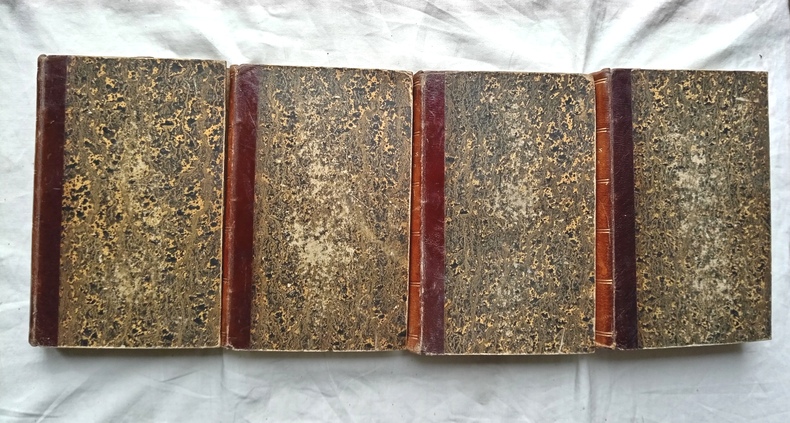
1851B02544 vol, 11,4 cm X 18,3 cm, 377 pp + 360 pp + 411 pp + 532 pp, reliure demi cuir, dos lisse, titre et tomaison dorés, tranche de tête grillée, tranches de queue et de gouttière mouchetées.
182044807Paris Crochard 1820. No wrappers as extracted fron 'Annales de Chimie et de Physique' Volume 15 2e Series. Pp. 93-102. <br/><br/><em>First appearance of this importent paper in which Arago gives an account of his discovery of how iron and steel could be magnetized by the action of the voltaic current THE FIRST STEP TOWARDS THE ELECTRIC TELEGRAPH. "Arago . made several important contributions to electromagnetism on his own. On 20 September 1820 he announced the discovery of the temporary magnetization of soft iron by an electric current which suggested to Ampère a theory about the nature of magnetic "currents" and provided the technological key to the electric telegraph. Ampère calculated that the magnetic power could be multiplied by twisting the current-carrying wire into a helix and with Arago he carried out the first experiments on primitive solenoids. In his historical articles Arago was always careful to credit Ampère with the major share of this discovery which ultimately depended upon Ampère’s mathematical theory."DSB.Arago formed a close freinship with Fresnelwhose views on the nature of light he ardently supported. He assisted Fresnel in some of his most importent work and made original discoveries in the same field.Magie "A Source Book in Physics" p. 443 ff. </em> unknown
182044807(Paris, Crochard, 1820). No wrappers as extracted fron 'Annales de Chimie et de Physique', Volume 15 (2e Series). Pp. 93-102.
183547003Philadelphia Fraklin Institute 1835. 8vo. Later full green cloth. Tome-and titlelabels in leather with gilt lettering on spine. In: "Journal of the Franklin Institute of the State of Pennsylvania. Edited by Thomas P. Jones" Vol. XV. New series. Engraved frontisp. 2446 pp. 2 folded engraved plates and 2 folded engraved maps. Entire volume offered. Henry's announcement: pp. 169-70. A stamp to verso of frontispiece Library of Congress duplicate stamp. <br/><br/><em>First printing of this importent paper the first to describe in detail how the phenomena of Self-Induction was discovered. Henry discovered the induction phenomena - how an electric current in one coil may set up a current in the other through the development of the magnetic field - independently of Faraday but Faraday was first to publish on electromagnetic induction. Henry's experiments with induction led him to his importent discovery of SELF-INDUCTION which is the phenomenon in which a change in electric current in a coil produces an induced emf in the coil itself. This phenomenon was also discovered inependently by Faraday but this time Henry had published first. The basic unit of inductance was to be called "the Henry". Relevant to the controversy between Faraday and Henry is the following statement by A D Bache Secretary of the American Philosophical Society introducing an abstract of Henry in J Franklyn Inst. 1835 pp. 169-70 H. Norman 1053 and the paper offerd: "A memoir on this subject has been since submitted to the Society containing an extension of the subject the primary fact in relation to which was observed by Professor Henry as early as 1832 and announced by him in the American Journal of Science. Mr. Faraday having recently entered upon a similar train of observations the immediate publication of the accompanying is important that the prior claims of our fellow countryman may not be overlooked."Spark Museum.Magee "Source Book in Physics" p. 515. </em> hardcover
183547003Philadelphia, Fraklin Institute, 1835. 8vo. Later full green cloth. Tome-and titlelabels in leather with gilt lettering on spine. In: ""Journal of the Franklin Institute of the State of Pennsylvania... Edited by Thomas P. Jones"", Vol. XV. New series. Engraved frontisp. (2),446 pp., 2 folded engraved plates and 2 folded engraved maps. (Entire volume offered). Henry's announcement: pp. 169-70. A stamp to verso of frontispiece (Library of Congress duplicate stamp).