289 résultats
1332648231.Gpaperback. Good. Access codes and supplements are not guaranteed with used items. May be an ex-library book. paperback
182949248Leipzig Johann Ambrosius Barth 1829. Without wrappers as issued in "Annalen der Physik und Chemie. Hrsg.von Poggendorff" Bd. 16 Siebentes Stück. 2 pp. 1 folded engraved plate. Entire issue offered with titlepage to volume 16. Berzelius's paper: pp. 387-415. Clean and fine. <br/><br/><em>First German printing - printed simultaneously with the English and Swedish version - of the paper in which Berzelius described his discovery of Thorium the first element after Uranium to be identified as such. In 1829 Jöns Jakob Berzelius of the Royal Karolinska Institute Stockholm extracted thorium from a rock specimen sent to him by an amateur mineralogist who had discovered it near Brevig and realised that it had not previously been reported. The mineral turned out to be thorium silicate and it is now known as thorite. Berzelius even produced a sample of metallic thorium by heating thorium fluoride with potassium and confirmed it as a new metal. He called the black mineral thorite in honor of the Scandinavian god Thor.Parkinson "Breakthroughs" 1829 C. </em> unknown
180143599Halle Rengerschen Buchhandlung 1801. Without wrappers as published in "Annalen der Physik. Herausgegeben von Ludwig Wilhelm Gilbert" Bd. 7 Zweites Stück. The entire issue offered =Heft 2. Pp. 137-264 a. 2 folded engraved plates. Herschels papers: pp. 137-156. The plate depicts Herschel's experimental arrangements. <br/><br/><em>First appearance in German of Herschel's epochal announcement of his discovery of infrared light in 1800. This was the first time that a form of light beyond visible light had been detected. The paper offered is the German translation of the main parts of Herschel's paper "An Investigation of the Powers of Prismatic Colours to Heat and Illuminate Objects"."In 1800 he tested various portions of the sun's spectrum by thermometer to see if he could find interesting differences in the amount of heat the different colors delivered. He did but in a rather unexpected way for he found that the temperature rise was highest in no color at all at a spot beyond the red end of the spectrum. He concluded that the sunlight contained invisible light beyond the red. This is now called infrared radiation. The following year Ritter was to extend the visible spectrum in the other direction."Asimov.Parkinson "Breakthroughs" 1800 P. </em> unknown
183645406Berlin G. Eichler 1836. In "Archiv für Anatomie Physiologie und Wissenschaftliches Medicin Herausgegeben von Johannes Müller". Jahrgang 1836. Pp. 66-89 a. pp. 90-139. The entire volume offered in its 6 parts in 5 all 5 issues uncut with orig. printed warppers. 2CCXXIV390 pp. and 15 engraved plates. The 2 first issues with a faint dampstain to lower part of leaves and plates. <br/><br/><em>First appearance of an importent paper in the history of biology in which Schwann describes his discovery and isolation of pepsin the substance in the stomach that aids digestion of eggwhite. It is the FIRST KNOWN ANIMAL ENZYME. The paper appeared at the same time in "Annalen der Physik und Chemie. Hrsg. von J.C. Poggendorff".Theodor Schwann 1810-1882 was a great German physiologist pathologist and experimenter. One of the founders of the cell doctrine and of the idea of the living nature of yeast. Born at Neuss near Düsseldorff. A catholic educated in the Jesuit Gymnasium in Cologne. Intended for the church but took to medicine. He was a pupil of Johannes Müller and a collegueand lifelong friend of J. Henle the anatomist. In Berlin Schwann was Johannes Müller's assistent for five years and it was then that he discovered pepsin in 1836 the paper offered.Parkinson "Breakthroughs" 1836 B. - Garrison & Morton no. 991.The first paper offered written together with Johannes Müller records the preliminary investigaions leading to the discovery of Pepsin. - Garrison & Morton no. 990.The volume also contains another famous paper by ROBERT REMAK "Vorläufige Mittheilung microscopischer Beobachtungen über den innern Bau der Cerebrospinalnerven und über die Entwicklung ihrer Formenelemente. Hierzu Tafel IV. Pp. 145-161. This paper contains the first announcement of his DISCOVERY OF "FIBRES OF REMAK" the non-medullated nerve-fibres. Garrison & Morton no. 1260. </em> unknown
180343638Halle Rengerschen Buchhandlung 1803. Without wrappers as extracted from "Annalen der Physik. Herausgegeben von Ludwig Wilhelm Gilbert" Jahrgang 1802 Bd. 12 Zwölftes Stück. Pp. 409-416. Titlepage to vol. 12. <br/><br/><em>This is Ritter's first expositon of his discovery of ultraviolet light. It was announced the year before in a halfpage letter addressed to Gilbert's Annalen and printed in the Annalen. With that discovery it became clear that visible light represents no more than a fraction of a continous spectrum.A year earlier in 1800 William Herschel discovered infrared light. This was the first time that a form of light beyond visible light had been detected. After hearing about Herschel's discovery of an invisible form of light beyond the red portion of the spectrum Ritter decided to conduct experiments to determine if invisible light existed beyond the violet end of the spectrum as well. He had heard that blue light caused a greater reaction in silver chloride than red light did. Ritter decided to measure the rate at which silver chloride reacted to the different colors of light. He directed sunlight through a glass prism to create a spectrum. He then placed silver chloride in each color of the spectrum and found that it showed little change in the red part of the spectrum but darkened toward the violet end of the spectrum. Johann Ritter then decided to place silver chloride in the area just beyond the violet end of the spectrum in a region where no sunlight was visible. To his amazement this region showed the most intense reaction of all. This showed for the first time that an invisible form of light existed beyond the violet end of the visible spectrum. This new type of light which Ritter called Chemical Rays later became known as ultraviolet light or ultraviolet radiation the word ultra means beyond. </em> unknown
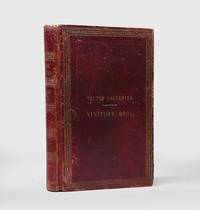
1904166196London: The Bruton Galleries Bond Street 1904-36. The blockbuster Discovery exhibition of 1904 The original visitor's book for one of the stellar red-carpet events of the season: the Bruton Galleries exhibition of artefacts and artwork from Scott's Discovery expedition a landmark in polar exploration. It includes the signatures of numerous crew members including Ernest H. Shackleton Edward A. Wilson Charles Royds Reginald Skelton and Ernest E. Joyce alongside Clements Markham and Llewellyn Longstaff a financial angel of the expedition. The exhibition which opened in November 1904 was curated by Clements Markham who had organized the expedition and launched Scott's polar career. It was remarkably extensive the catalogue listing 484 items including 150 photographs by Reginald Skelton 200 watercolours and drawings by Edward A. Wilson equipment from the expedition a model of the Discovery rations and the South Polar Times. The photographs and artwork constituted a visual record of Antarctic conditions and documented gruelling conditions bringing home "the scale magic and danger of Antarctica with a compelling immediacy" Merwe & Michell p. 66. The show proved extraordinarily popular with "Bruton Street and New Bond Street lined with motorcars and carriages" Huxley p. 141. "Persons of rank and fashion were marshalled into a long queue by a policeman. Society folk were not used to queues in those days and they protested that they had tickets; so had everyone the constable replied and kept them in line" Huxley p. 141. It fuelled the public's growing excitement about polar exploration: "an exhibit of Wilson's Antarctic art attracted over ten thousand viewers to London's prestigious Bruton Gallery. Advertisements in the gallery catalogue touted paints and binoculars used by the artist in the Antarctic" Larson p 159. The Discovery crew received an exuberant homecoming hailed for their "British grit" and Edward VII awarded each man the Antarctic medal. "Indeed for many Scott and his men became the national heroes that the Boer War had failed to supply. The explorers became celebrities. Crowds packed their public appearances" Larson p. 158. The leading actress Ellen Terry attended the event. She had been present when the expedition docked in Portsmouth later writing a postcard to Scott thanking him for letting her see the Discovery. The members of the Discovery expedition who have signed include Ernest H. Shackleton third lieutenant Edward A. Wilson assistant surgeon and artist Charles Royds first lieutenant Reginald Skelton chief engineer and photographer Ernest E. Joyce petty officer Arthur Henry Blissett steward Jacob Cross petty officer Hartley T. Ferrar geologist and Reginald C. Ford chief steward and stores officer. Curiously Scott is not among them. This might be a consequence of his resolve "to keep as quiet as possible" after the expedition Huxley p. 158. Three Shackleton family members attended: Ernest H. Shackleton's sisters Gladys and Helen besides Eileen Shackleton of Bushey. Other noted polar explorers feature among the visitors such as Robert Rudmose-Brown of the Scottish National Antarctic Expedition Scotia 1902-4 alongside its honorary secretary James G. Ferrier. Another notable voyager is Charles Ede the assistant surgeon on HMS Assistance on the British Franklin Search Expedition 1850-1 and a "Mrs. Reynolds" the great-niece of Franklin. The visitor's book serves as a record of an early 20th-century red carpet event and contains approximately 1000 signatures including the writer Walter Jerrold alongside the artists Felix Moscheles and Marietta Pallis. Robert Baden-Powell the founder of the Boy Scout movement also attended. Princess Beatrice and Maria Amelia Queen of Portugal likewise attended. Successive pages record visitors from Lancashire Yorkshire and Scotland. Moreover there are numerous admirals and military men together with a collector of Egyptian art. Two further sections in the book relate to miscellaneous exhibitions held in later years. Folio 283 x 245 mm. Contemporary dark red skiver by Jas. Truscott & Sons of London flat spine gilt-lettered direct spine and covers decorated in gilt front cover lettered "Bruton Galleries/Visitor's Book" marbled endpapers all edges gilt; 115 lined pages signed bearing approximately 2000 names and addresses all recto of which 57 lined pages with approximately 1000 signatures pertaining to the Discovery expedition. Extremities with slight wear from handling some stripping of leather minor toning general finger soiling. A very good copy. Elspeth Huxley Scott 1990; Max Jones The Last Great Quest 2004; Edward J. Larson An Empire of Ice 2011; Pieter van der Merwe and Jeremy Michell eds South: The Race to the Pole 2018. hardcover
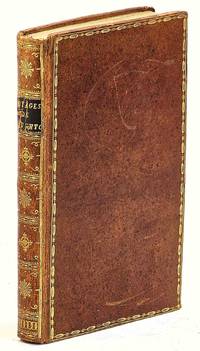
1797105650Paris: Chez Tavernier. 1797. 1st ed. An VI. Octavo full-leather binding with gilt-stamped decorations bands and title to spine gilt dec border to boards contemporary marbled endpapers pp viii 243 last page misprinted as 343. Three large folding engraved maps drawn up by Major James Rennell the leading British geographer of his time when Mungo Park returned from West Africa: all in very good condition. Spine rubbed minor scuffs to boards front free endpaper just starting to detach. Very good condition. First edition. Published in Paris in the revolutionary "An VI" 1797. Describes the explorations in the interior of Africa of Daniel Houghton 1740 - 1791 and Mungo Park 1771 - 1806. Daniel Houghton was sent by the African Association the Association for Promoting the Discovery of the Interior Parts of Africa; his instructions were to sail to the mouth of the Gambia navigate the river to the Barra Kunda falls and then to travel overland to the Hausa lands to the east. He was one of the first European explorers in the interior of Africa but after a successful visit in Bambouk territory he disappeared somewhere on his journey to Timbuctoo his last despatch being in July 1791. Mungo Park was then sent by the African Association and travelled more extensively in West Africa. He published the book "Travels in the interior districts of Africa" in 1799 i.e. this book precedes Park's publication. Uncommon. 1st Edition. Leather. Chez Tavernier hardcover
1997Q-0756000289Teacher's Discovery 1997-01-01. Paperback. New. New. In shrink wrap. Looks like an interesting title! Teacher's Discovery paperback
19722110502150403194Kodansha 1972. Soft Cover. Fine. Volume: 1 Kodansha paperback
0517800055.Ghardcover. Good. Access codes and supplements are not guaranteed with used items. May be an ex-library book. hardcover
0525462813.Ghardcover. Good. Access codes and supplements are not guaranteed with used items. May be an ex-library book. hardcover
1333671075.Gpaperback. Good. Access codes and supplements are not guaranteed with used items. May be an ex-library book. paperback
187844231Paris G. Masson 1878. 8vo. Contemp. hcalf raised bands gilt spine. Light wear along edges. Small stamps on verso of titlepage. In: "Annales de Chimie et de Physique" 4e Series - Tome 15. 512 pp. a. 3 folded engraved plates. The entire volume offered. Janssen's memoir: pp. 414-426. <br/><br/><em>First appearance of this milestone paper in chemistry physics and astronomy announcing the discovery of the helium lines in the spectrum of the sun. It was Lockyer in the same year that named it 'helium' for Helios the Greek God of the Sun. Helium was not discovered on the earth before 1895 by William Ramsay and it was Crookes who established its identity with the helium Janssen and Lockyer observed in the spectrum of the sun."He Janssen met immortality by travelling to India in 1868 to study the total eclipse. It was then that he observed the helium line and forwarded the spectral data to ockyer. He also noted the size of the solar prominences. The day after the eclipse he attempted to take their spectra again and succeeded despite the absence of the obscuring moon. he then announced jubilantly that it was the day after the eclipse that was the real eclipse day for him. Lockyer also reported this method of studying prominences without an eclipse.Like Lockyer he lived to see his observation of the helium line vindicated by Ramsay's discovery of that element on earth."Asimov."This the discovery of helium lines in the sun by Lockyer was announced on the same day by the French astronomer Janssen who was in India observing a total eclipse. As a result the French government some ten years later struck a medallion showing the heads of both scientists.By that time the two men had made a much more dramatic discovery at the same time this time in cooperation. Janssen studying the spectrum ofthe sun during the eclipse had noted a fine line he did not recognize. he send a report on this to Lockyer an acknowledges expert on solar spectra. Lockyer compared the reported position of the line with lines of known elements concluding that it must belong to a yeat unknown element possibly not even existing on the earth. He named the element from the Greek word for the sun."Asimov.Parkinson "Breakthroughs" 1868 A. - The volume contains other notable papers by Dumas Berthelot et al. </em> hardcover
190542829Leipzig S. Hirzel 1905. No wrappers. Issued in "Jahrbuch der Radioaktivität und Elekronik" 2. Bd. Heft 3. Hahn's paper: pp. 233-264. Enntire issue: pp. 233-262 = entire "Heft 3". Fine and clean. <br/><br/><em>First printing of this paper which is Hahn's Habilitation paper announcung his discovery of a new element in residues from a Ceylon mineral called Thorianite. He later showed that it is an intermediate disintegration product."Because the sample thorianite was small Ramsay proposed that Hahn confirm Marie Curie's determination of the atomic weight of radium by preparing it in some organic compounds thereby greatly increasing the total amount being examined and calculating the atomic weight from the measured molecular weights. Chance sometimes favors the unprepared mind and Hahn who familiarized himself with only the basic of radioactivity followed the prescribed separationss technique and found himself the discovere of a new radioelement: radiothorium. The explanation was that the material given him came from an ore which contained a large percentage of thorium in addition to the radium. Thus upon completion of the chemical procedure not all the activity was confined in the radium-containg fraction; indeed the nes subsyance in the remainder was several hundred thousand times more active than thorium and ultimately yielded the characteristic one.minute halflife of thorium emanation."DSB VI p. 15. - Weeks Discovery of the Elementsp. 308 ff. </em> unknown