1 816 résultats
186959086(Paris, Gauthier-Villars), 1869. 4to. In: ""Comptes Rendus Hebdomadaires des Séances de L'Academie des Sciences"", Tome 68, No 7. Pp. (349-) 408. (Entire issue offered). Janssen's paper pp. 367-376.
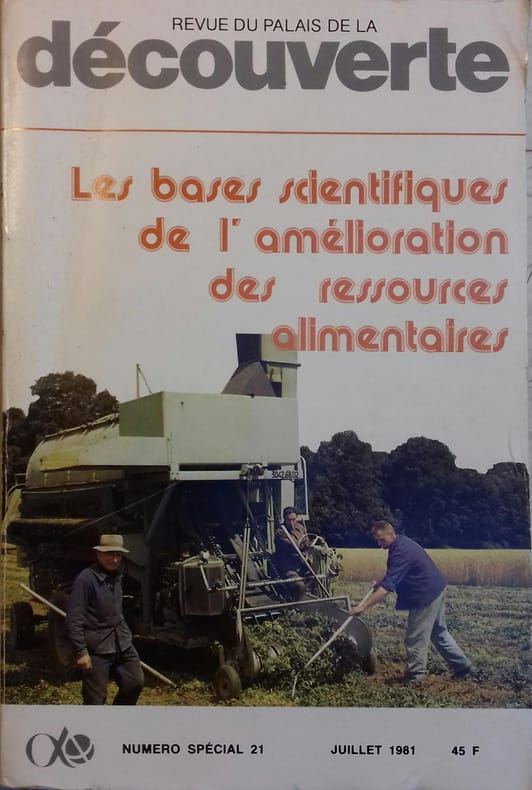
1981207582Couverture souple. Broché. 352 pages. Couverture légèrement abîmée.
171745962Paris L'Imprimerie Royale 1717. 4to. Without wrappers. Extracted from "Mémoires de l'Academie des Sciences. Année 1714". Pp.361-378 and 1 folded engraved plate. <br/><br/><em>First printing of the paper in which Cassini describes his discovery of the inclination of the orbit of Saturn's fifth satellite. </em> unknown
181046377Paris J. Klostermann 1810. Contemp. hcalf. Spine gilt. Slightly rubbed. A few scratches to binding. Small stamps on verso of titlepage.In: "Annales de Chimie ou Recueil de Mémoires concernant la Chemie" Tome 75. 336 pp. a. 2 folded engraved plates. Some scattered brownspots. The papers: pp. 27-77 129-175 256-263 264-273 274-289 a. 290-316. <br/><br/><em>First French version of Davy's "The Bakerian Lecture for 1809. On some new Electrochemical Researches on various Objects particularly the metallic Bodies from the Alkalies and Earth and on some Combinations of Hydrogene. Read November 16 1809." together with the controversy papers by Davy and Gay-Lussac & Thenard."Mr. Davy having from the commencement of his electro-chemical researches communicated the several steps of his progress to the Society The Royal Society takes the present opportunity of reporting the results of his further inquiries under four principal heads. First on the nature of the metals of the fixed alkalis. Second on the nature of Hydrogen and composition of ammonia. Thirdly on the metals of the earth; and Fourthly he makes a comparison between the antiphlogistic doctrine and a modified phlogistic hypothesis."Abstract. He further gives arguments for considering potassium and sodium which he discovered in 1808 as a element.""Gay-Lussac had a slight rivalry between himself and the creation scientist Sir Humphry Davy. Davy was chemically preparing Potassium and Sodium through an electrical current and this made Gay-Lussac and Thénard envious of his success. They too decided to perform the same task but they had no battery at their disposal as Davy had so they had to form another way to chemically prepare the two elements. In 1808 they used a red-hot iron fused to potash the water-soluble form of a manufactured salt containing potassium to perform this task a method that Davy admitted had its advantageous qualities. Gay-Lussac and Thénard were successful in preparing Potassium and continued to make a full analysis of its chemical properties and began to use it for their own experiments. In 1809 Davy performed the same task using it to reduce Boron in Boracic acid." </em> unknown
187947275Paris Gauthier-Villars 1879. 4to. No wrappers. In: "Comptes Rendus Hebdomadaires des Séances de L'Academie des Sciences" Tome 88 No 7. Pp. 313- 352. Entire issue offered. Boisbaudran's paper: pp. 322-324. <br/><br/><em>First apperance of the paper in which Boisbaudran revealed his discovery of a new earth that precipitated had a unique spectrum. De Boisbaudran named it samaria after the mineral from which it was derived. The mineral samarskite is named for a Russian mining engineer and Chief of Staff - Corps of Mining Engineers Colonel Vasili Evgrafovich Samarsky-Bykhovets."Samarium was discovered by French chemist Paul Émile Lecoq de Boisbaudran in 1879. He noticed in his research that impure didymium praseodymium and neodymium with other impurities seemed to contain more than just didymium based on spectroscopic work on various rare-earth minerals. When Lecoq de Boisbaudran added ammonium hydroxide to a concentrate prepared from the mineral samarskite he observed a precipitate that formed before the didymium Weeks and Leicester 1968 p. 685. Partington "Breakthroughs" 1879 C. </em> unknown
183443654Paris Crochard 1834. No wrappers. In: "Annales de Chimie et de Physique" 2. Series Tome 56 Cahier 4 last issue of tome 56. Entire issue offered. Pp. 337-444. Peltier's paper: pp. 371-386. The text calls for a plate but not present here. <br/><br/><em>First printing of the paper in which Peltier describes his discovery of the "Peltier-Effect" the thermo-electric cooling and heating of an electrical junction dependent on the direction of the current."Stimulated by the work of Nobili Peltier constructed a sensitive galvanometer to measure the conductivities of antimony and bismuth for small currents. Peltier's use of small samples of these nonductile materials was fortunate because the anomalous behavior of these materials led him to construct a thermoelectric thermoscope and to measure the temperature distribution along a series of thermocouple circuits. He discovered that a cooling effect can take place at one junction and an excessive heating at the other. He then confirmed this discovery by using an air thermometer in place of the thermoscope. Peltier did not pursue the effect he had discovered and its importence was not fully recognized until after the thermodynamic work of William Thomson twenty years later."DSB X p. 500.Wheeler Gift no 2684. - Ronald's Library p. 389. - Parkinson "Breakthroughs" 1834 P. </em> unknown
171745962(Paris, L'Imprimerie Royale, 1717). 4to. Without wrappers. Extracted from ""Mémoires de l'Academie des Sciences. Année 1714"". Pp.361-378 and 1 folded engraved plate.
181046377Paris, J. Klostermann, 1810. Contemp. hcalf. Spine gilt. Slightly rubbed. A few scratches to binding. Small stamps on verso of titlepage.In: ""Annales de Chimie, ou Recueil de Mémoires concernant la Chemie"" Tome 75. 336 pp. a. 2 folded engraved plates. Some scattered brownspots. The papers: pp. 27-77, 129-175, 256-263, 264-273, 274-289 a. 290-316.
187947275(Paris, Gauthier-Villars), 1879. 4to. No wrappers. In: ""Comptes Rendus Hebdomadaires des Séances de L'Academie des Sciences"", Tome 88, No 7. Pp. (313-) 352. (Entire issue offered). Boisbaudran's paper: pp. 322-324.
183443654(Paris, Crochard, 1834). No wrappers. In: ""Annales de Chimie et de Physique"", 2. Series, Tome 56, Cahier 4 (last issue of tome 56). Entire issue offered. Pp. 337-444. Peltier's paper: pp. 371-386. The text calls for a plate, but not present here.
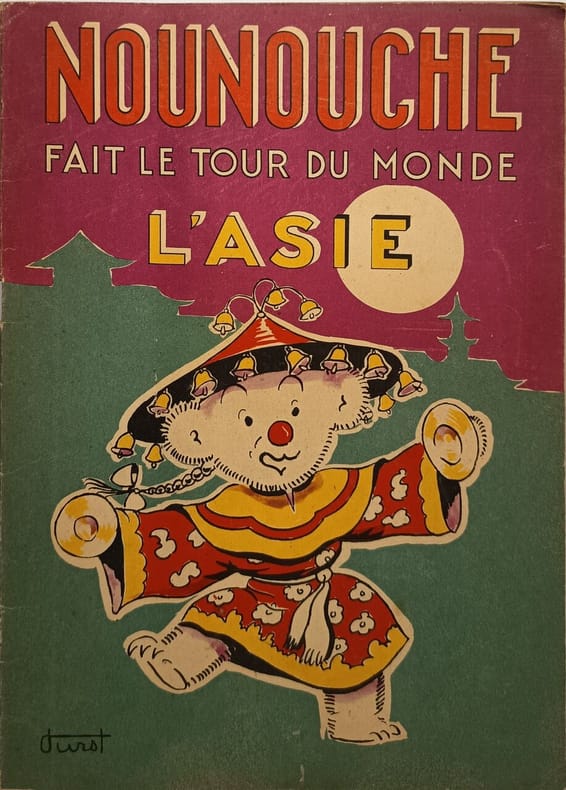
19499446Éditions des enfants de france 1949 32 pages IN4. 1949. agrafé. 32 pages. Album jeunesse illustré par André Durst faisant partie de la série 'Nounouche fait le tour du monde' consacré à la découverte de l'Asie. Publié par les Éditions des enfants de France vers 1949-1951 ce tome 12 présente de manière éducative les cultures et géographies asiatiques à travers les aventures du personnage Nounouche
6579petit in 8 cartonné d’éditeur dos pincé rouge, plats illustrés en couleurs faux-titre,titre 160 pages,148 charmantes illustrations en couleurs,dans le texte de M.P MARC Les éditions de l’école 1950.Bon exemplaire.
6695in 12 pleine toile verte d’éditeur,titre doré au dos et sur le premier plat,filets noir en encadrement.Faux-titre, titre,XII,621 page,non rogné.Deuxième édition revue et augmentée avec 273 figures intercalées dans le texte.J.B Baillière & fils 1884,reliure légèrement frottée quelques traces de manipulations en fin de volume tamons de bibliothèque
1703PHO-2014À La Haye, Chez les Frères L'Honoré, 1703. 2 tomes en un volume in-12, veau, dos à nerfs orné avec pièce de titre (reliure de l'époque) défauts d’usage. Rare édition de l'une des relations de voyage les plus importante pour l'histoire du Canada. - + 279 pp. & -- 220 + 8ff., Un frontispice et 24 planches ou cartes, certaines repliées, dont la « Carte Général de Canada ». Ex-libris manuscrit sur le titre. Première édition, troisième tirage.
3962In 12 broché,couverture illustrée,faux-titre,titre,242 pages,1 feuillet de table.Berger-Levrault 1932.rousseurs en début et fin de volume ainsi qu’au deuxième plat de couverture
1743WOC-1128Avec un Mémoire contenant des avis utiles à ceux qui voudront faire le même voyage. Cinquième édition, plus ample & plus correcte que les précédentes; & enrichie de nouvelles Figures. 79 planches, dont certaines dépliantes. A. La Haye, Chez Henry van Bulderen, Marchand Libraire, dans le Pooten, à l'Enseigne de Mezeray, 1731-1743. 3 volumes in-12 composite de (17,5x9,5cm) pour le 1 et 3 et de (16,8x9,5cm) reliés en plein veau, dos à nerfs ornés de caissons et de fleurons dorés, titre sur maroquin rouge, tranches rouges, fentes sur les charnières du tome 2 et coiffes supérieures faibles. ff-avis,339pp,ff-table + 364pp. + 414 ff-table.
102.447Bruxelles, Librairie de Frechet, Editeur, 1828. 14 x 22, 2 volumes, 515 + 666 + 100 pages, reliure plein cuir, bon état.
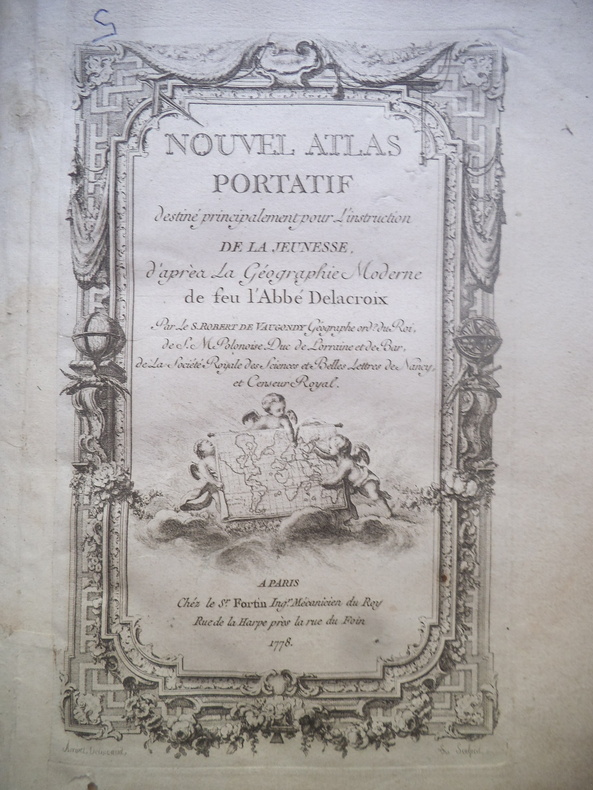
14501Nouvel atlas portatif destiné principalement pour l’instruction de la jeunesse d’après la géographie moderne de feu l’abbé DELACROIX par le S. Robert de VAUGONDY géographe du Roi de S.M Polonoise Duc de Lorraine et de Bar de la société royale des sciences et belles lettes de Nancy et censeur royal . A Paris chez le Sr FORTIN 1778. In 4 demi-chagrin fauve à nerfs, pièce de titre chagrin rouge, fers, roulette, filets, caissons dorés. Cartes 290x420mm. Faux titre, Titre gravé avec frise décorative en encadrement. IX, et suite de 52 cartes, sur double page pages, montées sur onglets. Contours couleurs d’origine., gavées par DUSSY. Complet. Coiffe inférieure manquante, mouillure pâle en marge supérieure visible au recto, jusqu’à la carte 20. Pages de faux titre avec quelques légères salissures sans gravité,. Cartes avec coloris frais Cartes numérotées au pochoir, au verso.
181843871Paris Crochard 18181819. No wrappers. In: "Annales de Chimie et de Physique Par MM. Gay-Lussac et Arago." tome 8 Cahier 3 a. 10 Cahier 2 pp. 225-336 and pp. 129-240. Entire issues offered. Pelletier & Caventou's papers: pp. 323-324 tome 8 and pp. 142-176 tome 10. A few scattered brownspots. <br/><br/><em>First printing of these classic papers in chemistry in which the authors announced their discovery of Strychnine. This was the first alkali of vegetable origin to be discovered after morphine. This discovery and their discovery of chlorophyll brought them international fame. The first small paper contains the announcement of the discovery and the second long memoir contains the elaborate exposition of the discovery."Strychnine was only the second alkaloid to be extracted the first was morphine. Pelletier and Caventou wanted to name their new alkaloid vauqueline after Nicolas Vauquelin one of their associates who had refined the technique of ether extraction for use in isolating alkaloids. However the officers of the Académe des Sciences in Paris rejected the idea on the grounds that a respected scientist’s name should not be paired with a deadly poison. In addition to strychnine the pair isolated other important compounds from plants including caffeine chlorophyll and the anti-malaria drug quinine. Paul L. Burnham.Parkinson:"Breakthroughs" 1818 C. - Garrison & Morton: 1846.The first issue also contains their importent memoir "Examen chimique de la Cochenillee et de sa matière colorante" pp. 250-287 which describes how they obtained crotonic acid from croton oil and analyzed carmine in the cochineal. </em> unknown
185649036Paris Mallet-Bachelier 1856. 4to. No wrappers. In: "Comptes Rendus Hebdomadaires des Séances de L'Academie des Sciences" Tome 43 No 13. Pp. 637- 672. Entire issue offered. Vulpian's paper: pp. 663-665. <br/><br/><em>First appearance of the paper in which Vulpian described his discovery of adrenaline in the adrenal medulla. Vulpian established that the medulla synthesised a substance that was liberated into the blood circulation. This substance was later identified as adrenaline.Garrison & Morton No. 1141. </em> unknown
184147143Paris Bachelier 1841. 4to. No wrappers. In: "Comptes Rendus Hebdomadaires des Séances de L'Academie des Sciences" Tome XIII No. 10. Pp. 487- 558. Entire issue offered. Matteucci's paper: pp. 540-41. <br/><br/><em>First appearance of a main paper in the history of electro-physiology."The discovery by Volta of means for producing galvanic currents led to the construction of a galvanometer for measuring currents and later to its refinement. In 1841 Matteucci presented. a paper which showed that a galvanometer indicates a curring flowing whenh it is connected from the surface of a muscle to a wound in the muscle a current that was later called the "current of injury" and also the "current of rest" since it flowed without observable muscular contraction. Johannes Müller showed tis paper to his brilliant pupil du Bois-reymond. Du Bois interest was caught at once. He published his first paper on "thierische Electricität" in 1843 and his two-volumes on the subject - soon to become the classic - in 1848-49."Boring "History of Experimental Psychology" p. 40. </em> unknown
184147143(Paris, Bachelier), 1841. 4to. No wrappers. In: ""Comptes Rendus Hebdomadaires des Séances de L'Academie des Sciences"", Tome XIII, No. 10. Pp. (487-) 558. (Entire issue offered). Matteucci's paper: pp. 540-41.
181843871(Paris, Crochard, 1818,1819). No wrappers. In: ""Annales de Chimie et de Physique, Par MM. Gay-Lussac et Arago."", tome 8 (Cahier 3) a. 10 ( Cahier 2), pp. 225-336 and pp. 129-240. (Entire issues offered). Pelletier & Caventou's papers: pp. 323-324 (tome 8) and pp. 142-176 (tome 10). A few scattered brownspots.
185649036(Paris, Mallet-Bachelier, 1856). 4to. No wrappers. In: ""Comptes Rendus Hebdomadaires des Séances de L'Academie des Sciences"", Tome 43, No 13. Pp. (637-) 672. (Entire issue offered). Vulpian's paper: pp. 663-665.