5 988 résultats
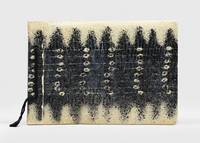
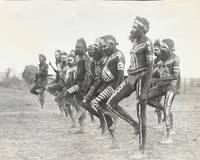
192760008Sydney NSW; Hobart Tasmania & New York: Beatties Studio; Photographers Photo Service ca. 1927-1934. Two vols. Thick oblong folio. 13.5 x 10.25 x 2 in. 200; 170 pp unpaginated. on thick black paper stock. With 197 silver gelatin photographs all tipped-in nearly all w/ typescript mimeograph captions mounted below or alongside sized from 5 x 7 in. up to 8 x 10 in. most sized 8 x 10 in. all printed on glossy photo stock some on thicker heavier weight most w/ pencil annotations typescript or imprints on verso a few w/ photographer’s imprint w/in negative at lower fore-edge others w/ embossed armorial photo studio stamp of kangaroo on shield. Uniformly bound in contemporary black pebbled flexible shagreen nested steel backed post-binders black brass screw-posts at gutter margin chipping edgewear to covers some scuffing spine leather covering perished occasional closed tears & chipping to some leaves light faint previous mounting offsetting occasional soiling or slight dampstaining to a few leaves still a VG- set of albums with nearly all of the photographs in excellent condition and with strong bright contrast. These substantial land promotion albums appear to have been designed to tout the advantages for potential homesteaders investors and visitors to Australia from the end of the Roaring 20’s into the Great Depression. Nearly 200 photos depicting bustling cities & shipping ports mines manufacturing burgeoning housing sports flora & fauna and some of the indigenous Australian Aborigine peoples extol the possibilities in Oceania’s economic engine. Following World War I Australia had seen massive changes in population and increasing economic and social changes following the devastation of World War I and the worldwide influenza pandemic with over 215000 killed and wounded between both catastrophes. With the onset of the Great Depression economic activity slowed and unemployment soared to nearly 20%. These albums include several photos of the newly constructed Canberra Provisional Parliament House completed in 1927 with bare land and little infrastructure nearby except for the Hotel Canberra. Designed originally to hold politicians and visitors when the parliament was in session the Hotel was built by contractor John Howie and designed by John Smith Murdoch. Several photos of Sydney Australia the streets a flapper driving her sporty 1927 Chevrolet Capitol AA Roadster and the famed beaches of Sydney. Several photos depict the Australian Lifesaving Clubs which began in 1907 as surf life saving with the Bondi Surf Bathers’ Life Saving Club but which denied full membership to women until 1980. One particular photo depicts a young comely Australian woman surfer leaning against her wooden longboard only about 15 years after Isabel Letham’s famed ride with Duke Kahanamoku in 1915. Many of the Sydney images reveal a capitol city in transition including horse-drawn cars alongside 1920’s automobiles and electric trolleys and trams. Also featured are photographs of the New Castle Steel works the Lithgow Steel Works whose blast furnace site closed in 1928 and the Mt. Boppy gold mining process mill depicting the cyanid vats to extract the ore. Still others show the Burrinjack Dam construction which had begun before World War I but not finished until 1928; horse-drawn silver ore mining wagons in the Barrgorang Valley from the Yerranderle Mines along roads to Camden NSW; orchards long the McDonald River and raising rabbits for the New South Wales Wool & Fur Co. Ltd. at Castle HIll near Parramatta. Also featured are many aerial and street photos of Queensland Brisbane Docks Victoria Bridge Queen Street with streetcars horse breaking in outback stations grape & cotton harvesting children attending “Bush Schools†and more. Still more reveal the bustling wharves at the Freemantle sheep sheering railway yards boaters on Henley-on-Yarra Flinders Street Station wheat harvest and farming and even the one of the famed wheat windjammers “The Carnandale.†Several of the photos depict the indigenous Australian Aborigines with one of the captions noting that 60000 “Full-Blood and 19000 half-caste Aborigines with 40000 still nomadic and others working sheep and cattle stations.†Another photo is included of two young Maori girls as well.The second album also contains views of a traveling salesman or traveling “Bust Hawker†featuring a horse-drawn wagon with sides hinged up and shoppers as well as aerial photos of gardens banana plantations date farms logging Kerri Trees in Western Australia and an entire section devoted to photos of Australian fauna. These depict Wombats Kangaroos pink & white Cockatoos Cassowary birds Wallabys Barn Owls Koala Bears Black Swans Opossums a Platypus Lyre-birds Kokaburra birds Australian penguins and others. Identified photographs by John Beattie Jr. from Beatties Studio Hobart Tasmania include Mt. Rugby from Balmoral Beach Big Ben Gum Tree on the estate of W.L. Clennett Saw Mill Proprietor Port Esperance whose height was nearly 250 feet as well as Dobson’s Basin Geeveston depicting a remarkable group of fen tree bowers. Originally founded in the 1840’s by the Anson Brothers John Beattie d. 1930 son of a Scottish-Australian emigre photographer worked for them in the 1880’s and then purchased the business renaming it Beatties Studio. He operated the studio for decades was the photographer who first developed all of Amundsen’s original photos of his South Pole Expedition in a single day and was an active proponent of the indigenous Aborigine population often defying popular opinion and authority over their historical mistreatment. Sadly a 1933 fire destroyed the studio and most of the negatives but it was reconstituted and many negatives and images rediscovered afterwards. See: Elizabeth Heffernan Exciting New World: Australia in the 1920s Royal Australian Historical Society 2022; Georgie Burgess Photography Pioneer John Beattie Shared Tasmania’s Wild Places with the World ABC Radio Hobart March 9 2019. Beatties Studio; Photographers Photo Service, hardcover
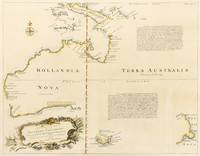
1744133907London: Printed for T. Woodward and others 1744. Very Good. London Printed for T. Woodward and others 1744. A hand-coloured engraved map visible image size 372 × 483 mm recently mounted and matted just outside the printed border using archival materials visible image size 372 × 483 mm external mat size 545 × 643 mm ready for framing or long-term storage in its custom-made Mylar sleeve. A long sealed clean tear to the blank area in the bottom right-hand corner mainly along the crease of the original fold; light central vertical crease; a few small insignificant light marks; in very good condition. The first dedicated English map of Australia originally issued as part of the second edition of John Harris's 'Navigantium atque Itinerantium Bibliotheca or a Complete Collection of Voyages and Travels' London 1744-1748; 'Vol. 1 page 325' is printed in the top right-hand corner. Clancy 'So They Came South' pages 136-37; Clancy 'Mapping of Terra Australis' page 91; Tooley 241: 'A reissue of Thevenot's map of 1663 but with title as above within cartouche bottom right. Bowen inserts the Tropic of Capricorn and two long legends. The first one is very exactly copied from the original . The second legend is a long laudatory account of the presumed riches of Terra Australis'. Printed for T. Woodward (and others) unknown
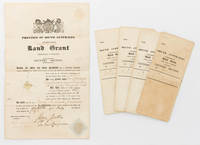
123505Very Good. Folio five documents approximately 387 × 240 mm each each being a bifolium centrefold blank last page docketed; the first page in each instance contains a small hand-coloured diagram of the block showing the orientation of the land a paper-over-wax impressed seal and the signature of Governor George Gawler as Resident Commissioner and Alfred Miller Mundy as Private Secretary dated 16 July 1840. Three horizontal creases when the documents are folded thus the docketed portion of the last page becomes visible on one of the exposed panels; a few tiny marginal chips; one document has a short split along one fold and its outer panels when folded are a little tanned; trifling signs of age; overall all five documents are in very good condition. The consecutively numbered land grants 1037 to 1041 are for 'Eighty acres numbered 957 to 961 in the Provincial Survey marked with the Letter C' purchased by 'George Frederick Dashwood Esquire Royal Navy Forest Lodge Bracknell Berks'. The purchase price of £80 per section is not shown; all five documents have the word 'Duplicate' in ink in a contemporary hand at the head of the first page and they have a slightly different title to examples we have seen where purchase prices are recorded 'Land Grant under Preliminary Sales in England and Partial Purchase in the Province'. <p>Lieutenant George Frederick Dashwood RN 1806-1881 . 'was a naval officer public servant and politician in South Australia. He was appointed an acting member of the Legislative Council of South Australia serving from June 1843 to June 1844. He entered the Royal Naval College Dartmouth in 1819 and served 1832-1833 under Captain C. H. Fremantle on HMS "Challenger" noted for earlier 1829 claiming all of New Holland west of New South Wales for the Crown. He was commissioned lieutenant in December 1833 later served on the survey vessel "Sulphur". Dashwood suffered terribly from rheumatism and was retired on half pay. Dashwood married Sarah Rebecca Loine on 27 December 1839 in a Catholic church in London. They arrived in South Australia aboard "Orissa" in November 1841. He purchased an estate 5 miles 8 km west of Meadows named Dashwood's Gully. He and Sarah married again in a civil ceremony for reasons of bureaucratic convenience. In 1844 he applied for partial remission of the purchase price of the land by virtue of his naval service. This was initially refused but granted in 1850 after much argument. In 1842 he was appointed justice of the peace and sworn in as magistrate and on 15 June 1843 he was appointed to the Legislative Council holding this position until July 1844 when he resigned and apart from a public meeting at which he protested against the proposed settlement in the colony of a contingent of Parkhurst boys he took no part in public life until November 1846 when he was reappointed JP and in April 1847 he was made Acting Commissioner of Police and Police Magistrate. Two years later he was appointed Stipendiary Magistrate for Port Adelaide. In October 1850 he was appointed Police Commissioner a position he held until January 1852 when he was appointed Collector of Customs succeeding later Sir R.R. Torrens. In July 1858 he was appointed Emigration Agent in Great Britain and apart from a visit in May 1861 was in England until late 1862 when the office was abolished and served as Stipendiary Magistrate in various places including Mount Barker and Strathalbyn. In 1875 he was appointed Stipendiary Magistrate for Port Adelaide and Edithburgh. He held this post until around 1880' Wikipedia. <p>'From Almanda to United States: Lost Localities in the City of Onkaparinga' consulted online records more specifically that Dashwood 'had purchased sections 955 956 957 958 959 960 and 961 in the Hundred of Kuitpo in 1840 while still living in Berkshire' that Dashwood Gully had a post office and a school which operated from 1863 to 1869 and that the area continued to be known as Dashwood Gully until at least the 1950s. George Gawler 1795-1869 was South Australia's second governor. 'Disputes between the first governor Captain Sir John Hindmarsh and the resident commissioner Sir James Fisher over their respective jurisdictions had retarded the colony's development so the two offices were combined in Gawler. Thus as governor he became representative of the Colonial Office in the province and as resident commissioner representative of the non-governmental Colonization Commission which was responsible for the control of land sales for applying the proceeds to the emigration of labourers and for raising loans until such time as the colony had sufficient revenue to support itself. On 12 October 1838 Gawler with his wife and five children arrived in Adelaide in the "Pestonjee Bomanjee" and found conditions far worse than he had been led to expect. The most urgent necessity he believed was to promote rural settlement. He persuaded Charles Sturt to accept the post of surveyor-general and until he could assume office Gawler himself took charge of the Survey Department reorganizing it and conducting preliminary explorations. He also hired every available surveyor including some of Light's former officers. In October 1839 to his dismay he was ordered to dismiss them. The commissioners had appointed Lieutenant Edward Frome as surveyor-general and sent him out with a party of sappers. Gawler solved the problem by amalgamating the two forces feeling justified by the increasing volume of land sales. In 1839 over 170000 acres 68797 ha were sold'. Gawler produced results: within twelve months 200000 acres had been surveyed and by May 1841 mapping of 7000 square miles had been completed and over 500000 acres divided into sections. These rare land grants are evidence of Gawler's energy and zeal. Unhappily for him history was about to repeat itself: his 'major weakness was his complete failure to understand political realities. His recall and his successor Captain Sir George Grey arrived together on 10 May 1841' 'Australian Dictionary of Biography'. <p>Alfred Miller Mundy 1809-1877 has his own claims to fame as well. He 'enlisted in the army and was stationed in Sydney in November 1827 when he was promoted . to lieutenant. He was appointed a Magistrate in Tasmania in March 1835 and as Justice of the Peace in 1837. He resigned his commission in 1839 but was later commonly referred to as "Lieutenant Mundy". On 11 July 1839 Mundy John Bourke and Joseph Hawdon set out from Melbourne for Adelaide Mundy and Bourke on a light tandem and Hawdon on horseback following the route taken by Charles Bonney via Portland Bay and the Glenelg River. They arrived in Adelaide exactly a month later and estimated it could easily be done in half that time. He joined with Edward Bate Scott and Edward John Eyre who had a scheme to purchase and transport livestock from Adelaide to the Swan River Colony now Perth aboard chartered ships as far as King George's Sound then the only deepwater harbor in Western Australia and then drive them overland to Perth. On 30 January 1840 they loaded some stock onto the schooner "Minerva" and a few days later the remainder onto the barque "Cleveland". Eyre sailed aboard "Minerva" while Mundy was aboard the "Cleveland". The stock consisted of 1700 sheep which included over 1000 ewes and 450 lambs 6 horses and 100 cattle. They achieved good prices in Perth and would have made a tidy profit except many sheep and cattle died on the track in Western Australia ascribed to their eating poisonous plants. On 3 April 1840 Eyre and Mundy were elected honorary members of the WA Agricultural Society. They arrived back in Adelaide aboard "Minerva" in May 1840. Mundy was appointed acting Clerk of the Legislative Council in June 1840 and Private Secretary to the newly appointed Governor Grey in May 1841. He was appointed by the Governor to the Legislative Council on 15 June 1843 originally as a non-official appointee then as Colonial Secretary from 15 June 1848 to 14 June 1849 when he returned to England on leave of absence. His brother Edward Miller Mundy who was MP for the constituency of South Derbyshire had died childless on 29 January 1849 and Alfred resigned on succeeding to the family estate which included lucrative coal mines. He was Sheriff of Derbyshire in 1855 and a JP and DL for that county and a JP for Nottinghamshire. He died on 30 March 1877 while on holiday in Nice' Wikipedia. <p>These documents indicate Mundy was also private secretary to Governor Gawler by mid-July 1840 little more than two months after he arrived in Adelaide. He was successful in securing another important government contract too: less than a year later on 5 June 1841 he married Jane Hindmarsh 1814-1874 the eldest daughter of the colony's first governor John Hindmarsh. He had been recalled by the Colonial Office and he sailed for England on 14 July 1838. The 'recall was not considered a disgrace either in Adelaide or at the Colonial Office' and he 'had high hopes of reinstatement and left his wife in Adelaide. she married off her daughters with enviable success: in July 1840 Mary to G.M. Stephen a cousin of James Stephen at the Colonial Office and in July sic 1841 Jane to Alfred Miller Mundy a cousin of the earl of Lincoln. Mrs Hindmarsh also managed the sale of her husband's land to such effect that her account of £12000 was by far the largest in the Adelaide branch of the Bank of Australasia when she left to rejoin her husband in 1841' after he was appointed governor of Heligoland in 1840 ADB. 5 items. unknown
184625916Paris: French Admiralty chart 1846. Very rare early map of the south west coast of Western Australia just 17 years after the founding of the colony. The map covers much of the Western Australian coast from the Dampier Archipelago in the north Broome Exmouth Gulf Shark Bay Perth Geographe Bay Cape Leeuwin Albany all the way to Port Lincoln in South Australia. To our knowledge the only copy held in an Australian institution is at the State Library of Western Australia. It is not recorded in the collection of National Library of Australia collection nor other Australian institutions.<br /> <br /> It is very interesting for the early inland detail. The areas around Perth and Fremantle are shown extending inland to Beverley York Bejoording Toodjoy and Northam on the Swan River with the Swan Avon & Moore Rivers.<br /> <br /> There are 4 insets: Plan de la entree de la Riviere Cygnes Swan River et de l'Ile Rottnest J. L. Stokes; Plan de Port Grey nomme aussi Baie Champion Captain Wickham Plan du Havre Peel dans la Baie Warnbro Lieut. J. S. Roe Plan de la Baie Warnbro J.S. Roe. Coastal features include Baie de l'Esperence; Houtmann's Abrolhos; Albany north east of Albany a mountain described as "Montagne escarpee visible a 10 lieues"; Golfe Exmouth with a prominent Cape Nord Ouest. Depth soundings are taken all around the coast. <br /> <br /> Daussy maps are rare. The State Library of Western Australia holds two. Their copy of this map bears the "Prix deux francs" lower right; with an applied printed chart sellers label from P. Sauvat Bordeaux below the rule on the lower right. They also hold the following: "Carte des mers Australes partie comprise entre les méridiens du Cap de Bonne Espérance et du Port du Roi Georges" cartographic material / dressée par M. Daussy Ingénieur Hydrographe en Chef ; gravé par Jacobs ; écrit par J.M. Hacq. MAPR0000018. This map is recorded as Tooley 1470 and Libraries Australia ID 23501679 which calls it "Rare". <br /> <br /> Centered below the margin - Ecrit de J. M. Hacq Grave par Jacobs lower left Noo. 1111 in upper right margin. Printed area 34.5 x 23.25" with very large margins 40 1/4 x 27 1/2". Backed with tissue on the center fold and margin edges supporting some small closed tears. <br /> <br /> In magnificent condition overall. An extremely rare map especially in this condition. French Admiralty chart unknown
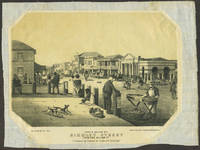
185128279Adelaide: Penman & Galbraith 1851. Print. An extraordinarily rare set of four of S. T. Gill's Adelaide views no. 1-3 i.e. Views in Adelaide No. 1. Hindley Street from King William St.; No. 2. Hindley Street Looking East; No. 3 Rundle Street Looking East; with a variant second copy of No. 3 which is black & white. The images are held at the Art Gallery of South Australia; the State Library of New South Wales the National Library of Australia and some a the City of Adelaide. There are tinted lithographs some with a tinted border others not and black & white lithographs as well. The street images appear to be the same in all the recorded prints consistent with these four- there are some minor variations which are noted. The three tinted lithographs are mounted on polished cloth. The period cloth mounting is unusual. It is not known if these were a reference set or perhaps proofs.<br /> <br /> Views in Adelaide No. 1./ Hindley Street from King William St./ Published by Penman & Galbraith Adelaide/ On Stone by S. T. Gill/ Printed by Penman & Galbraith/ Signed in the stone S T G 1851. Tinted plate with no tinted border outline. Image 17.5 x 22.5 on paper 18 x 23.5 cm. AGSA 684G11; SLNSW nmQdoR5n. SLNSW image has tan border outline this copy does not. Mounted on cream cloth trimmed outside the catty corners with margins.<br /> <br /> Views in Adelaide No. 2./ Hindley Street Looking East/ Published by Penman & Galbraith Pirie St. Adelaide./ On Stone by S. T. Gill/ Printed by Penman & Galbraith/ Signed in the stone S T G indistinct date. Tinted plate with a faint tinted border outline. Image 18 x 23.1 cm on paper 18.3 x 24 cm. AGSA 684G12; SLNSW 9PQ8kDxn; Nat Lib ID 7566602 Rex Nan Kivell Collection NK3544/B. Slt. foxing on left lower margin. Mounted on saffron cloth trimmed outside the catty corners with margins.<br /> <br /> Views in Adelaide No. 3/ Rundle Street Looking East/ Published by Penman & Galbraith Pirie St. Adelaide./ On Stone by S. T. Gill/ Printed by Penman & Galbraith/ Signed in the stone S T G 1851 S inverted. Tinted plate with tinted border outline. Image 18 x 22.8 on paper 18.2 x 23.4 cm. AGSA B 2430; SLNSW Yj7djR39 for 3 print set which is colored and without border outlines. Mounted on saffron cloth trimmed outside the catty corners with margins.<br /> <br /> Views in Adelaide No. 3/ Rundle Street Looking East/ Published by Penman & Galbraith Pirie St. Adelaide./ On Stone by S. T. Gill/ Printed by Penman & Galbraith/ Signed in the stone S T G 1851 S inverted. Black and white plate with no tinted border outline. Image 18 x 22.2 on paper 20.9 x 25.8 cm. AGSA B 2430; NLA Lib ID 7566601 Nan Kivell NK3544/C. Printed on cream paper some watermarks.<br /> <br /> A rare set of images by one of the master artists of this period in Australia. Penman & Galbraith unknown
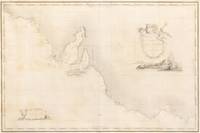
1812133915Paris: Imprimerie Royale 1812. Very Good. Paris Imprimerie Royale 1812 second issue/ 1811. An engraved map 'Gravé par P.A.F. Tardieu . Ecrit par Giraldon et Lale' matted framed and glazed visible image size surface 510 × 760 mm; external dimensions approximately 725 × 980 mm. Vertical centrefold crease as issued; paper a little tanned with some offsetting and a few spots of foxing; in excellent condition not examined out of the frame. One of the earliest published charts of the South Australian coastline compiled by Louis de Freycinet on the Baudin voyage 1800-1803. It includes the complete coastline of Kangaroo Island which was first circumnavigated and fully charted by the French on this voyage Matthew Flinders had charted its north coast a short time previously. The charming engraved vignettes of Australian wildlife are after drawings by Charles Alexandre Lesueur. <p>This example is from the scarce second issue published as Plate 10 of the imperial folio atlas to the 'Partie navigation et géographie' volumes of the official account of the expedition 'Voyage de découvertes aux terres australes' 1812. It had previously appeared as Plate 2 in the second part of the atlas to the 'Historique' volumes published in 1811 Tooley 611. Tooley does not appear to list this issue but does list a subsequent state twice as 414 and 633 which includes a price at the bottom right and the reference 'Hyd. Fr. N° 636' next to the plate number. Imprimerie Royale unknown
1800PHO-1086Texte In-8 (200 x 130 mm) Relié demi-basane, dos orné pièce de titre et de tomaison ,T1 manque coiffe sup.,T2 ,manque coiffes, papier bruni. 440 pp et 332 pp suivi de 109 pp de vocabulaire et table des planches contenues dans l’atlas, table des chapitres du volume et errata. ATLAS Atlas pour servir à la relation du voyage à la recherche de La Pérouse, fait par ordre de l’Assemblée constituante, Pendant les années 1791, 1792, et pendant la 1ere et 2eme année de la République Française. Paris : H. J. Jansen, An VIII de la République (1800). — In-folio, 510 x 335 : titre, 1 carte, 43 planches. Demi toile , dos lisse avec titre , planches 6 détachée et 35 détachée et émargée , dédicace «à Mr V. Rey, secrétaire général de la Nouvelle Calédonie,1903»
1940180936Adelaide: 20 July 1940. We're off to see the inland; the wonderful inland of Aust! A personal album kept by the Australian opera singer Una Rosalind Hale. It documents the trip she and 11 other schoolgirls took on 9 May 1940 travelling by train from Port Pirie to Alice Springs and the aboriginal community of Hermannsburg. They were given a tour of Alice Springs by Reverend Harry Griffiths who designed and opened the ANZAC Hill Memorial. Hale 1922-2005 was born in Adelaide to the Unitarian minister George Ernest Hale. This album dates from her education at Adelaide Methodist Ladies' College. As she describes on page 1 the girls were accompanied by their headmistress and four teachers on a train journey to the Australian inland. The photographs show their stopovers at Port Augusta Marree and Coward Springs where they posed for photographs outside the train and with aboriginal people. Once in Alice Springs the group were given a tour by Reverend Harry Griffiths and his wife Dorothy shown on pages 14 and 31. The album contains shots of the church and the manse where they stayed as well as the countryside and the missionary trips they performed. These include to Todd River Hermannsburg Palm Valley Standley Chasm and Simpson's Gap. One spread contains four photographs of a place they named "MLC Rock" and another contains a photograph of two girls riding a camel "with a steadfast and a strong intent fearful of the consequences". The two loose photographs show the Sydney Harbour Bridge and the AMP Building once Australia's tallest building completed in 1962. Hale moved to Britain in 1946 to study at the Royal College of Music. "On leaving the college she joined the Carl Rosa Opera Company and quickly established herself in such roles as Marguerite Faust Violetta La traviata Micaela Carmen Mimì La bohème and Donna Anna Don Giovanni invariably with success. Of a disastrous production of Tannhäuser The Times wrote: 'The one redeeming feature was the Elisabeth of Una Hale.'" The Times. She then joined the Covent Garden Company in 1954 and starred as Ariadne in the Australian premiere of Araidne auf Naxos in 1962. Oblong folio 190 x 276 mm. With 84 gelatin silver photographs mostly 63 x 85 mm snapshots landscape or portrait photographic postcard half-tone photographic illustration colour newspaper clipping colour manuscript map all corner-mounted on card leaves with manuscript captions. Two additional gelatin silver commercial photographs loosely inserted. Contemporary crocodile skin-textured boards black string binding with tassle light brown textured lining. Binding a little worn photographs generally bright with some toning slight silvering to postcard: a very good example. "Una Hale: Australian lyric soprano who shone in the 1950s and 1960s" The Times 12 March 2005. hardcover
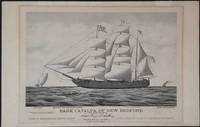
187623907Boston: Forbes Lith. Mfg. Co. 1876. First edition. This scarce tinted lithograph was issued to commemorate the escape of Irish political prisoners from Fremantle W.A. on April 17th 1876. The Fenians are shown rowing towards the bark which is under full sail. The Catalpa is flying a flag with the initials "J T R" - for John T Richardson the ship's agent. A pennant with the letter C the Fenian flag and the American flag are also flying. <br /> <br /> The police boat is in hot pursuit and the British steamship "Georgette" is steaming in from a distance. Among the Fenians freed in this effort was John Boyle O'Reilly who became a leading citizen in Boston and was later to edit the 'Boston Pilot'. <br /> <br /> Captain George Anthony an American whaling captain out of New Bedford Massachusetts recruited a crew for this mission and set sail for Western Australia where two Fenian agents John Breslin and Tom Desmond had already established themselves with aliases. With several delays the day for the escape was set for the 17th of April when most of the convict garrison was distracted by watching the Perth Yacht Club regatta.<br /> <br /> Captain Anthony who refused to surrender the escaped prisoners to the British later sold his story to Zephaniah W. Pease who published the account in 'The Catalpa Expedition'. See also Laubenstein 'The Emerald Whaler'.<br /> <br /> On its arrival in New York in August of 1876 the Catalpa was met with great crowds; jubilant celebrations were held in the US and Ireland.<br /> <br /> 17 x 13" on paper 22 x 14 1/4". For information on the artist E. N. Russell see Blasdale Artists of New Bedford pp 160-161; Kendall Prints 28; Ingalls 318. OCLC: 191908718 1 copy at the Boston Athenaeum. Trove 45254 at the Australian National Maritime Museum; and 57714676 at the State Library of Western Australia. Professionally deacidified. In very good condition. <br /> <br /> A rare print important for its depiction of an important Western Australian colonial event. Forbes Lith. Mfg. Co. unknown
32557Ninety-one numbers Volumes 23 and 24 were issued as one volume plus the separately issued paper envelopes of maps for Volumes 18 and 19 the second envelope is a little worn and stained; nine early numbers are bound as five volumes in publisher's half morocco and Volume 4 is bound in later binder's cloth; Volume 5 lacks the wrappers; those of Volume 10 are worn with a little loss with light stains to the front cover and the top corner of the title-leaf; the rear cover of the double issue is a little stained affecting slightly the top and bottom margins of the last ten leaves; a handful of volumes have trifling cover blemishes; all other volumes are in fine condition in the original wrappers. All subsequent issues are in print and can be supplied. A major repository of contemporary accounts of exploration frequently not published elsewhere with much on anthropology; complete sets are rarely offered for sale. unknown
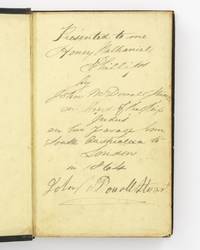
1860135299London: George E. Eyre and William Spottiswoode 1860. First Edition. Hardcover. Very Good. London George E. Eyre and William Spottiswoode 1860. 'Small pica 16mo' unpaginated. Original full morocco all edges gilt; leather a little rubbed at the extremities with a small glass-ring on the front cover; some foxing throughout; mild signs of age and use including a dried sprig of maidenhair fern loosely inserted at one opening; in very good condition. The front free endpaper is signed by John McDouall Stuart at the foot of the following inscription: 'Presented to me Henry Nathaniel Phillips by John McDouall Stuart on board of the Ship "Indus" on her pasage sic from South Australia to London in 1864'. <p>Written on the verso in another hand is '"Ask and it shall be given you". Matt 7th - 7.v'. The book has the contemporary blindstamp of the Adelaide booksellers W.C. Rigby 53 Hindley St Adelaide on the top corner of the rear free endpaper. We would like to think the book was purchased in Adelaide inscribed with a most apposite Biblical text and given to Stuart prior to his departure from Adelaide in late 1861 on his ultimately successful sixth expedition across the continent and back. However in many ways it was a Pyrrhic victory: 'Ill with scurvy and nearly blind Stuart had to be carried on a stretcher slung between two horses; recovering sufficiently to ride by the time they reached Mount Margaret on 26 November he pushed on with three of the party and arrived in Adelaide on 17 December 1862. On a public holiday on 21 January 1863 crowds lined the streets amid banners strung from buildings. He was awarded £2000 though allowed only the interest from it and his party received £1500 between them. <p>White-haired exhausted and nearly blind Stuart decided to visit his sister in Scotland and sailed in April 1864. He later went to London. His claims for a greater reward from the South Australian government led to another £1000 again with only the interest. His "Explorations in Australia. The Journals of John McDouall Stuart" was edited by W. Hardman and published in 1864. <p>He died of ramolissement and cerebral effusion on 5 June 1866 aged only 50 in London and was buried in the Kensal Green cemetery. He has remained a lonely and independent figure with a fierce pride. His reputation as a heavy drinker has led detractors to minimize his achievements even to the extent of doubting that he reached the Indian Ocean in 1862' 'Australian Dictionary of Biography'. Surprisingly apart from this singularly personal gift from Stuart Henry Nathaniel Phillips has left no other trace of his existence that we can find. George E. Eyre and William Spottiswoode hardcover
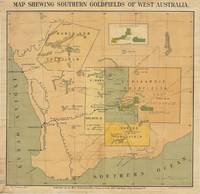
64089London: The West Australian Gold Fields Limited 29 St. Swithins Lane. Printers: Sir Joseph Causton & Sons Ltd. c.1895. Original colour-printed map overall 63 x 65 cm backed onto linen. Shows the Murchison Yilgarn Coolgardie and Dundas goldfields. With separate map of the Murchison goldfield with the addition of the Yalgoo goldfield on a separate slip 22 x 22 cm stating 'Whilst the map was in the press another goldfield - the Yalgoo - was proclaimed.and this slip has been prepared to show the new goldfield and the consequent subdivision of the Murchison field 30th March 1895'. Signs of old restored creases mainly to lower half and outer margins; the slip map browned and backed with archival tissue the top left corner clipped signs of old tears across the centre withal very good for such an ephemeral item. Shows the prospector's routes: Gregory 1846 Roe 1848 Dempster 1863 Giles 1875 Forest 1877 Lindsay 1891 Carnegie 1894 London: The West Australian Gold Fields Limited, 29 St. Swithins Lane. Printers: Sir Joseph Causton & Sons Ltd. [c.1895]. unknown
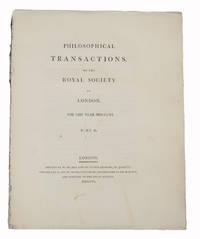
180645128London, W. Bulmer and Co., 1806. 4to. No wrappers as extracted from ""Philosophical Transactions"" 1806 - Part II. Pp. 239-268. Having also the titlepage to the volume (Part II, 1806). A faint bit of soiling to outer right margin of the first 2 leaves, otherwise clean and wide-margined.
180645128London W. Bulmer and Co. 1806. 4to. No wrappers as extracted from "Philosophical Transactions" 1806 - Part II. Pp. 239-268. Having also the titlepage to the volume Part II 1806. A faint bit of soiling to outer right margin of the first 2 leaves otherwise clean and wide-margined. <br/><br/><em>First printing of this important paper relating Flinder's observations on the ship "Investigator" when exploring the coast of Australia. IN THE PAPER THE NAME "AUSTRALIA" APPEARS PROBABLY FOR THE FIRST TIME IN A SCIENTIFIC MEMOIR p. 247.The name Australia was popularised by Matthew Flinders who pushed for the name to be formally adopted as early as 1804. When preparing his manuscript and charts for his 1814 A Voyage to Terra Australis he was persuaded by his patron Sir Joseph Banks to use the term Terra Australis as this was the name most familiar to the public. Flinders did so but allowed himself the footnote:"Had I permitted myself any innovation on the original term it would have been to convert it to Australia; as being more agreeable to the ear and an assimilation to the names of the other great portions of the earth." In the paper offered he used the name "Australia" as early as 1806."Captain Matthew Flinders RN 16 March 1774 - 19 July 1814 was one of the most successful navigators and cartographers of his age. In a career that spanned just over twenty years he sailed with Captain William Bligh circumnavigated Australia and encouraged the use of that name for the continent which had previously been known as New Holland. He survived shipwreck and disaster only to be imprisoned for violating the terms of his scientific passport by changing ships and carrying prohibited papers. He identified and corrected the effect upon compass readings of iron components and equipment on board wooden ships and he wrote what may be the first work on early Australian exploration A Voyage to Terra Australis."Wikepedia </em> unknown
1822003091Leblanc, chez Abel Ledoux, (s. d.), 1822
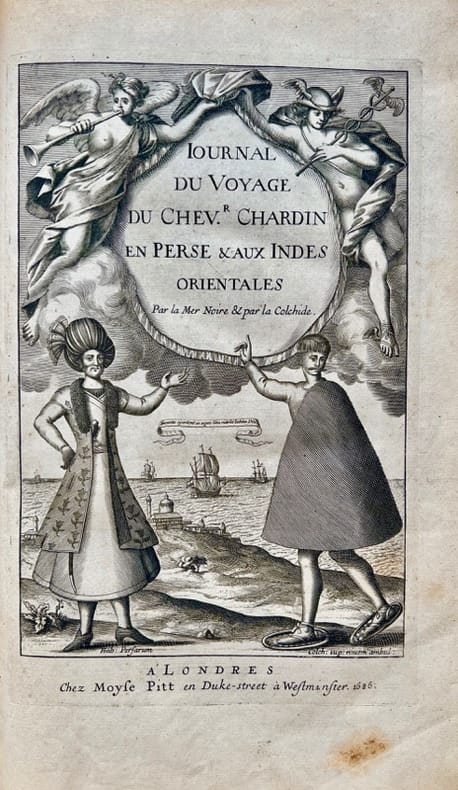
168642700Londres, Moses Pitt, 1686. In-folio de (10)-349-(5) pp., veau havane marbré, dos orné à nerfs, pièce de titre en maroquin rouge, tranches rouges (reliure de l'époque).
63186Gill's titles are 'Cradling Forest Creek 1852' 'The Claim Disputed' 'Mustering Cattle' 'Native Sneaking Emus' and 'The Bushranger Pursued'. Hamilton's titles in which the horse naturally enough features prominently are 'The Lost Bushman' 'The Found Bushman' 'Bushmen in Danger' 'Australian Bushmen' and 'The Bushman'. Unpublished but circa 1890 and based on original sketches from upwards of fifty years earlier. <p>The images are printed in brown ink on light brown arch-topped backgrounds printed surface 150 × 205 mm on uniform sheets of cream paper 200 × 275 mm. This set is in fine condition in a modern custom-made portfolio covered in brown cloth lettered in gilt on the front panel 'Scenes of Australian Country Life'. <p>The invaluable 'Dictionary of Australian Artists. Painters Sketchers Photographers and Engravers to 1870' edited by Joan Kerr has only this to say: 'MAY E.C. lithographer signed nine lithographs celebrating life in the bush and on the goldfields c.1855-60 ML. He may have been the May who was in partnership with George Walker q.v. at Melbourne in the early 1870s'. At least he appears on their radar . <p>We have established the following facts. Edgar Charles May 1867-1920 was born at North Adelaide on 27 May 1867; his name later appeared in the local Sands and McDougall's directories with his occupation listed as artist. One published example of his work not noted at all by Kerr and not attributed to May by Ferguson is '14 Views of Old Adelaide from Sketches in 1840-1849 by S.T. Gill F.R. Nixon S. Calvert and O. Korn' Adelaide E.S. Wigg 1890; oblong quarto 19 leaves all rectos blank comprising the gilt-pictorial title page signed in the image by E.C. May 14 full-page tinted lithographic views with tissue-guards the 3-page list of 181 subscribers and the key to plate 5 between plates 4 and 5'. This is Ferguson 9924e which is essentially the same item as Ferguson 9807 apart from the different publishers. We have inspected numerous copies of 9924e the Wigg version and the odd Galbraith one and it is clear that the original Galbraith imprint is masked by the gold blocking carrying the later Wigg imprint. The nature of the contents reworked material from well-known earlier artists the medium tinted lithographs printed in brown and the style of the work leave us in no doubt that May is responsible for all the material in '14 Views of Old Adelaide'. <p>We suggest that the ten lithographs offered here were prepared by him with the intention of putting out a companion volume to '14 Views of Old Adelaide'. The change of publisher after that book was printed leads us also to suggest that Galbraith or May or both lost money on the venture and who knows perhaps the Wigg issue was not a commercial success either. In any event one could see how enthusiasm for a sequel might be considerably diminished. All of these plates are rare; complete sets of them are exceptionally rare on the open market even Kerr's dictionary refers to only nine of them. Until now they have been poorly documented in the literature; fortunately some of them have survived to tell their own worthy tale. unknown
1880104852Adelaide: Goodfellow & Hele almost certainly the Author - James Dally was convinced 1880. First Edition. Hardcover. Very Good. Adelaide Goodfellow & Hele almost certainly the Author - James Dally was convinced 1880. Octavo 182 30 advertisements pages plus 6 lithographed plates of farm machinery by James Martin & Co. and 17 albumen paper carte-de-visite photographs individually mounted on tipped-in captioned leaves. Blind-decorated maroon cloth lettered in gilt on the front cover with a later gilt-lettered cloth title-label along the spine originally untitled; cloth a little flecked slightly sunned on the spine and a little rubbed and bumped at the extremities; some mounts lightly cockled as ever a production flaw; a few trifling signs of use; basically an excellent copy internally fine with the photographs in superb condition. A rare and desirable item attested to by the provenance of this copy: it has the armorial bookplate of Charles Glover on the pastedown and the blind-stamp of Sir Thomas Ramsay on the flyleaf 'T.M.R. Library of T.M. Ramsay'. Ferguson 11744; Holden 70. Holden's entry is more accurate and informative although the photographs may vary slightly between copies. The photograph facing page 16 in this copy is a portrait of Dr Nott rather than 'Frankel's Hotel' as called for in Holden facing page 17. Two other photographs are less-common variant images of the same subject: these are 'Fotheringham's Cordial Factory' facing page 57 and 'Stewart's Music Emporium' facing page 96. These variations notwithstanding two separate editions were produced: one in wrappers with advertisements on the verso of the front cover and on both sides of the rear cover without photographs but with the lithographs not noted by Ferguson; the other in gilt-lettered cloth without the cover advertisements containing 17 mounted photographs plus the lithographs. Both contain 30 pages of advertisements at the rear. <p>Rare in any state and in our view the version on offer is one of the more important and interesting photographically illustrated books produced in Australia. 'The handbook is illustrated with a number of views by Mr J. Taylor the local photographic artist representing the most important edifices and establishments in town' Holden quoting a contemporary review. The frontispiece is a portrait of John McKinlay 1819-1872; there are 14 pages devoted to him he married a Gawler woman in the early 1850s and was based in the town until his death. Justice is not done to the other photographs in describing them prosaically as 'the most important edifices and establishments in town'. Without exception signs of life and day-to-day activities flesh out the images and most of the businesses - butcher shop photographic studio cordial factory furnishing warehouse music emporium - feature well-stocked windows or yards and numerous staff members or customers. Holden reproduces two interesting ones including perhaps the best the butcher shop captioned merely 'Hodgson & Clements' but there are wonderful vignettes in many others. Not least of these are the horse-drawn tram in front of the 'Commercial Bank' and the ornate hearse outside 'F. Fowler's Furnishing Warehouse'. <p>While we are on the subject of death one chapter stands out. Among those to be expected say on 'Horticultural and Agricultural Progress. Gardens around Gawler' or 'The Humbug Society. Flam! Bam! Sham!' or 'The Streets - Number of Businesses - Description of Hotels' there is Chapter XI: 'The Neville and Adamson Tragedy'. Its thirteen pages describe in great detail the events surrounding the double suicide 'and its romantic accomplishment' of Neville and his partner Adamson. 'It is universally believed that Neville was the leading spirit in the suicide and so strong was Adamson's affection love friendship or whatever it may be termed for his companion that he consented to take that final leap in the dark in the wine cellar with him to visit that "bourne whence none return"'. Goodfellow & Hele [almost certainly the Author - James Dally was convinced] hardcover
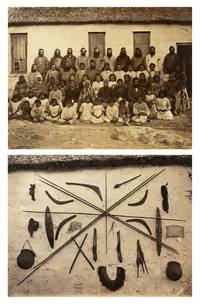
125425Original sepia-toned albumen paper photographs both 158 × 208 mm unmounted as issued; short sealed tear to the bottom corner of the photograph of weapons; essentially in fine condition. Captain Samuel White Sweet 1825-1886 sea captain surveyor and photographer: after he was censured when his ship ran aground in 1875 he 'retired from the sea opened a photographic studio in Adelaide and concentrated on landscapes. With his horse-drawn dark room he travelled through South Australia taking hundreds of skilful pictures of the outback stations and homesteads. The colony's foremost documentary photographer of the 1870s in the early 1880s he was one of the first to use the new dry-plate process' 'Australian Dictionary of Biography'. <p>'Point McLeay Mission was founded on the shores of Lake Alexandrina in 1859 by the Aborigines' Friends Association for the Aboriginal people of the Lower Lakes. George Taplin the Congregational minister was its first administrator. Following Government administration from 1916 Point McLeay was returned to the Ngarrindjeri people in 1974 and renamed Raukkan in 1982' State Library of South Australia. <p>The group portrait depicts 55 Indigenous men women and children posed in five rows in front of one of the thatch-roofed residential cottages at Point McLeay. 'Sweet Adelaide 463' is inscribed in the negative; 'Native Mission Station Ponindie sic' is written in pencil and in error on the verso. <p>The photograph of weapons and artefacts is inscribed 'Sweet Adelaide 462' in the negative and has an early caption in pencil on the verso 'Native Ornaments & Weapons'. The objects numbered 1 to 17 in the negative are displayed against a whitewashed wall of one of the cottages. <p>We have traced only one example of the latter photograph in Trove in the National Library of Australia and none of the group portrait. 'Captain Sweet's Colonial Imagination - The Ideals of Modernity in South Australian Views Photography 1866-1886' by Karen Magee a 2014 University of Adelaide doctoral thesis accessible online notes that Sweet visited Point McLeay in 1878 and 1880. She reproduces the latter photograph in her extensive catalogue see number 811 '"Ngarrindjeri weapons and hunting implements" 1878 Point McLeay. Private Collection' but does not record the group portrait. 2 items. unknown
1837PHO-2283Paris, A. Bertrand, 1837. 2 volumes in-8 (21,5x13,5 cm), xv, [1], 574 ; [4], 520, vii pp., illustré de 4 gravures et une carte dépliante, relié demi chagrin époque, traces de réparations à la reliure, cachets répétés, rousseurs et brunissures.
4to [29 x 24.5 cm]; [ii], xxiii, [i, errata], 388, 13, [i, directions] pp, engraved frontis portrait, plus 32 engraved plates, maps and charts including 20 folding. orig full tree calf, rebacked with orig gilt decorated spine, gilt title lettering on orig red spine leather label, wear at corners & spine ends, armorial bookplate of Robert Austen, marbled endpapers, interior clean, crisp & fine with only slight foxing. Taylor 401. Cox i, 301. Hill p. 108: 'Forrest sailed from Balembangan, in the 'Tartar', a native prahu of about ten tons burden, with two English officers and eighteen Malays, towards the Moluccas. He pushed further east than any of his company predecessors, eventually reaching Geelvink Bay in New Guinea. The voyage was one of examination and enquiry . . . the tact with which he conducted his intercourse with the natives, and the amount of work done in a small boat, deservedly won him credit as a navigator'. They explored the Gilolo Passage between New Guinea and the Moluccas, then sailed to Mindanao, examining the Sulu Archipelago, Mandiolo, Batchian and Waygiou, and reaching the Malay peninsula A vocabulary of the Magindano tongue is added at the end of the book. There is much on the native people, their customs, manners, activities. The book is famous for its fine engraved plates and maps.
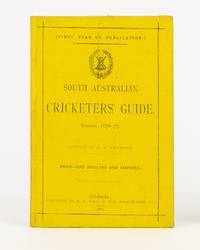
1877144575Adelaide: E.S. Wigg & Son 1877. First Edition. Hardcover. Near fine. Adelaide E.S. Wigg & Son 1877. Octavo vi 60 pages plus advertising on the outside rear cover. Original flush-cut yellow cloth with the full title page details repeated on the front cover with the addition of a vignette illustration and ruled border; first and last page tanned; later ownership details on the front pastedown with the name repeated on the dedication page; a near-fine copy. 'First Year of Publication' and rare especially in this condition. A second volume 'The South Australian Cricketers' Guide and Footballers' Companion. Season 1877-78' appeared the following year; a third and final volume 'The South Australian Cricketers' Guide. Season 1884-85' was published in 1885. <p>Padwick 3375. E.S. Wigg & Son hardcover
1849119606London: T. and W. Boone 1849. First Edition. Hardcover. London T. and W. Boone 1849 first edition slightly later issue. Octavo two volumes x iv 5-416 8 publisher's advertisements pages with 12 illustrations plus 8 plates 2 tinted 2 hand-coloured a folding map with rivers and Sturt's tracks in three colours and an advertising slip for Stokes tipped in after page x; and vi 308 92 4 prospectus for Siborne 8 publisher's advertisements pages with 6 illustrations plus 8 plates 2 hand-coloured and an advertising slip for Leichhardt tipped in on page 1. The woodcut illustrations on page 158 in the first volume and on pages 195 and 195 in the second volume are not noted in the plate list; the hand-coloured plates three of birds and one of Mus conditor 'The Building Rat' are from original artwork by John Gould and Henry Richter. Original blind-stamped green ribbed cloth the primary binding rebacked not professionally but more than adequately retaining the original backstrips and endpapers; cloth a little worn at the extremities stained and sunned on the spines with minor loss at the foot of the second one; the first volume has the front inner hinge reinforced the bottom corner of the free endpaper torn away slight loss near the foot of the front hinge the rear free endpaper removed and the rear pastedown stained; the second volume has slight loss to the restored front inner hinge and a few light stains to both endpapers; tidemarks to some plates not the hand-coloured ones and minor in all cases except the first frontispiece; brown stain to the bottom corner tips of some leaves in each volume most of them from pages 71-100 including a plate in the first volume and from pages 141-164 in the second volume but touching the text on one leaf only and rarely larger than a thumbnail elsewhere; short sealed tears to the leading margin of pages 27-52 in the appendix to the second volume; minimal signs of age and use including a partially erased word on one page and some words offset onto the last page of advertising in the first volume; overall a very decent set. Provenance: George Woodroofe Goyder with the pastedown of each volume inscribed in his hand 'Hill Side Cottage Medindie April 1858'. George Woodroofe Goyder 1826-1898 South Australia's surveyor-general for thirty-three years is best remembered for the eponymous Goyder's Line 'the line of demarcation between that portion of the country where the rainfall has extended and that where the drought prevails' a line of reliable rainfall that separates agricultural from pastoral lands. 'Goyder joined the Department of Lands as chief clerk in January 1853. In quick stages he rose from second assistant to assistant surveyor-general in January 1857. In April he took charge of an exploration to report on country north of pastoral settlement. He was amazed to find Lake Torrens full of fresh water and its flourishing eastern surroundings very different from the desert described by Edward Eyre in 1839. His exuberant report persuaded the surveyor-general Captain Sir Arthur Freeling to examine the area in September. No more rain had fallen but hot winds had killed the vegetation and turned the lake into a bed of mud. Freeling returned to criticize Goyder for mistaking flood for permanent water being misled by mirage and misconceiving the value of the northern country. Although Goyder had proved that Eyre's horseshoe of salt lakes was penetrable and thereby opened the way to further exploration he was too conscientious to ignore his blunder and in 1859 at his own request led survey parties to triangulate the country between Lakes Torrens and Eyre and to sink wells. When Freeling resigned Goyder was recalled from the north to become surveyor-general on 19 January 1861' 'Australian Dictionary of Biography'. <p>Goyder married in 1851; by 1856 the family with four children moved from rented accommodation in North Adelaide 'a short distance across the parklands to Medindie . into a "neat cottage" with six rooms a garden and a vineyard . Named Hillside the cottage was located on a private road now Hawkers Road close to Robe Terrace overlooking the parklands' Janis Sheldrick: 'Nature's Line. George Goyder - Surveyor Environmentalist Visionary' 2013. It is intriguing to discover that Goyder acquired a set of Sturt's account of his 1844-46 Central Australian expedition in search of an inland sea in April 1858 the year after his own expedition to Lake Torrens. 'The expedition started by following the Murray and Darling both to settle any doubt about the confluence of the two rivers and to avoid the "horseshoe" of Lake Torrens which had halted Eyre's progress a few years before' Wantrup and confounded Goyder himself in 1857. Wantrup 119 noting the point that distinguishes the first issue an inserted advertisement for Melville immediately following the text in the first volume: 'this leaf was suppressed shortly after publication of Sturt's book'. 2 items. T. and W. Boone hardcover
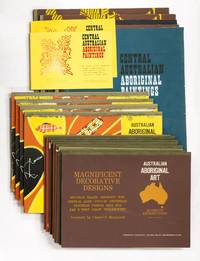
1967138977Melbourne: Newcraft Publicity 1967. First Edition. Paperback. Very Good. Melbourne Newcraft Publicity 1967 to 1969. Seventeen portfolios in various formats see below each containing a page or two of text and 5 colour serigraphs printed on card unless otherwise stated and interleaved with tissue-guards. Thick card covers with cloth spines; minor blemishes to some covers; minor damage to a bottom corner of portfolio B Volume 4 see below with loss of the corner-tip to the last three plates; overall the contents are in excellent condition. Two volumes are bound in portrait format; the others are presented in landscape format albeit with the spine along the top edge. The National Library of Australia catalogue states that this material was 'Available only in set of 24 portfolios at $310.00 . "Authentic reproductions ready for framing". Edition limited to 200 numbered copies' we have not traced the original source of this information. However we have incorporated below a number of pertinent details gleaned from Trove; in particular we found the relevant catalogue records provided by the State Library of Victoria to be the most informative. <p>A Magnificent Decorative Designs. Melville Island Abstract - Map Central Aust. - Pintubi Churingas - Victorian Possum Skin Rug - Far N. West Coast Phallocrypt 375 × 505 mm; #13/116. <p>B Australian Aboriginal Art. Primitive Traditional Decorative four volumes each 403 × 550 mm and all numbered #095; together with three larger-format volumes each approximately 550 × 795 mm respectively #1/086 #2/090 and unnumbered. The third volume without the subtitle 'Primitive Traditional Decorative' contains seven plates reproducing ones that appear in the smaller-format volumes; six are printed on paper the seventh is printed on the inside rear card cover. <p>C Cave Paintings of Arnhemland Volumes 1 2 3 and 5; each approximately 385 × 500 mm; all #126. The title of the fifth volume is 'Ceremonial Cave Paintings of Arnhemland "Amazing Anthropomorphic Figures"'. <p>D Central Australian Aboriginal Paintings. Brilliant Abstract Designs of the Pitjantjatjara two volumes bound portrait-format each 750 × 550 mm respectively #66 and #2/100. The first volume has a brown cover decorated in ochre and lettered in black; the second volume has a blue cover decorated in white and lettered in black. Both volumes contain seven plates. <p>E Magnificent Bark Paintings of Arnhemland and the Islands Volumes 1 2 and 4; each approximately 380 × 500 mm; respectively #1/126 #2/116 and #101. The title of the fourth volume is 'Magnificent Bark Paintings of Arnhemland'. <p>Offered together with three plates mounted as issued on thick card; these also appear in the volume of duplicated plates noted in B above. Also included are two copies of another Newcraft Publicity item 'Central Australian Aboriginal Paintings' by Winifred Hilliard wrappers oblong quarto with 7 colour plates; the second copy is numbered 153. Although the lengthy subtitles are different 'The Pitjantjatjara Abstracts. Designs in Vibrant Colours from Ancient Mythological and Totemic Motifs by Aboriginal Artists at Ernabella in the Musgrave Ranges' and 'Ancient Mythological and Totemic Motifs in Vibrant Colors by Finke River Aboriginal Artists' the contents are the same albeit in a different order and with minor variation to the introductory text. To complicate matters even more the same contents appear in the first very much larger-format volume in D above. <p>We have identified five portfolios not present in this run cross-referenced with the descriptions above: A Magnificent Decorative Designs. Volume 1 Churinga Patterns Ground and Rock Paintings; <p>C Cave Paintings of Arnhemland. Volume 4; E Magnificent Bark Paintings of Arnhemland. Volume 3: Oenpelli Portfolio; Australian Aboriginal Art: Bark Paintings - Angurugu Groote Eylandt Gulf of Carpentaria; and Australian Aboriginal Art: Decorated Shields of North Queensland. The SLV also identifies one related item we do not have: 'Australian Aboriginal Art' Melbourne Newcraft Publicity 1969. It is described as being a single volume 750 mm tall containing 'Colour prints on paper of items of aboriginal art miniaturised from the series of authentic reproductions of bark and cave paintings in the Newcraft collection of 23 portfolios'. 22 items. Newcraft Publicity paperback
17344They are drawn mainly on Adelaide banks and business houses in the 1860s and 1870s with payees generally in the Clare region including Clare Mintaro Spalding Yatina Watervale Auburn Rhynie Broughton and Bungaree. All are bank-stamped. Recognisable payees' signatures written on both sides of the notes include Benno Seppelt Albion Tolley George Wood and Philip Santo. Local well-known businesses represented include Simpson James Martin Faulding Wills William Morgan Fowler Harris Scarfe and Duncan Fraser. Offered together with 50 or more similar but lesser items from mainly the 1910s. Over 200 items. unknown