[Poster; Australia] Northfield, JamesBiblio.com

5 988 résultats
193025919Melbourne: Produced by Northfield Studios and J.E. Hackett 1930. Very good condition. Color lithograph travel poster depicting a mother koala with a cub clinging to her back in the top of a gum tree by the noted Australian illustrator James Northfield. Signed in the image at the lower right.<br /> <br /> Northfield 1887 - 1973 was the subject of the 2006 volume by the National Library of Australia Michelle Hetherington titled 'James Northfield and the Art of Selling Australia'. Northfield's work is prized for its draftsmanship & design and a distinctly Australian sense of color and light.<br /> <br /> Window card size 13 1/2 x 19 1/2". One small mark in margin only upper left corner left by old sticky tape. OCLC: 910601564 locates one copy only at the Library of Congress same image larger format. Trove 54841871 locates one copy at the National Library of Australia same image larger format. Produced by Northfield Studios and J.E. Hackett unknown
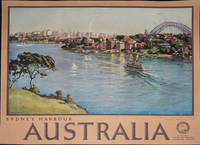
193518842Australian National Travel Association 1935. Very good overall. Travel poster illustrated by Sydney Harbour centered on the harbour with a ferry and sailboats with the Sydney Harbour Bridge in the top right background. A color lithograph 20 x 24.75" 50.8 x 62.25 cm. Further text; "Painting by Will Ashton R.0.I. W.T. Baker & Co Ltd. Engravers and printers. Australian National Travel Association." Crinkles and some light creases with a couple of light marks in the sky above the Bridge. Australian National Travel Association unknown
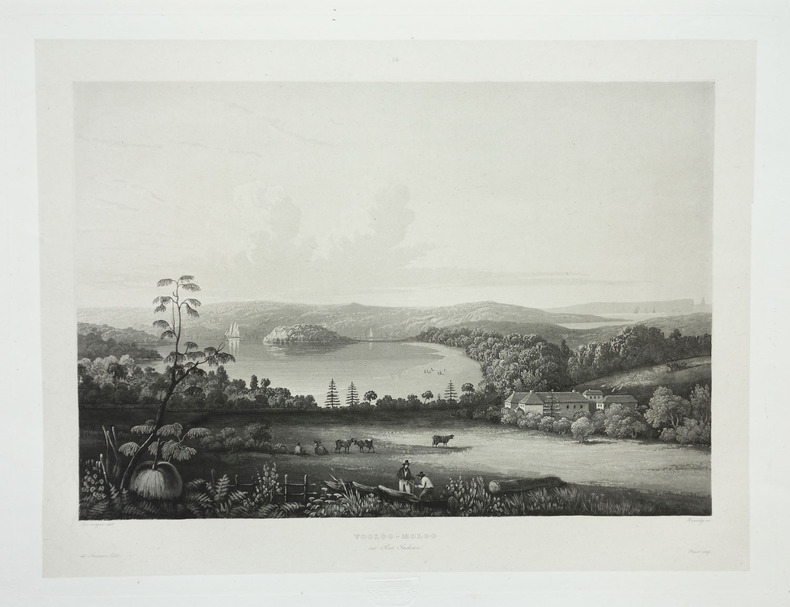
1833PHO-1811Paris,1833, in-folio, demi-reliure basane rouge, dos lisse, muet (rel. mod.), illustré avec 1 portrait en frontispice, lithographié par Lemercier d'après A. Maurin, [1] f. (titre gravé avec vignette), 20 planches disparates (8 cartes gravées sur acier dont 6 doubles, 11 vues reliées (dont 5 coloriées) et 15 planches en feuilles, papier des plats gondolé, quelques rousseurs aux planches libres avec défauts en marges.Recueil réunissant : 1 carte générale ; 1 carte de Nouvelle-Zélande (côte partielle); 1 carte du Pacifique; 1 de Nouvelle-Guinée; 1 de l'Archipel des îles Viti; 1 de l'île Tonga-Tabou; 1 des îles Vanikoro; 1 de Nouvelle-Zélande (nord); des vues de paysages; de personnages locaux (dont 7 coloriées).
1845036628London: T. And W. Boone 1845. xi 243pp 7 engraved plates map. Or cloth boards decorated in blind titled in gilt with gilt kangaroos to base of spine. Cloth splitting along rear spine edge front board starting to separate at top hinges starting. Ex- Mines Department library with usual stamps etc quite heavy foxing to map plates and title page. Corners bumped. Text pages generally clean. Scarce early account of the early settlement of Moreton Bay and New South Wales from Port Macquarie north. A great deal on the Aborigines. First Edition. Hard Cover. Good. 8vo. Ex-Library. T. And W. Boone Hardcover
17900032791790 A Paris, Chez Letellier, 1789-1790. Deux ouvrages reliés en un volume in-8 (131 X 200) basane fauve, double filet doré en place des nerfs, pièce de titre maroquin ocre, tranches mouchetées en rouge (reliure de l'époque) ; (1) f. blanc, titre, (1) f. d'avis préliminaire, 213 pages ; (1) f. blanc, VIII pages (dont faux-titre et titre), 266 pages, (1) f. blanc. Cernes de mouillures claires à certains feuillets, plus marqués aux premiers feuillets du volume. Manque de papier à l'angle inférieur des feuillets 153/154 et 169/170 de l'ouvrage de Tench, avec perte d'une lettre ("e" final de "espac[e]") au second feuillet. Quelques rares rousseurs. Minimes restaurations à la reliure.
1941137250Sydney: 'Sydney Morning Herald' 1941. First Edition. Paperback. Very Good. Sydney 'Sydney Morning Herald' 1941 and 1942. Large quarto 84 to 88 pages each issue extensively illustrated in colour and black and white; bound-in in the first number is a small two-part perforated order-gift subscription form. Binder's cloth retaining the original colour-pictorial card covers with the rear cover now bound in immediately after the front cover in each case; cloth a little flecked; edges a little foxed; endpapers discoloured; light foxing to a few leaves adjacent to the boards; in excellent condition. The fourth and final series of 'Art in Australia' comprised only six quarterly numbers between March 1941 and August 1942. They were a marked departure in all respects from the previous 94 numbers of the journal which commenced publication in 1916: new editor new format new emphasis on international art. The editorial in the first issue spells this out succinctly: there will be 'a complete change in appearance and methods of production with a broadening of policy. In the past "Art in Australia" has been almost entirely devoted to the painting sculpture and architecture of this country. Luxurious productions from France England and other countries were available to inform the artist student and art-lover of the work and activities of the art world outside. But the barbarity unleashed in Europe is destroying much of the art of the past and present and has made it impossible for periodicals we prized so much to continue production. The countries of their origin have fallen under Hitler's yoke men responsible for their production - artists and writers - killed art galleries and elaborate printing and processing plants blown to bits. But Art cannot die and we in Australia can and will carry on our efforts to preserve encourage and foster the culture our enemies would destroy. In spite of paper shortages and many other difficulties "Art in Australia" will play its widened part by presenting the art of all countries all periods and all schools'. <p>Peter Bellew modelled its visual excellence and intellectual content on 'Verve' and 'under his stewardship the art historian and director of London's National Gallery Sir Kenneth Clark declared it "unquestionably the best art magazine being published today anywhere in the world"' Harding and Morgan: 'Modern Love - The Lives of John and Sunday Reed' 2015. Notwithstanding the end came without warning: Series 4 Number 6 August 1942 the last one published with a strong and parochial editorial about the 'Need for War Artists' contained no hint of its fate. 'Sydney Morning Herald' paperback
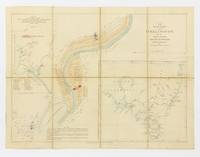
1842144203London: John Arrowsmith 1842. First Edition. Hardcover. Very Good. London John Arrowsmith Published 18 May 1842. A hand-coloured engraved map printed surface 402 × 551 mm external dimensions 446 × 591 mm cut into eight uniform panels mounted on linen as issued folding down to approximately 225 × 150 mm. When folded the two outside surfaces of linen are lined with plain purple textured cloth; a long sealed tear runs though the two top right-hand panels containing the printed title and a centimetre into the next-left panel but the only printed surface affected is the thin right-hand border: in spite of its length it is inoffensive and unobtrusive and may well be a production fault; in very good condition complete with the publisher's original slipcase in matching cloth lettered 'Wellington' in gilt on one thin side worn at the corners of the closed end and a little marked. John Arrowsmith 1790-1873 'was an important English cartographer especially for Australians. A member of a family of geographers his production focused on mapping British colonies around the world at a scale that surpassed that of any other contemporary map maker. Additionally he had access to the very latest despatches received at the Colonial Office and the British Admiralty which formed the source for many of his productions. His work covers the period 1832 to 1862'. <p>His lasting contribution is his 'London Atlas of Universal Geography' which went through at least eight editions between 1834 and 1858 Dorothy Prescott: 'Arrowsmith's Australian Maps' online resource. <p>We have previously sold uncut examples of this map on paper sourced from copies of the atlas. This cased example produced from the same plate used for the atlases shows the original allotments along the River Murray at Wellington and the upper entrance to Lake Alexandrina. This copy has three of these allotments additionally hand-coloured with initials added in black ink. They are blocks 8 blue FB 51 blue JB and 90 red FB. The two inset maps show the south-eastern portion of Australia and a 'Sketch of the Country between the Gulf of St. Vincent and the Great Bend of the River Murray shewing the Position of the Two Special Surveys of the Secondary Towns Association on the River Light'. <p>Tooley 115 b uncut version. John Arrowsmith hardcover
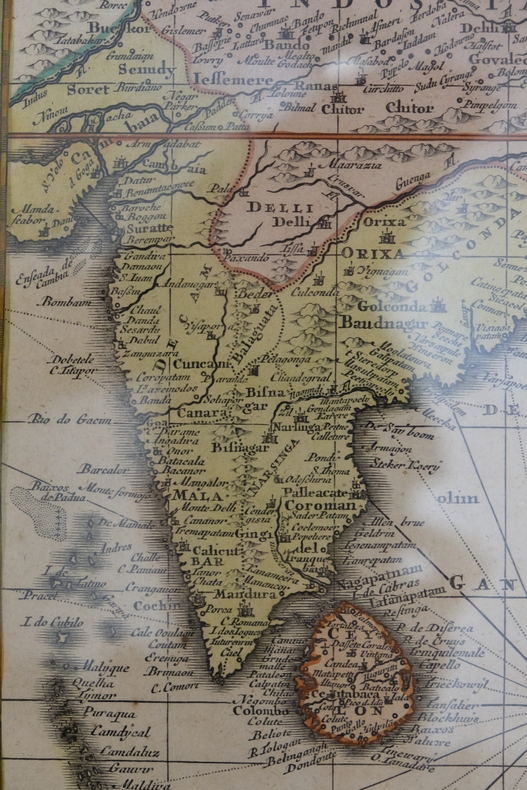
carte34t11Dimension du cadre : 52 x 61,5 cm. Cum adjacentibus insulis nova delineatione ob oculos pofita per Matthaeum Seutter. Cum gratia et Privil. S.R.I vicarcatus in partibus rheni, suevioe et juris franconici. Royaume de l'Inde. Magnifique carte, en très bon état général, dans un cadre sympathique.
8vo [21.5 x 14 cm]; 2 volumes, xxxii, [33] - 487; 344, 105, [vi, ads] pp, 45 engraved plates including frontis's, large folding map (short tear at stub), tables. contemporary half calf, marbled boards, red leather title labels, joints split, one board just holding, worn at edges, corners, bookplate of George Knight, light foxing on some leaves, but overall clean, text blocks tight, a very good set. A picture of th Hill p. 168: "Labillardiere was aboard the expedition under d'Entrecasteaux which was sent out to search for the missing Laperouse. Although unsuccessful in the search, the voyage was of considerable importance due to the scientific observations made and also for surveys of the coasts of Tasmania, New Caledonia, the north coast of New Guinea, and the southwest coast of Australia. Labillardiere's account of the Tongans is among the best contributions to the ethnology of that people." Cox 69: "of considerable importance. . . Labillardiere gives the first scientific description of the New Zealand flax and brought back several New Zealand plants." The plates include plants, birds, native peoples.
186780150Adelaide: David Gall 1867. First Edition. Hardcover. Very Good. Adelaide David Gall 1867. Duodecimo vi 82 52 'Chowla Advertiser' pages. Original flourescent green papered boards with expanded title page details repeated within a border on the front cover and with the contents listed on the rear; covers slightly marked and a little rubbed bumped and worn at the extremities with the hinges a little cracked; spine sunned lightly mottled and a little glue-stained; thin light tidemark to the top edge of the front endpaper; a very good copy of a scarce book rarely found with the spine intact and internally this copy is nothing short of fine. 'Storrie exhibits a keen sense of satire not only with regard to conventional tales whose perclivities are mercilessly ridiculed but also with regard to colonial society itself' Depasquale: A Critical History of South Australian Literature 1836-1930. Incidentally this is the first novel published in Adelaide. See Ferguson 16305 for confirmation of the Storrie/ McTavish connection. David Gall hardcover
8vo [23 x 15 cm]; xxiv, 424 pp, frontis, 61 illustrations including many full-page, mostly from photos, 3 folding maps, some drawings, index. original pictorial cloth, gilt spine title lettering and gilt picture on front cover, top edge gilted, endpaper bookplate, no tears of maps, near fine and clean. A picture of this book is available upon request by email. An important book by one of the great botanical explorers and naturalists of the nineteenth century, the Italian botanist, spent time at Kew, where he met Charles Darwin, William Joseph Hooker and James Brooke, the Rajah of Sarawak. The latter lead him to spending 3 years from 1865 to 1868 undertaking research in Sarawak, Brunei and other islands off present-day Malaysia and New Guinea, where he discovered many new species of palms, and many other plants such as a phosphorescent fungus that was bright enough to read a newspaper placed by it. Beccari was in Sarawak during 1865-67 where he collected over 800 bird skins including 40 not previously discovered of unrecorded species. He describes nature, the people, Dyaks and their customs in some detail, prior to the major impacts of the twentieth century, and describes his return to Sarawak some 20 years later, where he formed a botanical garden. He discovered the titan arum, the plant with the largest unbranched inflorescence in the world, in Sumatra in 1878. This edition also contains the valuable and detailed appendix on the forests of Borneo, which are currently being logged to extinction. The preface is by naturalist F. H. H. Guillemard who also wrote a book of his travels in the area. The later reprint does not include the maps of the original.
185257668New York: Cornish Lamport & Co. Publishers 1852. First edition. Handcoloured folding map at front. iv 5-154 2 ads pp. 1 vols. 8vo. Brown blind-stamped cloth. Spine ends chipped else Fine. Ex-library stamps on map and title page card pockets removed. First edition. Handcoloured folding map at front. iv 5-154 2 ads pp. 1 vols. 8vo. Ferguson: "At this time the author was conducting an 'Australian Emigration Office' at 120 Wall Street New York." Ferguson 10892 2 copies P.L. N.S.W. Cornish, Lamport & Co., Publishers unknown
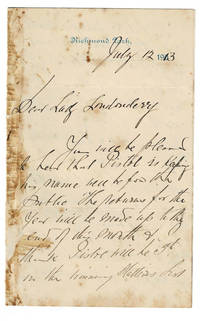
191397593Richmond Park South Australia: July 12 1913. 1913. Good. - Approximately 300 words penned on 4 sides of a folded sheet of creamy white paper with each page measuring 8 inches high by 5 inches wide. "Richmond Park" is printed at the top of the cover page. Aldridge has altered the partially printed date from "1903" to "1913". Started on the cover page Aldridge has continued his letter on the last page to then conclude on the inner 2 leaves. Signed "J.H. Aldridge" on the inner leaf. Once apparently mounted along the inner edge with glue or tape there are heavy stains with remnants of glue to the inner edge of the first and last page. There is a tiny tear along the fold with some light brown stains or foxing to all four pages. Good. <p>A RARE LETTER REPLETE WITH HORSE RACING ASSOCIATIONS. Aldridge writes to the Marchioness of Londonderry praising the horse he purchased from her and the Marquis of Londonderry. "You will be pleased to hear Pistol is keeping his name well before the public.I think Pistol will be 5th on the Winning.List in all Australia of course in this State 'South Australia' he is easily 1st.Londonderry by Pistol Antilles won the Broken Hill Cup a few days ago & the Chairman in presenting the cup to the winner referred to the fact that the horse got his name from his Breeder the Marchioness of Londonderry.Pistol is a most prolific father of winners & that is better than one good one & twenty duffers as some sires record. I believe there is only one sire in Australia which has produced more winners this year." He goes on to complain about the season as a whole mentions some "great loss" that she has had and he wishes the Marquis well and that "his illness worries will be settled ere long" Signed "J. H. Aldridge".<p>James Henry "Jim" Aldridge 1849-1929 was a popular and highly respected Australian sportsman. he began his career as a hotelier in Adelaide. He managed the Globe Hotel in Rundle Street a hotel that was popular with sportsmen. He later took charge of the Grand Hotel Broken Hill and the Gresham Hotel. In 1890 with the intent of establishing a stud farm he purchased at a Sydney sale the Stallion Carlyon. Carlyon was to be the lord of the harem so to speak. In addition he purchased a richly bred brood of a half-dozen mares. Sometime between 1888 and 1890 Aldridge purchased Richmond Park in South Australia from its original owner John Chambers. With the Chester horse Carlyon and the stud established Aldridge rapidly became well-known as a breeder. Carlyon and the thoroughbreds he sired at the Richmond Park stud farm made Aldridge's name famous throughout Australian racing circles. Although still able to perform as a stud Carlyon was badly injured in 1905. As it happened however in 1904 Aldridge had purchased Pistol the son of the famous English sire Carbine. Pistol was foaled in 1899 and arrived in South Australia as a five year old. He was purchased from the Marquis of Londonderry for the large sum of 1250 pounds. As a stud Pistol performed into his 26th year and sired winners of more than 641 races out of 1423 competitions. Up until Aldredge's death in 1829 the Pistol progeny had won approximately 200000 pounds in stake money. In atribute after his death the Chairman of the S.A.J.C. South Australian Jockey Club Whitmore Blake Carr "Doc Carr" wrote: "For years Mr. Aldridge has been one of the best widely known and most popular identities of the turf in South Australia and one to whom the sport owed much of its maintenance and stability. When he ran horses he did so for the pure love of the sport and the applause which always attended the success of his colours was a fine tribute by the racing public to the popularity of the owner. He was an exceptionally fine judge of a horse. The gratifying results which have been achieved at Richmond Park making it stand today so high in the list of studs in the Commonwealth was due to his sound judgment and ripe experience." Richmond Park, [South Australia]: July 12, 1913. unknown
185257668New York: Cornish Lamport & Co. Publishers 1852. First edition. Handcoloured folding mapat front. iv 5-154 2 ads pp. 1 vols. 8vo. Brown blind-stamped cloth. Spine ends chipped else Fine. Ex-library stamps on map and title page card pockets removed. First edition. Handcoloured folding mapat front. iv 5-154 2 ads pp. 1 vols. 8vo. Ferguson: "At this time the author was conducting an 'Australian Emigration Office' at 120 Wall Street New York." Ferguson 10892 2 copies P.L. N.S.W. Cornish, Lamport & Co., Publishers unknown books
1841BOOKS0057972 Volumes: Volume I xiv412 pages with black and white frontispiece 5 color and 5 black and white plates 11 in text illustrations 2 maps in pocket. Volume II viii482 pages with color frontispiece 10 black and white plates 17 in text illustrations lacks four page prospectus for Gould's Birds of Australia. Royal Octavo " x 6" bound in original publisher's brown cloth with gilt lettering to spine. <i>Ferguson</i> 3228 First edition.<br /><br />Grey is best known for his expeditions in the north-west interior of the continent which resulted in the discover of the Glenelg River Stephen Range and Mount Lyell. As a young lieutenant he had made a proposal to the Colonial Office to mount an expedition to the north-west coast of Australia for the purposes of establishing a settlement there for starving Irish peasants. His plans were approved and he sailed for Australia in the Beagle in 1837. He wen on to mount two expedition in the north-west in 1838 and 1839 which yielded particularly important geographical discoveries: "His expeditions were the first to examine the previously ignored north-west interior of the continent and he discovered much useful territory. The inland explorations of Grey and Lushington his deputy complemented by the associated coastal explorations of Wickham and Stokes in the Beagle were a major advance in the discovery of the Australian continent" Wantrup p 206 <br /><br /><b>Condition:</b><br /><br />Recased with original spines laid on scattered foxing corners bumped. Else a very good copy. T & W Boone hardcover books
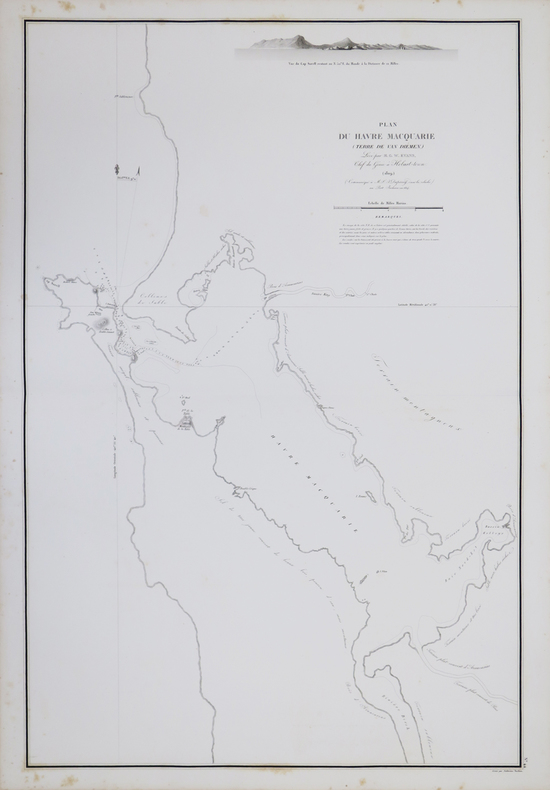
1827LBW-4433[1827]. 756 x 501 mm.
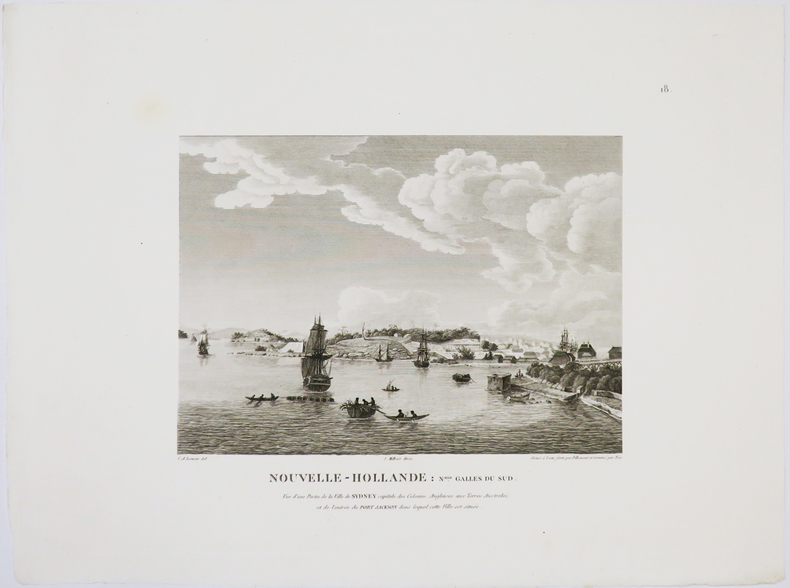
1824LBW-1064[1824]. 182 x 212 mm.
LBW-3957[1812]. 492 x 344 mm.
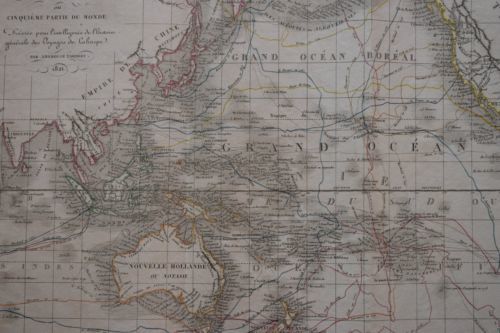
1820P1-22ATLASP1-4E-0AVEC L'ATLAS: LA HARPE (J.F). Abrégé de l'histoire générale des voyages, contenant ce qu'il y a de plus remarquable, de plus utile et de mieux avéré dans les pays où les voyageurs ont pénétré; les mœurs des habitants, la religion, les usages, arts et sciences, commerce et manufactures; par J.F. LAHARPE. Nouvelle édition, revue et corrigée avec le grand soin, et accompagnée d'un bel Atlas In-folio. Paris, Etienne Ledoux, 1820. 24 volumes in-8° (205x135) reliés demi-maroquin olive, dos ornés, tranches marbrées, belle série. 500pp. par volume, le dernier (XXIV) étant la table des matières. TARDIEU A., Atlas pour servir à l'intelligence de l'histoire générale des voyages de LA HARPE. In-folio (455x295mm), couverture éditeur, coins écornés. Paris, Ledentu, 1825. 15 cartes géographique (595x460mm), contours couleurs dressés par AMBROISE TARDIEU. Mappemonde, Afrique, Asie (2), Indes, Océanie, Chine, Japon, Sibérie, Golfe du Mexique, Mexique, Amérique Méridionale, Pérou, Brésil, Amérique Septentrionale, Europe.
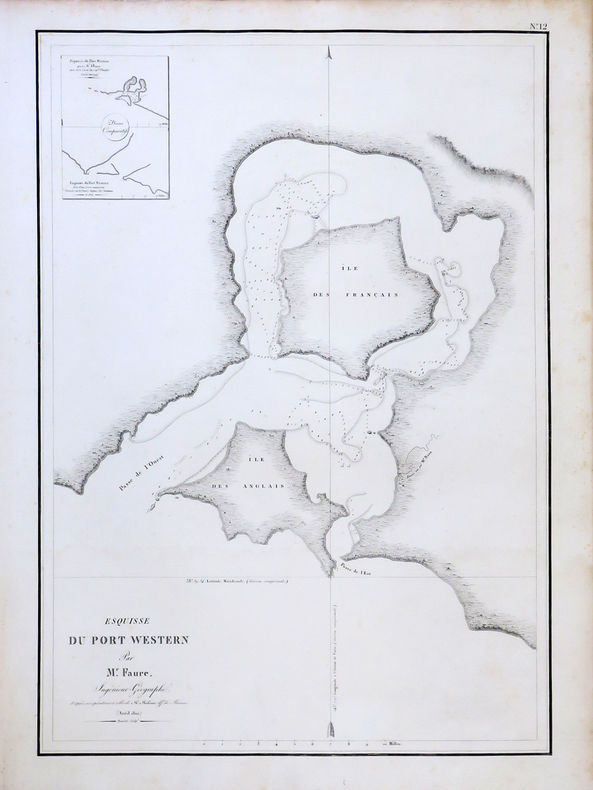
1833LBW-1978Paris, 1833-1839. 268 x 358 mm.
2015ASAP-9781626991323Studium Press India Pvt. Ltd. 2015. New. Studium Press (India) Pvt. Ltd. unknown
2015ASAP-9781626991323Studium Press India Pvt. Ltd. 2015. New. Studium Press (India) Pvt. Ltd. unknown
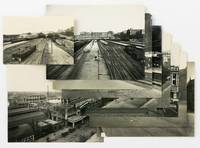
146428Very Good. Nine vintage gelatin silver prints eight approximately 220 × 285 mm one 138 × 206 mm all but two captioned or dated on the verso. Some prints with some residue on the verso from previous mounting; two with drawing pin-holes in some corners one of them with slight surface loss near a bottom corner the other with slight loss to a top corner; some with trifling chips or creases at the extremities; overall in excellent condition. The earliest image dated June 1926 shows the site on North Terrace before the commencement of construction; two show the station platforms in October 1926 and March 1927; two show the railway yards at the approach to the station one before construction one in December 1927; and four show the progressive construction of the western southern and eastern frontages of the station dated between April 1927 and March 1928. <p>An interesting observation by Paul McGuire appeared in 'The New Triad' Volume 2 Number 7 1 July 1928: 'The Railway Department also has been showing its superiority to mere prettiness too. A magnificent station is nearing completion and the Assembly hall has already revealed itself as a splendidly conceived piece far superior to anything of its kind in Australia. The walls are scarcely finished and they are already blotted with posters dodgers and various advertising signs. The architects themselves have protested but in this case too we will be pleasureably sic surprised if the official mind sees beyond its balance sheets'. <p>We have not identified the photographer or traced these particular images in institutional collections or elsewhere but they have the appearance of official photographs by a professional. 9 items. unknown
182580009London: William Darton 1825. First Edition. Hardcover. Very Good. London William Darton circa 1825. Octavo xii 64 pages plus 64 engraved portraits with tissue-guards. Early gilt-decorated half calf and marbled papered boards a little rubbed and bumped at the extremities; corners and the rear leading edge a little worn; 'Vol III' label missing from the spine; occasional scattered foxing and offsetting; a very good copy. Provenance: James Hurtle Fisher with his armorial bookplate on the pastedown and his signature in ink at the head of the engraved title page. Sir James Hurtle Fisher 1790-1875 'was one of the most important pioneers of South Australia' 'Australian Dictionary of Biography'. He commenced practice as a solicitor in London in 1816 and 'was drawn into the colonizing movement in 1835. He was selected as resident commissioner one of the most important offices under the South Australian Act . second only to the governor'. Fisher 'left England in July 1836 with the governor's party in the "Buffalo" arriving on 28 December 1836 at Holdfast Bay where the official oaths were administered a proclamation was read and a ceremony marked the beginning of settlement. In January 1837 Fisher erected his reed hut and Land Office near the survey camp of Colonel William Light at the north-western corner of the new capital site; the destruction of these temporary buildings by fire on 23 January 1839 caused both men serious loss. <p>Fisher had been allowed to draft his own instructions which were not shown to Governor Sir John Hindmarsh. Disputes between the two men over their respective powers had begun on the voyage and were soon revived in the new Council of Government and more violently outside and led in February 1837 to the Resident Magistrate's Court binding the participants over to keep the peace towards each other. The new governor George Gawler was appointed both governor and resident commissioner a radical departure from the principles on which the colony had been founded'. Fisher returned to his profession and became a leader of the South Australian Bar. In October 1840 he was elected first mayor of Adelaide; in 1860 he became the first resident South Australian to be knighted. The destructive fire referred to above is described in detail in the biography of Light Dutton and Elder 1991. <p>Light was living 'in the wood and reed surveyor's hut alongside Fisher's equally combustible house in the parklands on North Terrace. In his own account ". we discovered Fisher's house to be on fire. At the same time the breeze freshening up the destruction to both houses became inevitable. In less than ten minutes both houses were burnt to the ground mine catching fire at the roof by a lighted piece from Fisher's. We saved nothing of value"'. Accordingly personal mementoes such as this presumably brought by Fisher to South Australia on the 'Buffalo' must be of the utmost rarity. William Darton hardcover