11 044 résultats
198425483ESecaucus: Citadel 1984. First Edition. Signed and inscribed by the actor Frederic March: “To Rose and Burrill My dear ‘old friends’ - who are so very young. With love Freddie 1972â€. Oversized format. Illustrated 255 pages. Fredric March’s autograph in book form is very rare. Very good copy with some very minor use and edge wear in a very good bright dust jacket with a hint of fading to the spine and a few small chips and tears. A comprehensive look at the life and career of the great actor Fredric March winner of the Oscar for Best Actor for his films ‘Dr. Jekyll and Mr. Hyde 1931 and ‘The Best Years of Our Lives’ 1946. With stills from all of his films and many from his stage and television appearances cast lists synopses of the stories production credits critiques and reviews. Citadel unknown
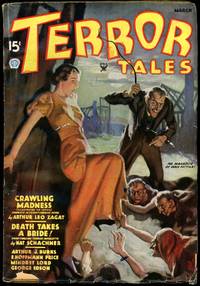
193529036Chicago: Popular Publications 1935. Pages browning still supple mild wear along lower edge small chip to lower left corner small rub marks to front cover a very good copy. 29036. Octavo cover by John Howitt pictorial wrappers. Pulp magazine. Fiction by Arthur Leo Zagat Arthur J. Burks E. Hoffman Price and others. Reference: Tymm and Ashley Science Fiction Fantasy and Weird Fiction Magazines pp. 660-661. Popular Publications unknown
in-4, pp. (12), 204, (16), leg. p. perg. coeva con tass. al d. Belliss. antip. in rame e altra tav. in rame raff. la Santa Casa di Loreto sostenuta dagli angeli con, sottostante, la carta delle coste del Mediterraneo con l'indicazione del tragitto della Casa. Iniziali xilogr. Ediz. orig. Ampia difesa del famoso miracolo contro le tesi negazioniste dei protestanti, scritta dal Centofiorini originario di Civitanova Marche. Manca a Piantanida. Presente in Lozzi e Ranghiasci. Una lieviss. gora al margine sup. interessa le prime 2 cc. Bell'esempl. a larghi margini. Raro. [120]
In-8 gr. (mm. 266x186), mz. pelle con ang. Cospicua raccolta di 64 documenti relativi a “Decisiones Sacrae Rotae Romanae”. I documenti, di lunghezza variabile, hanno frontespizi quasi sempre decorati con stemmi xilografici; riguardano cause di ogni genere discusse presso il tribunale pontificio a favore o contro cittadini di varie località delle Marche. All’esemplare sono legati alcuni fascicoli manoscritti, di mani coeve, contenenti la trascrizione di documenti originali. Raccolta di grande interesse giuridico-economico-amministrativo. Solo alc. carte con arross., altrimenti ben conservata.
1945005208New York Charles Henri Ford 1945 In-4 agrafé, couverture illustrée Edition originale
In-folio (cm. 32,3), legatura in cartonato d'attesa con titolo a stampa su tassello al dorso, pp. [8], 3-59 ma 61, [1], 110, [2] con 1 tavola in rame in antiporta fuori testo (golfo di Ancona con ascensione di S. Ciriaco) e 8 tavole numerate f.t. in fine (scene della vita del santo incise dal domenicano greco Podocartharo Christianopolo su disegni dell'anconitano Melchiorre Jeli); ripetute nella numerazione le pp. 57-58, lievi fioriture sparse. Edizione originale suddivisa in due parti, la prima agiografica, la seconda di confutazione del testo di Daniele Papebrocchi (con frontespizio proprio datato 1812). «Otto tavole figurate molto interessanti» [Lozzi 52]. Esemplare molto buono. (SO6)
73 pages plus eleven fold-out plans. Index. Gilt lettering upon navy blue front board and backstrip. Average wear. Usual library markings. Binding intact. A sound copy. Book
in-4 picc., pp. VI, 218, (8), bella leg. cart. dec. coeva con tass. ms. al d. In antip. bella veduta prospettica rip. e inc. in rame da L. Bonomi. Con 6 tavv. in rame al fine raff. oggetti di scavo e monumenti della città. Esempl. stampato su carta distinta in ottimo stato di conservazione. [063]
mon0000528058Collins Educational. Good. in x in x in. Ex-library book usual markings. Well read with some wear but still very useable. No dust cover. Collins Educational unknown
Very Good Turkish, Ottoman (1500-1928) Original manuscript autograph document signed by Mehmed Said Pasha sent to Trabzon Vilayat, Ordu Kaza, Hasbamane Nahiya local manager, faziletlu 'Mehmed Ali Sevki Beyefendi'. 33,5x20 cm. Folded. 1 p. In Ottoman script. Mehmed Said Pasha was an Ottoman monarchist, senator, statesman and editor of the Turkish newspaper Jerid-i-Havadis. He supported the CUP, the political party which came to power after the Ottoman coup d'état of 1913. His origin comes from 'Sebazâde family' from Ankara. He became first secretary to Sultan Abdul Hamid II shortly after the Sultan's accession, and is said to have contributed to the realizations of his majesty's design of concentrating power in his own hands; later he became successively minister of the interior and then governor of Bursa, reaching the high post of grand vizier in 1879. He was grand vizier seven more times under Abdul Hamid II, and once under his successor, Mehmed V. He was known for his opposition to the extension of foreign influence in Turkey. n 1896, he took refuge at the British embassy in Constantinople, and, though then assured of his personal liberty and safety, remained practically a prisoner in his own house. He came into temporary prominence again during the revolution of 1908. On 22 July he succeeded Mehmed Ferid Pasha as grand vizier, but on the 6 August was replaced by the more liberal Kâmil Pasha, at the insistence of the Young Turks. Also during 1908, Mehmed Said Pasha bought the famed Istanbul arcade in the Beyoglu (Pera) district, today known as Çiçek Pasaji ("Flower Passage"). The modern name became common in the 1940s; during Mehmed Said Pasha's ownership in the 1900s and 1910s, the arcade was known as Sait Pasa Pasaji ("Said Pasha Passage"). During the Italian crisis in 1911-12, he was again called to the premiership. He was again removed from power by the Savior Officers (who backed the Freedom and Accord Party (Liberal Union) against the Committee of Union and Progress) and replaced by a new cabinet supported by the Officers and the Freedom and Accord Party. The CUP would return to power, however, the next year after the Ottoman coup d'état of 1913. (Source: Wikipedia). Seven lines on special paper with watermark 'Joynson Superfine'. Letter of request to provide teaching for some students in the region.
Opera per la prima volta pubblicata nel Theatrum Civitatum et admirandorum Italiae, stampato da Johannes Blaeu ad Amsterdam nel 1663. Esemplare tratto dal Nouveau Theatre de l'Italie pubblicato ad Amsterdam nel 1704/5 da Pierre Mortier e ristampato da R. Alberts nel 1724. Johannes Blaeu, durante la sua lunga attività editoriale pubblica tre volumi sulle città italiane. Nel 1663 i primi tre, suddivisi in Stato della Chiesa, Roma e Regno di Napoli e Sicilia. Alla sua morte i suoi eredi danno alla luce altri due volumi datati 1682 incentrati sulle città del Piemonte e della Savoia, poi ristampati da altri editori nel 1693 e 1697. Il francese Pierre Mortier pubblica una ristampa nel 1704/5, intitolata Nouveau Theatre de l’Italie. L’opera è in quattro volumi e comprende le lastre del Blaeu, ritoccate e modificate in piccola parte, integrate dall’aggiunta di numerose nuove mappe di proprio disegno, raffiguranti le città della parte settentrionale della penisola, racchiuse nel primo volume dell’opera. L’atlante del Mortier venne pubblicato con testo latino, francese ed olandese. La particolarità che differenzia le due edizioni di Blaeu e Mortier è rappresentata dal fatto che il testo non è al verso della singola mappa (che quindi è bianca nel retro), ma si trova all’inizio di ogni singolo volume. Il grande successo dell’opera diede origine ad un’ulteriore ristampa, praticamente identica, curata da R. Alberts ed edita nel 1724/5. Le opere tratte dalla prima edizione del Blaeu, 1663, sono caratterizzate dalla presenza del testo al verso, qui assente. Incisione in rame, in buono stato di conservazione. Bibliografia Koeman pp. 332/338, Cremonini pp. 83-90. Work first included in Theatrum Civitatum et Admirandorum Italiae ad aevi veteris & praesentis temporis faciem expressum à Ioanne Blaeu G. F., printed by Johannes Blaeu, Amsterdam, 1663. Example taken from Nouveau Theatre de l'Italie - Amsterdam nel 1704/5 - by Pierre Mortier or from the da R. Alberts issue (1724). Without descriptive text on the back. The Theatrum Civitatum et Admirandorum Italiae is the first monumental town book entirely covering Italy, preceded by the "pocket-size" Italia Hodierna by Jodocus Hondius jr. (1627) and realized in likely competition with Johannes Janssonius who, in 1657, published the Theatrum praecipuarum urbium, containing a volume dedicated to Italy. Johannes Blaeu, during his long editorial activity published three volumes on Italian cities. In 1663 the first three, divided into the State of the Church, Rome and the Kingdom of Naples and Sicily. At his death his heirs gave birth to two more volumes dated 1682 focused on the cities of Piedmont and Savoy, then reprinted by other publishers in 1693 and 1697. Pierre Mortier publishes a reprint in 1704/5, entitled Nouveau Theatre de l'Italie. The work is in four volumes and includes the plates of Blaeu, retouched and modified in small part, supplemented by the addition of several new maps of his own design, depicting the cities of the northern part of the peninsula, enclosed in the first volume of the work. Mortier's atlas was published with Latin, French and Dutch texts. The great success of the work gave rise to a further reprint, virtually identical, edited by R. Alberts and published in 1724/5. Literature Koeman, Atlas Neerlandici, pp. 332/338; Cremonini pp. 49-52, 39.
1947145972Universal City: Universal International Pictures 1947. Revised First Draft script for the 1948 film. With faint holograph pencil annotations and watermarked CONTRACT FILE COPY throughout.<br/><br/>Based on the 1946 Broadway play and a prequel to the 1941 film "The Little Foxes." In the fictional town of Bowden Alabama the wealthy Hubbard family holds onto their old-South prominence and prestige through exploitation and cruelty. A searing portrayal of racism and class privilege in the post-Civil War American South.<br/><br/>Set in Alabama. <br/><br/>Green titled wrappers noted as REVISED FIRST DRAFT on the front wrapper rubber-stamped production No. 7494 dated June 9 1947 with credits for screenwriter Vladimir Pozner. Title page integral to the front wrapper. 178 leaves with last page of text numbered 169. Carbon typescript on onionskin stock rectos only. Pages Very Good plus wrapper Very Good plus with light foxing to the left edge bound with three gold brads. Universal International Pictures unknown books
18752091202133207734Libr. de Firmin-Didot Frere Fils et Cie 1875. Soft Cover. Fine. Number of books: 2 books in total Libr. de Firmin-Didot Frere, Fils et Cie paperback
2111902153102387Shin-Osaka Shimbun N.A. Soft Cover. Fine. Number of books: 6 Shin-Osaka Shimbun paperback
19292111902160600345Hakubunkan 1929. Soft Cover. Fine. The book is in fine condition. Hakubunkan paperback
18972111902160200201Book by Gakudo 1897. Soft Cover. Fine. Number of books: 1 book Book by Gakudo paperback
1374112Paris: Laurent D'Houry, 1710 in-12, 12 pages n.c. (titre, épitre, avis) - 127 pages - 4 pages n.c. (titre, avis au libraire) - 176 pages - 4 pages n.c. (approbation et privilège du Roy). Reliure veau brun d'ép., dos à 5 nerfs, caissons ornés, reliure usagée, coiffe sup. manquante, coins émoussés, un mors fendu sur 6 cm, bon état intérieur.
In - 4°. Pagine XVI, 401, (3) Rilegatura coeva in piena pergamena con titolo manoscritto al dorso. Bel frontespizio in rosso e nero. Mancanza all'angolo superiore della prima carta bianca. Ottimo stato di conservazione complessivo. Rara e documentata edizione originale di questa settecentesca storia della città di Civitanova nelle Marche. L’opera è divisa in tre parti (Istoria di S.Marone il cui corpo si venera nella sua Chiesa presso Civitanova; Memorie Sagre della medesima; Istoria civile di essa, tessuta con molte, e varie vicende della Provincia) e conserva la splendida tavola ripiegata raffigurante il martirio di San Marone patrono della città.
in-8, pp.IX, 120, rileg. mod. p. perg. antica con tit. calligrafico riportato al piatto ant. e al d. Antip. inc. in rame ad inchiostro rosso con lo stemma cardinalizio della famiglia Albani. A pag.42 bella tav. in rame raff. la piazza di Fermo, il Girfalco con l'antica rocca, il palazzo dei Priori e la cattedrale. Leg. arrossature marginali su alcune pp. Platneriana p.132. Lozzi 1582: "Assai raro". Bell'esempl. in barbe su carta forte. [301]
Amsterdam, 1590 circa. Dall' “Atlas” del Mercatore (che si compone di tre parti, tutte edite a Duisburg tra il 1585 ed il 1595 con il testo latino al verso) incisione in rame, vecchia ma non coeva coloritura, cm 36 x 48,5 (alla lastra). Testo francese al verso, indice della edizione di Amsterdam. Esemplare a pieni margini e in bella coloritura, buono lo stato di conservazione.
incisione rame f. 52x42 In: Mortier P. - Nouveau Théà tre d'Italie... a La Haye
Inc. rame, f. 52x41,3 In: Mortier P. - Nouveau Théà tre d'Italie... a La Haye
Inc. rame, f. 53x44. In: Mortier P. - Nouveau Théà tre d'Italie... a La Haye
Inc. rame f. 54x43,5. In: Mortier P. - Nouveau Théà tre d'Italie... a La Haye
Tre carte geografiche in un foglio, raffiguranti il territorio senese, la Corsica e le Marche. Foglio tratto dal Theatrum Orbis Terrarum e che è considerato il primo vero “atlante” moderno. L’opera fu pubblicata in 7 lingue e 36 edizioni, per il quale – nel 1570 - Ortelius ottenne il privilegio, ovvero una sorta di diritto d'autore che impediva ad altri cartografi di pubblicare i propri lavori. Il Theatrum rappresentava il lavoro più avanzato del lavoro della descrizione cartografica. L’Ortelius vi raccolse il sapere geografico e cartografico del suo tempo, proponendo in 147 spettacolari tavole incise l’immagine più fedele del mondo allora conosciuto e, in alcune straordinarie “carte storiche”, regioni e itinerari tratti dalla letteratura, dalla mitologia, dalla tradizione. Ortelius fu anche il primo a citare le fonti, menzionando i nomi dei cartografi nel “catalogus auctorum”. Dal 1598 al 1612 le edizioni postume del Theatrum furono realizzate dal suo collaboratore Johannes Baptiste Vrients. Incisione in rame, bella coloritura a mano, leggere ossidazioni, in ottimo stato di conservazione. Three maps in one sheet, showing Siena, Corsica and Marche. Maps taken from the Theatrum Orbis Terrarum, which is considered the first true modern "Atlas". The work was published in 7 languages and 36 editions, for which - in 1570 - Ortelius obtained the privilege, a kind of copyright that prevented other cartographers from publishing his works. The Theatrum represented the most advanced work of cartographic description. Ortelius collected in it the geographical and cartographic knowledge of his time, proposing in 147 spectacular engraved plates the most faithful image of the world then known and, in some extraordinary "historical maps", regions and routes taken from literature, mythology, tradition. Ortelius was also the first to cite sources, mentioning the names of cartographers in the "catalogus auctorum". From 1598 to 1612 the posthumous editions of the Theatrum were made by his collaborator Johannes Baptiste Vrients. Copperplate with later hand colour, some foxing, generally in good conditions. M. Van den Broecke "Ortelius Atlas Maps" (2011), n. 137.