11 044 résultats
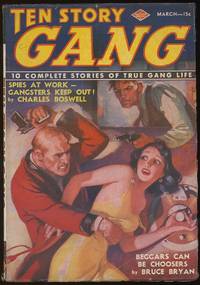
193820861New York: The Frank A. Munsey Company 1938. Issues four and six are very good with four having some paper loss to upper spine edge and six some edge wear the other issues are nearly fine to fine still an attractive set. 20861. Octavo six issues cover illustration for the March 19 issue by Rudolph Belarski pictorial wrappers. Pulp magazine. Complete six part serial "The Red Star of Tarzan." The editor had this serial re-written and expanded by Ben Nelson and Burroughs Mitchell. The novel published in book form as TARZAN AND THE FORBIDDEN CITY used Burroughs manuscript and not the serial version. Belarksi based his Tarzan cover painting on Johnny Weissmuller. Reference: Zeuscher Edgar Rice Burroughs: The Bibliography pp. 341-342. The Frank A. Munsey, Company unknown
194414708JNew York: Simon & Schuster 1944. Two copies of this book one belonging to Fredric March and the other to his wife Florence Eldridge. The poem was written during World War II and was presented in adapted dramatic form several times over the NBC radio network. The copy belonging to Fredric March is a second printing and is signed by him in pencil on the flyleaf - Fredric March November 1944. With some pencil notes by him referring to the text. At a later date the author has inscribed the book to his friend - For Fred March - Concerning whose reading of this poem words fail me - Russell Davenport. On the death of President Franklin Roosevelt in April 1945 the NBC Radio Network had March give a dramatic reading of the poem as part of its tribute to the fallen wartime President. The first printing copy belonging to Florence Eldridge is heavily annotated by her in pencil for an earlier radio reading in which she acted. Her copy is a first printing and inscribed by the author - For Florence Affectionately Russell Nov 30 / 44 And don’t for Dec 11!. There is an Autograph Letter Signed by Russell Davenport to Eldridge taped to the front pastedown tape browned dated December 12 1944 written after her radio reading - Dear Florence- This is just a little note wholly inadequate to express my appreciation for all your effort and care in the reading of My Country. You gave a superb performance. If there is ever anything that an unlikely scrivener can do in return you know where to come. Let me see you soon. Affectionately Russ. Both books are enclosed together in a custom clamshell box. Russell Davenport 1899-1954 was a very interesting man and close friend of the Marchs. As Wikipedia notes he “.served with the U.S. Army in World War I and received the Croix de Guerre. He enrolled at Yale University and graduated in 1923 where he was classmate of Henry Luce and Briton Hadden who founded Time magazine. While at Yale he became a member of the secret society Skull and Bones. In 1929 he married the writer Marcia Davenport; they divorced in 1944. He joined the editorial staff of Fortune magazine in 1930 and became managing editor in 1937. At age forty-one he turned to politics and became a personal and political advisor to Wendell Willkie. Willkie was the Republican nominee for the 1940 presidential election and lost the election to Franklin D. Roosevelt. After Willkie's death in 1944 Davenport became a defacto leader of the internationalist Republicans. Following World War II he was on the staff of Life and Time until 1952.†Simon & Schuster unknown books
194414708JNew York: Simon & Schuster 1944. Two copies of this book one belonging to Fredric March and the other to his wife Florence Eldridge. The poem was written during World War II and was presented in adapted dramatic form several times over the NBC radio network. The copy belonging to Fredric March is a second printing and is signed by him in pencil on the flyleaf - Fredric March November 1944. With some pencil notes by him referring to the text. At a later date the author has inscribed the book to his friend - For Fred March - Concerning whose reading of this poem words fail me - Russell Davenport. On the death of President Franklin Roosevelt in April 1945 the NBC Radio Network had March give a dramatic reading of the poem as part of its tribute to the fallen wartime President. The first printing copy belonging to Florence Eldridge is heavily annotated by her in pencil for an earlier radio reading in which she acted. Her copy is a first printing and inscribed by the author - For Florence Affectionately Russell Nov 30 / 44 And don’t for Dec 11!. There is an Autograph Letter Signed by Russell Davenport to Eldridge taped to the front pastedown tape browned dated December 12 1944 written after her radio reading - Dear Florence- This is just a little note wholly inadequate to express my appreciation for all your effort and care in the reading of My Country. You gave a superb performance. If there is ever anything that an unlikely scrivener can do in return you know where to come. Let me see you soon. Affectionately Russ. Both books are enclosed together in a custom clamshell box. Russell Davenport 1899-1954 was a very interesting man and close friend of the Marchs. As Wikipedia notes he “.served with the U.S. Army in World War I and received the Croix de Guerre. He enrolled at Yale University and graduated in 1923 where he was classmate of Henry Luce and Briton Hadden who founded Time magazine. While at Yale he became a member of the secret society Skull and Bones. In 1929 he married the writer Marcia Davenport; they divorced in 1944. He joined the editorial staff of Fortune magazine in 1930 and became managing editor in 1937. At age forty-one he turned to politics and became a personal and political advisor to Wendell Willkie. Willkie was the Republican nominee for the 1940 presidential election and lost the election to Franklin D. Roosevelt. After Willkie's death in 1944 Davenport became a defacto leader of the internationalist Republicans. Following World War II he was on the staff of Life and Time until 1952.†Simon & Schuster unknown
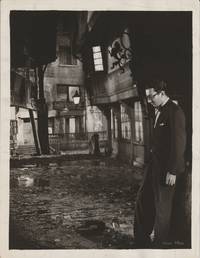
1931162334N.p.: N.p. 1931. Vintage reference photograph from the 1931 film showing director Rouben Mamoulian on the set. Provenance stamp and annotations in manuscript pencil on the verso.<br /> <br /> Based on Robert Louis Stevenson's classic 1886 novella and considered by many to be the definitive adaptation. A pre-Code film the adaptation is often remembered for its strong sexual content heavily edited after the film's 1936 re-release. Nominated for three Academy Awards winning one for Best Actor for Fredric March. <br /> <br /> 8 x 10 inches. About Near Fine with only light edgewear at the top and bottom edges to note. N.p. unknown
193932648Holyoke MA: Winford Publications Inc. 1939. Mild tanning to text paper covers have slight edge wear and two creases a nearly fine to fine copy. Uncommon. 32648. Octavo single issue pictorial wrappers. Pulp magazine. Stories by Frank Belknap Long Paul Selonke Bruce Bryan Albert Sundell with two using the pseudonyms "Undercover" Dix and Charles Cotten Herbert E. Smith and others. Reference: Cook Mystery Detective and Espionage Magazines pp. 560-561. Winford Publications, Inc. unknown
1995DADAX084938253XCRC Press 1995-11-30. 1. hardcover. New. 6.50x1.00x9.75. Buy with confidence. Excellent Customer Service & Return policy. CRC Press hardcover
in-8, pp. LXXXIX, 296, bella leg. m. perg. coeva con angoli e tit. al d. Ediz. orig. Sono perfettamente descritti 286 specie di uccelli sui 450 elencati dal Giglioli nella sua “Avifauna italica”. Ceresoli p. 268. Raro. [398]
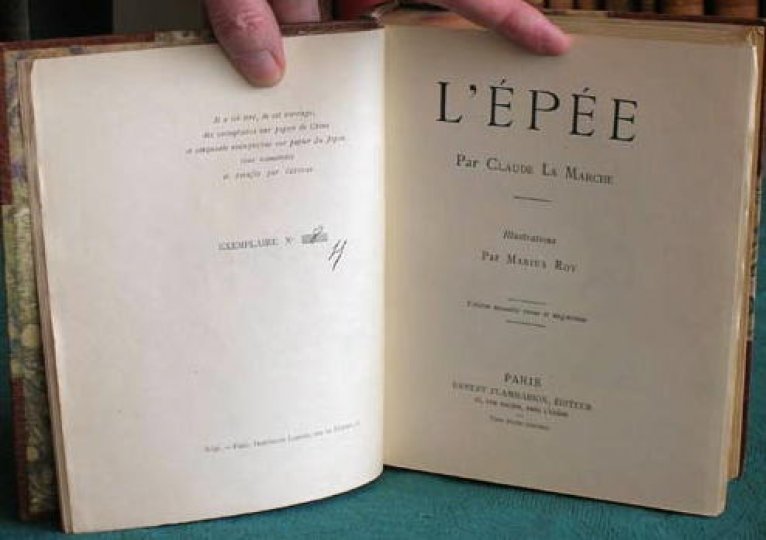
189814831Illustrations par Marius Roy.14 planches, la reproduction d'une gravure de Bonnart et une gravure sur la couverture. Vignette dans le texte.Édition limitée à 60 exemplaires. Il a été tiré, de cet ouvrage, 10 exemplaires sur papier de Chine et cinquante exemplaires sur papier du Japon tous numérotés et parafés par l'éditeur. Celui-ci (N°8) sur Japon.Édition nouvelle revue et augmentée. Paris, Ernest Flammarion, non daté, vers 1898 - 312 pages.Superbe reliure demi-maroquin chocolat à coins. Dos à 4 gros nerfs, filets dorés. Tête dorée sur témoins. Non rogné. Couverture illustrée et dos conservés. Très bon état pour ce bel exemplaire. Format in-8°(20x15).
gr. vol. in folio, pp. 607, (4), leg. cart. edit. Contiene le seguenti: Cronaca di Antonio di Niccolò, Annali di Fermo di Giovan Paolo Montani, Annali di anoimo autore dal 1445 al 1557. Inoltre ricchissimo apparato di documenti, appendici, annotazioni e trascrizioni. Importante e insuperato studi di storia locale. [394]
199723936KELTER MARTIN 1997. 1. softcover. UNHEIMLICHE GESCHICHTEN KELTER, MARTIN paperback
15973The Society for Film History Research London. Between March 1960 and September 1967 all published. 8 344 7pp. 12mo and four pages of plates vol.2 no.2. Fourteen issues loose with volume 1 issues 1-9 continuously paginated to 244; and volume 2 issues 1-5 paginated to 90; with the volume's separate prelims 8pp. and index 7pp. ready for binding up. Two identical fliers for the society giving its 'Purpose' loosely inserted. The collection is in good condition on lightly aged and worn paper but with rusted staples to all volumes. Hunnings and Gillett are named as editors of the first four volumes thereafter Hunnings alone. The editorial to the first issue begins by explaining the background: 'The Society for Film History Research was founded in January 1959 on the initiative of Ernest Lindgren Curator of the National Film Archive stimulated by the Federation Internationale des Archives du Film and its Bureau International de Recherche Historique Cinematographique. So far as we know apart from the research group formed in the Netherlands and described in this issue we are the only organisation concerned with historical research into the cinema in all its aspects as opposed to the collection and perservation of material which is the function of the film archive.' Contributors include Sidney Birt Acres Dave Aylott Kein Carroll Brian W. Coe Jan De Vaal Derek Eastaway Bent Grasten Hermann Hecht Tom Milne John Minchinton Liam O'Laoghaire Barrie Pattison Anthony Slide Audrey Wadowska Rune Waldekranz Eric Walter White. Topics range from 'Film Censorship in India' and 'Early Film Criticism in Leicester' to 'Wordsworth Donisthorpe Raquel Meller William Morton Viking Eggeling William Haggar and Herbert Ponting. The Society for Film History Research, London. Between March 1960 and September 1967 (all published). unknown
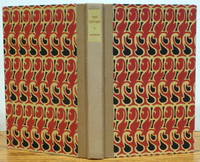
192835573New York: Covici Friede 1928. FIRST LIMITED EDITION of 275 copies. This is No. 161/275. Signed by Joseph Moncure March on the limitation page. Original tan linen cloth backstrip over bright red black and yellow art-deco style patterned paper boards. Yellow printed paper spine label and yellow endpapers. With the illustrations of Alexander King. Fine very bright and fresh copy. No name bookplate or other markings. Housed in a worn publisher's slipcase. By the author of The Wild Party. Scarce in the limited printing. . Signed. First Edition. Hard Cover. Fine. Illus. by Alexander King. 4to - over 9¾" - 12" tall. Covici Friede Hardcover
0115-20Amsterdam i. e. Leipzig Au depans de la Societé de Marche 1738. 2 vols. in 1. pet.-8°. 4 ff. 150 77 pp. HLdr. d. Zt. Mit Rückensch Bibliotheksetikett am Innendeckel. vgl. Weller Die falschen und fingierten Druckorte II 102; Amsterdam [i. e. Leipzig], Au depans de la Societé de Marche 1738. unknown
1889boz_001785Gravure par Armand-Émile Mathey-Doret d’après Charles Édouard Delort - Très grande eau-forte orientaliste – “Fâcheuse aventure” – Marché d’esclaves Grande eau-forte orientaliste, “Fâcheuse aventure”, Marché d’esclaves, 1889. La gravure est l’œuvre d’Armand-Émile Mathey-Doret, ici d’après un tableau de Charles Édouard Delort. Dimensions : taille du cadre : 82 x 68 cm ; taille du sujet : 65,7 x 53 cm (sans légende) État : Gravure encadrée, mouillure en bas à droite, cadre avec traces d'usure, sinon bel état de conservation, belle épreuve bien contrastée, tirage de qualité sur papier fort. Charles Édouard Delort né à Nîmes le 4 février 1841 et mort à Saint-Eugène le 6 mars 1895 est un peintre français. Armand-Émile Mathey-Doret est un graveur né le 18 novembre 1853 à Besançon et mort à Buffard le 29 septembre 1931.
Opera tratta dalla rara prima edizione del Theatrum Civitatum et Admirandorum Italiae ad aevi veteris & praesentis temporis faciem expressum à Ioanne Blaeu G. F., stampata ad Amsterdam nel 1663. Si tratta del primo, monumentale, libro interamente dedicato alla cartografia urbana della sola penisola, preceduto dal “tascabile” Italia Hodierna di Jodocus Hondius del 1627 e realizzato in probabile concorrenza con Johannes Janssonius che, nel 1657, aveva pubblicato il Theatrum praecipuarum urbium, contenente un volume dedicato all’Italia. Johannes Blaeu, durante la sua lunga attività editoriale pubblica tre volumi sulle città italiane. Nel 1663 i primi tre, suddivisi in Stato della Chiesa, Roma e Regno di Napoli e Sicilia. Alla sua morte i suoi eredi danno alla luce altri due volumi datati 1682 incentrati sulle città del Piemonte e della Savoia, poi ristampati da altri editori nel 1693 e 1697. Il francese Pierre Mortier pubblica una ristampa nel 1704/5, intitolata Nouveau Theatre de l’Italie. L’opera è in quattro volumi e comprende le lastre del Blaeu, ritoccate e modificate in piccola parte, integrate dall’aggiunta di numerose nuove mappe di proprio disegno, raffiguranti le città della parte settentrionale della penisola, racchiuse nel primo volume dell’opera. L’atlante del Mortier venne pubblicato con testo latino, francese ed olandese. Il grande successo dell’opera diede origine ad un’ulteriore ristampa, praticamente identica, curata da Alberts ed edita nel 1724/5. Esemplare con testo descrittivo la verso, della prima edizione del 1663. Bibliografia Koeman, Atlas Neerlandici, pp. 332/338; Cremonini pp. 49-52, 39. Map taken form the rare first edition of Theatrum Civitatum et Admirandorum Italiae ad aevi veteris & praesentis temporis faciem expressum à Ioanne Blaeu G. F., printed by Johannes Blaeu, Amsterdam, 1663. This is the first monumental town book entirely covering Italy, preceded by the "pocket-size" Italia Hodierna by Jodocus Hondius jr. (1627) and realized in likely competition with Johannes Janssonius who, in 1657, published the Theatrum praecipuarum urbium, containing a volume dedicated to Italy. Johannes Blaeu, during his long editorial activity published three volumes on Italian cities. In 1663 the first three, divided into the State of the Church, Rome and the Kingdom of Naples and Sicily. At his death his heirs gave birth to two more volumes dated 1682 focused on the cities of Piedmont and Savoy, then reprinted by other publishers in 1693 and 1697. Pierre Mortier publishes a reprint in 1704/5, entitled Nouveau Theatre de l'Italie. The work is in four volumes and includes the plates of Blaeu, retouched and modified in small part, supplemented by the addition of several new maps of his own design, depicting the cities of the northern part of the peninsula, enclosed in the first volume of the work. Mortier's atlas was published with Latin, French and Dutch texts. The great success of the work gave rise to a further reprint, virtually identical, edited by R. Alberts and published in 1724/5. Example of the first edition, showing descriptive text on the back of the map. Literature Koeman, Atlas Neerlandici, pp. 332/338; Cremonini pp. 49-52, 39.
Opera per la prima volta pubblicata nel Theatrum Civitatum et admirandorum Italiae, stampato da Johannes Blaeu ad Amsterdam nel 1663. Esemplare tratto dal Nouveau Theatre de l'Italie pubblicato ad Amsterdam nel 1704/5 da Pierre Mortier e ristampato da R. Alberts nel 1724. Johannes Blaeu, durante la sua lunga attività editoriale pubblica tre volumi sulle città italiane. Nel 1663 i primi tre, suddivisi in Stato della Chiesa, Roma e Regno di Napoli e Sicilia. Alla sua morte i suoi eredi danno alla luce altri due volumi datati 1682 incentrati sulle città del Piemonte e della Savoia, poi ristampati da altri editori nel 1693 e 1697. Il francese Pierre Mortier pubblica una ristampa nel 1704/5, intitolata Nouveau Theatre de l’Italie. L’opera è in quattro volumi e comprende le lastre del Blaeu, ritoccate e modificate in piccola parte, integrate dall’aggiunta di numerose nuove mappe di proprio disegno, raffiguranti le città della parte settentrionale della penisola, racchiuse nel primo volume dell’opera. L’atlante del Mortier venne pubblicato con testo latino, francese ed olandese. La particolarità che differenzia le due edizioni di Blaeu e Mortier è rappresentata dal fatto che il testo non è al verso della singola mappa (che quindi è bianca nel retro), ma si trova all’inizio di ogni singolo volume. Il grande successo dell’opera diede origine ad un’ulteriore ristampa, praticamente identica, curata da R. Alberts ed edita nel 1724/5. Le opere tratte dalla prima edizione del Blaeu, 1663, sono caratterizzate dalla presenza del testo al verso, qui assente. Incisione in rame, in buono stato di conservazione. Bibliografia Koeman pp. 332/338, Cremonini pp. 83-90. Work first included in Theatrum Civitatum et Admirandorum Italiae ad aevi veteris & praesentis temporis faciem expressum à Ioanne Blaeu G. F., printed by Johannes Blaeu, Amsterdam, 1663. Example taken from Nouveau Theatre de l'Italie - Amsterdam nel 1704/5 - by Pierre Mortier or from the da R. Alberts issue (1724). Without descriptive text on the back. The Theatrum Civitatum et Admirandorum Italiae is the first monumental town book entirely covering Italy, preceded by the "pocket-size" Italia Hodierna by Jodocus Hondius jr. (1627) and realized in likely competition with Johannes Janssonius who, in 1657, published the Theatrum praecipuarum urbium, containing a volume dedicated to Italy. Johannes Blaeu, during his long editorial activity published three volumes on Italian cities. In 1663 the first three, divided into the State of the Church, Rome and the Kingdom of Naples and Sicily. At his death his heirs gave birth to two more volumes dated 1682 focused on the cities of Piedmont and Savoy, then reprinted by other publishers in 1693 and 1697. Pierre Mortier publishes a reprint in 1704/5, entitled Nouveau Theatre de l'Italie. The work is in four volumes and includes the plates of Blaeu, retouched and modified in small part, supplemented by the addition of several new maps of his own design, depicting the cities of the northern part of the peninsula, enclosed in the first volume of the work. Mortier's atlas was published with Latin, French and Dutch texts. The great success of the work gave rise to a further reprint, virtually identical, edited by R. Alberts and published in 1724/5. Literature Koeman, Atlas Neerlandici, pp. 332/338; Cremonini pp. 49-52, 39.
Opera tratta dalla rara prima edizione del Theatrum Civitatum et Admirandorum Italiae ad aevi veteris & praesentis temporis faciem expressum à Ioanne Blaeu G. F., stampata ad Amsterdam nel 1663. Si tratta del primo, monumentale, libro interamente dedicato alla cartografia urbana della sola penisola, preceduto dal “tascabile” Italia Hodierna di Jodocus Hondius del 1627 e realizzato in probabile concorrenza con Johannes Janssonius che, nel 1657, aveva pubblicato il Theatrum praecipuarum urbium, contenente un volume dedicato all’Italia. Johannes Blaeu, durante la sua lunga attività editoriale pubblica tre volumi sulle città italiane. Nel 1663 i primi tre, suddivisi in Stato della Chiesa, Roma e Regno di Napoli e Sicilia. Alla sua morte i suoi eredi danno alla luce altri due volumi datati 1682 incentrati sulle città del Piemonte e della Savoia, poi ristampati da altri editori nel 1693 e 1697. Il francese Pierre Mortier pubblica una ristampa nel 1704/5, intitolata Nouveau Theatre de l’Italie. L’opera è in quattro volumi e comprende le lastre del Blaeu, ritoccate e modificate in piccola parte, integrate dall’aggiunta di numerose nuove mappe di proprio disegno, raffiguranti le città della parte settentrionale della penisola, racchiuse nel primo volume dell’opera. L’atlante del Mortier venne pubblicato con testo latino, francese ed olandese. Il grande successo dell’opera diede origine ad un’ulteriore ristampa, praticamente identica, curata da Alberts ed edita nel 1724/5. Esemplare con testo descrittivo la verso, della prima edizione del 1663. Bibliografia Koeman, Atlas Neerlandici, pp. 332/338; Cremonini pp. 49-52, 39. Map taken form the rare first edition of Theatrum Civitatum et Admirandorum Italiae ad aevi veteris & praesentis temporis faciem expressum à Ioanne Blaeu G. F., printed by Johannes Blaeu, Amsterdam, 1663. This is the first monumental town book entirely covering Italy, preceded by the "pocket-size" Italia Hodierna by Jodocus Hondius jr. (1627) and realized in likely competition with Johannes Janssonius who, in 1657, published the Theatrum praecipuarum urbium, containing a volume dedicated to Italy. Johannes Blaeu, during his long editorial activity published three volumes on Italian cities. In 1663 the first three, divided into the State of the Church, Rome and the Kingdom of Naples and Sicily. At his death his heirs gave birth to two more volumes dated 1682 focused on the cities of Piedmont and Savoy, then reprinted by other publishers in 1693 and 1697. Pierre Mortier publishes a reprint in 1704/5, entitled Nouveau Theatre de l'Italie. The work is in four volumes and includes the plates of Blaeu, retouched and modified in small part, supplemented by the addition of several new maps of his own design, depicting the cities of the northern part of the peninsula, enclosed in the first volume of the work. Mortier's atlas was published with Latin, French and Dutch texts. The great success of the work gave rise to a further reprint, virtually identical, edited by R. Alberts and published in 1724/5. Example of the first edition, showing descriptive text on the back of the map. Literature Koeman, Atlas Neerlandici, pp. 332/338; Cremonini pp. 49-52, 39.
Opera tratta dalla rara prima edizione del Theatrum Civitatum et Admirandorum Italiae ad aevi veteris & praesentis temporis faciem expressum à Ioanne Blaeu G. F., stampata ad Amsterdam nel 1663. Si tratta del primo, monumentale, libro interamente dedicato alla cartografia urbana della sola penisola, preceduto dal “tascabile” Italia Hodierna di Jodocus Hondius del 1627 e realizzato in probabile concorrenza con Johannes Janssonius che, nel 1657, aveva pubblicato il Theatrum praecipuarum urbium, contenente un volume dedicato all’Italia. Johannes Blaeu, durante la sua lunga attività editoriale pubblica tre volumi sulle città italiane. Nel 1663 i primi tre, suddivisi in Stato della Chiesa, Roma e Regno di Napoli e Sicilia. Alla sua morte i suoi eredi danno alla luce altri due volumi datati 1682 incentrati sulle città del Piemonte e della Savoia, poi ristampati da altri editori nel 1693 e 1697. Il francese Pierre Mortier pubblica una ristampa nel 1704/5, intitolata Nouveau Theatre de l’Italie. L’opera è in quattro volumi e comprende le lastre del Blaeu, ritoccate e modificate in piccola parte, integrate dall’aggiunta di numerose nuove mappe di proprio disegno, raffiguranti le città della parte settentrionale della penisola, racchiuse nel primo volume dell’opera. L’atlante del Mortier venne pubblicato con testo latino, francese ed olandese. Il grande successo dell’opera diede origine ad un’ulteriore ristampa, praticamente identica, curata da Alberts ed edita nel 1724/5. Esemplare con testo descrittivo la verso, della prima edizione del 1663. Bibliografia Koeman, Atlas Neerlandici, pp. 332/338; Cremonini pp. 49-52, 39. Map taken form the rare first edition of Theatrum Civitatum et Admirandorum Italiae ad aevi veteris & praesentis temporis faciem expressum à Ioanne Blaeu G. F., printed by Johannes Blaeu, Amsterdam, 1663. This is the first monumental town book entirely covering Italy, preceded by the "pocket-size" Italia Hodierna by Jodocus Hondius jr. (1627) and realized in likely competition with Johannes Janssonius who, in 1657, published the Theatrum praecipuarum urbium, containing a volume dedicated to Italy. Johannes Blaeu, during his long editorial activity published three volumes on Italian cities. In 1663 the first three, divided into the State of the Church, Rome and the Kingdom of Naples and Sicily. At his death his heirs gave birth to two more volumes dated 1682 focused on the cities of Piedmont and Savoy, then reprinted by other publishers in 1693 and 1697. Pierre Mortier publishes a reprint in 1704/5, entitled Nouveau Theatre de l'Italie. The work is in four volumes and includes the plates of Blaeu, retouched and modified in small part, supplemented by the addition of several new maps of his own design, depicting the cities of the northern part of the peninsula, enclosed in the first volume of the work. Mortier's atlas was published with Latin, French and Dutch texts. The great success of the work gave rise to a further reprint, virtually identical, edited by R. Alberts and published in 1724/5. Example of the first edition, showing descriptive text on the back of the map. Literature Koeman, Atlas Neerlandici, pp. 332/338; Cremonini pp. 49-52, 39.
Bulino, f. 40x28 Braun-Hogenberg, Civitates Orbis Terrarum, Anversa e Colonia
c5267Reu-CH1 Lyon, Benoît Rigaud, 1580 ; petit in-8°, plein veau brun, dos à nerfs orné de fleurons et petits fers dorés, titre doré sur étiquette rouge, roulette sur les coupes (reliure du XVIIIe); ; 216pp.et 8ff.nch. Manque le titre.Feuillets jaunis, traces de mouillure; reliure légèrement frottée, titre erroné doré au dos par le relieur" coutumes de Moulins", le livre est présenté dans un coffret recouvert de papier granité violine, tapissé de satin crème, filets dorés entourant le couvercle , fermoir métallique ( fin XIXème).
1958002204Paris Hazan 1958
Carta geografica di parte delle Marche e dell'Umbria in bella coloritura coeva
F. 50 x 41,5. In: Mortier P. - Nouveau Théà tre d'Italie... a La Haye
1695152791695 reliure plein veau brun in-quarto (binding full calfskin in-quarto), dos 5 nerfs (spine with 5 raised bands) - titre frappé or (gilt title) - plus d'or sur les fers (without gold on the blocking stamps), dos avec légères craquelures (spine with light cracks), coins de queue émoussés (corners of the bottom blunt), toutes tranches rouges (all red edges), pages de garde grises (grey endpapers), texte à manchette (marginal note), illustrations : page de ornée d'une petite illustration en cul-de-lampe et orné de bandeaux - lettrines et de culs-de-lampe (illustrations : title page with a small illustration in tailpiece and illuminated of headpieces and dropped initials and of tailpieces), quelques annotations manuscrites anciennes à l'encre (some old handwritten annotations with ink), quelques petites taches d'encre (some small ink stains), de mouillures claires à mouillures brunes (of light waterstains in dark waterstains), papier légèrement jauni sur certaines pages - sans conséquence pour la compréhension du texte (lightly yellowing of paper on some pages - no consequence for the understanding of the text), 3 feuillets de pièces liminaires (3 leaves of introductory pieces) + 340 - 101 - 31 pages et XIII pages de Table des Matières (XIII pages Table of contents) avec Privilège de Sa Majesté, 1695 à Paris Chez Jean Baptiste Coignard Imprimeur et Libraire Ordinaire du Roy - ruë Saint Jacques au Livre d'Or,
64 pages. A wonderful memento for Toronto Maple Leafs fans! Features: Front cover colour photo shows Leaf bench with George Armstrong, Frank Mahovlich and Eddie Shack; Colour photo ad for the Ford Country Squire Station Wagon inside front cover; Maclean's Reports - How one obscure report inflamed both sides of the Fluoride debate all over again; Editorial on Hypocrisy in the Criminal Code - "preventing conception" is an offense; The Maple Leaf Money Machine - a report on how they play and pay, by Peter Gzowski - fantastic two-page-wide black and white candid photo of the team spread out along the boards, complete with their names and positions - the following pages feature a similar two-page-wide black and white photo of the players spread out along the boards in their street clothes, complete with their names and second job, perhaps the most interesting of which is Myles G. (Tim) Horton, "Restaurateur" - little did he know how big his name would become with the eventual growth of his donut business; The Birth-Control Explosion; Portrait of Toronto's Little Italy - its citizens are 160,000 Italian Canadians; The Intimate Record of Sigismund Zippel's Open Heart Operation - artificial leaves in his main heart valve; Report from Africa's unreported war - in Portuguese Angola -Holden Roberto's rebels attack from the Congo; The Taping of Hamlet, starring Christopher Plummer and Elsinore; Colour illustrated Chevrolet centrefold ad; Colour photo full-page ad for TCA, Trans-Canada Air Lines/Air Canada; Cool all-red full-page photo ad for the 1964 Buick Special - with three models shown; Sidney Katz makes the case for a sane look at drivers who drink. Contents gently tanned with age. Somewhat above-average external wear. Unmarked. Magazine