DELAMARE NicolasLivre Rare Book
48 601 résultats
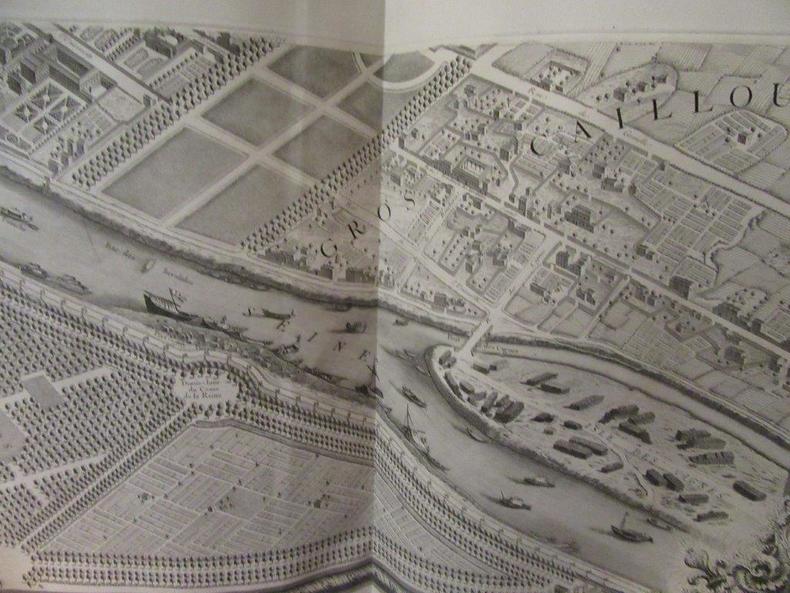
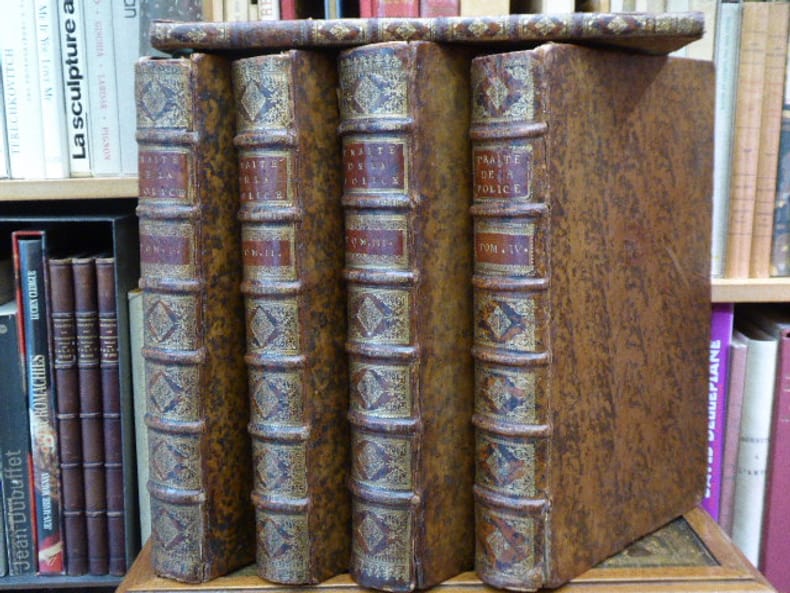
278472Cot - Brunet - Hérissant Paris 1735-1738 4 volumes + 1 volume de supplément in-folio. Reliures de l'époque pleine veau havane, dos à nerfs ornés de caissons de double filet doré richement et finement fleuronnés, pièces de titre et de tomaison en maroquin grenat, roulettes dorées sur coupes, toutes tranches rouges. Le supplément est en demi-reliure de l'époque. Orné de vignette sur titre répétée aux armes et chiffres royales, 10 en-têtes et lettrines historiées, et bien complet de ses 8 plans dépliants dont le plan des fontaines de la ville des faubourgs de Paris. Le supplément concerne les livres 1 et 2. Des cartes avec petites déchirures mais sans manque, divers défauts aux coiffes et mors mais l'ensemble reste solide et fort décoratif. BEL EXEMPLAIRE, peu commun
187490307Michel Lévy frères Calmann-Lévy | Paris 1874-1890 | 19.7 x 25.5 cm pour les volumes de texte & 33,7 x 45 pour l'atlas | 7 volumes brochés et un volume d'atlas relié
41228Chalcographie du Louvre, Musée Impérial. XIXème siècle.Cachet sec dans la pliure de la planche 1.Reproduction fidèle de l'édition originale de 1734-1739.In-plano de 20 planches sur onglets. Planche d'assemblage de l'édition originale. BE.Reliure moderne,demi-cuir blond à coins avec pièce de titre en maroquin brun sur le 1er plat; caractères dorés.Carte d'assemblage avec quelques rousseurs. Sur 5 planches, une tache à l'extrémité de la marge médiane.Coins un peu frottés.Mors fragiles,légèrement ouverts.
1785AUB-5589Paris, chez Hardouin, Libraire de S.A.S. Mme la Duchesse de Chartres / Gattey 1785. Nouvelle édition augmentée par l'Auteur de six Nouvelles expériences physiques et de nouvelles Gravures. Bel exemplaire relié, cartonnage orné d'époque, première garde avec armoirie (de Pury officier aux Gardes Prussiennes), 108 pages sur papier vergé avec annexes dont gavure de l'auteur par L.S. Thiery 1784, avis de l'auteur, 2 préfaces, discours préliminaire, table des matières, privilège du roi signé LEBEGUE, signé VALLEYRE jeune, Adjoint.
1930015758Paris Editions Kra - Collection «Club des soixante» n°1 1930 In-4 Reliure Edition originale Dédicacé par l'auteur
1521139884Venice: 1521. Treatise on duelling for soldiers and princes An elegant Italian edition of this important treatise on duelling laws and customs printed in italic type in the humanist octavo format made popular by Aldus Manutius. Paride del or dal Pozzo 1410-1493 called il Puteo Latinized as Paris de Puteo was a 15th-century Italian jurist. His treatise was first printed in Latin then in Italian at Naples by Sixtus Riessinger not before 1475. The two texts are rather different; the Italian which omits some matter from the Latin but expands on others appears to be an adaptation of the Latin directed at soldiers and princes rather than jurists. The Italian edition remained popular and was reset with updated spelling and punctuation and printed in Venice several times in the 16th century. This is the earliest such edition held in the British Library. Octavo 150 x 94 mm. Woodcut title device depicting a pair of duellists in front of a panel of jurists 10-line woodcut criblé opening initial 4-line woodcut initials throughout. Complete with final blank b8. Late 19th-century French black morocco by Petit spine gilt-lettered direct raised bands double gilt rules gilt inner dentelles marbled endpapers gilt edges over earlier marbling. Slight fading to sides internally clean and fresh a fine copy. Essling 2095; Sander 5414. hardcover
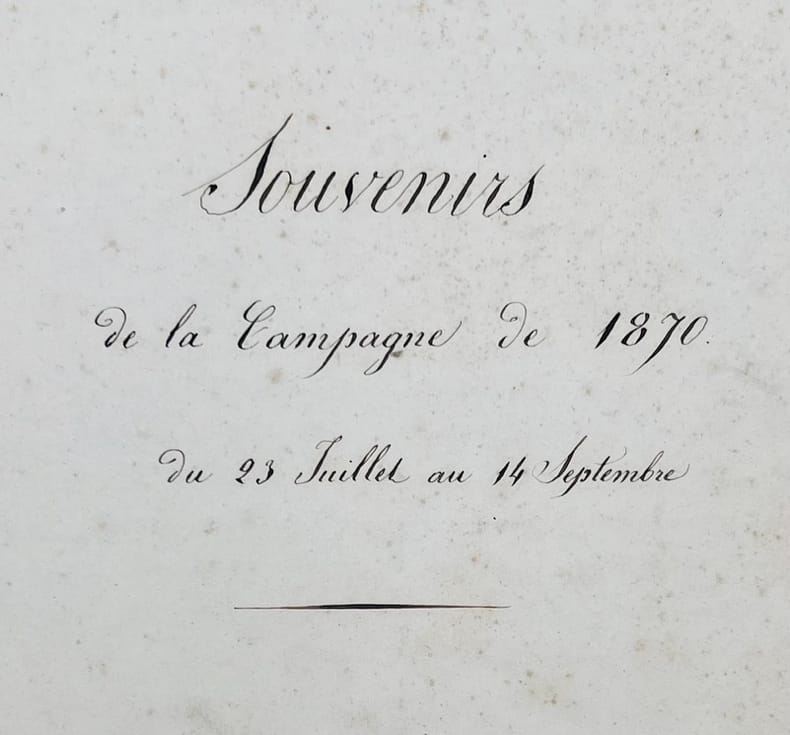
187344265, , 1873. Cahier petit in-4 manuscrit (20,5 x 17 cm) de (1)-144-(1) pp., titre manuscrit en long « Campagne 1870-1871 (Mémoires) ».
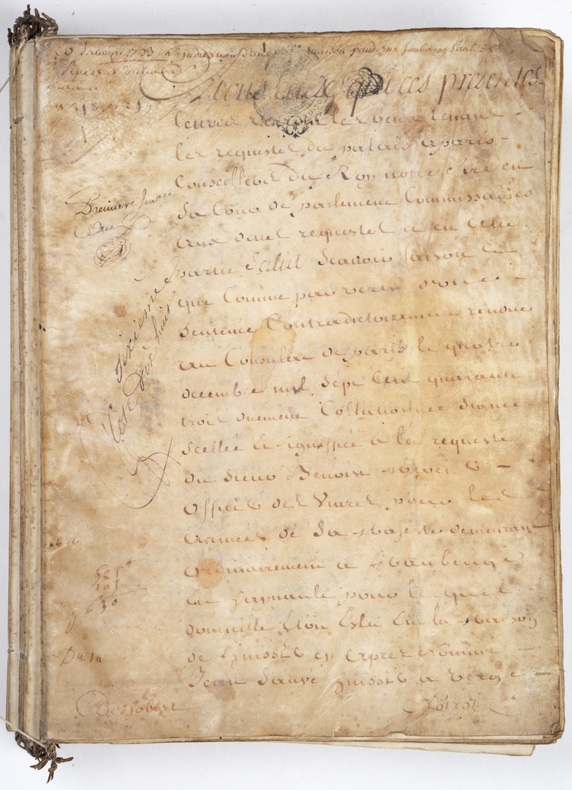
174315159, , 1743-1753. Manuscrit in-4 sur vélin de (164) ff. en 17 cahiers brochés à 23 lignes par page recto verso, cachets fiscaux de la Généralité de Paris en tête de page.
244644S.l. [Paris], s.d. (1760-1767), in-folio, [2] ff. n. ch., 290 pp., un f. n. ch., le tout couvert de graphies à plusieurs mains, régulières et très lisibles, peau de truie retournée teinte en vert, à lacets, dos lisse muet, tranches mouchetées de rouge (reliure de l'époque). Coins abîmés.
231101(XVIIIème siècle) à vue : 55 x 67,5 cm chaque , Techniques mixtes d'aquarelle, crayon et rehauts de gouache, cadre en bois et stuc doré à décor de frises et de rangs de perles. Agrandies en partie inférieure.
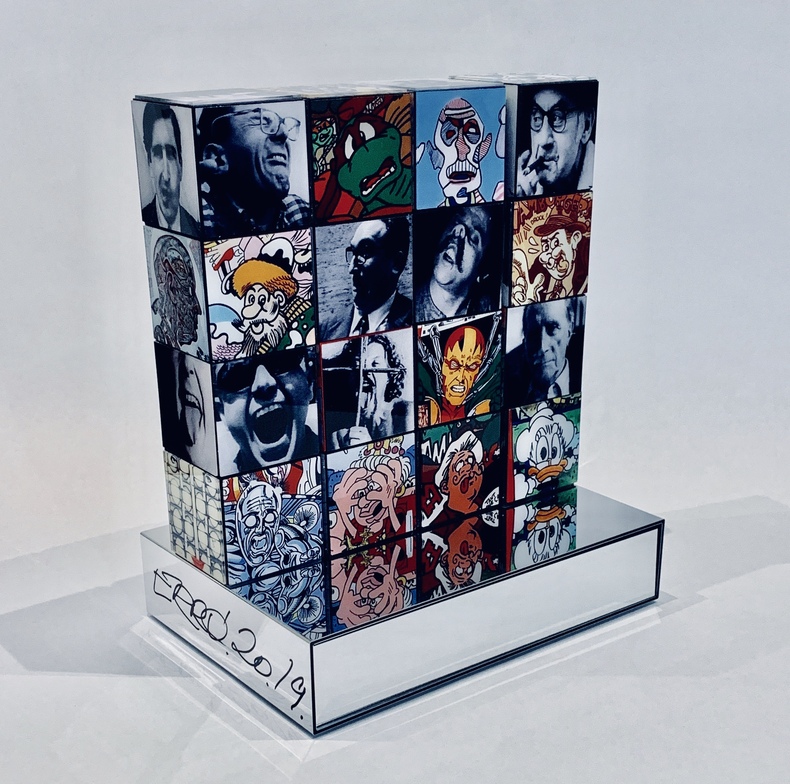
awd-1120Paris, Atelier Julien Martial, 2019. Livre-objet composé de 4 colonnes de cubes illustrés, posées sur un socle en dibond miroir contenant le coffret Grimaces.
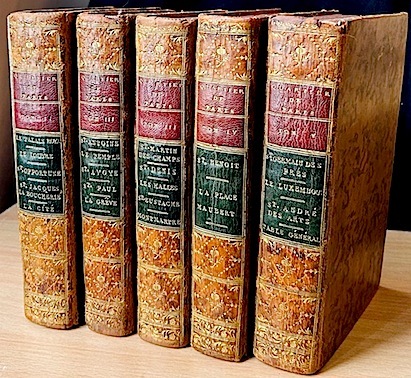
211896Paris, Guillaume Desprez et Jean Desessartz, 1725 5 forts vol. in-folio, veau brun, dos à nerfs cloisonnés et fleuronnés, pièces de titre et de tomaison cerise, encadrement de double filet à froid sur les plats, tranches mouchetées de rouge (reliure de l'époque). Coiffes rognées, trois mors en partie fendus.
177215588Auteur, Lottin Paris 1772-75 5 vol. 5 vol. in-8 de 2 ff.n.ch. XXIV 216 pp. 79 pp. 56 pp. 58 pp. et 94 pp., 2 ff.n.ch. 64 pp. 2 ff.n.ch. 51 pp. 1 f.n.ch. 40 pp. 2 ff.n.ch. 94 pp. et 2 ff.n.ch. 94 pp., 3 ff.n.ch. 56 pp. 1 f.n.ch. 36 pp. 1 f.n.ch. 40 pp. 1 f.n.ch. 48 pp. et 1 f.n.ch. 138 pp., 3 ff.n.ch. 181 pp. 1 f.n.ch. et 1 f.n.ch. 234 pp. 1 f.n.ch., 3 ff.n.ch. 150 pp. 1 f.n.ch. 1 f.n.ch. 120 pp. 1 f.n.ch. 88 pp. et 92 pp. (table), plein veau fauve marbré de l'époque, dos lisse orné, pièces de titre et de tomaison, tranches rouges (accroc à la coiffe supérieure du tome V).
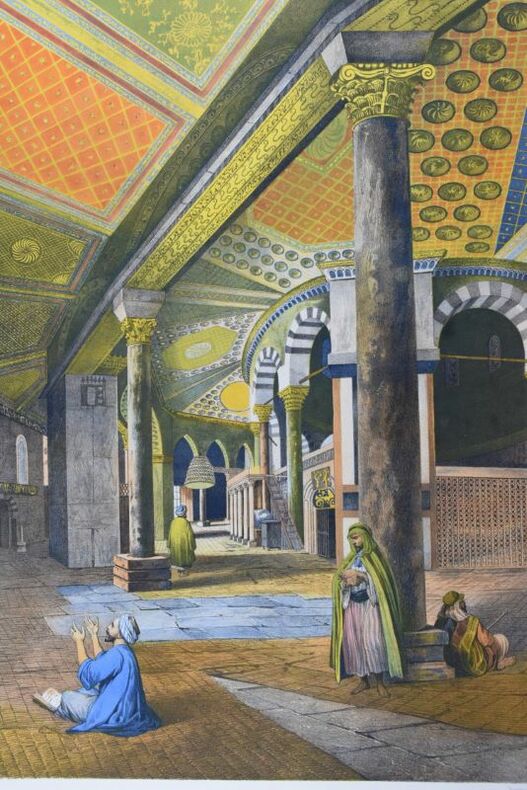
18626478Paris, Librairie Maritime et scientifique Arthus Bertrand, 1862. In-plano (600 x 464 mm), 1 f. de titre illustré du plan du Saint-Sépulcre, 2 ff. de texte et 14 planches lithographiées (dont 12 en couleurs) par Hubert Clerget, Bachelier, Jules Gaildrau et Fichot. Sous un boîtier moderne en toile, le premier plat illustré d'une photocopie de la page de titre, page de titre salie en marge avec traces de déchirures, il est entièrement doublé, les feuillets de texte ont probablement été lavés, les planches sont dans un état parfait. Bel exemplaire parfaitement complet.
AN EXCEPTIONAL COPY OF THIS IMPORTANT LIVRE D'ARTISTE, WITH PENCIL-SIGNED ETCHINGS BY MAURICE UTRILLO AND HIS WIFE, LUCIE VALORE, AND UNSIGNED ETCHINGS BY PICASSO AND BERNARD LAMOTTE. This book is a collection of poems about Montmartre by Vertex (there is even a poem dedicated to Utrillo and Valore!), illustrated with reproductions of drawings by many artists associated with Montmartre, including Marie Laurencin, Dunoyer de Segonzac, Dignimont, Laprade, Charles GuÈrin, Roger Wild. and Vertex himself. Also illustrated with FOUR LOOSE HORS-TEXTE ETCHINGS, one each by Utrillo, Valore, Picasso, and Bernard Lamotte.. All four etchings are signed in the plate. THIS IS AN OUTSTANDING ASSOCIATION COPY printed for Robert Conchon. On the verso of the title-page is a fine presentation inscription to Conchon underneath the reproduced drawing by Vertex, which he has colored by hand in this copy. Furthermore, THE ETCHINGS BY UTRILLO AND VALORE ARE SIGNED IN PENCIL BY THE ARTISTS. Maurice Utrillo (1883-1955), among the greatest of modern artists, married his fellow artist (and former patron) Lucie Valore (1878-1967) in 1935, after she had been widowed. Utrillo made very few original prints, and signed impressions are of the utmost rarity. From a total edition of 110 numbered copies, this is ONE OF ONLY 15 BEAUTIFULLY PRINTED ON FINE MARAIS WOVE PAPER. From the private collection of Sylvan Cole (1918-2005), the leading American print dealer. Large folio. Loose as issued in wraps. UNCUT AND UNOPENED. A few creases to extreme margin of half-title, else FINE AND BRIGHT. In the original (somewhat worn) board chemise and slipcase. Utrillo was surely Montmartre's most emblematic artist, and the signed etchings by him and his wife make this a truly wonderful book. Since these etchings are loose (as issued), they are ready for framing.
1871105204BBParis, ca. 1871. Quer-8° (13 x 18,5 cm.). Weinrotes blindgepr. OLdr. mit Goldschnitt.
1944013801Paris (Seghers), Editions Poésie 44 1944 In-4 Reliure Dédicacé par l'auteur
1875244190Paris: Michel Levy 1875. hardcover. very good. 7 volumes. Tall thick 8vo 3/4 blue morocco marbled boards t.e.g. a few hinges have been reinforced bookplates on marbled endpapers. Paris: Michel Levy 1875-1883. Very good.<br/> <br/> Each volume has a 1 2 or 5 page autographed letter written by the author tipped in a small 5 page letter in an separate envelope. Prince Philippe d'Orleans Count of Paris Louis Philippe Albert 1838-1894 was the grandson of Louis Phillippe I King of the French the last French ruler. A historian journalist and democrat he volunteered to serve as a Union Army officer in the American Civil War. His history of that war is considered a standard reference work.<br/> <br/> Michel Levy unknown
1783WRCAM20839London 1783. 10pp. printed in double-column format in parallel French and English. Small quarto. Dbd. Some old minor ink underscoring. Else very good. Untrimmed. In a half morocco box. The official English publication of the preliminary articles of peace between Spain and England. By this treaty an armistice was concluded Britain gave back the Floridas to Spain and Spain restored the Bahamas to England. AMERICAN CONTROVERSY 83-44. DAVENPORT 170. unknown books
62907(Freiburg, Kilian Fischer, ca. 1490/1491). Small folio. Bound (presumably in the 18th century) in later marbled boards with a vellum spine. Binding with wear, edges of baords worn, smaller wormholes, and overall wear. The spine seems to be make up of two peices of vellum, with a small gap where they meet at the middle of the spine. The small wormholes go through the block, causing tiny loss of parts of lettering here and there. The final leaf lacking a larger piece causing partial loss of text to ca. 20 lines. The leaf is mounted from verso. First eight leaves with a damp stain to lower margin and first and last leaves with some soiling and staining. Otehwise, the block is overall clean and fresh. (58) ff. 52 lines and headline, double columns. Three-and four-line initial spaces with printed guide-letters. Initials touched in red throughout and red underlinings and markings.
149062907Freiburg Kilian Fischer ca. 1490/1491. Small folio. Bound presumably in the 18th century in later marbled boards with a vellum spine. Binding with wear edges of baords worn smaller wormholes and overall wear. The spine seems to be make up of two peices of vellum with a small gap where they meet at the middle of the spine. The small wormholes go through the block causing tiny loss of parts of lettering here and there. The final leaf lacking a larger piece causing partial loss of text to ca. 20 lines. The leaf is mounted from verso. First eight leaves with a damp stain to lower margin and first and last leaves with some soiling and staining. Otehwise the block is overall clean and fresh. 58 ff. 52 lines and headline double columns. Three-and four-line initial spaces with printed guide-letters. Initials touched in red throughout and red underlinings and markings. <br/><br/><em>Scarce first edition thus being the second edition following the 1483-edition printed in Gand of William of Paris’ highly important work on the art of prayer and the first book printed in Freiburg. There has always been consensus about the book being printed around 1490 no later than 1491 but the printing place of the book has previously been contested. Earlier bibliographies Eg. Hain Grasse state that it was printed in Basel by Johannes Amerbach but it has later been proven after the thesis of BMC to have been printed by Kilian Fischer in Freiburg im Breisgau and is now considered the first book printed there. The scholastic philosopher Guillaume d’Auvergne ca. 1180 - 1249 also known under the names Guillermus Episcopus Parisiensis Wilhelm von Auvergne William of Paris etc. was the most prominent French philosopher-theologian of the early 13th century and one of the first Western scholars to attempt to integrate Classical Greek and Arabic philosophy with Christian doctrine. He was also a first mover in creating a new metaphysics that combines Neoplatonism with empiricism and ontology profoundly changing the face of medieval philosophy from the 13th century. “William of Auvergne or Paris ca.1180/90–1249 Bishop of Paris from 1228 until his death in 1249 was one of the first wave of thinkers in the Latin West to engage with the writings on natural philosophy and metaphysics by Greek Islamic and Jewish thinkers that had recently become available in Latin translation. William took these writings to pose errors dangerous to the Christian faith and his philosophical works are in large part aimed at combating their errors. Yet at the same time he recognized their philosophical value and though often confused about their meaning incorporated their teachings into his own thought. On many of the important issues of later medieval thought William is the first to provide in-depth discussions and his voluminous works are an important and still under-appreciated source for our understanding of the development of medieval philosophy.†Stanford Encycl. of Philosophy. “By the third decade of the thirteenth century there emerge the first signs of a new metaphysics. Alongside Neoplatonizing idealism we now see attempts to lay greater emphasis on the ontological density of the created world and to structure reality without resorting to the terms of a relation to the divine ideal… The two figures who did the most to promote the new metaphysics as well as a profoundly Aristotelianizing campaign to establish the criteria for knowledge were masters whose important work was done between 1220 and 1235 in the chools of theology at the new universities. Robert Grosseteste d. 1253… and William of Auvergne d. 1249.†John Marenbon Medieval Philosophy 1998 vol III p. 204. Making extensive use of Avicenna and Aristotle as they were just becoming known through translations in order to understand Christian faith and philosophy William as a bishop also had concerns that reflected the practical use of his teachings. The present work “Divine Rhetoric†is his instructive magnum opus. Here he seeks to explain and illustrate the art of prayer – or divine eloquence - listing seven characteristics and perfections of prayer. The work is equally famous for its application of Ciceronian rules of oratory to Christian oratory and prayer. For more on the Freiburger printer Kilian Fischer please see Hermann Baumeister’s “Der Freiburger Buchdruck in der Inkunabelzeit “Kilian Fischer Als „vermutlich erster Freiburger Druck' erscheint „nicht nach 1491 " aus der Offizin Kilian Fischers eine Predigtsammlung sechs ausgewählter Predigten von Ephrem dem Syrer 303- 373 in lateinischer Sprache die Kilian Fischer zusammen mit der „Rhetorica Divina†des Pariser Bischofs Guillelmus Alvemus herausgab.†p. 104; “Die Drucke Kilian Fischers sind reine Werkdrucke. Er verwendete drei verschiedene Grundchriften; ohne verzierende Initialen oder Abbildungen. Die entsprach auch dem rein wissenschaftlichen Charakter der Lehrbücher seiner Produktion.†p.107. Hain: 8303 Graesse: III:183; BMC III:693; GW: 11866. </em> hardcover
142104aafSanson & Compagnie, Deux-Ponts, 1785-1787, in-8vo, Oiseaux, vols 1-18. Avec 114 planches gravées et magnifiquement coloriées à la main, Ex libris “Bestein de Bassompierre”, reliures en d.-cuir d’époque. Bel ensemble.
5938Engraved frontis. port. & six folding engraved plates. 2 p.l. vii 1 40 256 pp. 8vo cont. red straight-grained morocco upper cover with small ink-stain some foxing panelled in gilt outer border elaborately gilt flat spine gilt a.e.g. Besançon: Librairie de Deis 1821.<br/> <br/> The catalogue of the collection of books and antiquities of Pierre-Adrien Pâris; the greatest professional library of the early 19th century. He bequeathed it to the city of Besançon. It contained a number of the essential books on architecture about 1500 manuscript architectural designs by Pâris and paintings and drawings by Fragonard Boucher and Saint-Aubin. <br/> <br/> Pâris 1745-1819 was architect to Louis XVI designer of the royal cabinet and directed royal festivities at Versailles Marly and Trianon. The collection reflects his deep appreciation for the classical architecture of Greece and Rome where he journeyed several times. During these trips he sketched buildings and artifacts found at Pompeii Herculaneum Paestum and other sites which along with other drawings compose the 1500 architectural designs described here. These experiences prepared him to serve as director of the Académie de France in Rome under Napoleon where he was responsible for excavations at the Colosseum. The library has considerable sections on architecture history the arts of antiquity etc. <br/> <br/> The first 40 pages provide a biographical sketch of Pâris. Pages 1-146 enumerate 777 lots of books. Pages 147-222 contain a description of his cabinet 509 lots. The book concludes with an index of authors and artists.<br/> <br/> The engravings depict bronzes terra cotta sculptures marble statues and other unique items in the collection.<br/> <br/> Nice copy apart from the foxing. From the library of Bernard H. Breslauer his sale Christie’s NY 22-23 March 2005 lot 660.<br/> <br/> ⧠N.B.G. Vol. 39 cols. 209-10. unknown
5938Engraved frontis. port. & six folding engraved plates. 2 p.l. vii 1 40 256 pp. 8vo cont. red straight-grained morocco upper cover with small ink-stain some foxing panelled in gilt outer border elaborately gilt flat spine gilt a.e.g. Besançon: Librairie de Deis 1821. The catalogue of the collection of books and antiquities of Pierre-Adrien Pâris; the greatest professional library of the early 19th century. He bequeathed it to the city of Besançon. It contained a number of the essential books on architecture about 1500 manuscript architectural designs by Pâris and paintings and drawings by Fragonard Boucher and Saint-Aubin. Pâris 1745-1819 was architect to Louis XVI designer of the royal cabinet and directed royal festivities at Versailles Marly and Trianon. The collection reflects his deep appreciation for the classical architecture of Greece and Rome where he journeyed several times. During these trips he sketched buildings and artifacts found at Pompeii Herculaneum Paestum and other sites which along with other drawings compose the 1500 architectural designs described here. These experiences prepared him to serve as director of the Académie de France in Rome under Napoleon where he was responsible for excavations at the Colosseum. The library has considerable sections on architecture history the arts of antiquity etc. The first 40 pages provide a biographical sketch of Pâris. Pages 1-146 enumerate 777 lots of books. Pages 147-222 contain a description of his cabinet 509 lots. The book concludes with an index of authors and artists. The engravings depict bronzes terra cotta sculptures marble statues and other unique items in the collection. Nice copy apart from the foxing. From the library of Bernard H. Breslauer his sale Christie's NY 22-23 March 2005 lot 660. ❧ N.B.G. Vol. 39 cols. 209-10. unknown books
16864982Toulouse: Chez Jean Boude 1686. Soft cover. Very Good. 4to - over 9¾ - 12" tall. 8 pp. Bound in marbled wrappers and housed in a fine red morocco case. $3850 Extremely rare first and only edition of this detailed popular newsletter concerning the contemporary reception of three Siamese ambassadors in Paris in September of 1686. The report gives a full description of their entrance their itinerary and the names and qualities of the individual ambassadors - whose 9-month stay in northern France between 1686 and 1687 must have provoked enormous interest. Providing the reader with some background the work notes that the King of Siam having been only recently convinced of the greatness of Louis XIV and the French nation has decided to send three more mandarins as envoys. "Ces Mandarins sont tres-honnestes les meilleures gens du monde doux civils & complaisans de tres-bonne & agreeable humeur .". According to this account they arrived at Brest on the 18th of June and reached Paris only on the 12th August. On the 'first day of this month of September' the delegation was officially presented to Louis XIV. Its centerpiece was the King of Siam's letter to Louis written on a blade of gold encased in a golden boëte bottle and poised atop a golden chalice all of which was carried aloft on a machine by 12 Swiss guards. The ambassadors themselves it is recorded took care to cover the machine with their parasols. Upon meeting the king "ils firent une profonde reverence en leur maniere se prosterant & mettant leurs mains sur leur vissage". The gifts presented by the envoys are notable for their overwhelming Japanese provenance a closed center of trade to the French and are accompanied here by occasional offhand remarks. Two vases of tombac a flexible alloy similar to brass are thought "presque aussi précieux que l'or" and are imputed to be "what the ancients called electrum"; two samurai swords presented by the King of Japan to the King of Siam are accompanied by the remark "they say that those who know how to handle these swords properly can cut a man's body in half; it's this that makes them beyond price"; etc. An antique marble sculpture apparently depicts a Chinese man whom the Siamese call To inghoing; "we belivee that this is the same as he whom we call Confuscius". The writer of the newsletter seems surprisingly well-informed and is certainly aware of the plans of the official retinue suggesting a source perhaps close to the court. "They are presently busy seeing the beauties and the riches of the Capital of our Kingdom. Around February after they have had their final royal audience they will return and recount all that they have seen and assuredly they will not forget what they have learned and understood of the suprising reunion of Protestants to the Roman religion for the King of Siam having proposed Louis le Grand as a model in all things and desiring to be able to make his entire kingdom French.has demanded that the King send him missionaries persons experienced in warfare wise men and men learned in many arts." Following this account of the ambassadors' visit is a brief 'Description du Royaume de Siam' - with much reference to Arab and Moorish settlements to the Siamese love of music to their 'superbly-dressed women' etc. Thanks to royal decree Siam enjoys public schools in which laws and religion are taught in the vernacular but the sciences are reserved for a learned tongue. Inspired no doubt by the Chinese rites controversty the commentator notes that despite their plural deities the Siamese do believe in one Creator of the Earth and the Heavens and they do maintain that the world will end in fire. The final leaf of the work is occupied with a discussion of the 'names and qualities' of the amabassadors. OCLC records only the copy at Cornell. OCLC 64004509 Chez Jean Boude paperback