424 résultats
Three parts in 6 vols., folio, limited to 350 copies, over 2,000 illustrs, orig. cloth, lightly marked. This monumental work is the most exhaustive bibliographical study of illustrated books of any place, country or period ever published, and it set new standards for descriptions. Essling, one of Italy's most famous collectors, assembled a vast collection of early Venetian woodcut books which served as a basis for his bibliography of Venetian illustrated books from 1450-1525. In all 2,585 works are meticulously described and collated.
1791109402Couverture souple. Un volume broché in-octavo, VIII pages + 475 pages. Couverture muette d'époque avec étiquette manuscrite, Petit manque au dos. Légèrement défraîchi. Marges poussiéreuses.
552(Québec, John Neilson, 1799). In-8 (20.6 cm) (1)f.,24p. Tiré d'un volume relié. Manque 2 feuillets, le faux-titre et le titre. Déchirure au 3e f., sans perte de texte, rousseurs. D'après Trémaine 1140, le tirage fut de seulement 497 exemplaires. TPL 731. Dionne I, 52. Gagnon I, 2723. Vlach & Buono 860. Lande 2079. [ Incunable canadien.]
4 Vols., 4to, over 2740pp., orig. cloth. Reproduces the catalogue cards of the ca. 16,000 items in this very important collection. Some of the many subjects include: incunabula, curiosities of bookmaking (such as chained books), modern fine printing, history of paper, type specimen books, printing manuals, graphic design, trade catalogues, binding, and much more.
RO40163646Joseph Baer & Co.. Non daté. In-8. Broché. Etat d'usage, Couv. légèrement passée, Dos abîmé, Papier jauni. 322 pages. Reproduction sur grande planche dépliable en frontispice. Illustré de nombreuses reproductions en noir et blanc dans le texte et sur planches hors texte. Couverture muette. Etiquette de code sur le dos. Tampons et annotations de bibliothèque sur le 1er plat et en page de titre. Dos taché.. . . . Classification Dewey : 93-Incunables
Joseph Baer & Co.. Non daté. In-8 Carré. Broché. Etat d'usage. Couv. légèrement passée. Dos abîmé. Papier jauni. 322 pages. Reproduction sur grande planche dépliable en frontispice. Illustré de nombreuses reproductions en noir et blanc dans le texte et sur planches hors texte. Couverture muette. Etiquette de code sur le dos. Tampons et annotations de bibliothèque sur le 1er plat et en page de titre. Dos taché. Incunabila xylographica. Incunabila typographica. Allemagne. Italie. Suisse. Pays-Bas. France. Belgique. Autriche-Hongrie. Angleterre...
2980France, vers 1450 Feuillet extrait d’un bréviaire, sur vélin très fin (veau mort né d’époque). Dimensions du feuillet : 110 x 152 mm.Espace occupé par l’écriture : 90x70 mm.34 lignes par pages sur deux colonnes, manuscrit à l’encre noire, orné de 45 initiales peintes en bleu filigranées à l’encre rouge, et alternativement, à l’or à la feuille filigranées de bleu.
3136Turin, 1807 Lettre à en tête de l’empire français, tampon impérial du gouvernement général des départements au delà des alpes Lettre de nomination de Monsieur Chaudron Chef de Bataillon au titre de commandant d’armes de la ville de Turin. Daté et signé à Turin le 28 février 1807 par le Général MenouContre signé par le général Dauzert.
1942ARC00110Sveriges Bibliografi intill Å R 1600 Uppsala 1934-1938, Svenska litteratursällskapet. Band I. 1478-1525 : Häft. 1_6 : 12_383_XXXVIII_XXXVII + (4). Band II. 1530-1539 : Häft. 1_7 :IV_528 + (2). Band III. 1583-1590 : Häft. 1_5 : 358_LXXXII + (2). Sveriges Bibliografi 1600-Talet. Uppsala 1942-1946, Svenska litteratursällskapet. Band I. Häft. 1_3 : A-Q Band II. Häft. 1_ 2 :R-Ö : XI_1080. numerous fac-simile throughout (some coloured, some folding).
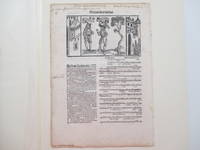
149617350AB1496. Straßburg Grüninger I.XI. 1496 305 : 21 cm. One leaf with one woodcut. Leaf LXX 'Secundus actus' from the "Heautontimorumenos". The woodcut shows the two protagonists of the play. - With some old annotations. - Hain/Copinger 15431; Goff T-94; GW M45481. unknown
192797291927 Paris et Bruxelles : G. Van Oest, 1927-1930. 2 volumes grand in-4,brochés,130 planches hors-texte dont 104 en couleurs, couvertures conservées. Bel exemplaire. Edition tirée à 650 exemplaires numérotés sur papier à la cuve des papeteries d'Arches. Superbement imprimée par l'Imprimerie nationale, elle est illustrée de nombreuses planches en héliochromie réalisées par D. Jacomet
Very Good Turkish, Ottoman (1500-1928) Original color map of Eastern Anatolia, Dogu Beyazit, Bayazid, Bargiri, Nakhchevan, Karakilise, Van, etc. 50x60 cm. In Ottoman script (Enverî). 1 p. Scale: 1:200.000. Slightly toned, several small holes on paper. Otherwise a very good copy. Enverî script is the war minister Enver Pasha's alphabet and writing amendment, which he tried to implement within the Ministry of War between 12 March 1914 and 10 August 1914. Starting from the Tanzimat (Westernization) period in the Ottoman Empire, the discussions on simplification in language, writing, alphabet and reading-writing had increased and at the end of the 19th century, military necessities also became one of the concerns. The problems such as the low rate of literacy among the recruited soldiers, the need to teach the soldiers how to read and write in a short time, and their misconceptions about the spelling of proper nouns led Enver Pasha to add the writing problem to his reform agenda, once he took office. Enver Pasha's reform is based on the principle of writing the Ottoman letters, which take different forms in the beginning, in the middle and at the end according to their unification with the other letters, separately in their original state without merging them. While this new alphabet was being created, the existing 32 letters in the Ottoman were preserved. The 8 vowels in the Turkish language, which could not be written with the old letters, was shown by placing small marks on the existing vowels and by doing so a new alphabet consisting of a total of 40 letters was created. With this alphabet, officially called 'Ordu Elifbasi', rules were adopted such as writing of the letters without merging them, writing the words as they are pronounced. At first glance, Enver Pasha's writing reform, which appeared as a definite solution to the theory of the solution of the ongoing debates on the alphabet and the spelling, formed a wide experiment field in the military. It was not possible to use Ordu Elifbasi, which essentially is a transliteration alphabet that allows transferring the sounds of these three different languages (Turkish, Arabic, Persian) to a single alphabet, in the daily life. Thanks to this new alphabet and spelling, learning to read and write were accelerated to some extent. However, it was seen that the literacy rate of the well-educated, literate people fell to the spelling and did not even progress. This alphabet and spelling reform, which Enver Pasha thought of spreading to the whole country, caused much more problems as it was experienced in the army. Although it was postponed until the end of the mobilization period following the declaration of the mobilization, Ordu Elifbasi, which remained in force for 152 days, eventually failed to be realized. (Source: Karakus: Enver Pasha's Alphabet And Spelling Attempt: Ordu Elifbasi (Army Alphabet)).In this extremely rare document, there are some articles and thoughts on a case. This is one the serie of the Bonn projection maps which are the first map series in modern techniques in Turkey and the Ottoman Empire. In order to produce these maps covering Turkish territory, Reconnaissance Branch was incorporated into The Mapping Commission. The maps were produced in the datum based on the latitude and longitude of Ayasofya Mosque in equal area Bonn Projection. The field works for the 123 sheets covering the country were conducted by 76 staff. The production was completed in 18 years starting from east west. Field works continued without stopping except in years 1914 and 1920. This map series called also reconnaissance maps contributed a lot to producing 1:25.000 scale maps. Extremely rare. KW: "Harfleri Islah Cemiyeti" Hurûf-i munfasila Reform Turkish Letter revolution First World War WW 1 Map Geography Military maps.
45867Johann Gruninger Strasbourg 1485. 8vo Intact single page with appropriate light age tanning and creases and only a small tear at upper left edge. This is a single page of a very famous hand printed German bible from one of Europe's most important pre 1500 printers. Recently mounted on black board with a gold frame. Both sides are printed and the page is only lightly attached at its upper edge to the mounting. Obviously over 530 years old now and is a small example of great historical interest. Johann Gruninger Strasbourg 1485 unknown
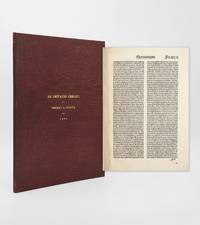
1494376720Nuremberg: Caspar Hochfeder 1494. Leaf XCII. Text in two columns 53 lines in black letter with rubricated N on verso running head Liber Sermonum. Small folio. Leaf with minor staining mounted in brown cloth folder with printed descriptive slip from 1927 Foliophiles portfolio of German Incunabula mounted opposite leaf. Leaf XCII. Text in two columns 53 lines in black letter with rubricated N on verso running head Liber Sermonum. Small folio. Attractive leaf from the Nuremberg 1494 edition of the Works of Thomas à Kempis printed by Caspar Hochfeder ISTC it00352000. Cf. Disbound and Dispersed 2005 Checklist 29. Provenance: General Theological Seminary bookplates perforated stamps Caspar Hochfeder unknown
69582aafLondon, The trustees of the british museum by british museum publications, 1949, in-folio, LXXXVII + 441 p. + 21p. + LXXII plates of facsimiles, original half-clothbound,
3377Feuille d'incunable parisien du quinzième siècle provenant de « La Mer des hystoires ». Texte anonyme traduit et adapté du « Rudimentum novitiorum » publié à Lubeck en 1475. Paris, Pierre Le Rouge pour Vincent Commin, 1488. Un feuillet grand in-folio de 2 pages (39.5 x 25.7 cm) en caractères gothiques sur 2 colonnes de 50 lignes. Recto : « La sixiesme aage » avec un trait de 10 cm à l'encre ancienne à la marge gauche et une déchirure marginale de 2 cm à droite. Verso : Feuillet vii.xx.vi, signature T.ii, avec un bois gravé (7.2 x 8 cm) montrant Constantin IIIIe de ce nom lxii empereur et une bordure renaissance décorée à la grotesque de plantes, angelots, sirène et griffon (non coloré). Édition originale. Graesse IV, 492. Brunet III, 1640.
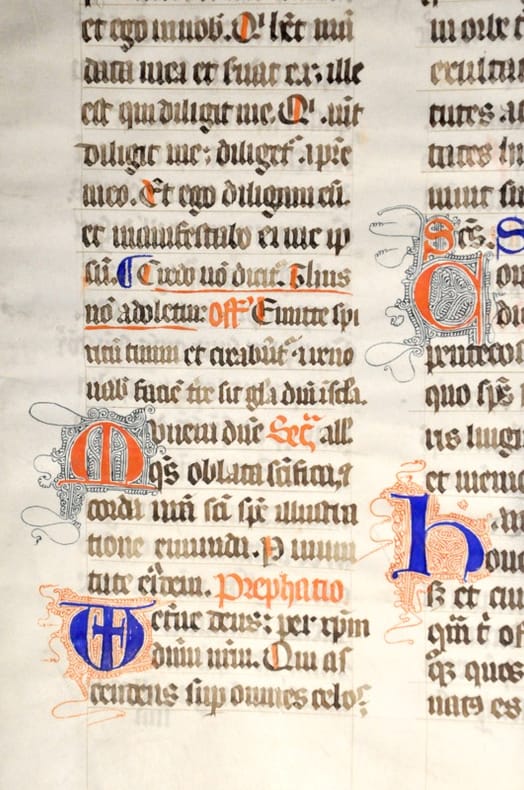
2978Premier tiers du XVe siècle (1420) Folioté 165 à l’encre rougeUn feuillet, recto-verso sur peau de vélin extrait d’un grand Missel.23 lignes par pages sur deux colonnes en écriture gothique, aux encres rouges et noires, réglures à l’encre rouge. Dimensions du feuillet 264 x 350 mm.Agrémenté de 8 grandes initiales occupants de 2 à 4 lignes de texte, alternativement peintes en bleu et rouge, très finement filigranées aux encres de couleurs avec prolongation marginales. Un extrait des actes des apôtres. Une splendide page ornée de 8 très grandes initiales courant sur plusieurs lignes dont un S bicolore très ornementé. Le filigraniste de grand talent a fait montre d’une virtuosité remarquable s’amusant à poursuivre dans les marges sa composition d’arabesques folles du plus bel effet.
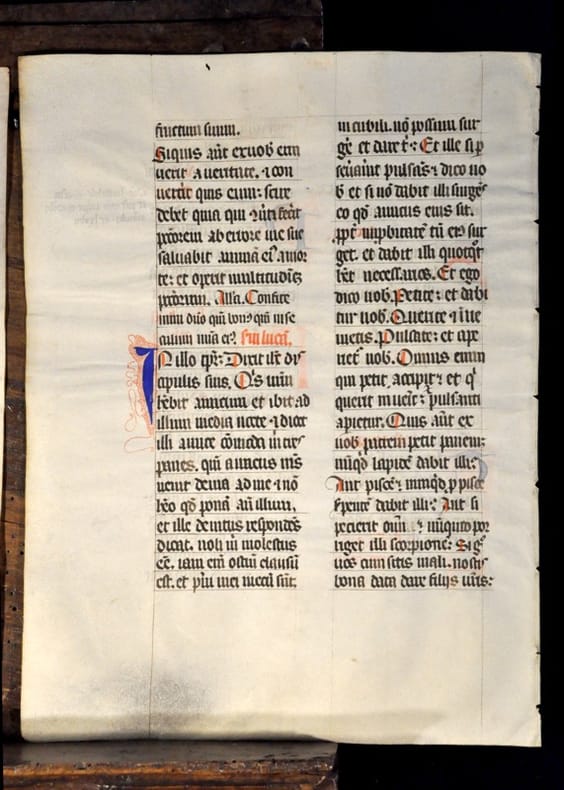
15722979Premier tiers du XVe siècle (1420) 1572 Folioté 157 à l’encre rouge. Un feuillet, recto verso (264 x 350 mm) sur peau de vélin extrait d’un grand Missel.23 lignes par pages sur deux colonnes en écriture gothique, aux encres rouges et noires, réglures à l’encre. Orné de 6 grandes initiales occupants de 2 à 4 lignes de texte, alternativement peintes en bleu et rouge, très finement filigranées aux encres de couleurs avec prolongation marginales. Rogation et extrait des évangiles selon Saint Luc.
2884Arnheim, 1799- 1815, Manuscrit constitué de feuillets de récupération, découpés et assemblés en cahiers reliés dans un petit in-8 en demi-veau miel. Un volume sur le thème des nombres.
Main work 7 vols., orig. cloth, Reichling 7 parts, orig. printed wrappers, 14 volumes in total. This work is the basic bibliography to which anyone working on fifteenth-century books refers or is referred to, this set includes the important appendix by Reichling.
Folio, [x],111,[3]pp., printed in Linotype Estienne with Civilite headings, Cockerell marbled paper boards, title label to spine, uncut. "This [library] was designed to be a guide and inspiration to a working printer and to illustrate the history of printing and all its adjuncts: types, pages, margins, woodcut and other decoration. The great names of Gutenberg, Fust and Schoeffer, Zel, Sweynheym and Pannartz, Wendolin of Speier, Jenson, Crantz, Gering and Friburger, and Caxton appear, and there are a number of examples of the fine borders and initials produced by the Zainers at Augsburg and Ulm and by Ratdolt at Venice."?Preface. Rogerson, 26.
2 Vols., 4to, xiii,407; xiv,577pp., one of 400 copies, facsimiles throughout, orig. printed wrappers, unopened, uncut, head of vol. I defective otherwise a nice set. A rare and detailed bibliography. From the library of Pierre Ber?s.
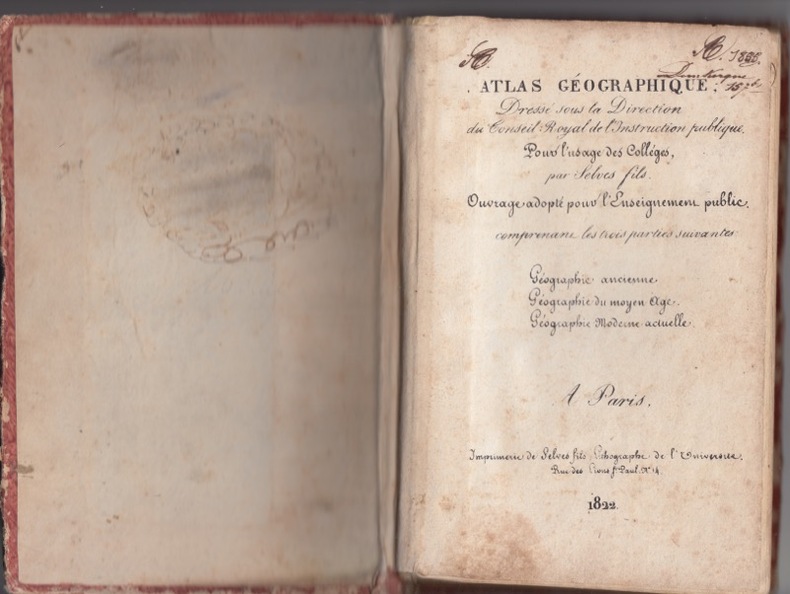
1822248131822 Imprimerie de Selves fils, Litographie de l'Université, Rue des Lions St. Paul, n°14, A Paris, Selves 1822, in8 reliure cartonnée époque leg.défraichie,42 cartes doubles coloriées en lithographie sur onglet, liste collée sur le premier plat, trés rare incunable de la lithographie.
64449[Nürnberg, Anton Koberger, 1487]. Fol. Mit eingemalten Initialen in Rot u. Blau sowie rubriziert. 4 nn. Bll. (Got. Typ., 2 Kol., 72-73 Zeilen, Text von Kommentar umgeben), Geheftet (ausgebunden; ohne Einband).