424 résultats
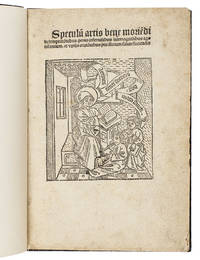
1495ABC_47543Cologne: Heinrich Quentell 1495. Recent marbled paper over boards by the Geneva bookbinder Jean-Luc Honegger b. 1953 who set up his atelier ca. 1978 signed with his honegger stamp in blue ink at the foot of the back paste-down sewn on 3 recessed supports the marbled paper in an antique spot pattern see Wolfe 162-163 with black spots on unusually fine-grained grey Stormont spots and with veins in red turquoise orange dark blue and white black morocco spine label with the title in gold roman capitals reading up the spine. Small Chancery 4to 20.5 x 14.5 cm. With a large woodcut 10.0 x 8.8 cm on the title page: depicting a teacher Pope Gregory the Great ca. 600 CE declared a saint in 1295 with a dove on his shoulder his attribute seated behind a lectern with an open book instructing two of his pupils seated before him each with a book in his hands with above them a scroll inscribed Accipies tanti doctoris dogmata sancti. Set in a single column with 36 lines to the page in a rotunda gothic type Quentell type 7 here 79G though in the Typenrepertorium 80G with a larger textura gothic for the first line of the title Quentell type 10 155G though the only capital in that line is the 8 mm lombardic initial S Quentell initials e described as 6/7 mm but noting that they are used with type 10. With spaces left for manuscript initials 1 6-line and many 3-line a few - mostly on b1v and b2r - with manuscript guide letters in black ink. Most pages with a few words underscored in black ink. Quentells second quarto edition of the well-known manual on the art of dying in the original Latin matching his ca. 1493 quarto edition almost line for line and using the same woodcut quite different from any used with this text before that date. Quentells quarto editions contain the original long version of the text known as Speculum artis bene moriendi often attributed to Matthaeus de Cracovia or Albertus Magnus editions in Italian are often attributed to Dominicus de Capranica Cardinal of Fermo. The Ars moriendi was one of the earliest incunabula printed and consists of two related Latin texts written around 1415 and 1450 offering guidance on how to have a good death according to Christian beliefs of the late Middle Ages. The texts were written in response to the Black Death and social upheavals of the 15th century with the earliest versions likely composed in southern Germany. The highly popular Ars moriendi was translated into many West European languages and was the first in a tradition of guides to death and dying. The first edition in the original Latin appeared ca. 1474 but was preceded by a German edition in 1473 and perhaps by an edition in Italian described as ca. 1471/75. Quentell published the Latin text together with other works in a folio edition described as ca. 1484/89 but he published four quarto editions of the Ars moriendi alone described as ca. 1493 the present ca. 1495 ca. 1498 and another probably after 1500. He published no Ars moriendi editions in vernacular languages. His first three quarto editions have the same collation but the present edition matches the ca. 1493 edition almost line for line and uses the same woodcut while the ca. 1498 edition differs considerably and uses a different woodcut.Heinrich Quentell one of the greatest early Cologne printer-publishers issued many theological and philosophical texts for university use but also liturgical texts working both alone and with Johann Helman who may have also jointly employed contract printers and dispatched servants to sell books. Quentell was one of the first printers to consistently provide his books with title-pages with approximately 91% of his over 380 publications including one.Quentell used the present Magister cum discipulis-woodcut in several other editions including the Heymericus de Campo Promptuarium argumentorum 1492 GW 12406 and Jacobus van Gruitrode Speculum aureum animae peccatricis 1493 GW M10728. Wynkyn de Worde used a copy in his Parabolarum Alani cum commento 1508 STC 254.3 and other printers copied it as well.All Quentells Ars moriendi editions are undated and the present one used his types 7 and 10 and initials e which all apeared in his books in the period 1488 to 1500. The present edition is probably dated ca. 1495 in the literature because it appears to fall between the two quarto editions thought to date from ca. 1493 and ca. 1498.The bookbinder Jean-Luc Honegger still active today is best known for his bindings for the Bibliothèque Nationale de France in Paris and the Bodmer Foundation near Geneva. With the bookplate of the Bibliotheca Philosophia Hermetica Joost Ritman in Amsterdam and probably bound for them. Slightly browned water stains at the foot of a few leaves not approaching the text some smudges in the margins and on the blank final page. The binding slightly worn at the extremities and with a few unobtrusive scratches on the back board. Otherwise in very good condition and only slightly trimmed about 5 mm at the head and probably no more at the fore-edge and foot giving generous margins about 2 3 and 4 cm at the head fore-edge and foot respectively and some leaves with tranchefiles at the foot.l Bibliothèque Nationale Catalogue des incunables A598; BMC I p. 294; Bod-Inc A449; Bohonos Szandorowska Incunabula quae in bibliothecis Poloniae asservantur 562; BSB-Ink A766; Buffévent VIII 45; Goff A1098; Günther Wiegendrucke der Leipziger Sammlungen 781; GW 02610; HC 14911; ISTC ia01098000; Madsen Kongelige Biblioteks inkunabler 352; Ohly-Sack 274; ÖNB-Ink A483; Pell 1339; Polain 972; Proctor 1425; Sack Freiburg 306; Sallander Uppsala 2046; Schramm VIII 484; Schreiber Manuel de lamateur de la gravure sur bois et sur métal au XVe siècle 3671; Thienen Incunabula in Dutch libraries 425; UBL-Ink A354; USTC 739947; Voulliéme Die Buhdrucker Kölns 305; Voulliéme Inkunabeln der Königlichen Bibliothek 1011; Voulliéme Trier 697. Heinrich Quentell, hardcover
15691Paris, Enguilbert I, Jean I et Geoffroy I de Marnef (impr Philippe Pigouchet), 1491. In-8 gothique (143 x 100 mm) de (96) ff. (sig. a-m8), maroquin brun, dos à 5 nerfs, quadruple filet d'encadrement et fleurons aux angles à froid sur les plats, tranches dorées (reliure du XIXe siècle).
Very Good Turkish, Ottoman (1500-1928) Contemporary quarter dark burgundy leather bdg. Grey cloth boards. Four compartments at spine. Cr. 8vo. (20 x 14 cm). In Ottoman script (Old Turkish with Arabic letters). 96 p. [48 leaves]. 19 lines on each page. Printed on paper with European watermarks. A small tear up to the last page with no loss of text. Overall a fine copy. The 9th incunable of the Islamic world, written by Ibrahim Müteferrika and printed in his legendary Basmahane. Known as the most significant work by Müteferrika, this incunable is a political and state-theoretical treatise composed in order to improve the Ottoman government. In his book, Ibrahim Müteferrika used the sources written in Latin in the Europe of his period, and he presented it to Sultan Mahmud I right after the Patrona Halil Revolt (1730). Müteferrika divided the state forms of government in Europe into three groups with the titles "monarkiya" [i.e. monarchy], "aristokrasiya" [i.e. aristocracy], and "demokrasiya] [i.e. democracy]. In the work, the importance of the sciences (physics, astronomy, and geography) in the state administration was emphasized, and it was stated that a solid-state order could not be established in a country where these sciences were not developed. In addition to this, he used the term "Nizâm-i Cedîd" [i.e. The New Order] for the first time and stated that the Ottoman Empire should definitely adopt and implement the new military orders of the 18th century Europe. In addition, this work is one of the earliest in which the "democracy" term is used in the Islamic world. The book was published in French in Vienna and Paris in 1769 (Traite de la tactique ou méthode artificielle pour l'ordonnance des troupes, Vienne, 1769. Translated by Karl Emerich Alexander von Reviczky von Revisnye [Baron Reviczki]), and was translated from French into Russian in 1777. One of only 500 copies. The volume appeared in 1732, about one and a half years after the uprising of Patrona Halil Revolt which had overthrown the system of Sultan Ahmed III and Grand Vizier Damad Ibrahim. The writing, recalling the characteristics of Ottoman siyâsetnâme [i.e. the book of politics], calls the attention of the Ottoman leaders to the results of the state and military development and to the reasons for the strategic superiority of the rival European powers, while strongly condemning the several centuries long disinterest of the Ottomans to the external world. An important feature of the work is to break with the hitherto prevailing nostalgic attitude to bygone golden ages. Although observes the stylistic conventions in as much he speaks contemptuously about the Christian nations, in the content, already turns away from the indifference referring to the superiority of Islam. It announces in a list organized by items the reasons for the state's weakness and the conditions of rising. In harmony with the main aspects of contemporary Ottoman reforms, the work mainly focuses on the necessity of the reorganization of the army. It also offers a broader historical background by describing after the Greek philosophers the various types of states (6v-7v), or by treating the origins and reasons for the success of the foundations of European culture, the Roman Empire (19v-20v). The concept "Nizâm-I Cedîd" (i.e. the New Order), which would be used for the newly organized military formations of Sultan Selîm III (1789-1807), appears here for the first time referring to the modernized European army (17v-18r). "The utopistic optimism of Risâle-i Islâmîye may have had some rational basis, if one takes into account the Karlovci Treaty (1699) which was a rather positive correction in contrast to the previous series of Turkish failures in the Balkans, the European 'internal wars' of the first decade of the 18th century, and the experiences of the reform and peace years of the Tulip Period. However, the Usûl ül-hikem. was already inspired by the atmosphere after the Pozarevac Treaty (1718) which was a further stro
65312[Köln, Johann Koelhoff d. Ä., um 1476-1477]. Fol. 45 nn. Bll. (ohne das letzte weiße; Got. Typ., 2 Kol., Rubriziert, eingemalte Initialen in Rot), Roter HLdr.-Bd. d. 20. Jhds. m. goldgepr. Rückentitel.
65279[Köln, Drucker des Salomon et Marcolphus (Ludwig von Renchen), nicht nach 1478). Fol. Mit einer rot eingemalten Initiale am Beginn. 66 nn. Bll. (ohne das erste u. letzte weiße; 40 Zeilen, Got. Type). HLdr. d. 20. Jhds. m. goldgepr. Rückentitel u. Rotschnitt.
192030011920, En feuilles (232 x 250 mm) sous un portefeuille. 153 feuillets.Sur japon nacre, chaque feuillet manuscrit recto verso est execute sur papier japon nacre a fort grammage et se compose d’un texte manuscrit a l’imitation de l’ancien encadre de compositions art nouveau, bandeaux, culs de lampes et motifs.Les motifs decoratifs a theme animalier ou abstrait, pour certains s’inspirent de l’art roman, d’autres de themes egyptiens et orientaux.Bien qu’uniforme dans l’esprit les themes changent subtilement d’une page a l’autre en changeant de couleurs d’une scene a l’autre. Chaque initiale du texte et le nom des personnages est peint en rouge.Chaque scene (en moyenne toutes les deux et trois pages, parfois moins) s’ouvre par une peinture occupant la moitie de l’espace dans une demi ogive, realisee a la gouache puis vernie.Les ornements etant peints dans une technique mixte gouache et aquarelle.La tonalite de l’ouvrage joue sur les clairs obscurs et privilegie les scenes de nuit ou d’interieurs eclairees par des lanternes et flambeaux.Ces scenes alternent des paysages crepusculaires.Ouvrage date et signe en fin d’ouvrage « Termine le 23 mars 1920, Serge Beaune »
7672CBBasel, Nikolaus Kessler, 1489. 4° (32 x 23 cm). 46 Bl. (letztes leer); 188 Bl.; 229 (von 230) Bl.; 320 Bl. (das letzte leer), 2 Spalten, 57 Zeilen. Mit 3 sich wiederholenden Holzschnitten (nachgeschnitten nach der Strassburger Ausgabe) sowie mit durchgehenden Rubrizierungen und eingemalten Initialen in Rot und Blau. Verfärbte Schweinslederbände über Holzdeckeln der Zeit, mit Stempel- und Plattenprägung. + Wichtig: Für unsere Kunden in der EU erfolgt der Versand alle 14 Tage verzollt ab Deutschland / Postbank-Konto in Deutschland vorhanden +, 7672CB|7672CB_2|7672CB_3|7672CB_4 4 Teile in 3 Bänden. [4 Warenabbildungen]
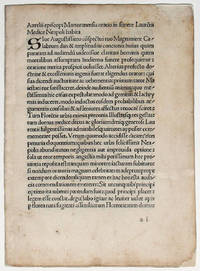
14922680<p>4to. 20.5 x 15 cm 4to. 20.5 x 15 cm 8 ff. rather dog-eared at edges and with some light soiling. Disbound in a cloth-covered box.<br /></p><p>Rare first edition of this funeral oration for Lorenzo de Medici read in Santa Maria Nuova on 16 April 1492 evidently the only contemporary printed oration of the many delivered and printed in his honor to survive.</p><p>"Lorenzo de' Medici… born January 1 1449 Florence Italy—died April 9 1492 Careggi near Florence Florentine statesman ruler and patron of arts and letters was the most brilliant of the Medici. He ruled Florence with his younger brother Giuliano 1453–78 from 1469 to 1478 and after the latter's assassination was sole ruler from 1478 to 1492." Brittanica.com</p><p>The present publication is the sole oration devoted to Lorenzo in the Short-Title List of Funeral Orations from the Italian Renaissance Ca. 1374-1534 compiled by John McManamon and the only printed example featured in the 1992 exhibition at the Bibliotheca Nazionale Centrale <i>Lorenzo dopo Lorenzo La Fortuna Storica di Lorenzo il Magnifico. </i>Notwithstanding the poor survival rate of ephemeral publications and the controversial character of the <i>laudandus</i> the statistic remains remarkable. The motive for the present oration was overwhelmingly political and meant to insure continuation of the traditionally strong alliance between Naples and Florence at a difficult time of dynastic transition. According to Miglio <i>DBI </i>X.369-70 the work was published before it was read.</p><p>A Naples edition was published the same year from the press of Cristannus Preller IGI VI.1722-A. The work was re-published in the 19th century by Vito Capialbi <i>in Memorie di R. Zeno e A. Bienato</i> Naples 1838 49-86. Milanese born Aurelio Bienato was Reader in Rhetoric at the University of Naples 1470-80 and later elected Bishop of Martirano modern Catanzaro in which sinecure he remained until his death. Miglio also lists an unpublished commentary on Quintilian <i>Iter Italicum</i> I.415-16 II.570 and a collection of Latin verses <i>Elegantiarum epithomata</i> an epitome of Lorenzo Valla's <i>Elegantiae linguae latinae</i> which went through a number of incunable editions 1479/80; 1488; 1491. </p><p>US copies ISTC: Huntington Newberry and Yale. </p><p>Provenance: Ritman copy.</p>Goff B-667; BMC vi.784; GW IV.1346; Paolo Pira ed. Lorenzo dopo Lorenzo. La Fortuna Storica di Lorenzo il Magnifico Florence Biblioteca Nazionale 1992 I.24; John M. McManamon Funeral Oratory and the Cultural Ideals of Italian Humanism 1989 p. 256 & 41-43. Phillipus de Mantegatiss
149565636[Paris, Pierre Le Dru für] Jacques Moerart, o. J. (um 1495). 8°. Titel m. einer fast blattgr. Holzschn.-Druckermarke. 95 (statt 96, fehlt das letzte weiße) Bll. (Got. Type, 32 Zeilen, rubriziert), Brauner Maroquin-Bd. d. frühen 20. Jhds., der Vorderdeckel m. grünen Intarsien u. reicher floraler Vergoldung, Rücken-, Deckel- u. Innenkantenverg., goldgepr. Rückentitel u. Goldschnitt.
65274[Basel, Michael Wenssler, nicht nach 1474]. Fol. 190 nn. Bll. (das letzte weiß; Got. Typ., 34 Z.), durchg. rubriziert u. mit zahlr. in Rot eingemalten Initialen. HLdr. d. 20. Jhds. m. goldgepr. Rückentitel.
29007Angers, Jean de La Tour, s.d. [1494-1495]. 2 ouvrages en 1 vol. in-16, veau brun, dos à nerfs orné de petites fleurs de lys dorées encadrées de doubles filets à froid, double encadrement d'un triple et d'un double filet à froid sur les plats, petites fleurs de lys aux angles de l'encadrement intérieur, fleuron doré au centre. Reliure moderne dans le goût du XVIe siècle. Cachet sur la garde blanche de Claude Lambert (Sablé, XXe s.), note manuscrite datée de 1710 au v° du premier feuillet par un avocat du Mans, note bibliographique du XIXe siècle et cachet de L. Lefebvre, prêtre de Mamers sur le dernier feuillet blanc en fin de volume. Premier feuillet dans une frise typographique gravée sur bois comprenant un personnage et des oiseaux dans des feuillages, impression en caractères gothiques à 23 lignes, qq. lettres peintes en rouge, ciii ff., (10) ff.; LIV ff., (1) f. blanc. Signatures : [A-N]8 O10 ; [a-g]8. Il manque les feuillets de titre (A1 et a1) des deux ouvrages. Quelques annotations marginales.
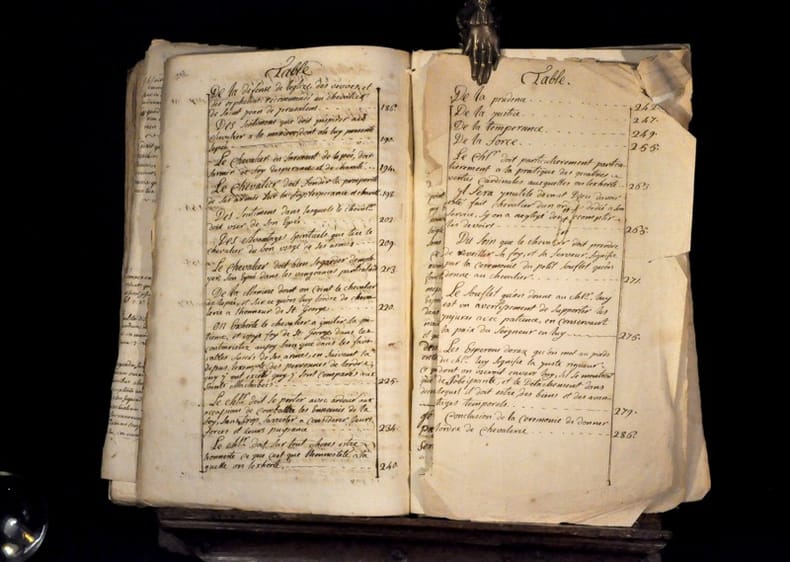
16883205Circa 1688 Manuscrit composé de 15 cahiers assemblés par des lacets et reliés entre eux par une cordelette de lin (177 feuillets in-folio (230 x 355 mm). Calligraphie très lisible, écrite à l’encre noire et à l’encre rouge, réglé au crayon en marge. Quelques déchirures, manques dans les premiers feuillets. Manuscrit très fortement raturé et surchargé. Composition - Avant-propos, 6ff.- Suivi de : « Formulaire de la profession reguliere des Chevaliers de Malte » (à l’encre rouge) 1ff.- Suivi de : « Oraisons que le prestre dit avant la profession ». En latin aux encres rouges et noires, 2ff.- Suivi de : « La forme de Donner l’ordre de Chevalerie, Les oraisons finies, le prestre commence la messe et sarreste avant levangil alors celui quy se dispose a recevoir l’habit se leve de devant l’autel, et va se mettre a genoux devant le chevalier quy la luy doit donner : pour en recevoir premierement lordre de chevalerie lequel luy dit (…), 4ff.- Suivi de : « Troisieme section contenant les paroles qui se prononcent en faisant les vœux », 1page. - suivi de : « Quatrième section contenant la forme de donner la croix et l’habit régulier de l’ordre et les oraisons quiserecitent pour conclusion de la cérémonie » 2 ff.- Suivi de : « Oraison après profession » (à genoux devant l’autel), 3ff.- Suivi de : « Reflexions dun Chevalier de Malte Religieux de l’ordre militaire des hospitaliers de Saint [Jean] de jerusalem. Sur la grandeur et les devoirs de son Etat ». 326 pages numérotées, dont les 4 derniers blancs. Le dernier marqué au verso d’une autre écriture : « Recu Ch de Malthe dan langue de provence le premier 7 bre 1572. »Défauts : Saut de pagination entre la dernière page de table marquée 293 à la partie commençant par : « réflexion d’un chevalier » paginée 303.
64882Nürnberg, [Johann Sensenschmidt, nicht nach 1471]. Fol. 20 nn. Bll. u. ein weiteres, einseitig bedrucktes kleineres Blatt (23 Zeilen), eingefügt zwischen den Bll. 16 u. 17. Mod. flex. Pgmt. m. durchzogenen Bünden u. Schließbändern.
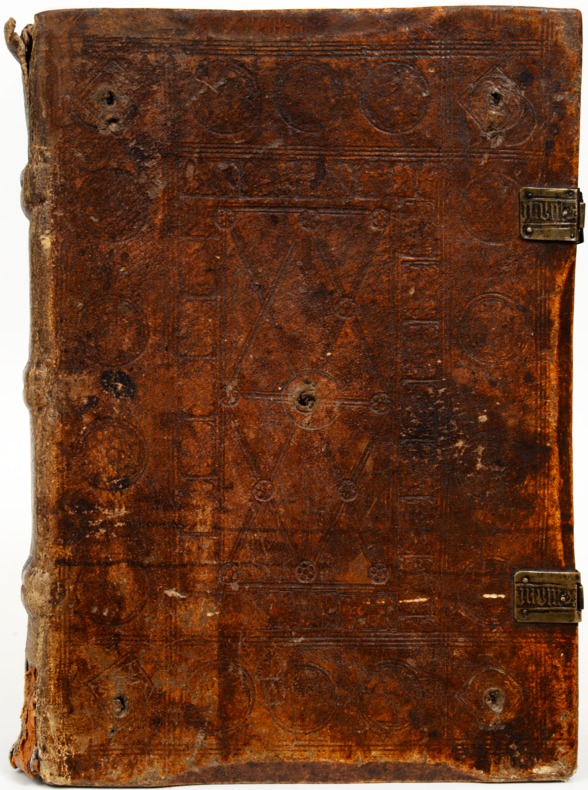
16006Ulm, Johann Zainer, [1478 ca]. Petit in-folio gothique (20 x 29 cm) de (418) ff. à 40 lignes par page, sans foliotation, réclames ni signatures dont 2 feuillets blancs (1er et 371e), peau de truie sur ais de bois biseautés, dos à trois nerfs, décor géométrique estampé à froid dans un encadrement de médaillons, titre manuscrit en noir sur le dos, fermoirs, traces de cabochons (reliure de l'époque).
1497WB19676Strasbourg: Johann Reinhard Grüninger 26 April 1497. Hardcover. Very Good. Chancery Folio; 304 x 207mm; 490 leaves of 492 lacking blank Z6 and the final leaf of the table; a bifolium from gathering B is bound in A. It features red and blue Lombard capitals with a woodcut depicting Saint Jerome on the title page. The first bifolium has undergone extensive repair work at the gutter and outside edges with the first leaf being soiled chipped and laid down on new paper. Throughout the volume there are smaller repairs and tears with one larger tear that has been repaired affecting the text on page ss2. <br /> <br />Dampstaining and some soiling are present particularly at the ends and there is worming affecting some of the text. The final leaf has been heavily repaired resulting in loss of text at the outer edge. The book is bound in modern black blindstamped morocco with clasps in a style reminiscent of the period with gilt edges showing some signs of wear. The provenance of the book includes extensive marginalia with an inscription indicating it belonged to Georgius Wenceslaus Pastor of Olbersdorf dated 1635 who acquired it from Samuel Ursinus. <br /> <br />A Bible printed by the prolific Strasbourg printer Johann Reinhard Grüninger replete with annotations credibly by Georgius Wenceslaus the Lutheran pastor who served in Olbersdorf a town in the historical region of Silesia which is now part of modern-day Poland. It features a woodcut on the title page portraying Saint Jerome depicted both in contemplative study and in prayer at the foot of the cross. <br /> <br />HC 3122; BMC I 111; BSB-Ink B-476; GW 4277; Bod-inc B-308; Goff B-600; ISTC ib00600000. Uncommon in commence. <br/><br/> [Johann (Reinhard) Grüninger,] hardcover
65209[Basel, Michael Wenssler, nicht nach 1474]. Fol. 52 nn. Bll. (34 Z., Got. Typ.). - Angeb. - Ders. De morali lepra. [Ebda., nicht nach 1475]. 68 nn. Bll. (34 Z., Got. Typ.), Roter Maroquin-Bd. d. 18. Jhds. a. 5 Bünden m. goldgepr. Deckelfileten, Rückenverg., 2 goldgepr. grünen Rückenschildern, Steh- u. Innenkantenverg. u. dreiseitigem Goldschnitt.
5759Haguenau, Henri Gran, pour Jean Rynman, 1500. In-folio gothique à deux colonnes de (264) ff., le dernier blanc [Collation: cahier signé de chiffres 8, a-g8, h6, i-k8, l6, m-n8, o6, p-q8, r6, s8, t6, cahier signé de chiffres 6, v-x8, y6, z8, A-B8, C6, D-K8]. Relié à la suite : PELBARTUS DE THEMESWAR. Sermões quadragesimales pomerii fratris Pelbarti de Themeswar diui ordinis sancti Francisci incipiut feliciter. Haguenau, Henri Gran, pour Jean Rynman, 10 juillet 1500. In-folio gothique à deux colonnes de (110) ff. [Collation: a-b8, c6, d-e8, f6, g-h8, c6, k-l8, m6, n10, o6, p6]. 2 ouvrages en 1 fort vol. in-folio, aies de bois recouverts de peau de truie estampée à froid de motifs de Vierge à l'Enfant, de lion, d'oiseau et de fleur, dans de grands croisillons, dos à quatre nerfs, fermoirs de cuirs avec attaches en laiton (reliure de l'époque).
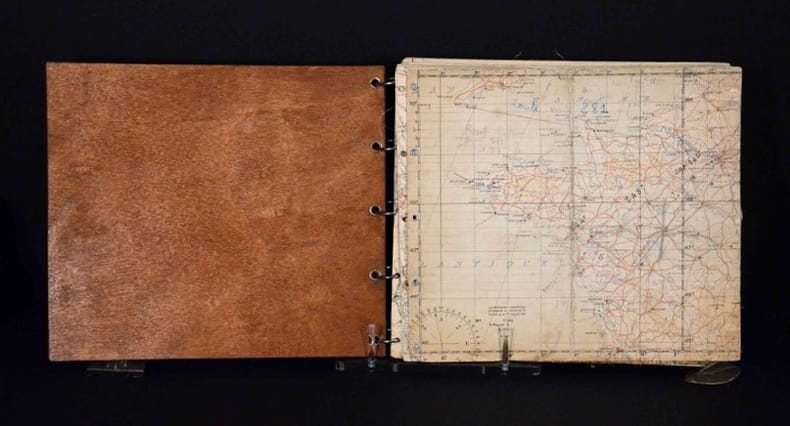
193021551930, Important registre de 33 cartes entoilées, noir et blanc et certaines en couleurs contenu dans une reliure mobile à plaques d'acajou marine tenue par cinq anneaux métalliques 27x30 cm , accompagné d'une pochette en plastique transparent à bords renforcées, 20 x 40 cm contenant les corrections de la hauteur de la Polaire, pour obtenir la latitude et les tables auxiliaires pour l'année 1929. Utilisés par Coste et Bellonte lors de leur traversée entre Paris et New York du 1er septembre 1930. Provenance Maurice Bellonte.
42926Paris, Thielman Kerver, 1498. In-8 gothique sur peau de vélin (115 x 175 mm) de (112) ff. (sig. A-O8), 25 lignes à la page, veau brun sur ais à large décor estampé à froid, dos orné à nerfs, tranches dorées, fermoirs (reliure de l’époque).
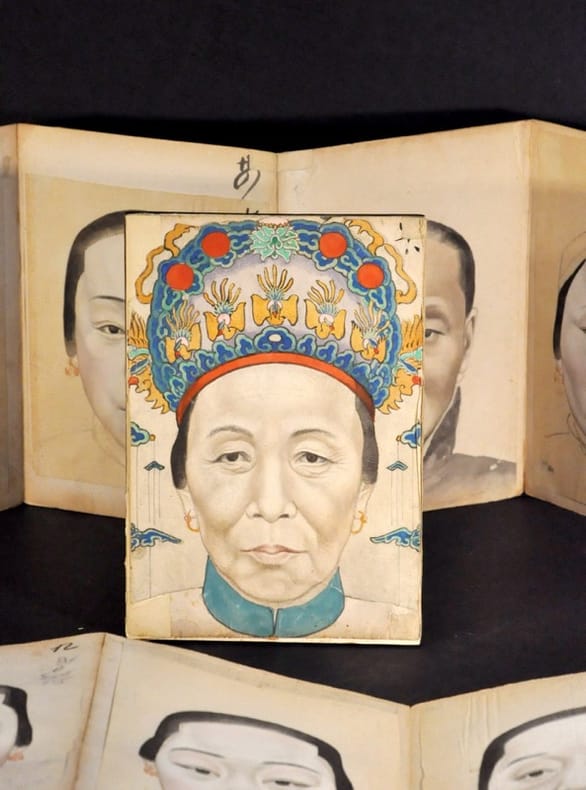
2986Dynastie Qin (1853) 117 portraits à l’aquarelle et au crayon, sur papier de Chine contrecollé sur cartonmonté en soufflets (185x13mm), recto ou recto-verso, protégé par deux haies de boisvernies.Certains onglets rompus ou consolidés anciennement par du scotch.Portant au dos un timbre humide à l’encre rouge plusieurs fois répété , en haut àdroite la plupart des portraits comportent une numérotation en chinois, deux de cesportraits sont accompagnés de commentaires en chinois.
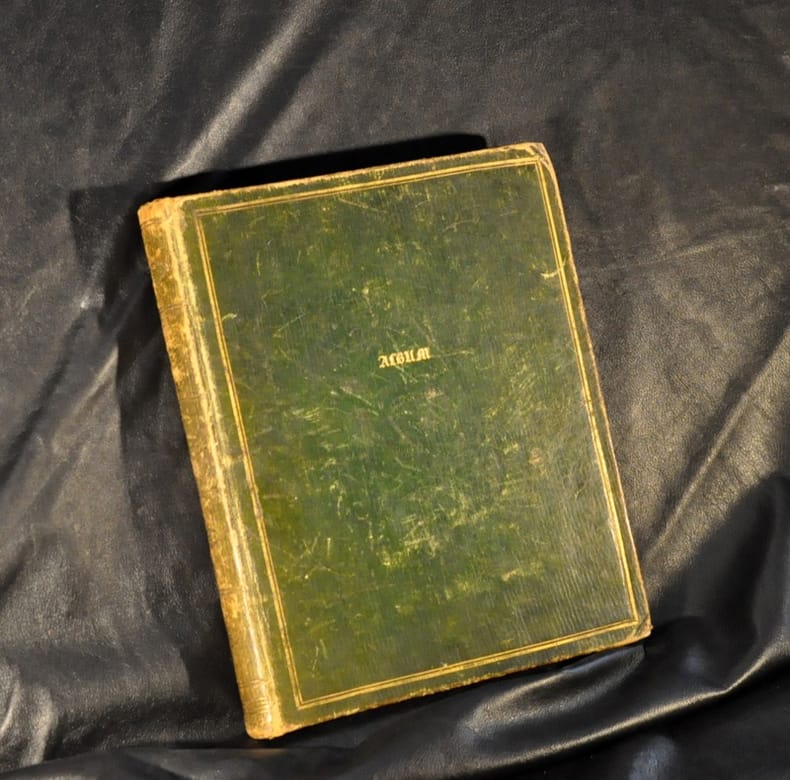
2998Album romantique de 205x260 mm, relie en basane maroquinee verte portant en super- libros sur le premier plat « Album ». Il se compose de feuillets de papier fort bleu montes sur onglets. Sur le verso de la premiere page, une table des matieres manuscrite.Les dessins au nombre de 39 sont colles a pleine page et certains d’entre eux sont decoupes, amputant une partie du dessin, ou sommairement replies en haut ou en bas. Certains dessins decoupes dans leur partie inferieure laissent deviner des ecritures au crayon qui ont ete otees. Un seul dessin, celui d’Anthony Thouret comporte une legende manuscrite.Le papier utilise est un papier fin, hativement decoupe. La plupart des dessins ont ete plies en deux ou en quatre. Certains semblent avoir ete mis sous enveloppe , certains ont ete dechires en tout ou partie puis recolles avec une bande en papier.
1493700DBNürnberg, Anton Koberger, 23. Dezember 1493. Folio (44,5 x 32 cm). (10), 286, (1) Bl. Mit 1980 teils wiederholten Holzschnitten von Michael Wohlgemuth, Wilhelm Pleydenwurff u. a. (einige Holzschnitte koloriert). Späterer Halblederband auf Holzdeckeln mit 2 Metallschliessen (neu aufgebunden mit erneuerten Vorsätzen).
1566WRCAM54413Mexico: Antonio de Espinosa 1566. 440416 leaves with several woodcut illustrations and woodcut initials throughout. Small thick quarto. Contemporary vellum with yapp edges remnants of vellum ties at fore-edge. Light wear and soiling to vellum endpapers renewed. Small marca de fuego on top edge. Moderate wear to initial leaves moderate worming in lower corner and occasionally along lower margin all expertly repaired slightly affecting only a few printed marginalia and catchwords. Light tanning and occasional foxing. A very good copy overall. A very rare complete and substantial example of early Mexican printing. This work was produced and published by Antonio de Espinosa the second printer in the New World after Juan Pablos and is one of the most considerable efforts of his career in Mexico. Espinosa was brought to Mexico by Juan Pablos as an assistant and type cutter in 1550 and he eventually broke Pablos' monopoly and began printing for himself in 1559. The present work printed in 1566 is one of only a handful produced in Mexico during that decade and is one of the initial books of the Mexican incunable period. <br> <br> The text itself is the first edition of a religious work by Bartholomé de Ledesma explicating church sacraments in great detail later reprinted in Salamanca in 1585. The work is split into six parts. The first discusses the sacraments generally and the ensuing five treat individual sacraments in depth. Ledesma was a key figure in the early Mexican church as a close advisor of the second Archbishop in the New World Alonso de Montúfar and the chair of theology at the nascent University of Mexico founded in 1551. He was also one of the foremost proponents of book censorship and prohibition in New Spain and vigorously investigated private libraries and booksellers for forbidden materials and was responsible for the destruction of many volumes. He later became the Bishop of Oaxaca a position in which he served until his death in 1604. <br> <br> Overall the work is a fine example of the sophistication which Espinosa brought to early Mexican printing. The titlepage contains a fine coat of arms that of Archbishop Montúfar and the section on marriage sacraments includes several finely executed woodcut diagrams of consanguinity. The text is printed elegantly in a Roman type which Espinosa had introduced to New World printing with printed marginal notes in italic and woodcut initials throughout. Below the colophon is an excellent example of Espinosa's printer's device the first used on any book produced in the Americas. In his 1940 census of Mexican imprints Wagner located twelve copies of this work and over seventy-five years later OCLC adds only three more. It appears just four times in auction records of which one copy was incomplete. <br> <br> A rare desirable Americanum printed by the second printer in the New World and one of the earliest Mexican incunabula still obtainable. ICAZBALCETA 47. MEDINA MEXICO 50. PALAU 134124. SABIN 39677. WAGNER NUEVA BIBLIOGRAFIA MEXICANA 47. Antonio de Espinosa hardcover books
14805273Gouda: Gheraert Leeu 1480. Contemporary limp sheepskin parchment without a spine so that the sewing is completely visible. Kept in a modern brown half morocco clamshell box. 4to 20.5 x 14 cm. With 4 full-page woodcuts plus 14 repeats. The first shows King Pontianus on his throne the Queen standing next to the throne and the seven wise men standing before them with one telling a story. The last shows the same group but with the king's son Diocletianus telling his story The other two show in one case a wise man and in the other the queen telling a story to the king and are used for various stories. That with a wise man has scroll with an opening where type is set to indicate which wise man is speaking. The first illustrated edition in any language of one of the oldest and most popular texts of early European literature. It is also the first illustrated book printed by Gheraert Leeu just before his better-known Dialogus creaturarum. No copy of any edition before 1483 in any language is recorded in a Dutch library. Known in English as The seven sages of Rome it is a series of educational short stories within a "frame story" in the tradition of the Indian Panchatantra the Arabian Nights etc. and some of the stories are variations on stories told there. These stories were first published in Latin at Cologne in 1472. Leeu probably published the first edition in the Low Countries in Dutch with only a single woodcut dated 25 July 1479. That edition is known only from two incomplete copies. His present Latin edition must date between that and 3 June 1480 so it is not clear whether it preceded the unillustrated Deventer edition of 1479 or later. Our copy is preserved in its original limp parchment and only very slightly trimmed giving wide margins 1.5 4 and 5 cm. With 8 early owners' inscriptions one dated 1579 and others clearly older four small and mostly marginal worm holes running through the first leaves and the usual traces of age and handling. The parchment is stained and slightly wrinkled. Nearly untrimmed and in good condition.l Campbell 947; Goff S-448; Goudriaan Een Drukker zoekt publiek. Gheraert Leeu te Gouda 1477-1484 list of publications no. 46; Hain 3000; ILC 1952; ISTC is00448000 7 copies; Klebs Incunabula 906.4; Kok Woodcuts in Incunabula printed in the Low Countries 69. 1-4; Polain 1970; Van Thienen & Goldfinch 1952 same 7 copies; Vijfhonderste Verjaring Boekdrukkunst Nederlanden 127 with. ill.; not in BMC STC Dutch; Incunabula in Dutch Libraries; Gheraert Leeuw exhibition at Gouda 1992; cf. Lexicon des Mittelalters VII pp. 1836-1839. Gheraert Leeu, unknown