FridolinAntiquariat.de

36 résultats
149114828Gedruckt in Nürnberg bei Koberger, 1491. 31,8 x 22 cm (Blattgröße), 24,6 x 15,6 (Druckspiegel)
149114827Gedruckt in Nürnberg bei Koberger, 1491. 31,8 x 22 cm (Blattgröße), 24,6 x 15,6 (Druckspiegel)
149114830Gedruckt in Nürnberg bei Koberger, 1491. 31,8 x 22 cm (Blattgröße), 24,6 x 15,6 (Druckspiegel)
149114829Gedruckt in Nürnberg bei Koberger, 1491. 31,8 x 22 cm (Blattgröße), 24,6 x 15,6 (Druckspiegel)
1472256254Strassburg: Johann Mentelin 1472. Single leaf printed recto and verso. Text in two columns 62 lines initials supplied in red 5 on recto one on verso. 1 vols. Folio. Fine. Mounted in card folder. Single leaf printed recto and verso. Text in two columns 62 lines initials supplied in red 5 on recto one on verso. 1 vols. Folio. Hain 10366; BMC I 56; ISTC No. in00133000 Johann Mentelin unknown
1472256254Strassburg: Johann Mentelin 1472. Single leaf printed recto and verso. Text in two columns 62 lines initials supplied in red 5 on recto one on verso. 1 vols. Folio. Fine. Mounted in card folder. Single leaf printed recto and verso. Text in two columns 62 lines initials supplied in red 5 on recto one on verso. 1 vols. Folio. From the Press of Johann Mentelin 1472. Hain 10366; BMC I 56; ISTC No. in00133000 Johann Mentelin unknown books
1493700DBNürnberg, Anton Koberger, 23. Dezember 1493. Folio (44,5 x 32 cm). (10), 286, (1) Bl. Mit 1980 teils wiederholten Holzschnitten von Michael Wohlgemuth, Wilhelm Pleydenwurff u. a. (einige Holzschnitte koloriert). Späterer Halblederband auf Holzdeckeln mit 2 Metallschliessen (neu aufgebunden mit erneuerten Vorsätzen).
147159416Rome: Adam Rot 1471. after 2 Oct. 1471. 8vo 12 leaves printed in black with red heading some marginal chipping in two columns good. Probably HC 14820; Pr 3433; BMC IV 42; BSB-Ink 447; GW M42586. Rules and constitution of the Apostolic Chancery. Notes on Benedict XII 1334-1342; Boniface VIII 1294-1303; Paul II 1464-1471; Calixtus III 1455-1458; Boniface VIII 1294-1303; Alexander IV 1254-1261; Gregory X 1271-1276; Clement VI 1342-1352. Adam Rot unknown books
149564829(Brescia, Angelus und Jacobus Britannicus, 26. März 1495. 8°. 94 nn. Bll. (1-2 Spalten, 40 Zeilen, Got. Typ.), Pgmt. d. 16. Jhds. m. durchzogenen Bünden.
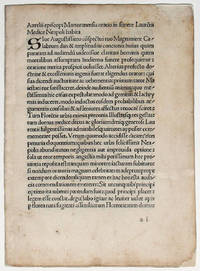
14922680<p>4to. 20.5 x 15 cm 4to. 20.5 x 15 cm 8 ff. rather dog-eared at edges and with some light soiling. Disbound in a cloth-covered box.<br /></p><p>Rare first edition of this funeral oration for Lorenzo de Medici read in Santa Maria Nuova on 16 April 1492 evidently the only contemporary printed oration of the many delivered and printed in his honor to survive.</p><p>"Lorenzo de' Medici… born January 1 1449 Florence Italy—died April 9 1492 Careggi near Florence Florentine statesman ruler and patron of arts and letters was the most brilliant of the Medici. He ruled Florence with his younger brother Giuliano 1453–78 from 1469 to 1478 and after the latter's assassination was sole ruler from 1478 to 1492." Brittanica.com</p><p>The present publication is the sole oration devoted to Lorenzo in the Short-Title List of Funeral Orations from the Italian Renaissance Ca. 1374-1534 compiled by John McManamon and the only printed example featured in the 1992 exhibition at the Bibliotheca Nazionale Centrale <i>Lorenzo dopo Lorenzo La Fortuna Storica di Lorenzo il Magnifico. </i>Notwithstanding the poor survival rate of ephemeral publications and the controversial character of the <i>laudandus</i> the statistic remains remarkable. The motive for the present oration was overwhelmingly political and meant to insure continuation of the traditionally strong alliance between Naples and Florence at a difficult time of dynastic transition. According to Miglio <i>DBI </i>X.369-70 the work was published before it was read.</p><p>A Naples edition was published the same year from the press of Cristannus Preller IGI VI.1722-A. The work was re-published in the 19th century by Vito Capialbi <i>in Memorie di R. Zeno e A. Bienato</i> Naples 1838 49-86. Milanese born Aurelio Bienato was Reader in Rhetoric at the University of Naples 1470-80 and later elected Bishop of Martirano modern Catanzaro in which sinecure he remained until his death. Miglio also lists an unpublished commentary on Quintilian <i>Iter Italicum</i> I.415-16 II.570 and a collection of Latin verses <i>Elegantiarum epithomata</i> an epitome of Lorenzo Valla's <i>Elegantiae linguae latinae</i> which went through a number of incunable editions 1479/80; 1488; 1491. </p><p>US copies ISTC: Huntington Newberry and Yale. </p><p>Provenance: Ritman copy.</p>Goff B-667; BMC vi.784; GW IV.1346; Paolo Pira ed. Lorenzo dopo Lorenzo. La Fortuna Storica di Lorenzo il Magnifico Florence Biblioteca Nazionale 1992 I.24; John M. McManamon Funeral Oratory and the Cultural Ideals of Italian Humanism 1989 p. 256 & 41-43. Phillipus de Mantegatiss
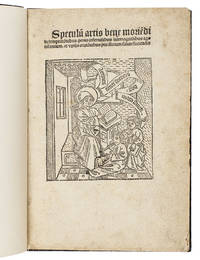
1495ABC_47543Cologne: Heinrich Quentell 1495. Recent marbled paper over boards by the Geneva bookbinder Jean-Luc Honegger b. 1953 who set up his atelier ca. 1978 signed with his honegger stamp in blue ink at the foot of the back paste-down sewn on 3 recessed supports the marbled paper in an antique spot pattern see Wolfe 162-163 with black spots on unusually fine-grained grey Stormont spots and with veins in red turquoise orange dark blue and white black morocco spine label with the title in gold roman capitals reading up the spine. Small Chancery 4to 20.5 x 14.5 cm. With a large woodcut 10.0 x 8.8 cm on the title page: depicting a teacher Pope Gregory the Great ca. 600 CE declared a saint in 1295 with a dove on his shoulder his attribute seated behind a lectern with an open book instructing two of his pupils seated before him each with a book in his hands with above them a scroll inscribed Accipies tanti doctoris dogmata sancti. Set in a single column with 36 lines to the page in a rotunda gothic type Quentell type 7 here 79G though in the Typenrepertorium 80G with a larger textura gothic for the first line of the title Quentell type 10 155G though the only capital in that line is the 8 mm lombardic initial S Quentell initials e described as 6/7 mm but noting that they are used with type 10. With spaces left for manuscript initials 1 6-line and many 3-line a few - mostly on b1v and b2r - with manuscript guide letters in black ink. Most pages with a few words underscored in black ink. Quentells second quarto edition of the well-known manual on the art of dying in the original Latin matching his ca. 1493 quarto edition almost line for line and using the same woodcut quite different from any used with this text before that date. Quentells quarto editions contain the original long version of the text known as Speculum artis bene moriendi often attributed to Matthaeus de Cracovia or Albertus Magnus editions in Italian are often attributed to Dominicus de Capranica Cardinal of Fermo. The Ars moriendi was one of the earliest incunabula printed and consists of two related Latin texts written around 1415 and 1450 offering guidance on how to have a good death according to Christian beliefs of the late Middle Ages. The texts were written in response to the Black Death and social upheavals of the 15th century with the earliest versions likely composed in southern Germany. The highly popular Ars moriendi was translated into many West European languages and was the first in a tradition of guides to death and dying. The first edition in the original Latin appeared ca. 1474 but was preceded by a German edition in 1473 and perhaps by an edition in Italian described as ca. 1471/75. Quentell published the Latin text together with other works in a folio edition described as ca. 1484/89 but he published four quarto editions of the Ars moriendi alone described as ca. 1493 the present ca. 1495 ca. 1498 and another probably after 1500. He published no Ars moriendi editions in vernacular languages. His first three quarto editions have the same collation but the present edition matches the ca. 1493 edition almost line for line and uses the same woodcut while the ca. 1498 edition differs considerably and uses a different woodcut.Heinrich Quentell one of the greatest early Cologne printer-publishers issued many theological and philosophical texts for university use but also liturgical texts working both alone and with Johann Helman who may have also jointly employed contract printers and dispatched servants to sell books. Quentell was one of the first printers to consistently provide his books with title-pages with approximately 91% of his over 380 publications including one.Quentell used the present Magister cum discipulis-woodcut in several other editions including the Heymericus de Campo Promptuarium argumentorum 1492 GW 12406 and Jacobus van Gruitrode Speculum aureum animae peccatricis 1493 GW M10728. Wynkyn de Worde used a copy in his Parabolarum Alani cum commento 1508 STC 254.3 and other printers copied it as well.All Quentells Ars moriendi editions are undated and the present one used his types 7 and 10 and initials e which all apeared in his books in the period 1488 to 1500. The present edition is probably dated ca. 1495 in the literature because it appears to fall between the two quarto editions thought to date from ca. 1493 and ca. 1498.The bookbinder Jean-Luc Honegger still active today is best known for his bindings for the Bibliothèque Nationale de France in Paris and the Bodmer Foundation near Geneva. With the bookplate of the Bibliotheca Philosophia Hermetica Joost Ritman in Amsterdam and probably bound for them. Slightly browned water stains at the foot of a few leaves not approaching the text some smudges in the margins and on the blank final page. The binding slightly worn at the extremities and with a few unobtrusive scratches on the back board. Otherwise in very good condition and only slightly trimmed about 5 mm at the head and probably no more at the fore-edge and foot giving generous margins about 2 3 and 4 cm at the head fore-edge and foot respectively and some leaves with tranchefiles at the foot.l Bibliothèque Nationale Catalogue des incunables A598; BMC I p. 294; Bod-Inc A449; Bohonos Szandorowska Incunabula quae in bibliothecis Poloniae asservantur 562; BSB-Ink A766; Buffévent VIII 45; Goff A1098; Günther Wiegendrucke der Leipziger Sammlungen 781; GW 02610; HC 14911; ISTC ia01098000; Madsen Kongelige Biblioteks inkunabler 352; Ohly-Sack 274; ÖNB-Ink A483; Pell 1339; Polain 972; Proctor 1425; Sack Freiburg 306; Sallander Uppsala 2046; Schramm VIII 484; Schreiber Manuel de lamateur de la gravure sur bois et sur métal au XVe siècle 3671; Thienen Incunabula in Dutch libraries 425; UBL-Ink A354; USTC 739947; Voulliéme Die Buhdrucker Kölns 305; Voulliéme Inkunabeln der Königlichen Bibliothek 1011; Voulliéme Trier 697. Heinrich Quentell, hardcover