424 résultats
4to (270 x 180mm), [6]pp., with introduction followed by 40 ff. in exact facsimile, one of 250 copies, a very good ex-library copy, orig. vellum-backed boards, vellum label on upper cover, uncut.
149564829(Brescia, Angelus und Jacobus Britannicus, 26. März 1495. 8°. 94 nn. Bll. (1-2 Spalten, 40 Zeilen, Got. Typ.), Pgmt. d. 16. Jhds. m. durchzogenen Bünden.
2 Vols., viii, 491; viii, 156pp., orig. cloth, upper hinge to mail work slightly torn.
First Edition, 4to, 133pp., numerous illustrs., orig. decorated wrappers.
15408Paris chez Edouard Giard Georges Andrieux Expert 1939, broché grand in 8 de 68 pages avec de nombreuses illustrations in texte et 4 ht. Manuscrits à miniatures, Livres d'Heures, Incunables, Impressions du XVIème, Livres illustrés des XVIIe, XVIIIe et XIXème siècles.
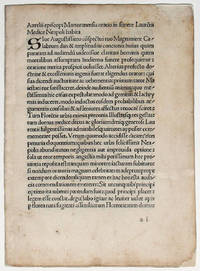
14922680<p>4to. 20.5 x 15 cm 4to. 20.5 x 15 cm 8 ff. rather dog-eared at edges and with some light soiling. Disbound in a cloth-covered box.<br /></p><p>Rare first edition of this funeral oration for Lorenzo de Medici read in Santa Maria Nuova on 16 April 1492 evidently the only contemporary printed oration of the many delivered and printed in his honor to survive.</p><p>"Lorenzo de' Medici… born January 1 1449 Florence Italy—died April 9 1492 Careggi near Florence Florentine statesman ruler and patron of arts and letters was the most brilliant of the Medici. He ruled Florence with his younger brother Giuliano 1453–78 from 1469 to 1478 and after the latter's assassination was sole ruler from 1478 to 1492." Brittanica.com</p><p>The present publication is the sole oration devoted to Lorenzo in the Short-Title List of Funeral Orations from the Italian Renaissance Ca. 1374-1534 compiled by John McManamon and the only printed example featured in the 1992 exhibition at the Bibliotheca Nazionale Centrale <i>Lorenzo dopo Lorenzo La Fortuna Storica di Lorenzo il Magnifico. </i>Notwithstanding the poor survival rate of ephemeral publications and the controversial character of the <i>laudandus</i> the statistic remains remarkable. The motive for the present oration was overwhelmingly political and meant to insure continuation of the traditionally strong alliance between Naples and Florence at a difficult time of dynastic transition. According to Miglio <i>DBI </i>X.369-70 the work was published before it was read.</p><p>A Naples edition was published the same year from the press of Cristannus Preller IGI VI.1722-A. The work was re-published in the 19th century by Vito Capialbi <i>in Memorie di R. Zeno e A. Bienato</i> Naples 1838 49-86. Milanese born Aurelio Bienato was Reader in Rhetoric at the University of Naples 1470-80 and later elected Bishop of Martirano modern Catanzaro in which sinecure he remained until his death. Miglio also lists an unpublished commentary on Quintilian <i>Iter Italicum</i> I.415-16 II.570 and a collection of Latin verses <i>Elegantiarum epithomata</i> an epitome of Lorenzo Valla's <i>Elegantiae linguae latinae</i> which went through a number of incunable editions 1479/80; 1488; 1491. </p><p>US copies ISTC: Huntington Newberry and Yale. </p><p>Provenance: Ritman copy.</p>Goff B-667; BMC vi.784; GW IV.1346; Paolo Pira ed. Lorenzo dopo Lorenzo. La Fortuna Storica di Lorenzo il Magnifico Florence Biblioteca Nazionale 1992 I.24; John M. McManamon Funeral Oratory and the Cultural Ideals of Italian Humanism 1989 p. 256 & 41-43. Phillipus de Mantegatiss
Folio, [x],111,[3]pp., printed in Linotype Estienne with Civilite headings, Cockerell marbled paper boards, title label to spine, uncut. "This [library] was designed to be a guide and inspiration to a working printer and to illustrate the history of printing and all its adjuncts: types, pages, margins, woodcut and other decoration. The great names of Gutenberg, Fust and Schoeffer, Zel, Sweynheym and Pannartz, Wendolin of Speier, Jenson, Crantz, Gering and Friburger, and Caxton appear, and there are a number of examples of the fine borders and initials produced by the Zainers at Augsburg and Ulm and by Ratdolt at Venice."?Preface. Rogerson, 26.
Folio, [iv],xlpp., with the H.P. Kraus bookplate, 46 plates, cont. quarter roan, spine rubbed, marbled sides. The marks of 93 different Spanish and Portuguese printers are included in this study. An alphabetical list of printers' and publishers' names refers the reader to biographical sketch in which each name appears. Information presented includes the dates during which a printer was active, cities in which he worked, and associates with whom he worked. Clear prints of marks are provided, as are the title, author, date and city of publication, and size of book(s) in which each mark appears, as well as citations to other scholarly resources. The index of printers' and publishers' names is comprehensive, guiding users of this work to both the main entry on a printer or publisher as well as to entries in which the name is mentioned, which makes this a useful book for researching the interactions between various printers.
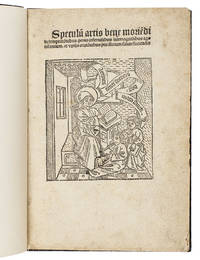
1495ABC_47543Cologne: Heinrich Quentell 1495. Recent marbled paper over boards by the Geneva bookbinder Jean-Luc Honegger b. 1953 who set up his atelier ca. 1978 signed with his honegger stamp in blue ink at the foot of the back paste-down sewn on 3 recessed supports the marbled paper in an antique spot pattern see Wolfe 162-163 with black spots on unusually fine-grained grey Stormont spots and with veins in red turquoise orange dark blue and white black morocco spine label with the title in gold roman capitals reading up the spine. Small Chancery 4to 20.5 x 14.5 cm. With a large woodcut 10.0 x 8.8 cm on the title page: depicting a teacher Pope Gregory the Great ca. 600 CE declared a saint in 1295 with a dove on his shoulder his attribute seated behind a lectern with an open book instructing two of his pupils seated before him each with a book in his hands with above them a scroll inscribed Accipies tanti doctoris dogmata sancti. Set in a single column with 36 lines to the page in a rotunda gothic type Quentell type 7 here 79G though in the Typenrepertorium 80G with a larger textura gothic for the first line of the title Quentell type 10 155G though the only capital in that line is the 8 mm lombardic initial S Quentell initials e described as 6/7 mm but noting that they are used with type 10. With spaces left for manuscript initials 1 6-line and many 3-line a few - mostly on b1v and b2r - with manuscript guide letters in black ink. Most pages with a few words underscored in black ink. Quentells second quarto edition of the well-known manual on the art of dying in the original Latin matching his ca. 1493 quarto edition almost line for line and using the same woodcut quite different from any used with this text before that date. Quentells quarto editions contain the original long version of the text known as Speculum artis bene moriendi often attributed to Matthaeus de Cracovia or Albertus Magnus editions in Italian are often attributed to Dominicus de Capranica Cardinal of Fermo. The Ars moriendi was one of the earliest incunabula printed and consists of two related Latin texts written around 1415 and 1450 offering guidance on how to have a good death according to Christian beliefs of the late Middle Ages. The texts were written in response to the Black Death and social upheavals of the 15th century with the earliest versions likely composed in southern Germany. The highly popular Ars moriendi was translated into many West European languages and was the first in a tradition of guides to death and dying. The first edition in the original Latin appeared ca. 1474 but was preceded by a German edition in 1473 and perhaps by an edition in Italian described as ca. 1471/75. Quentell published the Latin text together with other works in a folio edition described as ca. 1484/89 but he published four quarto editions of the Ars moriendi alone described as ca. 1493 the present ca. 1495 ca. 1498 and another probably after 1500. He published no Ars moriendi editions in vernacular languages. His first three quarto editions have the same collation but the present edition matches the ca. 1493 edition almost line for line and uses the same woodcut while the ca. 1498 edition differs considerably and uses a different woodcut.Heinrich Quentell one of the greatest early Cologne printer-publishers issued many theological and philosophical texts for university use but also liturgical texts working both alone and with Johann Helman who may have also jointly employed contract printers and dispatched servants to sell books. Quentell was one of the first printers to consistently provide his books with title-pages with approximately 91% of his over 380 publications including one.Quentell used the present Magister cum discipulis-woodcut in several other editions including the Heymericus de Campo Promptuarium argumentorum 1492 GW 12406 and Jacobus van Gruitrode Speculum aureum animae peccatricis 1493 GW M10728. Wynkyn de Worde used a copy in his Parabolarum Alani cum commento 1508 STC 254.3 and other printers copied it as well.All Quentells Ars moriendi editions are undated and the present one used his types 7 and 10 and initials e which all apeared in his books in the period 1488 to 1500. The present edition is probably dated ca. 1495 in the literature because it appears to fall between the two quarto editions thought to date from ca. 1493 and ca. 1498.The bookbinder Jean-Luc Honegger still active today is best known for his bindings for the Bibliothèque Nationale de France in Paris and the Bodmer Foundation near Geneva. With the bookplate of the Bibliotheca Philosophia Hermetica Joost Ritman in Amsterdam and probably bound for them. Slightly browned water stains at the foot of a few leaves not approaching the text some smudges in the margins and on the blank final page. The binding slightly worn at the extremities and with a few unobtrusive scratches on the back board. Otherwise in very good condition and only slightly trimmed about 5 mm at the head and probably no more at the fore-edge and foot giving generous margins about 2 3 and 4 cm at the head fore-edge and foot respectively and some leaves with tranchefiles at the foot.l Bibliothèque Nationale Catalogue des incunables A598; BMC I p. 294; Bod-Inc A449; Bohonos Szandorowska Incunabula quae in bibliothecis Poloniae asservantur 562; BSB-Ink A766; Buffévent VIII 45; Goff A1098; Günther Wiegendrucke der Leipziger Sammlungen 781; GW 02610; HC 14911; ISTC ia01098000; Madsen Kongelige Biblioteks inkunabler 352; Ohly-Sack 274; ÖNB-Ink A483; Pell 1339; Polain 972; Proctor 1425; Sack Freiburg 306; Sallander Uppsala 2046; Schramm VIII 484; Schreiber Manuel de lamateur de la gravure sur bois et sur métal au XVe siècle 3671; Thienen Incunabula in Dutch libraries 425; UBL-Ink A354; USTC 739947; Voulliéme Die Buhdrucker Kölns 305; Voulliéme Inkunabeln der Königlichen Bibliothek 1011; Voulliéme Trier 697. Heinrich Quentell, hardcover
65312[Köln, Johann Koelhoff d. Ä., um 1476-1477]. Fol. 45 nn. Bll. (ohne das letzte weiße; Got. Typ., 2 Kol., Rubriziert, eingemalte Initialen in Rot), Roter HLdr.-Bd. d. 20. Jhds. m. goldgepr. Rückentitel.
45867Johann Gruninger Strasbourg 1485. 8vo Intact single page with appropriate light age tanning and creases and only a small tear at upper left edge. This is a single page of a very famous hand printed German bible from one of Europe's most important pre 1500 printers. Recently mounted on black board with a gold frame. Both sides are printed and the page is only lightly attached at its upper edge to the mounting. Obviously over 530 years old now and is a small example of great historical interest. Johann Gruninger Strasbourg 1485 unknown
First Edition, 478,[2]pp., frontis., numerous plates, orig. cloth, d.w. The book contains 28 contributions of which 13 in English, 13 in French, and 2 in German.
3367Feuille d'incunable piémontais du quinzième siècle imprimé à Chivasso (Clavasii). Provenant de « Summa angelica de casibus conscientiae ». Clavassii, Jacobinum de Suigo de Sancto Germano, 1486. Un feuillet petit in-4 (21.5 x 15.3 cm) gothique latin sur 2 colonnes de 55 lignes avec lettrines et rubriques en bleu et rouge (folio L 2). Mouillures claires marginales. Bel état. Goff A-713. Graesse I, 128-129. Brunet I, 289 : « C'est l'unique production typographique connue que le XVe siècle ait vu paraître à Chivasso, petite ville du Piémont. Cette édition est la seule à laquelle on attache quelque prix ».
[Incunabolo-Chiavasso] (cm.20) solida piena pergamena sec. XVIII con titolo calligrafato al dorso. -- cc. 375 (su 388) carattere gotico, 55 linee, spazi bianchi per lettere capitali. Manca la prima carta bianca, la seconda, il nostro esemplare inizia da carta 3 segnata +: "In nomine domini nostri...amen". Manca poi la c. 378 bianca e le ultime 10 carte segnate 1-5 di cui l' ultima bianca. Pertanto il nostro esemplare si compone di 4 carte all' inizio + cc. 176 segnate a-y + cc. 12 segnate z + cc. 183 segnate A-Z.Editio Princeps della famosa "Summa" opera avversata da Lutero e primo ed unico libro stampato a Chivasso nel XV secolo. Fu ristampato circa 70 volte!. Secondo l' opinione più comune Giacomo Suigo, sarebbe nato a San Germano Vercellese; ma giustamente nota il Fumagalli nel "Lexicon Typographicum" p. 371 che Giacomino si dichiara milanese, che il nome di Suico è sconosciuto nel vercellese mentre si trova spesso nelle carte milanesi dell' epoca. Le ultime 10 carte mancanti al nostro esemplare contengono la "Rubrice Juris Civilis et Canonici" Il colophon con i dati tipografici è a carta 376, presente nel nostro esemplare con al verso il "Registrum" in 5 colonne. Segue la carta 377 bianca e presente. Esemplare modesto con margini contenuti, lievi gore e antiche riparazioni, alcuni fori di tarlo ben restaurati a varie carte per lo più all' inizio che intaccano il testo. Alcune antiche chiose ai margini bianchi di alcune carte. Al primo foglio ex libris manoscritto dell' epoca: " Loci palat(i) frus capuccinorum". (Cappuccini di Palazzolo). * Hain-Cop. 5382; * Igi 559; * Bmc VII 1111; * Goff A 713; * Oates 2725; * Pellechet 3812; * Polain I 205; Proctor 7323. Vedi anche la ampia nota sul tipografo nel catalogo d' asta Hoepli 3/4 Dicembre 1929 Lotto 222. [F80] Libro
29846Venise, Léonard Wild, 1489 [sic, pour 1479]. 1 fort vol. in-4°, veau brun estampé à froid sur ais de bois, dos à nerfs en basane blonde jaspée orné de roulettes et de fleurons dorés, pièce de titre en maroquin vert, encadrement de filets et de petits fleurons à froid sur les plats, petits fleurons à froid disposés en cercle au centre, gardes de vélin. Reliure de l'époque, dos refait au début du XIXe siècle, plats très frottés, traces de fermoirs. Exemplaire grand de marges. Impression en car. goth. sur 2 coll. de 48 ll, exemplaire rubriqué, initiales peintes en rouge et en bleu, (1) f. blanc, (378) ff., (1) f. blanc. Signatures : [a-g]12 [h-v]8-12 18 212 [3-4]8 [5-13]12-8 A12 B10 a8 b10. Le f. a2 (qui comporte l'incipit) est en fac-similé sur papier ancien, manque le quart sup. du premier feuillet blanc; Mouillure marginale sur une trentaine de ff. en début de vol. Le reste de l'exemplaire est d'une grande fraîcheur.
1942ARC00110Sveriges Bibliografi intill Å R 1600 Uppsala 1934-1938, Svenska litteratursällskapet. Band I. 1478-1525 : Häft. 1_6 : 12_383_XXXVIII_XXXVII + (4). Band II. 1530-1539 : Häft. 1_7 :IV_528 + (2). Band III. 1583-1590 : Häft. 1_5 : 358_LXXXII + (2). Sveriges Bibliografi 1600-Talet. Uppsala 1942-1946, Svenska litteratursällskapet. Band I. Häft. 1_3 : A-Q Band II. Häft. 1_ 2 :R-Ö : XI_1080. numerous fac-simile throughout (some coloured, some folding).
1511PHO-1971Florence, Sd (circa 1511 ou avant février 1513), Antonio Tubini et Andrea Ghirlandi, in-8, A8-C6, parchemin époque, page de garde détachée avec manque, vieille mouillure claire sur 2 feuillets.
Small 4to (265 x 180 mm), [vi]pp., + 38 pages of facsimiles, limited to 250 copies, a very good ex-library copy, vellum-backed boards, slightly rubbed, vellum label on upper cover, uncut.
4to (270 x 180mm), [6]pp., with introduction followed by 41 ff. in exact facsimile, one of 250 copies, orig. vellum-backed boards, vellum label on upper cover, uncut.
4to, 32pp., introduction followed by an 88pp., unpaginated facsimile on the 1486 edition, orig. old style parchment wrappers, a little browned with a couple of small tears, uncut.
First Edition, folio, 220,[2]pp., limited to 750 number copies, prelims slightly foxed, coloured frontis., 128 plates (of which 3 are coloured), some light foxing to prelims, orig. quarter vellum (the de-luxe binding), uncut, t.e.g.
First Edition, folio, 220,[2]pp., limited to 750 number copies, prelims slightly foxed, coloured frontis., 128 plates (of which 3 are coloured), some light foxing to prelims, orig. quarter vellum (the de-luxe binding), corners a little rubbed, soiled and torn dust wrapper, uncut, t.e.g.
Small 4to, limited to 250 copies, [vi]pp., followed by 26pp., of facsimiles, orig. vellum backed-boards, vellum label on upper cover, uncut, a nice copy.
4to (270 x 180mm), [6]pp., with introduction followed by 9 ff. in exact facsimile, one of 250 copies, ex-library, orig. vellum-backed boards, vellum label on upper cover, uncut.
A standard monograph on Iberian incunabula and post-incunabula. Dozens of facsimile plates. Large, squarish 8vo. Publisher's cloth. As new.