43 665 résultats
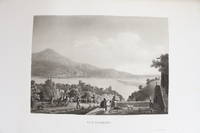
182385268Paris: Panckoucke 1823. Fine. Panckoucke Paris 1823-1832 36 x 54 cm relié First and only edition. This copy is one of the rare examples complete with the 64 full-page plates. The work is also illustrated with a title vignette depicting the artist Ambroise-Louis Garneray in a small boat sketching the entrance to the port of Brest. Contemporary binding of half tan sheep with corners smooth spine richly decorated in gilt and blind with multiple large typographic tools discreet restorations to the joints marbled-paper boards marbled endpapers and pastedowns. A magnificent work on the ports of France and one of the finest collections ever produced on the subject. The author of these highly precise engravings joined the navy at the age of thirteen and thereby witnessed numerous naval battles. From 1806 he was imprisoned for eight years in Portsmouth using his captivity to study drawing and painting and to record the scenes he had observed during his voyages. Upon his return from the United Kingdom Garneray became painter to the Duke of Angoulême then Grand Admiral of France later serving as director of the Rouen museum and entering the Sèvres manufactory where he executed numerous maritime subjects. His work of remarkable delicacy and realism was praised by Melville in Moby-Dick: ""Who Garneray the painter is or was I know not. But my life for it he was either practically conversant with his subject or else marvellously tutored by some experienced whaleman. The French are the lads for painting action."" Panckoucke hardcover
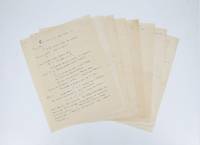
1930822781930. Fine. s. d. 21.40 x 27.20 cm 9 pages sur 8 feuillets ""In the end 5 hours of work for example to produce - per man - all that is necessary to man."" Complete unpublished autograph manuscript in French by Antoine de Saint-Exupéry. 9 pages on 8 leaves in black ink. Traces of horizontal and vertical folds. A small piece of paper missing in the center of two leaves. Exceptional unpublished manuscript by Saint-Exupéry to be compared with his political and economic reflections in Carnets 1989 p. 43. Personally affected by the 1929 crisis Saint-Exupéry the self-taught writer writes passionately about the economy and puts forward reform strategies. The manuscript features a lot of mathematical formulas and equations along with remarks To make the ideas clear about what is happening today p. 1 on the national economic system and the labor market. These unpublished pages testify to Saint-Exupéry's great intellectual curiosity his insatiable need for innovation in all fields of knowledge: mechanics technology politics economics. Saint-Exupéry writes on capitalist reform as he was an outspoken critic of the system which he later personified in The Little Prince businessman character. He develops theories where the State becomes the only employer banker and overall production manager: If the State pays all the salaries including those of the administrations and considers itself as owner of all the products nothing to be changed within the capitalist system in the sense that it can pay to the administrations special bonuses returning in their salaries and according to the quality as well as the quantity. He pays an amount X. He sells having taxed his stocks so that they express Y. His reflection is directly related to the stock market crash that bankrupted the Aéropostale the pioneering airline company where Saint-Exupéry had displayed his talents as an aviator-writer. One also remembers the splendid lines from Terre des Hommes on the value of work: The greatness of a profession is perhaps above all to unite men: there is only one true luxury and that is human relations. Concerned about a better distribution of wealth he develops throughout the pages several labor market and pension system theories halfway between Keynes and Marx. The writer was well aware of the value of labor having himself spent long hours on his aircrafts' mechanics. He details his views on the duration of a working day In the end 5 hours of work for example to produce per man all that is necessary to man. With little work and it is possible to supply men with everything that is and can with the increase of luxury become necessary to them and makes calculations on savings pensions purchasing power. His novels and personal writings contain numerous references to labor and hopes for a more equal human community: Saint-Exupéry was also a man of his time passionate about modernity especially technical innovation who constantly tried to reflect on all the problems that arose from it. Hence the countless notebooks notes and scattered sheets of paper that he constantly filled in and carried in his pockets and trunks with which he might one day have written a book. Jean-Claude Perrier Rare manuscript from a true Humanist a talented artist aviator novelist political and economic thinker. Saint-Exupéry tries to build a harmonious social order and lay the theoretical groundwork for an ideal society. unknown
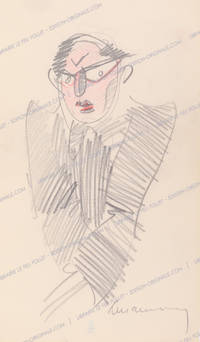
194286828s. l. 1942. Fine. s. l. s. d. 13.40 x 20.90 cm une feuille Original drawing with graphite blue and pink colored pencils signed by Antoine de Saint-Exupéry on a sheet of watermarked paper “Navarre”. HorÂizontal fold pencil annotation in the upper left margin very small loss of paper in the lower right margin. A remarkable caricature signed by Saint-Exupéry akin to a cartoon character. The writer-aviator-artist very rarely signed his graphic works.  « Je ne sais pas ce qui m'a pris je dessine toute la journée et de ce fait les heures me paraissent moins brèves. J'ai découvert ce pourquoi j'étais fait : le crayon Conté mine de charbon. »  ‘I don't know what came over me; I draw all day and the hours seem less fleeting as a result. I've discovered my true calling: the charcoal Conté pencil.' From sketches of barrack mates made in Casablanca during his military service to the watercolours in The Little Prince Saint-Exupéry's life also included an important side-activity: drawing. On letters to his friends in the margins of his manuscripts in books he gave away telegrams invoices tablecloths leaflets - everything he could get his hands on that could serve as a canvas for his imagination - Saint-Exupéry drew sketched caricatured illustrated invented and doodled living and imaginary people friends and girlfriends. He would often casually discard these ephemeral works extensions of his moods and daydreams.  Among these sketches of inspired by circumstance which seem to foreshadow in one way or another his immortal masterpiece very few are fully claimed by the artist-dilettante as his own. Although all of Saint-ExupéryÂ’s graphic work is highly sought-after today fullpage drawings signed by the author of The Little Prince are extremely rare and bear witness to his passion for Man in all his expressions.  Among his drawings which exhibit an astonishing variety of styles this mustachioed head stands out as one of the most accomplished examples of what his sister Simone called his “dreadful caricatures” — she herself along with many of the writer's friends was a frequent victim of his graphÂic parodies. The drawing showcases Saint-Exupéry's fondness for shades of blue and pink which often enliven his colored drawings. Far from being sketched in the margins the drawing is distinguished by its intentionality: the writer took the trouble to sign it which is a rare occurrence. The colored highÂlights and contrasting graphite give it a delightful cartoonish look with its eyes bulging out. Precisely dating Saint-Exupéry's drawings remains challenging. As The Little Prince began to take shape he started from his time in New York to systematically preserve his sketches. Before his American exile most of his earlier drawings—apart from those made in the margins of letters and manuscripts or given as gifts to friends—were discarded by the author.  Precious graphic creation by the faÂther of The Little Prince an importÂant example of his drawings' extraorÂdinary vibrancy and keen sense of contrast.  hardcover
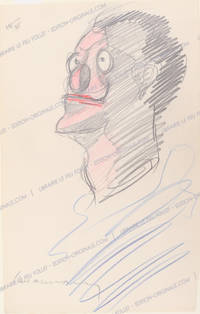
194286799s. l. 1942. Fine. s. l. s. d. 22 x 28 cm une feuille Original signed drawing in pencil and pink crayon by Antoine de Saint-Exupéry on Navarre watermarked paper. Horizontal fold annotation in pencil in upper left-hand corner minute tears in lower margin. Precious drawing signed by Saint-Exupéry the writer-artist very rarely signed his graphic works of a caricature character sharing some of the writer's own features. ""I don't know what came over me he says I draw all day so the hours don't seem so short. I discovered what I was made for: the Conté pencil. From the sketches of barrack mates that Saint-Exupéry then a young conscript made in Casablanca during his military service to the watercolors of 'The Little Prince' the writer's life was marked by the marginal but omnipresent activity of drawing. On letters to friends in the margins of manuscripts in donated books on incoming telegrams invoices tablecloths leaflets - on everything he could get his hands on to support his imagination - Saint-Exupéry drew sketched caricatured illustrated invented doodled living or imaginary beings friends and girlfriends. Then absent-mindedly he threw away these ephemeral works an extension of his moods and reverie of the moment. Among these sketches of inspired by circumstance which seem to foreshadow in one way or another his immortal masterpiece very few are fully claimed by the artist-dilettante as his own. Although all of Saint-Exupérys graphic work is highly sought-after today full-page drawings signed by the author of The Little Prince are extremely rare and bear witness to his passion for Man in all his expressions. Among all these incredibly varied drawings of Saint-Exupéry a recurring character emerges a humorous self-portrait he transforms into an infinite number of silhouettes and characters. Sometimes as it is the case here he transforms himself into a ferocious caricature or into the childlike benevolent figure of the Little Prince. Executed broadly and quickly this drawing shares a great deal with a comical full-length self-portrait also in the same shades with furious striated lines Bibliothèque R. Et B.L. auction sale October 7 2014 lot 196. Several of its attributes can be compared to the writer's own face: the shadow of hair on either side of a round skull or the famous V-shaped arched eyebrows that would later become characteristic of the Little Prince's face. It is difficult to date the writer's drawings precisely. Saint-Exupéry only began to keep his sketches more systematically in New York when The Little Prince was coming of age. Apart from doodles made in the margins of letters and manuscripts or given to friends he destroyed most of his drawings prior to his American exile. This precious portrait fortunately escaped Saint-Exupéry's merciless liquidation. The comical silhouette exudes a familiar air of self-mockery often hovering over the drawings of a writer-aviator who never quite believed in his talent as a draughtsman. hardcover
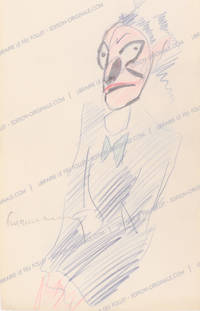
194286829s. l. 1942. Fine. 'I don't know what came over me; I draw all day and the hours seem less fleeting as a result. I've discovered my true calling: the charcoal Conté pencil.' s. l. s. d. 13.40 x 20.90 cm une feuille Original drawing in graphite and blue and pink colored pencils signed by Antoine de Saint-Exupéry on a sheet of watermarked paper ""Navarre"". Horizontal fold. One of Saint-Exupéry's quirky characters in a suit and bow tie spawn from the baroque and overflowing imagination of the Little Prince's author. The writer-aviator-artist very rarely signed his graphic works. From sketches of barrack mates made in Casablanca during his military service to the watercolours of The Little Prince Saint-Exupéry's life also included an important side-activity: drawing. On letters to his friends in the margins of his manuscripts in books he gave away telegrams invoices tablecloths leaflets - everything he could get his hands on that could serve as a canvas for his imagination - Saint-Exupéry drew sketched caricatured illustrated invented and doodled living and imaginary people friends and girlfriends. He would often casually discard these ephemeral works extensions of his moods and daydreams. Among these sketches of inspired by circumstance which seem to foreshadow in one way or another his immortal masterpiece very few are fully claimed by the artist-dilettante as his own. Although all of Saint-Exupérys graphic work is highly sought-after today fullpage drawings signed by the author of The Little Prince are extremely rare and bear witness to his passion for Man in all his expressions. This mysterious eccentric character is one of Saint-Exupéry's creatures whom Delphine Lacroix calls ""sacred monsters with undefined roles"" Antoine de Saint-Exupéry. Dessins aquarelles pastels et crayons. Surrounded by a halo of blue hair his large frightening and almost Cubist-like eyes seem to stem from a single original line. He added figurative elements and then a bow tie - a common feature of Saint-Exupéry's fantastic characters of strange proportions often wearing bow ties or cravats. Precisely dating Saint-Exupéry's drawings remains challenging. As The Little Prince began to take shape he started from his time in New York to systematically preserve his sketches. Before his American exile most of his earlier drawings were discarded by the author apart from those made in the margins of letters and manuscripts or given as gifts to friends. Saint-Exupéry's precious signed and colorful graphic work which fortunately escaped the fate of many of his drawings. hardcover
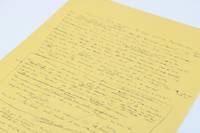
1938839081938. Fine. ""We fed on the magic of the sands others perhaps will dig their oil wells there"" 1938 21 x 27 cm 1 page sur un feuillet Original autograph manuscript by Antoine de Saint-Exupéry one page in black ink on a yellow paper sheet numerous corrections and rewritings. Exceptional working manuscript of a passage from the original French version of Wind Sand and Stars Terre des Hommes from chapter VI ""Dans le désert"" a magnificent ode to the barren wilderness of deserts doomed to disappear due to the inevitable development of the industrial age. This section from the original French novel was removed for the English version translated by Galantière and remains unpublished in English. Moreover the final two paragraphs of the manuscript are unpublished in the original French version. Saint-Exupéry recalls magnificent memories of liberating adversity and cherished ""dissidence"" he experienced in the heart of Mauritanian and Libyan deserts. This heavily corrected state of the text is the true genesis of Saint-Exupéry's Pulitzer Prize winning masterpiece: he reworked and rearranged here his memories published as articles reportages in Paris-Soir magazine in 1938. Some sentences ""What does it matter what you find at the pole if you walk in a state of enchantment"" remaining in the published version are variants of one of his reportages present in the manuscript among redacted and unpublished sentences obscured by pen strokes. This manuscript indicates an early writing stage not mentioned in the Notes et variantes of the comprehensive Pléiade edition. The passage is originally from his fifth article for Paris-Soir entitled ""La magie du désert c'est ça"" ""This is the magic of the desert "" from November 14 1938 published with some of the changes made in this manuscript and other later corrections at the end of the sixth chapter of Terre des Hommes. The central theme of the text dissidence is mentioned in the very first sentence of the manuscript and would later become the title of the passage indicated on the typed proofs. This leitmotiv is steeped in nostalgia with vivid descriptions of fleeting moments of freedom during the writer's escapades in the desert: ""The horizons crossed out : places towards which we ran one after the other faded away 'died out one after the other' in the published text like those insects once trapped by lukewarm hands 'which lose their color once trapped in lukewarm hands ' idem. But there was no illusion 'he who pursued them was not the victim of illusion' idem. We were not mistaken when we walked like this from miracle to miracle 'we were after these discoveries' idem. Nor was the Sultan of the Thousand and One Nights who ran one morning 'pursued a matter so subtle' idem sentence deleted that his beautiful captives one by one died at dawn in his arms having lost scarcely touched the gold of their wings"" It conveys an acute awareness of the end of an era marked by the bankruptcy of Aéropostale and his grave plane accident in Guatemala. Saint-Exupéry takes refuge in the memory of the rebel-filled deserts of Mauritania whose charm wore off with the passing of time: ""But there is no more dissidence. Cap Juby Cisneros Puerto Cansado Dora Smarra there is no longer any word struck out mystery."" It is followed by descriptions of the lands he and his fellow aviators flew over: ""For the pure shell powder sand and the forbidden palm groves gave us their most precious gift: they offered only an hour of fervor and we were the ones who dwelled in it"" The story is told in plural honoring the memory of Guillaumet and Mermoz his friends and famous aviators who fell from the sky. The manuscript also contains a prophetic remark on the deserts soon to be exploited for their resources: ""We fed on the magic of the sands others perhaps will dig their oil wells there and benefit from their deleted: this goods."" We can already see the businessman character in The Little Pr unknown
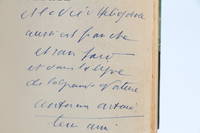
193480016Paris: Denoël & Steele 1934. Fine. Deluxe copy exceptional inscription and historic manuscript: The Crown the Ermine and the Sceptre of the Anarchist Heliogabalus Denoël & Steele Paris 1934 14.50 x 19.50 cm relié First edition one of 100 numbered copies on alfa the only grands papiers deluxe copies after 5 pur-fil paper. Bound in half green morocco paste paper boards marbled paper endpapers wrappers and spine preserved top edge gilt contemporary binding signed Lucie Weill. Skilful and discreet repair to the top of a joint. Illustrated with 6 vignettes by André Derain. Handsome inscription signed by Antonin Artaud: à Alice & à Carlo Rim que j'aime beaucoup parce que j'aime dans la vie tout ce qui est nature franc et sans fard et la vie d'Héliogabale aussi est franche et sans fard et dans la ligne de la grande Nature. Antonin Artaud leur ami. To Alice & Carlo Rim whom I love very much because I love in life all that is nature frank and unvarnished and the life of Elagabalus is also frank and unvarnished and in line with the great Nature. Antonin Artaud their friend. Carlo Rim one of Antonin Artaud's oldest friends was a companion of poetic beginnings and a brother of Marseille blood the French Chicago that nourished their works and their imaginations. Although we do not know exactly how the complicity between Antonin and Pagnol's young protégé Jean Marius Richard alias Carlo Rim was born we do know the melting pot in which their unbreakable friendship was formed: Marseille. Even more precisely between five avenues and the Vieux-Port in the heart of what was the city of Artaud's childhood and literary beginnings. It was in the magazine Fortunio founded by two young baccalaureate graduates Marcel Pagnol and Marcel Palnas Antonin's cousin that Artaud published some of his first poems alongside the very young cartoonist Carlo Rim. Shortly afterwards he titled his own magazine of which only two issues were published after the bilboquet that presided in the Fortunio offices and which had already sealed Rim and Pagnol's friendship during an epic baccalaureate review. When published the same day and with the same publisher Denoël Héliogabale and Carlo Rim's first work Ma belle Marseille the two accomplices went out to celebrate this simultaneous release together with the Literary Tout-Marseille: Kisling Lhote Raimu Dabit Dyssord. In Le Grenier d'Arlequin Carlo Rim will talk of this memorable evening at Titin's during which Artaud overexcited by four mominettes little glass of absinthe enthuses to his neighbouring table about the cult of the phallus and the Sperm Festival introduced by Elagabalus the Sodomite the empaffed Caesar. It was probably during this evening that the two friends respectively offered each other one of the rare luxury copies of their latrine volumes in the literary pool. The two works share more than their contingent publication. The Baudelairian ode to debauchery without thirst and love without soul of Ma belle Marseille agrees as a sister with the background of our wild literature which is according to Le Clézio Héliogabale. Rim's work will have a considerable impact on Artaud who in a famous letter to Jean Paulhan will make it one of the three books to consecrate the legend of his double mystic Saint-Artaud. It is especially at the reading of this unvarnished portrait of the aristocracy and the Phocaean underworld that Artaud will decide the future of Carlo Rim by persuading him to make his first film Justin de Marseille as the filmmaker will recount in his Mémoires d'une vieille vague: I want to play a crackpot ""fada"" in your film a crackpot who would be like a real madman a puzzle solver a proxy of fate an Elagabalus in a hat and sandals! Do you know Etienne the crackpot of the Vieux-Port He is my double and I will show this resemblance again by imitating his voice and his gestures. And Antonin Artaud suddenly dismantled his skinny car Denoël & Steele hardcover
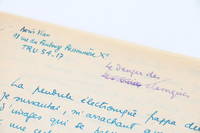
19508512498 rue du Faubourg Poissonnière Xe Paris: S. n.chez l'auteur 1950. Fine. We have not yet attempted to endow the machine with general knowledge S. n. chez l'auteur 98 rue du Faubourg Poissonnière Xe Paris s. d. 1950 21 x 27 cm 18 feuillets numérotés Important original autograph manuscript signed of Boris Vians short story written in 1950 first published in Bizarre no. 3233 in 1964 and later included in the posthumous collection Le Loup-Garou in 1970.With Vians autograph name and address at the head of the manuscript. Extensively revised manuscript written in blue and violet ink on the versos of each leaf with a pasted slip of corrections mounted to page 13. A striking work of speculative fiction in which Boris Vian prophesies artificial intelligence as a conversational module drawing on the integration of encyclopedic data: The model you see here is designed to acquire the complete knowledge contained in the sixteen volumes of the Larousse Grand Encyclopedic Memo of 1978 . It is an administrative machine Florence. It is meant to serve as an adviser . For every request for information it will provide the typical answer of an extensive French culture. In all circumstances it will indicate the course of action to follow explain what it is about and how to behave . It must absorb everything. It only has a chance of balanced behaviour if it knows everything. Only on this condition can it remain objective and impartial. Unlike the utopias of his time Vians narrator does not imagine an A.I. with its own thought and sensibility but rather a true aggregator of knowledge equipped with an autonomous and efficient search engine. Paradoxically its sensibility becomes the cause of its downfall: after absorbing Toi et moi Paul Géraldys sentimental romance the machine falls in love and ultimately assaults its creator. Anticipating Google and ChatGPT more than fifty years before their emergence Vians little futuristic tale above all stages the dynamics of human relationships the real subject of the story in which he joyfully inverts the conventions of seduction. A very rare signed literary manuscript by Boris Vian. Provenance: Boris Vian Foundation. S. n.[chez l'auteur] unknown
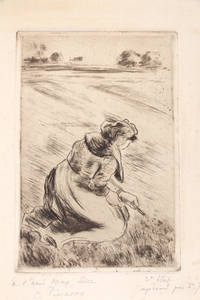
1887873521887. Fine. An Impressionnist Token of Friendship s. d. 1887 20.50 x 30.50 cm une feuille Original etching signed and inscribed by Pissarro to Maximilien Luce 1887 leaf: 205 x 305 cm; plate: 11 x 161 cm one leaf Rare original etching by Camille Pissarro titled ""La Sarcleuse"" one of 12 prints in 2nd state after the artist's first state print and three or four proofs in 2nd state. Like several other copies it is marked in pencil ""2e État imprimé par F. Jacques"". Uniformly browned scattered foxing outer margins sunned with small marginal tears. Exceptionally inscribed by the artist to his great friend the painter Maximilien Luce: ""Pour l'ami M. Luce"". Another print provides context for this beautiful portrait which is said to have been inspired by the silhouette of a peasant woman in the fields at Eragny in the Oise region. This rare and superb etching can be compared with the painting of the same name Les Sarcleuses Pontoise 1882 exhibited at the VIIth Impressionist exhibition. This print is the only one bearing an inscription by the artist listed in his catalogue raisonné Delteil no. 72 with only four listed Musée du Luxembourg - now BnF - New York Public Libary Campbell Dodgson Alfred Beurdeley. The etching also dates from the year of their meeting in 1887 when Pissarro along with George Seurat and Paul Signac met Luce at the Salon de la Société des artistes indépendants. They immediately bonded over their ideas and artistic pursuits: ""Luce's revolutionary convictions were confirmed when he met Camille Pissarro . Both men had a taste for the working environment industrial labor for the first agriculture for the latter"" Xavier Mauduit. Through contact with Pissarro Luce adopted the tonal division dear to the Neo-Impressionist movement Pissarro belonged to. unknown
186183274Paris: Poulet Malassis & De Broise 1861. Fine. Poulet Malassis & De Broise Paris 1861 12.50 x 19 cm relié The second édition originale on ordinary paper. Fifteen hundred copies had been printed plus 4 on chine paper a few copies on hollande and on vélin. Complete with the portrait of the author by Félix Bracquemond often missing here in first state on papier chine pasted on the page before letters i.e. L'Artiste on top of the portrait. Orange half cloth Bradel binding smooth spine double ruled in gilt gilt date at foot slightly scratched brown shagreen title-label marbled paper boards slightly later 19th-century binding. Mistakenly considered as partly original this edition was entirely revised by the author with 35 newly composed poems and 55 deeply rewritten poems profondément remaniés among the 129 poems. This true new first edition of Les Fleurs du Mal is the culmination of Baudelaire's grand uvre and the only text of reference for foreign language translations. AN EDITION WORTHY OF FURTHER RESEARCH Long considered a simple expanded edition this important publication has received little scholarly interest although it offers a valuable and instructive research area: namely the different states of Bracquemond's engraving but also the misprints of the very first copies partly corrected during printing including two missing initials in our copy p. 20 and 49 added in ink at the time. It strangely resonates with a remark made by Charles Baudelaire to his editor in January 1861: Without a doubt the book has good general appearance; but until the last good leaf I found gross negligences. In this house it is the proofreaders who are lacking. For example they don't understand punctuation from a logical point of view; and many other things. There are also broken letters fallen letters Roman numerals of unequal size and length etc. . His editor Poulet-Malassis had indeed separated from his printer De Broise and the new Fleurs du Mal edition was printed by Simon Raçon in Paris. This change of printer could also be linked with the foxing present in numerous second edition copies which could be explained by a paper of lesser quality making copies without foxing especially rare. POSTERITY'S CHOICE Les Fleurs du Mal have two faces. To the third one it is allowed to dream. When Claude Pichois collected Baudelaire's works for the Pléiade edition he had to choose between three: the first of 1857 the 1861 edition revised by the author and the last published shortly after Baudelaire's death in 1868. Although the 1868 third edition is the most complete with 25 added poems its architecture and perhaps even the choice of unpublished poems may not have accurately reflected the poet's initial wishes. This is certainly the more comprehensive however it can only be qualified as partly original. Along with an introduction by Théophile Gautier the poet Théodore de Banville established the order of the edition and included numerous unpublished poems among the already existing ones. The mythical historically influential 1857 first edition obviously cannot be stripped from its princeps status. With its famous misprints carefully hand corrected on the first copies given out by the author its censored poems missing from the second edition but above all its thoughtful and corrected editing right up to the very last proofs and to the point of driving his editor crazy nicknamed Coco mal perché that Baudelaire exhausted with remarks and criticisms the so-called 1857 edition is unquestionably a landmark in literary and poetic history. The few copies containing the condemned pieces are among the most desirable bibliophilic treasures. However the first edition could not be considered the sole form of Baudelaire's masterpiece as the poet thoroughly revisited it in the following years. Far from a simple collection of poems Les Fleurs du Mal is built from a unique narrative logic in the history of poetry. As his editor Pou Poulet Malassis & De Broise hardcover
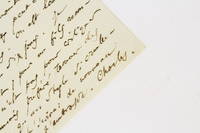
186562589Biponti Deux-Ponts 1865. Fine. Biponti Deux-Ponts Vendredi 12 mai 1865 13.20 x 20.80 cm 1 page sur un feuillet remplié Autograph letter signed by Charles Baudelaire written in ink and addressed to his mother. A few underlinings deletions and authorial corrections. This letter was first published in Charles Baudelaire Dernières lettres inédites à sa mère in 1926. Former collection of Armand Godoy no. 197. A precious letter from Baudelaire's Brussels period during the poet's voluntary exile at the end of his life. « Il est douteux que j'habite quelque part à Paris. Je crois que j'habiterai surtout une voiture dans laquelle je ferai si je peux toutes mes courses en un ou deux jours. » Haunted by Paris the city of vice and creditors he dreads this brief return. His exile in Brussels is in his eyes a sign of failure and ever since arriving in Belgium he has delayed his return to France. Yet weary of the flat country he despises he mocks its inhabitants: « On est lent ici. » The poet like the seventeen-year-old student who once promised his mother he would get back on track now vows: « Me voici en mesure d'accomplir tous mes plans. Je ne sais comment t'exprimer ma reconnaissance ; et je crois que la meilleure manière sera d'exécuter mes promesses. » Literally obsessed with this sacred mother « who haunts his heart and his mind » the « grateful son » sees himself as incapable of fulfilling his poetic destiny without her undivided attention. unknown
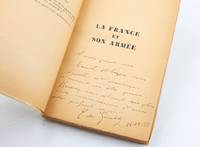
193886447Paris: Plon 1938. Fine. An important presentation inscription to his strategic mentor Plon Paris 1938 13 x 19.50 cm broché First edition on ordinary paper with the printed dedication to Marshal Pétain. Discreet restorations to the spine. Our copy is housed in a chemise and slipcase of navy blue half morocco smooth spine lettered with author title and date in palladium decorated paper boards grey paper pastedowns slipcase trimmed with matching navy morocco and decorated paper sides; binding signed by Boichot. An exceptional copy inscribed by General de Gaulle to Colonel Émile Mayer his great friend . without whom this book could not have been conceived as stated in the authors own inscription which continues: Receive my Colonel my deepest gratitude and my profound respect. A visionary soldier and theorist whom de Gaulle would later acknowledge as his strategic mentor Émile Mayer corrected the very proofs of this work which is here presented to him in these warm lines. Fifteen years before the First World War Mayer had predicted the trench warfare to come. From the 1920s de Gaulle frequented the salon of this great thinker of military art whose Jewish origins and Dreyfusard sympathies had subjected him to calumnious antisemitic attacks and suspension from the army between 1899 and 1907. Both Mayer and de Gaulle opposed the immobile dogma of the French General Staff. Their military prophecies proved extraordinarily accurate concerning the mechanisation of the modern army: For fifteen years they confronted the same themes not without disagreements and each evolved while enriching the other Milo Lévy-Bruhl. At their weekly lunches they exchanged perspectives on the future of corps and tactics both convinced of the futility of the Maginot Line. Mayer favoured a strategy of aerial and chemical warfare while de Gaulle advocated the use of armoured divisions. Despite their differences Mayer actively promoted the ideas of his protégé and assisted in revising France and Her Armyhaving been won over after the shock of the reoccupation of the Rhineland to de Gaulles ambition of creating a professional armoured army. De Gaulle addressed these remarkable words of gratitude to his mentor just two weeks before Mayers death on November 28 1938 which grieved him deeply. An exceptional presentation copy from General de Gaulle of his essential and visionary work on military strategya significant testimonial linking two independent spirits who revolutionised the theoretical understanding of national defence. Plon hardcover
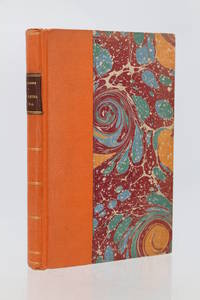
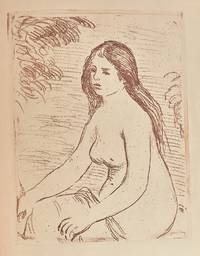
190687491Paris: H. Floury 1906. Fine. H. Floury Paris 1906 20.50 x 27 cm relié First edition one of 100 copies on Japon the only deluxe issue. Navy blue half shagreen with slight color restoration spine with five raised bands abundantly framed in gilt blue watered silk flyleaves marbled endpapers and pastedowns original wrappers and spine preserved gilt top edge binding signed J. Querelle. A superb copy on japon of the first authoritative publications on the history of Impressionism and the first bibliophile edition centered around this movement. Illustrated edition with 6 original etchings by Pissarro Les Faneuses; Renoir Femme nue assise and Femme nue couchée; one of only three etchings ever made by Cézanne Portrait of Guillaumin; Armand Guillaumin Vue près de Saardam - the copy is complete with the additional etching by Renoir on bistre Seated Nude Woman' reserved for copies on japon. The work also features a frontispiece rotogravure of Fantin-Latour's Atelier aux Batignolles. In addition to the six original etchings the book features 21 full-page plates including a colour rotogravure of Monet's famous Impression sunrise and no fewer than 105 reproductions of works and portraits of artists in the text. Théodore Duret paints here the great history of the movement he championed collected and theorized from its very beginnings. As early as 1878 he had published a small study that made him the first historian of these artists if not of the group itself just four years after their first exhibition at Nadar's studio. Twenty years after the last Impressionist exhibition Duret establishes the comprehensive story of this artistic revolution: ""For the early twentieth century and the decades to follow the history of Impressionism is Duret's 'The history of the Impressionist painters'."" Laura Iamurri. Renowned for its chronological accuracy - although in many cases Duret recalls events from his own memories - this work became a reference and was widely reprinted and translated London: Grant Richards 1910; Berlin: B. Cassirer 1909. Duret dedicates a monograph to each painter he mentions with the exception of Caillebotte and places Berthe Morisot in what he refers to as ""the core group of Impressionists."" Absent from his 1878 study Paul Cézanne now considered a post-Impressionist and Armand Guillaumin make their appearance here. A true art gallery on papier japon this text of reference for generations of readers' Laura Iamurri was the first to find a legitimate place for Impressionism in French art history. Not in Carteret. Etchings by Renoir Delteil 12 14 15; Camille Pissarro Delteil 94/XII Cézanne Venturi 1159; Armand Guillaumin Armand Guillaumin 1841-1927 gravures et lithographies 1995 p. 41. H. Floury hardcover
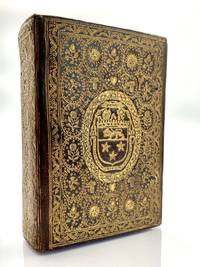
160275949Anvers Antwerp: Jean MoretusEx officina plantiniana apud Ioannem Moretum 1602. Fine. Jean Moretus Ex officina plantiniana apud Ioannem Moretum Anvers Antwerp 1602 8.20 x 12.60 cm relié New Plantin press editions in portable format of these three works. Ruled throughout in red ink. Copy with the arms of Nicolas de Villars clerical councillor at the Parlement of Paris and treasurer of the Sainte-Chapelle later bishop of Agen. Contemporary full soft brown morocco a fanfare binding with the rare Duodo-type decoration: smooth spine gilt with six medallions each containing a flower gilt foliage border covers fully gilt with 24 medallions some emblematic sun heart acorn bouquet sheaf of wheat arms stamped in the centre edges gilt. Discreet restorations to joints corners and headcaps; upper and lower borders with minor wear to leather 0.5 cm; lacking ties; pinhole at head of spine. From the first title-leaf a wormhole in the lower margin extending through to the final leaves of the Fables of Aesop gradually diminishing. A magnificent copy of the utmost rarity. The singular decoration of this style of binding representing one of the pinnacles of the art of French bookbinding is today identified as Duodo after Pierre Duodo Venetian ambassador to Paris from 1594 to 1597. About 150 small volumes were uniformly bound for a portable library only part now known probably towards the end of his stay. It is unlikely he ever enjoyed these treasures which fell into oblivion for nearly two centuries. When they reappeared on the English market at the end of the eighteenth century they were mistakenly attributed to Marguerite de Valois an error that persisted until the 1920s. Although the name Duodo remains attached to this style of decoration another great collector commissioned similar bindings: Nicolas de Villars bishop of Agen. Duodos bindings are now well identified while those of Nicolas de Villars are considerably rarer on the market. While the spine here is very close to the Duodo examples with flowers and foliage borders though in a finer and denser design the covers show 24 medallions compared to only 14 on Duodo bindings and the tools employed are not limited to floral motifs but include a variety of emblems such as the sun and the heart. Jean MoretusEx officina plantiniana, apud Ioannem Moretum hardcover
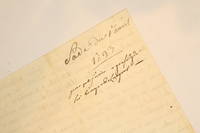
1793733941793. Fine. 1er avril 1793 15.60 x 20 cm une page sur un feuillet Unpublished autograph letter signed and dated written in black ink and addressed to a notary. On the verso probably in the hand of a secretary the inscription ""Sade du 1er avril 1793""; below this inscription a short sentence in the Marquis's hand: ""so that I may write to Gaufridy to send him money"". Some transverse folds from the original folding for posting. Lengthy letter addressed to a notary while the Marquis freed on April 2 1790 by the abolition of royal warrants is at liberty and attempting to put his affairs in order. After the Revolution his sons emigrated and he did not follow them. His name nevertheless appears on the list of persons who left France due to the revolutionary troubles: ""I hope that with all this I will manage to have my name erased from that fatal list of émigrés."" Anxious not to be considered a ci-devant Marquis in this period preceding the Terror he insists on the persecution of which he claims to be a victim despite his good will: ""It is an unparalleled atrocity that such a trick should have been played on me who have not left Paris since the revolution and who since that time have not ceased to give the most unequivocal proofs of my patriotism"". In this letter Sade also denounces the complexity of the workings of the French administration after the Revolution: ""I have just sent M. Lions the appropriate certificate of residence and I have attached a petition to the district which he tells me is . essential."" Impecunious he begs his lawyer ""to excite the zeal of those who owe him and to urge them to pay as much money as they collect immediately to M. Gauffridi sic"" and does not hesitate to show himself obliging in order to achieve his ends: ""spare no effort then I beseech you . always preserve for me your care and your friendship . I embrace and greet you with all my heart."" Sade's efforts would prove futile; in December 1793 he was imprisoned at the Madelonnettes before being admitted through the good offices of his friend Mme Quenet to the Coignard de Picpus establishment a nursing home sheltering wealthy suspects. Interesting unpublished letter showing the unfortunate Marquis at bay during one of his rare moments of freedom. unknown
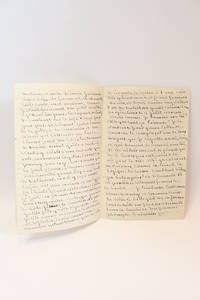
191564417La Maison-Forestière 1915. Fine. La Maison-Forestière 28 mai 1915 13.40 x 21.30 cm 4 pp. sur un feuillet double One of the most magnificent letters by Fernand Léger La Maison-Forestière Argonne 28 mai 1915 134 x 213 cm loose leaves A fabulous handwritten letter by the painter Fernand Léger written on the front line during the Battle of Argonne addressed to the Parisian art trader Adolphe Basler. 92 lines in black ink four pages on a double leaf dated 28 May 1915 by Léger. The handwritten letter is presented with a half forest green morocco chemise green paper boards with a stylised motif endpapers lined with green lamb slip case lined with the same morocco the piece is signed by Goy & Vilaine. The letter was chosen for Cécile Guilbert's anthology Les Plus Belles Lettres manuscrites de Voltaire à Édith Piaf Robert Laffont 2014. A true masterpiece of correspondence this exceptional missive by Fernand Léger shows that the experience of the trenches is of fundamental importance to his future work. Sent to the Engineering troops in 1914 Léger spent two years on the front at Argonne in the Maison-Forestière section from where he writes this letter on 28 May 1915 pendant que les obus lui passent au-dessus de la tête while shells were passing over his head. In complete freedom of tone and form the Célinian charm of this style is a surprise and is a sign of the mécanique mechanical period of his post-war painting. Through his letter we witness his political conscience awakening to contact with the men he has met on the front line whose merit and bravery made their mark on the painter. His particularly clear analysis of the inhumanity of the war gives this missive a place amongst the most beautiful combat letters of the first World War. Fernand Léger is replying to Adolphe Basler a Polish art critic who was Guillaume Apollinaire's secretary and a trader of paintings. Basler probably met Léger around 1910 since he was a member of the bande à Picasso Picasso's gang and was strongly influenced by Cubism alongside Derain Maurice de Vlaminck and Max Jacob. Trying his hand at monochrome and then at abstraction Léger applies the principles of form decomposition and perspective distortion. His work with Cubists becomes premonitory of the pending apocalypse. Some years later this Cubist vocabulary in fact becomes for Léger the perfect illustration of the war which he describes to Basler: It is linear and abrupt like a geometry problem. So many shells for such a long time on such a surface so many men every metre ready to go at any given time. More than ever the Cubist innovation allowed the contemporary world to be translated swaying between rationalism and chaos. Contact with the trenches causes a real upheaval both intellectual and artistic for the painter. As Blaise Cendrars comments It was at war that Fernand Léger had a sudden revelation of the depth of today.. Léger tell Basler of his vision of an industrial inhumane and depersonalised war: The wavering is over. It is a war without waste.' Everything goes. Everything is organised for maximum return. This war is the perfect orchestration of the all methods of killing old and new. It is intelligent through and through. It is even annoying there is nothing left that is unexpected. Léger's pertinent analysis was reflected in his post-war canvases by very calculated and balanced aesthetics a rendement pictural painting output of the image of the modern war in which he took part. For Léger the Cubist lesson is accompanied by a deep reflection of modernity and the modern men that he wishes to represent in his painting. The letter shows the gestation of his post-war painting style keeping the Cubist elements while making his canvases more vibrant with color and patterns taken from his time in the trenches. In fact Léger gives Adolphe Basler a glimpse of his famous période mécanique mechanical period in the 1920s of which the propheti hardcover
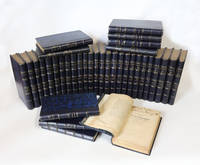
182669321Paris: Ladvocat 1826. Fine. Ladvocat Paris 1826-1831 & 1824 & 1838 13 x 21.50 cm 36 volumes reliés First collected edition partly original by far the most important and most sought-after cf. Clouzot with Chateaubriand having revised and reworked a large part of his writings.This set also contains in first edition several texts including Les Natchez Le Dernier Abencérage Le Voyage en Amérique and Moïse placed at the end of vol. XXII and often lacking. Each volume illustrated with a frontispiece by Charles Thompson. Bound in contemporary navy blue half shagreen spines with five raised bands marbled paper boards marbled endpapers and pastedowns. A few spots of foxing. Together with these collected works uniformly bound: a volume entitled uvres diverses collecting several political pamphlets in first edition; Le Congrès de Vérone 2 vols. Delloye 1838; Essai sur la littérature anglaise and Miltons Paradise Lost both Gosselin 1839. In the volume uvres diverses important presentation inscription signed by François-René de Chateaubriand to Monsieur Henri Bayart on the half-title of La nouvelle proposition relative au bannissement de Charles X et de sa famille. This inscription dating from the writers final years is addressed to Henri Bayart 18251892 godson of the Duchesse de Berry and brother of Sophie-Josèphe Bayart a close friend of François-René and his wife. The Chateaubriands and the Bayart family formed bonds of friendship and business during the Hundred Days and remained close until the end of their lives. As staunch legitimists devoted to the Bourbon cause they even attempted the impossible in seeking to have the writer appointed governor to the young Comte de Chambord claimant to the French throne. When writing this inscription probably around 1843 Chateaubriand was at the twilight of his political and literary life; close to the Comte de Chambord then exiled in England the Bayarts once again tried to intercede on his behalf sending Henri Bayart without success to persuade the last Bourbon heir to invite the ageing writer into his circle. A rare and fine set in uniform bindings containing numerous first editions and enriched with an important presentation inscription. Ladvocat hardcover
186771232Nohant Nohant-Vic 1867. Fine. Nohant Nohant-Vic 21 décembre 1867 13.40 x 20.70 cm deux feuillets sous chemise et étui Autograph letter from George Sand to Gustave Flaubert dated December 21 1867 8 pages on two lined leaves. Published in Sand's Correspondance XX pp. 642-645. From one of the finest literary correspondences of the century this letter written on Christmas Eve 1867 is a sublime testament to the frank friendship between George Sand the old troubadour and Gustave Flaubert christened cul de plomb leaden ass after declining his invitation to Nohant to complete L'Éducation sentimentale. Despite their seventeen year-age gap opposing temperaments and divergent outlooks on life the reader is gripped by the tenderness and astonishing verve of George Sand's long confession to Flaubert. At the height of her literary fame and enjoying her theater in Nohant Sand talks at length about politics their separation their conception of the writer's work and life itself. In this stream-of-consciousness letter Sand naturally and freely sets down on paper eight pages of conversations with Flaubert who made only too rare and brief appearances in Nohant: But how I chat with you! Do you find all this amusing I'd like a letter to replace one of our suppers which I too miss and which would be so good here with you if you weren't a cul de plomb leaden ass who won't let yourself be dragged along to life for life's sake whereas Flaubert's motto then busy writing L'Éducation sentimentale was rather art for art's sake. In the end of 1867 Sand grieved the death of an almost brother François Rollinat which Sand appeased with letters to Flaubert and lively evenings at Nohant: This is how I've been living for the last 15 days since I stopped working . Ah'! . Ah! when you're on vacation work logic and reason seem like strange swings. Sand was quick to criticize him for working tirelessly in his robe the enemy of freedom while she was running up and down mountains and valleys from Cannes to Normandy even to Flaubert's own home which she had visited in September. On this occasion Sand had happily reread Salammbô where she picked up a few lines for her latest novel Mademoiselle Merquem. Their literary and virile friendship similar to Rollinat's defied the old guard of literati who declared the existence of a sincere affair between man and woman utterly impossible. Sand who has been described in turn as a lesbian a nymphomaniac and made famous for her resounding and varied love affairs began a long and intense correspondence with Flaubert for whom she was a mother and an old friend. She called herself in their letters old troubadour or old horse and no longer even considered herself a woman but a quasi-man recalling her youthful cross-dressing and formidable contempt for gender norms. To Flaubert had compared the female writers as Amazons denying their femininity: To better shoot with the bow they crushed their nipples Sand replied in this letter: I don't share your idea that you have to do away with the breast to shoot with the bow. I have a completely opposite belief for my own use which I think is good for many others probably for the majority. A warrior yes but a peaceful warrior Sand willingly adopted the customs of a world of misogynistic intellectuals while remaining true to herself: I believe that the artist should live in one's nature as much as possible. To the man who loves struggle war; to the man who loves women love; to the old man who like me loves nature travel and flowers rocks great landscapes children too family everything that moves everything that fights moral anemia she then adds. A fine evocation of her green period this passage marks the time of Sand's country novels when mellowed by the years she gave herself over entirely to contemplation to write François le Champi La Mare au diable and La Petite Fadette. But her love of nature didn't stop unknown
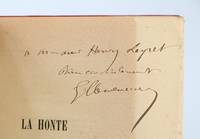
190386548Paris: P.V. Stock 1903. Fine. Rare inscription to a fervent Dreyfusard and chronicler at L'Aurore P.V. Stock Paris 1903 16 x 18.50 cm relié First edition one of 12 numbered copies on hollande paper the only large paper copies. Full red shagreen binding spine with three raised bands decorated with gilt fillets and gilt cartouche enriched with black typographic motifs marbled paper endpapers and pastedowns bookplate affixed to pastedown original wrappers and spine preserved top edge gilt other edges uncut. Foxing to some uncut edges. Autograph inscription signed by Georges Clemenceau to Monsieur Henry Leyret political and judicial chronicler and editor at L'Aurore. The Tiger here presents his monumental work on the Dreyfus Affair to one of his collaborators at L'Aurore where ""J'accuse!"" was published. Both Leyret and Clemenceau shared a profound sensitivity to social injustice. Leyret himself led a successful campaign in the pages of the same newspaper against the unjust sentences to hard labour imposed on anarchists. He was directly involved in L'Aurore's pro-Dreyfus commitment by writing a major article on the founding principles of the newly created League for the Rights of Man three months after ""J'accuse!"". In 1898 he compiled Esterhazy's correspondence for posterity: ""Let them now read the Letters of a Guilty Man let them read them to their wives to their sons. Ah! I defy them not to be indignant not to catch in the eyes of their listeners a flash of anger an expression of disgust and not to cry out: 'No! This acquitted man is not innocent!'"" An exceptional inscription to a committed chronicler who waged the fierce struggle for law and justice alongside Clemenceau in the columns of L'Aurore. P.V. Stock hardcover
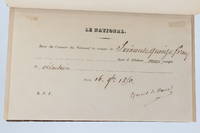
184880363Paris: Ferdinand Sartorius 1848. Fine. Ferdinand Sartorius Paris 1848 13.50 x 22 cm relié Ferdinand Sartorius Paris 1848 135 x 22 cm one volume bound in shagreen & one note First edition rare and very sought after according to Clouzot. Precious copy with the title page having the correct date of 1848. This work is the first to be published recounting Nerval's stay in Egypt and will be followed the same year by Femmes du Liban. These two main texts will form the famous Voyage en Orient in 1851. Copy free from foxing some leaves have angular fold marks. Binding in half green shagreen spine in four compartments enhanced with gilt stipples decorated with double gilt spine panels and fleurons black fillets some signs of rubbing marbled paper boards two corners restored sprinkled paper endpapers charming contemporary binding. Our copy is enriched with a receipt for the amount of seventy-five francs signed by Gérard de Nerval and mounted on the guards. Extremely rare in good condition according to Clouzot. Ferdinand Sartorius hardcover
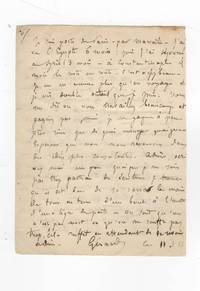
184475148Paris 1844. Fine. Paris 11 février 1844 10.40 x 13.60 cm quatre pages sur deux feuillets Three autograph letters signed by Gérard de Nerval 2 pages signed «Gérard» Théophile Gautier 1 page and a third unsigned letter 1 page penned by a certain «Robert» cf. Nerval's letter Louis Desessart Théophile Gautier's appointed publisher co-published Nervals play Léo Burckart with Barba in 1839. Following financial difficulties he was forced to take refuge «in that sad and charming city of Brussels». The three friends wrote this letter from Paris where they had reunited following Nervals long journey to the East: «I spent six months in Egypt; then three months in Syria four months in Constantinople and the rest en route. Its quite beautiful. I only enjoy myself while traveling and try to live twice as much as I can.» This journey deeply impressed Théophile Gautier who would only travel to Turkey and Egypt years later: «I am in Paris and wish I were in Cairo from where Gérard is returning.» The exoticism of distant lands starkly contrasts with the melancholy and severity of Europe: «How sad Paris is when one returns from sunlit countries.» Nerval And in Paris far from dreams of escape life means toil and melancholy: «We are like sick people who are never comfortable anywhere. I think the good times are gone and the golden hours of the past when we spoke such wise follies will never return. Whats the point of living if we must work and cannot see our friends or write to them or do anything we would like» Gautier The two writers express great compassion for their friends Belgian exile with Brussels appearing as the capital of spleen: «What! Youre still in that sad and charming city of Brussels! . Brussels is even darker poor fellow!» Nerval This joint letter was in fact initiated by «Robert»: «Isnt it true my dear friend that Im quite skilled at making you forget my faults . as a way of making it up to you Im sending you the autographs of two of your . comrades your fondest memories two men of fame who despite all their affection and friendship for you would never have written a word had I not trimmed their quills and handed them paper like sulky children and told them: write at once at once to the exile you love most.» unknown
188152259Paris: Alphonse Lemerre 1881. Fine. ""Bouvard et Pécuchet where Flaubert sought to enclose and subdue the whole world the whole of human striving and human failing"" Julian Barnes Flaubert's Parrot Alphonse Lemerre Paris 1881 12 x 18.50 cm relié First edition one of 50 copies on vergé de Hollande only deluxe issue with 10 copies on papier Chine. Contemporary dark red shagreen probably a publisher's binding spine in six compartments with gilt fleurons covers with double gilt fillet frame and gilt fleurons to corners marbled endpapers and pastedowns edge of covers ruled in gilt gilt roulette to head-pieces top edge gilt slipcase edged in dark red shagreen. A very rare and handsome copy perfectly set in a contemporary binding. Alphonse Lemerre unknown
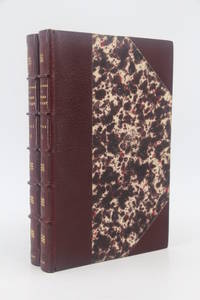
185788314Paris: Michel Lévy frères 1857. Fine. Michel Lévy frères Paris 1857 12 x 18.50 cm 2 volumes reliés First edition with all the features of first issue copies including the misprint Sénart on the dedication leaf. Contemporary plum-coloured 3/4 morocco binding signed by Georges Huser spines with five raised bands numerously ruled in blind with a gilt floral tool at centres dates in gilt at foot marbled paper boards marbled endpapers and pastedowns original wrappers preserved top edges gilt bookplates on each front pastedown. Complete with the publishers catalogue at the end of the first volume. A very handsome copy elegantly bound by Georges Huser with the rare original wrappers preserved. Michel Lévy frères hardcover
183077791Tours 1830. Fine. Tours 23 juin 1830 13.20 x 19.90 cm une feuille Unpublished autograph letter: As soon as I had arrived in Tours I was thrown on the coasts of Brittany by the best conditioned desire that had ever seized a man to shut off the atmosphere of Paris and its ideas by going to run on the beautiful rocks that border the sea in Brittany Tours 23 June 1830 13.2 x 19.9cm one leaf Unpublished handwritten letter signed by Honoré de Balzac one and a half pages written in black ink on a leaf of white paper. Transversal folds and ink a little faded at the bottom of the first page without making it difficult to read. The man from Tours poetically recounts his wanderings on the Breton coast during a trip he took in the company of Madame de Berny. Together they sailed up the Loire in a boat all the way to Le Croisic: As soon as I had arrived in Tours I was thrown on the coasts of Brittany by the best conditioned desire that had ever seized a man to shut off the atmosphere of Paris and its ideas by going to run on the beautiful rocks that border the sea in Brittany and there once arrived I stayed a fortnight the most delicious in the world running on the bays on the kelp collecting the pucelages that are in large numbers on the sea sand in reverse of the rue Vivienne. The pucelages here are shellfish so named because of their vulvoid shape allowing Balzac an allusion to the prostitution very popular at the time that occupied the Galerie Vivienne. This amusing letter is addressed to one of the editors of La Silhouette magazine as evidenced in particular by the sign off at the end of the letter mentioning the founder of the periodical: A thousand good friendships do not forget to give a large part to our friend Victor Ratier. Balzac also mentions several articles: I am writing to give you a sign of life proof of interest and of friendship but I write to you briefly because I have twenty letters to answer and I promise you a letter for.1st July which will contain the end of the charlatan issue 2 la bella dona and finally the articles that will have passed through my head and with which you will be furnished so as to not ask anything of me for a month or two and so that around August you will be my publisher. We have not found any trace of said letter in the writer's correspondence no more besides than the continuation of the Charlatan the first part of which was published in the second issue of La Silhouette. No article under the title of Bella Dona appears in the following issues either although Balzac emphasizes in his letter the desire to provide other texts given that the charms of the Loire must not make him forget that he is the poorest of those who live on a quill pen. A beautiful and spicy unpublished letter. unknown
183386496s. l. Neuchâtel 1833. Fine. Eve's first kiss: 'The gods grant no favours untainted.' s. l. Neuchâtel 29 septembre 1833 13.40 x 21.10 cm une page sur un double feuillet Autograph letter signed by Honoré de Balzac addressed to his friend the writer Charles de Bernard. One page written in black ink on a bifolium. On the verso of the second leaf appears the address of the recipient Charles de Bernard du Grail written in Balzacs hand along with postal stamps and the seal bearing the arms of the Balzac dEntraigues family which the author had appropriated. A few minor holes not affecting the text; fold marks as usual from mailing. Published in his correspondence Paris Calmann Lévy 1876 CXIV pp. 252253. Balzac wrote this letter four days after his very first meeting and first kiss with Madame Hanska in Neuchâtel following many months of epistolary correspondence. « Jai été très heureux ici. Je suis très content de ce que jai vu le pays est délicieux ; mais vous savez que Jupiter a deux tonneaux et que les dieux nont point de faveurs qui soient pures. » ""I have been very happy here. I am most pleased with what I have seen; the country is delightful. But you know that Jupiter has two jars and the gods grant no favours that are untainted."" Two years after receiving the first letter from the Stranger Éveline Rzewuska a lovestruck Balzac left Paris to join her in Switzerland. His brief stop in Besançon ostensibly a convenient detour served as a polite pretext for his departure from the capitalwhere he took the opportunity to visit his correspondent Charles de Bernard. « Il me semble que je vous ai bien peu remercié de la bonne journée que vous mavez donnée ; mais jespère vous prouver que je ne suis point un ingrat. À mercredi donc ; vous devez penser que jaurai bien du plaisir à vous revoir vous qui avez fait que mon voyage à Besançon na pas été inutile et que jy ai trouvé du plaisir ». I fear I thanked you all too little for the delightful day you gave me; but I hope to prove that I am not ungrateful. Until Wednesday then you must know how much I look forward to seeing you again you who ensured that my journey to Besançon was not in vain and even brought me joy. After a day in Besançon and a chaotic journey by mail coach Balzac finally met his beloved though regrettably in the company of her husband Count Hanski. Seizing upon the Counts absence the writer stole a long-awaited kiss with Madame Hanska on an ancient stone bench upon the hill of Crêt. In the rapture of their first encounter he could not help but invoke La Fontaines ominous fable in his letter: « mais vous savez que Jupiter a deux tonneaux et que les dieux nont point de faveurs qui soient pures ». but you know that Jupiter has two jars and the gods offer no favours untainted. His love affair with Madame Hanska would prove far from serene as Gonzague Saint Bris aptly summed it up: eighteen years of love sixteen of waiting two of happiness and six months of marriage. Neuchâtel would remain a powerful emblem of their union recurring in some sixty of their letters. Neuchâtel is like the white lily he wrote to her pure with a penetrating fragrance youth freshness brilliance hope happiness glimpsed. De Bernard who had previously arranged his journey to Switzerland was once again tasked with organising Balzacs return: « Jaurai le plaisir de vous revoir mercredi 2 octobre. Voulez-vous avoir lobligeance de me retenir une place à la malle pour Paris ». I shall have the pleasure of seeing you again on Wednesday 2 October. Would you be so kind as to reserve me a place in the mail coach to Paris The journey separating him once again from his beloved proved wretched: The mail coach was fully booked for six days so my friend from Besançon Charles de Bernard was unable to secure me a place. I was thus obliged to travel on the roof of a diligence in the company of five Swiss from the canton of Vaud unknown