Biblio.com

173 résultats
1600017131Circa 1600 1600. Original Antique Engraving . Single Sheet. Very Good. Original Antique Engraving On Laid Paper Mounted On Single Sheet Of White Paper. Plate Mark 4 1/2" X 5 1/2" With 1/2" To 3/.4" Margins. Text "Nomen Habent Acci Per Te Sebethides Unda Ut Per Sebethi Flumina Nomen Habes" Inear Bottom. Either From An Unidentified Book Or Possibly Published In A Set Of Similar Portraits In Similar Format. Not Signed By Artist; Numbered "I.Ll" At Lower Right. Part Of A Large Collection Of Original Antique Engravings Formed By A Southern California Artist In The Early To Middle Twentieth Century. Each Plate Has Small Glue Marks On Reverse Where They Were Tipped In To An Album. <br/> <br/> unknown
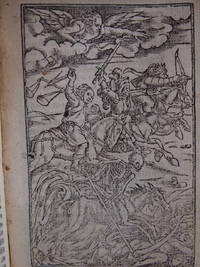
154252743Parisiis Paris Paris: Apud Franciscum Regnault 1542. Fine. Apud Franciscum Regnault Parisiis Paris Paris 1542 7.50 x 11.50 cm relié New miniature edition of the Latin Vulgate following the first which seems to have appeared in 1531 published by Yolande Bonhomme but which was not illustrated. An edition is also recorded in 1538 by Simon de Colines without illustration. Title page within an engraved Renaissance frame. A specific title page for the Epistles: Pauli aposto - l'epistolae. The work is illustrated with 30 woodcut figures detailed as follows: 4 figures for the Gospels saints with their attributes in medieval or Renaissance scenes and numerous historiated initials depicting the Passion narrative. A frontispiece for the Acts of the Apostles repeated for Epistola Petri apostoli prima. A frontispiece for the Epistles Saint James as preacher walking with a fortified city in the background dressed in 16th-century clothing and bearing the Saint James shell on his hat and cape figure repeated for Epistola canonica Iacobi apostoli. A frontispiece for Epistola beati Ioannis. 21 allegorical figures for the Apocalypse including the four horsemen of the Apocalypse a rain of stars the seven-headed crowned beast. Edition absent from English and French catalogues from the British Library and the Bibliothèque Nationale de France. The figures differ from the multiple illustrated editions published by Gryphe from 1539 to 1542. Absent from the Hollis catalogue at Harvard. Contemporary full glazed brown calf binding. Spine with raised bands unlettered. The binding having shifted the fore edge formed by the leaves creates a bulging protrusion that extends beyond the boards. Title page very browned. Right corner of the first three leaves missing in margin not touching text but having taken away a small part of the Renaissance frame of the title page. Last leaf detaching. Index leaves browned otherwise generally fresh with some leaves bearing small brown stains. Missing before the Apocalypse four leaves of Epistola beati Ioanni Apostoli secunda. Rare illustrated miniature edition of the New Testament. Apud Franciscum Regnault hardcover
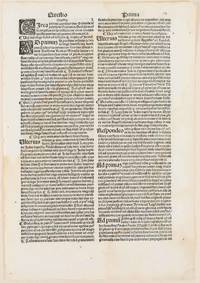
1501176078Venice.: Bonetus Locatelli. circa1501. Single leaf printed recto and verso 29.7 x 20.1 cm text in two columns 65 lines foliated initials scattered wormholes a few affecting the text the paper dampstained but the text in good condition. Leaf from the commentary of Thomas Aquinas on Peter Lombard's Bishop of Paris c. 1100-1160 third book of the Sentences a foundational work of medieval doctrinal theology. . [Bonetus Locatelli]. unknown
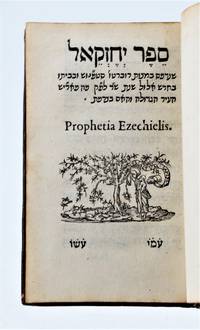
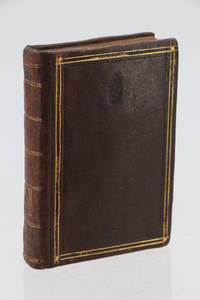
154382820Paris: Robert Estienne 1543. Fine. Robert Estienne Paris 1543 7 x 11.50 cm relié Prophetia Ezechielis BIBLE IN HEBREW ESTIENNE Robert Estienne Paris 1543 16°7x115cm a volume bound in brown morocco. First 16mo edition in Hebrew by Robert Estienne. This pocket edition was printed in 17 volumes between 1544 and 1546 after the success of the four-volume quarto edition printed from 1539 to 1544. Each individual volume unnumbered on the title-page could be acquired separately and considered complete in itself. Elaborate printer's woodcut device on each title page with book titles set within woodcut cartouche head-pieces. Only the title page is in Latin-Hebrew. Numerous contemporary Latin annotations certainly by a scholar. ""This little edition said to be very accurate is a true typographical jewel and perhaps the most beautiful one ever printed in the Hebrew language. Cette petite édition que l'on dit fort exacte est vraiment un bijou typographique et peut-être ce qui a jamais été imprimé de plus beau en langue hébraïque"" A. A. Renouard Annales de l'imprimerie des Estienne Brown morocco later binding 1590-1615 smooth spine with gilt fillets double gilt borders on covers all edges gilt. Binding slightly rubbed. This edition is based on the Hebrew Soncino princeps published in 1488 and was established by Humanist François Vatable early scholar of Hebrew studies during the Renaissance and royal lecturer of Hebrew under Francis I. The text in Hebrew follows the Masoretic tradition and presents diacritics that facilitate its vocalization. Talented scholar François Vatable 1495-1547 was a member of the Cénacle de Meaux' founded by Jacques Lefèvre d'Étaples and published with him in 1530 the first complete French translation of the Bible known as the Bible of Antwerp. After founding the Collège de France in 1530 King Francis I appointed him chair of Hebrew studies. As a Royal lecturer he actively participated ten years later in a Hebrew edition the Bible with Robert Estienne 1503-1559 printer to the King in Latin and Hebrew. This edition is undoubtedly a real typographical feat for a small format text in Hebrew lettering. It was certainly intended for scholarly use by Sorbonne and Collège Royal students given its pocket size sold in separate individual volumes. The presence of numerous contemporary marginal notes further indicates its educational purpose as is the numbering of lines of several pages in some of our volumes. A very beautiful and scarce collaborative work by two of the greatest figures of Parisian humanist scholarship a fine example of the renewed interest in classical texts and their study in the original language. Provenance: library of Charles John Dimsdale 1801-1872 fifth baron of the Russian Empire with his bookplate on each pastedown endpaper. Robert Estienne unknown
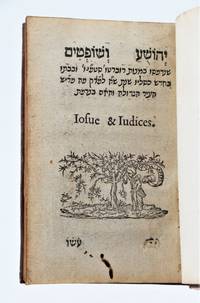
154482811Paris: Robert Estienne 1544. Fine. Robert Estienne Paris 1544 7 x 11.50 cm relié Iosue & Iudices BIBLE IN HEBREW ESTIENNE Robert Estienne Paris 1544 16mo 7x115cm a volume bound in brown morocco. First 16mo edition in Hebrew by Robert Estienne. This pocket edition was printed in 17 volumes between 1544 and 1546 after the success of the four-volume quarto edition printed from 1539 to 1544. Each individual volume unnumbered on the title-page could be acquired separately and considered complete in itself. Elaborate printer's woodcut device on each title page with book titles set within woodcut cartouche head-pieces. Only the title page is in Latin-Hebrew. ""This little edition said to be very accurate is a true typographical jewel and perhaps the most beautiful one ever printed in the Hebrew language. Cette petite édition que l'on dit fort exacte est vraiment un bijou typographique et peut-être ce qui a jamais été imprimé de plus beau en langue hébraïque"" A. A. Renouard Annales de l'imprimerie des Estienne Brown morocco later binding 1590-1615 smooth spine with gilt fillets double gilt borders on covers all edges gilt. Marginal wormhole on the lower part of the leaves not affecting the text. Upper part of joint slightly cracked some rubbing. This edition is based on the Hebrew Soncino princeps published in 1488 and was established by Humanist François Vatable early scholar of Hebrew studies during the Renaissance and royal lecturer of Hebrew under Francis I. The text in Hebrew follows the Masoretic tradition and presents diacritics that facilitate its vocalization. Talented scholar François Vatable 1495-1547 was a member of the Cénacle de Meaux' founded by Jacques Lefèvre d'Étaples and published with him in 1530 the first complete French translation of the Bible known as the Bible of Antwerp. After founding the Collège de France in 1530 King Francis I appointed him chair of Hebrew studies. As a Royal lecturer he actively participated ten years later in a Hebrew edition the Bible with Robert Estienne 1503-1559 printer to the King in Latin and Hebrew. This edition is undoubtedly a real typographical feat for a small format text in Hebrew lettering. It was certainly intended for scholarly use by Sorbonne and Collège Royal students given its pocket size sold in separate individual volumes. The presence of numerous contemporary marginal notes further indicates its educational purpose as is the numbering of lines of several pages in some of our volumes. A very beautiful and scarce collaborative work by two of the greatest figures of Parisian humanist scholarship a fine example of the renewed interest in classical texts and their study in the original language. Provenance: library of Charles John Dimsdale 1801-1872 fifth baron of the Russian Empire with his bookplate on each pastedown endpaper. Robert Estienne unknown
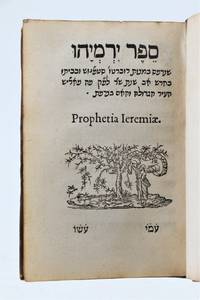
154582819Paris: Robert Estienne 1545. Fine. Robert Estienne Paris 1545 7 x 11.50 cm relié Prophetia Ieremiae BIBLE IN HEBREW ESTIENNE Robert Estienne Paris 1545 16mo 7x115cm a volume bound in brown morocco. First 16mo edition in Hebrew by Robert Estienne. This pocket edition was printed in 17 volumes between 1544 and 1546 after the success of the four-volume quarto edition printed from 1539 to 1544. Each individual volume unnumbered on the title-page could be acquired separately and considered complete in itself. Elaborate printer's woodcut device on each title page with book titles set within woodcut cartouche head-pieces. Only the title page is in Latin-Hebrew. ""This little edition said to be very accurate is a true typographical jewel and perhaps the most beautiful one ever printed in the Hebrew language. Cette petite édition que l'on dit fort exacte est vraiment un bijou typographique et peut-être ce qui a jamais été imprimé de plus beau en langue hébraïque"" A. A. Renouard Annales de l'imprimerie des Estienne Brown morocco later binding 1590-1615 smooth spine with gilt fillets double gilt borders on covers all edges gilt. Binding slightly rubbed. This edition is based on the Hebrew Soncino princeps published in 1488 and was established by Humanist François Vatable early scholar of Hebrew studies during the Renaissance and royal lecturer of Hebrew under Francis I. The text in Hebrew follows the Masoretic tradition and presents diacritics that facilitate its vocalization. Talented scholar François Vatable 1495-1547 was a member of the Cénacle de Meaux' founded by Jacques Lefèvre d'Étaples and published with him in 1530 the first complete French translation of the Bible known as the Bible of Antwerp. After founding the Collège de France in 1530 King Francis I appointed him chair of Hebrew studies. As a Royal lecturer he actively participated ten years later in a Hebrew edition the Bible with Robert Estienne 1503-1559 printer to the King in Latin and Hebrew. This edition is undoubtedly a real typographical feat for a small format text in Hebrew lettering. It was certainly intended for scholarly use by Sorbonne and Collège Royal students given its pocket size sold in separate individual volumes. The presence of numerous contemporary marginal notes further indicates its educational purpose as is the numbering of lines of several pages in some of our volumes. A very beautiful and scarce collaborative work by two of the greatest figures of Parisian humanist scholarship a fine example of the renewed interest in classical texts and their study in the original language. Provenance: library of Charles John Dimsdale 1801-1872 fifth baron of the Russian Empire with his bookplate on each pastedown endpaper. Robert Estienne unknown
154582813Paris: Robert Estienne 1545. Fine. Robert Estienne Paris 1545 7 x 11.50 cm relié Liber Paralipomenon BIBLE IN HEBREW ESTIENNE Robert Estienne Paris 1545 16mo 7x115cm a volume bound in brown morocco. First 16mo edition in Hebrew by Robert Estienne. This pocket edition was printed in 17 volumes between 1544 and 1546 after the success of the four-volume quarto edition printed from 1539 to 1544. Each individual volume unnumbered on the title-page could be acquired separately and considered complete in itself. Elaborate printer's woodcut device on each title page with book titles set within woodcut cartouche head-pieces. Only the title page is in Latin-Hebrew. ""This little edition said to be very accurate is a true typographical jewel and perhaps the most beautiful one ever printed in the Hebrew language. Cette petite édition que l'on dit fort exacte est vraiment un bijou typographique et peut-être ce qui a jamais été imprimé de plus beau en langue hébraïque"" A. A. Renouard Annales de l'imprimerie des Estienne Brown morocco later binding 1590-1615 smooth spine with gilt fillets double gilt borders on covers all edges gilt. Joints corners and spine-ends expertly restored. This edition is based on the Hebrew Soncino princeps published in 1488 and was established by Humanist François Vatable early scholar of Hebrew studies during the Renaissance and royal lecturer of Hebrew under Francis I. The text in Hebrew follows the Masoretic tradition and presents diacritics that facilitate its vocalization. Talented scholar François Vatable 1495-1547 was a member of the Cénacle de Meaux' founded by Jacques Lefèvre d'Étaples and published with him in 1530 the first complete French translation of the Bible known as the Bible of Antwerp. After founding the Collège de France in 1530 King Francis I appointed him chair of Hebrew studies. As a Royal lecturer he actively participated ten years later in a Hebrew edition the Bible with Robert Estienne 1503-1559 printer to the King in Latin and Hebrew. This edition is undoubtedly a real typographical feat for a small format text in Hebrew lettering. It was certainly intended for scholarly use by Sorbonne and Collège Royal students given its pocket size sold in separate individual volumes. The presence of numerous contemporary marginal notes further indicates its educational purpose as is the numbering of lines of several pages in some of our volumes. A very beautiful and scarce collaborative work by two of the greatest figures of Parisian humanist scholarship a fine example of the renewed interest in classical texts and their study in the original language. Provenance: library of Charles John Dimsdale 1801-1872 fifth baron of the Russian Empire with his bookplate on each pastedown endpaper. Robert Estienne unknown
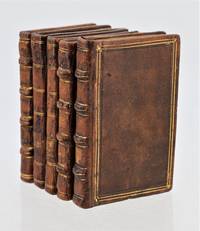
154682797Paris: Robert Estienne 1546. Fine. Robert Estienne Paris 1546 7 x 11.50 cm 5 volumes reliés TORAH Quinque libri legis BIBLE IN HEBREW ESTIENNE Robert Estienne Paris 1546 16mo 7x115cm 5 bound volumes. First 16mo edition of the Torah in Hebrew by Robert Estienne. Printer's woodcut device on each title page with book titles set within woodcut cartouche head-pieces. Only the title page is in Latin-Hebrew. Slightly later brown morocco bindings 1590-1615 two of the volumes with a smooth spine the three others with gilt raised bands gilt tooled boards all edges gilt. Some wormholes on the fifth volume not affecting the text. Numerous contemporary Latin marginalia mainly in the first two volumes. This five-volume Torah includes Genesis Exodus Leviticus Numbers and Deuteronomy. ""This little edition said to be very accurate is a true typographical jewel and perhaps the most beautiful one ever printed in the Hebrew language. Cette petite édition que l'on dit fort exacte est vraiment un bijou typographique et peut-être ce qui a jamais été imprimé de plus beau en langue hébraïque"" A. A. Renouard Annales de l'imprimerie des Estienne Brown morocco later binding 1590-1615 smooth spine with gilt fillets double gilt borders on covers all edges gilt. Some wormholes to the fifth volume not affecting the text. Joints corners and spine-ends expertly restored. Numerous contemporary marginal annotations in Latin manly in the first two volumes. This little edition said to be very accurate is a true typographical jewel and perhaps the most beautiful one ever printed in the Hebrew language.A. A. Renouard Annales de l'imprimerie des Estienne Exceptional copies of the Books of the Bible in Hebrew in first 16mo edition published by Robert Estienne. This pocket edition was printed in 17 volumes between 1544 and 1546 after the success of the four-volume quarto edition printed from 1539 to 1544. Based on the Hebrew Soncino princeps published in 1488 it was established by Humanist François Vatable. The text in Hebrew follows the Masoretic tradition and presents diacritics that facilitate its vocalization. Talented exegete François Vatable 1495-1547 early scholar of Hebrew studies during the French Renaissance was a member of the 'Cénacle de Meaux' founded by Jacques Lefèvre d'Étaples and translated for him in 1509 the Hebraicum one of the five psalters of the Quincuplex Psalterium published by Henri Estienne. After founding the Collège de France in 1530 King Francis I appointed him chair of Hebrew studies. As a Royal lecturer he actively participated ten years later in a Hebrew edition of the Bible with Robert Estienne 1503-1559 printer to the King in Latin and Hebrew. This edition is undoubtedly a real typographical feat for a small format text in Hebrew lettering. It was certainly intended for scholarly use by Sorbonne and Collège Royal students given its pocket size sold in separate individual volumes. The presence of numerous contemporary marginal notes further indicates its educational purpose as is the numbering of lines of several pages in some of our volumes. A very beautiful and scarce collaborative work by two of the greatest figures of Parisian humanist scholarship a fine example of the renewed interest in classical texts and their study in the original language. Provenance: library of Charles John Dimsdale 1801-1872 fifth baron of the Russian Empire with his bookplate on each pastedown endpaper. Robert Estienne hardcover
1572170897No place of publication.: 日立製作所. Hitachi Seisakujo. Circa 昭和 35. 1960. 21 pamphlets with colour photographic illustrations varied sizes and pages a few chips and tears but generally in very good condition. This interesting collection of Hitachi home appliances pamphlets from the 1960s covers washing machines black and white televisions refrigerators cooling fans toasters sewing machines electric heaters water pumps and florescent lights. Many of them have stamps of an electric retail shop in Matsuzaka City in Mie Prefecture. The pamphlets provide interesting snap shots on evolution on electric home appliances and their advertisement. Their prices were quite high for ordinary consumers of that period and often exceeded monthly wages. This interesting collection provides not only information but also beautifully illustrates some of the dreams of many aspiring Japanese households at that time. . 日立製作所. [Hitachi Seisakujo]. unknown
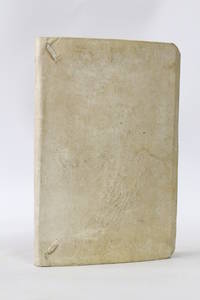
151569707Florentiae Florence Florence: Philippi Iuntae Giunta 1515. Fine. Philippi Iuntae Giunta Florentiae Florence Florence 1515 9.9 x 16.1 cm relié The rare and precious first edition of the works of Macrobius by Niccolo Angeli. The editorial information appears in the colophon the title page displaying only the full title: Impressum Flortiae opera & sumptu Philippi Iuntae. Anno à natiuitate D. XV. supra mille mense Iulio. Leone Decimo Pontifice. The italic typography and that of the entire work should be noted as particularly advanced for its time especially compared to France Germany and England where it would be imitated much later around 1550. 7 vignettes in Scipio's Dream including Macrobius's representation of the world in 5 climatic zones a representation that would enduringly mark the Middle Ages. Contemporary full vellum. Smooth unlettered spine. Good copy very fresh. A classic Renaissance text the two texts brought together in this edition constitute the major works of Macrobius who lived around 400 AD and of whom little is known except that he was a Neoplatonic and Stoic philosopher opposed to the increasingly widespread Christianity. The idea of Scipio's Dream is extracted from Cicero's Republic in which he attributes a dream to young Scipio where a conversation takes place between the deceased heroes of the Republic notably his father and grandfather. The work consists of Macrobius's commentaries particularly on the constitution of the universe. The second text refers to the Saturnalia days of celebration for the Romans; Macrobius relates the discussions held in the home of Vettius Praetextatus the author treating various subjects mythological and astronomical medical citing numerous ancient texts. This book has remained an important source for dating many lost texts and it is also one of the most important texts for Neoplatonism; and above all it would constitute a model for the 16th century which would abundantly imitate this way of presenting science. Philippi Iuntae( Giunta) hardcover
158840417Roma Rome Rome Rome: Ex typographia Iacobi Torne 1588. Fine. Ex typographia Iacobi Torne Roma Rome Rome Rome 1588 16 x 22.50 cm relié New edition rare. The first edition appears to have been published in Coimbra in Portuguese in 1549. Contemporary full vellum binding. Smooth spine with pen-and-ink title added later. Traces of ties. Small lacks to spine along the joints. The title inscription has been written upside down in relation to the binding orientation. Some scattered foxing notably to title page. Last edition published during the author's lifetime; he died in 1586 at the age of 94 in Rome. Principal work in which Navarrus The Manual for Confessors and Penitents establishes moral casuistry. Among the greatest intellectuals of his time and illustrious representative of the University of Salamanca Azpilcueta taught at Toulouse Cahors Coimbra and Salamanca. He was also a recognized jurist and economist widely consulted by the authorities. Ex typographia Iacobi Torne hardcover
158145085Venetiis Venice Venise Venice: Apud Horatium de Gobbis 1581. Fine. Apud Horatium de Gobbis Venetiis Venice Venise Venice 1581 8 x 15 cm relié New edition after the first collected edition published in Venice in 1564. Illustrated with 27 woodcut title vignettes. It contains Zanitolla the 25 books of Baldus the Moscheide on the battle of flies against ants epistolarum. Contemporary full limp vellum binding. Smooth spine. Later title label. One hole at tail. Title page and p.7 restored in margin with antique paper. Three wormholes from title page to p.70. The macaronic genre created by the author himself is a burlesque and fantastical poetry written not in Latin but in low Latin a slang Latin mixing the dialect of Mantua and Italian. The author's pseudonym means Merlin the cook and the macaronicorum is a dish of macaroni. This defrocked monk tells us the story of Baldus and his nomadic adventures. The episode of the giant Fracasse and the rogue Cingar probably served as a source of inspiration for François Rabelais who was notably inspired by the life of the monk Folengo and his burlesque style practicing excessive enumeration and generalized mockery. Folengo died in 1544. Folengo's works form one of the most original creations of Italian Renaissance literature. Apud Horatium de Gobbis hardcover
1572163316Kyoto. 昭和拾八 1943. Japanese manuscript written in calligraphy issued by the influential Japanese Zen Buddhist temple Tōfuku-ji awarding a Japanese monk 花伯齊 the honourable title of 法橋Hokkyō. This title is the third highest rank is given to the Buddhist sculptors and is followed by the first and second ranks 法印 Hōin and 法眼 Hōgen. Certificate folded in original envelope two chops on corners some light foxing on sheet and envelope small holes on folds on envelope otherwise in good condition. Text in Japanese. 19.3 x 53.5 cm when folded sheet measures 38.5 x 53.5cm. The temple was built in 1236 on the instructions of Kujo Michiie but unfortunately has been destroyed by fire a number of times since then. . unknown
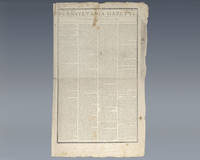
1518126803Philadelphia: Hall & Sellers January 15 1800. Exceedingly rare first appearance in print of Washington's Funeral Oration featured on the front page of the Wednesday January 15 1800 issue of the Pennsylvania Gazette. Folio four pages the headline reads "A Funeral Oration in Honor of the Memory of George Washington. Late General of the Armies of the United States. Prepared and Delivered at the Request of Congress at the German Lutheran Church on Thursday the 26th of December By Major-General Henry Lee One of the Representatives from the State of Virginia." Washington's eulogy was delivered by Major-General Henry Lee to both Houses of Congress and a crowd of 4000 at the first President's funeral on December 26 1799. This printing of the eulogy in the Pennsylvania Gazette precedes the first official Congressional printing Evans 37797 Sabin 39744. In very good condition. Exceedingly rare being one of two copies to have appeared in existing auction records the other in 1889. The father of his country" and the first president of the United States General George Washington died on December 14th 1799 and was buried at Mount Vernon in Virginia. In his Last Will and Testament written only months before his death Washington left explicit directions for the emancipation of each of his 123 slaves to be carried out after the death of his wife Martha. Legislature was passed in Virginia toward the end of the American Revolution in 1782 making it legal for slave holders to emancipate their slaves without an special action by the government. In his will Washington left a detailed slave census as well as stipulations regarding the treatment of the emancipated slaves who were sick and elderly orphaned children and the binding of children to masters and mistresses who would provide them with an education. Upon his death memorial processions were held in every major city and thousands wore mourning clothes for months; Martha Washington was known to have worn a mourning cloak for over a year. Hall & Sellers hardcover
153266816Norimbergae Nürimberg Nuremberg: In aedib. viduae Durerianae Hieronymus Andreae 1532. Fine. In aedib. viduae Durerianae Hieronymus Andreae Norimbergae Nürimberg Nuremberg 1532 20.50 x 32 cm relié Alberti Dureri clarissimi pictoris et geometræ. De symmetria partium in rectis formis humanorum corporum In aedibviduae Durerianae Hieronymus Andreae Norimbergae Nuremberg 1532 folio 20.5 x 32 cm 80 f. A-E6 F4 G-N6 O4 full parchment First edition of the Latin translation created by Joachim Camerarius the work appeared in German in 1528 under the title Vier Bücher von menschlicher Proportion. Our edition contains the first two books the following two will be published in 1534 under the title De varietate figurarum et flexuris partium ac gestibus imaginum. We will have to wait until 1557 for Louis Meigret's French translation to be published. Our edition is illustrated with 85 large wooden insert illustrations and many other smaller in-text illustrations the same as those used in the original German edition. The title page shows Dürer's well-known monogram. Gothic text. The last white leaf missing in most copies is present here. Large greatly fresh margined copy. Full parchment with preserved laces. Very beautiful copy of the most sought-after of Albrecht Dürer's technical works. The illustrations required the examination of several hundred male and female models and something rarer for the time children. These extremely precise analyses resulted in anthropometrical impressionist drawings showing the human body as a whole and also in detail hands feet heads etc. Each drawing squared or scaled in the margin allows the models to be easily reproduced the book being intended to avoid errors of proportion for young artists. Joachim Camerarius' Latin translation humanist and close friend of the author had at the time an essential role: it gave Dürer's work until then written in archaic German a significant audience; without Camerarius Michelangelo would never for example have known of Dürer's theory of proportions. Dürer whose godfather Anton Koberger published La Chronique de Nuremberg in 1493 frequented the world of printing and engraving very early on and unlike his contemporary Florentine Leonardo da Vinci who published nothing he produced several theoretical treatises. It was during a trip to Italy in 1494 that he met Jacopo de' Barbri 1445-1516 who introduced him to the role of mathematics in perspective and the study of the proportions of the human body. On returning to Germany he opened a workshop became the painter of Maximillian I of Habsbourg and joined the Great Council of the City of Nuremberg. Recognition is complete and Dürer becomes an internationally known artist with the knowledge and ability for well-received thought. In the last years of his life not abandoning the pictorial arts Dürer encouraged by his humanist friends spends most of his time writing. Determined to leave the results of his long theoretical thoughts for posterity he publishes several treatises: Instruction sur la manière de mesurer 1525 Instruction relative aux fortifications des bourgs villes et châteaux 1527 and finally Traité des proportions du corps humain 1528. In keeping with the artistic considerations of the Renaissance the intention of this last treaty is to establish a scientific basis geometrical and arithmetical applied to aesthetics and thus to provide practical guidelines aimed at achieving anatomical perfection. A true artistic testament this emblematic work will have a considerable influence on the history of Western art. In aedib. viduae Durerianae[ Hieronymus Andreae] unknown
158322395in Venetia Venice: Francesco Ziletti 1583. Fine. Francesco Ziletti in Venetia Venice 1583 14 x 20 cm relié New edition after the original by Zilotti in 1560. Rare. Contemporary full vellum binding. Smooth spine in Jansenist style. Handwritten title. One dampstain in the middle of the lower margin running through and fading over the first 15 leaves. Alessandro Piccolimini 1508-1579 of Siena was an important Italian humanist of the Renaissance he was an astronomer mathematician and philosopher. His astronomical works: Sfera del mondo Delle stelle fisse Speculazioni dei pianeti remained highly celebrated for having proposed the first reading of the world of stars. He also wrote comedies and translated numerous works of the Ancients in his youth. A work of truly humanist philosophy Della institution morale attempts to define the nature of man in his works one can distinguish chapters on the social nature of man on the quest for happiness on the nature of love but also chapters on astrology rhetoric geography astronomy mechanics as so many productions of human genius. One chapter deals more specifically with Passions at war against reason. Francesco Ziletti hardcover
1505000423bGENOA ITALY. Good with no dust jacket. 1505. Original Vellum. One hundred and eighty four hand numbered pages in this remarkable 500 year old handwritten manuscript ledger journal and diary : " 1505 Gendenze di Saviz - gnano" as stated on the cover. The first page begins: "Libro de tuto _____ quale so tato asan__giano ala venuta mia. To Alexandro salueto schrise e soto schrise de mia gnovia mar." Not written by a scribe this is a working journal and ledger containing hundreds of business entries purchases loans and repayments. There are long lists of foods and prices for what is assuredly shopping lists for parties and feasts. There are also what appears to be observations and business maxims and poetry in a number of entries. Certainly this fascinating book requires more research. The original vellum cover is in somewhat rough shape with tears rubbing and bumping and is barely attached to the text block though still held by the rear binding cords. Interior is in excellent shape save for the odd and to be expected ink blot age-toning and light soiling. Please email for pictures of this rare manuscript.; Italian Spanish Latin; 4to - over 9¾" - 12" tall; KEYWORDS: HISTORY OF ANCIENT ITALIAN GENOA VENICE MANUSCRIPT COMMERCE HANDWRITTEN HAND WRITTEN JOURNAL LEDGER MEMOIR PERSONAL LOG HOLOGRAPH AUTOGRAPH SPAIN SPANISH DIARY DIARIES ANCIENT ANTIQUE MEDIEVEL RENAISSANCE antiquité contrat vélin document manuscrit papier Antike Brief Pergament Dokument Manuskript Papier oggetto d'antiquariato atto velina documento manoscritto carta antigüedad hecho vitela documento manuscrito papel. . hardcover
157053001Antverpiae Antwerp Anvers Antwerp: Joannes Stelcius 1570. Fine. Joannes Stelcius Antverpiae Antwerp Anvers Antwerp 1570 6.50 x 11 cm relié New edition of this bible bearing the privilege on the verso of the title page dated January 20 1558. Preface by Johannes Hentenius and probably establishment of the text. Printer's device on title page. Decorated initials. Colophon on verso of last leaf: Excudebat Antverpiae Amatus Tavernerius anno M.D. LXIX. The text is found in the Vulgate version of the very famous Louvain edition of 1547; Charles V had indeed expressly requested a new more accurate version of the Bible and this was made from Greek Aramaic and Hebrew texts. This Old Testament comprises the Pentateuch: Genesis Exodus Leviticus Book of Numbers Deuteronomy and Joshua as well as the Book of Judges and Ruth. All other texts have been excluded from this edition: namely Book of Job Psalms Proverbs Ecclesiastes Song of Songs Wisdom of Solomon Ecclesiasticus but also the prophets: Isaiah Jeremiah. Full red morocco binding of the 17th century. Smooth spine decorated with 4 fleurons with frame of small dot tools. Gilt titles. Boards richly decorated with a central rectangle with medallion and leafy designs in the corners; corner tools and multiple framing fillets. Gilt edges. Tail headcap blackened with 2 small wormholes. Rubbing. Copy slightly warped. Missing the second marbled endpaper. Slight lack to upper joint at head. Handsome copy in decorated 17th-century red morocco. While references for this Antwerp bible can be found in libraries one notes that the collations of these bibles are not the same nor the format; thus the library of the Catholic University of the West at Angers shows Joannes Stelcius hardcover
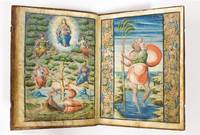
156957498s. l. Grenade Granada: S. n. 1569. Fine. S. n. s. l. Grenade Granada 1569 21.50 x 30.50 cm relié ILLUMINATED MANUSCRIPT ANONYMOUS Regla y Constitutiones de la Cofradia del Sanctissimo Sacramento de la Yglesia de San Christoval de Granada Autograph manuscript with three miniatures no publisher Granada 1569 folio 21.5 x 30.5 cm upper margin: 35 mm bottom margin: 50 mm interior margin: 30 mm exterior margin: 40 mm 31 ff. 16th-century full calf gilt Manuscript on vellum comprising 31 leaves: 50 pages of text ruled and lined and 3 full-page miniatures in colours heightened in gold. The four final leaves were numbered and partly ruled but left empty. Contemporary manuscript ex-libris on front endpaper. In Spanish throughout written in Caroline minuscule on 24 lines the text is very readable and very regular. The manuscript begins with a three-page summary covering the 24 chapters that comprise the Regla y constitutiones de la cofradia del Sanctissimo sacramento de la yglesia de San Christoval de Granada. One illuminated capital in red and blue indents and pagination in red small sketch in black ink to the inner margin. The verso of the final page of the summary has been ruled and lined in red but left blank. There follow the three full-page miniatures. The first shows a Communion scene on the recto of one leaf the second the Tree of Jesse verso of the same leaf and the third Saint Christopher bearing the baby Jesus recto of the following leaf. The verso of the miniature bears a short manuscript text explaining that these rules are those of the confraternity and brotherhood of the Holy Sacrament established in the Church of Saint Christopher of Granada on the 1st of May 1568. This is followed by the prohemio a prologue of two and a half pages in which the confraternity takes an oath; this starts with an imposing illuminated capital in red and blue. The chapters then follow on directly each with a tidy initial. The important terms are heightened in red allowing for quick navigation in the text. A long manuscript annotation to the outer margin of leaf 24. The aforementioned rules take up 23 ruled leaves ruled and lined in red. Leaf 27 bears two manuscript privileges. We have not been able to read the signature on the first dated May 1569 though quite elaborate. The second later one May 1596 is signed by Justino Antolinez de Burgos 1557-1637 at the time the Chaplain Royal charged with the inspection of ecclesiastical lodges. Long contemporary manuscript note to reverse of leaf 24. Contemporary light-brown calf spine in five compartments with gilt fillets and fleurons gilt fillet frame to boards small gilt fleurons to corner and a larger gilt fleuron to centre of covers. One clasp preserved. A few very skilful repairs and regilding practically invisible. This manuscript has three spectacular full-page miniatures in gouache heightened in gold. The first shows the Holy Communion with Christ himself establishing the Eucharist with the words This is my body this is my blood. The Apostles and Jesus with a halo blessing them are seated around a table set with bread and fish. This motif became a major theme of Christian art in the Renaissance as this miniature also shows. The second miniature shows the Tree of Jesse which symbolises the genealogy of Christ traced from Jesse Xese shown as an old man reclining. In keeping with the iconographic tradition a tree protrudes from his side the main branches of which bear some of Jesus's ancestors. Here they are: Zachary Jeremiah David an unidentified king and at the pinnacle Mary holding the Christ child within a mandorla. The third miniature presents a scene with Saint Christopher the patron of the Church in Granada to which the Confraternity of the Holy Sacrament was attached with a child on his shoulders as he was commonly represented. The iconography derives from a passage in the Golden Legend in which St Christopher helps a small b S. n. hardcover
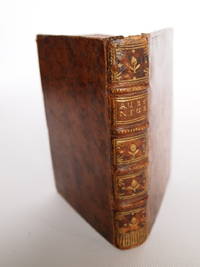
155574303Lutetiae Parisiorum Paris Paris: Ex officina typographica Michaelis Vascosani Michel Vascosan 1555. Fine. Ex officina typographica Michaelis Vascosani Michel Vascosan Lutetiae Parisiorum Paris Paris 1555 10.50 x 16.50 cm relié Statement of third edition. Printed in italics. The first edition appears to be that of 1550 by the same publisher in folio and octavo format. A second edition appeared in 1553. Copy with the large arms of Michel II de Marcillac Lord of Ollainville Baron of Atichy; master of requests and state counsellor. Argent masoned sable of 7 pieces two three and two each charged with a blackbird sable. Olivier Pl. 2082. Full marbled and glazed calf binding of the 17th century. Spine with raised bands decorated with 5 compartmented fleurons roll-tooling on the bands. Brown calf title label. Large arms stamped on boards. Skilful and fine restoration to headcaps joints and corners. One tear to upper board. According to the signature of the gatherings there should be 2 blank leaves after the last printed leaf there is only one; the second has been placed before the title. Fine copy. Ex libris DF. 1902. History of the reigns of Charles VIII Louis XII and Francis I. This history was intended as a sequel to Paolo Emilio's History of France De rebus gestis francorum from Pharamond to Charles VIII published in 1520. Ex officina typographica Michaelis Vascosani( Michel Vascosan) hardcover
1552GT1348Lyon: Gryphius 1552. Original printed issues 1st Editions . Hardback. Vg. 16mo. 419pp. Early full calf binding with some wear 11.5cms. Later binding but old. Attractive embellished capital letters for each of the eight chapters. PLEASE EMAIL FOR PHOTOS <br/> <br/> Gryphius hardcover
156410452Parisii Paris Paris: apud aegidium Gilliumin vico Ioan Lateran 1564. Fine. apud aegidium Gillium in vico Ioan Lateran Parisii Paris Paris 1564 16 x 10.40 cm relié Rare first edition. Not held by the Bibliothèque Nationale de France. Brunet II 1236. Title vignette. Modern full vellum binding with overlapping flaps. Plain spine ties. Light marginal dampstaining to first few pages. Some foxing. Auger Ferrier 1513-1588 of Toulouse was simultaneously a renowned astronomer physician and physicist he was one of Catherine de Medici's private physicians. The work is a treatise on the Spanish plague or Spanish pox otherwise called the Neapolitan disease which is none other than syphilis and which had been wreaking havoc in France for some time depending on the country it was also called the French disease. Description of the illness and remedies. There follows a chapter intended for barbers and the remedies they could employ not being physicians falling nails alopecia; this treatise is followed by its translation as barbers were not learned and did not speak Latin yet they often practiced various surgical operations. apud aegidium Gilliumin vico Ioan Lateran hardcover
157854000Antverpiae Antwerp Anvers Antwerp: Ex officina Christophori Plantini Plantin 1578. Fine. Ex officina Christophori Plantini Plantin Antverpiae Antwerp Anvers Antwerp 1578 7.50 x 11.50 cm relié Edition prepared and annotated by Theod. Pulmann. Text in italics. Full marbled calf binding from the 17th century. Spine with raised bands decorated. Morocco title label in brown. One lack at head. 3 corners slightly bumped. Rubbing. Ausonius or Decius or Decimus Magnus Ausonius 309-394 was a Latin poet from Bazas near Bordeaux where he studied. French literature places him at the origin of its literary and poetic history for having been one of the first Latin poets of France. Before retiring near Bordeaux he served as prefect for Italy then Africa and finally Gaul. His poetry often erudite and affected has the merit of presenting us with Latinity; his correspondence with Paulinus of Nola converted then canonized is of great importance for understanding this period. Ex officina Christophori Plantini( Plantin) hardcover
1574016807Venice / Vinetia/ Padovano: Girolamo Porro 1574. First Edition 1st Printing. Disbound. Very Good. Title Page And All Nine Full Page Portraits A Set Of These Plates Only Without The Pages Of The Book Trimmed Close To Plate Mark Each Approximately 8 1/4" X 6"; This Item Includes The Plates Only Excised From The Book Which Is Not Present. All Editions Of The Book Are Rare; These Detached Plates Were Part Of A Large Collection Of Original Antique Engravings Formed By A Southern California Artist In The Early To Middle Twentieth Century. Each Plate Has Small Glue Marks On Reverse Where They Were Tipped In To An Album. Very Short Tear At Left Edge Of Title Page Otherwise All Plates Well Preserved. <br/> <br/> Girolamo Porro unknown
1524000427STRASSBURG STRASSBOURG FRANCE: Joanne Gzieninger. Very Good. 1524. Decorative Cloth. Printed 1524 ORIGINAL CLASSIC TREATISE OF COCLES ON MEDICINE PHYSIOGNOMY AND PALM READING Chiromancy EXCEEDINGLY RARE EDITION. Not in the American Auction Records for 30 years! FILLED WITH WOODCUTS OF FACES AND THEIR CHARACTERISTICS AS WELL AS CLEARLY MARKED PALMS WITH INSTRUCTIONS FOR READING approx 80 full page woodcuts of Palms alone! An extremely rare an important edition of which I cannot readily trace other copies. Thorndike in his classic 'History of Experimental Magic" pg 64. states the First Italian edition was printed in 1525 and a German edition at Strassburg in 1530. The book here is not recorded by him and predates that German edition by six years. The Book: Cocliti B. Ein kurtzer bericht der gantzen Phiionomey und Ciromancy. Strassburg 1524. small 8vo mottled boards internally very clean copy handsome woodcuts throughout and fine dark impression last leaf in facsimile. An extremely rare well illustrated and important edition. The last earliest copy in the ABPC auction records is the 1534 edition in a very worn state. The 1536 edition realized last $747.00 at Sotheby's Oct 21st 1980 lot 448. Physiognomy is the interpretation of outward appearance especially the features of the face to discover a person's predominant temper and character. Physiognomy has also been used as a kind of divination and is often associated with astrology. o Coclès like others before and after him tried to create a science out of something each of us does from time to time: judge a person by his or her facial characteristics. Physiognomists like Coclès are wont to say things such as "people with snub noses are vain untruthful unstable unfaithful and seducers." Cocles extended the pseudo scientific analysis to palm reading writing one of the most enduring and influential text on Chiromancy. ; German Language; 24mo - over 5" - 5¾" tall; OCCULT NECROMANCY SORCERY PHYSIOLOGY CHIROMANCY PALM READING SATANISM ASTROLOGY DIVINATION RELIGION MAGIC antiquité contrat vélin document manuscrit papier Antike Brief Pergament Dokument Manuskript Papier oggetto d'antiquariato atto velina documento manoscritto carta antigüedad hecho vitela documento manuscrito papel. . Joanne Gzieninger hardcover