173 résultats
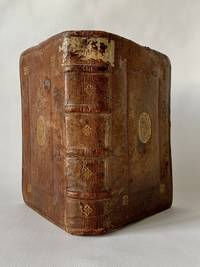
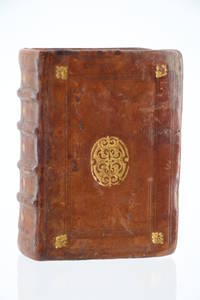
157475825à Paris: Chez Claude Micard 1574. Fine. Chez Claude Micard à Paris 1574 8.50 x 12.50 cm 2 parties reliées en un volume Very rare first edition of this collection which brings together translations that had appeared separately before: The Georgics translated by Richard Le Blanc 1554 The Eclogues translated by Clément Marot for the first and by Richard Le Blanc for the nine others in 1555 and The Aeneid by Louis Des Mazures first complete edition in 1560. This edition includes the verse translation printed in roman type facing the Latin text printed in italics. Manuscript ownership inscription on the title page. Contemporary full calf binding spine with four raised bands decorated with gilt typographical motifs and blind fillets covers decorated with multiple blind ruling frames gilt fleurons at corners and stamped with a large gilt typographical motif at their center. Binding very skillfully restored. Chez Claude Micard hardcover
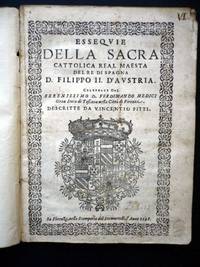
159822671In Firenze Florence Florence: Nella stamperia del Sermatelli 1598. Fine. Nella stamperia del Sermatelli In Firenze Florence Florence 1598 15.50 x 21 cm broché First edition. Rare. Title within an engraved frame. Arms of Philip II on title page and printer's device and colophon on the last leaf. In original wrappers plain dust cover. Funeral of Philip II of Spain died in 1598 given by the Grand Duke of Tuscany in Florence described by Vicentio Pitti Ferdinand II de' Medici who was related to Philip II as he was the son of Marie Madeleine of Austria and Cosimo II de' Medici. Nella stamperia del Sermatelli unknown
1557GT686Gandaui: Excudebat Cornelius Manilius 1557. 1st Edition . Hardback. Fine. small 12mo. 8 818-743 127pp. Volume two only of two. Chapter 27 covers Henry VIII p1567-1743. The collophon at the rear of this volume two is dated 1558. Original full calf and printed on quality paper. A very attractive clean dry and crisp copy of the second volume. Bound in the original full calf with four raised bands. The head and foort of the spine is frayed but the contents are fine. PLEASE EMAIL FOR PHOTOGRAPHS.14.5 cms.Cornelius was a printer and bookseller in the city of Ghent Belgium active 1548-1558. A very early printing. <br/> <br/> Gandaui: Excudebat Cornelius Manilius hardcover
1585W375Cambridge: Ex officina Thomæ Thomasii inclyta Academiæ Cantabrigiensis typographi 1585. Hardback. worn. 8vo. 16 867 1 pp. errata on reverse of last leaf Iii. Preface signed: S.G.S. i.e. Simon Goulart. FULL TITLE :'Doctrinæ christianæ compendium: seu commentarii catechetici ex ore D. Zacharias Ursini verè theologi qui Heydelbergæ catecheseos explicationem continuare solebat & iterare diuerso tempore ab ipsius discipulis excepti. Ad septem exemplaria diligenter inter se collata pluribus in locis emendati varijs quæstionibus thesibus & argumentis auctiores facti & nunc denuo non parua accessione eorum quæ in commentarijs desiderabantur quod ex indice facilè apparebit locupletati. Cum indice præcipuorum capitum' STC 24529. 2nd edition. Includes text of the Heidelberg catechism. 160x110mm. Thomas Thomas was the first Cambridge University printer appointed in 1583 and he printed 14 titles before his death in 1588. Henry VIII had granted the University a Letters Patent in 1534 but the London Stationers Company resisted for nearly fifty years the publishing of books despite the Royal grant. Cambridge is the worlds oldest publishing house in the wordl and the has the worlds oldest University Press. ORIGINAL FULL CALF with raised bands. Complete copy but usual staining wear and aging. Binding broken at page 282. Beautifully printed in a single column and with wood-cut initials fo chapter headings. Occasional worming but generally a worn and damp-stained copy of a rare item. NO auction records found. Worn blind stamped device impress to the centre of both front and back boards. IN A WORN CONDITION WITH BINDING BROKEN. <br/> <br/> Ex officina Thomæ Thomasii inclyta Academiæ Cantabrigiensis typographi hardcover
15250001371LOMBARDY ITALY. Good. 1525. Original Vellum. On offer is an ancient very charming and even beautiful manuscript relic of early civil law and legal procedure bound in vellum being the "Corpus Iuris Civilis of Justinian" the Digesta Digests or Pandects Books 1 through 38 in condensed form. All titular headings from 1.1.0 through 38.17.0 with each followed by an abbreviated explanation of the premise. In some instances may also have portions of subsections such as 1.5.6. The text does not contain the elaborations of Ulpianus Pomponius Florentinus or their like. Justinian the Great "Justice is the constant and perpetual wish to render to everyone his due" was the Roman Emperor of Byzantine Constantinople from 527 to 565. He was the last Roman Emperor to speak Latin as his first language. He tried to revive the greatness of the empire by reconquering the lost western half of the classical Roman Empire achieving only partial success in this although he did retake the city of Rome. But probably his most enduring legacy was the uniform rewriting of Roman law the Corpus Iuris Civilis which is still the basis for much civil law in many modern states and with which this volume is concerned. Dated October 30 1525 handwritten in one humanist hand this version appears to be a synopsis of the first 38 books of the Digesta and may have been used as a primer for a law student or as is more likely in this case given the marginalia a reference by a civil authority such as a lawyer or civil magistrate. On the spine is the word "Castaldus". Castaldus Gastaldo in Italian was also a term for a Lombardy official in charge of some portion of a demesne a gastaldia or castaldia with civil martial and juridical powers. When Lombardy submitted to a codified Roman law the term came to be used as a reference for civil magisterial matters. Another possiblility is this was owned by a Restaurus Castaldus an Italian civil lawyer d. 1564 and known to be the author of published book: "De imperatore in Tractatus universi iuris" or this book may possibly be a redaction or some other volume of the same Castaldus by another hand. This book offers a wonderful research opportunity for the right researcher! Description: CASTALDUS 1525 Italy. Cover of limp vellum 148x 119x 20mm Held by two leather straps through the spine to under the covers. Small section of cover on spine is missing. 124 leaves of linen rag paper 140 x105mm the first and last blank. 122 paginated folios; 1-109 CX-CXXII. Collation; i I 1313 a singleton II16 III15 39 a singleton IV15 51 a singleton V16 VI15 90 a singleton VII16 i. COMPLETE. 243 pages of text. Dated on recto of f.CXXII October 30 1525 verso blank. The pages have 15 lines in brown ink written in an elegant Humanist Bookhand with italic traits a few initials with minor flourishes near the beginning and marginal notations. Folios 73-79 some ink smear from damp stain f.74-75 stuck together in center toward spine. Folios 107-CXXII with spill stain over one half of page. In all instances the text is legible. The book is in unusually good condition for it's nearly five hundred years of life although it naturally shows appropriate signs of age and use and there is some brittleness to the cover. Overall G. ; Latin; 16mo - over 5¾" - 6¾" tall; KEYWORDS: LOMBARDY CIVIL LAW LEGAL JURISPRUDENCE CIVIL PROCEDURE JUSTINIAN LATIN PANDECTS ROMAN LAW MANUSCRIPT HANDWRITTEN HAND WRITTEN JOURNAL HOLOGRAPH AUTOGRAPH ANTIQUE MEDIEVEL RENAISSANCE antiquité contrat vélin document manuscrit papier Antike Brief Pergament Dokument Manuskript Papier oggetto d'antiquariato atto velina documento manoscritto carta antigüedad hecho vitela documento manuscrito papel. . hardcover
1544000635Good. 1544. Full-Leather. On offer is a superb ancient book VIA CRUCIS Way of the Cross; Twelve Stations of the Cross. "Domini Redemptoris ac Salvatoris Nostri Jesu Christim." Twenty-nine 29 printed pages detail the 12 stations of the Cross in the Cruxifiction of Jesus. Pagination begins at page 3 through page 32. Original binding 4 bands 5 compartments and while the original title page has been removed there are four 4 manuscript pages including a simple but beautifully handwritten new title page with the word Via rubricated leading to the Oratio. There are seven 7 pages in more lovely calligraphy at the end titled "Officium S. Spiitus". Followed by a number of blank pages. Seems like an ideal book for a pilgrim to record his own journey to the Holy Land. Handwritten is an 'ex libris' noting Ferdinandi de Graes as the owner. The full leather binding is well attached no cracks but some small worm holes in the endpaper. Old pencil note dates the book at 1544. All indications agree. Sensational early religious book with elegant manuscript calligraphy.; Latin; 32mo - over 4" - 5" tall; KEYWORDS: CHRISTIANITY BIBLE STUDIES CHRISTIAN JESUS WAY OF THE CROSS CRUXIFICTION CHRIST VIA DOLOROSA HANDWRITTEN HAND WRITTEN MANUSCRIPT JOURNAL LEDGER DIARY PERSONAL CATHOLIC CATHOLICISM ECCLESIASTIC RELIGION FAITH JOSEPH AND MARY SON OF GOD RESURRECTION APOSTLES JUDAS PETER PAUL SAINTS . hardcover
16000002211New England Indigenous Land. Good with no dust jacket. c1600s. Ephemera. On offer is a remarkable early manuscript extract preserving a 17th-century English colonial description of Indigenous peoples in New England. The text closely follows a passage from Edward Johnsons important Puritan history Wonder-Working Providence of Sions Saviour in New England first printed in London in 1654.Johnsons work is one of the major early histories of Massachusetts Bay and Puritan New England and this extract preserves his colonial description of Indigenous life hunting fishing labor clothing and religious practice. The passage is devoted almost entirely to English observations of Indigenous peoples in early New England likely in the Massachusetts Bay context. It includes detailed descriptions of bows and arrows fishing trapping hunting deer beaver otter moose birds and fish as well as comments on womens labor clothing seasonal hardship and domestic life. It also includes a reference to Powawes an early English colonial term used for Indigenous spiritual or healing figures. The manuscript is headed 1647 apparently as a chronological marker for the section being copied rather than as the date the physical manuscript itself was written. The language is strongly shaped by 17th-century Puritan colonial attitudes and includes offensive descriptions of Native peoples. It is best understood today as a colonial-era manuscript transcription preserving English settler perceptions of Indigenous life rather than as a neutral ethnographic account. An excerpt follows: The Indian People in these parts at the English first coming were very barbarous and uncivilized going for the most part naked although the country be extreme cold in the winter season; They are only clothed with a Deer skin and a little bit of Cloth to cover their privy part. The Women for the most part are very modest although they go as naked as the Men; They are generally very laborious at their planting time and the Men extraordinarily idle making squawes to carry their Children and the luggage beside The passage continues with descriptions of hunting fishing trapping bows and arrows and English colonial interpretations of Indigenous religious practice including reference to Indigenous healing charms. HISTORICAL NOTE: Although the manuscript is headed 1647 the heading should not be read as proof that the physical manuscript was written in that year. The text appears to be copied from or closely based upon Edward Johnsons Wonder-Working Providence which was completed after 1647 and first printed in 1654. The 1647 heading is therefore best understood as a chronological or historical marker within the copied material. A significant manuscript relic preserving early colonial New England commentary on Indigenous peoples Puritan worldview settler observation and the manuscript transmission of early American historical texts. Condition: Mild toning minor spotting smudging and a horizontal fold near the end. The fragment has been backed with a thin supporting layer and mounted to a larger modern support sheet. Ink remains bold dark and legible throughout. Overall very good condition for a manuscript fragment of this age and type.; Manuscript; 8vo - over 7¾" - 9¾" tall; 1 pages; KEYWORDS: HISTORY OF NATIVE AMERICAN INDIAN INDIANS NATIVES ABORIGINAL PEOPLES 17TH CENTURY PILGRIM NEW WORLD MASSACHUSETTS BAY COLONY NATIVE HUNTING AND FISHING METHODS POWAWES DORCHESTER COMPANY PURITANS QUAKERS MAYFLOWER SALEM BOSTON NEW ENGLAND PLYMOUTH INDIGENOUS AMERICANA HANDWRITTEN MANUSCRIPT AUTOGRAPHED AUTHORS DOCUMENT LETTER AUTOGRAPH KEEPSAKE WRITER HAND WRITTEN DOCUMENTS SIGNED LETTERS MANUSCRIPTS HISTORICAL HOLOGRAPH WRITERS AUTOGRAPHS PERSONAL MEMOIR MEMORIAL PERSONAL HISTORY ARCHIVE DIARY DIARIES JOURNAL LOG PRIMARY SOURCE FIRST HAND ACCOUNT SOCIAL HISTORY PERSONAL STORIES LIVING HISTORY ANTIQUITÉ CONTRAT VÉLIN DOCUMENT MANUSCRIT PAPIER ANTIKE BRIEF PERGAMENT DOKUMENT MANUSKRIPT PAPIER OGGETTO D'ANTIQUARIATO ATTO VELINA DOCUMENTO MANOSCRITTO CARTA ANTIGÜEDAD HECHO VITELA DOCUMENTO MANUSCRITO PAPELBIOGRAPHY BIOGRAPHICAL AUTOBIOGRAPHICAL AUTOBIOGRAPHY PERSONAL NARRATIVES . unknown
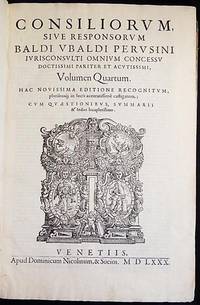
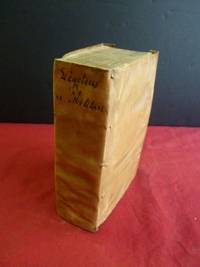
1580003503Venice: apud Dominicum Nicolinum & Socios Domenico Nicolino 1580. Hardcover. Very Good . Vols. 4 & 5 of 5 only. 2 volumes in 1. "Hac novissima editione recognitum pluribusq; in locis accuratissime castigatum; cum quaestionibus summarii & indice locupletissimo." 117 leaves 234 p. 139 leaves 278 p.; 37 cm. Signatures: A-P8 -P7 -P8 A-R8 S4 last leaf blank folio. Original parchment over boards. Five spine compartments between raised bands; hand-written title in first compartment. Handwritten identification also on lower page edges. Large and elaborate printer's device on title pages which combines the earlier printer's device of Domenico Nicolino a woman holding a wreath with three others presumably of the partners Socios referred to in the imprint. In Very Good Condition: original parchment over boards rubbed and soiled with loss of parchment at ends of spine and over raised bands; loss at lower corner of front board; small stain along lower edge of 5:2-22 not impacting text; minor soiling along lower edge of 5:42 verso and 5:43 recto; marginal worming in vol. 5; otherwise clean and bright. apud Dominicum Nicolinum, & Socios [Domenico Nicolino] hardcover
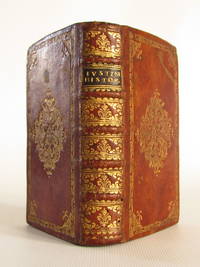
158567401Parisiorum Paris: Apud Hieronymum de Marnef 1585. Fine. Apud Hieronymum de Marnef Parisiorum Paris 1585 8 x 13 cm relié New edition. 12 portrait figures of emperors in medallions in The Lives and Deaths of Roman Emperors by Veneto. Publisher's device on title page and verso of last leaf. Printed in italics. 17th-century German full brown morocco binding. Spine with raised bands decorated. Black morocco title label. Covers stamped in blind with large central tool frame of garland with corner tools. Rubbing. Brown stains on title page. Handsome copy. The work of Trogus Pompeius is known to us only through the famous epitome made by Justin of his Philippic Histories which deals with all the countries conquered by Alexander the Great. The Histories of Trogus Pompeius are completed by the De vita et moribus imperatorum romanorum by Giovanni Baptista Egnatio Veneto. Apud Hieronymum de Marnef hardcover
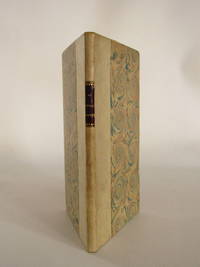
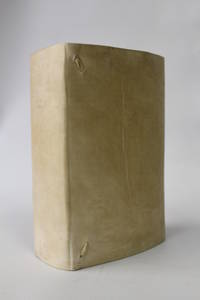
157543955Genève Geneva: Chez Eustache Vignon 1575. Fine. Chez Eustache Vignon Genève Geneva 1575 11 x 18 cm relié New edition reproducing that originally published by the same publisher in 1573. 84 letters text on 36 lines. Contemporary full vellum binding with overlapping edges. Smooth spine. Lower compartment clumsily restored as well as an angular lack to the lower corner of the second board. Light worming to the first endpaper and the first three leaves not touching the text. A pale dampstain to the lower margin of half the volume. Manuscript annotation on title page ""ExLB MMagdal Rochesse 1713"". Theodore de Bèze alone embodies and personifies Christian humanism; above all a churchman he was the undisputed leader of Protestantism from 1575 and directed the Church of Geneva for fifty years after Calvin. He was also a Latinist and Hellenist playwright poet and artist statesman and diplomat in the service of the cause of the Reformation as his correspondence amply testifies. Through his immense correspondence which surpasses in scope the already prodigious ones of Heinrich Bullinger and Calvin he organized and encouraged the defense of the reformed faith throughout the European continent. This edition brings together the letters of Bèze as theologian and polemicist concerned with political reflection. Chez Eustache Vignon hardcover
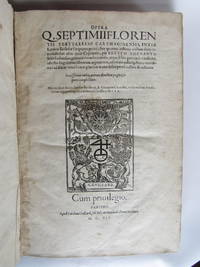
154561711Lutetiae Parisiorum Paris Parisiis Paris: Apud Carolam Guillard 1545. Fine. Apud Carolam Guillard Lutetiae Parisiorum Paris Parisiis Paris 1545 22 x 32.50 cm relié Edition of the works of Tertullian produced by Jean de Gagny and Martin Mesnart according to 2 notes on the verso of the title. Fine printer's device on title page. This edition contains 11 more treatises than previous editions of Tertullian's works two of which entitled ""De Trinitate"" and ""De cibis judaicis"" are actually by Novatian. Edition whose privilege was shared with Jean de Roigny. Adams T408. Notes and life of Tertullian by Beatus Rhenanus. This edition is based on that produced by Beatus Rhenanus in 1539 in Basel. Contemporary full brown calf binding. Smooth spine with raised bands. Head worn with cracks to joints. Damage to first raised band. Corners slightly bumped. Dampstains in central and top margins throughout the work quite light then fading then returning. On the last 50 pages dampstain on half the leaves rather light and not troublesome more pronounced on the last index leaves. Leaves 3 to 7 restored with a strip of paper mending a tear. Some manuscript notes in the margins. He who was considered the greatest theologian of his time came from a Berber family and was moreover the first theologian from North Africa. He died around 220 in Carthage but was never canonized by the church since he joined a heretical movement the Montanists at the end of his life. His work is remarkable; it is with him truly that Latin theology begins and the thought of the Trinity of which he employs the term for the first time. He thus affirms the unity of God in three persons and that Christ is both God and man composed of 2 substances. This theological thought as we know would have an immense future. His treatises address different subjects: On Patience On the Flesh of Christ On the Resurrection On the Soul Against the Jews On the Trinity. Among them are found a certain number of polemical works. Apud Carolam Guillard hardcover
156069414Lyon: Antoine Vincent 1560. Fine. Antoine Vincent Lyon 1560 14.8 x 21.4 cm relié First edition. The privilege was shared with Mathieu Bonhomme in Lyon as we find perfectly similar copies but with different addresses. Bilingual edition with the text upstream and in italics and 2 columns sharing the translation. Printer's device on title page. Contemporary full brown sheep binding certainly from Lyon. Spine with raised bands decorated with 4 fleurons. Title label in the first compartment partly torn off. Central rectangular frame on covers formed by 3 thick fillets with fleurons in the corners and central gilt medallion. The whole rubbed and stained. A tear in the tail compartment causing 2 holes. 3 lacks along the edges. Pale dampstain in the lower part of the first leaves including the title page; the same on the last leaves. Outstanding edition of these Comedies of Terence produced by Antesignan. It includes 2 translations in 2 columns under the original text in italics a literal translation and a paraphrastic translation more interpretative. It contains notes on all the authors who had written on Terence Melanchton Erasmus Scaliger Muret. To the right of the original text Antesignan marks the accents on all words of more than 2 syllables and next to each verse the way to scan them. Antoine Vincent hardcover
157066372Lugduni Leiden: Apud Benedictum rigaudum Rigaud 1570. Fine. Apud Benedictum rigaudum Rigaud Lugduni Leiden 1570 10.50 x 17 cm relié New edition. The earliest edition is found at the British Library 1498; this is likely the first edition as Charles VIII died that same year. The work was reprinted several times during the 16th century. Bound in rigid half vellum late 19th century. Smooth Jansenist spine. Red shagreen title-label. Some light rubbing. Handsome copy with wide margins. Some pale marginal dampstains. The De Lubrico is a poem on human misery and deception composed in the manner of numerous works of the period with first the poem itself followed by its explanation and the circumstances that produced it scholia. Modern bookplate of the library of F. Renard pasted on front pastedown. Apud Benedictum rigaudum (Rigaud) hardcover
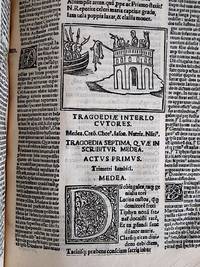
152247933Impressum Venetiis Venice Venise Venice: Per Bernardinum de Vianis 1522. Fine. Per Bernardinum de Vianis Impressum Venetiis Venice Venise Venice 1522 21 x 31 cm relié Very rare post-incunabula edition of Seneca's tragedies illustrated with 10 woodcut figures in-text 6.5 x 8 cm at the head of each of the ten tragedies. Numerous initials in black or criblé. Text of the tragedy in a central column with commentaries distributed around it in Roman type. Title within a large engraved floral border. The editio princeps of Seneca's tragedies is considered to be that of 1484 in Ferrara Andreas Gallicum. Colophon: ""Impressum Venetiis per Bernardinum de Vianis de Lexona Vercellensem. Anno Domini M.D.XXII die VI Novembris."" Contemporary full vellum binding with a raised-band spine remade in old vellum 18th or early 19th century. Manuscript title in black ink. Lacking the endpaper before the first title leaf. Front board detached from the visible sewing. Last leaves frayed at right margin. Lack to edge on lower board. A copy of fine freshness except for the title leaf slightly faded. Edition prepared by Girolamo Avanzi who brought together his own commentaries on Seneca's Tragedies which initially appeared in 1507 in Venice and those of Daniel Galetanus and Bernardino Marmitae from the 1498 edition of the same Tragedies of Seneca. This professor of philosophy and philology worked in Padua he prepared several editions of ancient texts notably Catullus Ausonius. He was Aldus Manutius's assistant in preparing editions of several ancient texts. Ten tragedies by the author have come down to us two of which pose problems regarding their attribution Octavia and Hercules Oetaeus. The Trojan Women is an adaptation of Euripides' Troades. Seneca's theater contains no scenic dramaturgy or intrigue it is a theater where as in Euripides - to whom the author is very close - the word is sovereign and commands the tragic outcome. The plays thus appear as a succession of declamations where action is absent Seneca concentrating his writing on the internal tragedy of his characters after the irremediable act that precipitated them into madness thus Medea after her crimes or Hercules after his infanticide. The influence of this writing would be great at the end of the 16th and beginning of the 17th century notably in Garnier. Per Bernardinum de Vianis hardcover
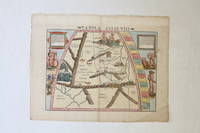
155068933s. l. Bâle Basel 1550. Fine. s. l. Bâle Basel s. d. circa 1550 42.10 x 33 cm une feuille Tabula Asiae VIII Basel ca 1550 42.1 x 33 cm one map Original map titled and heightened in colors by a contemporary hand. Published for the first time in 1540 in Munster's Geographia. Central fold. Two repairs with paper strips to verso and two little wormholes without consequence. A very good copy of one of the most important maps of monsters from the 16th century done by one of the most famous mapmakers of the Renaissance. The map covers the territories of Central Asia as well as Tibet and Nepal. One finds at the edges of the topography three kinds of congenital deformations monopods headless men and people with the heads of dogs as well as a legendary bird. All these creatures emerged from the superstitions of the Middle Ages based on accounts by travelers who had preceded Marco Polo into Central Asia. Also worth noting is a scene showing cannibalism in the North part of the map. unknown
15749997s. l. Lyon: apud Petrum Santandreanum 1574. Fine. apud Petrum Santandreanum s. l. Lyon 1574 17 x 11.50 cm relié The rare first edition of these works of Sallust in Latin and Greek. Full modern Flemish vellum binding perfectly executed. A second part containing Carrione's commentaries and Sallust's text in Greek has its own title page: In C. Sallustii crispi catilinam et iugurtham. Aldi Manutii Paul F. Scolia. Cypriani a opma emendetiones. In Histotiarum lib. VI a ludovico carrione suma diligentia collectos. 1574. Printer's device of Pierre de Saint André on the title page. These works of Sallust are a reprint of the Greek texts held by Aldo Manuce in Venice. The work is formed of two distinct parts the first is a Latin translation the second is composed of commentaries by Louis Carrion of Bruges and Sallust's texts in Greek. Louis Carrion was a specialist in the Greek language in the 16th century he contributed to numerous editions. 16th-century editions of Sallust appear to be rare only Oxford holds a similar copy and only the Russian National Library holds 3 works prior to 1500. The majority of the earliest editions found in libraries are from the 17th century. A manuscript ex libris: johannes Frederici Gronovii 17th century a second engraved: Bibliothèque du Dr Broca. apud Petrum Santandreanum hardcover
159221979Lugduni Batavorum Leiden Leyde Leiden: Ex officina Plantinianaapud Franciscum Raphelengium 1592. Fine. Ex officina Plantiniana apud Franciscum Raphelengium Lugduni Batavorum Leiden Leyde Leiden 1592 12 x 17 cm relié Second Plantin edition with Steewech's commentaries after that of 1585. A printer's device on both title pages. Fine and esteemed edition. Illustrated with 51 woodcuts in and outside the text military machines military manoeuvres. and with a folding plate showing the organization of a Roman camp. The commentaries by Stewachius 1557-1588 have a particular title page: Godescalci Stewechii Commentarius ad Flavi Vegeti Renati De re militari libros. Accesserunt eiusdem G. Stewechii & Francisci Modii. The text of Polybius book VI of his History was translated into Latin by Janus Lascaris 1445-1535. The military dictionary Modesti libellus De vocabulis rei militaris was compiled by Pomponius Laetus 1425-1497 or Leto and his students based on Vegetius's work. Contemporary limp vellum binding with overlapping edges. Traces of ties. Black title in pen. Handsome copy. Binder's error: pages 49-64 have been placed after page 32 so that after page 48 comes page 65. Vegetius was a Roman military writer of the second half of the 4th century and apart from the fact that he was a civil servant of the Empire little is known about his life. We have from this author a treatise in five parts: the first deals with recruits and recruitment the second with the organization of the Legion and ancient Roman armies the third with military manoeuvres in the field the fourth with the attack and defense of fortified places the fifth concerns naval tactics. Steewech commentator of this edition was professor at Pont-à-Mousson. Engraved armorial bookplate of Jean-Baptiste Peyer lord of Fontenelle. Ex officina Plantinianaapud Franciscum Raphelengium hardcover
155530246Lugduni Leiden Lyon: Apud Ioanem Frellonium 1555. Fine. Apud Ioanem Frellonium Lugduni Leiden Lyon 1555 8 x 12.50 cm relié The editions of Quintus Curtius on the life of Alexander were numerous in the 16th century. We have been unable to determine whether this was a first edition from Jean Frellon although we have not found any earlier edition from this publisher notably in the Aurelianensis catalogue of 16th-century Lyon editions present only in the Edinburgh catalogue. Fine printing in Italic Minuscules. The last leaf bears the printer's mark with the scorpion of Michaël Sylvius typographus. Two old manuscript leaves at the end of the work on Alfonso king of Naples and the Alexander of Quintus Curtius. The last unpaginated part bears as its header: Alexandri magni epistola de situ India . ad Aristotelem praeceptorem suum in latinitatem vesa a Cornelio Nepote. Full chocolate calf binding from the 19th century. Raised spine decorated in blind with Renaissance friezes. Boards hot-stamped with a Renaissance motif a flower in a square framed by fleur-de-lis and blind-stamped with multiple framing fillets hot-stamped trefoils in the corners. Traces of ties. Edges gilt. Joints rubbed with the upper joint partly split and fragile. Both headcaps have been restored in the past some damage. 2 corners bumped. First blank endpaper detached an ochre dampstain in the middle on the first and last leaves. The history of Alexander is the only book by Quintus Curtius Roman writer of the 1st century that has come down to us yet it has reached us incomplete since the first two books have been lost and the last two are incomplete. His qualities as a writer his geographical and military knowledge have always been praised even though they teem with errors. This biography of Alexander would enjoy immense success during the Renaissance. Apud Ioanem Frellonium hardcover
15546951Bâle Basel: Chez Nicolas Bryling 1554. Fine. Chez Nicolas Bryling Bâle Basel 1554 11 x 17.5 cm relié New edition. Although we have found no trace of this Basel edition the first edition was published in Venice by Aldus in 1527 with a different collation. Not held by the Bibliothèque nationale de France and absent from French catalogues. Oxford holds an edition with the same date. English catalogues mention several copies at different dates. Printed in italic type. Fine contemporary German binding on pigskin with clasps in perfect working order. Spine with 3 raised bands unlettered with handwritten paper lettering piece boards stamped in blind with decorative rolls in frames leafy designs with medallions representing Erasmus of Rotterdam and Philip of Milan Martin of Paris John of . Central rectangle with interlacing foliate mirror patterns. 2 dampstains on the upper board one 2cm in diameter and the other 4cm extending outward. Fresh paper. Priscian was a Roman grammarian of the 6th century AD whose Latin name was Priscianus Caesariensis named after his native city of Caesarea in Mauritania. Little is ultimately known of his existence except that he taught in Constantinople and above all that his major work to which he owes his fame the Institutiones Grammaticae in 18 books became the reference for Latin grammar until the end of the Middle Ages. The present work is a collection that brings together different works by Priscian linguistic studies or translations of Hermogenes and Dionysius Periegetes. Chez Nicolas Bryling hardcover
154631817Lugduni Leiden Lyon ; Lutetiae Paris Paris: Ex officina Roberti Stephaniapud Seb. Gryphium 1546. Fine. Ex officina Roberti Stephani apud Seb. Gryphium Lugduni Leiden Lyon ; Lutetiae Paris Paris 1546 10.20 x 16.60 cm 2 volumes reliés New edition for Polydore Vergil's book of inventions and first edition for Cicero's sentences. Fine italic impressions. Printer's devices on the title page. The Cicero edition is absent from English catalogues. De rerum inventoribus was placed on the Index and republished in 1575 in an expurgated form and the edition we present is therefore not expurgated. The first French translation appears to have been published in 1527 according to a copy at the University of Glasgow although contradictory information gives 1528 as the date of the first French edition in Latin by Robert Estienne. Brunet gives 1499 for the date of the first edition. Half marbled blonde sheep binding early 19th century. Smooth spine with three fleurons. Beige title and volume labels. Missing endpaper on upper board of volume 1 and on lower board of volume 2. Very fresh interior. Vergil's book of inventions had lasting success in the 16th century. It is the very type of Renaissance book blending legendary accounts and historical sources. In the form of articles it treats all sorts of inventions: salt pottery painting linen music. The book is also a history of medicine and magic. Polydore Vergil naturally drew abundantly from the Ancients. Polydore Vergil 1470-1555 was born and died in Urbino; after studying in Bologna and Padua he became secretary to the Duke of Urbino and chamberlain to Alexander VI. His first two writings made him famous and were very popular: Proverbiorum libellus and De inventoribus rerum in French Les Inventeurs des choses. In 1501 the Pope sent him to England where he became intimate with Henry VII who commissioned him to write a history of England through which Polydore became the first modern historian. Not content with establishing a simple chronicle but studying events he influenced all future historians and even Shakespeare in his vision of history. He returned to his native country during the religious changes in England. The edition of Cicero's maxims and sentences was provided by Pierre Lagnier at Robert Estienne. Ex officina Roberti Stephaniapud Seb. Gryphium unknown
1564000442Italy: Gabriel Giolito de' Ferrari. Very Good with no dust jacket. 1564. Half-Leather. POLIBIO HISTORICO GRECO Vinegia - 1564 "The Histories" by the Greek historian Polybius in 17 books translated into Italian by Lodovico Domenichi. Printed in 1564 by Gabriel Giolito de' Ferrari. PLEASE NOTE: The frontispiece is NOT the original. It is a photocopy done on antique paper.Pages number: reproduction frontispiece 22 546 registro Half calf binding. Very clean pages. First 8 pages have been reinforced.Size: 8.50 in. x 6.50 in.; Italian Language; 8vo - over 7¾" - 9¾" tall; Ancient History Greek Greece Rome Roman . Gabriel Giolito de' Ferrari hardcover
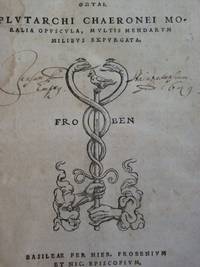
154245064Basilae Basel Bâle Basel: Per Hier. Frobeniumet Nic. Episcopium 1542. Fine. Per Hier. Frobenium et Nic. Episcopium Basilae Basel Bâle Basel 1542 20 x 30 cm relié Rare Greek edition of the Moralia moral and miscellaneous works published by editor Hieronymus Froben and his brother-in-law Nicolaus Episcopius who continued the work of their father Johann Froben making Basel an important center of printing. Fine publisher's device on title page and a woodcut headpiece at the beginning of the first treatise. Text entirely in Greek on 47 lines. Seventeenth-century manuscript annotations on the title page. Modern speckled paper boards binding smooth spine printed label; joint slightly cracked at head very solid binding. Corner dampstain and tiny lack on title page several other more extensive but faint dampstains on the last ten leaves of the volume. Lacking 3 pages at the end after the complete text with the printer's device. A copy with fine margins. Per Hier. Frobeniumet Nic. Episcopium hardcover
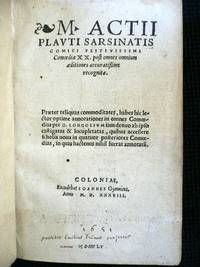
153812409Coloniae Cologne Cologne: Excudebat Ioannes Gymnicus 1538. Fine. Excudebat Ioannes Gymnicus Coloniae Cologne Cologne 1538 16 x 10.50 cm relié First edition. Edition not found in German libraries which possess an edition of 1535 in Basel with another commentator nor in French and English libraries. Fine italic printing in small type. The first edition of Plautus is from 1472. Edition not cited in Brunet. Later full vellum binding perhaps 18th century. Spine with raised bands. Manuscript title in black ink in the 19th century. The comedies of Plautus constitute the largest collection of works that we possess from antiquity. A manuscript note on the title page ""Possedet Emilius Friaud professor anno 1855."" Engraved bookplate Jean Baptiste Peyer seigneur de Fontenelle. Library label of Dr Broca. Manuscript gift inscription from 1651 at the bottom of the title page: Emilius Frinaut professor. Excudebat Ioannes Gymnicus hardcover
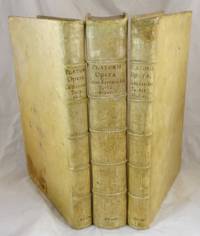
1578620Geneva: Henr. Stephani 1578. First Edition. vellum. Very good. The STEPHANUS Plato <br />The Book That Established the UNIVERSAL REFERENCE System for Platos Writings <br /><br />PLATO. Platonis opera quae extant omnia. The Complete Works of Plato Title also in Greek Henr. Stephani Geneva 1578. First Greek/Latin Edition. <br />Volume 1: TP 16 unnumbered leaves handwritten replacement preliminaries circa 18th c = Dedication to Queen Elizabeth Studioso Lectori Platone Epigrammata Catalogus Dialogorum half title with first page of text - unnumbered - on the verso 1 469 471 471 542. <br /><br />Volume 2: Half-title blank leaf lettered AA.i. 3 unnumbered leaves printed replacement preliminaries circa 18th c. = Dedication to King James the Sixth of Scotland later James the First of England Two Poems 3-701 672 673 704 992. <br /><br />Volume 3: Half-title 3 unnumbered leaves handwritten replacement preliminaries circa 18th c. = Dedication to the Republic of Bern Poem AAAA.i. = Contents Page 3-374 375 368 377-416 1-139; Folio. <br /><br />Three vols. 10.25 x 15.5 in. text block sheets are 10 x 15 in. Folio. <br /><br />"A great Renaissance author and scholar as well as a member of one of Europe's most illustrious families of printers Henri Estienne II himself edited his grand Plato for which he commissioned a new Latin translation by Jean de Serres. Together with his monumental 1572 Thesaurus graecae linguae the lavish Plato was responsible according to Schreiber for securing both Estienne's scholarly reputation and his financial ruin" Garden Ltd. #40. <br />First Greek/Latin edition printed in parallel text with translation and commentary by Jean de Serres noted French historian and advisor to King Henry IV during the reformation. The famous Stephanus edition which has served as the universal reference system for all other editions of Plato's writing since its publication. In every translation of Plato there are small numbers in the margin which refer to the pagination in this edition affording scholars the opportunity to cross-reference each other's work in any language - they are called the "Stephanus numbers." For example Socrates major speech in the Symposium completes at 212c. <br /><br />Some preliminary pages dedication poems etc. are not original but rather were printed and inserted sometime in the 18th century. Because the preliminary pages included dedications to Queen Elizabeth copies of the Stephanus Plato circulating in countries hostile to the throne at the time of publication 1578 often had these pages removed. Some copies of the Stephanus Plato have appeared at auction lacking preliminaries altogether. In 2008 Sokol Books Ltd. catalogued the missing prelims: their absence is the works most common defect. Others like this copy had the preliminaries replacedsometimes by hand other times by a local printeronce relations with England had improved. This is one of those rare copies with replacements. Thus not only is this an important and rare antiquarian book The Stephanus Plato! but also an important historical artifact given its unique history and provenance. <br /><br />CONDITION: Very Good in uniformly bound contemporary possibly early 17th c. vellum with manuscript lettering to spines. Minor repairs to vellum on head and heel of spine mostly on volume 3. Expert old paper repairs to title page of volume I and half-titles of vols. II & III with bookplates on all three pastedowns: Inter Libros Josephi Mariae Parascandolo Antecessoris Regii A.L.N. of Naples. Woodcut-engraved printers vignette on title woodcut-engraved decorated initials head-pieces & tail-pieces. Large paper 15 x 10. Handwritten and printed preliminaries replaced sometime in the 18th c. A tightly bound historically important copy of one of the most important books in the history of philosophy. Henr. Stephani hardcover
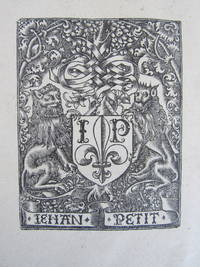
152266218Paris: Jehan Petit 1522. Fine. Jehan Petit Paris 1522 14 x 20 cm relié First edition very rare. Printed by Jean Parvi in gothic rotunda. Title page within a portico with publisher Jean Petit's device beneath the title. One criblé initial. Large publisher's device on verso of final leaf the recto bearing the colophon. A manuscript note in ink beneath the title dated 1537. One copy at the British Library 2 in Spain Universities of Madrid and Salamanca one at the Hesburgh Library USA nothing in French catalogues. Colophon: Parissis sumptibus honesti viri Ioannis Parvi via Iacobea sub lilio aureo co morantis. M.D.XXII. Full sheep binding worn 17th century. Jansenist spine with raised bands. Brown sheep title label. Head cap torn with loss along lower joint. Last compartment loose and tail cap torn. 3 corners cut and heavily bumped. Epidermis worn with scratches. One tear to title page starting from upper margin 2.5cm long. Foliation jumps from CLXXXVII to CLXXXIX without loss. Two leaves CCC follow in succession by error. CCCXXXI to CCCXXXIII without loss. Interior fresh. Pierre Sutor pseudonym of Pierre Couturier was a French theologian doctor at the Sorbonne then Carthusian. In this work on the Carthusians the author refutes some detractors of monastic life particularly that of the Carthusians. In the first book he makes an apology for his order; in the second he discusses the occupations of the Carthusians and the excellence of their spiritual exercises and devotes a chapter to the writers of this order. He furthermore supports the truth of the history of the canon of Paris and treats monastic vows and the manner of observing them. Jehan Petit hardcover