Louise MICHELBiblio.com
12 695 résultats
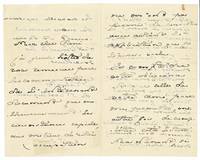
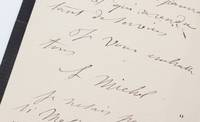
188583957s. l. Paris 1885. Fine. s. l. Paris 12 juin 1885 11 x 16.90 cm 2 pages 1/2 sur un bifeuillet Autograph letter signed by Louise Michel addressed to Lucien Barrois; two and a half pages written in black ink on a white paper bifolium with black border. Transverse folds inherent to postal delivery. Louise Michel requests help for one of her acquaintances: ""Madame Maron à qui Lafont ou Clémenceau avait fait avoir promesse à la mairie d'un terme de son loyer elle en doit trois n'a plus entendu parler de rien et il faut qu'elle déménage pour aller en face où elle paiera moins. Sa propriétaire l'aurait attendue avec un terme payé sur les trois. Il faut enfin que ce soit vous qui rappeliez cette pauvre femme qui a rendu tant de services."" ""Madam Maron for whom Lafont or Clémenceau had secured a promise from the town hall for one term of her rent she owes three has heard nothing more and must move across the street where she will pay less. Her landlady would have waited for her with one term paid out of the three. You must finally be the one to remind them of this poor woman who has rendered so many services."" Moving letter testimony to the unwavering devotion of the former Communard. unknown
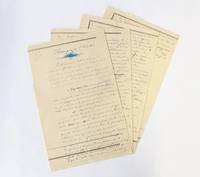
189060481Paris 1890. Fine. Paris s. d. 1890 21.30 x 14 cm 3 pages in-8 au verso de 4 feuillets de l'Assistance publique de Paris VERLAINE Paul Complete autograph manuscript signed by Paul Verlaine of one of his Hospital Chronicles: We poets as well as they the workers our companions in misery Paris n. d. 1890 213 x 140 mm 8 3/8 x 5 1/2 3 pages in-8 at the back of 4 leaves of the Assistance publique de Paris Complete autograph manuscript signed by Paul Verlaine of one of his Hospital Chronicles 90 close lines in black ink on the verso of paper from the Assistance publique de Paris. The chronicle of one of Verlaines stays in hospital between September 1889 and February 1890. The note III has been crossed out in blue printers pencil. In the definitive collection this text is in fact second. In the version published by Le Chat noir on 5 July 1890 there appear to be no variations with the text of this manuscript. This is thus the final state of the text the one sent to the printer. Jacques Borel dates the writing of this chronicle to a hospital stay in Cochin in June 1890. Verlaine spent many days in hospital during his life especially in this period. During these stays he wrote Hospital Chronicles prose poems in eight parts. Here he mixed anecdotes observations of the lives of the patients and a delicate poetical analysis of the world of the hospital. Verlaine starts off with a troubling and tired observation: But certainly all the same the Hospital darkens despite the fine June weather.Yes the Hospital is dark despite philosophy insouciance and pride. Despite the fine weather the inflexibility of the system the misery and the sickness give the poet a gloomy take on things: let us punish all objections under pain of expulsion still severe even in this month of flowers and hay of warming days and clement nights if you have the devil at your back and debt and hunger at home. Discharge whether by way of being thrown out or getting cured and life outside did not offer more comfort than the stay itself: Clearly well all get out sooner or later more or less well more or less happy more or less sure of the future at any rate more or less alive. So we will think sadly.of our suffering emotional and otherwise of the doctors good or inhuman. This was a feeling he had already experienced during what he called my intervals the times when he was out of hospital. Life outside hospital was a miserable prospect despite his established fame. Verlaine compares his misery to that of the working classes who share his stays in various hospitals. The poet calls for resignation from his brothers artisans of one sort or another workers without a lifes-work and poets.and publishers too let us accept our fate let us drink up the cup of tea with barely any sugar or this little hot chocolate and let us be brave whether it be with our medicine or an enema or chewing tobacco. Let us follow their prescriptions closely let us obey all injunctions so that injections and colonics will seem sweet to us and let us reprimand all objections.. And along with them the poet wanted to take advantage of the beauties of June in quoting two verses from the Chanson sentimentale of Xavier Privas: We are pleased with ourselves in the strong sun. And under the green branches of the oaks we poets as well as they the workers our companions in misery.. Equal in the face of misfortune whether active or passive they might feel nostalgia once they were out: And perhaps some day we will miss these good times where you workers you could rest and where we we poets worked and where you artists earned your wine and your cups . Despite this reverie Verlaine was: tired of so much poverty provisionally believe me because I have been so used to it these last five years! and concludes bitterly with the observation of the lack of humanity in modern medicine: Hospital with a capital H an awful idea unknown
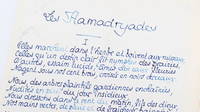
189686812Paris 1896. Fine. Paris s. d. ca 1896 21.50 x 26 cm trois pages sur trois feuillets Autograph manuscript signed by Pierre Louÿs entitled ""Les Hamadryades"" composed of sonnets on three sheets pasted onto more rigid leaves. The first two sonnets are written in blue ink the third in black ink. This poem was published in September 1896 in Volume II of the famous symbolist review ""Le Centaure"" to which notably contributed André Gide Paul Valéry Henri de Régnier Jean de Tinan and Pierre Louÿs. ""Elles marchent dans l'herbe et boivent aux ruisseaux Celles q'un destin clair fit nymphes des prairies. D'autres essaim lucide âmes des eaux fleuries Nagent sous nos cent bras croisés en noirs arceaux. . Maîtres des foudres Dzeus sauveur le verrons nous Frapper l'arbre mortel qui ferme nos genoux Et livrer la terre ivre à nos jambes écloses Connaîtrons-nous les grands horizons nébuleux L'eau du fleuve le lac de lumière les roses Et l'humide sommeil les champs profonds et bleus."" A fine poem by Pierre Louÿs one of the two with Byblis that was published in the luxurious and ephemeral review ""Le Centaure"". unknown
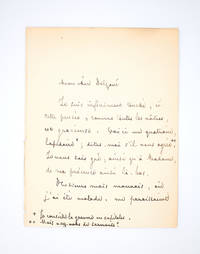
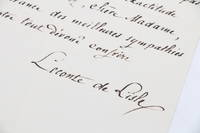
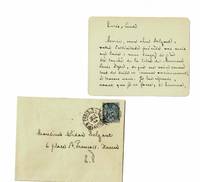
1892759251892. Fine. s. d. 15 avril 1892 12.60 x 16.40 cm 2 pages sur un double feuillet une carte et un calque Autograph letter signed by Stéphane Mallarmé to Alidor Delzant. Two pages written in black ink on a bifolium. Envelope enclosed. Also included is a signed autograph quatrain by Mallarmé on a card the one later inscribed on the mantelpiece: « Ici le feu pour renaître Tantôt durable ou charmant Comme l'amitié du maître Mêle du chêne au sarment. » Alidor Delzant was a lawyer collector and bibliophile. A friend of the Goncourt brothers he devoted a work to them and served as Edmonds secretary and executor. A fine letter in which Mallarmé evokes the composition of a quatrain to adorn Delzants mantelpiece: « Je suis infiniment touché et cette pensée comme toutes les vôtres est gracieuse. Voici un quatrain lapidaire je conseille la gravure en capitales; dites-moi s'il vous agrée. Mais usez-vous de sarments » Also included is the original tracing probably made by Mallarmé himself of the quatrain intended to decorate the lintel of Alidor Delzants library fireplace in his house at Paraÿs. Delzants reply to this letter is known: « Mon cher ami / Ces vers sont très beaux juste ce qui convenait pour glorifier la Cheminée de Paraÿs où les sarments pétillent autour des bûches des chênes. / Je demeure touché et reconnaissant. / Alidor Delzant. » unknown
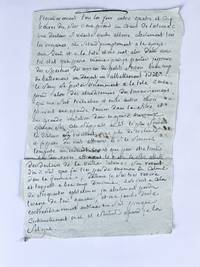
180185841Charenton 1801. Fine. ""I experience spasms a sort of shivering a lot of yawning disgust total despondency the blood rushes violently to my head then I feel dizzy spinning which makes me stumble and a thousand other things proving a great tension in the body and a great irritation in the nervous system."" Charenton 1801 15 x 22.80 cm un feuillet composé deux papiers encollés Original autograph letter by the Marquis de Sade consists of 27 lines of relatively tight handwriting. Most likely written to his wife as evidenced by the letter's origin from Sade's family. The letter is physically composed of two glued pieces of paper. On the verso the Marquis wrote 19 lines and scrupulously crossed them out - a few words and letters are still quite visible. Cited in Maurice Lever's biography 'Donatien Alphonse François marquis de Sade' Paris Fayard 1991 p. 631. On March 7 1801 Armand de Sade the Marquis's son received a letter from the Minister of Police Joseph Fouché notifying him that his father had been arrested yesterday and that handwritten pages from the novel 'La nouvelle Justine' Justine or the Misfortunes of Virtue had been found on his person: Nevertheless sensitive to your request for leniency and concerned to preserve the honor of your name I have decided to have your father transferred to the Charenton nursing home.. It should be noted that for Fouché Charenton an insane asylum was nothing more than a nursing home a prison. It should not be forgotten that a large proportion of the population of these asylums did not fit into the social and moral field and psychiatry has long had no other aim than to normalize to make them fit for social life. Contrary to what has been said Sade fits in perfectly. However as soon as he entered Charenton Sade's attitude led to his expulsion to Bicêtre the Bastille of scoundrels but his family succeeded in getting him back into the Charenton asylum. Charenton was not only the Marquis de Sade's last incarceration but also the last place he lived in where he died in 1814. The 19 lines scrupulously crossed out on the back of the leaf reveal a few words or letters; in this respect we can conjecture that it's a coded message which Sade was quite fond of for if censorship had been behind these erasures absolutely everything would have been yet the message clearly shows that almost everything has been conscientiously crossed out apart from a few words or letters. We can still make out a few of them: 'Nécessaire' 'à tous' 'ger' 'ue' 'quel' 'je trouve' 'de'. As for the letter itself it is remarkable for the homogeneity of its message. It is a lengthy complaint describing the physical ailments Sade has suffered. It is an account of the sum total of the symptoms that overwhelm the writer. In a hyperbolic style using among other figures of speech adverbs of intensity si tel très. Sade methodically spells out the violent pains his body is suffering with the whole of this violence constituting a system a structure in which all the parts are linked. In the writer's correspondence it can be said that each time he found himself incarcerated his letters mention uncontrollable physical attacks although we know of no other letter so uniform and systematic.The pain originates in the pit of the stomach radiating out to the periphery: head eyes legs all converging on vertigo loss of balance. .because that's what it's all about: Sade isn't suffering from any illness he's besieged by anguish whose ultimate meaning is vertigo the wavering of a reality from which his freedom to live as he pleases his freedom of movement and his name have been taken away. The loss of these fundamental elements of his existence sends Sade in turmoil. In addition and as regards the formation of these particular symtoms if we consider that the fulfillment of a certain sexual sadism is necessary to him the deprivation of this satisfaction turns this sadistic driv unknown
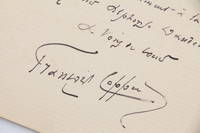
189884138s. l. Paris: S. n. 1898. Fine. S. n. s. l. Paris 3 Janvier 1898 11.50 x 18 cm une feuille Autograph letter dated and signed by François Coppée 12 lines in black ink to his friend Léon Daudet. Fold marks inherent to mailing. François Coppée shows himself touched by the last letter that Léon Daudet addressed to him and invites him to his home: "". Come whenever you wish. so that we can chat quietly."" He shares the grief and sadness of the Daudet family after the death on December 17 1897 of Alphonse Daudet his friend: "". and I think tenderly of the memory of my dear Alphonse Daudet."" S. n. unknown
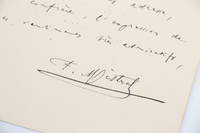
189886539Maillane Bouches du Rhône Maillane 1898. Fine. Maillane Bouches du Rhône Maillane 28 Février 1898 11.50 x 17.50 cm trois pages sur un double feuillet Autograph letter dated and signed by Frédéric Mistral addressed to Anatole France 44 lines in black ink regarding the publication of his work ""Les mannequins d'osier"" which he has just sent him with a dedication. Fold marks inherent to postal delivery a vertical shadow on the first leaf. Frédéric Mistral has just received ""Les mannequins d'osier"" and gives a glowing portrait of his correspondent's style: "". ce livre qui m'a donné tous les plaisirs de la lecture. Je suis de ceux que le roman n'intéresse guère lorsqu'ils ne sont que prétentieux tableaux de la vie contemporaine. . mais il y a dans les vôtres une si fine quintessence d'érudition et d'observation agréablement mêlées et une si joyeuse fleur d'optimisme tolérant qu'on s'y retrouve sans rechercher dans la façon gauloise omnisciente et libre de Maître Rabelais."" this book which has given me all the pleasures of reading. I am one of those whom novels hardly interest when they are merely pretentious tableaux of contemporary life. . but there is in yours such a fine quintessence of erudition and observation agreeably mixed and such a joyful flower of tolerant optimism that one finds oneself in it without seeking in the Gallic omniscient and free manner of Master Rabelais. The félibrige loves equally the characters created by his illustrious and charming master ""Tous vos personnages sont si naturels si bien en situation si logiques que ma foi on les aime tous et quoique tout cela provienne d'un aimable et indulgent scepticisme on y a là l'explication de ce phénomène étrange que si loin si injuste si douloureux que soit le monde chacun pourtant y pousse volontiers sa brouette avec la conviction en le réconfort d'avoir raison."" All your characters are so natural so well placed in their situations so logical that my faith one loves them all and although all this comes from an amiable and indulgent skepticism there one has the explanation of this strange phenomenon that however distant unjust painful the world may be each person nevertheless willingly pushes his wheelbarrow with the conviction and comfort of being right. as the spirit that breathes and animates his books: "". la sympathie du reste vraiment universelle qui accueille tous vos écrits doit vous prouver combien vous êtes humain et sage dans l'antique sens de ces mots."" the truly universal sympathy that welcomes all your writings must prove to you how human and wise you are in the ancient sense of these words. unknown
188984470s. l.: S. n. 1889. Fine. S. n. s. l. 5 Mai 1889 10.50 x 6 cm une feuille une enveloppe Autograph signed carte de visite from Alphonse Daudet 13 lines written in blue ink addressed to journalist and librettist Philippe Gille sending his thanks and congratulations for a recent performance. Envelope included. S. n. unknown
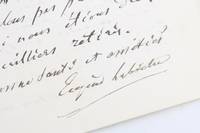
187986117s. l.: S. n. 1879. Fine. S. n. s. l. 24 Juillet 1879 10 x 13.50 cm deux pages une enveloppe Autograph letter dated and signed by Eugène Labiche 27 lines in black ink addressed to journalist and librettist Philippe Gille about the theatrical adaptation of Emile Zola's l'Assommoir. Fold marks inherent to mailing envelope included. Eugène Labiche's monogram being stamped in blind at the head of the letter. In 1879 two years after its publication as a novel l'Assommoir was adapted for the theater by William Busnach and Octave Gastineau aided by Emile Zola. Eugène Labiche and Philippe Gille seem to have participated in the creation of the play: "". je n'ai pas vu l'assommoir et j'ignorais que notre monologue y ait été introduit. Je suis absolument de votre avis il ne faut pas le mettre. La bande à Zola pousserait des cris de blaireaux."" and prefer to temper their collaboration: ""Nous verrons plus tard s'il faut ajouter quelque chose pour Brasseur mais il faudra être très discrets Brasseur s'impose un peu trop au public."" His theatrical torments are fortunately attenuated by the presence at his side of his friend Emile Augier and his wife: "". ce sont de charmants compagnons. Quant il pleut nous fesons des whists échevelés et nous ne parlons pas plus théâtre que si nous étions deux quincailliers retirés."" S. n. unknown
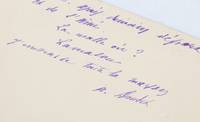
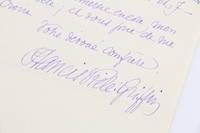
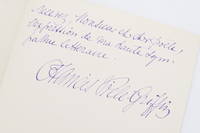
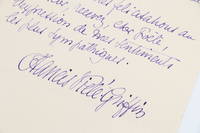
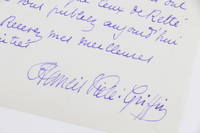
189684132s. l. Paris: S. n. 1896. Fine. S. n. s. l. Paris 31 Décembre 1896 13 x 20 cm une page et demie Signed autograph letter by Francis Viélé-Griffin 32 lines in purple ink from his Parisian home addressed to Edouard Ducoté poet bibliophile and director of the review l'Ermitage since 1895. Fold mark inherent to postal handling pen annotations on verso of fourth leaf. Francis Viélé-Griffin thanks his fellow poet Edouard Ducoté who dedicated his future collection Fables to him and apologizes for the intransigence of Mercure de France which only wants to publish authors and poets stamped Mercure de France: "". je ne comprends pas l'exclusivisme du Mercure il m'a étonné et peiné."" "". I don't understand the exclusivism of Mercure it surprised and saddened me."" He assures him that he has no influence within the review and publishing house directed by Alfred Valette because he takes care of none of the administrative formalities: "". je n'ai que peu assisté jusqu'à présent aux séances du comité où mon influence au reste est nulle."" "". I have attended committee meetings little until now where my influence moreover is nil."" As a good friend Francis Viélé-Griffin wishes to temper Edouard Ducoté's disappointment at not being published by Mercure: ""Mais n'êtes vous pas aussi bien chez Perrin "" ""But aren't you just as well off at Perrin's"" and invites him to visit soon to: "". causer de vos projets d'art."" "". discuss your artistic projects."" Intimate friend of Stéphane Mallarmé friend of André Gide Paul Valéry Francis Jammes Emile Verhaeren Francis Viélé-Griffin is an American symbolist poet writing in French. He became with Gustave Kahn one of the principal theorists of free verse. S. n. unknown
189884108s. l. Paris: S. n. 1898. Fine. S. n. s. l. Paris s. d. 1898 10 x 15.50 cm une feuille Autograph letter signed by Reynaldo Hahn dandy composer and great love of Marcel Proust 22 lines in black ink regarding the biography that Léon Daudet devoted to his father Alphonse in 1898. Trace of fold inherent to mailing. Reynaldo Hahn congratulates Léon Daudet for the rational pertinence and clarity of the biography: "". où l'on retrouve tout ce qui était définissable et analysable en Alphonse Daudet."" "". where one finds all that was definable and analyzable in Alphonse Daudet."" while regretting nonetheless that he had only imperfectly captured the author of Lettres de mon moulin : "" . ce que vous n'avez pu fixer c'est le mystère brûlant et doux qui émanait de lui et qui s'est évanoui à tout jamais."" "". what you could not capture is the burning and sweet mystery that emanated from him and which has vanished forever."" In order to temper this criticism he wishes to warmly thank Léon Daudet for having evoked in the work his friendship with Alphonse Daudet: "". je suis si fier de l'affection qu'il me témoignait."" "". I am so proud of the affection he showed me."" S. n. unknown
189683995Nazelles: S. n. 1896. Fine. S. n. Nazelles 8 Juillet 1896 13 x 20.50 cm une page et demie Autograph letter dated and signed by Francis Viélé-Griffin 20 lines in violet ink from his property in Nazelles Indre-et-Loire addressed to Edouard Ducoté poet bibliophile and director of the review l'Ermitage since 1895. Fold marks inherent to being placed in an envelope. He thanks his fellow poet Edouard Ducoté for the latest book he has just sent him with a dedication and expresses his delight at having been invited by him to contribute some of his poems to the review l'Ermitage: ""I shall gladly collaborate in the form of some poems with your review which I always read with interest and profit."" Francis Viélé-Griffin also mentions a painting by his friend Théo Van Rysselberghe depicting Madame Edouard Ducoté that he recently noticed in his studio: "". a truly charming portrait."" A close friend of Stéphane Mallarmé friend of André Gide Paul Valéry Francis Jammes and Emile Verhaeren Francis Viélé-Griffin was an American symbolist poet who wrote in French. He became along with Gustave Kahn one of the principal theorists of free verse. S. n. unknown
189574355s. l.: S. n. 1895. Fine. S. n. s. l. s. d. circa 1895 12.50 x 20 cm quatre pages sur une feuille rempliée Autograph letter signed by the dandy count four pages 43 lines written in black ink thanking his friend Henry Lapauze and one of his acquaintances for having procured for him: ""l'intéressant document"" ""the interesting document"" which his overwhelming activity has not yet allowed him to read: "". avec autant d'application que je l'aurais voulu."" "". with as much attention as I would have wished."" Robert de Montesquiou therefore relies on his friend's indulgence also transmitting his apologies and gratitude to the unknown person who helped him through Henri Lapauze: "". je compte sur votre obligeance et celle de votre ami pour me permettre une autre fois de compléter cette lecture. veuillez bien lui transmettre ma gratitude en même temps que le surplus de mon désir."" "". I count on your kindness and that of your friend to allow me another time to complete this reading. please convey to him my gratitude along with the remainder of my desire."" A small brown stain at the top of one page a light crease at the foot of another without significance. Henry Lapauze 1867-1925 was a journalist and art critic who became in 1905 curator of the Petit Palais converted four years earlier into a museum and whose collections he considerably enriched by acquiring notably the Courbet Henner and Falguière collections with at the twilight of his life a marked preference for the Decorative Arts of which he was an ardent promoter. S. n. unknown
186984461Paris 1869. Fine. Paris 21 unknown
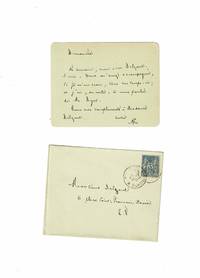
189476276Paris 1894. Fine. Paris 11 mars 1894 11.40 x 8.80 cm une carte recto et une enveloppe Autograph card signed by Stéphane Mallarmé addressed to Alidor Delzant written on the recto in black ink. Envelope attached. Alidor Delzant was a lawyer collector and bibliophile. Friend of the Goncourts he devoted a work to them and was the secretary and testamentary legatee of Edmond. Card written upon return from a trip to Oxford during which Mallarmé gave a lecture on aesthetics: "".j'ai du reste à vous parler de M. Dyer."" "".I have moreover to speak to you about M. Dyer."" Louis Dyer friend of Delzant is an Oxford alumnus and was then professor of Greek at Harvard. Through Delzant's intermediary he had offered hospitality to Mallarmé who did not know him before his lecture but this card attests that the two men finally met. unknown
189684130Nazelles: S. n. 1896. Fine. S. n. Nazelles 4 Septembre 1896 13 x 20.50 cm une page Autograph letter signed by Francis Viélé-Griffin 23 lines in violet ink from his property in Nazelles in Indre-et-Loire addressed to Edouard Ducoté poet bibliophile and editor of the review l'Ermitage since 1895. Fold mark inherent to mailing. A perfectionist Francis Viélé-Griffin postpones sending a poem he had promised to the review l'Ermitage not yet judging it completely accomplished: "". ce scrupule est seul cause de mon retard et vous me le pardonnerez aisément."" ""this scruple alone causes my delay and you will easily forgive me."" He finds the quality of the previous issue of the review excellent and particularly praises the verses of his colleague Stuart Merrill: "". les vers de Merrill sont délicieux n'est-ce pas "" ""Merrill's verses are delightful aren't they"" and congratulates Edouard Ducoté. Intimate of Stéphane Mallarmé friend of André Gide Paul Valéry Francis Jammes Emile Verhaeren Francis Viélé-Griffin is an American symbolist poet writing in French. He becomes with Gustave Kahn one of the principal theorists of free verse. S. n. unknown
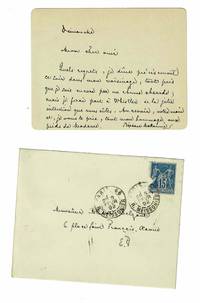
189276345Paris 1892. Fine. Paris 7 février 1892 11.40 x 8.80 cm une carte et une enveloppe Autograph letter signed by Stéphane Mallarmé addressed to Alidor Delzant written on the recto in black ink. Envelope included. Alidor Delzant was a lawyer collector and bibliophile. Friend of the Goncourts he devoted a work to them and was Edmond's secretary and testamentary legatee. ""Quels regrets je dîne précisément ce soir dans mon voisinage tout pris que je sois encore par un rhume absurde ; mais je ferai part à Whistler de la jolie intention que vous eûtes."" ""What regrets I am dining precisely this evening in my neighborhood taken as I still am by an absurd cold; but I will inform Whistler of the lovely intention you had."" unknown
190084131s. l. Paris: S. n. 1900. Fine. S. n. s. l. Paris 31 Mai 1900 13 x 20.50 cm une page Autograph letter signed by Francis Viélé-Griffin 15 lines in violet ink from his Parisian residence addressed to Edouard Ducoté poet bibliophile and editor of the review l'Ermitage since 1895. Fold mark inherent to mailing. To please the poetess Julia Daudet Francis Viélé-Griffin took the liberty of imposing verses on Edouard Ducoté for his review: "". je vous ai recommandé ces vers pour complaire à un souhait de madame Daudet je n'en ai pas pris connaissance ; mais reste songeur."" ""I recommended these verses to you to comply with a wish of Madame Daudet I have not read them; but remain thoughtful."" which the editor of l'Ermitage finds poor. Intimate of Stéphane Mallarmé friend of André Gide Paul Valéry Francis Jammes Emile Verhaeren Francis Viélé-Griffin is an American symbolist poet writing in French. He becomes with Gustave Kahn one of the principal theorists of free verse. S. n. unknown
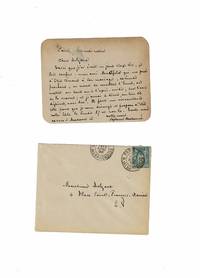
189676279Paris 1896. Fine. Paris 15 avril 1896 11.40 x 8.80 cm une carte recto et une enveloppe Signed autograph card from Stéphane Mallarmé addressed to Alidor Delzant written on the recto in black ink. Envelope included. A small water stain affecting the beginning of the card without hindering readability. Alidor Delzant was a lawyer collector and bibliophile. Friend of the Goncourts he devoted a work to them and was Edmond's secretary and testamentary legatee. ""Voici que j'écris un jour trop tôt je suis confus : mon ami Muhlfeld qui me prie d'être témoin à son mariage ce lundi prochain."" ""Here I am writing a day too early I am confused: my friend Muhlfeld who asks me to be witness at his wedding this coming Monday."" ""On the 20th of this month also spring-like he signs the municipal register as witness at the wedding of Lucien Muhlfeld one of the leading figures of La Revue blanche and all this fine company dines in evening dress at La Tour d'Argent enlivened by the laughter of Misia and the Natanson brothers."" Jean-Luc Steinmetz unknown
1826774711826. Fine. 1826 18.50 x 24 cm une feuille rempliée Autograph letter signed addressed to the painter Jean-Pierre Granger and dated April 24 1826 one page written in black ink with the correspondent's address on the verso. 15 lines in a beautiful slanted handwriting on a folded sheet. The celebrated Empire painter recommends to his colleague: ""a young man who seems very interesting to me and too young to enter my studio. Dear Grand Diable please do me the favor of taking good care of him in yours and when he has spent some time copying if it does not inconvenience you I will take him back with pleasure and well on his way."" Jean-Pierre Granger was first a pupil of Jean-Baptiste Regnault before joining Antoine-Jean Gros in Jacques-Louis David's studio. In 1800 he became laureate of the first Rome Prize for history painting with Antiochus renvoie son fils à Scipion Paris École nationale supérieure des beaux-arts while his fellow student Jean-Dominique Ingres received the second prize. unknown
189476272Paris 1894. Fine. Paris 12 février 1894 11.40 x 8.80 cm une carte recto-verso et une enveloppe Autograph letter signed by Stéphane Mallarmé addressed to Alidor Delzant written on both sides in black ink. With envelope. Alidor Delzant was a lawyer collector and bibliophile. A friend of the Goncourts he devoted a work to them and served as secretary and testamentary legatee to Edmond. Mallarmé mentions a future stay in Oxford and thanks Delzant for having recommended him to a friend: "".vous songez si j'ai été touché de la lettre de Monsieur Louis Dyer de qui me voici connu tout de suite et comme anciennement à travers vous. Je lui réponds avant que je ne fasse si heureux sa connaissance. Hôte je ne pourrai l'être M. Powell qui a eu l'initiative de ma conférence m'ayant de longue date offert son toit pendant mon bref séjour à Oxford."" "".you can imagine how touched I was by the letter from Monsieur Louis Dyer through whom I find myself known immediately and as if from long ago through you. I am writing back to him before I have the pleasure of making his acquaintance. I will not be able to be a host as M. Powell who initiated my lecture has long since offered me his roof during my brief stay in Oxford."" Mallarmé would indeed give a lecture on aesthetics on March 1st 1894 at Oxford the text of which was published in 1895 under the title Oxford Cambridge. La musique et les lettres. unknown
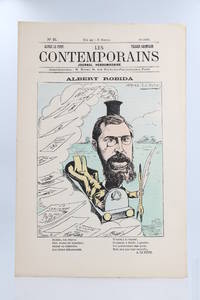
188079318Paris: Au bureau du Journal ""Les contemporains"" 1880. Fine. Au bureau du Journal ""Les contemporains"" Paris s. d. 1880 20 x 29.50 cm en feuilles First edition of this issue of the magazine founded by writer Félicien Champsaur and illustrator Alfred Le Petit consisting of two folded sheets. Handsome copy. On the first a color woodcut depicting Albert Robida by Alfred Le Petit. On the following text by Félicien Champsaur in first edition titled ""Albert Robida"". Au bureau du Journal ""Les contemporains"" unknown
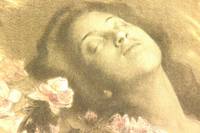
189874340Paris: Imprimerie Champenoispour CH. MassonH. Piazza 1898. Fine. Imprimerie Champenois pour CH. Masson H. Piazza Paris Février 1898 31 x 27 cm une feuille et une serpente Rare original colour lithograph executed by Albert-Émile Artigue for L'Estampe Moderne series no. 10 published in February 1898. One of 50 deluxe proofs printed on Japon with wide margins artist's signature within the stone publisher's blindstamp depicting a child's profile in the lower margin numbered stamp of the deluxe issue on the verso; the print is preceded by a captioned tissue guard with the artist's name the title and an excerpt from the work; with additional plain tissue guard. Lithograph inspired by an excerpt from Emile Zola's novel La Faute de l'abbé Mouret reproduced on the tissue guard of the print. A magnificent French monthly publication issued between May 1897 and April 1899 L'Estampe Moderne comprises original chromolithographs which unlike other periodicals such as Les Maîtres de l'Affiche and as specified on the tissue guards were created expressly for the journal by each artist. In all 100 prints were published encompassing the major artistic movements of the late 19th century: Symbolism Art Nouveau the Pre-Raphaelites Orientalism and the Belle Époque. Each issue of four plates was printed in 2000 copies sold at 3.50 francs and 100 on Japon paper offered at 10 francs. Henri Piazza also planned an exclusive printing of the utmost luxury: 50 copies on Japon with wide margins and 50 in black on China paper at the considerable price of 30 francs. This large-format print is superbly printed on the most prestigious of papers: Japon. Thick silky satin-finished and pearly it elevates each sheet into a work of art in its own right. Its exceptional capacity for ink absorption and affinity with colour make it the ideal medium for these splendid lithographs. The interest of French collectors in artistic posters intensified at the beginning of the 1890s. Octave Uzanne to describe this craze coined the term affichomanie. The poster originally popular and pasted up on the streets of the capital then became an art object its ephemeral support transformed into something precious and destined for preservation. Piazza resolved to remove the poster from its advertising purpose and elevate it to the rank of a work of art in its own right on a par with the deluxe illustrated book. In this way he assembled a prestigious collection of entirely original works by the most prominent European artists of the time: Georges de Feure Eugène Grasset Henri Detouche Emile Berchmans Louis Rhead Gaston de Latenay Lucien Lévy-Dhurmer Gustave-Max Stevens Charles Doudelet Hans Christiansen Henri Fantin-Latour Steinlen Ibels Engels Willette Henri Meunier Evenepoël Bellery-Desfontaines Charles Léandre etc. A handsome copy. Imprimerie Champenoispour CH. MassonH. Piazza unknown
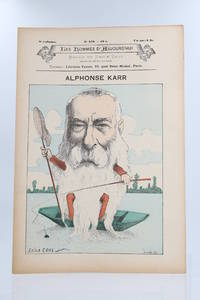
188879317Paris: Léon Vanier 1888. Fine. Léon Vanier Paris s. d. circa1888 20 x 29.50 cm en feuilles First edition of this issue of the magazine consisting of two folded sheets. Handsome copy. On the first a color woodcut depicting Alphonse Karr by Emile Cohl. On the following text by Pierre and Paul in first edition titled ""Alphonse Karr"". Léon Vanier unknown
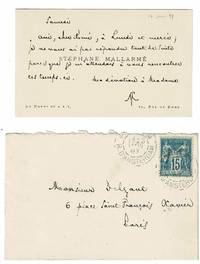
189776333Paris: S. n. 1897. Fine. S. n. Paris 23 janvier 1897 10.20 x 6.30 cm une carte de visite et son enveloppe Signed autograph visiting card from Stéphane Mallarmé addressed to Alidor Delzant. Envelope included. Alidor Delzant was a lawyer collector and bibliophile. Friend of the Goncourts he devoted a work to them and was Edmond's secretary and testamentary legatee. ""Ami cher ami à lundi et merci ; je ne vous ai pas répondu tout de suite parce que je m'attendais à vous rencontrer ces temps-ci."" ""Friend dear friend until Monday and thank you; I did not answer you right away because I expected to meet you these days."" S. n. unknown