12 695 résultats
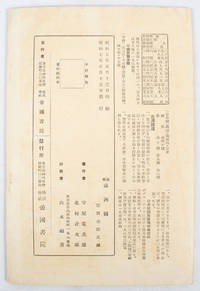
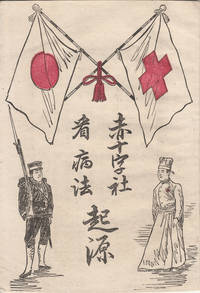
1895171267大阪. Osaka.: 村上俊吉. Murakami Shunkichi. 明治28 1895. 22pp 19.5 x 13.8cm colour pictorial upper cover very good copy. Written during the Sino-Japanese War at the time when Japanese Red Cross nurses were deployed to the battle fields for the first time this 1895 booklet featuring a Japanese soldier and a nurse on its cover was printed just two days before the end of Sino-Japanese War. <br> <br>The Japanese Red Cross was first established as Hakuaisha in 1877 and renamed as the Japanese Red Cross in 1887 following the ratification by the Japanese government of the Geneva Convention in 1887. This booklet gives the organisation's history and is a translation of an essay written by an American author named Atkinson first name not given. As well as the origin of the Red Cross it also details it's origin principles and provides details of some famous nurses including Florence Nightingale. <br> <br>The timing of this booklet's publication is interesting as it was due to the Sino-Japanese War that the Japanese public learned about the Red Cross nurses for the first time. . 村上俊吉. [Murakami Shunkichi]. unknown
1893171903Z. Takenouchi. 明治 26 1893. Striking black and white wood engraved illustrations 32pp 26.6 x 19.5cm very good copy. This is a fascinating catalogue of Takenouchi Safes from 1893 with detailed illustrations specifications and prices. Takenouchi was the first safe manufacturer in Japan and the business was very successful numbering the Royal Household and major companies amongst their clients. The idea of the business started soon after Yokohama was opened as a trading port. The founder's father an iron monger was asked to repair a British businessman's safe after it was damaged by fire. He learned how effective the safe was in protecting its contents from the fire. Since fires were frequent and hazardous in Japan his son Zenjiro Takenouchi founded the business to produce fireproof safes in Japan. The company obtained numerous patents and had the reputation for safes that were extremely robust and difficult to break-in. This reputation still survives today. <br> <br>The catalogue includes beautiful engravings of the company's shopfront factory and trademarks and of numerous versions of its safes. These show the thick steel doors which were elegantly decorated with distinctively Japanese designs including images of pine trees. The inner drawers of the safes were made of paulonia wood which protects the contents from humidity. The brochure gives specifications and prices weighing scales also illustrated details of the effectiveness of safes letters of appreciation from clients who managed to rescue their valuables from fire hazards and a list of businesses who used their safes. The clients included Mitsui Trading Company branches in China and India and Kanematsu in Sydney. . Z. Takenouchi. unknown
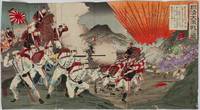
1894218366Yokoyama.: Ryōhachi . 1894. Conjoined triptych of ink and watercolour woodblock prints trimmed to the margins together 35 x 63.3 cms backed onto Japanese scrap paper with some writing title and descriptive cartouches top right red censor's stamp lower left and artist's signature lower right some paper abrasions wear at the joins slight bleeding of ink and offsetting on the verso but overall in good condition. Vivid depiction of the Battle of Seonghwan also known as the battle of Asan in Korea July 29 1894 the first major land battle on of the Sino-Japanese War 1894-1895. Chinese troops are seen fleeing the charging Japanese marines and the silhouettes of airborn casualties are depicted in the bright orange explosion. <br> <br>Yōsai Nobukazu 1872-1944 was active towards the very end of the ukiyo-e period when the popular days of this style were over. Printmakers like Yōsai struggled and he survived as an artist by depicting the Sino-Japanese and Russo-Japanese wars. Yōshū Chikanobu was his teacher active 1838-1912 and Yōsai Nobukazu was considered his best student. The majority of his prints were triptychs of battles of the Sino-Japanese war. See a digitisation of this woodblock from the Lavenberg Collection of Japanese prints online at the University of Oregon The caption on top right praises the Japanese troops' bravery against 500 strong Chinese troops. <br> <br>From the collection of the late John Caiger lecturer in Asian studies ANU. . Ryōhachi (?) unknown
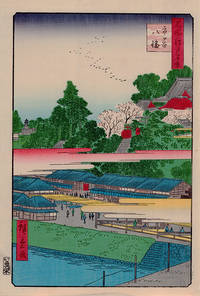
1858218370Tokyo.: 魚屋栄吉. Uoya Eikichi. Post-1858. Colour woodblock print 38 x 26 cms title cartouches publisher's stamp and artist's signature but without the censor's date stamp sheet a little toned old paper repair at the lower margin not affecting the image but in very good bright condition. Number 41 from the series "One hundred famous views of Edo" Meishō Edo Hyakkei which Hiroshige worked on between 1856 and 1858. This print of Hachiman Shrine in Ichigaya was published a month after his death in 1858 and it was most likely that Hiroshige II contributed to this work. Hachiman Shrine in Ichigaya was founded in the15th century and during the Edo period it attracted many visitors. It still stands on the original site. <br> <br>From the collection of the late John Caiger lecturer in Asian studies ANU. . 魚屋栄吉. [Uoya Eikichi]. unknown
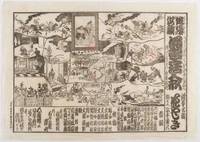
1895215186Japan.: 浅草蔵前通好文堂. Asakusa Kuramaedōri Kōbundō. Circa1895. Black and white woodblock advertisement 25 x 35cm a paper tape repair on reverse. Pink watercolour in three small areas few tiny holes but otherwise clean. This richly illustrated advertisement flyer for the chrysanthemum doll displays at the Hanayashiki Amusement Park in Asakusa features various scenes from famous kabuki plays First Sino-Japanese War battles and a fairy tale Momotaro Peach Boy. Human figures made out of chrysanthemum flowers were placed in various dioramas. In addition various animal and bird figures including lions peacocks and pelicans are created using the flowers. These chrysanthemum doll displays an enduring autumn tradition continue to attract numerous visitors each year with their remarkable artistry and seasonal charm. . 浅草蔵前通好文堂. [Asakusa Kuramaedōri Kōbundō]. unknown
1884222938Deutsche Verlags-Anstalt Stuttgart 1884. Hardcover mit Leinenrücken 1884 1887. Zustand: eine Namenseintragung. Rücken Ecken Kanten stärker bestoßen und verletzt. Innen sauber und fleckenfrei. Deutsche Verlags-Anstalt, Stuttgart, hardcover
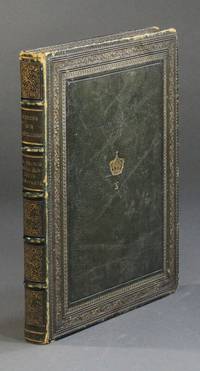
184658406Paris: J. Dumaine 1846. 4to 1 volume only of 6 - the second volume wasn't published until 1851 and volumes 3-6 weren't published until 1862-71; pp. xxviii 387 1; 10 engraved plates of weapons and equipment of war; contemporary full green morocco elaborate gilt rules on covers enclosing the Napoleonic crown with the letter 'N' beneath gilt-decorated spine in 6 compartments gilt-lettered direct in 2 a.e.g. inner dentelles; extremities a bit rubbed small crack starting at the bottom of the front joint all else very good. This copy inscribed "Lord William Lennox souvenir de la part de l'auteur Napoleon Louis B" part of the 'B' lost to the binder's knife. Lord William Pitt Lennox 1799-1881 was a British Army officer and writer of bad novels. He preferred sport horseracing literature and other entertainments to military life - a life cut short by blindness in one eye. J. Dumaine unknown
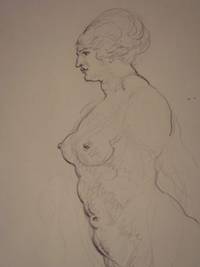
1899257951899. Fine. Fin XIXème - Début XXème 23 x 36 cm Original pencil drawing. Stamp signature of the artist in the lower right corner of the work and stamp signature of the studio on verso. Light fold marks two tiny tears in left margin 1 cm and right margin 0.5 cm otherwise very fine condition. Provenance: artist's studio referenced in the catalogue Atelier Louis Anquetin Thierry de Maigret 28/11/08. Louis Anquetin born in Étrépagny in 1861 and died in Paris in 1932 is an important French painter. He began his career alongside avant-garde painters such as Vincent Van Gogh or Henri de Toulouse-Lautrec. With Émile Bernard he invented Cloisonnism. From 1884 to 1893 Louis Anquetin continuously explored the new possibilities offered by the liberation introduced by Impressionism in French painting. From 1893 onwards following a long confrontation with the ""old masters"" he adopted a pictorial stance that would place him on the margins of the general art movement and distance him from his friends. Dazzled by baroque art and its creative vigor he then thought that his youthful friends had embarked on a path that would lead to the death of painting. He believed in a ""perfect painting"" embodied in the remembrance of the lessons of Michelangelo and Rubens in particular. His work thus became more classical; he advocated a return to craftsmanship proposing to reflect on the a priori conditions of any possible form of art while respecting the rules of perspective and anatomy as practiced by the masters of the 16th and 17th centuries. Leaving only a few works that could be qualified as monumental Anquetin proved prolific through his numerous studies and sketches he who considered drawing to be ""an all-powerful means of expression"" the obligatory foundation of all plastic arts. By deliberately working against his era Louis Anquetin made possible the existence of an original modern figuration. Through his obstinacy and passion for painting he indeed prevented the complete obstruction of the path of the great Western tradition. His works can be admired in numerous and prestigious museums such as the Musée d'Orsay or the Louvre in Paris in San Francisco or Detroit at the Hermitage Museum in Saint Petersburg at the National Gallery and the Tate in London etc. unknown
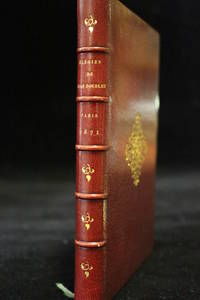
187149410Paris: Librairie des Bibliophiles 1871. Fine. Librairie des Bibliophiles Paris 1871 10.50 x 17 cm relié Reprint for the Cabinet du bibliophile Collection of the Elegies of the Dieppe poet Jean Doublet born at the beginning of the 16th century and died around 1580. Edition of 333 copies this one of 15 numbered copies on Whatman paper. Contemporary binding in full red morocco signed Allô - Wampflug spine with five raised bands decorated with gilt fleurons in compartments gilt fleurons stamped at center of boards double gilt fillet emphasizing edges and headcaps wide gilt dentelle framing pastedowns all edges gilt. Handsome copy in a fine binding by Allô gilt by Wampflug gilder at Lortic from 1856 to 1876. From the library of Baron de Marescot 1879 no. 151 with his engraved armorial bookplate. Librairie des Bibliophiles hardcover
184658406Paris: J. Dumaine 1846. 4to 1 volume only of 6 - the second volume wasn't published until 1851 and volumes 3-6 weren't published until 1862-71; pp. xxviii 387 1; 10 engraved plates of weapons and equipment of war; contemporary full green morocco elaborate gilt rules on covers enclosing the Napoleonic crown with the letter 'N' beneath gilt-decorated spine in 6 compartments gilt-lettered direct in 2 a.e.g. inner dentelles; extremities a bit rubbed small crack starting at the bottom of the front joint all else very good. This copy inscribed "Lord William Lennox souvenir de la part de l'auteur Napoleon Louis B" part of the 'B' lost to the binder's knife. Lord William Pitt Lennox 1799-1881 was a British Army officer and writer of bad novels. He preferred sport horseracing literature and other entertainments to military life - a life cut short by blindness in one eye. <br/><br/> J. Dumaine unknown books
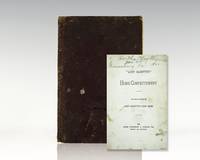
189375073Chicago and Cincinnati: Bloch Publishing & Printing Co 1893. First edition of this early collection of confectionery recipes published as a companion to the author's first book Aunt Babette's Cook Book the first American Jewish cookbook to become a best-seller in 1889. Also published by Bloch Publishing Company the oldest Jewish printing house in the United States Aunt Babette's Cook Book was perhaps so successful because of the extensive inclusion of non-Kosher recipes reflecting the early assimilation tendencies of the 19th-century Reform Jewish movement. Small octavo original cloth. In good condition. This 'little pocket edition' of Aunt Babette's Home Confectionery includes a selection of recipes for popular candies simple enough for even a child to make. Recipes include chocolate kisses cherries in cream butter taffy marshmallows tutti-frutti candy and vanilla caramels. Bloch Publishing & Printing Co hardcover
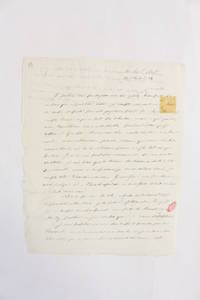
188863597Paris 1888. Fine. Paris 20 juin 1888 12.40 x 16.70 cm un feuillet Autograph letter signed addressed to Jacques Le Lorrain from Joris-Karl Huysmans 30 lines written in black ink on 2 pages. Manuscript correction by the author. Fold inherent to the letter's mailing. Remarkable letter with sometimes obscure remarks where Huysmans emphasizes the importance and rarity of the writing craft at work in the novel Nu by the cobbler-poet Jacques Le Lorrain. « In these times when people rush books in simple language - you know as well as I what these indigences mean - it is a pleasure to see elucidated sentences labored over expression delivered with forceps ». Sharp as usual Huysmans positions himself as a fierce defender of literary writing experienced as labor which contemporary production seems to be abandoning: « this concern is too exhausted by all and despised for me not to congratulate you on your care ». Accustomed to receiving works from his colleagues Huysmans endeavors to highlight the innovative particularities of each author he receives: « Many pages are truly curious. Lorgeral on the grass closing his eyes listening to the voices - it's fresh and absolutely accurate. The scene of Juliette's armpit kissing. This work so well explained of man's jealousy for the child are particular original corners of this book whose very scrupulous style has captivated me. ». The author Huysmans distinguishes himself here always attentive to the right measure necessary according to him for literary expression: « you have managed to enhance the language to make it neither powerless nor inert. And I know how difficult and rare that is! » unknown
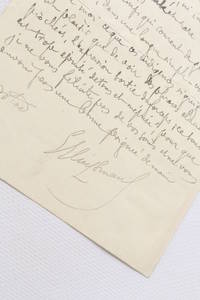
188060600Paris 1880. Fine. Paris s. d. décembre 1880-juillet 1884 11.70 x 9 cm en feuilles Autograph letter-card signed by Guy de Maupassant to Countess Potocka 19 lines in black ink on letterhead ""GM 83 rue Dulong"". Published in Marlo Johnston ""Lettres inédites de Maupassant à la comtesse Potocka"" Histoires littéraires n°40 October-November-December 2009. Maupassant was part of the circle of suitors of Countess Potocka whom she had nicknamed the ""Macchabées"". The author was much in social demand and this created scheduling problems for him: ""Or voici le cas . Legrand m'avait recommandé de ne pas m'engager . à ce dîner en m'annonçant une invitation de sa belle-soeur invitation qui n'est pas venue."" ""Now here is the case . Legrand had recommended that I not commit . to this dinner by announcing an invitation from his sister-in-law an invitation which never came."" He decides to clear up the doubt by going to his friend Georges Legrand's: ""prendre le vent."" ""to test the waters."" A close friend of Maupassant's it was he who introduced him to Countess Potocka. The author would dedicate to him in 1884 the short story Suicide reprinted in the volume Les Soeurs Rondoli and which had previously been published in the magazine Le Gaulois. Maupassant seems more anxious about visiting Potocka whom he had nicknamed ""présidente"" ""president"" and whose ""conscience le préoccupe. Je m'efforcerai de bien la diriger."" ""conscience worries him. I shall endeavor to guide it well."" He refers to the creation of the ""Société religieuse Coopérative sous la dénomination de Société Anonyme Anti-Soporifique pour la Récréation perpétuelle de la comtesse Potocka"" ""Religious Cooperative Society under the name of Anti-Soporific Anonymous Society for the perpetual Recreation of Countess Potocka"" one of the many games that took place during evenings at Countess Potocka's. Before leaving her he reiterates his admiration: ""Je suis aux pieds de ma présidente."" ""I am at the feet of my president."" Provenance: Jean Bonna collection. unknown
1805669741805. Fine. 10 Floréal 13 30 avril 1805 18.50 x 23.10 cm une feuille Stendhal's autograph letter addressed to his sister Pauline. 28 lines written with a fine writing in black ink. First name ""Pauline"" from the hand of the sender at the bottom of the letter. Inventory number ""36"" in ink from another hand. Two small traces of stamp and stamp a small tear restored in the bottom margin of the page. A few tiny folds inherent in the enveloping of the letter. Rare and beautiful letter of Stendhal addressed to his sister Pauline in which all the sensitivity of the young man and his love for the dramatic art shows more than twenty years before his big romantic successes. This letter comes from the correspondence between Henri Bayle here twenty-two years with his sister Pauline three years younger. This true epistolary liaison which quickly took the form of a ""diary"" - Pauline's answers were rare - is an essential milestone in the constitution of the intellectual journey of the future Stendhal. Our letter of a great lyricism testifies to the strength of the bond uniting the young writer and his sister: ""Let's shake each other my good friend. We will never find anyone who loves Pauline as Henry nor will Henry ever find a more beautiful soul than Pauline. ""The use of the third person and a lover vocabulary erects the young woman to the rank of alter ego a sister-soul and even perfect mistress. The young Henri is then precisely under the yoke of a devouring passion for the actress Melanie Guilbert whom he met during his declamation classes at Dugazon: "" I'm going to be bored perhaps by my dark sadness. I know very well that the seriousness of ardent passions is not pleasant. "" Contrasting with this passionate relationship Pauline symbolizes reason and balance a figure that Henri like a pygmalion can fashion at leisure. In good tutor he advises: ""Learn by heart roles. About declamation I will teach you a thousand things. I'm bringing you a Gil Blas and a Tracy. ""We understand here worship Stendhal devoted to the theater from his earliest years both as a player as a playwright the fund of its archives to the Grenoble Library contains nearly 700 sheets of blanks:"" I am in despair at not being able to wear you Beanies. But wait maybe someday will come . as Ulino says. ""This passion for theater Henry intends to pass it to his sister:"" We will work like hell during the time that I stay in Grenoble. ""In total opposite view with the education of women in his time he put a point of honor that Pauline is an educated person; In several letters moreover we find injunctions from the brother ordering his sister to give up needlework in favor of the reading he recommends. Truly obsessed with theater and convinced that he will become an author of successful comedies he works tirelessly: ""I am told a room where I will not be free and where I can not just declaim. Try to disturb this arrangement. ""Years before writing great novels that make her famous Stendhal already understands that loneliness is for him a source of creation and says:"" A lonely is jealous of his freedom. It is his greatest good as that of all men. "" unknown
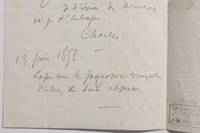
185862164Paris 1858. Fine. ""My dear little mother you are mad"" Paris 13 juillet 1858 mal datée « juin » 13.30 x 20.60 cm 2 pages sur un feuillet remplié sous chemise et étui Autograph letter signed by Charles Baudelaire written in pencil and addressed to his mother. Dry-stamped stationery of the Grand Hôtel Voltaire Faubourg Saint-Germain. Address to Madame Aupick in Honfleur Calvados in the author's hand together with several postal markings dated 13 and 14 July 1858. Several underlinings deletions and corrections by Baudelaire. Trace of a wax seal bearing Charles Baudelaire's initials in pencil probably in the author's hand. A small portion of the second leaf has been excised with no loss of text. This letter was first published in the Revue de Paris on 15 September 1917. From the former collection of Armand Godoy no. 102.The letter is preserved in a half black morocco chemise with abstract-patterned paper boards housed in a matching slipcase edged in the same black morocco and covered with abstract-patterned paper boards. A precious document bearing witness to a decisive moment in the poet's life: his reconciliation with the now widowed Madame Aupick that revered mother «who haunts her son's heart and mind». Victorious Baudelaire had overcome the obstacle represented by his burdensome stepfather whose death he had at times wished for; he was now ready to reclaim his place beside the mother by whom he had so often felt neglected. Following the death of her husband in April 1857 she invited her son to come and live with her in her « toy-house » at Honfleur. This letter reveals a Baudelaire torn by complex emotions: divided between his longing for an ideal union with his mother and his irresistible attraction to spleen. For the « low bohemian » as the Goncourts called him hounded by creditors Honfleur and the exclusive attention of his mother held out the promise of fulfilling his poetic destiny. The poet expressed this hope to his friends notably Antoine Jaquotot mentioned at the end of the present letter: « Je veux décidément mener cette vie de retraite que mène un de mes amis . qui par la vie commune qu'il entretient avec sa mère a trouvé un repos d'esprit suffisant pour accomplir récemment une fort belle uvre et devenir célèbre d'un seul coup. » 20 February 1858 «Tu vas dans peu de jours recevoir le commencement de mon déménagement . Ce seront d'abord des livres tu les rangeras proprement dans la chambre que tu me destines.» By entrusting his books to her he asks his mother to create for him an ideal world in which to write and create. Yet alongside these promises and hopes of a life finally serene and peaceful Baudelaire also reveals his attachment to the existence of the cursed poet: «Tu sais cependant bien que ma destinée est mauvaise.» Beyond his «nouveaux embarras d'argent» it is above all his work that keeps him in Paris: «Si mon premier morceau à la Revue contemporaine a été retardé c'est uniquement parce que je l'ai voulu ; j'ai voulu revoir relire recommencer et corriger.» The «premier morceau» referred to here is none other than « De l'Idéal artificiel le Haschisch » the first text of the future Paradis artificiels 1860 which would not appear until the issue of 30 September 1858. This passage illustrating Baudelaire's relentless perfectionism recalls the extraordinary complexity of the poet's drafts and proofs which he continued to revise meticulously until the very last moment even on the first copies of Les Fleurs du Mal; see the copy we offer. Despite his financial difficulties Baudelaire revised and altered his texts incessantly limiting the number of articles he could produce. Yet he remained convinced that writing would bring him prosperity and confidently declared: «Cette fois-ci je m'en tirerai à moi tout seul sans emprunter un sol.» Baudelaire ultimately left Paris for Honfleur only in January 1859 and did not remain there long. After only a few weeks he hardcover
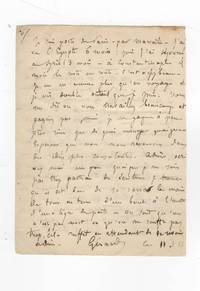
184475148Paris 1844. Fine. Paris 11 février 1844 10.40 x 13.60 cm quatre pages sur deux feuillets Three autograph letters signed by Gérard de Nerval 2 pages signed «Gérard» Théophile Gautier 1 page and a third unsigned letter 1 page penned by a certain «Robert» cf. Nerval's letter Louis Desessart Théophile Gautier's appointed publisher co-published Nervals play Léo Burckart with Barba in 1839. Following financial difficulties he was forced to take refuge «in that sad and charming city of Brussels». The three friends wrote this letter from Paris where they had reunited following Nervals long journey to the East: «I spent six months in Egypt; then three months in Syria four months in Constantinople and the rest en route. Its quite beautiful. I only enjoy myself while traveling and try to live twice as much as I can.» This journey deeply impressed Théophile Gautier who would only travel to Turkey and Egypt years later: «I am in Paris and wish I were in Cairo from where Gérard is returning.» The exoticism of distant lands starkly contrasts with the melancholy and severity of Europe: «How sad Paris is when one returns from sunlit countries.» Nerval And in Paris far from dreams of escape life means toil and melancholy: «We are like sick people who are never comfortable anywhere. I think the good times are gone and the golden hours of the past when we spoke such wise follies will never return. Whats the point of living if we must work and cannot see our friends or write to them or do anything we would like» Gautier The two writers express great compassion for their friends Belgian exile with Brussels appearing as the capital of spleen: «What! Youre still in that sad and charming city of Brussels! . Brussels is even darker poor fellow!» Nerval This joint letter was in fact initiated by «Robert»: «Isnt it true my dear friend that Im quite skilled at making you forget my faults . as a way of making it up to you Im sending you the autographs of two of your . comrades your fondest memories two men of fame who despite all their affection and friendship for you would never have written a word had I not trimmed their quills and handed them paper like sulky children and told them: write at once at once to the exile you love most.» unknown
186562589Biponti Deux-Ponts 1865. Fine. Biponti Deux-Ponts Vendredi 12 mai 1865 13.20 x 20.80 cm 1 page sur un feuillet remplié Autograph letter signed by Charles Baudelaire written in ink and addressed to his mother. A few underlinings deletions and authorial corrections. This letter was first published in Charles Baudelaire Dernières lettres inédites à sa mère in 1926. Former collection of Armand Godoy no. 197. A precious letter from Baudelaire's Brussels period during the poet's voluntary exile at the end of his life. « Il est douteux que j'habite quelque part à Paris. Je crois que j'habiterai surtout une voiture dans laquelle je ferai si je peux toutes mes courses en un ou deux jours. » Haunted by Paris the city of vice and creditors he dreads this brief return. His exile in Brussels is in his eyes a sign of failure and ever since arriving in Belgium he has delayed his return to France. Yet weary of the flat country he despises he mocks its inhabitants: « On est lent ici. » The poet like the seventeen-year-old student who once promised his mother he would get back on track now vows: « Me voici en mesure d'accomplir tous mes plans. Je ne sais comment t'exprimer ma reconnaissance ; et je crois que la meilleure manière sera d'exécuter mes promesses. » Literally obsessed with this sacred mother « who haunts his heart and his mind » the « grateful son » sees himself as incapable of fulfilling his poetic destiny without her undivided attention. unknown
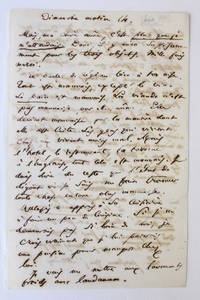
186459356Biponti Deux-Ponts 1864. Fine. Biponti Deux-Ponts Dimanche matin 14 août 1864 13.40 x 20.60 cm 3 pages sur un feuillet remplié N. p. Bruxelles Sunday morning 14 August 1864 134 x 206 cm 3 pages on a folded leave Autograph letter signed in black ink addressed to his mother and dated Sunday morning the 14th. A few underlinings deletions and corrections by the author. Formerly in the collection of Armand Godoy n°188. A fading Baudelaire: The state of disgust in which I find myself makes everything seem even worse. Drawn by the promise of epic fame Baudelaire went to Belgium in April 1864 for a few conferences and in the hope of a fruitful meeting with the publishers of Les Misérables Lacroix and Verboeckhoven. The meeting didn't happen the conferences were a failure and Baudelaire felt boundless resentment for Poor Belgium. Nonetheless despite numerous calls to return to France the poet would spend the rest of his days in this much-castigated country living the life of a melancholic bohemian. Aside from a few short stays in Paris Baudelaire floored by a stroke that left him paralyzed on one side would only return to France on 29 June 1866 for a final year of silent agony in a sanatorium. Written barely a few months after his arrival in Brussels and his initial disappointments this letter shows us all the principal elements of the mysterious and passionate hatred that would keep the poet definitively in Belgium. In his final years in France exhausted by the trial of The Flowers of Evil humiliated by the failure of his candidacy to the Académie Française a literary orphan after the bankruptcy of Poulet-Malassis and disinherited as an author by the sale of his translation rights to Michel Lévy Baudelaire was above all deeply moved by the inevitable decline of Jeanne Duval his enduring love while his passion for la Présidente had dried up her poetic perfection not having withstood the prosaic experience of physical possession. Thus on 24 April 1864 he decided to flee these decomposing loves of which he could keep only the form and the divine essence. Belgium so young as a country and seemingly born out of a Francophone Romantic revolution against the Dutch financial yoke presented itself to the poet phantasmagorically as a place where his own modernity might be acknowledged. A blank page on which he wanted to stamp the power of his language while affirming his economic independence Belgium was a mirror onto which Baudelaire projected his powerful ideal but one that would send him tumbling even more violently into the spleen of his final disillusionment. Published in the Revue de Paris in November 1917 without the sensitive passage about his cold enemas this emblematic letter evokes all of Baudelaire's work as poet writer artist and pamphleteer. The first such reference is via the reassuring mentor-like figure of the publisher of The Flowers of Evil Poulet-Malassis: If I was not so far from him I really think I'd end up paying so I could take my meals at his. This is followed by a specific reference to the venal value of his Aesthetic Curiosities: all these articles that I so sadly wrote on painting and poetry . Baudelaire then confides in his mother his hopes for his latest translations of Poe which to his great frustration are not getting published by L'Opinion La Vie Parisienne or in Le Monde illustré. He concludes with his Belgian Letters which Jules Hetzel had just told him had been after negotiations with Le Figaro received with great pleasure. Nonetheless as Baudelaire literally underlined they were only to be published when I come back to France. His perennially imminent return to France is a leitmotiv of his Belgian correspondence: Certainly I think I'll go to Paris on Thursday. It is nonetheless always put off I'm putting off going to Paris until the end of the month he corrects himself eight days later and it seems to stoke up the poet's ferocity towards his new unknown
188460604s. l. Paris 1884. Fine. s. l. Paris s. d. circa juillet 1884-décembre 1889 7 x 9.10 cm 2 pages sur une carte-lettre Autograph letter-card signed by Guy de Maupassant to Countess Potocka 13 lines in black ink on letterhead « GM 10 rue Montchanin ». Published in Marlo Johnston « Lettres inédites de Maupassant à la comtesse Potocka » Histoires littéraires no. 40 October-November-December 2009. From 1877 onwards Maupassants health underwent continuous decline beginning that year with the contraction of syphilis. In addition he had to contend with hereditary dementia within the family. Subject to violent migraines his sociability sometimes suffered: « Je dois vous prévenir que je suis plus muet et plus ennuyeux que jamais je le sais vous pouvez donc ne pas me le dire. » He nevertheless took care to reassure his correspondent: « Moi je serai ravi de vous voir. Je vais rester fort peu de temps à Paris je ne vous fatiguerai donc pas trop. » Provenance: Jean Bonna collection. unknown
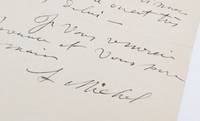
188683952s. l. Paris 1886. Fine. Letter to the Tiger: ""Before returning to the cage"" s. l. Paris 7 août 1886 13.20 x 19.20 cm 3 pages sur un bifeuillet Autograph signed letter from Louise Michel addressed to Georges Clemenceau; three pages written in black ink on a bifolium of white paper. Transverse creases inherent to posting. Fine letter from Louise Michel to Clemenceau one of her most important supporters before yet another incarceration: « Il faut avant de rentrer en cage . que je vous demande le grand service de faire entrer à l'hospice mon cousin le petit Dacheux à qui vous avez bien voulu faire avoir sa dispense d'âge. » ""Before returning to the cage . I must ask you the great favor of having my cousin little Dacheux admitted to the hospice for whom you were kind enough to obtain his age exemption."" The former communard has indeed just been sentenced to four months in prison for having given a speech in favor of the Decazeville miners alongside Jules Guesde Paul Lafargue and Étienne Susini. But for now it is the condition of her cousin Lucien Dacheux that concerns her: « Son genou étant de plus en plus malade on l'envoie en congé de deux mois mais il faut qu'il entre à l'hospice s'il ne veut pas rester estropié. De plus on n'a pu lui donner une mécanique pour son genou et en même temps le médecin lui disait que c'était indispensable - peut-être pourra-t-il en avoir une au Val de Grâce - je le recommande bien à vous et au citoyen Lafont - J'irai vous voir pour cela et une autre chose du même genre avant le 12 mais s'il était possible de faire entrer avant à l'hospice le petit Lucien Dacheux je serais bien heureuse car il sera tout à fait estropié et incapable de continuer son service où on est très content de lui. » ""His knee being increasingly ill they are sending him on two months' leave but he must be admitted to the hospice if he doesn't want to remain crippled. Moreover they couldn't give him a mechanism for his knee while at the same time the doctor told him it was indispensable - perhaps he could get one at Val de Grâce - I recommend him highly to you and to citizen Lafont - I will come to see you about this and another matter of the same kind before the 12th but if it were possible to have little Lucien Dacheux admitted to the hospice beforehand I would be very happy because he will be completely crippled and unable to continue his service where they are very pleased with him."" Louise Michel met Clemenceau in October 1870 when he was mayor of Montmartre and she was assistant schoolmistress. From their first meeting was born a strong friendship that lasted until Louise Michel's death. Clemenceau never ceased to support her particularly during her banishment to Nouméa and they maintained an extensive correspondence. A moving letter testimony to the unwavering devotion of the former communard and to the great friendship that united Louise Michel to Georges Clemenceau. unknown
188460657Paris 1884. Fine. Paris s. d. début janvier 1884 10.20 x 13 cm 4 pages sur un feuillet double Signed autograph letter from Guy de Maupassant to the Countess Potocka 67 lines in black ink on a letterhead ""GM 83 rue Dulong"" envelope attached. This long letter begins with a commission that was made to Maupassant: "" I immediately pay for a commission for which I am charged although I seem to find a little irony in it. The Princess Ourosow who has just written to me to ask to see her this evening begs me in postscript to remind her of your memory when I see you. Princess Ourosov was the wife of the Russian ambassador to Paris. With the Countess she was part of that worldly gotha that surrounded authors and artists. The irony he mentions is this: "" As reputed perceptive people asserted that all the thought of a woman's letter is in the postscript . I wanted to fulfill my role immediately 'intermediate. Because of this addition he deduced: "". that the letter of the Princess despite what it contains of amiable for me was addressed to you ."" This amazing letter then addresses a little-known leaning of Maupassant: his taste for fetishes. He informs his correspondent that: "" The hand since she came home seems to me in an extraordinary agitation. This is the famous hand that Maupassant had bought from George Powell. It was through the poet Charles Swinburne whom Maupassant almost saved from drowning that the two men met at Etretat in 1868. Powell and Swinburne shared a house there filled with Powell's collection of curiosities. The hand in question was mummified and it inspired Maupassant twice. A first in 1875 with La Main de l'écorché then in 1885 with La Main . This nervousness of the lucky charm makes Maupassant wonder: "" Perhaps you were wrong not to keep it as a fetish He adds: ""But I have other singular fetishes. Do you want one Indeed he possesses a collection: "" I own the shoe of a little Chinese woman who has died of love for a Frenchman. He comments on the potential effects of these objects: "" This talisman brings happiness to the desires of the heart. I still have a large copper cross very ugly which worked miracles in the village where I found it. But these talismans do not all work as they should: "" Since she is at home she does not. Maybe it's the environment that's bothering her. But it is not the most astonishing: ""But what I possess most singular are the two ends of a man deceived by his wife and died of shagreen. The guilty wife kept the husband's foot and horn . and made them weld together. I do not know what the effect of this object may be. Despite the seriousness of the affair Maupassant did not abandon his humor: "" Say madam do you want a fetish"" I add that my friends pretend that I bring happiness myself! I place at your feet this last vegetarian who asks for the preference . "" To echo his statement regarding female postscript he adds two to his letter. The first asked the Countess Potocka to recall Maupassant to the memory of Madame Lambert. This lady was the wife of Eugene Lambert a painter known for his cats and who frequented the same milieu as Maupassant and the Countess. The second is much more flavourful: "" Men should not be attached to the postscript of the same importance as to women. "" unknown
189463596Paris 1894. Fine. Paris 8 février 1894 10.60 x 13.50 cm un feuillet remplié Autograph letter of Joris-Karl Huysmans signed to Camille Mauclair 44 lines written in black ink 3 pages on a folded sheet handwritten correction of the author. Two restorations using strips of paper in high and low fold of the letter the second band very slightly affects a word of the text a fold inherent in the enveloping of the letter. A long and beautiful letter in which all Huysmans' respect and interest are shown for the writings of the young Symbolist generation. Both author and literary critic Huysmans embodies a central figure for young poets like the 22-year-old Camille Mauclair who sends him one of his first poetic collections: "" The chapter on the symbol is perfect ; it is certainly the first time that we explain and with such lucidity we put things back in place. "" Heart of the symbolism and the poetic fiber of Huysmans the music of the language is particularly honored both in the lyrics and in the author's writing: "" the pieces on death on sensuality are woven into the most vivid language . and the fine writer who found the cold and ethereal absentee who wrote such sentences: ""we strive to determine our true ghost in the tumult of appearances "". "" Introduced by the mention of the myth of Narcissus Symbolist figure par excellence the letter shows the philosophical questions that underlie the movement. « Narcissus is God - It is not very beautiful to contemplate the soul . It is true that you in a melancholy return on the vanity of being have shown in a vibrant page the actors of ourselves as we are. The mystical evocations direct to Satan and more ambiguous to God echo the literary conversion of Huysmans who in 1894 prepares the writing of En Route the first part of his trilogy during direct ""black book"" that is there : ""Ah! the damn God! Really that makes me dream of a literature that feeds less his Satan as you say to a literature of humility! "" Accustomed to digressive theoretical reflections on literature Huysmans concludes his letter with: "" At bottom I am stupid to quibble over ideas because in short all the ones we express and that we will make are already in d ' other times and they are more or less new depending on whether they are more or less forgotten but what is not done before you what you own is the way to coat them. And that's where I admire you wholeheartedly because those are your sentences. "" unknown
188566470s. l. 1885. Fine. s. l. s. d. juillet-août 1885 9.60 x 15.50 cm une feuille Autograph manuscript by Guy de Maupassant to Countess Potocka 36 lines in ink on one page. Horizontal fold at center. Published in Philippe Dahhan ""Guy de Maupassant et les femmes : essai"" Bertout 1996. Unusual manuscript by Maupassant giving a false rabies vaccine formula he calls ""Élixir Pasteur"" made with namely ""seven tears of a rejected academic candidate"" ""five drops of journalist's drool"" and ""one centimeter of novelist's pride"". This amusing prescription is addressed to Countess Potocka a wealthy aristocratic socialite and intellectual whose beauty and fickle personality greatly inspired feminine Maupassant characters: Christiane Andermatt in Mont-Oriol and Michèle de Burne in Notre cur Our Heart. Maupassant writes to Emmanuela Pignatelli di Cergharia wife of the extremely rich Polish count Nicolas Potocki who allowed her a great deal of freedom. Her Parisian salon in the avenue Friedland was from 1882 onwards the exclusive meeting place for an elite composed of writers socialites and literary types. It hosted each Friday a council of suitors ""dying of love"" ironically nicknamed the ""Maccabees"" in reference to the seven martyred brothers of the Bible. Visitors included Guerlain who made a perfume for her called Shore's caprice and composer Camille Saint-Saëns who wrote a mazurka for her artist Léon Bonnart who painted her portrait as well as young Marcel Proust who wrote a Figaro column about her renowned gathering. She remained Maupassant's greatest conquest and muse whom he courted until the end of his life. The author gives the Countess an unlikely recipe for Elixir Pasteur inspired by Louis Pasteur's rabies experiments using rabbit marrow. The undated autograph manuscript was probably written in July-August 1885 when Pasteur successfully administered his rabies vaccine to nine-year-old Joseph Meister. Maupassant deploys his talents for farce and parody twisting medical jargon to create a fake vaccine: ""So this last animal receives the rabies virus at its seventh potency and instantly goes into a rage. You then remove its left eye and extract the visual fluid with a morphine syringe. You put this fluid in a small granite jar with five drops of journalist's slime"". Diagnosed with syphilis some ten years earlier Maupassant was in fact particularly familiar with remedies and potions. He was a frequent visitor to spa towns and consulted numerous doctors before his internment at Doctor Blanche's clinic where he died of general paralysis on July 6 1893. This humorous note to Countess Potocka is one of his countless seduction attempts. He remained an eternally thwarted lover despite having written numerous manuscripts for her composed poems written on fans and visited her almost daily during his stays in Paris. Their correspondence went on for many years with Maupassant going so far as to create the ""Société Anonyme Anti-Soporifique pour la Récréation perpétuelle de la Comtesse Potocka"" with the sole aim of entertaining the Countess and escaping her indifference: ""Realizing that my efforts are often fruitless in the face of your deliberate indifference I've tried to find a way to overcome your boredom on every occasion"" Letter August 1885 The Morgan Library New York. Maupassant ends his note with an amusing remark proving the effectiveness of his remedy against rabies: ""It is by this method that all accidents were avoided during the last Congress"" in reference to the Berlin Conference of 18841885 also known as the Congo Conference where the colonial partitioning of Africa was decided. Provenance: Jean Bonna collection. unknown
188960645Triel Triel-sur-Seine 1889. Fine. Triel Triel-sur-Seine s. d. 8 juillet 1889 9.90 x 15.20 cm 3 pages sur un feuillet rempliée Autograph letter signed by Guy de Maupassant to Countess Potocka 38 lines in black ink on a double sheet. Published in Marlo Johnston ""Lettres inédites de Maupassant à la comtesse Potocka"" Histoires littéraires no. 40 October-November-December 2009. Darker than usual Maupassant seems troubled by some incident he does not mention but for which he apologizes to the Countess: ""Je vous demande encore pardon ce qui du reste n'atténue pas mon remords ; et je vous assure qu'il est cuisant car j'ai cette arrière-pensée que cous m'en voudrez un peu pendant longtemps."" ""I ask your pardon once again which moreover does not diminish my remorse; and I assure you that it is stinging for I have this nagging thought that you will hold it against me for a long time."" Maupassant had earned a reputation as a prankster as well as a man of very free speech; he had no doubt crossed a line in word or deed. A few years earlier he had distinguished himself with the famous doll prank. Countess Potocka had given Maupassant rag dolls representing the guests at a dinner she was hosting at her home. As a joke he stuffed the bellies of said dolls and sent them back to the Countess the next day thus claiming to have impregnated them overnight. The prank became known and provoked many outraged reactions but the Countess had eventually assured him of her forgiveness. Whatever the unfortunate event may have been the letters seem to have crossed in the mail: ""Votre lettre m'a été renvoyée à Triel car le facteur ne me savait pas à Paris."" ""Your letter was forwarded to me at Triel because the postman did not know I was in Paris."" Thinking he would again face reproaches he admits to having: "". été en la lisant pénétré de confusion."" ""been upon reading it filled with confusion."" Anxious to please the Countess he expresses his concern: ""Pourquoi suis-je ainsi nerveux par moments comme une femme sans motifs réels et sans avoir ressenti vraiment aucun froissement. Je n'en sais rien. Je ne peux que le constater."" ""Why am I thus nervous at times like a woman without real motives and without having truly felt any offense. I know nothing of it. I can only observe it."" Whether they were the early signs of the madness in which he would end his days or the consequences of his feelings for the Countess whom he feared to anger these fits of nervousness would never cease for the rest of the author's life. To ensure the Countess's visit to Triel Maupassant asks for confirmation: ""Je compte sur vous demain n'est-ce pas."" ""I count on you tomorrow do I not."" To this end he advises her to take the train: ""Si vous venez par le chemin de fer comme vous y paraissez décidée j'irai vous attendre à Meulan . Si vous veniez par le bateau de Georges je vous prie de vouloir bien m'en informer par une dépêche."" ""If you come by railway as you seem decided to do I will go wait for you at Meulan. If you were to come by Georges's boat I beg you to kindly inform me by telegram."" The Georges in question is Georges Legrand journalist one of the Countess's ""Macchabées"" whom she introduced to Maupassant and according to painter Jacques-Émile Blanche the only one who enjoyed her favors. Provenance: Jean Bonna collection. unknown
185965117Honfleur 1859. Fine. Honfleur 28 février 1859 13.10 x 20.50 cm 3 pages sur un feuillet remplié Remarkable autograph letter signed by Charles Baudelaire to Auguste Poulet-Malassis publisher of Les Fleurs du Mal dated 28 February 1859 and written in Honfleur. 64 lines in black ink some passages underlined housed in a modern black half-morocco folder. Baudelaire appears preoccupied with the Sainte-Beuve/Babou affair one of the many controversies following the Fleurs du Mal trial in which the writer Hippolyte Babou accused Sainte-Beuve of failing to defend Baudelaire during the proceedings. Excerpts from this letter were quoted by Marcel Proust in his celebrated Contre Sainte-Beuve where he lamented Sainte-Beuves cowardice during the trial of Les Fleurs du Mal and the undue esteem Baudelaire continued to show him. The poet writes from Honfleur where he had retired in January to live with his mother a revered figure who haunts her sons heart and mind. This letter was written eight days after a new development in the aftermath of the Fleurs du Mal trial. Torn by conflicting emotions Baudelaire confides in Malassis after his friend Hippolyte Babou had on 20 January published an article in La Revue française attacking Sainte-Beuve for failing to defend Baudelaire during the trial: He will glorify Fanny by Ernest Feydeau the honest man and remain silent about Les Fleurs du Mal he wrote. Despite Baudelaires pleas Sainte-Beuve had never published anything in support of the collection. In response to Babous attack Baudelaire received a horrible letter from Sainte-Beuve: It seems the blow . struck Sainte-Beuve deeply. I must do him the justice of saying he did not believe I had prompted Babou in any way. Although outraged by the accusations Sainte-Beuve did not hold Baudelaire personally responsible. Baudelaire is surprised by the critics vehemence writing to Poulet-Malassis: Truly here is a passionate old man with whom it is dangerous to fall out . You cannot imagine what that letter from Sainte-Beuve is like. It appears that for twelve years he had been noting every sign of malice from Babou. Baudelaire stands helpless amid the quarrel between two respected men while expressing a clear attachment to Sainte-Beuve now jeopardised by Babous article: Either Babou wanted to help me which would imply a certain degree of stupidity or he wanted to play a trick on me; or he simply pursued a mysterious grudge without any concern for my interests. Baudelaire indeed held Sainte-BeuveUncle Beuvein the highest regard. A senator an academician and the undisputed master of literary criticism Sainte-Beuves opinions carried great weight in Parisian literary circles. For years Baudelaire had awaited a formal sign of approval from Sainte-Beuve which might have bolstered his fragile career still tarnished by the scandal of Les Fleurs du Mal. The poet thus finds himself torn between his admiration for Sainte-Beuve and his long-standing friendship with Hippolyte Babouwho according to legend suggested the title Les Fleurs du Mal. To Poulet-Malassis he confides: What made this situation dangerous for me was that Babou appeared to be defending me against someone who had done me a great many favours. It remains unclear what Baudelaire meant by favours given that Sainte-Beuve had done relatively little to advance his career. This letter was later quoted in Marcel Prousts posthumously published Contre Sainte-Beuve 1954 a fierce and famous indictment in which Proust reproaches Sainte-Beuve for failing to recognise Baudelaires poetic genius and highlights his cowardice during the Fleurs du Mal trial. To preserve his position in the Senate Sainte-Beuve refrained from public support and provided only a defence strategy which the lawyer was authorised to use provided Sainte-Beuves name was not mentioned. Nearly two years after the verdict the disastrous trial of Les Fleurs du Mal still haunted B unknown