Jean PAULHANBiblio.com
48 402 résultats
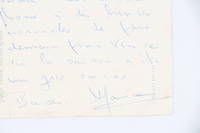
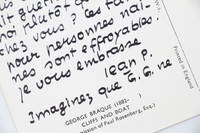
195585253Paris 1955. Fine. Paris s. d. circa 1955 13 x 9 cm une feuille Autograph postcard signed by Jean Paulhan 22 lines written in black ink addressed to Felia Leal the publisher of ""Paroles transparentes"" a work by Jean Paulhan decorated with 14 original lithographs by Georges Braque. Central fold mark on the card which represents the painting by Georges Braque entitled: Cliffs and Boat. Jean Paulhan asks for news of his correspondent: ""Are you completely cured What if it were me instead who came to your place"" and is amazed by the smallness of Parisian taxis: ""These taxis for dwarf people are dreadful."" From the narrowness of taxis Jean Paulhan shifts to Gallimard's editorial timidity: ""Imagine that G.G. keeps neither Blanchot nor Noël Devaulx nor. nor. . Basically G.G. is becoming Hachette and all the experience of the young nrf has to start over."" unknown
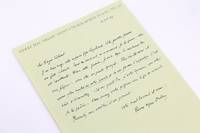
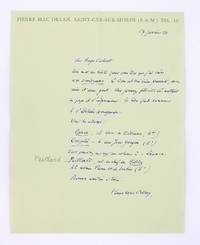
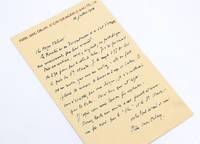
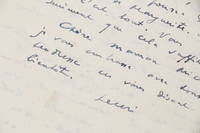
194984075Saint-Cyr-sur-Morin: S. n. 1949. Fine. S. n. Saint-Cyr-sur-Morin 19 Octobre 1949 21 x 27 cm une feuille Autograph letter dated and signed by Pierre Mac Orlan 12 lines in blue ink to his young friend the beginning poet Roger Valuet. Fold marks inherent to being placed in an envelope. Pierre Mac Orlan thanks his poet friend for having offered him a pipe: ""J'ai bien reçu cette superbe pipe Longchamp. Votre gentille pensée me fait plaisir. Tout en écrivant en ce moment je la fume."" ""I received this superb Longchamp pipe. Your kind thought pleases me. While writing at this moment I am smoking it."" and congratulates him on his latest work and the progress achieved : ""Vous êtes en grand progrès. Plus sûr de vous et aussi plus maître de votre pensée et de vos formes d'expression."" ""You are making great progress. More sure of yourself and also more master of your thought and your forms of expression."" He encourages him to persevere and promises him a preface for his next work : "". c'est un grand don à notre époque que celui de la poésie. Vous aurez votre préface vers la fin de ce mois."" ""it is a great gift in our time that of poetry. You will have your preface towards the end of this month."" Originally from Arras Roger Valuet is a popular writer who signed under the pseudonym Roger Vilard numerous detective and espionage novels. At the beginning of his career he was helped by Pierre Mac Orlan who prefaced his first collection of poems. S. n. unknown
195084039Saint-Cyr-sur-Morin: S. n. 1950. Fine. S. n. Saint-Cyr-sur-Morin 27 Janvier 1950 20.50 x 26.50 cm une feuille Laudatory autograph letter dated and signed by Pierre Mac Orlan 15 lines in blue ink to his young friend the beginning poet Roger Valuet who has just sent him his collection of poems Embruns: "". le livre est très bien présenté avec soin et goût. Vous pouvez féliciter le metteur en pages et l'imprimeur."" "". the book is very well presented with care and taste. You can congratulate the typesetter and the printer."" He provides him with the addresses of his friends Francis Carco Roland Dorgelès and Léonce Peillard so that they too might receive their copies of Embruns in order to better publicize and distribute this work. Fold marks inherent to being placed in an envelope. A native of Arras Roger Valuet was a popular writer who signed under the pseudonym Roger Vilard numerous detective and espionage novels. At the beginning of his career he was helped by Pierre Mac Orlan who wrote the preface to his first collection of poems. S. n. unknown
194684037Saint-Cyr-sur-Morin: S. n. 1946. Fine. S. n. Saint-Cyr-sur-Morin 16 Juillet 1946 13.50 x 21.50 cm une feuille Autograph letter dated and signed by Pierre Mac Orlan 16 lines in black ink to his young friend the budding poet Roger Valuet. Fold mark inherent to postal handling. Pierre Mac Orlan thanks his friend for sending him tobacco which he seems to appreciate greatly and sends him a check to reimburse him: "". if you don't accept my check I won't accept the tobacco. thank you again for the St Claude blue."" A native of Arras Roger Valuet is a popular writer who signed under the pseudonym Roger Vilard numerous detective and espionage novels. At the beginning of his career he was helped by Pierre Mac Orlan who wrote the preface to his first collection of poems. S. n. unknown
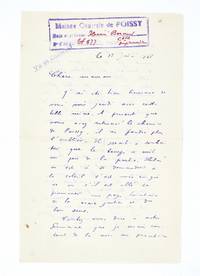
194584040Poissy: S. n. 1945. Fine. S. n. Poissy 2 Juin 1945 13 x 21 cm trois pages Touching autograph letter dated and signed by Henri Béraud addressed to his mother-in-law while imprisoned at Poissy prison 65 lines in blue then black ink on three pages relating his situation as a prisoner while praising the love of the latter and his wife who watch over him and allow him to envisage prison life under better auspices. The letter is on the letterhead of the infirmary of the central prison of Poissy with fold marks inherent to being placed in an envelope. Henri Béraud rejoices at having been able to see his mother-in-law in good health and worries about the sacrifices she inflicts upon herself for the well-being of her imprisoned son-in-law: "". j'ai été heureux jeudi de vous voir avec si bonne mine.je pense aux difficultés. je crains que toujours que vous ne vous priviez pour moi."" "". I was happy Thursday to see you looking so well. I think of the difficulties. I always fear that you deprive yourself for me."" while remaining lucid about the indignity of his prisoner's condition which does not allow him to protect his loved ones: "". je compte tellement sur vous pour veiller sur notre Germaine Henri Béraud's wife pour l'obliger à se soigner et à se ménager."" "". I count so much on you to watch over our Germaine to force her to take care of herself and spare herself."" He considers his arrest and imprisonment illegitimate and abusive and shows confidence in his future with his mother and spouse ""by his side"": "". le triste et injuste sort qui m'est fait. C'est cela qui me donne le plus de confiance dans l'avenir - cela et votre bonté à mon égard chère maman et bien sûr l'amour de la plus noble et de la plus belle des épouses."" "". the sad and unjust fate that has befallen me. This is what gives me the most confidence in the future - this and your kindness toward me dear mother and of course the love of the noblest and most beautiful of wives."" Finally Henri Béraud continues in black ink with a recommendation for his wife: "". en ce qui concerne sa visite à l'ami d'H. Espiau je la laisse naturellement juge d'orienter cette conversation. au mieux de mes intérêts immédiats."" "". regarding her visit to H. Espiau's friend I naturally leave her to judge how to direct this conversation. in the best interest of my immediate concerns."" A bon vivant native of Lyon Henri Béraud was an international journalist and reporter Le canard enchaîné Le Crapouillot Petit Parisien France-Soir and Gringoire and a prolific writer Goncourt Prize 1922 for Le martyre de l'obèse and Le vitriol de lune published a year earlier whose political evolution moving from the extreme left to the extreme right pro-collaborationist is characteristic of the inexorable rise of totalitarianisms between the wars and the corruption of many French intellectuals. Friend of Roland Dorgelès Albert Londres and especially Joseph Kessel whom he met in 1922 in Ireland then recently and partially liberated from the British yoke Henri Béraud defended very left-wing opinions. But after a trip to the U.S.S.R. he began to revise his positions while drifting toward anti-parliamentarianism Anglophobia Faut-il réduire l'Angleterre en esclavage published in 1935 and dedicated to Joseph Kessel antisemitism ""without realizing it"" according to his friend journalist Jean-Galtier Boissière. It was the Stavisky affair and its corollary the riots of the fascist and anti-parliamentary leagues of February 6 1934 that triggered Henri Béraud's manifest passage to the extreme right going so far as to break his friendship with his great friend Joseph Kessel. In 1936 his violent articles in Gringoire would lead to the suicide of Popular Front Interior Minister Roger Salengro accused of desertion during the First World War. Arrested in September 1944 and condemned to death on December 29 1944 for intelligence with the enemy he was pardoned by General S. n. unknown
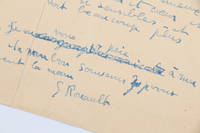
193084180s. l.: S. n. 1930. Fine. S. n. s. l. s. d. circa 1930 21.50 x 18 cm une page Autograph letter signed by the painter Georges Rouault 19 lines in blue ink on one page apologizing for having to hastily postpone an appointment due to feeling unwell. Fold marks inherent to being placed in an envelope. His mind clouded by pain Georges Rouault presents his apologies for their appointment which he cancelled and attempts despite his correspondent's tight schedule to meet with him nonetheless: ""Je ne sais ce que j'ai pu écrire hier ayant été pris de violentes douleurs de tête et pressé de vous prévenir de l'impossibilité où j'étais."" ""I don't know what I could have written yesterday having been seized with violent headaches and pressed to inform you of the impossibility in which I found myself."" "". je suis bien désireux de vous voir avant et de vive voix de m'exprimer mieux qu'ici."" "". I am quite desirous to see you beforehand and to express myself better in person than here."" He feels better and ready to endure the physical ordeal of an interview while considering that he does not take much care of his precarious health: "". je malmène trop cerveau et coeur et alors se vengent mes organes si sensibles et qu'avec l'âge on doit beaucoup plus ménager."" "". I mistreat my brain and heart too much and then my organs so sensitive and which one must spare much more with age take their revenge."" S. n. unknown
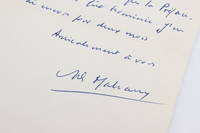
195384015Boulogne-sur-Seine Boulogne-Billancourt: S. n. 1953. Fine. S. n. Boulogne-sur-Seine Boulogne-Billancourt 5 Septembre 1953 11.50 x 18 cm une feuille une enveloppe Autograph letter dated and signed by André Malraux 14 lines in blue ballpoint pen from his Boulogne home on avenue Victor Hugo discussing his workload related to the preparation and delayed publication of the work Des bas-reliefs aux grottes sacrées for which André Parinaud is sending him documentation. André Malraux is not yet ready to send his work to the publisher: "". le livre ne parait pas cette année. Peut-être en mars 54. Et pour savoir où nous allons il faudrait que la préface au moins fût terminée. J'en ai encore pour deux mois."" "". the book is not coming out this year. Perhaps in March 54. And to know where we are going at least the preface would need to be finished. I still have two months of work ahead."" Fold mark from mailing envelope included. Resistance fighter participating in Combat André Parinaud is a journalist columnist art critic and writer. From 1959 to 1967 he held the position of editor-in-chief of the important weekly Arts bringing together the elite of French creation in all artistic fields: literature painting theater cinema. He would then conduct more than 1000 radio interviews with the greatest writers and artists including Salvador Dali Louis-Ferdinand Céline Colette Paul Léautaud André Breton Georges Simenon and André Malraux. While continuing to work at O.R.T.F. and radio he founded several festivals or artistic events such as Le Festival international du film d'art l'Académie nationale des arts de la rue. S. n. unknown
194684064Poissy: S. n. 1946. Fine. S. n. Poissy 15 Juin 1946 13.50 x 21 cm une page recto verso Touching autograph letter dated and signed by Henri Béraud addressed to his mother-in-law while he was incarcerated at Poissy prison 40 lines in blue ink on one recto-verso page relating his situation as a prisoner while praising the love of the latter and his wife who watch over him and allow him to envisage prison life under better auspices thanks notably to the parcels that improve his daily fare. The letter is headed with the infirmary of the central prison of Poissy where Henri Béraud was being treated creasing traces inherent to being placed in an envelope. A printed stamp of the prison administration ""Seen and checked"" in the left and upper margin of the letter Henri Béraud rejoices in his mother-in-law's good health which allows her to visit him again: "". Now that you have found your way back to Poissy you must not forget it again."" even if the weather is not cooperating: "". One wonders if the sun has gone on strike or if it has gone for a walk in the distant land of true justice and common sense."" thus establishing a parallel between his dark condition as a prisoner and the darkness of the sky. He hopes to see his wife Germaine again: "". with the hairstyle that suits her so well."" and to receive new photographs of her. The author of Le Martyre de l'obèse wants to reassure his family thanks to whose support he copes: ""Tell them that morale remains strong - and the parcels are wonderful."" and ends his letter remaining the pamphleteer that he is with an anti-American quip: ""I embrace you with my deep and respectful tenderness although respect and Mickey clash a bit!"" He also requests paper and envelope to escape episodically from the darkness of his prison routine: "". don't forget to put envelope and paper in your letter."" and asks for news of his relatives: ""give me news of your in-laws who are also mine and who show me such generous affection."" A bon vivant native of Lyon Henri Béraud was a journalist and international reporter Le canard enchaîné Le Crapouillot Petit Parisien France-Soir and Gringoire and a prolific writer Prix Goncourt 1922 for Le martyre de l'obèse and Le vitriol de lune published a year earlier whose political evolution moving from the extreme left to the extreme right pro-collaborationist is characteristic of the inexorable rise of totalitarianisms in the inter-war period and the corruption of many French intellectuals. Friend of Roland Dorgelès Albert Londres and especially Joseph Kessel whom he met in 1922 in Ireland then recently and partially liberated from British rule Henri Béraud defended very left-wing opinions. But after a trip to the U.S.S.R. he began to revise his positions while drifting towards anti-parliamentarianism Anglophobia Faut-il réduire l'Angleterre en esclavage published in 1935 and dedicated to Joseph Kessel antisemitism ""without realizing it"" according to his friend the journalist Jean-Galtier Boissière. It was the Stavisky affair and its corollary the riots of the fascist and anti-parliamentarian leagues of February 6 1934 that triggered Henri Béraud's manifest passage to the extreme right going so far as to break his friendship with his great friend Joseph Kessel. In 1936 his violent articles in Gringoire would lead to the suicide of the Interior Minister of the Popular Front Roger Salengro accused of desertion during the First World War. Arrested in September 1944 and sentenced to death on December 29 1944 for intelligence with the enemy he was pardoned by General De Gaulle. S. n. unknown
194584202Poissy: S. n. 1945. Fine. S. n. Poissy 22 Septembre 1945 13.50 x 21 cm trois pages Fine autograph letter dated and signed by Henri Béraud addressed to his mother-in-law while he was incarcerated at Poissy prison 43 lines in blue ink on one recto-verso page the day after his 60th birthday. The letter is on letterhead of the infirmary of the central prison of Poissy fold marks inherent to being placed in an envelope Henri Béraud erroneously indicated the year 1942 in the date instead of 1945. Henri Béraud overflows with thanks: "". quel époustouflant colis cette semaine ! Il n'y manquait que les petites bougies du rituel gâteau."" "". what a stunning package this week! All that was missing were the little candles from the ritual cake."" and projects himself into a happier and freer future: ""Espérons qu'au 21 septembre prochain nous le mangerons en famille. avec une bougie de plus."" ""Let's hope that next September 21st we'll eat it as a family. with one more candle."" He rejoices in his brothers-in-law's professional successes only to better caricature himself as the ugly duckling: "". vous seriez chère maman comblée par la vie si votre gendre ne vous donnait à lui seul plus de souci que toute la famille réunie ne vous en a jamais donné. Ce n'est pas mon moindre chagrin vous le savez."" "". you would be dear mama fulfilled by life if your son-in-law alone didn't give you more worry than the entire family combined has ever given you. This is not my least sorrow as you know."" and as a burden: "". il m'est cruel après toute une vie de travail d'être une charge pour les miens et de ne pouvoir leur apporter que le poids d'une destinée affreuse encore qu'immeritée pour vous plus encore que pour moi."" "". it is cruel to me after a lifetime of work to be a burden to my loved ones and to be able to bring them only the weight of a terrible destiny though undeserved for you even more than for me."" Henri Béraud is also tormented by his wife Germaine whom he senses is unhappy although she wants to hide it from him: "". il faut qu'elle me dise tout. J'ai tellement confiance en elle qu'elle ne doit rien me cacher. Nous la savons si courageuse ! mais mon propre courage a besoin de tout savoir."" "". she must tell me everything. I have such confidence in her that she must hide nothing from me. We know her to be so courageous! but my own courage needs to know everything."" After psychological concerns Henri Béraud shifts to the material imperatives so crucial for the prisoner he is: ""j'aurais besoin d'un tube de brillantine si toutefois il est possible d'en trouver. Je voudrais aussi que mes caleçons fussent prêts."" ""I would need a tube of brilliantine if it's possible to find one. I would also like my underwear to be ready."" even taking interest in the family garden: "". il faudra utiliser cette semaine au jardin la seconde moitié des grains envoyés par Pierre. C'est le moyen qu'ils ne soient pas tous perdus."" "". we'll need to use this week in the garden the second half of the seeds sent by Pierre. That's the way to ensure they're not all lost."" A bon vivant native of Lyon Henri Béraud was an international journalist and reporter Le canard enchaîné Le Crapouillot Petit Parisien France-Soir and Gringoire and a prolific writer 1922 Prix Goncourt for Le martyre de l'obèse and Le vitriol de lune published a year earlier whose political evolution moving from the extreme left to the pro-collaborationist extreme right is characteristic of the inexorable rise of totalitarianisms between the two wars and the corruption of many French intellectuals. Friend of Roland Dorgelès Albert Londres and especially Joseph Kessel whom he met in 1922 in Ireland recently and partially liberated from British rule Henri Béraud defended very left-wing opinions. But after a trip to the U.S.S.R. he began to revise his positions while drifting toward anti-parliamentarianism Anglophobia Faut-il réduire l'A S. n. unknown
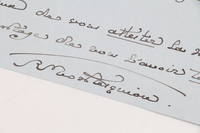
192083142s. l.: S. n. 1920. Fine. S. n. s. l. s. d. circa 1920 27 x 22 cm deux pages sur deux feuilles Autograph letter dated and signed by the dandy count 20 lines on 2 pages written in black ink about friendship and certain constraints that his correspondent seems to encounter probably his friend Henri Lapauze: ""Cher ami puisque vous souffrez c'est vous qu'il faut plaindre ; puisque je souris ce n'est pas moi qu'il faut blâmer. Votre souffrance vient de ne pas faire ce que vous voulez ; donc votre vindicte doit viser qui vous contraint. Ce que mes yeux ont vu aura comme suite conséquente ce que mes oreilles ont entendu on l'a écrit plaisamment. Il faut fournir à ces tomes là. Vous pensez bien que votre logique et votre justice ne visent qu'à établir les responsabilités. Car nous nous estimons au dessus de la louange mais pas au dessus de l'amitié. J'étais heureux de vous attester la mienne. Je le suis davantage de vous l'avoir témoignée. Votre Montesquiou."" ""Dear friend since you suffer it is you who must be pitied; since I smile it is not I who should be blamed. Your suffering comes from not doing what you want; therefore your vindication must target whoever constrains you. What my eyes have seen will have as a consequent sequel what my ears have heard it has been written pleasantly. We must provide for those volumes there. You well think that your logic and your justice aim only to establish responsibilities. For we consider ourselves above praise but not above friendship. I was happy to attest mine to you. I am even more so to have shown it to you. Yours Montesquiou."" S. n. unknown
194584178Poissy: S. n. 1945. Fine. S. n. Poissy 6 Octobre1945 13 x 21 cm deux pages Touching autograph letter dated and signed by Henri Béraud addressed to his mother-in-law while he was incarcerated at Poissy prison 46 lines in blue ink on one recto-verso page relating his situation as a prisoner and worrying about his mother-in-law's failing health. The letter is on letterhead from the infirmary of the central prison of Poissy with fold marks inherent to being placed in an envelope. Henri Béraud is very sad not to have been able to see his mother-in-law who encounters some health problems preventing her comforting visits to Poissy: "". j'ai été bien peiné de ne pas vous voir jeudi."" ""I was very saddened not to see you Thursday."" but promises to see her again soon in good health: "". que du moins après cela je vous retrouve en belle santé et toute gaie comme toujours."" ""may I at least find you again after this in good health and all cheerful as always."" He asks for news of his helpful mother-in-law's family and positions himself as the ugly duckling of the family: "" . seul en somme votre gendre vous donne du souci. Que voulez-vous il faut bien que dans toutes les familles y comprises les meilleures on compte un mauvais sujet ."" ""alone in short your son-in-law gives you worry. What can you do it's necessary that in all families including the best ones there be one bad subject."" Finally Henri Béraud ironizes about his condition so as not to make ""his dear mama"" feel too guilty about missing their meetings in the visiting room Henri Béraud's only source of escape to the outside world: "". ne vous fatiguez pas surtout comme je vous soupçonne de le faire pour les colis de ce chenapan. Il est infiniment trop gâté et une fois de plus il vous remercien de tout coeur pour la peine que vous prenez."" ""don't tire yourself especially as I suspect you do for the packages of this rascal. He is infinitely too spoiled and once again he thanks you with all his heart for the trouble you take."" A bon vivant native of Lyon Henri Béraud was a journalist and international reporter Le canard enchaîné Le Crapouillot Petit Parisien France-Soir and Gringoire and a prolific writer Prix Goncourt 1922 for Le martyre de l'obèse and Le vitriol de lune published a year earlier whose political evolution moving from the extreme left to the extreme right pro-collaborationist position is characteristic of the inexorable rise of totalitarianism in the inter-war period and the corruption of many French intellectuals. Friend of Roland Dorgelès Albert Londres and especially Joseph Kessel whom he met in 1922 in Ireland when it was recently and partially liberated from British rule Henri Béraud defended very left-wing opinions. But after a trip to the U.S.S.R. he began to revise his positions while drifting toward anti-parliamentarism Anglophobia Faut-il réduire l'Angleterre en esclavage published in 1935 and dedicated to Joseph Kessel and anti-Semitism ""without realizing it"" according to his friend the journalist Jean-Galtier Boissière. It was the Stavisky affair and its corollary the riots of the fascist and anti-parliamentarian leagues of February 6 1934 that triggered Henri Béraud's manifest passage to the extreme right going so far as to break his friendship with his great friend Joseph Kessel. In 1936 his violent articles in Gringoire led to the suicide of the Popular Front's Interior Minister Roger Salengro accused of desertion during the First World War. Arrested in September 1944 and sentenced to death on December 29 1944 for intelligence with the enemy he was pardoned by General De Gaulle. S. n. unknown
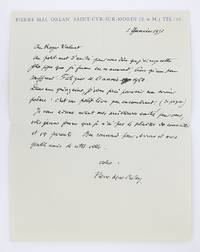
195184038Saint-Cyr-sur-Morin: S. n. 1951. Fine. S. n. Saint-Cyr-sur-Morin 5 Janvier 1951 21 x 27 cm une feuille Autograph letter dated and signed by Pierre Mac Orlan 13 lines in black ink to his young friend the budding poet Roger Valuet. Fold marks inherent to postal handling. Pierre Mac Orlan tired from his past year thanks his friend for offering him a pipe and promises to send him his latest work: "". in about two weeks I will send you my latest poem: it's a small unencumbering book 30 pages."" He sends his regards to Roger Valuet's family and to the people of Arras: ""I send you first my best friendship for you your young wife. and your parents. Kind regards to Arras and my dear friends in that city."" A native of Arras Roger Valuet is a popular writer who signed under the pseudonym Roger Vilard numerous detective and espionage novels. At the beginning of his career he was helped by Pierre Mac Orlan who wrote the preface to his first collection of poems. S. n. unknown
194684506Poissy: S. n. 1946. Fine. S. n. Poissy 8 Juin 1946 13 x 21 cm une page recto verso Fine autograph letter dated and signed by Henri Béraud addressed to his mother-in-law while he was incarcerated at Poissy prison 45 lines in blue ink on a recto-verso page suffering psychologically from his situation as a prisoner. The letter is on the headed paper of the infirmary of the Poissy central prison with fold marks inherent to being placed in an envelope. The prisoner Henri Béraud recalls the intense joy of having had the consoling visit of his mother-in-law in a somewhat more private manner than usual: "". l'heureux hasard qui nous donna ce parloir tout intime. Souhaitons que ce ne soit là qu'un coup d'essai et que tout concourra désormais à en faire une réconfortante habitude."" ""the fortunate chance that gave us this intimate visiting room. Let us hope that this was only a trial run and that everything will henceforth conspire to make it a comforting habit"" He asks his wife Germaine to send him some objects that would help relieve him somewhat of his condition as an inmate: "" Il me faudrait un flacon d'encre bleue-noire waterman pour remplir le bel encrier dû à la gentillesse de mon épouse ! Une ou deux têtes d'ail un ou deux crayons très tendres."" ""I would need a bottle of Waterman blue-black ink to fill the beautiful inkwell due to my wife's kindness! One or two heads of garlic one or two very soft pencils."" Finally Henri Béraud conscious of all the psychological and material support shown to him expresses his gratitude: "". Chère maman Mickey je vous embrasse avec toute ma tendresse en vous disant à bientôt ."" ""Dear mama Mickey I embrace you with all my tenderness while saying see you soon."" A bon vivant native of Lyon Henri Béraud was an international journalist and reporter Le canard enchaîné Le Crapouillot Petit Parisien France-Soir and Gringoire and a prolific writer Prix Goncourt 1922 for Le martyre de l'obèse and Le vitriol de lune published a year earlier whose political evolution moving from the extreme left to the extreme right pro-collaborationist position is characteristic of the inexorable rise of totalitarianisms between the wars and the corruption of many French intellectuals. Friend of Roland Dorgelès Albert Londres and especially Joseph Kessel whom he met in 1922 in Ireland then recently and partially liberated from the British yoke Henri Béraud defended very left-wing opinions. But after a trip to the U.S.S.R. he began to revise his positions while drifting toward anti-parliamentarianism Anglophobia Faut-il réduire l'Angleterre en esclavage published in 1935 and dedicated to Joseph Kessel antisemitism ""without realizing it"" according to his friend the journalist Jean-Galtier Boissière. It was the Stavisky affair and its corollary the riots of the fascist and anti-parliamentarian leagues of February 6 1934 that triggered Henri Béraud's manifest passage to the extreme right going so far as to break his friendship with his great friend Joseph Kessel. In 1936 his violent articles in Gringoire would lead to the suicide of the Popular Front Interior Minister Roger Salengro accused of desertion during World War I. Arrested in September 1944 and sentenced to death on December 29 1944 for intelligence with the enemy he was pardoned by General De Gaulle. S. n. unknown
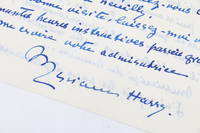
194786700Neuilly-sur-Seine 1947. Fine. Neuilly-sur-Seine 23 Juin 1947 26.50 x 20.50 cm une page recto verso Autograph letter signed by Myriam Harry addressed to historian Pierre Belperron who has just published at Plon his work entitled ""La guerre de sécession"" 30 lines in blue ink on a leaf recto verso. Fold mark inherent to postal delivery. Myriam Harry offers an enthusiastic critique of the historian's book: ""Combien j'ai aimé et admiré ""La guerre de sécession"". C'est un livre prodigieux stupéfiant éblouissant par la minutie et la profondeurs scrupuleuses de sa formidable érudition . par l'immensité ramassée de son sujet ces puissances tranquilles du style et cette merveilleuse clarté qui entraîne les évènements historiques aux récits d'un roman si passionnant."" ""How I loved and admired 'The War of Secession'. It is a prodigious book stupefying dazzling by the meticulous and scrupulous depth of its formidable erudition . by the concentrated immensity of its subject these tranquil powers of style and this marvelous clarity that carries historical events into the narrative of such a passionate novel."" so much so that she delights in reviving its atmosphere which transported her: ""tantôt peignant au bord d'un bayou d'un autre ami grand planteur de coton d'un domaine où caïmans tortues géantes et serpents à sonnette se promènent sous d'éclatantes lianes."" ""sometimes painting by the edge of a bayou of another friend great cotton planter of an estate where alligators giant turtles and rattlesnakes roam under brilliant lianas."" Myriam Harry hopes to see Pierre Belperron soon before overwhelming him again with praise: ""En attendant cette bonne visite laissez-moi vous remercier pour les charmantes heures instructives passées grâce à vous et veuillez me croire votre admiratrice. Et j'aéi oublié de vous féliciter du prix académique plus honorifique que l'eût été le Femina Vacaresco."" ""While awaiting this good visit let me thank you for the charming instructive hours spent thanks to you and please believe me your admirer. And I forgot to congratulate you on the academic prize more honorable than the Femina Vacaresco would have been."" unknown
194684179Poissy: S. n. 1946. Fine. S. n. Poissy 22 Juin 1946 13 x 21 cm une page recto verso Fine autograph letter dated and signed by Henri Béraud addressed to his mother-in-law while he was incarcerated at Poissy prison 43 lines in blue ink on one recto-verso page suffering psychologically from his situation as a prisoner. The letter is on letterhead from the infirmary of the central prison of Poissy with fold marks inherent to being placed in an envelope. Morally affected the prisoner Henri Béraud attempts to show optimism by putting his misfortunes in perspective: "". Mauvaise période ! Mais après la pluie le beau temps. Celui qui a trouvé cela est un consolateur qui en vaut bien d'autre et qui somme toute n'est pas le plus bête."" ""Bad times! But after the rain comes fair weather. Whoever found that saying is a comforter as good as any other and who all in all is not the most foolish."" He asks his wife Germaine to send him: "" . Si elle en a la possibilité elle peut forcer sur le pain d'épices qui vraiment est d'un grand secours."" ""If she has the possibility she can increase the gingerbread which truly is of great help."" and rejoices ironically about his condition : "". Pour le reste madame la marquise tout va très bien trop bien ! "" ""For the rest madame la marquise everything is going very well too well!"" Finally Henri Béraud impatiently awaits a new photograph of his wife: "". pour cela je suis insatiable. Et ma cellule pourtant en est illuminée dejà ! ."" ""for that I am insatiable. And my cell however is already illuminated by it!."" A bon vivant native of Lyon Henri Béraud was a journalist and international reporter Le canard enchaîné Le Crapouillot Petit Parisien France-Soir and Gringoire and a prolific writer Prix Goncourt 1922 for Le martyre de l'obèse and Le vitriol de lune published a year earlier whose political evolution moving from the extreme left to the extreme right pro-collaborationist position is characteristic of the inexorable rise of totalitarianism in the inter-war period and the corruption of many French intellectuals. Friend of Roland Dorgelès Albert Londres and especially Joseph Kessel whom he met in 1922 in Ireland when it was recently and partially liberated from British rule Henri Béraud defended very left-wing opinions. But after a trip to the U.S.S.R. he began to revise his positions while drifting toward anti-parliamentarism Anglophobia Faut-il réduire l'Angleterre en esclavage published in 1935 and dedicated to Joseph Kessel and anti-Semitism ""without realizing it"" according to his friend the journalist Jean-Galtier Boissière. It was the Stavisky affair and its corollary the riots of the fascist and anti-parliamentarian leagues of February 6 1934 that triggered Henri Béraud's manifest passage to the extreme right going so far as to break his friendship with his great friend Joseph Kessel. In 1936 his violent articles in Gringoire led to the suicide of the Popular Front's Interior Minister Roger Salengro accused of desertion during the First World War. Arrested in September 1944 and sentenced to death on December 29 1944 for intelligence with the enemy he was pardoned by General De Gaulle. S. n. unknown
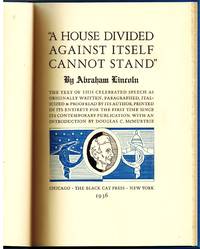
1936010649Chicago: The Black Cat Press 1936. Book. Near Fine. Cloth. Limited Edition. 8vo - over 7¾ - 9¾" tall. Limited Edition. "140 copies of this volume have been printed from Linotype Garamond on Ivory Wove Normandy Vellum. Title Page Decoration by Calvin Brazelton. Designed by N.W. F. Norman W. Forgue ." Blue cloth covered boards with gilt design to front and gilt lettering to the spine. Near Fine. Slight rubbing at spine end and tips. Slight toning to front paste down and end paper. " The text of this celebrated speech as originally written paragraphed italicized & proofreadby its author printed in its entirety for the first time since its contemporary publication." Norman W. Forgue was an African -American bookmaker typographer and founder of several private presses including At the Sign of the Gargoyle The Black Cat Press The Norman Press and Normandie House. The Black Cat Press Hardcover
195185222Milly-la-Forêt 1951. Fine. Milly-la-Forêt 7 Février 1951 21 x 27 cm une page Autograph letter signed by Jean Cocteau addressed from his house in Milly-la-Forêt 15 lines in black ink to Olivier Quéant. Traces of folds inherent to postal mailing. ""Milly Février 1951 7 Très cher Quéant Pardonnez moi. Je traverse une crise très pénible de santé. L'opération a redéclenché les symptomes de mes supplices de la Belle et la Bête. Les médécins s'y perdent et je vais être tenu de changer de climat. Bref tout un ordre ou un désordre qui m'empêchent d'écrire surtout sur un tel sujet. Je sais que vous m'aimez bien et me comprendrez. S'il s'agissait de plusieurs mois peut-être tenterai-je la chose mais vous le voyez je forme à demi mes lettres. Tt coeur à vous. JeanC."" ""Milly February 1951 7 Very dear Quéant Forgive me. I am going through a very painful health crisis. The operation has triggered again the symptoms of my torments from Beauty and the Beast. The doctors are at a loss and I will have to change climate. In short a whole order or disorder that prevents me from writing especially on such a subject. I know that you care for me and will understand. If it were a matter of several months perhaps I would attempt the thing but as you can see I can barely form my letters. All my heart to you. JeanC."" unknown
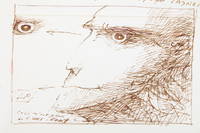
200287842Lagnes: S. n. 2002. Fine. S. n. Lagnes 12 Avril 2002 23 x 16 cm une feuille Manuscript envelope by Louis Pons addressed to his friend art critic Georges Raillard specialist in the works of Joan Miro and Antoni Tapies on the verso of which he created an original drawing signed with his initials and bearing this humorous note: ""Ceci n'est pas de l'art brut."" The envelope reimagined by Louis Pons in his whimsical manner features below his personal address in Vaucluse a human face staring at an eye. S. n. unknown
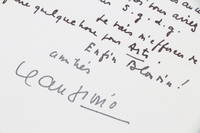
1955844221955. Fine. s. d. circa 1955 13.50 x 21 cm une feuille Autograph letter signed by Jean Giono addressed to Roger Nimier 11 lines in black ink in which he justifies his delay in responding to a request for an article submitted to him by the author of Hussard Bleu. Trace of fold inherent to envelope insertion. ""Pour Mars ça me paraît difficile. Au surplus je n'ai pas le texte et j'ai oublié mes anciennes lectures."" ""For March that seems difficult to me. Moreover I don't have the text and I have forgotten my previous readings"" but Jean Giono does not give up on all production: "". je vais m'efforcer de faire quelque chose pour Arts."" "". I will endeavor to do something for Arts."" He also rejoices at the publication of a new work by Antoine Blondin great friend of Roger Nimier probably the bookstore release of L'humeur vagabonde in 1955 or Un singe en hiver in 1959 with a thunderous: ""Enfin Blondin ! "" ""Finally Blondin!"" unknown
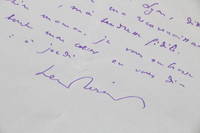
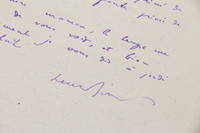
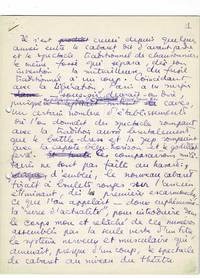
195376377Paris: s. n. 1953. Fine. s. n. Paris s. d. ca 1953 21 x 27 cm 11 feuillets rédigés au recto Manuscript partly unpublished of an article on cabaret nine pages plus two additional pages written in purple ink on perforated squared paper sheets. Numerous deletions and corrections as well as several additions. The sheets are numbered in the upper right margin from 1 to 9 then 12 and 13. The first nine sheets of this text which was never published during Boris Vian's lifetime were transcribed in Les Vies posthumes de Boris Vian by Michel Fauré 1975. The text was erroneously dated 1948 by Fauré: the mention of Samuel Beckett's En attendant Godot whose premiere took place in 1953 makes this dating impossible. An interesting text evoking cabarets and the ""troglodytes"" a fine echo to the famous Manuel de Saint-Germain-des-Prés 1951: ""Let us give back to Saint-Germain-des-Prés what rightfully belongs to it: besides a certain tonnage provided to journalists short of copy this much-decried district - by those who precisely only knew it in its journalistic aspect - is at the origin of the profound transformation of cabaret. Yes there was indeed a reason why intelligent people like Sartre Prévert Camus Merleau-Ponty etc. in short all those who today count in literature or the arts followed with such attention the great movement of the cellars despite the turbulence of the troglodytes and the incongruity of the photographer monkeys despite the muddled activity of a generation of illiterate and boorish journalists despite the vacant curiosity of the gawker and the bitter resentment of the chamber pot emptiers of rue Dauphine."" After briefly evoking jazz a subject on which he is usually dithyrambic Boris Vian devotes the greater part of his text to theater: ""Jazz on one side carved out with great trumpet blows a place in the shade on the engine room side; that is its true environment: a smoky cellar a back room a dark laboratory where the faithful gather. . The musicians finally relaxed. But for their part the actors did not remain inactive."" Visionary Vian senses ""in the air a scent of renewal"" understanding the importance that cabaret theater would assume in the years to come. Two sheets not transcribed in Fauré's work evoke the theatrical avant-garde of the early 1950s: ""And it is no accident if En attendant Godot Samuel Beckett's astonishing play is a clown entrance that lasts two hours deals with nothing in particular poses all problems wrests laughter at the moment when one should be terrified . And it is no accident if the principal interpreter of Beckett's work this pillar of avant-garde theater is a cabaret veteran."" s. n. unknown
195080910s. l. Klarskovgaard 1950. Fine. s. l. Klarskovgaard 17 novembre 1950 21 x 34 cm 2 pages sur un feuillet Autograph letter signed with the initials of Louis-Ferdinand Céline addressed to his lawyer Master Thorvald Mikkelsen. Two pages written in blue ink on a large sheet of white paper; number ""568"" in Céline's hand in red pencil at the top left. Transversal folds inherent to mailing. This letter was very partially transcribed in Année Céline 2005. Early November 1950 Gaby Paul had come to visit Céline and Lucette at Klarskovgaard: ""Oh mille mercis à Mme Christensen pour son aimable repas qui réchauffé fit nos délices ! Et puis aussi gratitudes pour tout le soin qu'elle a pris de Mme Gen Paul !. Laquelle ne donne aucune nouvelle. Quelle vacherie encore . Comme c'est amusant ! Je crois qu'elle avait des projets ""journalistiques"" mais que mon attitude l'a désenchantée. """"Oh a thousand thanks to Madame Christensen for her kind meal which reheated was our delight! And also gratitude for all the care she took of Mme Gen Paul!. Who gives no news. What nastiness again. How amusing! I believe she had 'journalistic' projects but my attitude disenchanted her."" Céline also mentions the Swedish writer Ernst Bendz one of the few to defend Céline alongside Paraz: ""Une lettre amusante de Bendz ! Bendz appartient vraiment à l'aristocratie des esprits ! La preuve ! La façon qu'il ""m'estime""!!!""""An amusing letter from Bendz! Bendz truly belongs to the aristocracy of minds! The proof! The way he 'esteems me'!!!"" In 1947 Céline pursued by French justice for his collaborationist involvement was confined in Denmark. It was in May 1948 accompanied by Lucette and Bébert that he arrived at his lawyer Master Thorvald Mikkelsen's home at Klarskovgaard. The latter owned a large property by the Baltic Sea and invited the exile to stay there. On February 21 1950 as part of the épuration the writer was definitively sentenced in absentia by the civic chamber of the Paris Court of Justice for collaboration to one year of imprisonment which he had already served in Denmark. The Swedish Consul General in Paris Raoul Nordling intervened on his behalf with Gustav Rasmussen Danish Foreign Minister and managed to delay his extradition. On April 20 1951 Jean-Louis Tixier-Vignancour his lawyer since 1948 obtained Céline's amnesty under the title of ""severely disabled veteran of the Great War"" by presenting his file under the name Louis-Ferdinand Destouches without any magistrate making the connection. Céline would leave Denmark the following summer after three years spent at his lawyer's home. unknown
197479135Londres London 1974. Fine. Londres London 14 avril 1974 13 x 18.10 cm une carte postale Autograph postcard signed by Maurice Béjart addressed to André-Philippe Hersin written in blue ballpoint pen on the verso of a photographic reproduction of Vermeer's painting titled A Lady Standing at a Virginal. ""Before leaving London I think of you. Impossible to reach Paris by telephone at normal hours. I leave tomorrow for Venice. Here the summer season has been a great success. Kiss - Maurice"" Journalist dance critic and editor-in-chief of Les Saisons de la danse Hersin was a great defender of Béjart's choreographic style and devoted laudatory articles to him in his review as well as monographic fascicles on his work. unknown
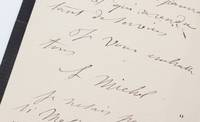
188583957s. l. Paris 1885. Fine. s. l. Paris 12 juin 1885 11 x 16.90 cm 2 pages 1/2 sur un bifeuillet Autograph letter signed by Louise Michel addressed to Lucien Barrois; two and a half pages written in black ink on a white paper bifolium with black border. Transverse folds inherent to postal delivery. Louise Michel requests help for one of her acquaintances: ""Madame Maron à qui Lafont ou Clémenceau avait fait avoir promesse à la mairie d'un terme de son loyer elle en doit trois n'a plus entendu parler de rien et il faut qu'elle déménage pour aller en face où elle paiera moins. Sa propriétaire l'aurait attendue avec un terme payé sur les trois. Il faut enfin que ce soit vous qui rappeliez cette pauvre femme qui a rendu tant de services."" ""Madam Maron for whom Lafont or Clémenceau had secured a promise from the town hall for one term of her rent she owes three has heard nothing more and must move across the street where she will pay less. Her landlady would have waited for her with one term paid out of the three. You must finally be the one to remind them of this poor woman who has rendered so many services."" Moving letter testimony to the unwavering devotion of the former Communard. unknown
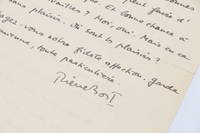
194483439Paris 1944. Fine. Paris 8 février 1944 15 x 19 cm une feuille Touching autograph letter signed 32 lines in black ink on one leaf from Pierre Bost to his friend Carlo Rim in which he shares his grief concerning the death of a loved one and how friendship can somewhat ease overwhelming sadness. Traces of creases inherent to folding for mailing. ""8 février 44 Cher Carlo oui je t'envoie oui nous vous envoyons de bons voeux s'il en est temps encore ; c'est à ça que servent les amis c'est à dire à pas grand'chose mais à quelque chose après tout. J'ai pensé à toi avec beaucoup d'affection dans ton deuil. Il y a un an que mon père mourait à Marseille. C'est tout près encore je devine ce que tu sens je prévois ce que tu sentiras quand les mois passeront - pas encore les années. Et cet étonnement il faut le dire de se trouver orphelin à un âge où l'on croyait bêtement que le mot n'est plus de mise. Mais si oui j'ai beaucoup pensé à toi et si je te le dis un peu tard ça ne fait rien. Et à l'accident de ta femme aussi. Je connais ces accumulations de catastrophes je vous plains de tout coeur. Comment va-t-elle Bien je l'espère et sans suites Heureux mortels qui faites du ski nous comprendrions bien que vous soyez un peu permis du plaisir que vous y prenez ; maus un coup de soleil sur le nez une fourbure. là c'est trop. Pourra-t-elle recommencer au moins Faites-lui nos bonnes amitiés nos voeux tout ce qu'on peut fzirer d'aimable dans une clinique. Et bonne chanceà vous deux. Tu travailles Moi oui. Mais en ce moment sans plaisir. Où sont les plaisirs Partagez-vous notre fidèle affection. Garde pour toi la mienne toute particulière. Pierre Bost."" ""8 February 44 Dear Carlo yes I send you yes we send you good wishes if it is still time; that's what friends are for that is to say not much but something after all. I thought of you with much affection in your grief. It was a year ago that my father died in Marseille. It is still very close I can guess what you feel I foresee what you will feel when the months pass - not yet the years. And this astonishment it must be said of finding oneself orphaned at an age when one thought foolishly that the word no longer applies. But yes indeed I have thought of you much and if I tell you this a bit late it doesn't matter. And about your wife's accident too. I know these accumulations of catastrophes I feel for you with all my heart. How is she Well I hope and without complications Happy mortals who ski we would well understand that you are somewhat forgiven for the pleasure you take in it; but sunburn on the nose a strain. that's too much. Will she at least be able to start again Give her our kind regards our wishes all that one can do that is pleasant in a clinic. And good luck to both of you. Are you working I am yes. But at the moment without pleasure. Where are the pleasures Share our faithful affection. Keep for yourself mine quite particular. Pierre Bost."" Provenance: from the Carlo Rim collection who was a Provençal writer author notably of Ma belle Marseille a caricaturist a filmmaker and friend of Fernandel Raimu and Marcel Pagnol but also of Max Jacob and André Salmon whom he met in Sanary. unknown
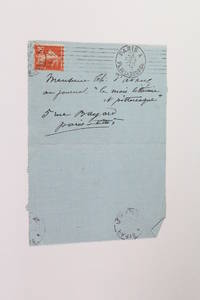
1911719101911. Fine. 21 avril 1911 11.10 x 15.10 cm Un feuillet Autograph letter signed by the painter George Desvallières to the director of ""Le Mois littéraire et pittoresque"" requesting authorization for the reproduction of a painting. One leaf. unknown