67 résultats
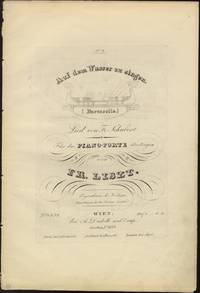
184031569Braunschweig: G.M. Meyer PN 361 1840. SCHUBERT Franz 1797-1828. Folio. 1 title 2-19 1 blank pp. Engraved.<br/><br/>Contents: <br/>- Erlkönig D 328<br/>- Sei mir gegrüsst D 741<br/>- Du bist die Ruh D 776<br/>- Auf dem Wasser zu singen D 774<br/><br/>Musicseller's handstamp to foot of title.<br/><br/>Slightly worn; very minor soiling offsetting and foxing throughout. An early edition. LW A42. Searle 558. Raabe 243. <br/><br/>Liszt transcribed nearly 150 songs for solo piano including 44 of Schubert's Lieder. <br/><br/>"His response to poetic imagery his conviction that purely musical images of poetic ideas are capable of projection to the listener and his belief that he could illustrate such imagery without words are keys to understanding Liszt's lifelong aesthetic. The musical image of the idea the true symphonic poem thus had its genesis in concept and form in Liszt's adoration of Schubert." Derek Watson: Liszt p. 214. G.M. Meyer [PN 361] unknown books
188022872Leipzig: Breitkopf Und Hartel. Very Good. 1880. First German Edition. Hardcover. Bound in three-quarter leather with paper covered boards. Text is in Old German. I believe this is the first German edition. ; Small 4to 9" - 11" tall; 215 pages . Breitkopf Und Hartel hardcover
184031569Braunschweig: G.M. Meyer PN 361 1840. SCHUBERT Franz 1797-1828. Folio. 1 title 2-19 1 blank pp. Engraved.<br /> <br /> Contents: <br /> - Erlkönig D 328<br /> - Sei mir gegrüsst D 741<br /> - Du bist die Ruh D 776<br /> - Auf dem Wasser zu singen D 774<br /> <br /> Musicseller's handstamp to foot of title.<br /> <br /> Slightly worn; very minor soiling offsetting and foxing throughout. An early edition. LW A42. Searle 558. Raabe 243. <br /> <br /> Liszt transcribed nearly 150 songs for solo piano including 44 of Schubert's Lieder. <br /> <br /> "His response to poetic imagery his conviction that purely musical images of poetic ideas are capable of projection to the listener and his belief that he could illustrate such imagery without words are keys to understanding Liszt's lifelong aesthetic. The musical image of the idea the true symphonic poem thus had its genesis in concept and form in Liszt's adoration of Schubert." Derek Watson: Liszt p. 214. G.M. Meyer [PN 361] unknown
183831571Wien: A. Diabelli und Comp. PN D. et C. No. 6532 1838. SCHUBERT Franz 1797-1828. Large octavo. Disbound. 1 title 2-15 1 blank pp. Engraved.<br/><br/>Occasional light offsetting. First Edition. LW A42/2. Searle 558/2. Raabe 243/2. <br/><br/>Liszt transcribed nearly 150 songs for solo piano including 44 of Schubert's Lieder. <br/><br/>"His response to poetic imagery his conviction that purely musical images of poetic ideas are capable of projection to the listener and his belief that he could illustrate such imagery without words are keys to understanding Liszt's lifelong aesthetic. The musical image of the idea the true symphonic poem thus had its genesis in concept and form in Liszt's adoration of Schubert." Derek Watson: Liszt p. 214. A. Diabelli und Comp. [PN D. et C. No. 6532] unknown books
183940937Berlin: Ad. Mr. Schlesinger PN S. 2224 1839. Folio. Disbound. 1f. recto title verso blank i blank 4-13 i blank pp. Engraved. With secondary pagination to rectos in manuscript.<br /> <br /> Formerly in the collection of the Forbes Library in Northampton Massachusetts with their handstamp to upper outer corner of title and several pages.<br /> <br /> Slightly worn and browned; outer leaf separated at spine; narrow strip of early paper tape to inner margin of title. First Edition later issue. Searle 470. Raabe 134. Ad. Mr. Schlesinger [PN S. 2224] unknown
187441065Leipzig: Breitkopf & Härtel PN 9056 1874. Octavo. Original publisher's dark ivory wrappers. 1f. recto title verso blank 1f. recto preface in German verso preface in French 1f. recto composer's note in German on performance practice verso same note in French dated "Weimar Mars 1856" 97 i blank pp. Title preface and note lithographed; music engraved. <br /> <br /> Small B & H stamp to lower outer corner of title.<br /> <br /> With publisher's catalogue to verso of lower wrapper. <br /> <br /> Wrappers slightly worn and soiled; spine lacking. Occasional small stains; dampstaining to lower outer corners of first leaves; one signature partiallky detached. Re-issue from first edition plates. Searle 97. Raabe 414. Sonneck p. 266. <br /> <br /> Liszt was a distinguished Hungarian composer pianist conductor and writer.<br /> <br /> "Sketchbook evidence points to 1846-7 as the years when Liszt began to conceive the idea of a series of programmatic orchestral works. Of the four works he named all based on French poetry Ce qu'on entend sur la montagne and Les Préludes eventually became symphonic poems. . <br /> <br /> Liszt's concentration on the symphonic poem largely coincided with his tenure as Kapellmeister in Weimar where he had an orchestra at his disposal and provided music for performances at the Court Theatre. The Grand Duke commissioned Liszt's 'overtures' to preface specific dramas which thereby determined the subject matter of what were to become a number of his symphonic poems. Cormac F2017 argues that Liszt's approach to the overtures and their transformation into symphonic poems was influenced by his experience of an array of dramatic media opera plays melodramas tableaux vivants and by his interaction with staff and actors involved in the dramatic productions in Weimar. A New German School acolyte Felix Draeseke writing about the symphonic poems in a series of essays from the late 1850s acknowledged the influence of dramatic music especially opera on Liszt's Festklänge. Draeseke also addressed the issue that continues to interest scholars - the symphonic poems' engagement with sonata form. .<br /> <br /> Looking at the 12 Weimar symphonic poems Vande Moortele . views all but three Orpheus Héroide funèbre and Hunnenschlacht as using sonata form as one of the central principles guiding their large-scale organization. Furthermore Liszt seems to have attempted the same merging of sonata form and sonata cycle evident in the B Minor Sonata in Tasso Les préludes and Die Ideale and possibly Ce qu'on entend sur la montagne. .<br /> <br /> Some of the symphonic poems include mimetic representation of scenes and actions such as Hunnenschlacht's depiction of a battle and Prometheus's evocation of a voice followed by a storm. The inclusion of such passages drew criticism that a number of the symphonic poems seemed formless and could not be understood without access to a programme. In other symphonic poems such as Les Préludes and Orpheus Liszt responded to a philosophical programme without compromising musical logic. In these cases critics recognized Liszt the 'tone poet' who could capture a poetic stimulus in an expressive evocative musical flow unified by a single theme that underwent transformations. In general Liszt's sumptuous orchestral colorings were the dominant focus of critics' positive reception of his symphonic poems and programme symphonies." Dolores Pesce Maria Eckhardt and Rena Charnin Mueller in Grove Music Online. Breitkopf & Härtel [PN 9056] unknown
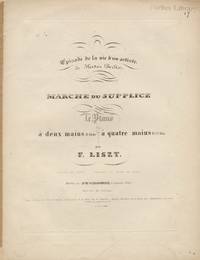
186631560Paris: S. Richault PN 15383 R 1866. BERLIOZ Hector 1803-1869. Folio. Original publisher's light green printed wrappers. 1f. title 7 1 blank pp. Engraved.<br/><br/>From the collection of pianist Mario Feninger 1923-2016 with his small handstamp to upper wrapper "Ex Mario Feninger de Rogatis Libris" and head of first page. Publisher's handstamp to foot of title.<br/><br/>Wrappers detached. Somewhat worn and soiled; minor offsetting. First Edition co-published with Biedermann in Germany. LW A205. Searle 475. Raabe 142. LC Catalog 152.<br/><br/>Liszt was a fervent champion of Berlioz while in Paris and transcribed a number of his works for piano. It was Berlioz who first introduced Liszt to Goethe's Faust. <br/><br/>"A lucid and delicately laid-out scherzo of charming effect." Derek Watson: Liszt p. 201. S. Richault [PN 15383 R] unknown books
189455718Berlin - Paris : Otto Liebmann - Pedone-Lauriel 1894. 265x175mm. XXVI- demi-basane dos ˆ nerfs piÂce de titres rouge et verte cuir par endroit frottÂŽ cachet de bibliothÂque sur la page de titre cuir tachÂŽ sur un bord. 1821 Otto Liebmann - Pedone-Lauriel unknown
186631560Paris: S. Richault PN 15383 R 1866. BERLIOZ Hector 1803-1869. Folio. Original publisher's light green printed wrappers. 1f. title 7 1 blank pp. Engraved.<br /> <br /> From the collection of pianist Mario Feninger 1923-2016 with his small handstamp to upper wrapper "Ex Mario Feninger de Rogatis Libris" and head of first page. Publisher's handstamp to foot of title.<br /> <br /> Wrappers detached. Somewhat worn and soiled; minor offsetting. First Edition co-published with Biedermann in Germany. LW A205. Searle 475. Raabe 142. LC Catalog 152.<br /> <br /> Liszt was a fervent champion of Berlioz while in Paris and transcribed a number of his works for piano. It was Berlioz who first introduced Liszt to Goethe's Faust. <br /> <br /> "A lucid and delicately laid-out scherzo of charming effect." Derek Watson: Liszt p. 201. S. Richault [PN 15383 R] unknown
1880066737Leipzig: Breitkopf & Härtel 1880. 215 S.; aus dem Französischen von La Mara d. i. Ida Marie Lipsius; Privateinband etwas späterer Zeit; Titelblatt mit Besitzerstempel stellenweise mässig stockfleckig Kanten teils etwas berieben u. bestossen stabiles Expl. Erste deutsche Ausgabe. Halbleinen. Gut. 249 cm. Privateinband. Breitkopf & Härtel Hardcover
1855125775Druck: Weimar, Hof-Buchdruckerei 1855. * 29 Seiten. 16,5 x 13 cm. Bedruckte graue Original-Broschur (fleckig).
187514164Berlin - Wien: Schlesinger-Haslinger Ca. 1875. Used; Like New/Used; Like New. Score of Liszt's Hungarian Rhapsody no. 12 "A J. Joachim" with the ownership stamp of the important twentieth-century German pianist Elly Ney who has also penned "12. Ungarische Rhapsodie" in blue ink at the head. A few paper repair within edges lightly nicked with small tears spine reinforced with green cloth overall very good. There are no markings within the score. <br style="">Elly Ney was one of the 20th century's outstanding pianists and at 16 won the Mendelssohn prize 1900—in a contest of which the famous Hungarian violinist Joseph Joachim was one of the judges.  The present work by Liszt is dedicated to Joachim. <br>Of Ney's great performing Willhelm Kempff wrote: "My ears still hear her melodious voice with its unmistakable hint of her Rhineland origins which had the gift of establishing immediate contact with everyone she spoke to. This happened even more intensely when she stepped onto the concert platform. Just one mysterious chord Beethoven's D minor sonata for instance and the listener was drawn into her magnetic field. What then ensued cannot and should not be described in words nor should it be scientifically dissected. Those who had ears heard for themselves. But that was by no means the end of the matter. A realisation continued to resonate in her listeners' hearts as it had begun to resonate from the moment this greatest of performers stepped onto the platform - the realisation that artistry of this quality draws its strength from roots that have their being in the unfathomable depths of the human soul."<br style=""> Schlesinger-Haslinger hardcover books
185040941Leipzig: Breitkopf & Härtel PN 8090 1850. Folio. Unbound as issued. 1f. recto title verso blank 3-29 i blank pp. Engraved.<br /> <br /> Small oval handstamp to blank lower margin of title.<br /> <br /> Slightly worn browned and foxed. First Edition. Searle 414:3. Raab 223.<br /> <br /> Liszt made numerous transcriptions from the operas of Meyerbeer including L'Africaine Le Prophète Les Huguenots and Robert le Diable. Breitkopf & Härtel [PN 8090] unknown
188128117ABNouvelle édition. Leipzig, Breitkopf & Haertel, 1881. Gross-8°. (1) Bl., (4), 538 S., (1) Bl. Illustr. silbergeprägter Orig.-Leinenband
188128117AB1881. Nouvelle édition. Leipzig Breitkopf & Haertel 1881. Gross-8°. 1 Bl. 4 538 S. 1 Bl. Illustr. silbergeprägter Orig.-Leinenband Um 200 S. erweitere Neuauflage über die von Liszt beschriebene Volksmusik der Roma und der Juden in Ungarn und Russland. - Mit getilgtem Namenszug auf dem Halbtitelblatt. Einband berieben und bestossen. unknown
190011344Paris, Rouart, Lerolle et Cie. non daté, vers 1900 - 2 parties 10 et 21 pp.Belle reliure à la bradel demi-maroquin bleu à coins. Dos lisse orné et doré. Tête dorée. Couverture conservée. Pas de rousseur. Dos et coins légèrement frottés. Bon état. Format in folio (35x28).
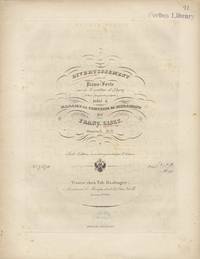
183840939Vienne: Tob. Haslinger PN T. H. 7573 1838. Folio. Disbound. i title 2-23 i blank pp. Engraved. With secondary pagination to rectos in manuscript.<br /> <br /> Small oval handstamp of P.K. Weizel Brooklyn NY to lower margin of title. <br /> <br /> Formerly in the collection of the Forbes Library in Northampton Massachusetts with their handstamp to upper outer corner of title and several pages.<br /> <br /> Very slightly worn soiled and foxed; outer bifolium separated at spine; small blank piece of ivory paper laid down to final blank page. First Edition. Searle 419. Raabe 230. Tob. Haslinger [PN T. H. 7573] unknown
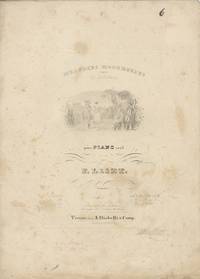
184040936Vienne: A. Diabelli & Comp. PN D et C No. 6959 1840. Folio. Unbound. 1f. recto title with vignette of dancing couple and group of musicians 3-1. i blank pp. Engraved<br /> <br /> Some wear and minor foxing; outer bifolium separated at spine' 6" in contemporary manuscript to upper outer corner of title.<br /> <br /> Indecipherable signature in pencil to lower outer corner of title with several annotations in purple ink. First Edition. Searle 425. Raab 250. Auman and White 124a. A. Diabelli & Comp. [PN D et C No. 6959] unknown
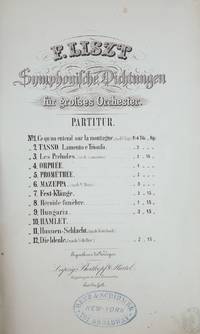
186241066Leipzig: Breitkopf & Härtel PN 9056 1862. Octavo. Original publisher's blue printed wrappers. 1f. recto title verso blank 1f. recto composer's note on performance practice in German verso same note in French dated "Weimar Mars 1856" 1f. recto preface in German verso preface in French 97 iii blank pp. Title note and preface lithographed; music engraved. <br /> <br /> With publisher's catalogue to verso of lower wrapper. <br /> <br /> With Beer & Schirmer New York and Musik-Antiquariat Doblinger handstamps to upper wrapper; Beer and Schirmer and publisher's handstamp to title.<br /> <br /> Wrappers worn soiled chipped and torn; spine reinforced with paper tape with small pieces of same tape to verso of upper wrapper. Minor internal wear. First Edition later issue. Searle 97. Raabe 414. Sonneck Orchestral Music p. 266. <br /> <br /> Liszt was a distinguished Hungarian composer pianist conductor and writer.<br /> <br /> "Sketchbook evidence points to 1846-7 as the years when Liszt began to conceive the idea of a series of programmatic orchestral works. Of the four works he named all based on French poetry Ce qu'on entend sur la montagne and Les Préludes eventually became symphonic poems. . <br /> <br /> Liszt's concentration on the symphonic poem largely coincided with his tenure as Kapellmeister in Weimar where he had an orchestra at his disposal and provided music for performances at the Court Theatre. The Grand Duke commissioned Liszt's 'overtures' to preface specific dramas which thereby determined the subject matter of what were to become a number of his symphonic poems. Cormac F2017 argues that Liszt's approach to the overtures and their transformation into symphonic poems was influenced by his experience of an array of dramatic media opera plays melodramas tableaux vivants and by his interaction with staff and actors involved in the dramatic productions in Weimar. A New German School acolyte Felix Draeseke writing about the symphonic poems in a series of essays from the late 1850s acknowledged the influence of dramatic music especially opera on Liszt's Festklänge. Draeseke also addressed the issue that continues to interest scholars - the symphonic poems' engagement with sonata form. .<br /> <br /> Looking at the 12 Weimar symphonic poems Vande Moortele . views all but three Orpheus Héroide funèbre and Hunnenschlacht as using sonata form as one of the central principles guiding their large-scale organization. Furthermore Liszt seems to have attempted the same merging of sonata form and sonata cycle evident in the B Minor Sonata in Tasso Les préludes and Die Ideale and possibly Ce qu'on entend sur la montagne. .<br /> <br /> Some of the symphonic poems include mimetic representation of scenes and actions such as Hunnenschlacht's depiction of a battle and Prometheus's evocation of a voice followed by a storm. The inclusion of such passages drew criticism that a number of the symphonic poems seemed formless and could not be understood without access to a programme. In other symphonic poems such as Les Préludes and Orpheus Liszt responded to a philosophical programme without compromising musical logic. In these cases critics recognized Liszt the 'tone poet' who could capture a poetic stimulus in an expressive evocative musical flow unified by a single theme that underwent transformations. In general Liszt's sumptuous orchestral colorings were the dominant focus of critics' positive reception of his symphonic poems and programme symphonies." Dolores Pesce Maria Eckhardt and Rena Charnin Mueller in Grove Music Online. Breitkopf & Härtel [PN 9056] unknown
185131564Leipzig: Breitkopf & Härtel PN 8271 1851. MENDELSSOHN Felix 1809-1847. Folio. Disbound. 1f. title 3-27 1 blank pp. Engraved.<br/><br/>Title detached and slightly foxed with publisher's and musicseller's handstamps to foot. First Edition. LW A166. Searle 410. Raabe 219. LC Catalog 114. <br/><br/>Liszt's paraphrase of Mendelssohn's incidental music to Midsummer Night's Dream includes the fairies' music and the famous wedding march. Breitkopf & Härtel [PN 8271] unknown books
186030660ABLeipzig, Breitkopf & Härtel, um 1860. 4°. 51 S. Moderner Einband.
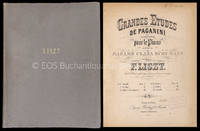
186030660AB1860. Leipzig Breitkopf & Härtel um 1860. 4°. 51 S. Moderner Einband. Platten-Nr. V.A. 484. 6 Etüden «seule édition authentique entièrment revue et corrigée par l'auteur» Titelbatt. Ders.: Zwei Episoden aus Lenau's Faust für grosses Orchester Piano zu zwei Händen. Leipzig J. Schuberth um 1860. 26 S. Ders.: Etudes d'exécution transcendante pour le piano par F. Liszt. Cah. 1. Leipzig Breitkopf und Härtel um 1860. 54 S. gestochene Noten. Ders.: Légendes. No. 1 St. Francois d'Assise. Piano. Pars Ménestrel um 1870. 13 S. Platten-Nr. H. 4612. Papier gebräunt zum Teil mit hinterlegten Einrissen. Mit handschr. Namenszügen auf den Titelblättern. unknown
189461511London:: H. Grevel & Co. Very Good. 1894. Hardcover. Complete in two volumes. Volume I: From Paris to Rome: Years of Travel as Virtuoso. Volume II: From Rome to the End. Collected and edited by La Mara. Translated by Constance Bache. First edition thus. Octavos half-bound in green leather with green cloth covered boards raised band along spines gilt lettering and elaborate design along the spines top edges gilt marbled endpapers. Previous owner's book-plate on front paste-downs leather along the spines is toned brown else both volumes are very good or better. Bindings are solid and tight. . H. Grevel & Co., hardcover books
1881106040Leipzig : Breitkopf et Haertel 1881. 250x170mm. reliure demi-toile coins avec dos muet. Plats papier marbr. Bel exemplaire. 1233 Breitkopf et Haertel unknown
184031559Leipzig: Breitkopf & Härtel PN 6266 1840. BEETHOVEN Ludwig van 1770-1827. Folio. 1 decorative lithographic title printed in green 2-15 1 blank pp. Engraved. Music printed within decorative blue borders.<br/><br/>Disbound. Slightly soiled and foxed; occasional performer's markings in pencil. Publisher's handstamp to foot of title. First Edition. LW A58. Searle 466. Raabe 121. LC Catalog 146. Hoboken 10 98. <br/><br/>Liszt's transcription of Beethoven's Adelaide Op. 46; 1795 was the first of many arrangements he made of Beethoven's songs. He dedicated the work to the Marchese Maria Martellini an Italian noblewoman who was one of Liszt's early supporters and patrons. Breitkopf & Härtel [PN 6266] unknown books