Royer A., Vaez G., Scribe, Donizetti G.Livre Rare Book
962 résultats
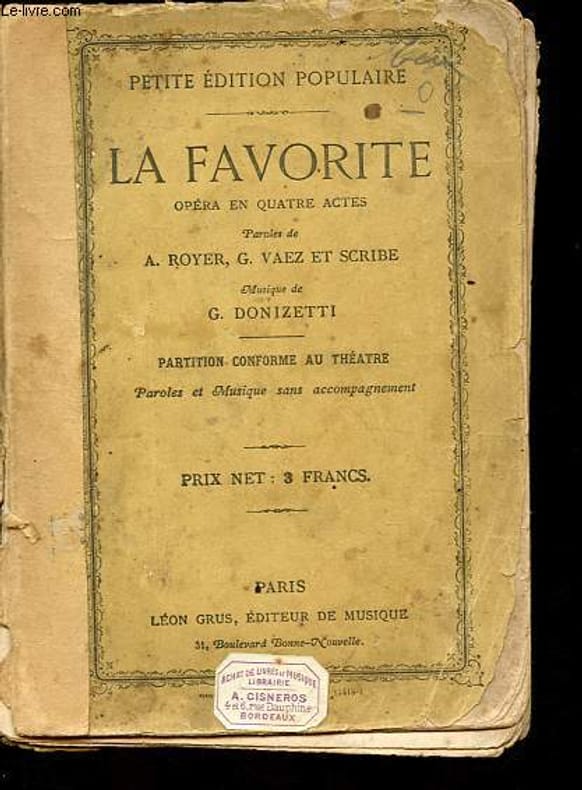
R200136959Léon Grus. non daté. In-8. Broché. A relier, Plats abîmés, Dos abîmé, Quelques rousseurs. 128 pages de phrases musicales - papier jauni, étiquette, pliures, taches et déchirures sur le 1er plat, 2e plat de substitution, renfort adhésif sur le dos, page de garde partiellement manquante, tampon sur la page de titre, annotations au crayon papier sur quelques pages ne génant pas la lecture, ouvrage partiellement désolidarisé.. . . . Classification Dewey : 782.1-Théâtre musical, opéra
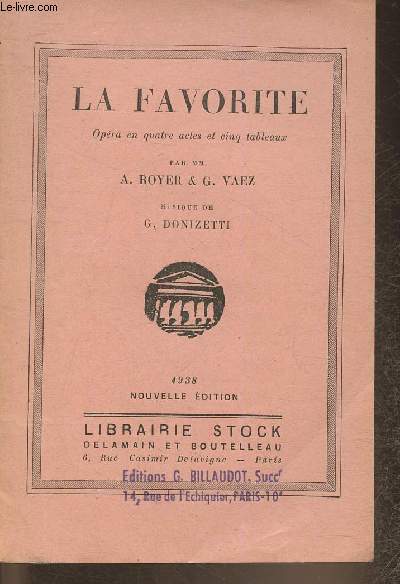
1938RO30339698Stock. 1938. In-12. Broché. Etat d'usage, Coins frottés, Dos satisfaisant, Papier jauni. 43 pages. Quelques rousseurs. Tampon en 1er plat.. . . . Classification Dewey : 782.1-Théâtre musical, opéra
RO30163408. NON DATE. In-12. Broché. Bon état, Couv. convenable, Dos satisfaisant, Intérieur frais. 1 disque audio 33 tours - pochette en bon état - une étiquette contre collée sur la face de la pochette. . . . Classification : 410-33 Tours
(Firenze), (1851), (Tip. Galletti), in-16, br. editoriale azzurra con elegante cornice tipografica e vignetta centrale alla copertina posteriore, pp. 31, (1). Fregio "musicale" inciso al frontespizio, in calce al quale è stato incollato un tassello di carta che occulta il nome del tipografo e su cui è stato impresso l'emblema (mulino) dell'Accademia degli Immobili. Elencati i nomi degli interpreti a pagina 3: nel ruolo di Maria Padilla (la cui 1a era stata 10 anni prima al Teatro della Scala) il soprano di coloritura Rosina Penco (Napoli 1823-1894); acclamata interprete verdiana (Il Trovatore, La Traviata, ecc.), alla Pergola riscosse ampio successo anche nella Sonnambula e come Desdemona nell'Otello di Rossini.
45172190like new. unknown
In-16° (17,4 x 10,5 cm), pp. 44, copertina editoriale con titoli entro cornice decorata. Qualche normale segno d'uso e del tempo alla copertina. Alla copertina anteriore, firma d'appartenenza e data scritte da mano coeva; vignetta al frontespizio. Qualche leggero segno d'umido alle pagine, per il resto ben conservato. La première dell'opera era andata in scena al Teatro di via della Pergola di Firenze il 17 marzo 1833. Musica del Maestro Gaetano Donizetti, scenografia curata da Domenico Menozzi, Baldassarre Cavallotti e Carlo Ferrari. Personaggi ed interpreti: Azzo, signor di Ferrara, Berardo Winter; Parisina, moglie di Azzo, Enrichetta Lalande; Ugo, che poi si scopre figlio d'Azzo, Francesco Pedrazzi; Ernesto, ministro d'Azzo, Luciano Mariani; Imelda, damigella di Parisina, Felicita Bayllou; Cori e comparse: Cortigiani, Cavalieri, Damigelle, Gondolieri, Armigeri e Soldati. La scena si svolge in parte nell'isola di Belvedere sul Po, in parte a Ferrara, nel XIV secolo. Musicisti. Maestro Direttore della Musica: Cesare Pugni; Al cembalo: Giacomo Panizza e Giovanni Bajetti; Primo Violino, Capo e Direttore d'Orchestra: Eugenio Cavallini; Altro primo Violino, in sostituzione al sig. Cavallini: Giovanni Cavinati; Capi dei secondi violini a vicenda: Giacomo Buccinelli e Giuseppe Rossi; Primo Violino per i Balli: Ferdinando Pontelibero; Altri primi Violini, in sostituzione al sig. Pontelibero: Francesco De Bayllou e Giuseppe De Bayllou; Primo Violoncello al Cembalo: Vincenzo Merighi; Altri primi Violoncelli in sostituzione al sig. Merighi: Giacomo Gallinotti e Pietro Storioni; Primo Contrabbasso al Cembalo: Francesco Hurth; Altro primo Contrabbasso in sostituzione al sig. Hurth: Fabiano Ronchetti; Prime Viole: Carlo Maino e Pietro Tassistro; Primi Clarinetti a perfetta vicenda: Ernesto Cavallini e Felice Corrado; Primi Oboe a perfetta vicenda: Carlo Yvon e Giovanni Daelli; Primi Flauti: per l'Opera, Giuseppe Raboni, pel Ballo, Filippo Marcora; Primo Fagotto: Antonio Cantù; Primo Corno da caccia: Agostino Belloli; Prima Tromba: Giuseppe Viganò. Arpa: Antonia Zanetti Sperati. Direttore del Coro: Giulio Cesare Granatelli; Istruttore del Coro: Filippo Luchini; Editore della Musica: Giovanni Ricordi; Vestiaristi proprietarj: Briani e Figlio, e Mondini; Direttore della sartoria: Giovanni Mondini; Capi sarti: Giacomo Colombo e Paolo Veronesi; Berrettonaro: Giosuè Paravicini; Sorvegliante alle ordinazioni del vestiario e guardarobiere dell'impresa: Ercole Bosisio; Attrezzista proprietario: Giuseppe Fornari; Macchinisti: Fratelli Abbiati; Parrucchiere, Innocente Bonacina; Capi illuminatori, Antonio Abbiati - Giuseppe Pozzi. Ballerini. Compositore de' Balli: Giovanni Galzerani; Primi Ballerini serj: Augusto Lefebvre, Francesco Delorge, Elisa Vaque Moulin, Paola Ancement, Amalia Braschi, Carolina Bonalumi; Primi Ballerini per le parti: Antonio Ramacini, Marietta Conti, Giuseppe Bocci, Tomaso Casati, Carolina Casati, Leopoldo Pagliaini,Teresa Aman; Primo ballerino per le parti giocose: Ippolito Philippe; Primi ballerini di mezzo carattere e per le parti: Giovanni Baranzoni, Carlo Della Croce, Eduardo Viganò, Antonio Caprotti, Antonio Rugali, Carlo Rugali, Francesco Villa, Antonio Rumolo, Bartolomeo Pincetti, Gaetano Croce, Fioravanti Boresi, Costantino Ravetta, Elia Bertuzzi, Rachele Cazzaniga, Giuseppina Rumolo, Luigia Rumolo, Silvia Angiolini, Carolina Ramacini, Eugenia Braschi; Imperiale Regia Scuola di Ballo. Maestri di Perfezionamento: Claudio Guillet e Anna Giuseppina Guillet; Maestro di Ballo: Carlo Villeneuve; Maestro di Mimica: Giuseppe Bocci; Allieve: Teresa Aman, Carolina Frassi, Luigia Sassi, Giuseppa Caffulli, Rosalia Molina, Elisabetta Monti, Teresa Merli, Carolina Conti, Adelaide Frassi, Angela Morlacchi, Teresa Morlacchi, Adelaide Volpini, Antonia Bussola, Luigia Bellini, Luigia Monti, Metilde Bertuzzi, Michelina De Vecchi, Marianna Cottica, Luigia Marzagora, Antonia Zucchinetti, Tamiri Angelini, Giuseppa Sala, Giuseppa De Vecchi, Augusta Domenichettis, Virginia Rizzi, Adelaide Pirovano. Signori: Aurelio Quattri, Solone Viganoni, Giovanni Battista Gramegna, Pasquale Borri, Domenico Senna, Paolo Meloni. Ballerini di Concerto: n° 12 Coppie. Giovanni Galzerani, celebre coreografo, nacque a Porto Longone nel 1790. In giovane età entrò nel Collegio Militare della Nunziatella, ove stette fino ai 17 anni. Alla morte del' padre, abbandonò gli studi militari, e si dedicò al ballo, frequentando la rinomata scuola della Dupré. Ebbe quindi inizio la sua carriera teatrale: eseguì i suoi balli a Milano, a Napoli, a Vienna, e in molti altri teatri italiani. Morì nel 1865. A giudizio dei critici il Galzerani è il coreografo che più si distinse nella prima metà dell'Ottocento per la fantasia e la creatività.
1541111257.Gpaperback. Good. Access codes and supplements are not guaranteed with used items. May be an ex-library book. paperback
1719877149.Gpaperback. Good. Access codes and supplements are not guaranteed with used items. May be an ex-library book. paperback
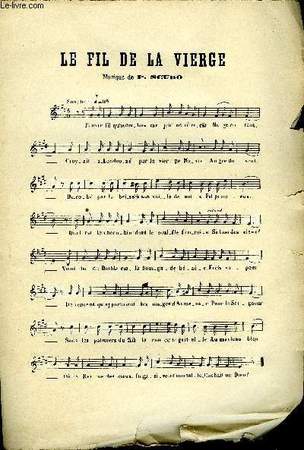
RO50034090Non Renseigné. Non daté. In-8. En feuillets. Etat d'usage, Livré sans Couverture, Dos satisfaisant, Déchirures. 4 pages de partitions. . . . Classification Dewey : 780.26-Partitions
1875456451London : Cramer Beale & Co. ; R. Cocks & Co. ; T. Boosey & Co. ; Chappell ; etc 1875. First Edition. Hardcover. Good copy only in contemporary half maroon leather over marble boards with surface loss to the marbled coverings on the bottom portion of both boards. Gilt-blocked titles and compartment decorations to spine with raised bands. Panel edges spine bands and joints somewhat rubbed. Marbled edges somewhat dust-dulled and faded. Binding starting to separate along the bottom in one location before the first composition ""Home Sweet Home Polka"" but holding at the top. Text otherwise tight throughout and clean with marginal dust-dulling only. An internally strong and very serviceable copy overall. Physical description; 1 volume in various paginations : music ; 35 cm. Notes; A bound collection of engraved sheet music for piano published in London c.1850-1875. Contains popular dances and operatic arrangements of the period including: Madame Oury's 'Home sweet home' polka with illustrated title page; Camille Schubert's quadrille 'Les joyeux enfants de Paris'; Rudolph Nordmann's piano duet arrangement of Donizetti's tyrolienne 'In questo semplice'; Adolph Marschan's 'Alpenlieder' waltz; Charles d'Albert's 'Faust' waltz for piano four-hands; and others. Subjects; Piano music - 19th century - Scores Dance music - England - 19th century - Scores Waltzes - Scores Polkas - Scores Quadrilles - Scores Operas - Excerpts Arranged - Scores Sheet music - England - London - 19th century. London : Cramer, Beale & Co. ; R. Cocks & Co. ; T. Boosey & Co. ; Chappell ; [etc] hardcover
Mm 200x275 Volume cartonato, legatura in mezza pelle rossa con cinque nervature, titoli in oro al dorso, piatti marmorizzati, piatti originali conservati, VI-357 pagine, numerose illustrazioni in bianco e nero entro e fuori il testo. Esemplare in buone condizioni. SPEDIZIONE IN 24 ORE DALLA CONFERMA DELL'ORDINE.
19691022351969 N° 186, Novembre 1969 - Petit In-4, broché, couverture et 4ème de couv. illustrées - Revue mensuelle illustrée - 64 p. - Sommaire en image
0469313862.Ghardcover. Good. Access codes and supplements are not guaranteed with used items. May be an ex-library book. hardcover
1918052375Pera - Constantinople: Imprimerie D'Andria 1918. 1st Edition . Soft cover. Very Good. Folio - over 12 - 15" tall. Paperback. Folio. 33 x24cm. In Ottoman script and French. 3 1 p. Ottoman stamped in period. The Ottoman Empire used anthems since its foundation in the late 13th century but did not use a specific imperial or national anthem until the 19th century. During the reign of Mahmud II when the military and imperial band were re-organized along Western lines Giuseppe Donizetti was invited to head the process. Donizetti Pasha as he was known in the Ottoman Empire composed the first Western-style imperial anthem the Mahmudiye Marsi. Like in many other monarchies of its time the anthem of the Ottoman Empire was an imperial anthem not a national one. Hence it paid homage to a specific ruler and a new anthem was composed at each imperial succession. However in 1844 with the Tanzimat reforms the Mecidiye Marsi was recognized as the first official Ottoman national anthem. The first official Ottoman national flag which was in essence identical to the present-day Turkish flag was also adopted in 1844. Giuseppe Donizetti was an Italian musician. From 1828 he was Instructor General of the Imperial Ottoman Music at the court of Sultan Mahmud II 1808-39. His younger brother was the famous opera composer Gaetano Donizetti. He studied music first with his uncle Carini Donizetti and later he was a pupil of Simone Mayr. After enlisting in Napoleon's army 1808 he served there as band leader. He took part in the campaigns against Austria and in Spain and followed Napoleon to Elba. He was present at the Battle of Waterloo. After the fall of Napoleon he continued his career as a bandmaster in the Savoy army. Giuseppe Donizetti Pasha as he was called in the Ottoman Empire played a significant role in the introduction of European music to the Ottoman military. Apart from overseeing the training of the European-style military bands of Mahmud's modern army he taught music at the palace to the members of the Ottoman royal family the princes and the ladies of the harem is believed to have composed the first national anthem of the Ottoman Empire supported the annual Italian opera season in Pera organised concerts and operatic performances at court and played host to a number of eminent virtuosi who visited Istanbul at the time such as Franz Liszt Parish Alvars and Leopold de Meyer. Although the elder Donizetti was born in Bergamo Italy Constantinople became a second home for him and he lived there until his death in 1856. He is buried in the vaults of the St. Esprit Cathedral near the Beyoglu district of Istanbul in Pera. Giovanni Avolio 1849-1936 was an Italian conductor and composer. According to the sheet musical paper this first anthem was composed in 1831 by Donizetti and arranged by Avolio into piano in 1918. J. D. Andria is one of the best known music publishers among the Ottoman Empire mionrities. According to he documents in hand it can be estimated that he began musical score publication in the year of 1904. Andria dealt with music publication at the address of Beyoglu Istiklal Street Near Agha Mosque at 68 no. Andria also published four pieces of Turkish marche parties for piano as far as we know; besides his big sized west music works which were published in general by him. Donizetti's 'Marche' is one of them as well besides Halit Recep Arman's Miilok's and Orente's ones. It is known when publishing life of Andria ended. Source: Musical publications from Ottoman Empire up today 1876-1986.; BÜLENT ALANER. <br/> <br/> Imprimerie D'Andria paperback
R320072386CERF LEOPOLD. NON DATE. In-4. Relié demi-cuir. Bon état, Couv. convenable, Dos satisfaisant, Intérieur frais. 95 + 127 + 111 + 85 pages de partition - Plats et contre-plats jaspés - Auteurs et filets dorés au dos - Coins émoussés - 3 PHOTOS DISPONIBLES. . . . Classification Dewey : 780.26-Partitions
1978R320076488BREITKOPF. 1978. In-4. Broché. Bon état, Couv. convenable, Dos satisfaisant, Intérieur frais. 144 pages de partition.. . . . Classification Dewey : 780.26-Partitions
R320096275PIANO REVUE. NON DATE. In-4. En feuillets. Bon état, Couv. convenable, Dos satisfaisant, Intérieur frais. Paginé de 159 à 160 - PARTITION.. . . . Classification Dewey : 780.26-Partitions
19988709Tübingen, Heliopolis-Verl., 1998. Neuausg., (3. Aufl.) 384 S. mit Ill. 21 x 14 cm, Leinen mit OSchU
Q-0793553830RICORDI. Paperback. New. New. In shrink wrap. Looks like an interesting title! RICORDI paperback
RO50016888Inconnue. XXème. In-8. En feuillets. Bon état, Livré sans Couverture, Dos satisfaisant, Intérieur frais. Non paginé. 4 pages environ.. . . . Classification Dewey : 780.26-Partitions
1986Q-0793553725G. Schirmer Inc 1986-11-01. Paperback. New. In shrink wrap. Looks like an interesting title! G. Schirmer, Inc paperback
Gaetano Donizetti si situa tra le figure di Rossini, Bellini e Verdi, formando con loro i quattro grandi del teatro musicale italiano dell'Ottocento. Il musicista bergamasco, uomo cordiale e sincero, star internazionale all'epoca, è autore di circa settanta melodrammi tra il serio e il comico. Alcuni come Lucia di Lammermoor, Elisir d'amore, Don Pasquale non sono mai usciti di repertorio. La "Donizetti Renaissance" ha svelato altri capolavori come Anna Bolena, Lucrezia Borgia, La Figlia del Reggimento, La Favorita, Maria Stuarda, Roberto Devereux e ne va recuperando altri nel Festival annuale nella città natale. Essi rivelano la peculiarità del romanticismo "umano" di Donizetti, l'ansia dello sperimentatore di nuove forme drammatiche, la qualità del sorriso bonario, la bellezza melodica del canto. Soprattutto, la comprensione profonda del cuore umano: Donizetti piange ride ama con tutti. Questo testo vuol essere un invito a scoprire un genio unico a cui molti, Verdi per primo, saranno debitori. Un uomo e un musicista dall'animo grande, comprensivo di ogni lato delle vicenda umana, lieta e triste, nella quale si lascia coinvolgere con autentica passione. Autori: Mario Dal Bello.
199353992Deutsche Grammophon, 1993. 435309-2 2 CD, Schuber, 180 S.; Abb. CD
1986Q-0793528623G. Schirmer Inc 1986-11-01. Paperback. New. New. In shrink wrap. Looks like an interesting title! G. Schirmer, Inc paperback