1 313 résultats
1986149439Budapest: ICPS 1986. 38p. 8x5.5 inch wraps booklet faintest signs of age or handling. ICPS H-1415 / Documents on the struggle against chemical weapons volume II. ICPS unknown books
140 pages. Short Stories: Hard-Luck Girl; The Words of Love; Dangerous Bluff; His Sister's Keeper. Articles: Why do they Hate us in Panama? - photo-illustrated article about anti-American riots; The Birds' Last Stand - 6,000 exotic birds may be evicted from their Stone Harbor, New Jersey haven; Pilots Aren't Obsolete Yet - the recently-cancelled B-70 Valkyrie bomber may be necessary for our survival; Los Angeles' Cure for Drunks - California desert rehabilitation farm; The Movies' Modern Marco Polo - Stanley Goldsmith is Twentieth Century Fox's chief trouble shooter for pictures filmed overseas; They Call Me Madam (part 2 of 4) - Washington's legendary hostess Perle Mesta; Fabulous Mine in the Sea - The Grand Isle Sulphur Mine in the Gulf of Mexico; Touring Russia Made Easy. Serials: If Hitler Had Invaded England (part 2 of 3); The Tewksbury Feud. Ads: Dogde Trucks (inside front cover); Employers Mutuals of Wausau - with photos of John M. Fox of the Minute Maid Corporation and company driver Eddie Mew plus Ed Waters; GE Appliances; Spring cigarettes; Fantastic two-page color-photo (red) Corvair ad features gents in black suits and hats checking out the car; Old Crow Whisky, with one-page color illustration of James Crow with his neighbors; Two-pages of the Ford Galaxie; Lowry organs; Quaker State Oil; The BMC 850 (Mini) (2 pages in color); Canadian Pacific Dome Cars (1 color page); Nice color photo ad for the (red) Chrysler Imperial in a horse-racing setting; Hotpoint fridges; Cadillac Guide-Matic; Scott Paper; ScottTowel multi-color towels; Schlitz beer - flying a kite; Kem-Tone and Kem-Glo Paint; Johnson V-75 outboard motor; Toro lawn and garden products; Admiral TVs; Cracker Barrel Cheese; Caterpillar; Smith-Corona typewriters; Hertz rental cars; Boeing 720; Samsonite luggge with Queen's guards in background; The Denver Hilton Hotel; Karpen furniture (very funky); Nabisco Veri-Thin Pretzels; American Seating Company; Lucky Strike cigarettes (back cover). Average wear. Unmarked. A sound vintage copy. Magazine
1980KOS01700644TBD 1980. Soft Cover. Fine. KOS01700644 TBD paperback
1945TAB0000042. 1945. In-12. Broché. Bon état, Couv. convenable, Dos satisfaisant, Intérieur frais. Huile sur toile. Dimensions : 60 x 74cm. Oeuvre datée et signée en bas à gauche. (P. Titeux de la Croix 45).. . . . Classification : 920.4-Huile
TAB0000003Non Renseigné. XXème siècle. In-12. Broché. Bon état, Couv. convenable, Dos satisfaisant, Intérieur frais. Huile sur toile. Dimensions : 65 x 81 cm. Oeuvre signée bas droite. Composition abstraite. Titre au dos de la toile : L'océan des pins.. . . . Classification : 920.4-Huile
352 pages. Index. Bibliography. Extensively illustrated in black and white. A sensational reference. Average wear. Unmarked. Chips from top of backstrip. A sound reference copy. Book
0266922937.Ghardcover. Good. Access codes and supplements are not guaranteed with used items. May be an ex-library book. hardcover
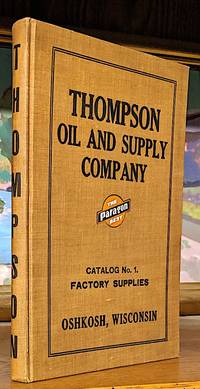
19009733Oshkosh Wisconsin 1900. Hardcover. Near fine. Tall 8vo. 229 pages many illustrations of various products. Black and white photo illustrations of the "Home of the Thompson Oil and Supply Co." and the "Thompson Oil and Supply Co's. Filling station. -- Binding slightly bowed. No other notable defects. hardcover
60 pages. Features: John Lennon cover photo; Winnipeg's Christmas Cheer Board; Gloomy view from Jim Gray of Canadian Hunter in Alberta's Oil Patch; Newspaper groups have become too large, too wealthy and too successful; Silo construction halts air travel to Chatham, Ontario's municipal airport - farmer Bob Walker does not agree to expropriation; Jeworski's general store near Regina does booming liquor business; UBC Professor Cyril Belshaw acquitted of murdering his wife; Jean Lesage - reluctant reformer; Poland marks time on a tightrope; El Salvador's Col. Adolfo Arnoldo Majano; Ballots and Bullets in Uganda; Ronald Reagan's new cabinet; Murder of Dr. Michael Halberstam by Bernard Welch; Oilmen keep up pressure on Ottawa's energy plan; The UTDC and its ALRT; Canada's prime interest rate hits 17%; The Legacy of John Lennon - photo-illlustrated article; Photo of figures skaters Baier and Eisler; Surgeons at Toronto General Hospital lose their viewing gallery in exchange for a new wing; Parapsychologists and the long road toward respectability; Pop Psychology is the newest gimmick on the AM Dial - with photo of Nadine Berger at work; Anne Murray in 'Save the Children' ad; Bruce Springsteen - photo-illustrated article; Book and movie reviews; and more. Neat 2"x1" clipping from bottom corner of front cover. Average wear. A sound vintage copy. Book
1927613j0194New Orleans: The Wesson Oil & Snowdrift People. Good. 1927. Reprint. Paperback. Features recipes using Snowdrift vegetable shortening. 45 pages. All recipes apportioned for six people. Appears to be a 1927 reprint. Clean and unmarked with light wear. A quality vintage copy.; 24mo . The Wesson Oil & Snowdrift People paperback
S15J-00840LaSalle Corporation Service. Used - Good. Good condition. 5 book set. Writing inside. Owner's name on front endpage. industry oil LaSalle Corporation Service unknown
1527877167.Gpaperback. Good. Access codes and supplements are not guaranteed with used items. May be an ex-library book. paperback
0265774659.Gpaperback. Good. Access codes and supplements are not guaranteed with used items. May be an ex-library book. paperback
No marks or inscriptions to contents. Bump/crease to lower corner of front covers and minor bump to top of spine. A very clean very tight copy with bright very faintly marked boards. 472pp. The history and main functions of the oil industry with special reference to The British Petroleum Company Ltd.
1962173982Rangoon Burma: The Burma Oil Co 1962 88 pages The cover has a bit of wear with a few small scuffs on the edges light tanning and fading. The page edges are lightly tanned and foxed. Books listed here are not stored at the shop. Please contact us if you want to pick up a book from Newtown. Paperback. Good. The Burma Oil Co paperback
19596408Northampton, Clarke and Sherwell / BP, o.J. [1959]. Leineneinband mit Schutzumschlag, Lex-8°, 158 S., mit zahlreichen Abbildungen; -Schutzumschlag mit einem Einriss, Einband gebräunt, sonst gutes Exemplar.
160 pages. Index. Contents include: Round Strand Ropes; Galvanized Wire Ropes and Strands; Flattened Strand Wire Ropes; Special Wire Ropes; Wire Rope Fittings and Slings; Ordering Wire Rope; Handing Wire Rope; Socketing Wire Rope; Splicing Wire Rope; Attaching Clips; Wire Rope Recommendations for Construction, Quarries, Gravel Pits, Elevators, General Industry, Logging, Mines, Oil and Gas, Ships. Prior owner's name and date in marker inside front board. Couple of drops of paint near base of spine. Binding tight. Average wear. A sound vintage copy. Book
19321450Various places mostly Texas Tennessee Kentucky and Virginia 1932. Overall good plus. Eighty-five typed and manuscript letters including thirty mimeographed copies of a form response. Moderate chipping and wear to a few letters most previously folded but otherwise in strong condition. A fascinating collection of correspondence relating to spurious Depression-era claims on the famed Beaumont estate of Pelham Humphries 1810-1835. In 1834 Humphries a colonist in the disputed lands along the US border with Mexico filed a claim for a league some 4428 acres of land to the west of the Neches River a few miles south of what is now Beaumont in Jefferson County Texas. The land a patchwork of swamp and grassland good only for grazing was deemed valueless until oil was discovered there in 1901 by which time it had become known as Spindletop and the area became the epicenter of the Texas oil boom. <br/><br/>No one made more money than William Perry Herring McFadden 1856-1935 a rancher who had bought Spindletop in 1883 but ownership of the land was in dispute when he made the purchase. Humphries had died in obscurity possibly killed in a gunfight or perhaps hanged for stealing horses and there was no clear transfer of title. The first suit over the Humphries Land Grant was filed in 1880. McFadden purchased the rights of both parties in the suit but later claimants argued that neither had had a legitimate interest. When geologists stuck oil hundreds of people discovered their fortunate genealogy as a story swiftly spread that the heirs to the Humphries estate were due a share in the profits from the great companies that extracted oil from Spindletop. Numerous lawsuits followed beginning shortly after the discovery and continuing through the 2010s some extending over decades and involving thousands of claimants.<br/><br/>After one such suit entitled Anderson v. Lucas was settled in 1906 the Humphries story appears to have been forgotten for several decades before it emerged again during the depths of the Great Depression. Humphries reportedly hailed originally from Tennessee and in October 1931 the Knoxville Journal reported that members of the Humphreys family were gathering in Madisonville Tennessee to discuss their options. In November another meeting was held in Knoxville drawing over 200 attendees. Responding to the growing number of inquiries sent to his office W. T. Blackmon the Jefferson County Clerk wrote to the Knoxville Journal to set the record straight - "the Humphreys have absolutely no chance of getting $40000000 worth of oil land" the Journal summarized. "And so far as he is concerned he had rather hear no more about it. . He informed the Journal that he had quit opening letters from the Tennessee Humphreys." But Blackmon's letter had no effect. The next day the paper ran a piece in which Oscar Humphrey a stringer for the Associated Press voiced his suspicion at the clerk's response and urged people to fight for their millions.<br/><br/>The documents present here constitute Blackmon's file of inquiries from various Humphries claimants and their representatives all dated 1931 to 1932. A defiant letter here from Oscar Humphrey encloses clippings from the Knoxville Journal and informs Blackmon that "You may rest assured that I am going to have these stories reproduced in other papers in several cities in Tennessee and Georgia." The bulk of the archive consists of over fifty letters containing requests and claims from eleven states including Tennessee Virginia Kentucky Louisiana and Texas as well as the District of Columbia suggest that Humphrey's threat was not an idle one. Some of the letters are a few typed lines and comprise simple requests for information while others are handwritten and run on for pages with elaborate descriptions of the supplicant's claims and genealogy. Also present are carbon copies of general Blackmon's response which he adapted as a mimeographed form letter as well as copies of two more personalized . To dissuade inquirers from further correspondence his form letter notes that a full abstract of the survey of claims to Spindletop would cost "about $2500.00." Additional material here suggests that this may have been side scam Blackmon had with Earl Singleton the proprietor of the Jefferson County Abstract Company. At any rate the fresh rounds of claims on Spindletop delineated here came to nothing and Blackmon gave up his duties as County Clerk and accepted a new position as tax assessor and collector for Jefferson County the pursuit of tax delinquents perhaps seeming a restful occupation by comparison.<br/><br/>An excellent collection of documents detailing one episode in the long saga concerning the rights to the Spindletop fortune. unknown books
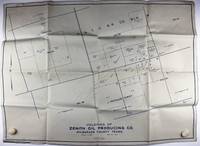
19291995Wichita Falls Tx: Montgomery & Ward 1929. Very good plus. Large blue line map approximately 22 x 29 inches. Folded. Very light tanning and a few small spots of soiling. Scattered contemporary pencil annotations. Unrecorded map showing the extent of mineral rights held in a section of Wilbarger County Texas by the Zenith Oil Producing Company and several competing interests. The county is located in North Texas on the border with Oklahoma west of the oil rich areas surrounding Wichita Falls and Burkburnett. Indeed the land here was mapped by a civil engineering firm from Wichita Falls Montgomery & Ward certainly not to be confused with the famed mail order and department store business. The Zenith Oil Producing Company for whom this map was created owned mineral rights in seven contiguous plots in the charted region but seems to have been active only for a short period of time at the end of the 1920s and solely in the area of Wichita Falls. We locate no other copies of the present map and only one other recorded example of a map by the Montgomery & Ward firm a 1931 plan of Wichita Falls. Montgomery & Ward unknown books
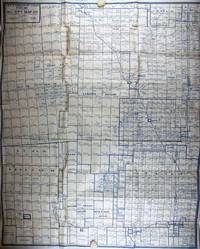
19301996Fort Worth: Oil City Map Co 1930. Very good. Large blue line map 34.25 x 27.5 inches. Folded. Scattered contemporary pencil annotations. Minor wear and a couple of short separations along fold lines. Small cut into neat line near upper right corner. Rare and detailed oil map of the oil fields in Shackelford and Callahan Counties just east of Abilene Texas. The map indicates the locations of well being drilled those producing gas wells dry holes and abandoned wells. The owners of the mineral rights are named and well as many of the surface owners which include various railroads and also the Lunatic Asylum. Deaf & Dumb Asylum Bayland Orphan Asylum and other institutions. A large number of the producing wells both oil and gas were owned by Texas Company Texaco the Magnolia Petroleum Co. but many major and small oil companies had obtained mineral rights on lands in the area when this map was produced. The area around the town of Moran as indicated by the number of wells in the vicinity was one of the major sites of oil production in Texas during the 1920s and was indicative of the spread of the oil business to the western and southern portions of the state during that decade. The publishers of this map the Oil City Map Company of Fort Worth were not particularly prolific -- we locate six examples of their other cartographic work all recorded in single institutional copies and no copies of the present map. Oil City Map Co unknown books
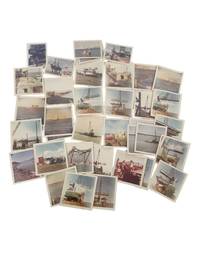
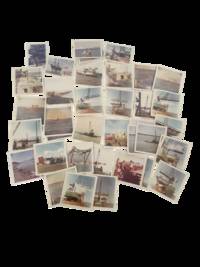
1970233331970. Texas and Kansas petroleum infrastructure photo archive 1970s and 1984 documenting the industrial system that linked Gulf Coast fabrication yards port facilities heavy marine transport offshore petroleum extraction and inland drilling in the mature oil fields of Kansas. The photographs show offshore structures moving from shore side assembly into open water service and a separate 1984 Kansas sequence inscribed "Lee's oil well" where a land based drilling rig trucks workers and rig floor equipment record oil production away from the coast. The archive places petroleum extraction within both the Gulf Coast industrial corridor that built and deployed offshore structures and the inland lease field where drilling remained dependent on mobile rigs pipe handling and small crews. Its value lies in that shift of scale from Galveston waterfront engineering and offshore installation to the working machinery of a Kansas well in the early 1980s.<br /> <br /> Photo archive of 42 chromogenic color photographs 3.5 x 5 inches Galveston Texas circa 1970s and Kansas 1984. The photographs center first on large offshore structures at several stages of completion and deployment including jack up rigs elevated decks cranes and a prominent circular helipad or radar platform mounted above the main deck. Several views show rigs still at dockside beside harbor pavement parked vehicles and industrial lifting equipment; others place the same or similar structures offshore standing above open water on extended legs or surrounded by service craft. One photograph includes a banner reading "Galveston Project Post USA" anchoring part of the sequence to a named project site while another frames the Galveston waterfront with dense ranks of harbor cranes and marine industrial equipment. Additional images show smaller fixed platforms a long yellow boom or gangway extending over water crane barges maneuvering beside offshore structures and a wider sea view with multiple platforms operating at once establishing repeated movement between fabrication yard port transfer and offshore installation. Six later Kansas photographs show "Lee's oil well" in 1984 including a land drilling rig in open field country truck mounted support equipment a lowered mast or rig component being moved into position workers on the rig floor handling chain and pipe a standing derrick and close views of the drill string hoisting line block and metal rig fittings.<br /> <br /> By the mid 1960s offshore oil had become central to both the U.S. energy economy and Texas coastal industry. Gulf Coast yards built and serviced the jackets pipe vessels and equipment that allowed companies to move farther offshore and later federal studies described fabrication yards as a core part of the offshore system that linked land based labor to offshore production. Texas held a special place in that expansion because its ports yards engineering firms and petroleum capital helped turn the Gulf into a permanent industrial frontier. Kansas had a different petroleum history beginning with commercial production in the 1890s and continuing through thousands of smaller lease fields where independent operators and mobile drilling crews extended the life of older oil districts. The 1984 "Lee's oil well" photographs add that inland production economy to the Galveston material showing how petroleum infrastructure depended not only on large coastal fabrication and marine transport but also on field rigs pipe work trucks and crew labor at individual wells. Light surface wear mild fading and minor edge wear; overall very good condition. A concentrated visual record of how American petroleum production moved between Gulf Coast offshore construction marine installation and inland drilling work in late twentieth century Texas and Kansas. unknown
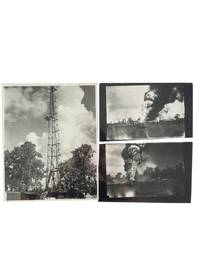
1952217461952. Oil Extraction and Oil Well Fires in South Texas. Three silver gelatin black-and-white photographic prints including one gelatin silver press photo 8 x 10 in. and two photo prints from negatives 5 x 7 in. Dated 1952 and 1954. Content includes an image of a wildcat rig in Lavaca County Texas and dramatic scenes of oil well fires. All photos with extensive manuscript notations on verso including references to press filing. This small but gripping photo archive documents the volatility and danger of oil drilling operations in mid-century South Texas including one catastrophic blowout and fire. The 8 x 10 inch silver gelatin press photograph dated June 1954 and stamped "RETURN TO CHRONICLE FILES" shows a towering oil derrick rising above dense trees. The reverse identifies the location as Lavaca County and describes a wildcat operation in Hallettsville Texas where drilling reached 8000 feet. A hand-written note reads "Field Drilling Co. Ext. Exterior - cementing protective casing 10240 down to 8000 ft - Lavaca County 2 1/2 mi. N. Hallettsville."<br /> <br /> The two smaller prints-captioned in manuscript as "Oil Well Fires"-capture the momentous force of an uncontrolled eruption. One image shows a roiling column of black smoke and flame rising from a well site surrounded by distant silhouettes of onlookers. Another more closely framed emphasizes the explosive power as the plume expands over nearby treetops. A note on the verso dates one of these prints to October 1952 stating it is a "Print from Studio of late Cecil Thomson." Cecil Thomson 1881-1953 was a prolific Houston-based commercial photographer and photojournalist who operated Thomson Studio a major supplier of images to regional newspapers including the Houston Post and Houston Chronicle. His studio active from 1909 until his death in 1963 continued producing prints posthumously from its extensive negative archive making it likely these fire images were developed and distributed under the studio's imprint even if not taken by Thomson personally.<br /> <br /> All three photos are from the Houston Chronicle archives with two stamped or inscribed "Return to Chronicle Morgue." One image includes the notation "Sunday Oil - Lavaca County Wildcat." These images preserve both the ambition and peril of mid-century oil operations in Texas a period when wildcat drilling fueled economic speculation and technological innovation often with great human and environmental risk. Surface creases and light wear to edges; verso of each image shows editorial markings and annotations in grease pencil and ink. Overall very good condition. A vivid visual record of the oil industry's volatility in 1950s Texas with provenance from the Houston Chronicle press files. unknown
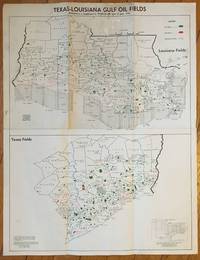
195096Houston 1950. Very good. Map 22 x 17 inches. Folded. Light wear and soiling. Map of the Louisiana and southern Texas oil fields along the Gulf of Mexico. Each county is outlined with oil fields noted in green and gas fields noted in red. unknown books
1965233141965. Offshore oil construction photographs documenting platform fabrication barge work marine transport and field logistics tied to the Gulf Coast petroleum industry in 1965-66 with direct evidence of how offshore drilling depended on a broad labor system before a rig ever reached a producing field. Taken at Farmers Marine Copper Works in Galveston Texas the archive records the building and handling of steel jackets deck sections cranes work barges service vessels and crew activity that made offshore extraction possible. The Gulf of Mexico was the proving ground of the modern offshore petroleum industry as the region became the incubator for an industry later exported worldwide.<br /> <br /> Photo archive of 53 color photographs 3.5" x 3.5" Galveston Texas 1965-66. The photographs show offshore structures in multiple stages of assembly and movement rather than a single completed drilling scene. Repeated views include steel platform legs and jacket sections standing in the water beside cranes and barges; large deck modules being hoisted or aligned over pilings; work decks with hoses railings and moored service boats; crewmen gathered onshore and aboard vessels; and small aircraft and automobiles used in project access and inspection. Several images show major marine lifts in progress with cranes extending over partially assembled structures and barges positioned tight against the work. Others widen out to open water towing scenes or partially completed platforms against distant mountainous terrain indicating that some photographs may record project deployment or field work beyond Galveston even if no specific destination is identified on the objects themselves. Handwriting on one verso of a group of men identifies "McClure / Chas. Young / Smithy."<br /> <br /> By the mid 1960s offshore oil had become central to both the U.S. energy economy and Texas coastal industry. Gulf Coast yards built and serviced the jackets pipe vessels and equipment that allowed companies to move farther offshore and later federal studies described fabrication yards as a core part of the offshore system that linked land based labor to offshore production. Texas held a special place in that expansion because its ports yards engineering firms and petroleum capital helped turn the Gulf into a permanent industrial frontier. Light handling wear and most exhibit curling; images generally clean and well preserved. Overall good condition. A strong documentary record of offshore construction labor at the moment when Texas Gulf Coast yards were helping scale the offshore oil industry from regional enterprise to national system. unknown
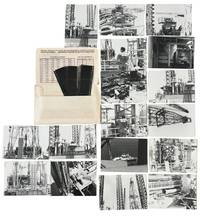
1970233351970. Offshore oil rig construction photographs of marine industrial labor and heavy equipment operations at the Port of Galveston Texas undated showing how Gulf Coast petroleum infrastructure was assembled through coordinated crane work deck staging and vessel support. Made by an unidentified worker contractor or site observer with direct access to the platform and adjoining work areas the group records the operational system behind offshore petroleum expansion rather than only the finished structure: derrick components rising between lattice boom cranes machinery positioned on crowded deck surfaces workers monitoring equipment from railings and platforms and service craft moving below the job site. Within the history of Gulf Coast oil and gas development these images preserve the waterfront and offshore construction process through which drilling and extraction infrastructure entered service in one of the chief locations which allowed Texas entry into national and international trade.<br /> <br /> <br /> Photo archive of 17 silver gelatin snapshot photographs each about 3.5" x 5" also includes 18 negative images 35 mm Port of Galveston Texas circa 1960s-1970s. The prints concentrate on a single marine construction environment with repeated views of tall lattice cranes a derrick or drilling tower under assembly steel framework catwalks railings deck mounted machinery and industrial piping. Several photographs move between wide and close vantage points: one looks down onto a work deck strewn with cables drums tools and structural members; another isolates a crane boom overhead; others frame the rig against open water with a small service boat alongside. Two views show a worker in coveralls standing at the railing and looking across the site; in one image the patch on his back reads "Farmers Marine Copper Works Inc. Petro Chemical Marine Galveston Texas" directly tying the group to a named Galveston industrial contractor. Another figure in light clothing appears deeper in the structure. Interior or semi enclosed machinery views include a hopper shaped component rollers and processing equipment. The accompanying negative strips are marked and the original photo processing envelope survives with printed instructions preserving the group's original commercial processing context.<br /> <br /> <br /> Galveston's port facilities formed part of the larger Gulf Coast industrial network that supported offshore petroleum construction marine transport and heavy fabrication across the twentieth century and this group fixes that system at deck level through workers machinery staging practices and support traffic in the water below. Light wear curling and handling to prints and negatives; processing envelope creased and worn. A concise visual record of offshore oil infrastructure under construction with strong research value for petroleum history labor history and Gulf Coast industrial development showing Galveston as a site where harbor industry and offshore oil support work converged making the port a key setting for mid twentieth century energy expansion.<br /> l. unknown