503 résultats
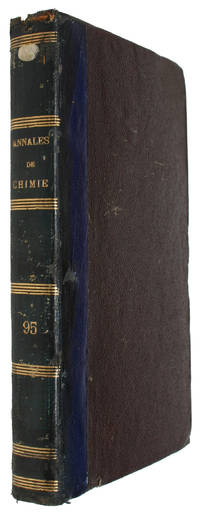
181543079Paris Chez Crochard 1815 Contemp. hcalf. Spine gilt. Top of spine with wear. A few scratches to binding. In: "Annales de Chimie ou Recueil de Mémoires concernant la Chemie" Tome 95. - 336 pp. the entire volume offered. Gay-Lussac's paper: pp. 136-231. Some scattered brownspots throughout. <br/><br/><em>First appearance of this milestone paper in organic chemistry in which Gay-Lussac describes the preparation the chemical reactions and the determination of the physical properties of prussic acid."One of the most importent contributions of Gay-Lussac was his work on hydro-cyanid acid and its compounds. In the course of his investigations on the combining volumes of gases he had prepared gaseous hydrogen cyanide. This led him to the study of related compounds and in 1815 he published a paper "Recherches sur l'acide prussique" the paper offered wherein he announced the discovery of cyanogen and chlor-cyanogen and the composition of hydrocyanic acid. His demonstartion that hydrogen cyanide contains no oxygen added another oxygen-free acid to those already known hydrogen halides and sulfide and contributed to the overthrow of Lavoisier's oxygen theory of acids. Gay-Lussac found that the cyano radicalthe first orgianic radical clearly recognized could act as an element analogous to chlorine passing unchanged through various reactions. This concept of an organic radical was importent to organic chemistry."Leicester & Klickstein "A Source Book of Chemistry" p. 293. - Partington IV p.85 a. p. 253. - Roy G. Neville p. 505. - Parkinson "Breakthroughs" 1815 C. </em> unknown
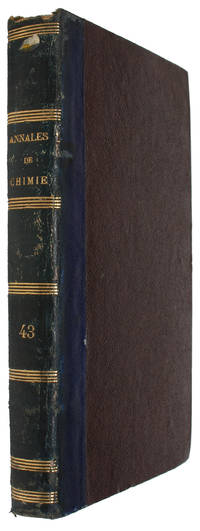
180243078Paris Chez Fuchs An X 1802. Contemp. hcalf. Spine gilt. Top of spine with wear. A few scratches to binding. In: "Annales de Chimie ou Recueil de Mémoires concernant la Chemie" Tome 43. 3324 pp. 2 engraved plates the entire volume offered. Gay-Lussac's paper: pp. 137-175. The first 20 leaves a bit brownspotted otherwise with a few marginal brownspots. 1 leaf pp. 197-98 torn with loss of some letters. Gay-Lussac's paper fine and clean. <br/><br/><em>First printing of this extremely important discovery in which Gay-Lussac first formulated the law Gay-Lussac's Law stating that if the mass and pressure of a gas are held constant then gas volume increases linearly as the temperature rises. This is sometimes written as V = k T where k is a constant dependent on the type mass and pressure of the gas and T is temperature on an absolute scale. In terms of the ideal gas law k = n R / P."In 1802 he Gay-Lussac showed that different gases all expanded by equal amounts with rise in temperature. Charles had made the same discovery some years earlier but had not published it; the credit therefore belongs to Gay-Lussac at least as much and probably more. This was an extremely importent discovery which Avogadro was to use within the decade to formulate hid long-neglected hypothesis that equal volumes of different gases at equal temperatures contained equal numbers of particles."Asimov.Magie "A Source Book in Physics" p.165-172 - Leicester & Klickstein "A Source Book of Chemistry" p. 374-379. - Parkinson "Breakthroughs" 1802 C.The volume contains other importent papers in chemistry by Humphrey Davy first French translation of his announcement of the finding of "Laughing Gas" Nitrous Oxide Parmentier Vauquelin Clement et Desormes Thenard Guyton Chenivix </em> unknown
1824EBS100401Annales de Chimie et de Physique 1824. 1st Edition. Hardcover. Very Good/No Jacket. VOLUME WITH FIRST PAPER TO DISCUSS GLOBAL WARNING AND FIRST PAPER TO IDENTIFY ISOMERISM. This volume contains "the first paper on global warming" by Fourier pp. 136-167 Fourier didn't yet know what molecular mechanisms were trapping the heat. But in this 1824 paper he surmised that over a long period of time the amount of heat held in by the atmosphere could change altered by both the Earth's natural evolution and human activity. "Wöhler's analysis of cyanates appeared in 1824 the paper offered shortly after Liebig's analysis of fulminates. Gay-Lussac then editor of the 'Annales de Chimie' noted that the analysis of cyanic and fulminic acid were identical - the first case of isomerism. This incident brought Wöhler and Liebig together and there followed many years of collaboration in which the two studied the chemistry of benzaldehyde and numerous other compounds." Klickstein "A Source in Chemistry." p. 309. 8vo 448 pp one folding plate at end; ¼ cont. leather over green marbled boards black spine labels label of bookseller. FULL VOLUME OF JOURNAL RATHER THAN EXTRACTED PAPERS. Overall VG. From Arthur C. Greenberg History of Chemistry Collection. Annales de Chimie et de Physique hardcover
180243078Paris, Chez Fuchs, An X, (1802). Contemp. hcalf. Spine gilt. Top of spine with wear. A few scratches to binding. In: ""Annales de Chimie, ou Recueil de Mémoires concernant la Chemie"" Tome 43. 332,(4) pp., 2 engraved plates (the entire volume offered). Gay-Lussac's paper: pp. 137-175. The first 20 leaves a bit brownspotted, otherwise with a few marginal brownspots. 1 leaf (pp. 197-98) torn with loss of some letters. Gay-Lussac's paper fine and clean.
181469738Paris, Chez M. Desmarais, 1814-1835, in-8, [4]-XVIII-[2]-396 pp. ; diverses pièces imprimées et manuscrites, paginées à l'encre 397 à 666. ; 7 pl. dépl. et rehaussées à la main, dont 3 dessinées à la plume, demi-veau tabac, dos lisse, Ex-dono manuscrit, non signé, de Laurent Chaudet : "Offert à l'auteur à M. E. Onfraye", au titre de la première pièce. A la suite de L'art de l'essayeur, diverses pièces ont été numérotées à l'encre 397 à 666 pp. : de 397 à 546 figurent des pièces imprimées ; les pages 547 à 595 sont manuscrites, 596-642 vierges, 643-657 imprimées, et 659-666 manuscrites. Ces pièces, extraites de recueils, touchent à la certification des métaux et aux travaux du Laboratoire des essais de monnaie. Ces documents sont particulièrement intéressants pour l'histoire des techniques proto-industrielles, à la croisée des chemins avec la science académique. Le compilateur et transcripteur, anonyme, y a fait figurer des mémoires de Chaudet, d'Arcet, Gay-Lussac et Puymartin, reliés dans l'ordre suivant : - CHAUDET, Mémoire contenant quelques expériences sur l'emploi du bismuth dans la détermination du titre des matières d'or et d'argent. Tirage à part, extrait des Annales de chimie et de physique. 24 pp. - CHAUDET, Mémoire sur quelques expériences tendantes [sic] à déterminer, par la coupellation et le départ seulement, le titre exact d'un lingot contenant de l'or, du platine, de l'argent et du cuivre. 24 pp. (Tirage à part, extrait des Annales de chimie et de physique, t. II, 1816.) - CHAUDET, Note contenant quelques expériences relatives à l'action de l'acide hydrochlorique sur les alliages d'étain et d'antimoine. 11 pages. (Tirage à part, extrait des Annales de chimie et de physique, t. III, 1816.) - CHAUDET, Note sur la fabrication des médailles coulées. 12 pages. (Tirage à part, extrait des Annales de chimie et de physique, t. VI, 1817.) - PUYMARTIN, Mémoire sur les procédés les plus convenables pour remplacer le cuivre par le bronze dans la fabrication des médailles. Paris, A. Égron, 1823. 58 pages. - [MANUSCRIT] D'ARCET, Mémoire sur la détermination des quantités de plomb nécessaires pour passer à la coupelle les essais d'argent à différens titres. (Retranscrit à partir des Annales de chimie et de physique, t. I, 1816.) - [MANUSCRIT] D'ARCET, Note sur les alliages de platine et d'argent, et sur l'application que l'on peut faire de ce procédé à l'exploitation des mines d'argent contenant du platine. (Retranscrit à partir des Annales de chimie, ou recueil de mémoires concernant la chimie et les arts qui en dépendent, t. 89, 1814). - [MANUSCRIT] CHAUDET, Note sur l'essai d'or fin (or à 1000 millième). (Retranscrit à partir des Annales de chimie et de physique, t. IV, 1817.) - [MANUSCRIT] GAY-LUSSAC, Observation sur l'essai des matières d'argent par la voie humide. (Retranscrit à partir des Annales de Chimie et de Physique, tome LVIII, 1835.) - CHAUDET, Description du laboratoire des essais des monnaies. (Tirage à part, extrait des Annales de l'Industrie française et étrangère, Août 1830.) Ex-libris Henri Vieillard et cachet annulé de la bibliothèque catholique de Paris. Étiquette en pied du dos. Charnières frottées, rousseurs. Couverture rigide
2313P., Deterville, 1811, 2 volumes in 8 reliés en pleine basane, toutes tranches dorées, fers dorés sur les plats (reliures de l'époque), (plats épidermés et frottés avec petits manques de peau en bordure du premier plat au tome 2), T.1 : 15pp., 405pp., T.2 : (2), 443pp., (1pp.), 6 planches dépliantes numérotées 1 à 6
181543079Paris, Chez Crochard, 1815 Contemp. hcalf. Spine gilt. Top of spine with wear. A few scratches to binding. In: ""Annales de Chimie, ou Recueil de Mémoires concernant la Chemie"" Tome 95. - 336 pp. (the entire volume offered). Gay-Lussac's paper: pp. 136-231. Some scattered brownspots throughout.
181119869Paris, Deterville, 1811. In-8 de [4]-443 pages, demi-basane brune, dos lisse orné de filets dorés, pièces de titre et tomaison verte.
a107346aParis 1829 first edition. Crochard. Original binder's blue wraps with mounted manuscript paper spine label. Octavo. 448p. in volume. Gay-Lussac article on Les Poudres Fulminant on pp. 2-25. Several other important articles in same volume on other topics by : Poisson Robiquet Hennell Marianini Berzelius many others. In French. Some occasional light foxing throughout . Good no owner marks. . paperback
182159787Paris Crochard 1821. No wrappers as extracted. In: "Annales de Chimie et de Physique Par MM. Gay-Lussac et Arago." tome 16 Cahier 4. Pp. 389-427. <br/><br/><em>First printing of the official raport on captain Freycinet's voyage. He sailed from Toulon on 17 September 1817 in L'Uranie with his wife Rose who secreted herself aboard and who wrote a separate account of the voyage. After refreshing at the Cape of Good Hope and Mauritius he landed at Shark Bay on 12 September 1818 where he set up an observatory thoroughly surveyed the inlets and the coastal districts and removed the plate left by Willem de Vlamingh which he had found and re-erected in 1801. He then sailed north to Timor. His accounts and description of the landscape and life and customs of that and other islands in the East Indies captivated the attention of people in Europe much more than his Australian reports and a widespread interest developed in the expedition. Leaving Timor on 27 November he sailed via the Moluccas the Carolines the Marianas and the Sandwich Islands and reached Port Jackson on 19 November 1819 the scientists on board adding constantly to their store of information on hydrography botany cartography and anthropology. After spending Christmas ashore they sailed on 26 December and falling in with the westerlies set a course for Cape Horn.On 13 February 1820 L'Uranie was wrecked on the Falkland Islands; the scientific records and notes were saved before the vessel foundered but 2500 of the 4175 plant specimens were lost. Freycinet returned to France in November 1820 and died on 18 August 1842. </em> unknown
182144122Paris Crochard 1821. No wrappers. In: "Annales de Chimie et de Physique Par MM. Gay-Lussac et Arago." tome 16 Cahier 4. Pp. 337-445. The entire issue offered. Rapport: pp. 389-427. <br/><br/><em>First printing of the official raport on captain Freycinet's voyage. He sailed from Toulon on 17 September 1817 in L'Uranie with his wife Rose who secreted herself aboard and who wrote a separate account of the voyage. After refreshing at the Cape of Good Hope and Mauritius he landed at Shark Bay on 12 September 1818 where he set up an observatory thoroughly surveyed the inlets and the coastal districts and removed the plate left by Willem de Vlamingh which he had found and re-erected in 1801. He then sailed north to Timor. His accounts and description of the landscape and life and customs of that and other islands in the East Indies captivated the attention of people in Europe much more than his Australian reports and a widespread interest developed in the expedition. Leaving Timor on 27 November he sailed via the Moluccas the Carolines the Marianas and the Sandwich Islands and reached Port Jackson on 19 November 1819 the scientists on board adding constantly to their store of information on hydrography botany cartography and anthropology. After spending Christmas ashore they sailed on 26 December and falling in with the westerlies set a course for Cape Horn.On 13 February 1820 L'Uranie was wrecked on the Falkland Islands; the scientific records and notes were saved before the vessel foundered but 2500 of the 4175 plant specimens were lost. Freycinet returned to France in November 1820 and died on 18 August 1842. </em> unknown
182144122(Paris, Crochard, 1821). No wrappers. In: ""Annales de Chimie et de Physique, Par MM. Gay-Lussac et Arago."", tome 16, Cahier 4. Pp. 337-445. (The entire issue offered). Rapport: pp. 389-427.
182159787(Paris, Crochard, 1821). No wrappers, as extracted. In: ""Annales de Chimie et de Physique, Par MM. Gay-Lussac et Arago."", tome 16, Cahier 4. Pp. 389-427.
ORD-4351Séance du 19 juin 1846 de la Chambre des Pairs. In-8 (144 x 224mm) broché, sans couverture, 41 pages. Bon exemplaire, exempt de rousseurs, non rogné.
ORD-4352Séance du 2 août 1847 de la Chambre des Pairs. In-8 (ca 144 x 222mm) broché, sans couverture, 34 pages. Bords de feuilles plissés, rousseurs marginales, non rogné. Assez bon exemplaire. Cachet de la bibliothèque du comte Adrien de Gasparin.
11120(à la fin : Paris, Imprimerie Royale, 1830).
1830G88206Paris, Imprimerie Royale 1830 vii + 80pp.+ 1 planche hors-texte (avec 4 figures), Edition originale, 26cm., sans couv. (comme paru), texte frais et sans rousseurs, bon état, rare, G88206
GF22644Photographie format 40 x 30 cm - beau tirage plastique noir et blanc - années 1980 pour l'émission "Apostrophes"-
GF9750Lithographie P. Degobert - format 25,5 x 16,5 cm marges comprises - Bruxelles - Méline -1848 - Extraite de la "Galerie des Contemporains illustres, par un homme de rien" (Mr de Loménie)-
181046377Paris J. Klostermann 1810. Contemp. hcalf. Spine gilt. Slightly rubbed. A few scratches to binding. Small stamps on verso of titlepage.In: "Annales de Chimie ou Recueil de Mémoires concernant la Chemie" Tome 75. 336 pp. a. 2 folded engraved plates. Some scattered brownspots. The papers: pp. 27-77 129-175 256-263 264-273 274-289 a. 290-316. <br/><br/><em>First French version of Davy's "The Bakerian Lecture for 1809. On some new Electrochemical Researches on various Objects particularly the metallic Bodies from the Alkalies and Earth and on some Combinations of Hydrogene. Read November 16 1809." together with the controversy papers by Davy and Gay-Lussac & Thenard."Mr. Davy having from the commencement of his electro-chemical researches communicated the several steps of his progress to the Society The Royal Society takes the present opportunity of reporting the results of his further inquiries under four principal heads. First on the nature of the metals of the fixed alkalis. Second on the nature of Hydrogen and composition of ammonia. Thirdly on the metals of the earth; and Fourthly he makes a comparison between the antiphlogistic doctrine and a modified phlogistic hypothesis."Abstract. He further gives arguments for considering potassium and sodium which he discovered in 1808 as a element.""Gay-Lussac had a slight rivalry between himself and the creation scientist Sir Humphry Davy. Davy was chemically preparing Potassium and Sodium through an electrical current and this made Gay-Lussac and Thénard envious of his success. They too decided to perform the same task but they had no battery at their disposal as Davy had so they had to form another way to chemically prepare the two elements. In 1808 they used a red-hot iron fused to potash the water-soluble form of a manufactured salt containing potassium to perform this task a method that Davy admitted had its advantageous qualities. Gay-Lussac and Thénard were successful in preparing Potassium and continued to make a full analysis of its chemical properties and began to use it for their own experiments. In 1809 Davy performed the same task using it to reduce Boron in Boracic acid." </em> unknown
183545505Paris Chez Crochard 1835. Without wrappers. In: "Annales de Chimie ou Recueil de Mémoires concernant la Chemie" Ser. II Tome 60 Cahier 2. Pp. 225-331. Entire issue offered. Gay-Lussac's paper: pp. 225-261 and 1 folded engraved plate. - <br/><br/><em>First printing. In 1824 Gay-Lussac extended earlier methods for the estimation of hypochlorite or chlorinated lime solution using indigo solution. He later improved on the method in the paper offered.by the use of standard solutions of certain reducing agents: arsenious oxide mercurous nitrate and potassium ferrocyanide and describing the apparatus depicted on the plate. </em> unknown
181046377Paris, J. Klostermann, 1810. Contemp. hcalf. Spine gilt. Slightly rubbed. A few scratches to binding. Small stamps on verso of titlepage.In: ""Annales de Chimie, ou Recueil de Mémoires concernant la Chemie"" Tome 75. 336 pp. a. 2 folded engraved plates. Some scattered brownspots. The papers: pp. 27-77, 129-175, 256-263, 264-273, 274-289 a. 290-316.
183545505(Paris, Chez Crochard, 1835). Without wrappers. In: ""Annales de Chimie, ou Recueil de Mémoires concernant la Chemie"" Ser. II, Tome 60, Cahier 2. Pp. 225-331. (Entire issue offered). Gay-Lussac's paper: pp. 225-261 and 1 folded engraved plate. -
26534Paris E.J. Bailly, Place Sorbonne n°2 in-8 cart. mod., cachet
181525774(Paris), de l'Imprimerie de Feugueray, s.d. [circa 1815]. 1 plaquette au format in-8 (213 x 132 mm) de 8 pp., cousu, sous couverture d'attente de l'époque de plein papier bleuté.