503 résultats
18181302957Nürnberg, Schrag, 1818. S. 258 - 368, 2 Bl. OBroschur (Umschl. etwas fleckig u. m. kl. Randläsuren, leicht gebräunt, unaufgeschnitten).
1021832944.Gpaperback. Good. Access codes and supplements are not guaranteed with used items. May be an ex-library book. paperback
1020141778.Ghardcover. Good. Access codes and supplements are not guaranteed with used items. May be an ex-library book. hardcover
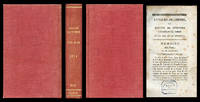
1814753Paris: Chez Crochard 1814. 1st Edition. FIRST EDITION FIRST PRINTING OF GAY-LUSSAC'S CLASSIC PAPER ON IODINE. Two volumes bound as one. The Dictionary of Scientific Biography notes this as one of Gay-Lussac's most important papers DSB Noted in DSB 5 327. In the late nineteenth century the chemist Wilhelm Ostwald winner of the 1909 Nobel Prize selected Gay-Lussac's paper as "one of the first and one of the best monographs of all time on a single element and its most important compounds and as such it has served as a model for many later pieces of research" Crosland Gay-Lussac: Scientist and Bourgeois 85. <br /> <br /> Louis Joseph Gay-Lussac 1778-1850 was a French chemist and physicist with a well-known rivalry with Humphry Davy. While J. C. Courtois discovered iodine in 1811— and while he recognized iodine to be a distinctive substance from its purple vapor — he confused its compound with hydrogen as that of hydrogen chloride. Gay-Lussac and Davy were asked to further explore the issue however they carried out their research virtually simultaneously making it somewhat difficult to assign priority. Davy's claim for the originality of his study of iodine depends upon his argument of knowledge prior to that of Gay-Lussac. While the publication history is confusing history credits Gay-Lussac DSB Vol. 5 p. 322. <br /> <br /> "In 1814 Davy did some further research on iodine but. in prolonged and detailed research he was outshone by Gay-Lussac who presented a full study of the new element in a major memoir read to the Institute on 1 August 1814" Crosland. Davy's work had been somewhat hurried and incomplete while Gay-Lussac's was anything but. When published this paper at 155 pages filled an entire issue of the Annales de chime" Crosland. <br /> <br /> Gay-Lussac's work in this paper was exceptionally detailed and he "deserves full credit for his detailed study of hydrogen iodine which he found to have a 50 percent hydrogen content by volume. He contrasted its thermal decomposition with the stability of hydrogen chloride. By the action of chlorine on iodine he prepared. iodine monochloride and trichlorise. After further careful study of the properties of iodine he prepared and examined a number of iodides and iodates. He prepared for the first time ethyl iodide by distilling together concentrated hydriodic acid with absolute alcohol" DSB Vol. 5 p. 322. <br /> <br /> In this paper his most important on the subject Gay-Lussac settled Courtois's confusion proving that the new substance was an element analogous of chlorine and it was Gay-Lussac who gave iodine the name iode from the Greek ioeides "violet colored". In a curious side-note some even saw Gay-Lussac's paper as wondrous including the "normally restrained German edition L. W. Gilbert who suggested that the memoir transports the reader into a sort of fairyland. In order to understand Gilbert's remarks the 20th century reader would have to forget his modern sophistication and try to recapture the childlike wonder which might be engendered on first seeing the black crystals of iodine transformed by heat into a beautiful violet vapor with no equal among contemporary dyestuffs" ibid. <br /> <br /> ALSO INCLUDED is the first publication of a paper read to the Institute of France in 1804 by the French chemist Armand Séguin. In it Séguin details his study of opium of the greatest import being his "technique for obtaining another substance from opium" Robinette 378. Séguin "did not know it but he was on the trail of one of the most far-reaching medical discoveries of all time" — morphine Booth Opium 68. Séguin's discovery was not published for a decade until the paper offered here by which time the chemist was in disgrace for embezzling drug supplies from the French army and his work was dismissed. In his speech and paper Séguin "reported finding ‘a very peculiar vegetable-animal material'" Robinette. Though the timing in muddled as by the time of publication other researchers had made similar discoveries writing in 1832 Pelletier argued strongly for Séguin's preeminence; that Séguin's "vegetable-animal material" was in fact the discovery of morphine: ‘M. Séguin signaled the existence of the most energetic principle of opium described the means of obtaining it and indicated its essential and distinctive characteristics so that he only lacked the naming of it ‘morphine' in order to be in possession of the honor of its discovery'" ibid. CONDITION & DETAILS: Paris: Chez Crochard. Volumes 91 and 92 bound as one. Ex-libris with NO spine markings and minimal interior markings small stamp on title page occassional text page blank front flyleaf. 8vo. 8.25 x 5.5 inches 206 x 137mm. 1 plate. Tightly and very solidly bound in maroon cloth with a gilt-lettered spine; minor scuffing to the edge tips. Moderate foxing throughout largely minor. title page is not detached but is loosening. Withal very good condition. Chez Crochard hardcover
181443080Paris Chez Crochard 1814. Contemp. hcalf. Spine gilt. Top of spine with wear. A few scratches to binding. In: "Annales de Chimie ou Recueil de Mémoires concernant la Chemie" Tome 91. - 336 pp. a. 1 engraved plate.the entire volume offered. Gay-Lussac's paper: pp. 5-160. Some scattered brownspots. <br/><br/><em>First printing of Gay-Lussac's classic paper on Iodine discovered 1811 by J.C. Courtois in which he showed that the new substance was an element analogous of chlorine and in which he named the substance Iode from the Greek ioeides meaning "violet colored".Gay-Lussac's and Davy's rechearches on iodine were carried out simultaneously which makes it difficult to assaign priority. Gay-Lussac was annoyed at Davy's introsion. His work however is considered as a model of experimental research. Leicester & Klickstein "A Source Book of Chemistry" p. 293."Gay-Lussac's major publication on iodine was not ready to be read to the Institute until August 1814 by which time not only Davy but Vaquelin had explored the subject fairly extensively. Gay-Lussac however deserves full credit for his detailled study of hydrogen iodide which he found to have a 50 percent hydrogen content by volume. He contrasted its thermal decomposition with the stability of hydrogen chloride. By the action of chlorine and iodine he pepared independently of Davy and at about the same time iodine monochloride and trichloride. After further carefull study of the properties of iodine he prepared and examined a number of iodides and iodates. He prepared for the first time ethyl iodide by distilling together concentrated hydriodic acid with absolute alcohol. The close analogy that he emphasized between chlorine and iodine led him to further investigation of the former and he discovered chloric acid by the action of sulfuric acid on a solution of barium chlorate."DSB V pp. 322-23. - Parkinson "Breakthroughs" 1814 C. - Duveen p. 237.The volume contains other importent chemical papers A. Séguin: "Premier-Second Mémoire sur le Quinquina" pp.273-284 a. 304-317 and 3 other papers by him one together with Lavoisier by Guyton-Morveau Payssé Colin etc. </em> unknown
182022536Paris: Chez Crochard 1820. First Edition. Boards. Very Good. First Edition. 448 pages plus 5 plates 1 folding. 8vo. Contemporary quarter calf over marbled boards with black spine labels. Early label Coquard a Epinal on front pastedown. The entire volume of "Annales de Chimie et de Physique" Vol. Quinzieme XV 15 offered. Surface wear/damage to the leather finish resulting in minor loss to gilding and top label and minor fraying to the head/tail spine panel. Small spot of worming inside lower rear board at the gutter. Text generally bright and clean. <br /> <br /> This volume contains the original journal appearance of the separately issued "Memoires sur l'Action Mutuelle de Deux Courans Electriques" in three sections over two articles pp. 59-76 & 170-218. Section 1: "De l'Action mutuelle de deux courans electriques" pages 59-76 continued as "Suite Du Memoire sur l'Action mutuelle entre deux courans electriques entre un courant electrque et un aimant ou le globe terrestre et entre deux aimans" on pages 170-188. Section 2: "Direction des courans electriques par l'action du globe terrestre" on pages 188-196. Section 3: "De l'Action mutuelle entre un conducteur electrique et un aimant" pages 196-218. Plus plate number 4 in the rear which illustrates the articles. Boards. Ampere is today celebrated for his fundamental work in the new field of electrodynamics. The three part paper offered here established “the relationship between electric current-flow and magnetism and established the new science of electrodynamics.†Norman <br /> <br /> “In a four page circular dated Copenhagen July 21st 1820 H.C. Orsted communicated his great discovery that a closed voltaic circuit exerts forces on an adjacent magnetic needle. In more modern language: a current-carrying electric circuit gives rise to magnetic forces in its surroundings. Orsted had found the long sought affinity between electricity and magnetism. The letter reached Arago … who at the next meeting of Academie des Sciences on Sept. 11th 1820 with Ampere in attendance presented the letter and Orsted's experiment. It was indeed a memorable meeting. Already at the next weekly meeting on Sept. 18th Ampere delivered an explanation of Orsted's experiment and supported it with new experiments of his own. At every weekly meeting in the following months Ampere produced new results.†Ekelof<br /> <br /> 'In this first paper Sept. 18 he explains the law determining the position of the magnetic needle in relation to the electric current and he also makes known his intended experiments with spiral of helical wires which he predicts will acquire and retain the properties of magnets so long as the electrical current flows through them He constructed his spirals and helices and to the astonishment of all he produced magnets formed only of spools of copper wire traversed by electric currents.' Mottelay<br /> <br /> The Honeyman sale #82 notes that the paper offered here is "The first appearance of the first of a series of important papers reporting Ampere's discoveries on the electric current." Honeyman also had #83 the first separate appearance of these journal articles published as "Memoires sur l'Action mutuelle de deux courans electriques." which we believe had additional information not present in this journal appearance and hence is not a traditional "offprint" but a later state of the work. Norman notes that Ampere developed the science of electrodynamics over the next seven years publishing in a "bewildering array of journal articles offprints and revisions of earlier works.further noting some 'reprints' of Ampere's articles appear in as many as five different versions."<br /> <br /> This is an opportunity to own the original first printed appearance of Ampere's fundamentally important work in Electrodynamics. It would be an interesting collection to build the variations of Ampere's work over those seven years to see how his thought evolved. As far as we are aware there is no standard bibliographic reference for Ampere's work.<br /> <br /> LITERATURE<br /> Dibner Heralds of Science 62 first separate edition<br /> Honeyman Sale 82 original journal appearance<br /> Mottelay Bibliographical History of Electricity and Magnetism p. 472<br /> Norman 43 first separate edition. <br /> Ekelof Catalogue of Books and Papers in Electricity and Magnetism pp 284-286<br /> Sparrow Milestones of Science p33 first separate edition. Chez Crochard unknown
181443080Paris, Chez Crochard, 1814. Contemp. hcalf. Spine gilt. Top of spine with wear. A few scratches to binding. In: ""Annales de Chimie, ou Recueil de Mémoires concernant la Chemie"" Tome 91. - 336 pp. a. 1 engraved plate.(the entire volume offered). Gay-Lussac's paper: pp. 5-160. Some scattered brownspots.
7639P., Bernard, 1807/1817, 3 VOLUMES in 8 reliés en pleine basane racinée, dos ornés de fers et filets dorés, étiquettes de titres et de tomaisons rouge, tranches jaspées (reliures de l'époque), (cachets de la bibliothèque de la société de Jésus dans la marge des pages de titres dont le fonds scientifique fut vendu à l'hotel Drouot en 1984), T.1 : (2), 4pp., 382pp., 1 TABLEAU DEPLIANT, 1 PLANCHE DEPLIANTE, T.2 : 3 feuillets non chiffrés, pp. 6/498, 1 TABLEAU DEPLIANT, 2 PLANCHES, T.3 : 6pp., (1), 618pp., 1 TABLEAU DEPLIANT
198784119Paris: Gallimard 1987. Fine. Gallimard Paris 1987 11.50 x 21 cm broché First edition one of 20 numbered copies on pure rag vellum from Rives the only deluxe copies. Two bookplates pasted on an endpaper. Handsome copy. Gallimard hardcover
198784119Gallimard | Paris 1987 | 11.50 x 21 cm | broché
ENE47AP827
188410945Paris, Hachette, 1884 ; in-4, broché ; (4), 772 pp., 9 planches dont 1 lithographiée en couleurs (incendie causé par la chute d'un bolide, à La Chaux en Saône et Loire le 16 janvier 1846).
1922137726Couverture souple. Broché. 116 pages.
1812S14065no place:: G. De Turris 1812. 1812. 8vo. 110 2 pp. Some spotting. Modern quarter vellum boards black spine title. Very good. 171 'Memoirs on the Metals of Soda and Potash by Messrs. Gay-Lussac and Thenard. With researches on ammonia gas by Mr. Berthollet. Being Extracts from the Proceedings of the Society of Arcueil. Translated into Italian with notes by Mario Giardini.' There should be two issues of this pamphlet the other is described as having a pagination error at pp. 57-64 which is corrected here suggesting a second state which this should be. / Chemist L.J. Thenard collaborated with Gay-Lussac in the study of metals and together they arrived at the separation of sodium and potassium by chemistry which had already been achieved through Volta's battery. The book was dedicated to Francesco Carelli knight of the order of the Two Sicilies etc. by M. Giardini who recalled how Davy's recent discovery on the "nature of alkalis and alkaline earths "had attracted the attention of all European chemists and so he published this vol. p.5 which contains: Method employed by Mr. Davy Metodo Impiegato dal Sig. Davy p. 9 for the decomposition of soda ash and potash; Attempts Tentativi . . . p .11 employed by Davy to know the nature of alkaline earths; Extract of the memoirs read at the Inst. National from Mar. 7 to Feb. 27 1809 Estratto p. 18 by Messrs. Gay-Lussac and Thenard; Process for obtaining the metals of potash and soda Processo per ottenere I metallic p. 21 ; Properties of the metal of potash Proprieta del metallo della potassa; Properties of fluoric acid and particularly of its action on the metal of potash p. 48; Action of the metal of potash over oxides metal salts earthy alkaline p. 63; Of the metal of soda p. 68; Nature and properties of muriatic acid and oxygenated muriatic acid p. 71; Memoir on the analysis of ammonia p. 88 by Mr. Berthollet read at the Institute at Mar. 24 1808. / Crosland describes this Italian 'Society of Arcueil' as one of social standing and personal relationships – not a proper scientific association or academy as is typically thought of; rather in this case Napoleon's support of science is reflected with this loose associated body – here a 'society.' / "In the field of research Berthollet's work was above all a model for Gay-Lussac. On a personal level Berthollet was a pleasant man and a good friend; yet it was the man of science that Gay-Lussac took as his model. What mattered most was his conception of scientific activity. Even if his subject chemistry distanced him from the great mathematics on the one hand and biology on the other he remained open to a certain multidisciplinary approach. It was applied chemistry that interested him the kind that justifies the scientific approach by the search for applications in the tradition of the Encyclopedie." - Maurice Crosland Gay-Lussac savant et bourgeois p. 43. REFERENCES: See: Maurice Crosland The Society of Arcueil: A View of French Science at the Time of Napoleon I. Cambridge: Harvard University Press. 1967. [G. De Turris, 1812]. hardcover
2329414544.Gpaperback. Good. Access codes and supplements are not guaranteed with used items. May be an ex-library book. paperback
2329414552.Gpaperback. Good. Access codes and supplements are not guaranteed with used items. May be an ex-library book. paperback
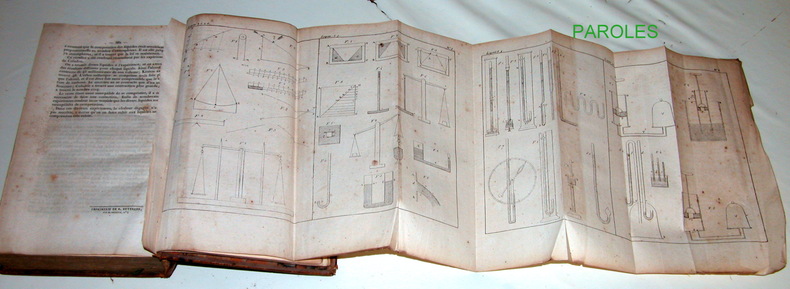
13860Paris, 1828,GROSSELIN,In-8,562p.,12 planches depliantes,une manquante,dos abimé,charnieres fendues,tres rare,dans l’etat
182815416Paris, chez Grosselin, Papinot, Hachette, Gautier, 1828 1 volume In-8° (12,3 x 20,2cm) Reliure d'époque pleine basane blonde; dos lisse à 4 fleurons dorés et pièces d'auteur et titre rouge et de tomaison noire, en alternance avec bandes de triples filets et chainette dorés, large roulette dorée en queue; gardes marbrées. 1 faux-titre, 1 titre, 562p., 2 feuillets; 5 doubles planches dépliantes in fine (paginées de 1 à 10). Fente verticale de 7cm sans manque au 1/3 inférieur du dos; épidermures; quelques pages fumées.
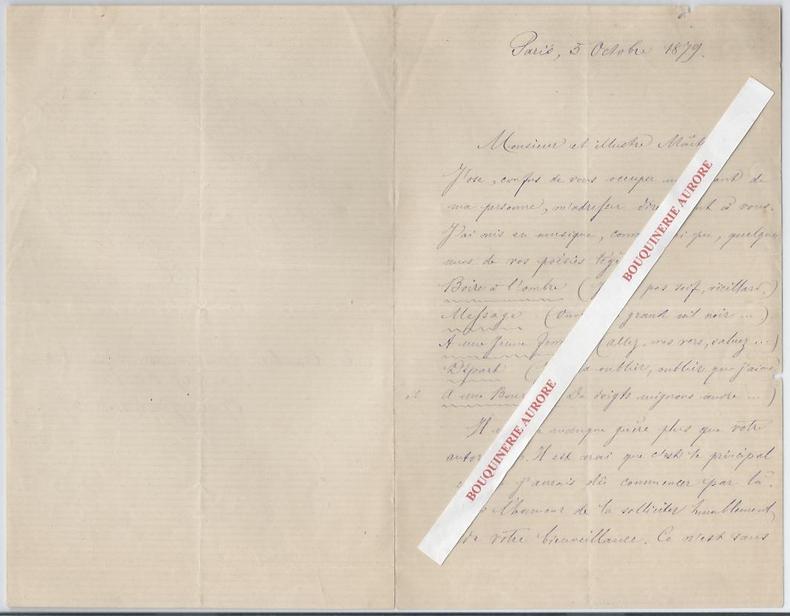
92381 L.A.S. (205 x 133), 2 pages, " Paris, 5 Octobre 1879 ", à " Monsieur et illustre Maître " [ Emile Augier]. Très bon état.
Paris, Gallimard 1955. In-12, broché, 272 pp. Edition originale. Un des 28 exemplaires numérotés sur pur chiffon de Lana, seul tirage en grand papier, Bel exemplaire en parfait état. N° 12.
ENE49AP829
60417Limoges, Association des Anciens élèves et fonctionnaires du Lycée Gay-Lussac fondée en 1867 à Limoges, 2008, in-8, br., couv. photos coul. éd., 107 pp., nb. publicitée, Le bulletin de contact entre les anciens de Gay-Lussac de Limoges. Très bon état
60577Limoges, Association des Anciens élèves et fonctionnaires du Lycée Gay-Lussac fondée en 1867 à Limoges, 2012, in-8, br., couv. photos coul. éd., 115 pp., nb. publicitée, Le bulletin de contact entre les anciens de Gay-Lussac de Limoges. Très bon état
1922100117946Armand colin 1922 in12. 1922. Broché.
39793Paris N.R.F Gallimard 1985 in 12 (18,5x12) 1 volume broché, 181 pages [1]. Achevé d'imprimer à la date du 25 mars 1985. Collection Blanche. Bel exemplaire