PTOLEMAEUS, Claudius.MareMagnum

17 332 résultats
in-folio, ff. (6), 143, (1 bianco), pregevole legatura del primo settecento in cartone decorato a fiori, tit. ms. al dorso, tagli azzurri. Titolo impresso in rosso e nero, impresa tipogr. in rosso, iniziali silogr. ornate, un gran numero di figure e diagrammi astronomici in silografia nei margini. Dedica di Luca Gaurico, editore dell'edizione, a Domenico Pallavicini, e prefazione di Andrea Trapezuntio, figlio di Giorgio, a Papa Sisto IV. Nuova traduzione in latino, fatta direttamente dal greco, per volere di Nicola V, da Georgio di Trebisonda, dotto studioso di Creta venuto in Italia agli inizi del XV secolo. Opera astronomica del secondo secolo (Cl. Ptolomaeus, circa 100 -170 d. C.), tra le fondamentali per lo sviluppo delle conoscenze umane. "I metodi matematici e geometrici usati per questa opera la fecero preferire alle simili di quel tempo e le fecero presto acquistare ampia diffusione... L'Almagesto costituisce il primo e più completo trattato di astronomia della storia...; rappresenta l'insieme di tutte le cognizioni astronomiche di quel tempo e offre le migliori ipotesi che, pima di Copernico, servirono a spiegare i moti e a fissare e predire le posizioni degli astri in cielo" (Diz. Bompiani, Opere I, p. 92). Bell'esemplare, fresco e marginoso (nel bianco del titolo abile piccolo restauro e lieve alone).. Camerini I, n. 327. Sander II, 5972. BMC, STC, 542. Adams P-2214. Renouard, Notice, p. XXVI, n. 92. Cens. 16 CNCE 29477. Dictionnary of Scientific Biography, XI, pp.186-206..
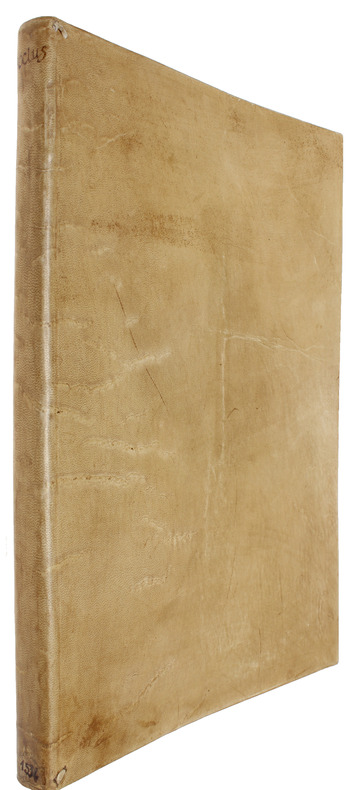
153452023Tübingen, Hulderich Morhart, 1534. Small folio. Nice full vellum with yapp edges. A, exceptionally nice, clean, and fresh copy. One blank corner of f. 100 restored and small part of upper blank margin of last three leaves restored - far from affecting text. (7), (1 - blank), 133 ff + 1 leaf with portrait. With numerous woodcut astronomical illustrations and diagrams in the text and the woodcut portrai, which is attributed to Holbein the Younger.
Tübingen, Hulderich Morhart, 1534. Small folio. Nice full vellum with yapp edges. A, exceptionally nice, clean, and fresh copy. One blank corner of f. 100 restored and small part of upper blank margin of last three leaves restored - far from affecting text. (7), (1 - blank), 133 ff + 1 leaf with portrait. With numerous woodcut astronomical illustrations and diagrams in the text and the woodcut portrai, which is attributed to Holbein the Younger.
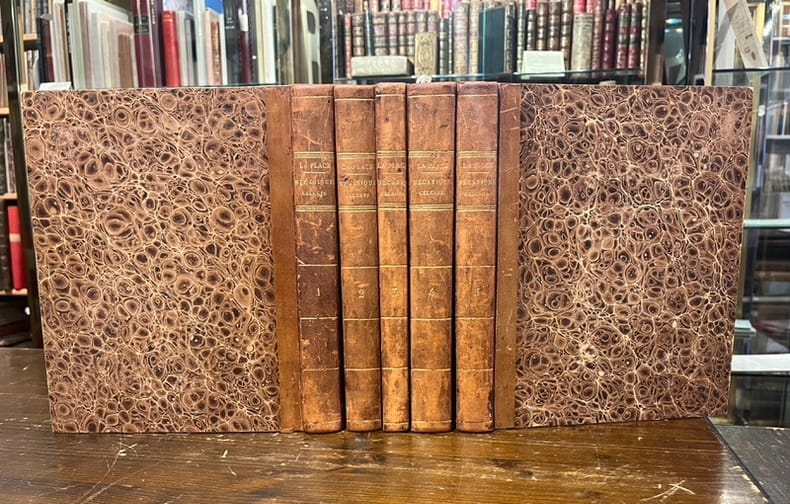
179814397Paris, J.B.M. Duprat; Bachelier, 1798-1825. 5 volumes in-4 de XXXII-368; [4]-382; XXIV-303-[1]; XL-347-[1]-[2]-65-[1]-[2]-78-[2]; VIII-419-[1] pages, demi-veau brun, dos lisses ornés de filets dorés, tranches jaunes.
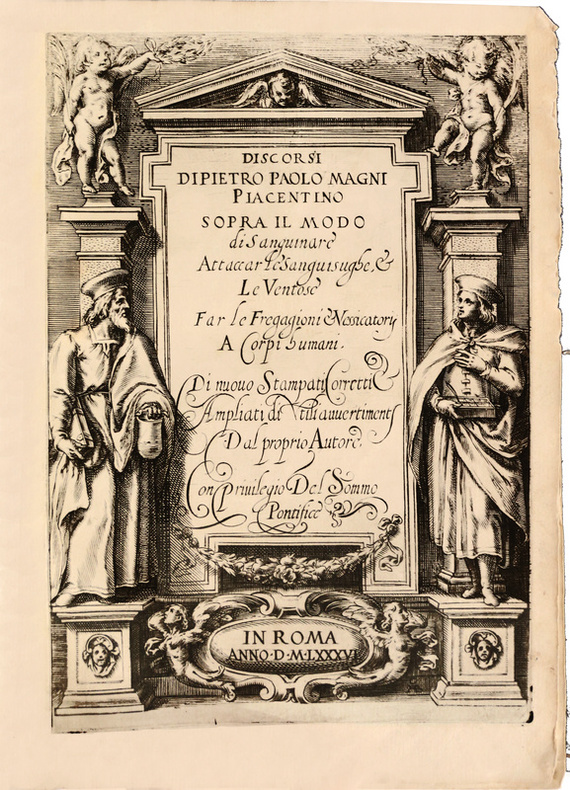
LCS-17596Bel exemplaire bien complet de toutes ses planches et conservé dans son pur vélin de l’époque. Roma, Bartholomeo Bonfadino, 1586. In-4 de (6) ff. dont 1 titre gravé encadré d’une bordure architecturale, 118 pp. y compris 11 figures en taille-douce à pleine page, (1) f.bl. Pte. déchirure dans la marge blanche inférieure de la p. 93 sans atteinte au texte. Plein vélin souple de l’époque, dos lisse, titre calligraphié sur la tranche inférieure. Reliure de l’époque. 210 x 154 mm.
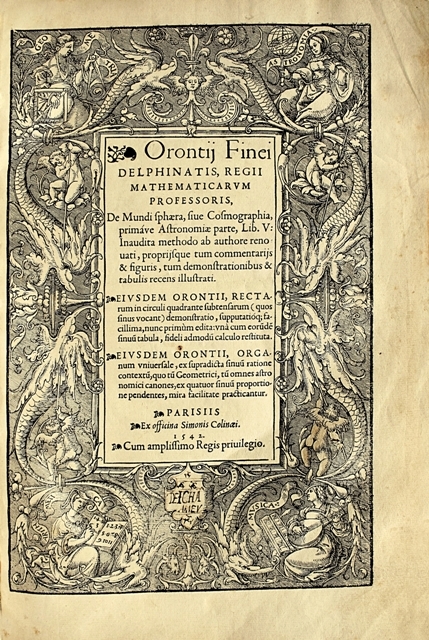
LCS-16146Paris, Simon de Colines, 1542. Paris, Simon de Colines, 1542. Cum amplissimo Regis privilegio. In-folio de (1) f.bl., (6) ff. dont le titre-frontispice et une gravure à pleine page, 112 ff., (2) ff.bl., 92 gravures et vignettes dans le texte. Longue note manuscrite au verso du dernier f. Vélin souple, dos lisse. Reliure de l’époque. 316 x 212 mm.
LCS-17788Précieux exemplaire de Cambacérès, relié en maroquin vert aux grandes armes de l’Archichancelier de l’Empire. Paris, J. G. Dentu, 1810.3 tomes en 3 volumes in-8 de : I/ (3) ff., viii pp., (1) p. de table, 394 pp., 1 planche dépliante en fin de volume, pages 5 à 12 reliées au mauvais endroit sans manque ; II/ (2) ff., 401 pp., 3 planches dépliantes en fin de volume ; III/ (2) ff., 452 pp., 1 planche dépliante en fin de volume, qqs témoins. Qq. rares piqûres.Plein maroquin vert, large dentelle dorée d’encadrement sur les plats, grandes armes dorées frappées au centre, dos lisses ornés, coupes décorées, tranches dorées. Reliures de l’époque.200 x 121 mm.
83060P., David, 1761-1780, 8 TOMES reliés en 4 volumes in 4, plein veau marbré, tranches rouges, dos ornés de fers et caissons dorés, étiquettes rouges et vertes, tranches rouges (reliures de l'époque), T. 1 : 14 pp., 1fff.n.ch. (table des mémoires), 303pp., (1pp.), 7 planches dépliantes, T.2 : 2 feuillets non chiffrés (titre + table des mémoires), 328pp., 2 feuillets non chiffrés (errata + privilège), 2 planches dépliantes, T.3 : 17pp., 420pp., 1 planche dépliante, T.4 : 16pp., 380pp., 1pp., 2 planches dépliantes, (le feuillet 7-8 de l'avertissement a été relié avant le feuillet 5-6), T.5 : 20pp., 520pp., 4 planches dépliantes, T.6 : 12pp., 443pp., (1pp.), 4 planches dépliantes, (habile restauration dans la marge supérieure de la page 132), T.7 : (2), 8pp., 397pp., (1pp.), 5 planches dépliantes, T.8 : (2), 4pp., 399pp., 5 planches dépliantes, (le carton Gii (51-52) du tome 8 annoncé dans l'avis au relieur au tome 7 semble n'avoir jamais été imprimé. En effet ce carton n'existe pas aux trois exemplaires que nous avons consultés)
2 parti in 1 volume in folio, pp. (8), 146, (38); (20), 294, (2), legatura coeva in pergamena floscia, tagli rossi. Numerose figure geometriche n.t. Seconda edizione dell'importante opera di Regiomontano, la prima esposizione di trigonometria piana e sferica in base alla quale furono per molti decenni calcolati i movimenti dei pianeti, le comete, le eclissi. "The first systematic treatise on plane and spheric trigonometry to be published in Europe. Although it drew heavily on Arabic sources, those earlier treatises had been either lost or forgotten by 1533 when Regiomontanus's work was first printed" (Rose, The Italian Renaissance of Mathematics, pp. 99-100). Scritto e completato nel 1464, fu pubblicato per la prima volta nel 1533 a Norimberga a cura di Johann Schoener. Nella prima parte, alla fine dei cinque libri del Regiomontano, sono inseriti la dedica di Johann Schoener e il "Tractatus Georgii Peurbachii super propositiones Ptolomaei de Sinibus et Chordis" (p. 131-139); chiudono la prima parte le tabelle dei seni di Regiomontano. La seconda parte fu aggiunta dal curatore Daniel Santbech e tratta problemi di geometria applicata ed in particolare degli strumenti di misura, riferendosi all'astronomia, alla gnomonica (pp. 125-164), alla meccanica. Esemplare con piccoli camminamenti di tarlo nel margine interno bianco di alcuni ff., alcune bruniture della carta, rinforzi al primo e ultimo f.. Adams R-281. PMM 40. Dreyer, St. dell'astronomia, p. 264. Horblit Coll., cat. 168, 155. Montucla, Histoire, II, 449. Olschki, Choix VI, 7630 (solo prima parte, senza data precisa-1550 ca.).
in-8 (ma segnato in-4, mm 192 x 140), pp. (4), 34, (2), legatura in cartone rustico. Al titolo raffigurazione del ''sole ellittico'', nel testo 9 tavole di osservazione solare e 10 illustrazioni, il tutto in silografia n.t., testatine e finalini ornati. Prima edizione, assai rara, di questo trattato dedicato dallo Scheiner al fenomeno di rifrazione solare all'orizzonte che, soprattutto al mattino, fa apparire il sole ellittico anziché sferico, anche attraverso l'osservazione al telescopio. Basato sulle osservazioni che l'astronomo gesuita (1573-1650) compì di ritorno da Ingolstad tra 1612 e 1613 questo lavoro si inserisce nella dibattuta querelle sulle Macchie Solari che nacque tra lo Scheiner e Galileo. Il testo apparve una seconda volta nel 1617 ma con il titolo ''Refractiones coelestes'' e sostanzialmente cambiato nel contenuto e nelle illustrazioni. Esemplare con margini ridotti (foglio del titolo rifilato sul lato esterno, con piccola perdita su 5 righe).. Cinti, Galileiana, n. 53. Carli-Favaro p.15. Sommervogel VII 737. Zinner 4523..
In -folio, due voll. legati assieme; pp. (68), 504, (4); (40), 334, (2). Legatura in piena pelle alle armi di Felipe Ramirez Nuñez de Guzmán de Medina, nervi e titolo al dorso. Questa di Basilea del ’32 è considerata l’ultima e migliore edizione nel Cinquecento in latino delle Genealogie [...] che si deve all’umanista strasburghese Jakob Moltzer. Notevoli le illustrazioni genealogiche a piena pagina in quest’opera che, in vita, diede fama a Boccaccio, i cui lavori in volgare erano considerati una produzione minore. Rilegato con i Saturnalia e il commentario al Somnium Scipionis, le due maggiori opere di Macrobio nell’edizione di Camerario. Numerose illustrazioni nel testo fra cui l’incisione del planisfero macrobiano, diviso in zone climatiche, che costituì per circa un millennio il modello geografico terrestre: nella prima riproduzione a stampa di questa mappa, del 1483, le linee climatiche erano dritte, qui per la prima volta sono curve e rimandano a un modello di terra sferica e non piatta. This Basilea 1532’s edition is considered the last and the best latin edition in XVI century of “Genealogie”: it’s due to austrian scholar Jakob Moltzer. The full page genealogic illustrations are remarkable; this work gave a reputation to Boccaccio while he was still alive, and whose works in volgare were then considered a less important production. Bound with the “Saturnalia” and commentary to “Somnium Scipionis”, the most important Macrobio’s works in Camerario edition. Many illustrations in text: between them the macrobian world map, divided in climatical areas, that was for about 1000 years the geografic Earth pattern: in the first printed reproduction of this map, from 1483, the climatical lines were straight, while here they are bent and they suggest a spheric Earth model.
In-8°, pp. (24), 331,(12), ritratto di Bonaventura Cavalieri, numerosi legni nel testo, legatura in piena pelle con tassello e titolo in oro al dorso, nervature, buona copia. Nel 1682, uscì il Trattato della sfera (a Roma presso il Mascardi). Molto si è discusso, senza tuttavia giungere a una conclusione definitiva, sulla paternità di quest'opera, dacché nel 1690, il D., morto ormai da alcuni anni, ne uscì a spese e a cura del libraio A. Manari (a Roma presso il Molo) una "ristampa" con il titolo modificato in Sfera astronomica, che indicava come autore B. Cavalieri e relegava il D. al ruolo di semplice editore. In realtà, il trattato è in larga misura del Cavalieri: diviso in due parti - una che espone la dottrina della sfera, la seconda costituita dalle pratiche astronomiche (molte delle quali il D. aveva già pubblicato nel '56) - e preceduto da una vita del Cavalieri, esso è la traduzione parziale, con aggiunte e modifiche del D. stesso, di uno scritto latino del matematico milanese (sfuggito finora all'attenzione degli studiosi del Cavalieri e dei D.), la Sphaera seu doctrinae sphaericae tractatus... authore F. Bonaventura Cavalerio, datato 1642 e conservato nella Biblioteca della università di Bologna (ms. Lat. 1858). Interamente del D. sono i capitoli XVII e XVIII che riprendono le due lettere del '67. Così pure nel cap. XVI, dopo aver esposto la teoria dei quattro elementi quale la trovava nel Cavalieri, giudica, "cose immaginarie" i calcoli relativi alle quantità di quegli elementi stessi. Riccardi, I, 329-390, 398-399; Gamba 1852; Meschini, DBI, 33, 1987. In-8 °, pp. (24), 331, (12), portrait of Bonaventura Cavalieri, several woodprints in the text, full calf binding with bands and gilt title on the spine, good copy. In 1682, the Trattato della sfera was published (in Rome at Mascardi). Much has been discussed, without however reaching a definitive conclusion, about the authorship of this work, since in 1690, the D., who had been dead for some years, came out of it at the expense and by A. Manari (in Rome at the Molo) a "reprint" with the title changed to Sfera astronomica, which indicated B. Cavalieri as the author and relegated the D. to the role of simple editor. In reality, the treatise is largely by Cavalieri: divided into two parts - one which explains the doctrine of the sphere, the second constituted by astronomical practices (many of which D. had already published in '56) - and preceded by a life of the Cavalieri, it is the partial translation, with additions and modifications of the same D., of a Latin writing by the Milanese mathematician (so far escaped the attention of the scholars of the Cavalieri and the D.), the Sphaera seu doctrinae sphaericae tractatus .. authore F. Bonaventura Cavalerio, dated 1642 and preserved in the Library of the University of Bologna (ms. Lat. 1858). Entirely of the D. are the chapters XVII and XVIII which take up the two letters of '67. So also in chap. XVI, after having exposed the theory of the four elements as he found it in Cavalieri, judges the calculations relating to the quantities of those elements as "imaginary things". Riccardi, I, 329-390, 398-399; Gamba 1852; Meschini, DBI, 33, 1987
In-4°, XX, pp.210, tavola fuori testo legatura in cartonato. Christian Kramp fu un astronomo, fisico e matematico francese, scrisse di vari argomenti e molti trattati di matematica pura. La sua opera principale benché di carattere astronomico è - Analyse des refractions astronomiques et terrestres - In questa opera affronta il problema della elasticità dell'aria in relazione alla sua densità ma soprattutto presenta una dettagliata tavola numerica delle funzioni trascendentali che cosi divenne importante nel CALCOLO DELLE PROBALITA' da essere chiamata " Kramp's trascendental", introdusse anche la funzione "n". Come Bessel, Legendre e Gauss egli estese la nozione di fattoriale ai sistemi di numeri non interi (non-whole). DSB ad vocem. In-4°, XX, pp.210, plate, cardboard binding Christian Kramp was a French astronomer, physicist and mathematician, he wrote of various and many subjects treatises on pure mathematics. His main work although of an astronomical nature is - Analyze des refractions astronomiques et terrestres - In this work he addresses the problem of air elasticity in relation to its density but above all it presents a detailed numerical table of transcendental functions which thus became important in the CALCULATION OF PROBALITIES to be called "Kramp's transcendental", also introduced the function "n". Like Bessel, Legendre and Gauss he extended the notion of factorial to non-whole number systems. (See DSB)
Hafniae (i.e. Copenhagen), Henric Waldkirch, 1612. 4to. Bound in a recent half vellum with handwritten title to spine. Text browned, due to the quality of the paper. A tiny hole to the woodcut frame of the title-page and a handwritten ""4"" to the top of the title-page. A good copy. 83 pp. Title within an ornamental woodcut border, large woodcut initials, and woodcut illustrations in the text. With dedicatory letter to King Christian IV and a eulogy to the author by Casper Bartholin.
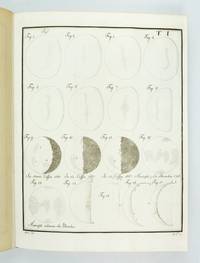
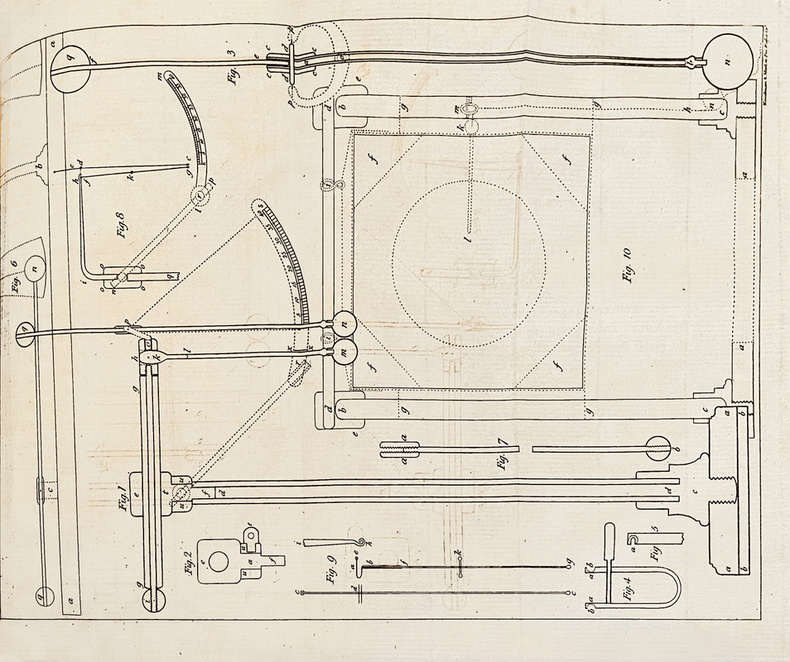
1796ST20813Helmstedt: Printed and commissioned by C. G. Fleckeisen 1796. FIRST EDITION. 275 x 225 mm. 10 3/4 x 9". XVI 250 2 pp. <br/> Contemporary brown paste paper boards smooth spine with red roan label. WITH 10 ENGRAVED PLATES one folding by "G. T." after Schröter. Honeyman 2825; de la Lande p. 635; Poggendorff II 846; cf. DSB XII p. 226 NDB XXIII 590 Schröter and 510 Schrader. See also Sheehan and Baum "Observations and inference: Johann Hieronymous Schroeter 1745-1816" Journal of the British Astronomical Association vol.105 no.4 p.171-175. Joints and extremities somewhat rubbed boards with a hint of chafing occasional very minor foxing including to the final plate half a dozen leaves with faint dampstain to head edge but a really excellent copy the other plates clean and bright the text especially clean and fresh and the binding entirely sound.<br/> <br/> This is a very rarely seen early work on the topography of Venus written by the astronomer who first observed the planet's so-called phase anomaly and illustrated with 10 folding plates. One of a series of "fragments" Schröter published--the others concerning the sun the moon Saturn and Mercury--"Aphroditographische Fragmente" discusses the author's observations of Venus' surface at the same time coining the term "Aphroditographie" in reference to the Greek version of the goddess' name. The most important observation contained in our work concerns the phases of Venus: like the moon Venus appears to wax and wane when observed through a telescope. However due to the thickness of its atmosphere the planet will always appear less full than mathematical calculations indicate it should be. This phenomenon known as Venus' phase anomaly--or the Schröter Effect--first observed by the man who gave it its name in 1793 is discussed in detail in this text which is accompanied by highly detailed plates. Eight of these are focused on Venus primarily depicting its phases; another is a diagram of the telescope; and the other depicts the Orion Nebula to which there is a short addendum. Schröter 1745-1816 built a state-of-the-art observatory at Lilienthal in Lower Saxony equipped with the largest telescopes available at the time. One such instrument which he built in his own workshop was an impressive 27-foot telescope discussed in the present work which has sometimes been incorrectly credited to Schröter's colleague William Herschel 1738-1822. Schröter made systematic long-term observations of the surfaces of the moon and planets something DSB tells us he was the first to do. Not everything he discovered or asserted turned out to be true. Based on his findings he posited the existence of a mountain range on Venus' surface and suggested a rotation period for the planet. Both subsequently were disproven modern scientists have suggested that Schröter's "mountain" may have been an overly optimistic observation of a cloud formation but like the rest of his work they demonstrated the commitment to observational astronomy that leads astronomy historians William Sheehan and Richard Baum to call Schröter "the man who laid the foundations of planetology and modern selenography." His long and impressive astronomical career came to an unfortunate end in 1813 when during the Napoleonic invasion the French reportedly set fire to his observatory. His library instruments unpublished notes and copies of many of his works which were published in small runs at his expense were said to have been destroyed in the fire a fact that may partly explain the current rarity of our book. We have been able to trace at auction only an ex-library copy of the book with significant condition problems that sold in 1981 for a hammer price of £260; the fact that such an unattractive copy came from the distinguished Honeyman collection reinforces how difficult the work is to obtain. Printed and commissioned by C. G. Fleckeisen unknown
2 vol. in-4 picc., pp. 470, (10, le ultime 3 bianche); (4 con dedica dello stampatore inserita dopo p. 8), 217, (1, con grande impresa tipogr. e colophon). Legatura coeva cart. rustico. Impresa tipogr. sui due titoli, numerosi diagrammi e figure silogr. n.t., 9 delle quali sono a piena pag. e raffigurano strumenti astronomici. Dedica all'arcivescovo di Magonza Giovanni Filippo. Seconda edizione collettiva in due volumi. La prima opera ("Progymnasmata"), pubblicata postuma da Keplero a Praga nel 1602 è un trattato scolastico contenente le osservazioni fatte dal Brahe nel 1572-74 circa la "Supernova in Cassiopea", con la riconsiderazione delle teorie sui movimenti del Sole e della Luna ed un catalogo delle posizioni di 777 stelle fisse. La seconda opera ("De Mundi Aetherei" apparsa ad Uranibor nel 1588) contiene le osservazioi sulla grande cometa del 1577 e comprende una descrizione della sua formulazione geo-eliocentrica dell'universo, una delle svariate nuove teorie che aprirono la stada all'accettazione delle dottrine copernicane. "Tycho's observations of the supernova and comet led him nothing new could he born in the heavens" (Norman Cat.). Esempl. completo delle 4 pagine di dedica e delle 8 d'indice, talvolta mancanti; a pieni margini (la carta con usuali forti arrossature).. Cinti 24 e 25 descrive l'edizione del 1610 di entrambe le opere (vedi commento). Norman 321. Houzeau-Lancaster 2704..
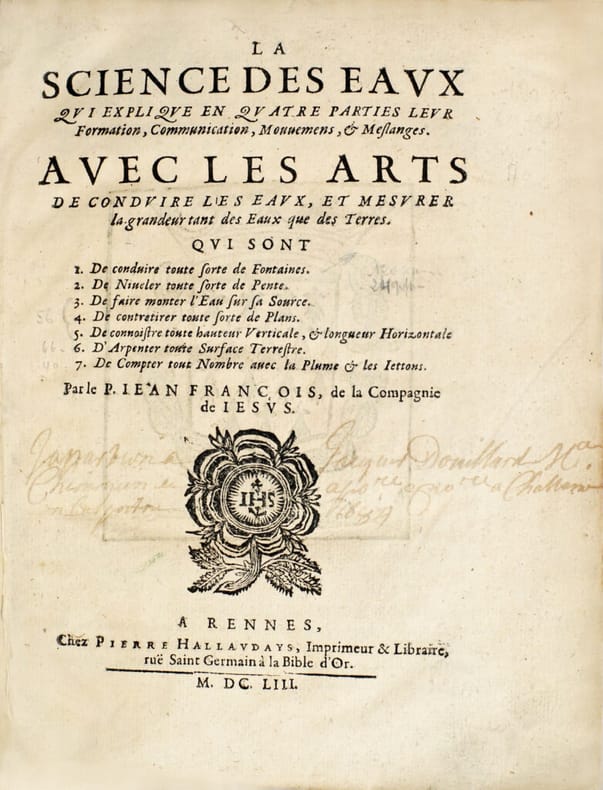
LCS-17901Précieux exemplaire conservé dans son authentique reliure en vélin souple de l’époque. Rennes, Pierre Hallaudays, 1653. 6 parties en 1 volume in-4 de (8) ff., 120 pp., 40 pp., 24 pp., 56 pp., 70 pp., 40 pp., 1 planche gravée dépliante, nombreuses gravures sur bois dans le texte, ex libris manuscrit sur le titre. Vélin souple de l’époque, dos lisse. Reliure de l’époque. 206 x 155 mm.
LCS-17904Edition originale peu courante de ce traité de météorologie dû au physicien et géologue suisse Jean-André de Luc. Londres, Imprimerie de T. Spilbury, 1786-1787. 3 parties reliées en 2 volumes in-8 de : I/ (2) ff. bl., (2) ff. de table, 320 pp., (1) f., pp. 319 à 543, pp. 485 à 516 (appendice), 2 planches dépliantes hors texte, (2) ff. bl. ; II/ (1) f., (2) ff. de table, 478 pp., (1) f. d’errata. Maroquin rouge à grain long, filets et grecques dorés encadrant les plats, dos lisses à compartiments ornés de grecques et petits fers floraux dorés, filet or sur les coupes, grecque intérieure, tranches dorées. Reliure du début du XIXème siècle dans le style de Bozérian. 211 x 131 mm.
1990211200Kiel, Berlin, 1840-1990. Versch. geb. (teilw. mehr. Jgg. zus.) u. in Heften. Einbde. teilw. beschabt od. leicht beschäd. Teilw. m. St. u. Rsign. Einige wenige Bde. in Nachdruck.
200962838Taschen, 2009. Folio (465 x 395 mm). Unopened in original plastic protection, in the original pictoral cloth binding housed in the original plastic box with a convex plexiglas window, symbolising the window on the Apollo 11 Command Module. The present copy is number 1646 out of 1969.The accompanying photograph (323 x 400 mm), part of the work and also numbered 1646 out of 1969, in plexiglass frame (368 x 445 mm) of the famous ""visor"" photo of Buzz Aldrin on the moon. Signed by Aldrin on verso. Housed in the original numbered cardboard-case.Very light wear to the cardbard-case, otherwise essentially in untouched, mint condition.
True author's presentation offprint in the original wrappers, of Einstein's obituary for Austrian physicist and philosopher Ernst Mach. - Edition: Mach is particularly known as influential philosopher of science for his contemporaries. Through his criticism of Newton's theories of space and time he for instance foreshadowed Einstein's theory of relativity. - Condition: Corners and margins of wrappers with some very small faults, cover slightly water-stained, paper minimally foxy, otherwise solid copy. - Rarity: Present copy is imprinted „Überreicht vom Verfasser“ (presented by the author) on the upper right corner of the first page, which indicates it's utmost rarity, as author's presentation offprints of Einstein papers, from any journal or any period, were printed in a small print run for the use of the author only. ABPC (1973ff.) and APO (1988ff.) show no record at all. - Reference: Collected Papers, vol. 6, 29; Schilpp-Shields 96; Weil 89.
Amsterdami, Guilielmum Blaeu, 1634, 19 x 12 cm., pergamino a la romana de época, 8h. + 246 págs., marca xilográfica en la portada, numerosas ilustraciones xilográficas en el texto, letras capitulares grabadas. (Primera edición extremadamente rara de este libro en el que se describe la primera construcción de una esfera representando el sistema Copérnico. Se publicó en latín y en holandés en el mismo año. Krogt cita sólo 5 ejemplares. Publicado en el mismo año que el magnum opus de Blaeu, el "Atlas Novus", este tratado clásico sobre el uso de los globos, esferas y relojes solares ofrece una descripción de los sistemas contrapuestos de Ptolomeo y de Copérnico. Con la condena de Galileo en 1633 se dejaba el camino expedito para el desarrollo de la astronomía en el norte de Europa que llevaría a Newton. Este tratado fue uno de los primeros en proponer abiertamente el sistema copernicano. Blaeu quien había estudiado astronomía, matemáticas y la confección de globos con Tycho Brahe, maestro de Kepler, había abrazado la hipótesis heliocéntrica de Copérnico. Creía, sin embargo, que el estudio del sistema de Ptolomeo podría ser útil como introducción a la cosmografía, así que en su tratado describió la construcción de una esfera que lo representaba. La construcción de estas esferas forma parte de la gloriosa época de la construcción de globos que se inicia en Holanda a principios del siglo XVII. En la segunda parte de su obra Blaeu describe la esfera del sistema copernicano diseñada por él que fue la primera de este tipo que se construyó. En el prefacio al tratado, el traductor al latín, Martinus Hortensius, defensor e importante propagador de la astronomía copernicana, alaba la novedad que es representar el sistema heliocéntrico por medio de globos. Comenta que los escritos de Copérnico eran demasiado oscuros para que pudieran ser entendidos por la mayoría de los lectores y si se hubiese representado su sistema antes de forma gráfica, tal como lo había hecho Blaeu, no hubiera sido condenado como absurdo.[EXTREMELY RARE FIRST EDITION OF THIS WORK WHICH DESCRIBES THE CONSTRUCTION OF THE FIRST GLOBE TO REPRESENT THE COPERNICAN SYSTEM (published in Latin and Dutch in the same year) : Krogt cites only 5 copies. Published in the same year as Blaeu's magnum opus the "Atlas Novus", this classic treatise on the use of globes, spheres and sundials gives an account of the competing Ptolomaic and Copernican systems. The sentencing of Galileo to life imprisonment in 1633 for his pro-Copernican writings left the way open for the development of astronomy in northern Europe. This treatise was one of the first to openly defend the Copernican system. Blaeu, who had studied astronomy, mathematics, and globe-making with Tycho Brahe, Kepler's teacher, had accepted the Copernican hypotheses. He believed, however, that the Ptolomaic sytem could be useful as an introduction to cosmography and so illustrated the construction of a globe which represented it. In the second part of the work he describes the new sphere of the Copernican system which he had designed and which was the first of such spheres to be made available. The construction of these globes is part of the great history of globe making in Holland that began in the XVIIth century. Martinus Hortensius, the translator into latin of this treaty, who himself made an important contribution to diffusion of Copernican astronomy, welcomes in his preface the completely new way of explaining the heliocentric system through a system of globes. The writings of Copernicus himself, he comments, are too obscure to be understood by everyone and had the Copernican system been presented graphically sooner as it had been by Blaeu, it would not have been condemned as absurd. The manual, partly designed for the use of mariners reflects the trading interests of the Dutch and contains references to Brazil and other parts of South America].
LCS-17876Rare édition originale de ce traité d’astronomie écrit par Maupertuis à l'occasion du passage de la comète de 1742. S.l. [Paris], 1742. In-12 de (1) f.bl., (5) ff. (y compris le frontispice), 111 pp., (1) f.bl. Relié en plein veau marbré de l’époque, dos à nerfs orné, filet or sur les coupes, tranches mouchetées rouges. Reliure de l’époque. 156 x 87 mm.
1783340504W. Strahan, J.F. And C Rivington, A. Hamilton etc., London 1786, 1779,1781 + 1783. mehr als 1000 Seiten je Band mit Titelkupfer in Band 1 und mit 145 (von 146) teils gefalteten Kupferstich-Tafeln sowie 78seitigem Index im Tafelband, (more than 1000 pages per volume with title copper in volume 1 and 145 (of 146) partly folded plates (copperplate engravings) and with 78-page index extensive index in the plate volume), 2° (40 x 24 cm), Originalganzledereinbände der Zeit mit Rückentitel, fachmänisch restauriert, Papier ganz vereinzelt leicht braunfleckig, Innendeckel mit Exlibris, insgesamt sehr gute Exemplare mit sauberen Tafeln, (Original all-leather bindings of the period with spine title, professionally restored, paper with occasional slight brown spots, overall very good copies with clean plates),
2751La Hague, Moetjens, 1698, un volume in 4 relié en plein veau moucheté (reliure de l'époque), (petite tache brune sans gravité sur le premier plat de couverture, habiles restaurations aux coiffes et aux mors), 2pp., 144pp., 5 PLANCHES DEPLIANTES