Galilei, GalileoAntiquariat.de

17 331 résultats
17445061DBPadova, Nella Stamperia del Seminario, appresso Gio: Manfrè, (pubbl. dal abbate Gius Toaldo), 1744. 4°. (4) Bl., LXXXVIII, 601 S; (2) Bl., 564 S.; (2) Bl., 486 S.; (4) Bl., 342 S., (1) Bl., mit vielen Vignetten, Holzschnitt Abbildungen und Diagrammen im Text, Porträt von Galileo Galilei von Zucchi, gefalteter Kupfertafel. Kalblederbände mit Rückenvergoldung, Rückentitel und Supralibros. + Wichtig: Für unsere Kunden in der EU erfolgt der Versand alle 14 Tage verzollt ab Deutschland / Postbank-Konto in Deutschland vorhanden +, 5061DB|5061DB_2|5061DB_3|5061DB_4 4 Bände. [4 Warenabbildungen]
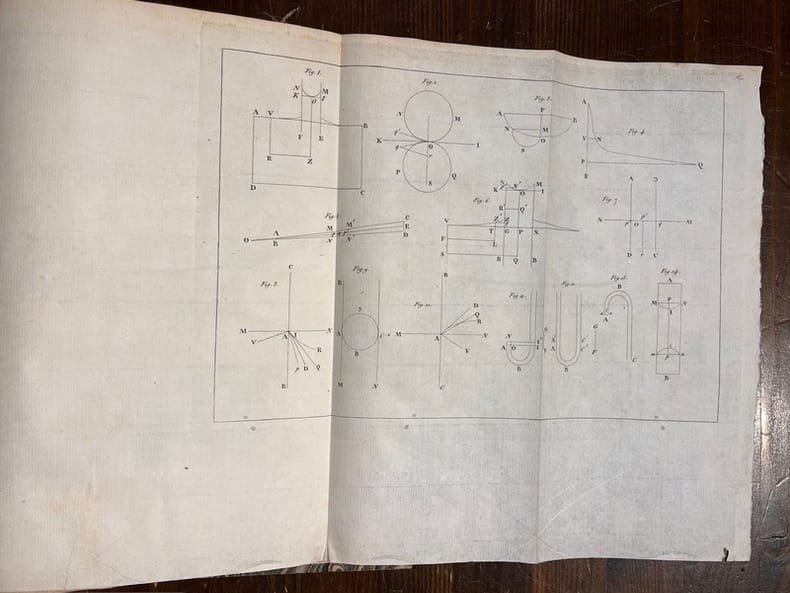
In-8 (mm. 241x175), 4 volumi, legatura in cartonato coevo (dorso rifatto in mz. pelle mod. con ang., fregi e titolo oro), pp. (8),LXXXVIII,(4),601; (4),564; (4),486; (4),342,(2); grande marca tipografica xilografata al frontespizio (fenice ad ali spiegate su fiamme, rivolta al sole. Motto: Post fata resurgo); all’antiporta del primo vol. ritratto dell’A. inc. in rame da F. Zucchi, con titolo in rosso e nero al frontespizio. Il testo è ornato da testatine, grandi capilettera e finali inc. su legno, con numerose figure pure xilografate nel t. e 1 grande tavola, inc. in rame e più volte ripieg. f.t., che illustra il compasso geometrico, oltre a una tabella (nel II vol., p. 535). "Prima edizione della raccolta completa" delle opere di Galileo Galilei; contiene infatti parecchie scritture inedite e, nel quarto tomo, il "Dialogo dei Massimi Sistemi" che non compare nelle due edizioni precedenti del 1655 e del 1718. Cfr. Riccardi,I, pp. 522-523 che riporta lunghe annotazioni e precisa: ".. questa edizione risulta molto piu' completa ed ordinata delle due precedenti.." - Cinti “Biblioteca Galileiana”,176 - Carli Favaro,478 - Gamba,484: “Questa edizione fu diretta ed illustrata con Note dall’astronomo abate Giuseppe Toaldo.. In quei primi tre Volumi si è aggiunto di più il "Trattato della Sfera", quello di "Misurar con la vista", e diverse "Lettere"; quasi tutto ricavato dalla Libreria de’ pp. Somaschi in Santa Maria della Salute a Venezia..”. Rare e lieviss. fioriture margin., ma certamente esemplare ben conservato.
Particularly rare, early anastatic reprint from the original separate edition of Einstein's »General Theory of Relativity«, using the original cover. - Edition: The „original edition“ (Weil) of this classic paper was published in 1916 as vol. 49 from »Annalen der Physik«. According to Weil present reprint, which uses the original cover, is of better printing quality than others. - Condition: Cover loose at front hinge, margins with some small faults, front cover with shelf wear, paper heavily time-stained, otherwise clean copy. - Rarity: ABPC (1973ff.) and /APO (1988ff.) record 4 copies of this edition at auction (2015, 2014, 2013, 2006). - Reference: BRL 78; Carter-Muir 408; Norman 696; Schilpp-Shields 86; Weil 80a
151763752CB[Paris], für Pasquier Lambert gedruckt von T. Kees, [1517]. 4°. 21 x 14,5 cm. Späterer, schlichter Halblederband mit marmoriertem Deckelbezug und rauem Buchschnitt. [7 Warenabbildungen] 34 Blatt. [Signaturformel: [A1], [A4], B-I4].
179820855Paris, J.B.M. Duprat; Bachelier, 1798-1805. 4 volumes relié en deux tomes in-4 demi-vélin de XXXII-368; [4]-382 et XXIV-304; 24; 40-347-[1]; [2]-65-[1]; 78-[2] pages, dos lisses, étiquette de titre brune. Reliure XIXe. Collation: vol. 1: a-d4; A-Z4; Aa-Zz4. vol. 2: []2; A-Z4; Aa-Zz4; Aaa4; Bbb3 (le feuillet Bbb4 semble être un feuillet blanc). vol. 3: a-c4; A-Z4; Aa-Pp4. suppl. 1: A-C4. vol. 4: a-e4; A-Z4; Aa-Vv4; Xx2. suppl. 2: []1; AH4; I2 (le second feuillet est la planche dépliante). suppl. 3: A-K4.
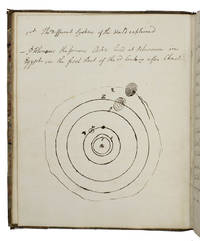
1820ABC_45977England 1820. Late 18th-century half calf marbled sides. 4to. Manuscript volume of notes on practical astronomy and mathematics in English written in ink on Dutch paper with a Maid of Dordrecht watermark without countermark. The leaves are numbered from the front 101 and 26 leaves of text and diagrams 39 blank leaves in the middle last 26 leaves in reverse order illustrated with several astronomical and mathematical diagrams including one of a solar system. A fascinating manual of astronomy written in English particularly as it relates to the form of the motions of the heavens dating from the period 1780-1825 probably from the beginning of that range. It is written in a single hand with the exception of one page though with some variations indicating that different parts of the MS were written at different times. The MS could have been prepared for personal use or as part of public tuition probably the former. The writer summarizes the subject matter of the manual on the first leaf: Astronomy is that part of Natural Philosophy which treats of the Phenomena of the heavenly Bodies. It is divided into 2 Parts Physical and Plain: by the latter we discover their Motions from the Apparent Motions; by the former the Causes of these real Motions. The manuscript comprises three parts with distinct subject matter. The first part covers the motion of the earth around the sun and its rotation about its axis with the consequences for the apparent motions of the sun and the heavens; with the moon and its phases and motion; and with lunar and solar eclipses. There are several references to John Keills An introduction to the true astronomy London 1721 or later editions. The second part principally discusses section 11 of Newtons Principia 1713 or later editions in particular as it relates to the motion of the moon. This part ends with a short section on algebra particularly polynomials which seems to have been composed more haphazardly than the remainder of the text. The third part which runs backwards starting from the end of the notebook gives demonstrations of various results in Book I of Principia notably the theorem that the orbits of the bodies in the solar system do not precess if and only if the central attractive force operating on them is exactly inverse-square. This is an important result not only for Newtons system of universal gravitation but also for the observational astronomy of the solar system which is discussed in the opening section of the book. Between the end of the second part and that of the third there are a few blank leaves and others have been torn out but the text appears to be complete.The manuscript appears to work through at least two different texts beginning with Keills on astronomy. There is a section devoted to what is called the precession of the equinoxes the westward drift of the points where the ecliptic and equator intersect due to the precession of the earths axis - the author notes that Sir Isaac Newton has demonstrated that it arises from the broad spheroidal figure of the earth. The author then turns to sunspots and the arguments for and against their being on the surface of the sun. Then comes a long discussion of the planets: the planes and periods of their orbits phases conjunctions retrograde motions apparent brightness and their distances from the sun. The second and third parts are notably more mathematical in nature than the first.The third part of the manuscript consists of a reading of various sections of Newtons Principia 1713 or later editions. Again it appears to work through and in some cases repeat Newtons proofs rather than representing a translation or paraphrase. It is not based on Mottes translation nor does it correspond with Thorps partial translation and edition. It does not appear to be based on any other intermediary between Newton and the writer such as Pemberton but to rely on Newtons Latin original here rendered in places pretty exactly into English. It renders propositions 43 to 59 of section 9 of book 1 of the Principia which concern the motion of bodies in moveable orbits and the motion of the apsides. This topic remains of considerable interest to astronomers and historians of astronomy. The manuscript hand remains fairly constant throughout the book: some variations more likely indicate the same writer at a different times or with a different pen than a different writer. The manuscript hand and paper together date the manuscript fairly securely to the period 1750-1825. If our hypothesis that the author used Thorps edition of Principia is correct that would date the manuscript no earlier than 1777. The section on the planets in the first part does not mention Uranus Georgium sidus discovered by William Herschel in 1781. Since the anonymous author seems to have followed astronomical discoveries closely this suggests a date no later than 1781. We therefore tentatively date the composition ca. 1777/81.We are indebted to Scott Mandelbrote for his assistance with the description of this notebook.Binding slightly rubbed. A couple pages have a tear at the foot and others are stained. Otherwise in very good condition. unknown
2 opere in 1 vol. in-4, bella legatura 600esca in pergamena rigida, titolo e simbolo araldico del drago della famiglia Boncompagni impressi in oro al dorso. I) Danti: pp. (12), 316; impresa tipogr. sul tit. ed altra in fine, fregi ed iniz. silogr., adorno di oltre 60 silografie n.t., tra cui vari diagrammi, riproducenti per lo più divers tipi di astrolabi ed altri strumenti, anche a piena pagina. Seconda edizione (prima 1569), dedicata a Ferdinando de Medici, di quest'opera del Danti, apparsa presso i Giunti nello stesso 1578 anche con il titolo "Primo volume dell'uso della fabbrica", in cui viene aggiunta in fine una sezione sull'armilla equinoziale e si modifica la dedica. Trattasi di uno dei più antichi e rari trattati d'astronomia in lingua italiana. II): Tolomeo: pp. (16), 93, (3); impresa tipogr. al tit. e altra in fine, iniziali istor. e numerose figure geometriche n.t. Prima edizione, estremamente rara, della traduzione della Sfera Celeste di Tolomeo a cura di Ercole Bottrigari (1531-1612, umanista esperto di musica, di lettere greche, ebraiche e latine, si dedicò anche alla matematica e all'astronomia). Ottimo esemplare d'illustre provenienza: è presente anche un antico timbro della famiglia Boncompagni al primo titolo: impresso su carta fort, con rarissime fioriture.. .
3114P., IMPRIMERIE ROYALE, 1843-1847, 7 VOLUMES GRAND IN 4 reliés en PLEIN CHAGRIN BLEU MARINE, dos ornés de caissons dorés, filets dorés sur les plats, frises dorées à l'intérieur des plats, armes impériales dorées sur les plats, toutes tranches dorées (reliures de l'époque), (quelques rousseurs), T.1 : (3), XVpp., 420pp., T.2 : (2), XVIpp., 440pp., T.3 : (4), XIXpp., 381pp., T.4 : (2), XXXIXpp., 552pp., 1 PLANCHE DEPLIANTE, T.5 : (3), Vpp., 540pp., (1-errata), T.6 : (2), VIIpp., 479pp., T.7 : (3), CXCVpp., 691pp.
1963003620<p>U.S. Government Printing Office. Fine. 1963. Original Wraps. A one-of-a-kind historical document for serious collectors on May 21 1963 the U.S. State Department sponsored a luncheon for astronaut Gordon Cooper in honor of his successful 22-orbit flight in Faith-7 on May 15-16 1963 this is the four-page program that was handed out at the event it is signed by six of the seven original astronauts on the front the second page contains a quote from President Kennedy and a list of the six Mercury flights page three contains the luncheon menu and the back page has a photograph of Cooper also included is the guest list which does not include astronaut John Glenn's name - proof that he wasn't there to sign it this event took place in the Benjamin Franklin Room and this unique document was obtained by us from a former State Department employee who personally obtained the signatures the program is printed on heavy-stock paper and is flawless it is housed in a manila State Department envelope the guest list is also flawless and all of the signatures are clean and legible. .</p> U.S. Government Printing Office
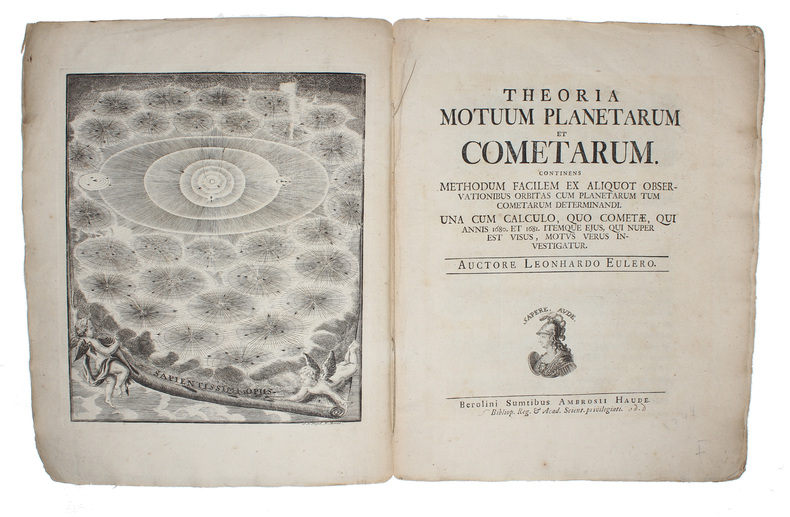
174438114Berlin: Ambrosii Haude, 1744. 4to. (246x199mm). Uncut in original marbled paper wrappers. Spine strip nearly worn away, but sewing still strong. A fine copy in its original and untouched state. Large engraved frontispiece showing comets orbiting the sun and planets, 187 pp. and 4 copper engraved folding plates. A4 (pp.7-8) canceled - catchword continues. Complete.
Berlin: Ambrosii Haude, 1744. 4to. (246x199mm). Uncut in original marbled paper wrappers. Spine strip nearly worn away, but sewing still strong. A fine copy in its original and untouched state. Large engraved frontispiece showing comets orbiting the sun and planets, 187 pp. and 4 copper engraved folding plates. A4 (pp.7-8) canceled - catchword continues. Complete.
LCS-17900Précieux exemplaire conservé dans son authentique reliure en vélin à recouvrement de l’époque. Amsterdam, chez Jean & Corneille Blaeu, 1642. In-4 de (9) ff., 277 pp., nombreux bois gravés dans le texte. Vélin à recouvrement, dos lisse avec le titre manuscrit, restes de lanières. Reliure de l’époque. 192 x 154 mm.
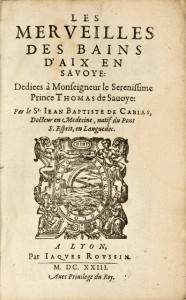
LCS-15321Rare édition originale du premier ouvrage consacré aux eaux d’Aix-les-Bains conservée dans sa toute première reliure en vélin souple de l’époque. Lyon, Jacques Roussin, 1623.In-8 de 208 pp., (8). Petite tache dans l’angle supérieur d’un f., mouillure pâle au titre. Vélin souple de l’époque, titre manuscrit au dos et sur la tranche supérieure. Reliure de l’époque. 170 x 103 mm.
18470152-24St. Petersbourg, L'Académie Imperiale des Sciences 1847. gr.-8°. IV, 108 S. HLdr. d. Zt. m. Rückengoldpräg. Einige Bll. stockfleckig. EA. [4 Warenabbildungen]
First print run (with no date printed on title) of the first separate edition (the 1st print was published as the concluding section of the author's »Protomathesis« in 1532) of this early, important and profusely illustrated account on sundials, clepsydrae and other ancient time-keeping instrument including diptychs, rings, multi-faceted and pillar dials, quadrants, mariner's astrolobes, as well as the mathematical or astronomical principles governing their use and design. The woodcuts by „G. Bordei“ (as mentioned in the preface) are elaborate adaptions of or newly cut versions taken from the blocks of those depicted in the »Protomathesis«. Oronce Finé (1494-1555), a famous French scholar and chair of mathematics at the Collège Royal since 1531, had also constructed an ivory sundial in the form of a ship, nowadays housed by the Milan Museo Poldi Pezzoli. Several woodcuts of the book refer to this construction. - Present copy was separated of a Sammelband and is protected with mould paper wrappers. Top edge of block with tighter cut, no text loss however, p. 202 with tight cut front edge, some pages foxy and stained, spine in parts loose, otherwise well preserved copy indeed. - Particularly hard to find with the big (37,5:29 cm) folded diagram usually bound in at the end of the volume. - Adams F 473 (copy without folded diagram); Fairfax-Murray 165; Harvard 232; Houzeau-L. 11351; Mortimer I, 232; Poggendorf I, 747ff. Description thanks to Heritage Book Shop, USA.
Edizione: Prima edizione . Pagine: 240 . Illustrazioni: Incisione all'antiporta e tavole . Formato: 24° . Rilegatura: Pergamena con dorso scritto in gotico a mano . Stato: Buono . Caratteristiche: L'opera è dedicata all'Eminentissimo e Reverendissimo Francesco Cardinal Mont'Alto. Bruniture. Piccoli segni di tarlo alle ultime pagine.Timbri di appartenenza. Nicolosi originario di Paternò, fu sacerdote e funzionario della Curia Vaticana. Scrittore e geografo aderì alla teoria tolemaica, dichiarando di essere obbediente alla Chisa fino al patibolo. Ammirava Galileo definendolo filoso principe e faro di filosofia, deplorando l'abiura a cui era stato costretto.Foto disponibili .
182848955Berlin, Königl. Akademie der Wissenschaften etc., 1828-1928. 8vo a. Lex8vo. 1830-90 uniform hcalf, gilt spines (a few with wear), 1891-1928 in uniform hcloth, spines with gilt lettering (a few with wear and one with a lose spine). A stamp to titlepages.
Berlin, Königl. Akademie der Wissenschaften etc., 1828-1928. 8vo a. Lex8vo. 1830-90 uniform hcalf, gilt spines (a few with wear), 1891-1928 in uniform hcloth, spines with gilt lettering (a few with wear and one with a lose spine). A stamp to titlepages.
174955564BBParis, chez David l'ainé., 1749. 4°. XXXVVV p., 2 p.n.ch., 184 p et 4 planches dépliantes. Demi-basane brune, dos lisse orné de filets et fleurons dorés, non rogné (reliure XXe).
6035Modena, Andrea & Hieronymi Cassiani, 1653 & 1654. Petit in-folio de [12]-232p. et 1 planche dépliante; 24p. et 2 tableaux développés sur 3 ff., et 6 pages de planches. Pleine basane fauve, dos à nerfs orné de filets et fleurons à froid, pièces de titre en maroquin rouge, plats ornés de filets, roulettes, fleuron central à froid (reliure moderne).
WB18617Italy ca 1790. Hardcover. Very Good. 182 leaves 8vo 220 x 158 mm. In Italian. Written in cursive in dark ink. Written in the right-hand column with notes and diagrams in pencil and ink in the left column. Fading to first part some minor staining a few quires becoming disbound. 18th-century paste-paper covered boards worn. <br/><br/>A series of astronomy lectures presumably in Orianis hand with a note on the front free endpaper from Professor Rossi attributing the manuscript to Oriani. Comprising some 36 lessons with additional information about physics and astronomy at the end likely delivered to his students at the college of Brera. Oriani studied astronomy under Joseph Louis Lagrange and was ordained a priest in 1776. He joined the Jesuit-operated Brera Observatory and was later appointed by Napoleon as director of the Milan Observatory in 1802. He used his calculations to prove that Uranus was a planet rather than a comet and was named a member of the French Academy of Science a Fellow of the Royal Society and a member of the Berlin Academy hardcover
176138885Augspurg, Eberhard Kletts Wittib., 1761. Contemporary white-dyed sheepskin. Spine with a bit of surface wear, old hand-written paper-label to spine. XXVIII, 317 pp. A stamp inside front free end-paper. Light browning, scattered marginal brownspots, but in general a fine copy. A few leaves in ""Vorrede"" misbound.
Augspurg, Eberhard Kletts Wittib., 1761. Contemporary white-dyed sheepskin. Spine with a bit of surface wear, old hand-written paper-label to spine. XXVIII, 317 pp. A stamp inside front free end-paper. Light browning, scattered marginal brownspots, but in general a fine copy. A few leaves in ""Vorrede"" misbound.
in-4, ff. 120, legatura settec. mezza pelle, tit. e filetti oro al dorso. Testo in carattere semigotico, numerose grandi iniziali ornate e istoriate su fondo nero, in fine magnifica impresa tipogr. a piena pagina con tre sfere armillari, impressa a due colori. Importante e rara edizione di queste celebri tavole astronomiche (''Coelestium motuum tabulae'') fatte compilare nel 1252 dal grande illuminato Re Alfonso X di Castiglia (''il Sapiente'', 1221-1284); l'autore è, secondo alcuni, l'astronomo arabo Isaac aben-Sid, e secondo altri, Isaac Hazan. Divenute famose, le ''tavole alfonsine'' furono utilizzate in tutta Europa fino al XVI secolo, quale unico strumento per determinare il movimento dei corpi celesti e misurare longitudine e latitudine delle stelle fisse. Bell'esempl.. Houzeau-Lancaster II, Bibliogr. de l'Astronomie, I B n.12487. BMC 20. Cantamessa I, 103, note..
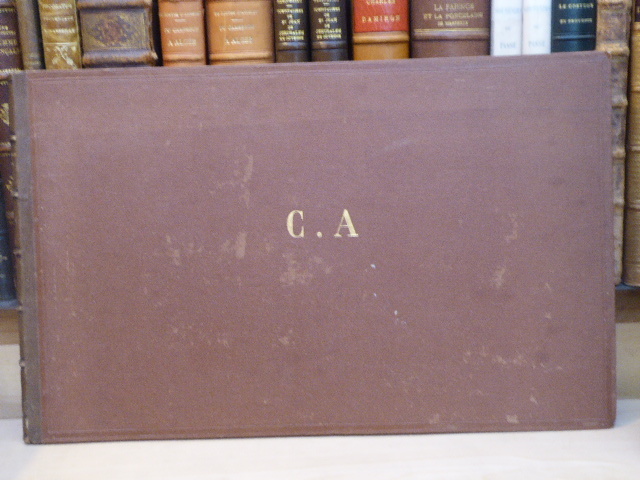
214899S.N. S.L. S.D. (Vers 1840) Important MANUSCRIT d'ASTRONOMIE. Les CONSTELLATIONS, in-4 oblong "à l'italienne" ( 310 X 50 mm ) de 14 feuillets, demi-chagrin noisette, dos à nerfs orné de fleurs de lys à froid, plats de percaline chagrinée de la même teinte avec monogramme "C.A." frappé à l'or au centre du premier, tranches bleues mouchetées d'étoiles dorées du plus bel effet ( Reliure de l'époque ). Très beau manuscrit sur papier fort d'une fine et élégante écriture très lisible avec encadrements et titres au pochoir. Magnifiques et minutieuses illustrations de constellations à la gouache blanche sur un beau bleu profond et lumineux, contrecollées sous serpentes. Pièce unique en très bel état.