Piccolomini Alessandro.MareMagnum

17 331 résultats
Formato cm 21x15 La sfera del mondo: pagine (12), 252 De le stelle fisse: pagine 30, 48, 25 - 93, (2). Rilegatura in piena pergamena coeva con titolo manoscritto al dorso. Legatura leggermente allentata. Manca il frontespizio sostituito da una riproduzione in fotocopia. All'interno lievi tracce di tarlatura, macchie, bruniture ed alcune annotazioni di antica mano. Le due opere sono rilegate insieme. Stato di conservazione complessivamente buono. Raccolta di due rare opere di astronomia del Piccolomini, stampate entrambe a Venezia dal Varisco nel 1579, riccamente corredate da figure ed illustrazioni geometrico - astronomiche.
In 4° (cm 16,5 x 24), legatura piena pergamena coeva, incisione in rame al frontespizio raffigurante Giove assiso ad un tavolo, circondato da altri otto personaggi rivestiti di toghe o antiche armature ed elmi, i protagonisti dei cinque dialoghi che costituiscono l'opera. Sguardie rifatte in carta filigranata "Fabrica della margarita", pp (56), 242, (2), antiche annotazioni all'occhietto, sul verso dell'antiporta, alla terza carta. Uno strappetto restaurato, interno in buone condizioni, carta forte. Dedica al Cardinale di Richelieu. Tra gli argomenti dibattuti tra gli interlocutori: grande spazio è dedicato all'attendibilità dell'Astrologia, che "ci annuncia i comandi del Cielo e ci dispone a seguirli"; esistono però gli astrologi "rei", e l'A. fornisce la descrizione delle loro caratteristiche, che si avvicinano a quelle di Alchimisti, Maghi, Incantatori, affinchè il lettore possa diffidarne. Molte pagine sono dedicate alle sorprendenti proprietà dei Magneti. Poi, i Cieli e la visione cosmica dell'universo, suddiviso in infinite costellazioni, descritte con immagini di grande respiro ed echi danteschi; le Comete, le Stelle Erranti, le Polari, la Via Lattea, e i "lor cittadini, quando n'avessero", loro morfologia nonchè influenza sui destini terreni; le Eclissi e il loro meccanismo ed effetti; i Cannibali, un esempio della relatività di cosa sia considerato abominevole e cosa lecito, in zone disparate della Terra; gli organi del corpo umano, loro funzioni e meccanismo: il cuore, il sangue, il suo "giro" nel corpo umano, le vene, la cava e arteriosa; qua e là troviamo curiose ricette popolari: l'unghia o il corno, "nati delle superfluità del nudrimento degli animali", liberano e custodiscono dal mal caduco e dai veleni. Seconda edizione (la prima del 1533). Due esemplari censiti nelle biblioteche italiane. Michel & Michel, v. 7 p. 145; "Non è registrata nelle principali bibliografie, pur dovendo avere un certo interesse, a suo tempo..." Vinciana n. 3552
1938ZA-08357Kiel, C. Schmidt, 1929 - 1938. Braune Halbleinenbände mit goldgeprägten Rückentiteln, Buchdeckel in bräunlicher Marmorierung und mit Leinenecken. Großformat 29 x 23 cm. Wissenschaftliche Zeitschrift der traditionsreichen Astronomischen Gesellschaft, die bereits im Jahre 1800 - damals als "Vereinigte Astronomische Gesellschaft" - von dem Direktor der Sternwarte zu Gotha, Franz Xaver von Zach, sowie dem Gründer der Lilienthaler Sternwarte, Johann Hieronymus Schröter, ins Leben gerufen worden war.
1929ZA-08353Leipzig, Wilhelm Engelmann, 1915 - 1929. Braune (1915 - 1922) sowie schwarze (1923 - 1929) Halbleinenbände mit schwarzgeprägten bzw. goldgeprägten Rückentiteln. Buchdeckel in sehr schöner mehrfarbiger Marmorierung und mit Leinenecken. Format: 23 x 15 cm. Jeweils drei Jahrgänge in einem Band gebunden. Führende deutsche Zeitschrift zur Astronomie.
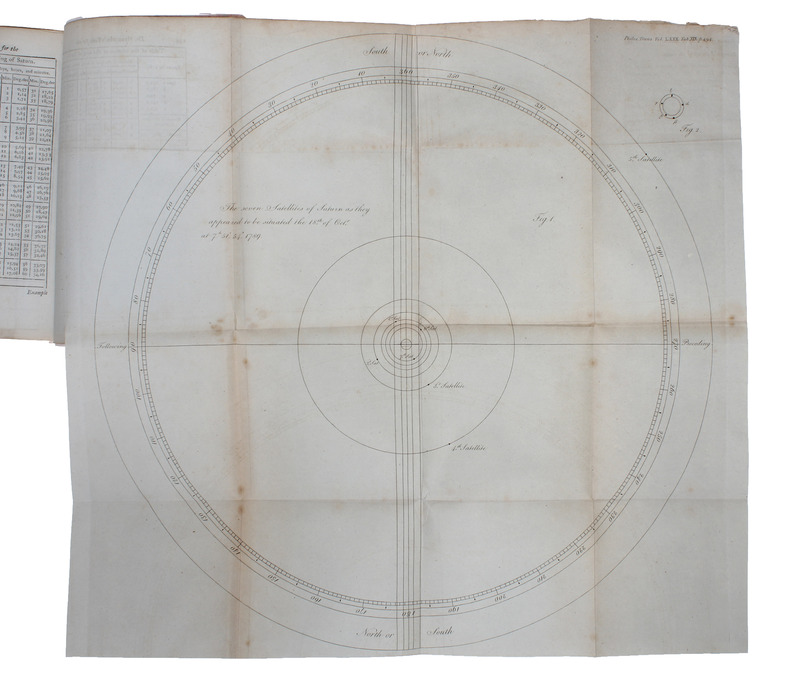
179057206London, Lockyer Davis, 1790 4to. In recent marbled paper wrappers. Extracted from ""Philosophical Transactions"". Including title-page of volume. Leaves reinforced in margin. Very light brownspotting through out and light offsetting from folding plate as usual. (I)-IV, 427-496 pp. + 1 folded plates.
London, Lockyer Davis, 1790 4to. In recent marbled paper wrappers. Extracted from ""Philosophical Transactions"". Including title-page of volume. Leaves reinforced in margin. Very light brownspotting through out and light offsetting from folding plate as usual. (I)-IV, 427-496 pp. + 1 folded plates.
Aratea. Leiden, Bibliotheek der Rijksuniversiteit Leiden, Ms. Voss. Lat. Q. 79. Faksimile Verlag, Lucerna, 1987. Realizzato tra l'816 e l'840 alla corte di Ludovico il Pio, l'origine e chi ha commissionato il manoscritto miniato rimane sconosciuta. All’interno delle 198 pagine (99 carte) una composizione poetica, in latino, che descrive costellazioni e fenomeni astronomici. L’originale era in greco chiamato Phaenomena, che fu compilato da Arato di Soli che visse tra il 315-240/239 a.C. Trentanove miniature a piena pagina raffigurano le costellazioni con caratteristiche umane. Trentasei miniature a tutta pagina raffigurano le quarantadue costellazioni e le Pleiadi; due ulteriori immagini illustrano la rappresentazione mitologica dei cinque pianeti e la personificazione delle quattro stagioni. Legatura in pelle naturale nappata. Commentario, in tedesco, a cura diObbema Pieter F.J.; Mütherich Florentine; Eastwood Bruce; Bischoff Bernhard; Klein Peter K. Cofanetto di custodia. Edizione limitata di 980 copie. Condizione ottima.
Settecentina, Rifiorimento della Sardegna proposto nel miglioramento di sua agricoltura Libri tre di Francesco Gemelli Volume primo - secondo (opera completa in due volumi) Presso Giammichele Briolo, Torino 1776, cm 27,5x21, pp. XVI-400 (volume primo), pp. 344 (volume secondo), frontespizi di entrambi i volumi con piccola ill. incisa in b/n. Legatura coeva in cartonato muto. Opera completa in due volumi. Condizioni di conservazione Volumi entrambi ben conservati con tracce d'uso e leggeri segni del tempo, coperte con alcune abrasioni, piccole mancanze e strappetti ai margini, angoli e dorso. Interni ben conservati con alcune leggere bruniture e aloni, volume secondo con lieve allentamento delle cuciture dei fascicoli. Pagine in bella carta forte con barbe. Rara edizione originale di una delle più, accurate e importanti opere di storia economica sarda, con un tracciato che va dall'epoca romana al '700. Opera completa in due volumi. SETT176.L15882 N
028785Pasadena: D. Lothrop And Company 1972. 1st Edition . Hardcover. Fine. Three Ring Binder Looseleaf 1 5/8" Thick Plus The Printed Binder Itself Six Sections Each Paginated Separately. Prepared By Members Of The Lunar And Planetary Science Section Under Nasa Contract Nas 7-100 To "Present An Up-To-Date Scientific Model Of The Planet Mars With Data Values Limitations And Sources And With A Limited Amount Of Interpretation Where Appropriate". The Manual Was Updated Later Notably In 1972 And 1977. A Wealth Of Information In Charts Transparent Overlays Maps Etc. Carefully Organized And Indexed With Large Folding Map And Separate Large Folding Planning Chart In The Pocket At Front With Two Copies Of The September 29 1972 Transmittal Memo For This Revision. Very Scarce <br/> <br/> D. Lothrop And Company hardcover
1882039051Washington: Bureau Of Navigation Navy Department. 1882. 1st Edition 1st Printing. Hardcover. Near Fine. Xiv 487 Pp. Clean Pages Slightly Aged In A Modern Sturdy Blue Cloth Binding Spine Gilt By Tassinari Bros. Of Indian Orchard Ma. Light Wear. Two New Hampshire Institutional Stamps. Simon Newcomb 1835 -1909 Was A Canadian-American Astronomer Applied Mathematician And Autodidactic Polymath. Newcomb Visited Paris France In 1870 Already Aware That The Table Of Lunar Positions Calculated By Peter Andreas Hansen Was In Error. While In Paris He Realized That In Addition To The Data From 1750 To 1838 That Hansen Had Used There Was Further Data Stretching As Far Back As 1672 And Newcomb Used The "New" Data To Revise Hansen's Tables. In 1878 Newcomb Started Planning For A New And Precise Measurement Of The Speed Of Light Using A Refinement Of The Method Of Léon Foucault. A Letter From Albert Abraham Michelson Began A Long Collaboration And Friendship. In 1880 Michelson Assisted At Newcomb's Initial Measurement But Michelson Left To Start His Own Project. Miichelson Published His First Measurement In 1880 Reprinted Here But Newcomb's Measurement Was Substantially Different And In 1883 Michelson Revised His Measurement To A Value Closer To Newcomb's. In 1881 Newcomb Discovered The Statistical Principle Now Known As Benford's Law Formulating The Principle That In Any List Of Numbers Taken From An Arbitrary Set Of Data More Numbers Will Tend To Begin With "1" Than With Any Other Digit. In 1891 Within Months Of Seth Carlo Chandler's Discovery Of The 14-Month Variation Of Latitude Now Referred To As The Chandler Wobble Newcomb Explained The Apparent Conflict Between The Observed Motion And Predicted Period Of The Wobble As Due To Elasticiity; He Used The Variation Of Latitude Observations To Estimate The Elasticity Of Earth Finding It To Be Slightly More Rigid Than Steel. He Wrote On Economics And His Principles Of Political Economy 1885 Was Described By John Maynard Keynes As "One Of Those Original Works Which A Fresh Scientific Mind Not Perverted By Having Read Too Much Of The Orthodox Stuff Is Able To Produce From Time To Time In A Half-Formed Subject Like Economics." He Was Credited By Irving Fisher With The First-Known Enunciation Of The Equation Of Exchange Between Money And Goods Used In The Quantity Theory Of Money. His Reputation Suffers From His Hostility To C. S. Pierce And Also From Newcomb's Disbelief In The Possibility Of Manned Flight. Source: Wikipedia. Albert A. Michelson 1852-1931 Performed Early Measurements Of The Velocity Of Light With Amazing Delicacy And In 1881 He Invented His Interferometer For The Purpose Of Discovering The Effect Of The Earth's Motion On The Observed Velocity. In Cooperation With Professor E.W. Morley And Using The Interferometer It Was Shown That Light Travels At A Constant Speed In All Inertial Systems Of Reference. The Instrument Also Enabled Distances To Be Measured With Greater Accuracy By Means Of The Length Of Light-Waves. At The Request Of The International Committee Of Weights And Measures Michelson Measured The Standard Metre In Terms Of Wavelength Of Cadmium Light. He Invented The Echelon Spectroscope And During His Wartime Service In The Navy He Performed Research Work On Devices For Naval Use - He Developed A Rangefinder Which Was Adapted As Part Of U.S. Navy Equipment. On His Return To Civilian Life Michelson Became More Interested In Astronomy And In 1920 Using Light Interference And A Highly Developed Version Of His Earlier Instrument He Measured The Diameter Of The Star Betelgeuse: This Was The First Determination Of The Size Of A Star That Could Be Regarded As Accurate. He Was The First American To Receive The Nobel Priize For Physics. Nobel Lectures Physics 1901-1921 Elsevier Publishing Company Amsterdam 1967. With 1985 Purchase Receipt Of Space Scientist Richard E. Bateman From Astronomy Book Dealer Paul Luther. <br/> <br/> Bureau Of Navigation, Navy Department. hardcover
1994059827New York: Norton 1994. 1st Edition . Hardcover. Fine/Fine. 9 1/4" Tall. Drawings and Photographs Throughout. 619 Pp. Grey Cloth Spine Lettered In Silver Blue Boards. First Printing. A Fragile Binding For Unknown Reasons Often Found Near New But With Front Hinge Cracked Or Broken This Copy Not So Fine With Fine Dust Jacket Priced $30.00. This Copy Inscribed By Thorne On The Title Page. <br/> <br/> Norton hardcover
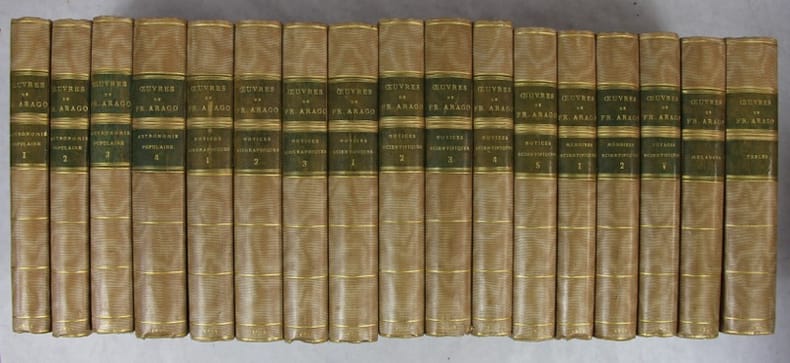
186250757Paris - Leipzig, P. & Leipzig, Gide & Baudry ; T. O. Weigel 1862 17 tomes. In-8, bradel demi-percaline marbrée beige, dos lisse orné de filets dorés, pièces de titre et tomaison de maroquin vert rel. moderne. Illustré de 362 figures in-texte et de 20 planches gravées hors-texte dont 15 doubles. Infimes rousseurs. Très bel exemplaire agréablement relié.
1865107184Paris, Théodore Morgand, impr. J. Claye, à Paris 1865 17 volumes. In-8 22,5 x 14 cm. Reliure de l’époque demi-chagrin rouge à coins, dos à nerfs, têtes dorées, environ 600 pp. par volume, tables des matières.
192922460München, Oldenbourg, 1929. XI, 431 S. mit 159 Textabb. 4 gefalt. Tafeln. Gr.-8°. OLwd. (kl. Gebrssprn.). [5 Warenabbildungen]
1789D16582Boston: B. Edes & Son 1789. First Edition. Hardcover. Good. 12mo. 19thcentury ¾ leather and marbled paper over boards. 16pp. Lacking the folding plate which holds the distinction of being the first chart of the solar system produced in the United States. Nevertheless a book that has become quite scarce on the market. Housed in a custom box with a reproduction of the lacking chart folded and laid in. <br/><br/> B. Edes & Son hardcover
1789D16582Boston: B. Edes & Son 1789. First Edition. Hardcover. Good. 12mo. 19thcentury ¾ leather and marbled paper over boards. 16pp. Lacking the folding plate which holds the distinction of being the first chart of the solar system produced in the United States. Nevertheless a book that has become quite scarce on the market. Housed in a custom box with a reproduction of the lacking chart folded and laid in. <br/><br/> B. Edes & Son hardcover books
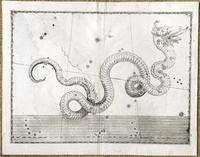
16392230<p><strong>Bayer Uranometria Celestial Chart. </strong></p><p>The constellation Serpens from the second edition of Johann Bayaer’s <em>Uranometria…</em> Augsburg Christophorus Mangus 1639 or later. Fine condition good margins centerfold. One corner of the margin has been restored see detail. Image is about 11 x 15 inches sheet is about 12 ¾ x 16 ¼ inches.</p><p>The verso of this chart is blank indicating the second edition. The first edition had the star catalogue printed on the verso of the plates. The first printing of the second edition was in 1639 but because of its popularity the atlas was reprinted many times into the early 18th century. Bayer was the first to use Greek letters to name stars in each constellation in order of magnitude an innovation still in use today. According to Warner Bayer used Tycho Brahe’s catalogue of stars for stellar positions. The constellation Serpens as seen on this chart was chosen by Warner to illustrate her entry of Bayer in "The Sky Explored"</p> unknown books
177529832Leipzig, Flittner und Müller, 1775. Cont. boards. Titlelabel with gilt lettering. Back with a few tears to paper. (48),744 pp. and 16 folded engraved plates (also showing instruments, globe and map) and 1 folded table. Some browning to leaves and scattered brownspots. Old inscription to titlepage.
162950131Franckfurt, Thumius, 1629. 4to. Contemp. full, richly blindtooled pigskin over wood. Raised bands. Ms title on spine. Engraved pictorial titlepage, engraved portrait. Printed titlepage in red/black. (10),242,1294,(84) pp. A faint dampstain to some right margins of some leaves in the Index. Internally fine.
Leipzig, Flittner und Müller, 1775. Cont. boards. Titlelabel with gilt lettering. Back with a few tears to paper. (48),744 pp. and 16 folded engraved plates (also showing instruments, globe and map) and 1 folded table. Some browning to leaves and scattered brownspots. Old inscription to titlepage.
Franckfurt, Thumius, 1629. 4to. Contemp. full, richly blindtooled pigskin over wood. Raised bands. Ms title on spine. Engraved pictorial titlepage, engraved portrait. Printed titlepage in red/black. (10),242,1294,(84) pp. A faint dampstain to some right margins of some leaves in the Index. Internally fine.
(London, Bulwer and Co., 1803 a. 1804). 4to. Without wrappers as extracted from ""Philosophical Transactions of the Royal Society of London."" Year 1803-Part II. Pp. 339-382 and 2 engraved plates. a. Year 1804-Part II. Pp. 353-384 a. 1 engraved plate. Light browning to a few margins. 2 plates with scattered brownspots, otherwise clean and wide-margined.
Incisione all'acquatinta edita nel 1825 circa. Architettura di Stefano Gass. L. Cerasoli disegnatore ed A. Pizzala incisore. Cm. 45x65 oltre margini con titolo. Assai rara e pregevole veduta della specola napoletana, famosa in Europa per l'accuratezza delle ricerche. Di assoluto valore artistico la fedele raffigurazione della campagna circostante ricca di alberi e sottobosco. Il Vesuvio fumante sullo sfondo. Suggestiva la tonalità di seppia che impreziosisce vieppiù questa sconosciuta immagine.
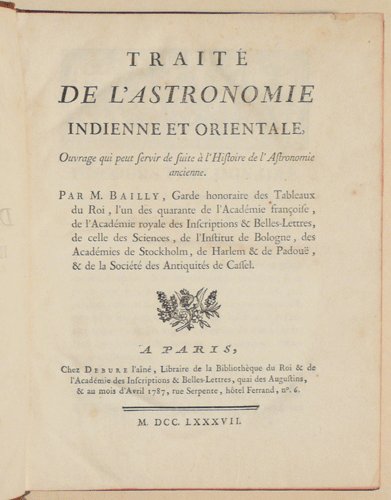
17870034551787 Paris, Debure l'aîné, 1787. In-quarto (208 X 260 mm) basane fauve racinée, dos cinq nerfs, caissons dorés ornés, pièce de titre maroquin grenat, coiffes et coupes ornées, tranches rouges (reliure de l'époque) ; (1) f. blanc, faux-titre, titre, CLXXX [180] pages de "Discours préliminaire", 427 pages, (1) f. blanc. Infimes travaux de vers aux mors et sur le dos, épidermure au second plat.
In -4°, pp. (4), 74, b. A fine original document about the calendar reform.