17 331 résultats
1919164646Pretoria, The Government Printing and Stationary Office., 1919. 1st ed. All 70 maps (-22°), all 70 maps (-28°), 70 maps (-34°, map no. 38 and no. 40 missing), all 60 maps (-40°), 57 maps (-46°, map no. 38, no. 80, 82, 84 missing), all 48 maps (-52°), 48 maps (-58°, map no. 90 and no. 92 missing), all 40 maps (-64°), 33 maps (-70°, maps no. 56, 64 and 18 missing), all 24 maps (-76°), all 16 maps (-82°), all 8 maps (-88°). Index: VIII p. 4°, modern cloth box.
Very Good Arabic Original manuscript without binding. 12mo. (16 x 11 cm). In Arabic. [40] p., drawings, and tables. Marginal texts additionally. A linear wormhole on the bottom from beginning to the end, the thread in the spine is broken hence two separate parts. Otherwise a good copy. Rare manuscript compiled from works related to astronomical instruments written by probably Sibtu'l-Mardînî, copied anonymously in the early 19th century on the paper with 'ahar' with four marginal drawings and tables. The copier of this manuscript is not described. An 'Ebced' notes on the last blank page. The manuscript starts with a calendar in the Islamic system which is prepared with red and black inks and annotated info around the table. The first part includes how to use an almucantar, directions on the sphere, location of the stars in the sky. On the last two pages, the author describes the preparation of an almucantar. The second part is titled "Hadhâ risâle-i cenûb tarafi" [i.e. Tractate on the South direction], and the third and last part titled " Hadhâ risâle-i cenûb taraf, Hadha mukharrar latashich al-shaat fî taraf al-cayb min al-rub'u' mu'âl-ihtizâr", includes some 'sinus mathematics' with two impressive tables on the opposite page. Sibt al-Maridini, the full name Muhammad ibn Muhammad ibn Ahmad ibn Muhammad ibn al-Ghazal (1423-1493), was an Egyptian-born astronomer and mathematician. His father came from Damascus. The word "Sibt al-Maridini" means "the son of Al-Mardini's daughter". His maternal grandfather, Abdullah al-Mardini, was a reputed astronomer of the eighth century AH. He was a disciple of the astronomer Ibn al-Majdi (d. 850/1506). Sibt al-Mardini taught mathematics and astronomy in the Great Mosque of al-Azhar, Cairo. He was also a timekeeper (muwaqqit) of the mosque. He wrote no fewer than fifty treatises in astronomy (sine quadrants, sundials, astronomical tables, and prayer times) and wrote at least twenty-three mathematics textbooks. Al-Sakhawy counted two hundred books that were written by Sibt al-Mardini, on Islamic law, astronomy, and mathematics. Libraries that specialize in ancient manuscripts, all over the world, have transcripts of his works. Sibt al-Mardini's declared that "the opinion of the muezzins (those who call people to prayer) is less correct than that of the legal scholars and it is the latter that should be used as the basis for the determination of prayer time". (Wikipedia). Sib? al-Maridini was a prolific author of astronomical texts, which were still being used and studied into the 19th century. Little is known with certainty about his life. It is thought that he grew up in Damascus, where his maternal grandfather, Abd Allâh ibn Khalîl ibn Yûsuf Jamâl al-Dîn al-Mâridînî (died: 1406), was the muwaqqit (timekeeper) in charge of regulating the daily rituals of the Islamic community) of the Umayyad Mosque. Later he traveled to Cairo, where tradition places him as a student of Ibn al-Majdî. Sib? al-Mâridînî wrote extensively on mathematics and mathematical astronomy. Like his grandfather, he was especially interested in astronomical instruments. The bio-bibliographical sources list some 25 treatises, many of which exist today in multiple copies. According to the historian al-Jabarti (died: 1822), Sib? al-Mâridînî's works on mîqât (ritual timekeeping) and astronomical instruments were still being studied in the curriculum of Cairo's al-Azhar, one of the preeminent educational institutions in the Islamic world, at about the beginning of the 19th century. (Biographical encyclopedia of astronomers, 2007).
Inscription copy of this rare first separate printing of an important early paper on analytical geometry by Austrian mathematician and physicist Christian Doppler, famous for the »Doppler effect«, his observations on wave frequency utilised mainly in astronomy and acoustics. – Contents, Edition: Present essay was Doppler's first accepted for publication in the periodical of the renown Bohemian Society of Sciences and founded his membership with this institution. – Provenance: With author's dedication on rear side of front cover to an unknown addressee: „Als ein geringes Grüßen meiner besonderen Hochachtung übersendet Ihnen diesen literarischen Versuch / Der Verfasser.“ (Sending this literary attempt as a small greeting expressing my special esteem / The Author). – Rarity: JAP/APO (1988ff.) record only one copy at auction (2009). - Reference: Kayser VII, 225; Poggendorff I, 594; Wurzbach 3, S. 370ff.; Schuster, Doppler, S. 51.
First separate printing, in the original wrappers. – Condition: Wrappers with little traces of use, otherwise very fine, partly uncut copy. – Rarity: APO (1988ff.) and ABPC (1973ff.) record no copy at all at auction.
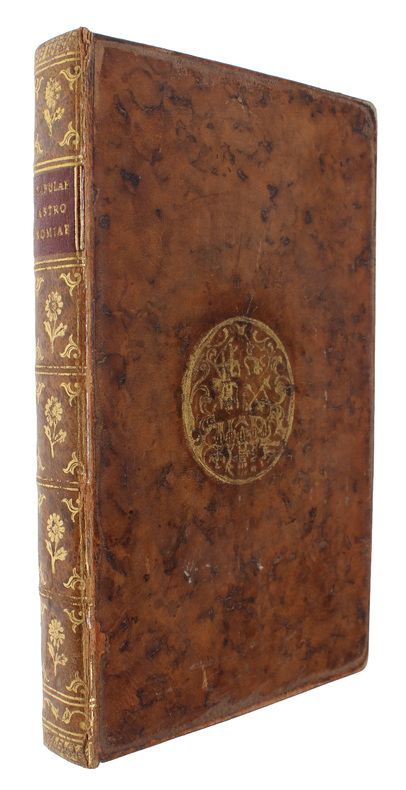
159854719No Place (Wittenberg), 1598. Bound in 18th century full mottled calf. Richly gilt spine. Titlelabel with gilt lettering. Large oval mongram in gold on both covers. Light edgewear. (32),105 (=205) pp. Many astronomical woodcuts in the text. With only one movable hand (pointer) of 4. Title-page with a large sphaerical woodcut. Title-page mounted and a bit frayed, loosing some paper of upper right corner, no loss of text. A bit of fraying to the next three leaves. Old names on title-page. On top ""Libris D. Procopii..."".
182851337Berlin, Königl. Akademie der Wissenschaften etc., 1828-41. 8vo. Bound in 7 contemp. hcalf. One volume with loose spine, otherwise with weak hinges, a few broken. Small stamps on title-pages. Each year around 300 pp. 2 engraved plates. Some leaves at beginnings with browning and brownspots. On inside on frontcovers in all 7 bound volumes the engraved bookplate of John Couch Adams (Ex Libris Johannis Couch Adams and is portrait).
178544925(Paris, Moutard, 1785). 4to. Extracted from ""Mémoires fe Mathematique et de Physique, Présentés à l'Academie des Sciences par divers Savans"", Tome X. Pp. 65-160. Wide-margined, clean and fine.
172759045Berlin, Ambrosius Haude, 1727. 4to. Contemp. full calf. Raised bands. Tome- and titlelabels with gilt lettering. Minor repairs at upper joint. In: ""Miscellanea Berolinensia, ad Incrementium scientiarum ex Scriptis Societati Regiæ Scientiarum exhibitis editia, Continuatio II."" (6),346,(4) pp., 11, partly folded engraved plates. Scattered brownspots. Roemer's letter to Leibniz: pp. 276-78, 2 textillustrations. The entire volume offered.
No Place (Wittenberg), 1598. Bound in 18th century full mottled calf. Richly gilt spine. Titlelabel with gilt lettering. Large oval mongram in gold on both covers. Light edgewear. (32),105 (=205) pp. Many astronomical woodcuts in the text. With only one movable hand (pointer) of 4. Title-page with a large sphaerical woodcut. Title-page mounted and a bit frayed, loosing some paper of upper right corner, no loss of text. A bit of fraying to the next three leaves. Old names on title-page. On top ""Libris D. Procopii..."".
Berlin, Königl. Akademie der Wissenschaften etc., 1828-41. 8vo. Bound in 7 contemp. hcalf. One volume with loose spine, otherwise with weak hinges, a few broken. Small stamps on title-pages. Each year around 300 pp. 2 engraved plates. Some leaves at beginnings with browning and brownspots. On inside on frontcovers in all 7 bound volumes the engraved bookplate of John Couch Adams (Ex Libris Johannis Couch Adams and is portrait).
(Paris, Moutard, 1785). 4to. Extracted from ""Mémoires fe Mathematique et de Physique, Présentés à l'Academie des Sciences par divers Savans"", Tome X. Pp. 65-160. Wide-margined, clean and fine.
Berlin, Ambrosius Haude, 1727. 4to. Contemp. full calf. Raised bands. Tome- and titlelabels with gilt lettering. Minor repairs at upper joint. In: ""Miscellanea Berolinensia, ad Incrementium scientiarum ex Scriptis Societati Regiæ Scientiarum exhibitis editia, Continuatio II."" (6),346,(4) pp., 11, partly folded engraved plates. Scattered brownspots. Roemer's letter to Leibniz: pp. 276-78, 2 textillustrations. The entire volume offered.
1729SB-20-1072Budißin (Bautzen), David Richter, 1729. 15 Bl., 476 S., 14 Bl. Halbpergament-Band der Zeit mit unterschiedlichen Deckelbezügen (der vordere schwarze Deckelbezug erneuert; der hintere Deckel mit originalem Buntpapierbezug) und großen Pergamentecken sowie dreiseitigem Rotschnitt (dieser etwas verblaßt). Titelfortsetzung: .Darinnen Alles das jenige, was von dieser nützlichen Scientz, einem politen Menschen und Anfänger der Astronomie, zu wissen nöthig, deutlich erkläret und beschrieben wird; Anbey ist auch ein zulänglicher Unterricht mitgetheilet, wie man nicht allein einen Calender, nach allen seinen Eintheilungen und Characteribus, gründlich verstehen, sondern auch, wie ein jeder sich selbst, einen Calender verfertigen könne.Mit ganzseitiger Kupferstich-Illustration von Johann Daniel de Montalegre (Personen vor dem Gymnysium Zittau, die den Sternenhimmel beobachten) als Frontispiz sowie 22 beiliegenden astronomischen Kupfertafeln; ferner mit ausführlichem Register im Anhang.Hauptwerk des Mathematiklehrers und Astronomen Christian Pescheck zum seinerzeitigen Stand der Astronomie. Peschek, ab 1704 öffentlicher Lehrer der mathematischen Wissenschaften am Gymnasium in Zittau tätig, erwarb sich durch eine Reihe mathematischer Publikationen den Rang eines "Rechenmeisters", der ihn in die Nähe der großen sächsischen Rechenmeister des 16. Jahrhunderts, Adam Riese und Petrus Apianus, rückte. Die 8. Auflage des Brockhaus Lexikons nennt im Hinblick auf die Genauigkeit und Zuverlässigkeit von Berechnungen Riese und Pescheck in einem Atemzug. Der Wiederentdecker des Halleyschen Kometen, Johann Georg Palitzsch, benutzte das Werk zum Selbststudium.Peschecks "Vorhof der Stern-Wissenschaft" gewährt einen Überblick über den Wissensstand der Astronomie im frühen 18. Jahrhundert. Gliederung des Werkes: I: Von der künstlich gemachten Himmels-Kugel. II. Von der Stellung der künstlich gemachten Himmels-Kugel. III. Von der Erd-Kugel. IV. Von den Planeten. V. Von der eigentlichen ungleichen Bewegung der Haupt-Planeten. VI. Von denen Fix-Sternen. VII. Von der Astrognosie oder Stern-Erkäntnis. VIII. Von den Cometen und neuen Sternen. IX. Von denen Adspecten. X. Von denen Welt-Gebäuden. XI. Von der Zeit und ihrer Eintheilung. XII. Com Calender. XIII. Von denen Astronomischen Problematibus oder Aufgaben.
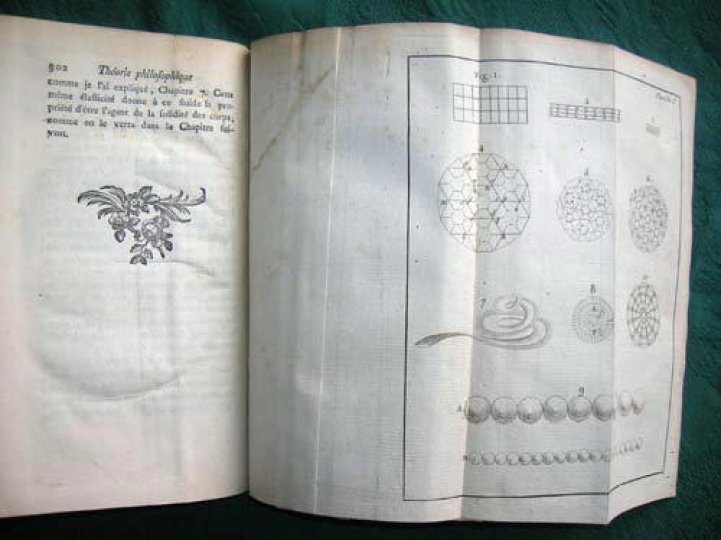
178114588Par Jean Marie Vialon (1746-1805) Bibliothécaire adjoint à la bibliothèque Sainte Geneviève à Paris en 1772, puis sous bibliothécaire en 1790 - 2 parties en 1 volume. 12 planches dépliantes.Première partie : De la nature des Corps. De la Matière, De l'Air, De la Lumière, Du Feu, Du Fluide magnétique, Théorie du Magnétisme, De la Sphère magnétique des autres Corps célestes.Deuxième partie : Avertissement sur la Suite de cet Ouvrage. Contenant 11 Tables des Ages dont une repliée.Très rare édition originale. A Bruxelles, chez Emmanuel Flon, et se trouve à Paris, chez Belin libraire 1781 - 564 pages.Reliure plein-veau de l'époque. Dos à nerfs orné et doré avec pièce de titre rouge. Pas de rousseur. Très bon état. Format in-8° (20x13).
1797571Paris, Agasse, "An V de la République" (1797). Édition originale. Deux volumes reliés en un. Frontispice bien présent, intertitres bien présents. Fort in-8, 13,5 x 20 cm, (2 ff.) (3 ff.) 283 pp., (1 ff.) 316 pp. (2 ff.) Relié demi-maroquin noir. Dos janséniste à 5 nerfs, nom d'auteur et titre frappés en doré et séparés d'un mince trait doré, plats couverts de tissu noir. Gardes marbrées. Mince tranchefile. 2 ff. reliure dont un avec ex-dono à la plume de 1860. 3 ff. originaux, faux-titre avec tampon bleu en haut à droite, frontispice et page de titre du premier volume. Avertissement de Joseph Black et Jacques Hutton, Précis de la vie et des écrits d'Adam Smith par Dugald Stewart, Histoire de l'astronomie en IV sections avec notes des éditeurs anglais. Second volume : Histoire de la physique ancienne, Histoire de la logique et de la métaphysique des anciens, De la nature de l'imitation dans les arts imitatifs, Des arts imitatifs, Des sens externes, Réflexions sur les oeuvres posthumes d'Adam Smith par le traducteur, Avis du traducteur sur la lettre suivante. Lettre aux auteurs du journal d'Édimbourg, Notes du traducteur signalées comme "très-intéressantes".
Paris, Belin, 1821 - 1822. Dieci volumi rilegati in cinque volumi a numerazione continua. (mm. 210 x 130). Mezza tela moderna con tassello con titolo ai dorsi. pp. (4), xxviii, 576, una tabella f.t. più volte ripiegata; (4), 621, (2); (4), 742, (2); (4), 544; (4), 479(1). Opera completa di tutte le dieci parti, ognuna con proprio frontespizio, ma con la numerazione delle pagine che non si interrompe. Bruniture sparse ma ottimi esemplari. Contiene: Elemens de philosophie - sur le systeme du monde - sur la precession des equinoxes - sur l'inoculation - de la liberte de la musique - de l'abus de la critique en materie de religion - sur le calcul des probabilites - sur la cause des vents - sur le mouvement des fluides - sur le lois de l'equilibre - sur la destruction des jesuites - memoires sur Christine - Eloges - Correspndance - etc.
1651P., Coucier, 1806 pour le premier traité, 1817 pour le second, un volume in 4 relié en demi-basane à coins, dos richement de fers dorés (reliure de l'époque), (mouillures et petit travail de vers dans les marges intérieures des premiers feuillets)
176544139Steyr: Gregor Menhardt. 1765. 8 Bll., 133 (1) S. 4°. Mit gest. Titelvignette und 17 Abbildungen auf 3 gefalteten Kupfertafeln. EA. - Erster und einziger Druck. Lederband der Zeit auf 5 Bünden mit Rückenschild.
191989834Alfredo Lamas, Motta & Cie | Lisbonne s. d. [1919-1920] | 16.5 x 23.5 cm | 2 volumes reliés
In-8, veau marbré de l'époque, dos à nerfs orné de compartiments fleuronnés et cloisonnés, pièce de titre de maroquin bordeaux, tranches rouges, xvi, 495 p., 12 planches dépliantes gravées, 17 bandeaux historiés gravés sur cuivre. Edition originale de la traduction française, donnée par Elie de Joncourt. Médecin et physicien, proche collaborateur et éditeur de Newton, Henry Pemberton (1694-1771) procure une synthèse claire et fidèle de la révolution newtonienne en matière de philosophie, de physique (loi de l'attraction universelle), d'astronomie, sur la lumière, les couleurs et les sciences de la nature. Elaboré sous la supervision de Newton lui-même dans les derniers moments de sa vie, l'ouvrage contribua dans sa version anglaise, puis dans cette version française, à la diffusion et à la vulgarisation internationales de l'oeuvre du savant. (Gray, 134. Wallis, 133. Manque à Babson). Petits accrocs aux coiffes et coins. Mors légèrement fendillés. Provenance: le duc d'Albret (Gascogne), XVIIIe siècle, avec son ex-libris gravé et armorié. Petit cachet sur le titre. Bon exemplaire, bien relié à l'époque.
5 vol. in-8, pp. XII, 155; VIII, 164; VIII, 156, VIII, 184; leg. dell'epoca in cartonato marmorizzato. Illustrato con 10 interessanti tavole astronomiche inc. in rame, ripieg. f.t. Prima edizione, completa di questo notevole trattato di astronomia e cosmografia dello Scanelli, nobile canonico e studioso (nato a Forlì nel 1723), costituito da una serie di cento lettere asai interessanti, di cui le prime dieci erano già state stampate nel 1772 col titolo ''Saggio cosmologico'' a seguito di una discussione sulle comete, in riferimento alla cometa del 1669. Bell'esemplare, intonso.. Riccardi, II, 430: «...ben esteso trattato di Astronomia e di Cosmografia, che presenta molta utilità per la storia di queste scienze»..
239New York: The American Physical Society. 1st Edition. 1956 FIRST EDITION IN ORIGINAL WRAPS of the two papers that won Chamberlain and Segre the 1959 Nobel Prize for the first experimental confirmation of the antiproton a new subatomic particle identical in every way to the proton except that its electrical charge was negative instead of positive. <br /> <br /> Chamberlain and Segre's discovery was the culmination of a hunt whose origins go back to 1928 when British physicist Paul Dirac formulated a theory to describe the behavior of relativistic electrons in electric and magnetic fields. Dirac's equation was unique for its time because it took into consideration both Einstein's special theory of relativity and the effects of quantum physics as proposed by Erwin Schrödinger and Werner Heisenberg to describe the behavior of slow-moving particles. While the math worked few physicists gave Dirac's equation much serious consideration because it allowed particles of negative energy. From the standpoint of both physics and common sense the energy of a particle could only be positive Yarris "The Golden Anniversary" Science at Berkeley Lab 2005. <br /> <br /> A number of physicists attempted to find the antiproton but Chamberlin and Segre were particularly clever. According to Segre "I decided to attack the problem in two ways. One was based on the determination of the charge and mass of the particle. The other concentrated on the observation of the phenomena attendant on the annihilation of a stopping antiproton. The stopping antiproton and a proton of the target should mutually annihilate each other and the rest mass of the two particles should transform itself in one of many possible ways into other particles such as pions. These would leave tracks in a photographic emulsion and the annihilation would thus become evident. . . <br /> <br /> "We started the run on August 25 1955 and after a few days of tuning up we began observing antiproton signals. We based the identification on measurement of the velocity momentum and charge of a particle. The signals for velocity were oscilloscope traces recording the passage of a particle through a velocity-selecting Cerenkov detector. . . . We detected about one antiproton for every few hundred thousand other particles crossing our apparatus. . . . We decided to write a letter to the Physical Review and an article for Nature. . . . The mass-spectrograph experiment concluded on October 1 1955 having proved the existence of the antiproton and soon thereafter the emulsion work confirmed it" Segrè A Mind Always in Motion pp. 256-57. <br /> <br /> "The antiproton also became a workhorse of experimental particle physics as scientists at CERN Fermilab etc. later spent decades smashing it into protons in racetrack-shaped accelerators and measuring the sprays of weird new particles that emerged producing what seemed to be an endless stream of Nobel Prizes" New York Times Obituary March 2 2006. According to physics Nobelist Stephen Weinberg: "If it had not been discovered the foundations of physics really would have crumbled" Dr. Weinberg said. He added that the antiproton "was something like the South Pole: it's something that you know is there but you just have to get there anyway" ibid. CONDITION & DETAILS: New York: The American Physical Society. "Observation of Antiprotons" in Physical Review 100 Issue 3 pp. 947-950 November 1 1955; WITH "Antiproton Star Observed in Emulsion" Physical Review 101 pp. 909 January 15 1956. Very light scuff to the front wrap of 101. Otherwise both issues are in near fine condition. The American Physical Society paperback
1842SZEPEBKS007872IToledo: J. de Cea 1842. Hardcover. Near Fine. 16mo. - 4782 pp. - Contemporary full leather spine with 3 bands and title in gilt on leather label. - Marbled endpapers. - With "Fe de algunas erratas mas principales" on last page. - With engraved bookplate in red and black of Armando Colarelo Valledor. - Very fine. - The Spanish astronomer and mathematician Jose REGUERO ARGUELLES 1803-1853 of Asturias established his fame with the present work and later he also published a three-volume "Astronomia fisca" 1850-51. - Armando Colarelo Valledor 1879-1850 was a prolific Spanish playwright and literary critic. - Very rare: WorldCat gives only two locations Biblioteca Nacional de Espana Madrid and Red de LecturaPublica de Euskadi. Vitoria -gazteiz <br/> <br/> J. de Cea hardcover
17211292CBLondon, Bernard Lintot, 1721. 28 gefaltete Tafeln mit unregelmäßger Paginierung, XV, 396 S., (6 Bl. Index). Schöner Lederband der Zeit mit dekorativer Blindprägung auf beiden Buchdeckeln (etwas bestoßen).