17 328 résultats
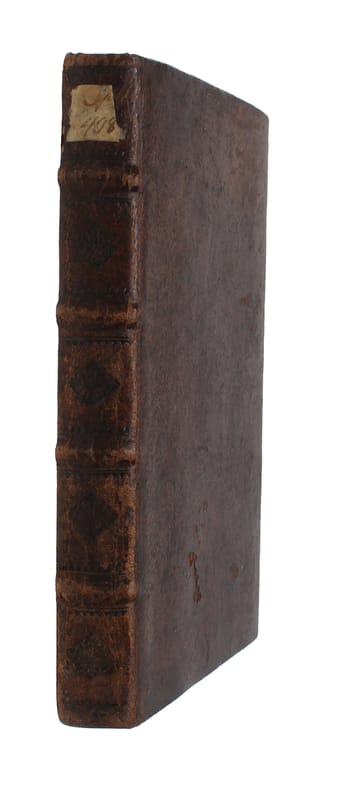
P., chez la Vve de F.Langlois, 1647. In-12 reliure vélin d'époque, titré à l'encre au dos, p.de t.- 6ff - 332 pp. ; à la suite : la longimétrie ou géodésie nouvelle en 2 parties : 2 ff-109 pp ; puis 32 ff [1 pl.depl.-24 pl.] .Mouillure dans la marge externe, plus ou moins marquée, sur les 90 premières pp., ondulations du vélin sur les plats. Rare complet des 25 planches. Le père jésuite Pierre Bobynet enseigna dans plusieurs établissements de son ordre, dont le collège de la Flèche (fondé en 1603 par Henri IV ; Descartes y suivit des cours à partir de 1606). 1ère édition en 1643.
4 volumi, 250x190 mm, pp. XI, 311; 240; 276; 314. Complessivamente 25 tavole più volte ripiegate fuori testo. Rilegatura coeva in mezza pergamena, piatti marmorizzati. Copertine segnate dal tempo. Vignetta incisa a ogni frontespizio: 4 putti con strumenti astronomici. Esemplare brunito, il primo volume ha un piccolo segno di tarlo al lato esterno lontano dal testo. Il terzo volume una pagina con piccole macchioline di inchiostro che non disturbano il testo e firme di possesso al frontespizio. Esemplare nell'assieme discreto. Prima edizione veneta della summa dell'opera di Fortunato da Brescia, al secolo Girolamo Ferrari, astronomo e matematico francescano antiaristotelico.
175889658ABLondon, Printed for W. Owens, at Homer's Head, 1754-1758. Bd. 1. Mit 1 gestoch. Frontis. u. 33 gestoch. Tafeln. 11,11, 410 Seiten, 2 Bll. Index. Dunkelbrauner Lederband der Zeit. - Ob. Kapital m. grösserer, vord. Gelenk u. Titelblatt m. kl. Fehlstelle. Papierüberzog der Innengelenke beschädigt. Anfangs u. zum Schluss m. sehr leichtem Feuchtigkeitsrand, sonst gutes Ex.
Tre volumi di cm. 24,5, pp. (10) 280 (6) + 9 tavole f.t; (8) 219 (1) + 3 tavole f.t.; (8) 148 + 5 tavole f.t. Legatura coeva uniforme in piena pergamena rigida con titoli in oro ai dorsi. Qualche brunitura e traccia d'uso, peraltro esemplari genuini ed in buono stato di conservazione. Un timbretto privato id possesso. Raccolte dei tre volumi che compongono le lezioni del La Caille in tema di geometria, astronomia e fisica; matematica e meccanica.
in-8, pp. XXXVI, 507, (1), leg. coeva in p. pelle, fregi e tassello arancione al dorso a nervi (lievi lacune al dorso). Corredato di 16 belle tavole f.t. incise da De la Gardette, fregetto al tit., iniziali e testatine istoriate. Prima edizione dell'opera del De La Lande, volta ad un pubblico più ampio e con fini maggiormente didattici rispetto all'Astronomie, opera di maggior successo dell'autore. Precede l'opera una lunga prefazione dell'autore. Provenienza: al risguardo ant. ex libris dei librai V.e Le Jeune e Fils (tracce di gore d'acqua nel margine inf. dei primi e degli ultimi ff.).. Houzeau-Lancaster II, 8908..
8vo; 1st edition. Original green publisher's cloth with gilt lettering and top edge gilt. 8vo, 393 pages, illustrated with 16 plates with tissue guards, including 4 in color, as well as photographs, maps, and in-text woodcuts. Early 20th Century work on the observations of Mars. Percival Lawrence Lowell (1855-1916) was a businessman, author, mathematician, and astronomer who fueled speculation that there were canals on Mars, founded the Lowell Observatory in Flagstaff, Arizona, and formed the beginning of the effort that led to the discovery of Pluto 14 years after his death. He was particularly interested in the canals of Mars, as drawn by Italian astronomer Giovanni Schiaparelli, who was director of the Milan Observatory. In 1894 Lowell chose Flagstaff, Arizona Territory as the home of his new observatory. For the next fifteen years he studied Mars extensively, and made intricate drawings of the surface markings as he perceived them. Lowell published his views in three books: Mars (1895), Mars and Its Canals (1906), and Mars As the Abode of Life (1908). With these writings, Lowell more than anyone else popularized the long-held belief that these markings showed that Mars sustained intelligent life forms. His works include a detailed description of what he termed the 'non-natural features' of the planet's surface, including especially a full account of the 'canals,' single and double; the 'oases,' as he termed the dark spots at their intersections; and the varying visibility of both, depending partly on the Martian seasons. He theorized that an advanced but desperate culture had built the canals to tap Mars' polar ice caps, the last source of water on an inexorably drying planet. While this idea excited the public, the astronomical community was skeptical. Many astronomers could not see these markings, and few believed that they were as extensive as Lowell claimed. Light shelf wear to corners of cloth as expected, internally very clean, an excellent copy, Very Good Condition (MX-38-2)
1892163199Paris, Gauthier-Villars, 1892. 1ere ed. 3 vols. 385, 479, 414 p. Gr.-8°, demi-toile du temps. 1899.
Due volumi legati in uno di cm. 21,5, pp. iv, 249 (3); 225 (3). Con 6 tavole incise in rame e ripiegate fuori testo. Legatura di fine '800 in mezza percallina con punte e titoli in oro al dorso. Timbri di un istituto tecnico ceco ai frontespizi ed alle tavole. Esemplare genuino e ben conservato. Edizione originale, non comune. Cfr. Honeyman collection.
172615-0-331Nürnberg, J. C. Weigel, 1726. 8° (21:13,5 cm). mit gestochenem Frontispiz und 42 gefalt. Kupfertafeln, 7 Bll., 197 S., 5 Bll. spät. HLn
175412-2-236Wittenberg, S. G. Zimmermann, 1754. 4°, mit 16 Kupfertafeln, 3 Bll., 384 S., 3 Bll., Ppbd. d. Zt.
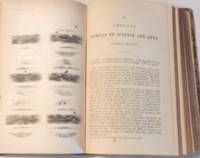
187197507New Haven: Printed by Tuttle Morehouse & Taylor 1871. 1871. Good. THE FIRST APPEARANCE OF THE ESSAY "ON JUPITER AND ITS SATELLITES" BY THE FIRST FEMALE ASTRONOMER IN THE U.S.A. - Octavo 8-1/2 inches high by 5-3/8 inches wide. The contemporary brown calf and marbled boards are detached but present and the spine has perished and is thus lacking. The text block is intact and tight. 978 pages in all with the pagination as follows: Volume I: pages i-viii & 1-484; and Volume II: pages i-viii & 1-480. Pages 327/328 are skipped in numbering as published which collates with the copy at the Peter H. Raven Library at the Missouri Botanical Garden. The volume is illustrated with 3 plates including one folding as well as several textual illustrations. Although the title page to the second volume indicates the presence of a map intended to illustrate E.W. Hilgard's article "On the Geological History of the Gulf of Mexico" page 391 the map is not here present if it ever was included. The endpapers are foxed and there is some light soiling to the title page of the first volume. The edges of the first few leaves are lightly darkened with a tiny spot of dampstaining to the top edge of those leaves. A very good tight copy which would be well worth rebinding. <p>Most noteworthy is the first publication of Maria Mitchell's essay "On Jupiter and its Satellites" illustrated with a plate volume I pages 393-395.<p>The first American scientist to discover a comet Maria Mitchell 1818-1889 was the first female astronomer in the United States. Working as the librarian of the Nantuckett Atheneum Maria Mitchell read through the day and spent her nights with her father at the observatory he built atop the Pacific Bank. Her discovery in 1847 of the comet which came to be named "Miss Mitchell's Comet" brought her international acclaim. She was awarded a gold medal by King Frederick of Denmark and elected as the first woman to join the American Academy of Arts and Sciences the following year. Mitchell traveled throughout Europe after leaving the Atheneum in 1856 meeting with astronomers the world over. She became involved and active in the anti-slavery movement and the suffrage movement and was subsequently instrumental in the formation of the American Association for the Advancement of Women. After the Civil War Mitchell was recruited to join the faculty at Vassar College where with a 12 inch telescope then the third largest in the US she specialized in studying the surfaces of Jupiter and Saturn. She made waves by encouraging her female students to come out at night for classes and celestial observations and brought in noted feminists including Julia Ward Howe to speak on political issues. Continuously championing the advancement of women she gave an important speech entitled "The Need for Women in Science" during the 1876 centennial. Mitchell was one of only 3 women to be elected to the Hall of Fame of Great Americans in 1905. She was also inducted into the National Woman's Hall of Fame in Seneca Falls New York. A lunar crater on the moon was named in her honor.<p>Also worth noting is Professor L. Respighi's essay "On the Solar Protuberances" illustrated with a folding plate volume I pages 283-287.<p>The Italian astronomer Lorenzo Respighi 1824-1889 was appointed appointed professor of mechanics and hydraulics at the University of Bologna. In that context his first works were mathematical and included a well-known memoir on the principles of differential calculus. Captivated by astronomy he succeeded Calandrelli as director of the astronomical observatory at the University of Bologna in 1855. After making observations on comets Respighi became director of the Campidoglio observatory in Rome where he devoted his attention to studying solar phenomena. His studies of the spectra of sunspots were particularly important as he observed the splitting of the absorption lines later described by Hale as the result of the Zeeman effect.<p>Henry James Clark's essay "The American Spongilla a Craspedote Flagellate Infusorian" illustrated with a plate is here published on pages 426 through 436 of volume II.<p>The American naturalist Henry James Clark 1826-1873 was a pupil of Asa Gray at the Cambridge botanical garden. He became an assistant to Louis Agassiz after graduating from Harvard and was professor of Zoology and of Natural History at numerous colleges and universities. From 1872 until his death in 1873 Clark was Professor of Veterinary Science at the Massachusetts Agricultural College in Amherst Massachusetts. He contributed to a number of periodicals and authored "Mind in Nature" 1863 and "Mode of Development of Animals" 1865. New Haven: Printed by Tuttle, Morehouse & Taylor, 1871. hardcover
1870163060Leipzig, Engelmann, 1870. 1. Aufl, 2 Bde. VI, 353, VII, 635 S. Gr.-8°, Halbleinenbände neuerer Zeit. 1880.
173060711Ulm, Wagner, 1730. 8vo. In contemporary full calf with four raised bands and blindstamped ornamentation to spine. Small paper-label pasted on to top of spine. Light wear to extremities and tear to folded plate and vague dampstaining to lower margin of last leaves, one plate with tear, otherwise a nice copy. (12), 80, (28), 75, (10) pp. + 4 plates and numerous illustrations in text.
175061913Kiøbenhavn, Høppfner, 1750. 8vo. In a modest contemporary half calf binding, with considerably wear. Verso on front board annotated in pencil. Internally nice and clean. 90, (6) pp. + 2 folded plates (Not mentioned in Biblioteca Danica).
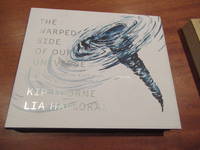
2023060015Liveright Pub Corp 2023. 1st Edition 1st Printing. Hardcover. Fine/Fine. 255 Pp. Blue Cloth Large Format Oblong Hardcover. First Printing Indicated. Fine In Fine Dust Jacket Priced $50.00. Signed Without Inscriptiojn By Both Thorne And Halloran. <br/> <br/> Liveright Pub Corp hardcover
177120041Leipzig, Schwickert, 1771. 2 Bll., 176 S. 7 gefalt. Kupfertafeln. 8°. Pp. der Zeit mit Rückenschild (bestoßen). [4 Warenabbildungen]
1912220304New Haven, 1912-54. 4°. In 20 Hlwdbdn. u. 3 Heften. Teilw. St. o. Sign. a. Tit. o. OU. 1 OU. beschäd. Bd. 7 einige S. ausgebessert. 3 Einbde. stockfl.
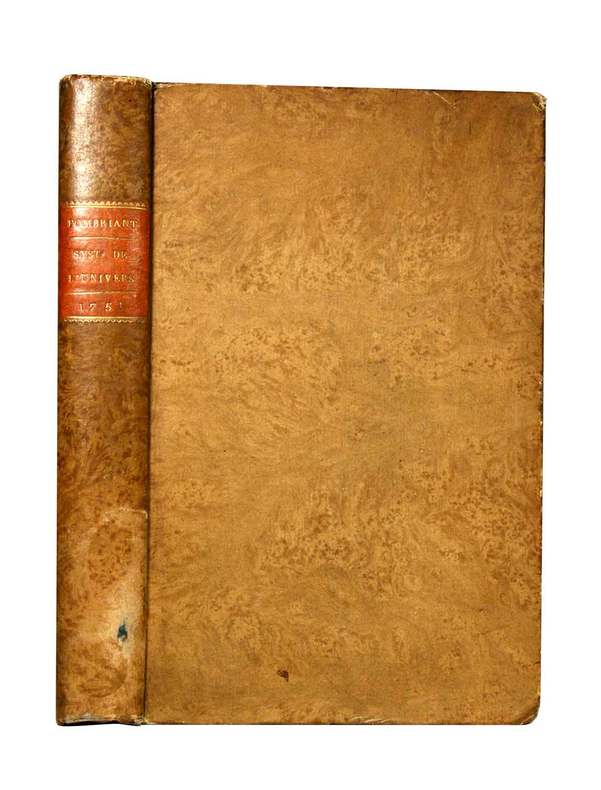
120693aafParis, chez Chaubert et chez Ballard, M. DCC. LI., 1751, gr. in-8vo, (22 x 14.5 cm), titre avec vignette gravée + VI (table des matières) + 290 p. + 1 f. (privilège du Roi), taches d’eau sur les premières feuilles et vers la fin, Exlibris aux armes ‘du Baron Etienne Félix d’Hénin de Cuvillers, Maréchal-de-Camp’ avec devise ‘Nihil Agere Poenitendum’, cartonnage original d’époque. Pièce de titre en maroquin orange au dos.
1813ZA-0954London, T. Bensley, 1810 - 1813. 8 Bl., 162 S., 3 Bl., 10 Bl., 162 S., 1 B., 10 Bl., 163 S., 18 S. Blauer Halbleinenband mit goldgeprägtem Rückentitel. Buchdeckel in mehrfarbiger Marmorierung und mit Leinenecken. Format: 23 x 14,5 cm. Offizielles Astronomisches Jahrbuch der internationalen Astronomie und der Geowissenschaften. Wichtigster Inhalt des Almanachs sind präzise Vorausberechnungen aller größeren Körper des Sonnensystems. Die Erstausgabe von "The Nautical Almanac and Astronomical Ephemeris" erfolgte für das Jahr 1767 in England, das amerikanische Pendant "The American Ephemeris and Nautical Almanac" wurde erstmals für das Jahr 1855 herausgegeben. Die britische Ausgabe erschien unverändert bis 1959 und wurde dann in "The Astronomical Ephemeris" umbenannt. Von 1981 an erscheinen britische und amerikanische Ausgabe gemeinsam unter dem Titel "The Astronomical Almanac".
18441309211St. Petersburg, (Académie Impériale des sciences), 1844. 4to. 4 Bl., 152 S. m. zahlr. Tabellen. Moderner Lwdbd (Stempel u. Signatur auf Vortitel, Titel u. letzter Seite, leicht gebräunt, Feuchtigkeitsränder im letzten Drittel).
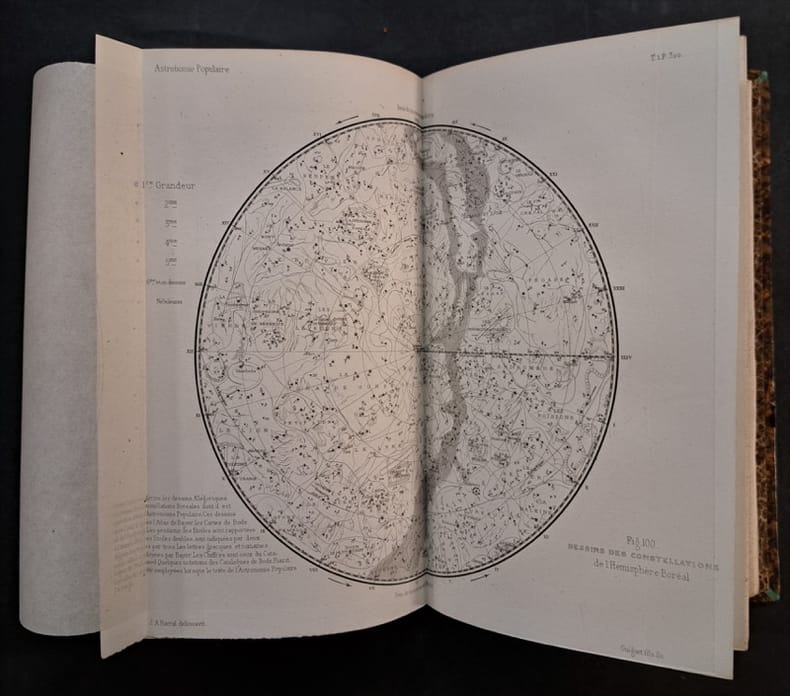
1865128241Paris, Théodore Morgand 1865 In-8 22 x 13 cm. Reliures demi-basane fauve, dos à nerfs ornés de filets et encadrés de petits fers dorés, XII-559-554-635-854 pp., plus de 350 figures dans le texte et 24 planches hors texte dont 22 doubles, table des figures, précieuse table des matières in fine vol. IV. Ouvrage élégamment relié, exempt de rousseurs.
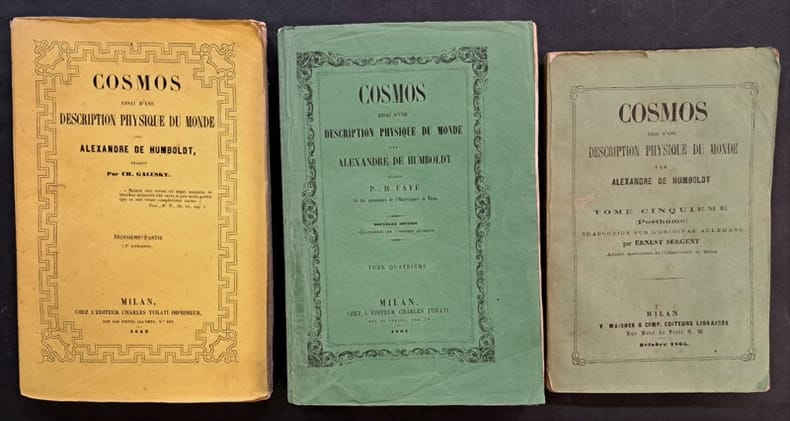
1865127421Milan, chez Charles Turati, Maisner & Comp. 1865 5 tomes en 6 volumes. In-8 22 x 14,5 cm. Brochés, couvertures d’origine, XIX-435-XIII-459-589 p. en continu 2 vol-616-VI-132 pp., Couvertures froissées, rousseurs marginales.
16165853Getruckt zu Augspurg/ bey David Francken/ Im Jahr 1616. Mit 1 Titelkupfer und 23 Textkupfern. (1) 6, 45 (1) S. Fadengeheftet ohne Einband. 19x15 cm. [3 Warenabbildungen]
1803046362Philadelphia: Published by Jacob Johnson 1803. First American Edition . Hardcover. Good. 16mo - over 5¾ - 6¾" tall. 16mo. 137 3 pages. Hardcover bound in original full brown leather. The binding shows wear and bumping but is sound with rubbed but secure hinges. Headcap of the spine is chipped. Small wormhole near the foot of the spine. Complete with endpapers and illustrated with 5 full-page copperplate engravings collates complete as well as several smaller text woodcuts. Early owner's signature on the recto of the frontis reads "Solomon Mordecai / Warrenton North Carolina Jan.y. 1st 1804." Another early signature for "Jos. Mordecai" is at the top of the title page. The Mordecai family was an important Jewish family in eastern North Carolina in the late 18th and early 19th centuries. Jacob Mordecai founded the Warrenton Female Academy in 1809 and was assisted by his son Solomon and several daughters. This title was first published in 1761 by John Newbery in England thought to have actually be written by Oliver Goldsmith under the pseudonym of Tom Telescope. It was a science book written for youth. This is the First American edition. The Second American edition of 1808 is much more common. The "Teacher of Philadelphia" referred to on the title page is believed to have been Robert Patterson Professor of Mathematics at the University of Pennsylvania. This is a decent sturdy copy of a rare and important edition. <br/> <br/> Published by Jacob Johnson hardcover
1903028837Boston And New York: Houghton Mifflin And Company 1903. 1st Edition 1st Printing. Hardcover. Near Fine/No Jacket. Frontispiece. X 424 Pp. Blue Cloth Gilt. Detailed Autobiography With Succinct Explanations Of His Own Work And That Of Others He Worked With. This Example Inscribed "From The Author" To R C Archibald Who Wrote The Official Biography And Bibliography Of Newcomb Published In The Memoirs Of The National Academy Of Sciences In 1924 And Also With The 1956 Signature Of A Prominent Jpl Astronomer Who Managed The U.S. Halley Watch Group. This Example Very Good / Near Fine Light Wear Gilt Brilliant Hinges Tight. Simon Newcomb 1835 -1909 Was A Canadian-American Astronomer Applied Mathematician And Autodidactic Polymath. Newcomb Visited Paris France In 1870 Already Aware That The Table Of Lunar Positions Calculated By Peter Andreas Hansen Was In Error. While In Paris He Realized That In Addition To The Data From 1750 To 1838 That Hansen Had Used There Was Further Data Stretching As Far Back As 1672 And Newcomb Used The "New" Data To Revise Hansen's Tables. In 1878 Newcomb Started Planning For A New And Precise Measurement Of The Speed Of Light Starting Development A Refinement Of The Method Of Léon Foucault. A Letter From Albert Abraham Michelson Began A Long Collaboration And Friendship. In 1880 Michelson Assisted At Newcomb's Initial Measurement But Michelson Left To Start His Own Project. Miichelson Published His First Measurement In 1880 But Newcomb's Measurement Was Substantially Different And In 1883 Michelson Revised His Measurement To A Value Closer To Newcomb's. In 1881 Newcomb Discovered The Statistical Principle Now Known As Benford's Law Formulating The Principle That In Any List Of Numbers Taken From An Arbitrary Set Of Data More Numbers Will Tend To Begin With "1" Than With Any Other Digit.I N 1891 Within Months Of Seth Carlo Chandler's Discovery Of The 14-Month Variation Of Latitude Now Referred To As The Chandler Wobble Newcomb Explained The Apparent Conflict Between The Observed Motion And Predicted Period Of The Wobble As Due To Elasticiity; He Used The Variation Of Latitude Observations To Estimate The Elasticity Of Earth Finding It To Be Slightly More Rigid Than Steel. He Wrote On Economics And His Principles Of Political Economy 1885 Was Described By John Maynard Keynes As "One Of Those Original Works Which A Fresh Scientific Mind Not Perverted By Having Read Too Much Of The Orthodox Stuff Is Able To Produce From Time To Time In A Half-Formed Subject Like Economics." He Was Credited By Irving Fisher With The First-Known Enunciation Of The Equation Of Exchange Between Money And Goods Used In The Quantity Theory Of Money. His Reputation Suffers From His Personal Hostility To C. S. Pierce Son Of Newcomb's First Great Mathematics Instructor And Also From Newcomb's Disbelief In The Possibility Of Manned Flight. <br/> <br/> Houghton, Mifflin And Company hardcover