17 331 résultats
1983R150176857HEMMA.. JUIN 1983. In-4. Cartonnage d'éditeurs. Bon état, Couv. légèrement passée, Dos satisfaisant, Intérieur frais. 32 pages. Nombreuses illustrations en couleurs dans le texte et hors texte.. . . . Classification Dewey : 520-Astronomie et sciences connexes
ISBN : 2800602627. HEMMA.. JUIN 1983. In-4 Carré. Cartonnage d'éditeurs. Bon état. Couv. légèrement passée. Dos satisfaisant. Intérieur frais. 32 pages. Nombreuses illustrations en couleurs dans le texte et hors texte. Traduit de l'anglais par MC SUIGNE. Adapté du français par C DAUVISTER. Avec la collaboration de M C ROBERT..
1983R160202641HEMMA. 1983. In-4. Relié. Etat d'usage, Couv. légèrement passée, Dos satisfaisant, Intérieur frais. 32 pages augmentées de nombreuses illustrations et photos en noir et blanc et en couleur in et hors texte. . . . Classification Dewey : 520-Astronomie et sciences connexes
20123228IBHeidelberg, Spektrum Verlag, 2012. 208 S. Gebunden. Versand aus Deutschland / We dispatch from Germany via Air Mail. Einband bestoßen, daher Mängelexemplar gestempelt, sonst sehr guter Zustand. Imperfect copy due to slightly bumped cover, apart from this in very good condition. Stamped. Gestempelt. Spektrum Sachbuch.
200568787Hamburg : Palstek-Verl. - Königswinter : Heel 2005. 253 S. : zahlr. Ill., Kt. ; 30 cm Pappe 0
1916R160200637ERNEST FLAMMARION. 1916. In-12. Broché. Etat d'usage, Couv. légèrement passée, Dos abîmé, Rousseurs. 431 pages - Nombreuses illustrations, figures, cartes et photographies en noir et blanc dans le texte - Déchirure sur le coin bas droit du 1er plat n'altérant pas la lecture - Tampons sur plusieurs pages. . . . Classification Dewey : 520-Astronomie et sciences connexes
Cm. 18, pp. xii -330 (4). Con tavole ed illustrazioni. Bross. orig. Buona conservazione.
Edizione: Première édition . Pagine: 196 . Illustrazioni: Avec 36 illustrations dans le texte . Formato: 8° . Rilegatura: Brossura . Stato: Buono .
PP. 54, CM. 18,5X13, BROSS.
97994Hamburg, Hamburger Abendblatt, 2020. 105 S. Mit sehr zahlr. meist farb. Abb. (= Abendblatt-Magazin. Nr. 32). 29 cm. OBrosch.
1830163097Berlin, Dümmler / Königl. Akademie der Wissenschaften, 1830. 1. Aufl. 500 S. (ca.) Folio, Halbleinenband neuerer Zeit. 1858.
Very Good Arabic Original manuscript without binding. 12mo. (16 x 11 cm). In Arabic. [40] p., drawings, and tables. Marginal texts additionally. A linear wormhole on the bottom from beginning to the end, the thread in the spine is broken hence two separate parts. Otherwise a good copy. Rare manuscript compiled from works related to astronomical instruments written by probably Sibtu'l-Mardînî, copied anonymously in the early 19th century on the paper with 'ahar' with four marginal drawings and tables. The copier of this manuscript is not described. An 'Ebced' notes on the last blank page. The manuscript starts with a calendar in the Islamic system which is prepared with red and black inks and annotated info around the table. The first part includes how to use an almucantar, directions on the sphere, location of the stars in the sky. On the last two pages, the author describes the preparation of an almucantar. The second part is titled "Hadhâ risâle-i cenûb tarafi" [i.e. Tractate on the South direction], and the third and last part titled " Hadhâ risâle-i cenûb taraf, Hadha mukharrar latashich al-shaat fî taraf al-cayb min al-rub'u' mu'âl-ihtizâr", includes some 'sinus mathematics' with two impressive tables on the opposite page. Sibt al-Maridini, the full name Muhammad ibn Muhammad ibn Ahmad ibn Muhammad ibn al-Ghazal (1423-1493), was an Egyptian-born astronomer and mathematician. His father came from Damascus. The word "Sibt al-Maridini" means "the son of Al-Mardini's daughter". His maternal grandfather, Abdullah al-Mardini, was a reputed astronomer of the eighth century AH. He was a disciple of the astronomer Ibn al-Majdi (d. 850/1506). Sibt al-Mardini taught mathematics and astronomy in the Great Mosque of al-Azhar, Cairo. He was also a timekeeper (muwaqqit) of the mosque. He wrote no fewer than fifty treatises in astronomy (sine quadrants, sundials, astronomical tables, and prayer times) and wrote at least twenty-three mathematics textbooks. Al-Sakhawy counted two hundred books that were written by Sibt al-Mardini, on Islamic law, astronomy, and mathematics. Libraries that specialize in ancient manuscripts, all over the world, have transcripts of his works. Sibt al-Mardini's declared that "the opinion of the muezzins (those who call people to prayer) is less correct than that of the legal scholars and it is the latter that should be used as the basis for the determination of prayer time". (Wikipedia). Sib? al-Maridini was a prolific author of astronomical texts, which were still being used and studied into the 19th century. Little is known with certainty about his life. It is thought that he grew up in Damascus, where his maternal grandfather, Abd Allâh ibn Khalîl ibn Yûsuf Jamâl al-Dîn al-Mâridînî (died: 1406), was the muwaqqit (timekeeper) in charge of regulating the daily rituals of the Islamic community) of the Umayyad Mosque. Later he traveled to Cairo, where tradition places him as a student of Ibn al-Majdî. Sib? al-Mâridînî wrote extensively on mathematics and mathematical astronomy. Like his grandfather, he was especially interested in astronomical instruments. The bio-bibliographical sources list some 25 treatises, many of which exist today in multiple copies. According to the historian al-Jabarti (died: 1822), Sib? al-Mâridînî's works on mîqât (ritual timekeeping) and astronomical instruments were still being studied in the curriculum of Cairo's al-Azhar, one of the preeminent educational institutions in the Islamic world, at about the beginning of the 19th century. (Biographical encyclopedia of astronomers, 2007).
1883011242Braunschweig, Friedrich Vieweg und Sohn, 1883. 2 Blatt, 46 Tafeln. Halblederband der Zeit. Der Rücken berieben und das Vordergelenk oben ca. 6 cm aufgeplatzt. Die Tafeln stockfleckig und zwei mit größerem Einriß, sonst insgesamt jedoch ordentliches Exemplar.
182793744Altona, Hammerich & Heineking, 1827. [1] Bl., 20 S. Gr.-8vo, 24 x 20,5 cm. Bedruckte graublaue Orig.-Broschur, unbeschnitten.
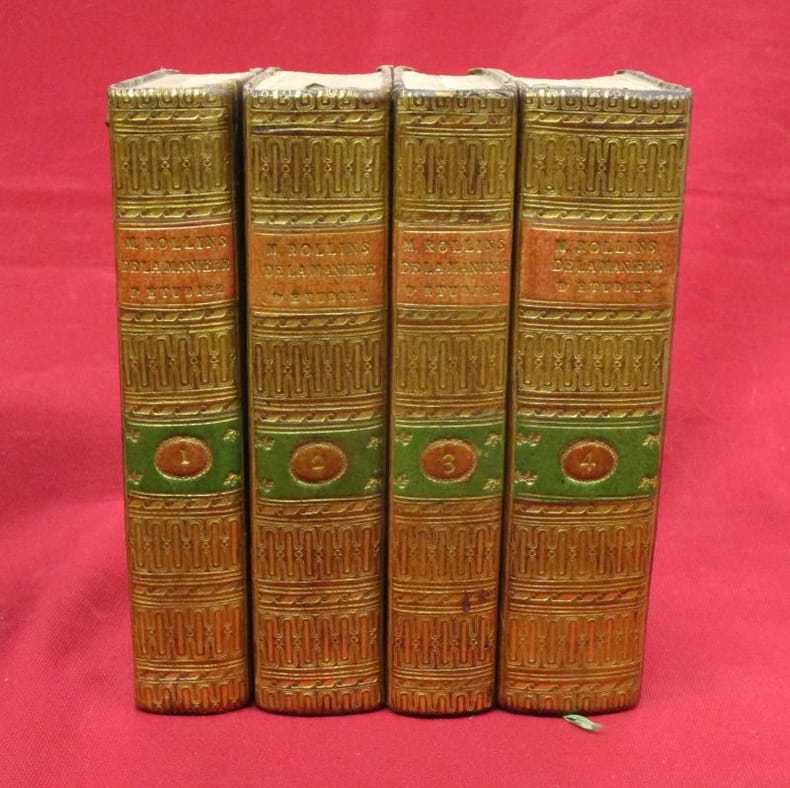
11908933 Ensemble de 33 volumes aux dates de parutions non chronologiques. A Paris, Chez Savoye, Barrois / les Frères Estienne, 1787-1785-1787-1770, 4 volumes in-12 de 428 à 681 pages chacun [suivi de], A Paris, Chez Savoye, Barrois / les frères Estienne / la Veuve Desaint / Saillant & Nyon 1788-1793-1769-1794-1785-1786-1787-1788-1787-1776-1776-1777-1779-1779-1781-1781, 16 volumes in-12 d'environ 450 pages chacun [suivi de] A Paris,Chez Savoye, Barrois / les Frères Estienne, 1788-1786-1788-1774-1764-1776-1779-1779-1787-1783-1788-1789-1772, 13 volumes in-12 d'environ 450 pages chacun, 2 cartes dépliantes, 2 planches dépliantes, 1 plan dépliant, le tome XI contient bien ses deux parties. Demi-reliure marbrée postérieure, dos long portant titres et tomaisons dorés sur pièces de cuir rouge et verte, jolis fers dorés, gardes blanches. Frottements usuels sur les coiffes et les coins, tranches curieusement colorées de bleu sur certains volumes, galeries de vers sur quelques feuillets (sur deux volumes certains de ces feuillets sont restaurés), des rousseurs éparses, sinon intérieur propre, bel ensemble. (Histoire Ancienne : "Avertissement de l'auteur" relié au mauvais endroit du tome III, peut-être incomplet car seulement 2 feuillets présents, la pagination indique vii).
19921061411Paderborn: Schöningh, 1992. 128 S. Originalbroschur.
[IN HEBREW]. 240x170 mm. 71 pages. Softcover. Cover slightly yellowing. Cover edges slightly creased. Spine edges slightly exposed. Pencil markings at inner cover with no damage to text. Front and back cover pages yellowing. Pages slightly yellowing. Else in good condition.
Very Good Turkish, Ottoman (1500-1928) Original color manuscript calendar prepared on a fine special paper with 'ahar'. 36x22,5 cm. In Ottoman script (Turkish with Arabic letters). 2 p. Several ink stains on paper, chipped on extremities. A very good manuscript. It shows astronomic situations, locations of planets and stars, and climates in 1324 [AD 1908]. It starts with high praise to Sultan Abdülhamid II with an old style of color moon & crescent icon. Sealed by Mehmed Pasazâde A. Ihsan. On the verso of paper, can be seen detailed calendar and details of 'ruzname'. Written on 'printed' down of the paper, probably it's prepared for the printing, therefore it's understood that Ihsan and Refet were thinking to print this 'taqwim'. Prepared in the year of the Second Constitutional Regime (II. Mesrutiyet) which was Abdul Hamid II's fall came as a result of the 1908 Young Turk Revolution, and the Young Turks put the 1876 Constitution back into effect. It seems, it's prepared before fall of the Sultan, and for the present to the Sultan. The Second Constitutional Period spanned from 1908 until after World War I when the Ottoman Empire was dissolved. "The starting year of the Hijrî calendar (al-taqwim al-hijri), the fundamental Islamic lunar calendar still in use among Muslims until today, is 622 CE. Its beginning corresponds to the Hijra or emigration of Prophet Muhammed and his followers from Mecca to Medina. It is based on the revolution of the moon around the Earth and consists of twelve months of 29 or 30 days: Muharram (30), Safar (29), Rabî' al-awwal (30), Rabi' al-thani (29), Jumâda al-awwal (30), Jumâda al-thani (29), Rajab (30), Sha'ban (29), Ramadhan (30), Shawwal (29), Dhul-'l-qi'da (30) and Dhul-hijja (29 or 30). The lunar year consists of 354 days, which is 11 days less than the solar year, and every 33 years it falls one year behind the Gregorian calendar. The discrepancy with the solar year, which follows the seasons, meant that Muslim countries also used the solar calendar, and some calendars drawn up by astronomers include the dates according to the European Gregorian calendar named after Pope Gregory XIII in 1582. Ottoman Turkey used both the Islamic lunar calendar and a solar calendar known as the Rumî or Roman calendar, which was based on the Julian calendar introduced since the times of Julius Caesar in 46 BC. The Roman calendar was inherited from the Byzantines and was used by the Ottomans for the taxation of agricultural revenues. The year according to the Rumî or Julian calendar began on 1 March, and the Ottomans took the starting year to be that of the Hijra. To make up for the gain of 11 days made by the solar Rumî calendar over the Islamic calendar, a leap year was deducted from the Rumî calendar every 33 years. A rûzname is a set of tables giving the first days of the months in both the Islamic and Rumî calendars, the date on which the sun enters each sign of the zodiac, and eclipses of the sun and moon. Also known as takvîm-i dâimî (perpetual calendar) or takvîm-i devr-i dâim (calendar of perpetual motion), the ruzname were permanently valid whatever the year. There is no evidence that such calendars were produced in pre-Ottoman times, and they may, therefore, be regarded as a type unique to Ottoman Turkey.". (Source: Glances on Calendars and Almanacs in the Islamic Civilisation by Salim Ayduz).
6 volumi in 1 in-8° (cm. 21), solida ed elegante legatura coeva in m. pelle, dorso a nervi con titolo e decorazioni in oro, tagli a spruzzo; carte in ottimo stato (sporadiche e lievi fioriture). Bell'insieme di 12 opere d'interesse lombardo ma di svariati argomenti. Contiene una tavola ripiegata f.t. dell'eclissi. Ottimo esemplare.
151763752CB[Paris], für Pasquier Lambert gedruckt von T. Kees, [1517]. 4°. 21 x 14,5 cm. Späterer, schlichter Halblederband mit marmoriertem Deckelbezug und rauem Buchschnitt. [7 Warenabbildungen] 34 Blatt. [Signaturformel: [A1], [A4], B-I4].
Sammelband with the major works by eminent Italian Renaissance mathematician and engineer Niccolò Tartaglia. – Author, Content: Present Sammelband contains 3 profusely illustrated volumes with early editions of the major works of Niccolò Fontana Tartaglia (1499/1500-1557), an important Venetian mathematician, engineer, translator (of Archimedes and Euclid into Italian) and author of scientific works: (1) The 2nd edition of 1554 (1st in 1546) of his seminal work about mathematics and their technical application in the fields of military ballistics (for calculating canon trajectories in particular), fortification, statics and topographic surveying, with the addendum to part no. 6 (of 9), which is considered one of the most important early publications on fortification. Present copy also includes the often missing folding flap (depicting a fortification wall) to the addendum, mounted to fore-edge of l. 71r. „Tartaglia's »Quesiti« contains his most important mathematical accomplishment: the independent discovery of the rule for solving third-degree (cubic) equations...“ (Norman). (2) The 3rd edition of 1562 (1st in 1554) of Tartaglia's »Regola«, a particularly rich illustrated treatise on retrieving sunken ships, on which subject he was also interested in his function as accountant for the Venetian Republic. The book, written in the form of imaginary dialogues between Tartaglia and his student, Richard Wentworth, also deals with deep sea diving (3 striking woodcuts with divers for illustration), meteorology for maritime shipping, as well as it prints extracts of Archimedes treatise »De insidentibus aquae«, completely translated and published by Tartaglia in Italian only 3 years later. (3) The 4th edition from 1558 of Tartaglia's Chef d'Œuvre »Nova Scientia« (1st published in 1537), the very first printed treatise on ballistics and a seminal work on motion in general, that led to the discoveries of Galileo and others in this area. The title page of »Nova Scientia« consists of a large woodcut illustration with the coat of arms of Francesco Maria II della Rovere, Duke of Urbino, and a full-paged allegorical depiction showing the author in the midst of the scientific disciplines (all incorporated female) and surrounded with the great scholars of the ancients, like Euclid, Aristotle and Plato.– These three treatises were probably issued together by Venetian printer and co-publisher Curzio Troiano Navò in 1562, using sheets left over from previous editions of (1) and (2), originally printed Niccolò de Bascarini. – Provenance: Engraved pictorial ex-libris with the monogram „F. C.“ at front paste down. – Condition: Cover at corners and edges bumped and worn, boards creased, ll. 1 and 2 of (3) with old repair at bottom, some leaves with water-stains at margins and occasionally foxy, (3) with tight bookbinder's cut to lower margin, no text loss however; generally a solid copy of this Sammelband of particular importance for the history of mathematics and military engineering. – Reference: (1) Adams T 184; Breman 293; CNCE 31875; Cockle 660; Norman 2055; Riccardi I/2, 499. (2) Adams T 187, CNCE 31563; Cockle 660, Riccardi, I/2, 504. (3) Adams T 191; CNCE 31552; Riccardi I/2, 496; Scherrer 49.
2006143176Stuttgart : Kosmos 2006. 191 S. : Ill., graph. Darst. 22,5*14,5 cm. OPappband, OSchu.