Lier, Johannes van.MareMagnum

13 972 résultats
4to. (6), 372 pp. Engraved additional pictorial title with letterpress explanatory leaf, 3 hand-coloured engraved plates. Contemporary tree calf, spine gilt, marbled edges. First edition of this rare monograph on snakes. Text printed intwo columns throughout in Dutch and French. The fine plates, drawn from nature by W. Veltman and engraved by J. C. Philips, show an unidentified snake, a viper, and a slow-worm. A printed explanation is provided opposite the engraved title. - Johannes van Lier was a politician, lawyer, tax collector and Deputy of Drenthe. He wrote several treatises on a wide variety of subjects including history, archaeology and natural history. - Marginal adhesion mark to L4 and M1, very faint dampstaining to some gatherings. Extremities lightly rubbed, head- and tailcaps more heavily, spine label slightly defective. Nissen ZVB 2509.
8vo. 107, (1) pp. - (Bound with) II: Bischof, Johann Christoph. Betrachtungen des Weltgebäudes und einiger Merkwürdigkeiten der Natur. Danzig & Leipzig, Wedel, 1764. (40), 226, (12) pp. With 14 engraved plates. - (Bound with) III: Schmid, N[icolaus Ehrenreich Anton]. Von den Weltkörpern. Zur gemeinnützigen Kenntniss der großen Werke Gottes. Hannover, [Schlüter], 1766. (12), 172 pp. - (Bound with) IV: Huygens, Christian. Weltbeschauer oder vernünftige Muthmaßungen, daß die Planeten nicht weniger geschmükt und bewohnt seyn, als unsere Erde. Zürich, Orell, Geßner u. Comp., 1767. (8), 224 pp. (Bound with) V: Dommerich, Johann Christoph. Sphaerologia Oder Kurzer Unterricht Wie sowol Die Himmels als Erdkugel beschaffen, und recht zu gebrauchen [...]. Lemgo, Meyer, 1745. (16), 164, (12) pp. With 6 (instead of 8) folding engr. plates. With engr. title vignette and 4 engr. plates. Contemporary half calf with giltstamped title to spine. Splendid sammelband containing five rare 18th-c. "Cosmologica" (spine title). - I: Very rare first German edition of Maupertuis' "Essai de cosmologie" published the previous year. Not in OCLC or German auction records. - II: First edition of the only work published by Bischof, teacher at the Stettin Gymnasium; treats fixed stars, comets, will-o'-the-wisps, dew, storms, and rainbows. Very rare; only a single, faulty copy in auction records (R&A, 71, 2196; wanting frontispiece and 4 engravings). - III: First edition of Schmid's much-reprinted and translated principal work. Treats the earth, the planets, their orbits, size, and distance, the sun, light, gravitation, fixed stars, and comets. Schmid was among the first astronomers to attempt using the new science of electricity for sun physics. - IV: Second German edition. "In contrast to most other Huygensian writings, Cosmotheoros has had wide appeal and a broad readership and has been translated into several languages" (DSB). V: First edition of this standard work about constructing and using terrestrial and celestial globes, written by the 21-year-old scientist and philosopher. The plates depict globes, the world model according to Ptolemy and Tycho Brahe, etc. Wants two plates. Very rare; only one copy in German postwar auction records. No copy in America (OCLC). - Binding somewhat rubbed and bumped. Frontispiece of II remargined (not touching image), otherwise clean and wide-margined throughout. Exceptionally well-preserved sammelband containing three rare works on applied astronomy and the much-sought German editions of two classic works of modern astronomy. Ms. ownership note "CMB" on front pastedown; ms. table of contents on flyleaf. I: Fromm 16973. - II: Houzeau/L. 8890. Roller/G. I, 121. Poggendorf I, 203. - III: Hirsching XI, 261-263. Lalande 512. HAB Mass, Zahl und Gewicht 11.11 (only later eds.). - IV: Cf. DSB VI, 611. V: Lalande 428. Houzeau/L. I, 9758. Meusel II, 406. ADB V, 326.
4to. (6), 161, (21) pp. With 58 figures on 10 (counting 1 as frontispiece) engraved plates, mostly folding. Contemporary half calf with label to gilt spine. Second edition of the work first published in Frankfurt in 1719 under a slightly different title and the pseudonym of "Gregorius Anglus Sallwigt". Important for the history of Rosicrucianism, "the mystical content of which is very much unclear" (Kopp). An enlarged version, entitled "Opus Mago-Cabbalisticum et Theosophicum [...]", was published in 1735 under the name of the author (who had died in 1727) and was reprinted in 1760 and 1784. Compared with later copies, the present one is not only more beautifully printed, but also has larger plates and is generally executed with greater accuracy. "The ten folding plates are of absorbing interest to the Rosecrucian turn of mind. Goethe studied this book intensively" (Hoover). Details about Welling (1652-1727), according to Hoover "a man of great learning but very superstitious", the various editions of his works and their content are provided by Frick, Die Erleuchteten, pp. 54, 491ff. and 426ff.: "At the beginning of the eighties of the 18th century, Welling's Opus Mago-Cabbalisticum became the most important text and instruction book of the Order of the Gold- and Rosicrucians [...] The fourth chapter of the first part, 'De mundo archetypo', was transferred almost verbatim into the instruction documents of the first Degree of the Order". - The fine engravings depict geometrical figures and cabbalistic symbols, among them the "Systema Magicum Universi". Slightly browned and insignificant spotting; occasional underlinings and pencil marginalia, otherwise a good copy. Ferguson II, 317. Duveen 526. Neu 4323. Ferchl 466. Mellon 150 (note). Kopp II, 240. Cf. Hoover 872.
4to. LXXVIII, (2), 416, (84) pp., including 27 letterpress tables. With engraved armorial title vignette and 9 (instead of 10) engraved folding plates. Contemporary half vellum over marbled boards with giltstamped calf spine label. First edition of the pioneering regulations for two Florence hospitals, marking "the first appearance in print of [Chiarugi's] landmark reforms in the humane treatment of the mentally ill" (Garrison/M.). - In 1774 Grand Duke Peter Leopold of Tuscany (later Emperor Leopold II) promulgated Europe's first law concerning the hospitalization of persons recognized as being insane, and several years later he undertook to build a new hospital for the mentally ill. In 1875 the young physician Vincenzo Chiarugi, who had studied at the University of Pisa and then at the hospital of Santa Maria Novella in Florence, was given responsibility to plan the new hospital of San Bonifacio, which opened in 1788. The following year the regulations of the hospital were published, together with the statutes of the hospital of Santa Maria Nuova. The regulations reflect Chiarugi's pioneering attitude towards the treatment of the insane: "A detailed history was required for each patient admitted to the hospital. The hospital was built to meet high hygienic standards, men were separated from women, and the rooms and furniture offered full protection to the patients [...] under no circumstances could force be used on patients, and the only methods of restriction allowed were strait jackets and strips of reinforced cotton, in order to prevent impairment in the patient's circulation" (Mora). - The fine plates, carried out by G. Cecchi, G. Salvetti and others, include plans of the premises of both hospitals, images of the kitchen and heating system, and views of the facade, as well as an organisational chart for both hospitals combined. - Lacks the engraved frontispiece. Extremities and spine-label slightly rubbed; small defect to vellum at lower spine. Front view of the Bonifazio hospital with a larger tear; several plates show small tears, occasionally affecting image. Occasional light foxing throughout. A good copy of this landmark work. Garrison/M. 4920.2. Norman 474. G. Mora, "Vincenzo Chiarugi", in: Journal of the History of Medicine 14 (1959), p. 431.
8vo (160 x 228 mm). 2 vols. XVI, (2), 303, (1) pp. VII, 361, (3) pp. With a double-page plate in vol. 1 and a portrait frontispiece in vol. 2. Publisher's original green cloth. All edges gilt. First Hungarian edition of Darwin's "On the Origin of Species", called "the most important single work in science" (Dibner) and "a turning point, not only in the history of science, but in the history of ideas in general" (DSB). "No work of science has ever been so fully vindicated by subsequent investigation, or has so profoundly altered humanity's view of itself and how the living world works" (Wilson). - Translated by László Dapsy, revised by Tivadar Margó. Bindings a little rubbed, extremeties worn, interior quite clean. Original publishers' binding by Lajos Bóka of Pest signed with his blindstamp to the white lacquer endpapers. Freeman 703. OCLC 978009347. Természettudományi társulat vállalata II-III. Cf. PMM 344.
I: Zur Theorie der Lichtfortpflanzung in dispergierenden Medien. 1922. [Weil 120. Seelig 162. Schilpp-Shields 145. Boni 132]. - II: Zu Kaluzas Theorie des Zusammenhanges von Gravitation und Elektrizität. Erste [und zweite] Mitteilung. 1927. [Weil 156. Seelig 212]. - III: Riemann-Geometrie mit Aufrechterhaltung des Begriffes des Fernparallelismus. 1928. [Weil 161. Seelig 161. Boni 174]. - IV: Neue Möglichkeit für eine einheitliche Feldtheorie von Gravitation und Elektrizität. 1928. [Weil 162. Seelig 218. Cf. PMM 416]. - V: Einheitliche Feldtheorie und Hamiltonsches Prinzip. 1929. [Weil 166. Seelig 227. Schilpp-Shields 227. Boni 184. Cf. PMM 416]. - VI: Die Kompatibilität der Feldgleichungen in der einheitlichen Feldtheorie. 1930. [Weil 169. Seelig 239]. - VII: Zum kosmologischen Problem der allgemeinen Relativitätstheorie. 1931. [Weil 179. Seelig 249, Schilpp-Shields 249]. - VIII: Systematische Untersuchung über kompatible Feldgleichungen, welche in einem Riemannschen Raume mit Fernparallelismus gesetzt werden können. 1931. [Weil 180. Seelig 250. Schilpp-Shields 250]. - IX: Einstein & W. Mayer: Einheitliche Theorie von Gravitation und Elektrizität. 1931. [Weil 182. Seelig 251. Hook/Norman 701]. - X: Einstein & W. Mayer: Einheitliche Theorie von Gravitation und Elektrizität. Zweite Abhandlung. 1932. [Weil 185]. 10 of a total of 36 "Sonderausgaben aus den Sitzungsberichten" published under Einstein's name between 1914 and 1932. Such offprints of the session reports of the Academy of Sciences (largely with independent pagination) were presented to the author by the publisher in a limited number as vouchers or dedication copies. - The present offprints date from Einstein's middle and late period at the Berlin Academy. They mainly treat the connection between gravity and electricity/electromagnetism. Einstein strove for a "unified field theory", as the General Theory of Relativity did not allow for properly integrating the electromagnetic field into the geometry of space-time. After a first attempt at a solution in 1925, Einstein tackled the problem again three years later, "only to find that Riemann's conception of space, on which the general theory was based, would not permit of a common explanation of electromagnetic and gravitational phenomena. In a series of papers devoted to the development of 'A Uniform Theory of Gravitation and Electricity' he outlined a new theory of space with a view to the unification of all forms of activity that fall within the sphere of physics, giving them a common explanation. All that would then remain to complete a scientific unison is the correlation of the organic and inorganic" (PMM 416). - The present offprints reach from the first publication after the Nobel Prize to the last but one before Einstein's leaving Germany. Three articles were published in collaboration with Einstein's assistant, Walter Mayer. - One issue with slight crease to front cover, otherwise very well preserved throughout.
4to. (8), XLVIII, 362, (14) pp. With 22 folding engraved plates, title vignette, and 19 engraved text vignettes. Contemporary vellum with double fillets, blindstamped centrepiece, and ms. title to spine. All edges sprinkled in red. First edition of the Parisian astronomer's work about the application of Newton's Laws to astronomy. The plates mostly depict astronomical and mathematical diagrams. The attractive text vignettes by Charles Nicolas Cochin le jeune (1715-90) are an early example of his book decorations. - Fine copy with ms. note of ownership by "Ed. Declercq, Prof." and bookplate "Dr. Hautrive père". - Important work, recently edited on microfilm in the "Landmarks of science" series. Poggendorff I, 840.
Kl.-Folio (200 x 305 mm). (8), 42 SS. Mit gest. Titelvignette und 4 (davon 2 gefalteten) gest. Tafeln mit ca. 80 beweglichen Teilen. Halbleinenband des 19. Jhs. mit goldgepr. Deckeltitel "Anatomie". Zweite verbesserte und noch zu Lebzeiten Hellwigs erschienene Ausgabe des erstmals 1716 erschienenen anatomischen Ansichtenwerks, einer Überarbeitung von Johann Remmelins "Catoptorum Microscosmicum". Von besonderem Interesse sind die vier von J. H. Werner gestochenen anatomischen Tafeln mit vielen ausklappbaren Teilen (einige lose in der Bauchhöhle; sichtlich jedoch alle Teile vorhanden). Christoph von Hellwig (1663-1721) war Stadtphysicus zu Erfurt, Publizist und Schöpfer des "Hundertjährigen Kalenders". - Einband etwas beschabt und gering bestoßen Titelblatt aufgezogen und knapp beschnitten, dadurch fehlt ein Teil des Impressums. Tafel IV im Falz hinterlegt. Durchgehend gebräunt und braunfleckig sowie wasserrandig. Wellcome III, 240. Waller 4288.
(10), 671, (17) SS. Titel in rot und schwarz gedruckt. Mit gest. Frontispiz und 9 Kupfertafeln. Pergamentband der Zeit auf 3 durchzogenen Bünden mit hs. Rückentitel. Dreiseitiger Rotschnitt. 8vo. Erste Ausgabe. "The best early accounts of arsenic, zinc, and a variety of pyrites" (Hoover). Bei dem von Henckel beschriebenen neuen Blau handelt es sich um das Soda-Ultramarin, das er mit dem Berlinerblau verwechselte. Zur wissenschaftshistorischen Einordnung vgl. Partington: "Henckel accepts Becher's theory of three earths. He also accepts Stahl's phlogiston theory. Henckel thought minerals were formed on the third day of Creation and increased and improved since" (II, 707). - Vorsatz und Titel mit zeitgenöss. hs. Rezensionsnotizen. Das Frontispiz am linken Seitenrand knapp beschnitten. Gutes Exemplar. Partington II, 706. Pritzel 3955. DSB VI, 259. Ferchl 225. Hoover 399.
Folio. 3 vols. 9, (3), 295, (1) pp. 9, (1), 296-546 pp. 16, 547-902 pp. With 364 colored lithogr. ornithological plates and numerous text illustrations. Conmtemp. half calf with title to gilt spine; faux raised bands colored black and raised with gilt fillets, enclosing the image of a bird). All edges marbled; marbled endpapers. A magnificent publication and the standard work on Scandinavian ornithology. Originally published between 1828 and 1838 in 105 installments. In addition to the original 184 plates, the present second edition contains reproductions of further drawings by the Wright brothers newly discovered in the Kungl. Vetenskaps-Akademien Stockholm and in the Helsingfors University Library. - "[D]ie Bilder schwedischer Vögel der Brüder von Wright [sind] so vorzüglich [...], daß man sie noch ein Jahrhundert später einer Neuausgabe für wert gehalten hat, wobei noch fast die gleiche Anzahl bisher unveröffentlichter Tafeln ans Licht gekommen ist" (Nissen, p. 54f.). - A fine, appealingly bound copy. Nissen, Vogelb. 1026. Anker 544. Wood 637.
188850460Dunod ; E. Lacroix 1888 14 volumes in-folio, demi-toile, plats imp. Chaque volume : table annuelle, 12 livraisons, ch. près de 140 pp. & 50 à 60 planches, certaines doubles, l’ensemble sur onglet, texte sur 2 colonnes.
4to. 278 pp. 18th century half vellum with marbled covers. Edges sprinkled. First and only edition of this rare and exceedingly curious book of secrets and popular medicine, a fantastical collection of miracles and notes on disparate topics by the native Tyrolean Theodor Albmair, former secretary to Emperor Ferdinand III. - "In the twenty-five discourses or chapters of his book, the author has something to say about not only the elements but all the fruits of the earth, whilst the most important chapter of all is the twenty-sixth; it is called 'Discorso particolare', and it deals with man in health and in sickness. The fourteenth 'Discorso' deals with bread, the fifteenth with wine" (Simon). Other subjects include gems and precious stones, moss, ambra and balms, metals, herbs, rare flowers and how to cultivate them; various animals, including such as supposedly dwell in fire, etc. "Ein rares, seltenes Buch" (Grass, Verzeichniß einiger Büchermerkwürdigkeiten, 1790, p. 8). - Binding rubbed and bumped. Interior somewhat brownstained throughout; some insignificant worming to lower corner (not touching text). Without flyleaves or final blank leaf. - Provenance: title-page has 18th century manuscript ownership of Giovanni Modesto Canciani, who probably commissioned the binding; last page of text has his handwritten statement: "1770: 20 Xbris liber iste a me Joanne Modesto Canciani totaliter usque ad hanc diem est perlectus" (last word trimmed by binder and then supplied again by the same writer). Additional stamped ownership of the Collegio Universitario Antonianum in Padua ("Antonianum Coll. Univ. Bibl.") with their shelfmarks to title-page. Very rare: OCLC lists only four copies in libraries (Wellcome Library; Univ. of Chicago; Univ. of Michigan; Bibliothèque de Genève); a single copy in auction records (André L. Simon's copy, sold at Sotheby's in 1981). Simon 80. Wellcome II, 26. Sinkankas 60-A ("not seen"). Agassiz I, 111. Böhmer IV, 1, 281. Haym, p. 517, no. 9. Brückmann, Bibliotheca animalis continuatio (1747), p. 12. Cat. of the Science Library in the South Kensington Museum (1891), p. 242. Cat. of the Library of the Museum of Practical Geology (1878), p. 9. OCLC 23632541. Not in Krivatsy, Rosenthal, Ferguson etc.
8vo (162 x 232 mm). 387, (1) pp. With a folding lithographed plate. Publisher's original burgundy cloth. First Czech edition of Darwin's "On the Origin of Species", called "the most important single work in science" (Dibner) and "a turning point, not only in the history of science, but in the history of ideas in general" (DSB). "No work of science has ever been so fully vindicated by subsequent investigation, or has so profoundly altered humanity's view of itself and how the living world works" (Wilson). - The Czech translation predates the Latvian, Armenian, Ukrainian, Bulgarian, Romanian and Slovenian versions by several years. The translator, Professor Fratisek Klapálek, was a prominent entomologist, a founding member and the first chairman of the Czech Entomological Society. - Covers very lightly warped, but finely preserved altogether. Freeman 641. OCLC 62034158. Cf. PMM 344.
(6), 110 pp. With engr. frontispiece (M. Rein sc.). Modern marbled boards. 8vo. First edition in book form (parts had been published in 1720 in the periodical "Berlinische und Cölnische ordinaire Post-Zeitung"): descriptions of lamps capable of burning for prolonged periods without having to be refueled, invented by the Saxonian court mechanic Andreas Gärtner (1654-1727). Gärtner, a cabinet maker and mechanic, had learned his trade over twelve years travelling throughout Germany and Italy (Venice, Bologna, and Rome). By 1686 he was royal cabinet maker to the Dresden court, and later also royal mechanic. Delighting in complicated machanical models and devices, he soon became known as the "Saxon Archimedes". Unfortunately, most of his works perished in a fire at the Wackerbarth Palace in 1728. Gärtner's famous world clock (c. 1700), boasting 365 dials, has survived and still draws crowds at the Dresden Zwinger. The frontispiece shows some of his newly-invented lamps. - Rare; KVK locates 4 copies in Germany (Erlangen, Augsburg, and Munich); OCLC locates no copies in the U.S.; not in COPAC. - Insignificant browning. A very good, clean copy. Thieme/Becker XIII, 37ff.
4to. (10), 226, (26) pp. Title page printed in red and black. With engraved frontispiece (J. G. Puschner del et sc.), engr. separate double-page-sized title, and 28 double-page-sized engraved plates. Contemporary half vellum with ms. spine title; all edges coloured blue. A later edition of Kirchner's important manual of Jewish ceremonies and rites, first published in Jauer in 1716 (while Jungendres's expanded and well-illustrated edition first appeared in 1724). The plates show Rosh Chodesh, the Sabbath, Passover, Shavuot, Rosh Hashanah, Yom Kippur, Sukkot, Chanukkah, Purim, circumcision, engagement, marriage, divorce, burial, etc., as well as liturgical objects, costumes, and rooms. The Polish-born Kirchner had been a rabbi in Fürth before converting to Protestantism in 1713, giving up his birth name Gumpel Mardochai (though Jungendres's preface suggests that he later returned to his old faith). Many of his descriptions are representative of the stricter Polish rites, rather than those observed by the more lenient German community. The engravings by the Nuremberg artist Johann Georg Puschner (commissioned by Jungendres) depict scenes from the Jewish congregation and synagogue of Fürth. "Today most libraries offer merely the reprint published in 1974. This reproduces the Erlangen University Library's copy of an edition of which the exact year of printing is not known, as it is not fully printed, reading only '173...'. Thus, it is only known that another edition was produced in the 1730s - likely in 1730, and certainly in 1735" (cf. Herzig, p. 19). In the present copy, the year of printing has been completed by a contemporary hand to read "1739". Binding somewhat rubbed and stained; old library shelfmarks to flyleaf. Altogether a good, fairly wide-margined copy. A. Herzig, Das Interesse am Judentum zu Beginn des 18. Jahrhunderts: Paul Christian Kirchners 'Jüdisches Ceremoniel', in: Ashkenas 20 (2010), pp. 1-20. Cf. Lipperheide Oc 20. Hiler 500. Fürst II, 190. Mayer, Bibliography of Jewish Art, 1261. Not in Colas.
Large 8vo. (4), 314 pp. With figural woodcut vignette on title-page, 1 printed and 6 engraved folding plates of tables. Contemporary marbled calf with giltstamped title to gilt spine. Leading edges gilt. Edges in red. First edition of one of the most important works in the history of modern chemistry. "To persuade a new generation of chemists to join their ranks and to complete what Lavoisier had envisaged since 1773 - a revolution in chemistry - these men brought out a collaborative work, the 'Méthode [...]'. Originally suggested by Guyton de Morveau to eliminate the confused synonymy of chemistry, and prefaced by a memoir of Lavoisier, it emerged as a complete break with the past" (DSB VIII, 80). The result of this collaboration by de Morveau, Lavoisier, Berthollet, de Fourcroy, Laplace, and Monge is the system presented within the present work, which was to form the basis for the nomenclature still used today, the language of modern chemistry. "The work lists 55 known elements in a series of tables, introducing many new terms which have remained in standard use" (Norman Cat., 604). - Spine-ends damaged; lower corner of front cover bumped. Slight worming to front hinge (small defect at top end). Some browning and finger-smudging inside. First engraved plate water-stained. Front pastedown with contemp. French bookseller's label of the Viennese bookseller Jean-Baptiste Mangot (cf. Öhlberger, p. 203 and 290). Duveen 340. Duveen/Klickstein 126. Honeyman 1936. Norman 1291. DSB VIII, 87.
189547674Philadelphia.: G. Wm. Baist. No date. Ca. 1895. Broadside map handcolored lithograph 39 1/4 x 27 1/4 inches on sheet 41 1/4 x 28 3/4 inches folded. A few extra creases loss to upper left margin just touching neatline couple of other chips and tears in margin one just entering the map area blank at left centre. Overall clean and crisp very good condition. A very attractive softly handcolored map showing the growing city of Everett shortly after its incorporation in 1893 and the completion of the Great Northern Railroad. Additions mapped include Riverside Addition at the south end of the map Bay View Addition and Church Loveland Lamoure's Addition at the west and Church & La Moure's Addition at the north end. The Hotel Monte Cristo and many industries are marked. The Great Northern Railroad enters Everett from the east and the railroad along the Puget Sound is the Seattle and Montana Railway. An inset map at the upper left shows Western Washington the inset map at upper right shows Everett and vicinity. A large and handsome map of great historical interest. . G. Wm. Baist. unknown books
1929025041Pasadena 1929. Original Drawing . No Binding. Near Fine. 13 3/4" x 12 1/4. Original Pencil Engineering Drawing Of Three Views Of A "Latitude Finder At Any Hour Angle With Three Reflections" Dated 1929 Signed Rwp. The Drawing Is 9 5/8" X 11 1/8" With Ample Margins. Porter Is Famous For His Prescient Pre-Construction Drawings Of The Palomar Observatory And Its Telescopes Machinery And Buildings So Well Visualized That They Were Used As Guides During Construction. <br/> <br/> unknown
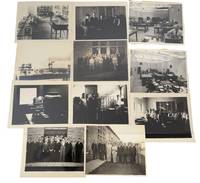
1930232561930. Stanford University Military Engineering Archive Documenting the First Army Ordnance Reserve Gauging Program ca. 1930. Stanford University photo archive documenting the emergence of interwar military-industrial technical education ordnance gauging instruction and precision engineering research on campus during the early development of Stanford's engineering and applied science programs. Rather than depicting science classrooms in a general sense these photographs specifically document the technical culture surrounding Army ordnance training instrumentation systems machine calibration and laboratory-based engineering instruction that linked universities to the expanding infrastructure of American military preparedness between World War I and World War II. Taken together the archive captures Stanford at the moment when higher education increasingly merged scientific research industrial precision manufacturing and military technical training into a unified research model that later shaped the wartime and Cold War defense university system.<br /> <br /> Photo archive of 11 large silver gelatin photographs each approximately 8" x 10" Stanford University California dating from 1930 into the 1950s; two later views mounted to decorative yellow board. Several photographs depict laboratory interiors filled with precision instrumentation gauging apparatus optical and mechanical measuring devices machine-tool equipment calibration benches microscopes drafting stations and technical worktables arranged for instruction and inspection work. One especially important close-up photograph shows a large precision gauging or rotational calibration apparatus associated with ordnance measurement and machine tolerance testing. Surrounding the device are machined cylindrical components threaded fittings gauge rings and polished metal parts likely used in dimensional inspection bore alignment concentricity testing or interchangeable manufacturing instruction. Another darkened workshop view depicts what appears to be a heavy precision lathe or gauging bench fitted with a mounted cylindrical test component equipment consistent with ordnance inspection and military engineering instruction during the interwar period. Additional photographs show groups of students and instructors posed around technical apparatus inside instrumentation laboratories while later mounted photographs document more formalized postwar engineering office and drafting environments associated with large-scale technical administration and research organization.<br /> <br /> Most important is a detailed handwritten verso inscription reading: "Equipment used Feb 1930 Ordnance School at Stanford University. This was first time a course in gauging was given in any Army Ordnance Reserve Unit permanent facilities excepted. Instructor; Lieut Merrill S. Hingo. Photo; Lieut Howard Story Taylor." The inscription firmly identifies the archive as documentation of early Army ordnance reserve technical instruction conducted at Stanford and specifically ties the machinery to military gauging education. In the 1920s-30s "gauging" referred not merely to ordinary measurement but to the specialized science of precision dimensional inspection used in artillery manufacture weapons-part standardization shell tolerances bore measurement interchangeable machining systems and industrial calibration. Such instruction formed a critical component of modern military-industrial production where even minor deviations in machining tolerances could affect artillery accuracy chamber pressure shell seating or mechanical reliability.<br /> <br /> Several outdoor group portraits further reinforce the military context. One large group stands beneath a doorway marked "Military Science and Tactics" while another includes Colonel Donald C. Cubbison a career U.S. Army officer and West Point graduate who served as professor of military science and tactics at Stanford from 1930 to 1935 before later attaining the rank of major general during World War II. His appearance situates the archive directly within Stanford's interwar military training system and links the photographs to broader national efforts to train technically educated reserve officers in engineering ordnance artillery science and industrial preparedness.<br /> <br /> The archive also reflects Stanford's broader transformation into a modern research university centered on applied science and engineering. During the interwar years Stanford's scientific departments expanded laboratory instruction instrumentation programs and research-based technical education under faculty including Robert E. Swain John P. Mitchell William H. Sloan and George S. Parks. Parks in particular became associated with analytical chemistry and geochemical laboratory science disciplines heavily dependent upon precision instrumentation and calibrated measurement systems. The engineering and laboratory culture documented here overlaps with contemporary developments in industrial metrology applied physics materials testing optical measurement and machine-tool inspection that increasingly tied university research to industrial production and military logistics.<br /> <br /> What makes the archive especially significant is the way it documents the transitional infrastructure between traditional university instruction and the emerging defense-oriented research university model. These photographs preserve not simply classrooms but the physical systems of technical education itself: calibration benches inspection machinery gauging apparatus optical instruments drafting rooms and laboratory spaces where students and reserve officers were trained in the precision engineering practices underlying twentieth-century industrial warfare and mass manufacturing. In doing so the archive visually traces the early foundations of the university-based defense engineering culture that would later expand dramatically during World War II and the Cold War throughout California research institutions and the broader military-industrial complex.<br /> <br /> Photographs are sharp and highly detailed with clear views of equipment and interiors; handwritten identifications remain legible. The two mounted 1950s photographs have several large tears without image loss with lighter handling wear elsewhere. Overall good condition. unknown
4to. (8), 237, (3) pp. Bound in contemporary 'carta rustica', faded manuscript title to spine. Rare first edition of this treatise on bread and bread-making, by the physician and naturalist Saverio Manetti (1723-85). The work deals with wheat, flour, different kind of bread (corn, rye, buckwheat and sweat bread, donuts, farinata, waffles, bread with raisins etc.), how to prepare and bake it, substitutes of bread and molds and worms that can grow on it. A separate section details the specifics of oriental bread - "Pane Etiopico, e Saracenico", and varieties "in grand' uso appresso l' Egitto" (pp. 148ff.). "This work precedes Parmentier's 'Parfait Boulanger' by 13 years" (Westbury). - Very lightly foxed, but a very good copy, uncut. With Lord Westbury's bookplate to front pastedown. Bitting 185 (1766 edition only, s.v. "Ginori"). Gamba 2328 (1768 ed. only). Re III, 103. Westbury 138-140.
Messing, vergoldet und graviert. Oktogonalform mit zentral eingelassener, verglaster Kompassdose. Aufstellbarer Schattenwerfer mit Stellzeiger für Polhöhen. Auf der Unterseite des Bodens Polhöhenangaben und Monogramm "L.T.M". 49 x 53 mm. Hübsche Taschensonnenuhr des Augsburger Instrumentenmachers L. T. Müller (1710-70), auf der Unterseite des Deckels sind die Polhöhen von 9 Städten eingraviert, darunter Lissabon, Venedig, Wien, München und Krakau. Tadellos erhalten mit intakter Stundenskala und Gradbogen. Vgl. Syndram, Wissenschaftliche Instrumente und Sonnenuhren, Kataloge der Kunstgewerbesammlung Stiftung Huelsmann Bd. 1, Nrn. 182/183.
FIRST AND ONLY EDITION of the MOST IMPORTANT MONOGRAPH ON THE CANAL LINKING PARIS WITH THE SEA, one of the great engineering projects of its time. XI, 221 pp. plus 3 lithographed maps. The book is divided into two sections: Besons (near Paris) to Rouen, and Rouen to Le Havre. Each section is divided into numerous (and very detailed) subsections. Numerous tables throughout. At the end are three large folding lithographed maps, with the course of the Seine colored by hand in blue. Beautifully printed by Didot on fine wove paper, with large margins. From the library of noted engineer Rudolph Glossop (1902-1993), with his bookplate on pastedown. 4to. Attractively bound in half crimson morocco. FINE AND BRIGHT, with no defects. An outstanding copy of an important book.
190953577Evansville IN: A.L. Swanson Electrical & Manufacturing Co. ca. 1909-1925. Oblong 4to. 62 original silver gelatin photos nearly all backed in linen some w/ embossed photographer’s stamp in lower right corner or photographer’s logo in negative several marked in pencil or ink on versos occasional fraying and dustsoiling to fore-edges of linen. Recent black post-binder original brass split pin posts at gutter margin gilt lettering stamped on front cover VG exemplar. This factory sales photo album for the Swanson Electrical & Manufacturing Co. offers an important visual record of the growth of a Midwestern American manufacturing firm after World War I through the Jazz Age. Founded originally in 1900 by Albert Swanson 1876-1949 in Evansville IN this firm became one of the largest Midwestern companies engaged in electrical engineering construction repair maintenance and retail sales. These photos show how the company built and sold washing machines electric motors radios lighting systems industrial fans installed lighting displays for department stores repaired electric motors rewound generators and installed massive electric generating steam plants for factories. These include photos of the new mill built after 1909 for Swans Down Flour showing the exterior stack for steam the control panels and more; followed by images of the electrical conduits and sea of electric motors for the spinning mill machinery of the Cannelton Cotton Mill in Indiana for the Rumble & Wensel Company; a Heinz plant near Indianapolis IN; and of special interest are the photos of the generating plant installed for the Mead Johnson Co. infant formula plant built in Evansville IN in the wake of World War I. These photos also show the repair shops the massive electrical machines the winding of coils the oil and grease-soaked workers amidst a sea of electrical machine parts work benches metal lathes and more. In addition there are a number of photos of the interior of the new Monitor Furniture Co. Plant on East Virginia St. in Evansville IN finished at the end of 1920. Swanson began repairing and installing electrical equipment in a small downtown shop before the end of the 19th century and by 1915 was refurbishing and selling giant Westinghouse and General Electric motors and generators. In 1919 the Company was incorporated and began quickly expanding finally changing its name to the Swanson-Nunn Co. which continued to install and sell equipment out of their building on 8th street much of the 20th Century. Mason 1886-1944 was a commercial photographer who specialized in architectural and advertising photography in Evansville IN throughout his career. See: Evansville Electrical Concern Re-organzied In: Electrical Review August 2 1919 pp. 209-210. A.L. Swanson Electrical & Manufacturing Co., unknown
4to. (6), 36, (4) pp. With a folding table and a folding engraved map in hand colour, 147 cms in length. Modern marbled boards. First monograph about the just-completed Strömsholm Canal connecting Grangärde (in Dalarna, middle Sweden) with Strömsholm on Lake Mälaren, from where ships have easy access to Stockholm. Work on the 62-mile canal, intended to facilitate transport for the numerous steel works along the waterway, had begun in 1772: based on plans by Johan Ullström, a series of lakes were connected by short canals and a total of 25 locks. The fine map, nearly one and a half metres long, shows the entire stretch of the structure. Earlier the same year, the author Magnus Schenström (1775-1848) had published an eight-page Latin dissertation "De canalibus et catarractis in Svecia generatim, speciatim vero Strömsholmensibus", which he subsequently expanded into the present account of the canal. - Some slight marginal waterstaining, but a good, wide-margined copy. Rare; only four copies listed in OCLC (Baker Library-Harvard Business School; National Library of Sweden; Danish National Library; Staatsbib. Berlin). OCLC 186273921.
1662d3372Cologne: Pauli Pricipus. Worn condition. Boards detached rubbed and scuffed. Occasional edge foxing and browning but content in overall good condition. 1662. First Latin Edition. Brown hardback leather cover. 350mm x 220mm 14" x 9". xi 53pp plates. 131 of 154 b/w plates. Lacking plates 15 31 32 43 44 46 49 63 64. 84 86 108 - 112 116 132 133 141 142 145 153. Text in Latin. . Pauli Pricipus hardcover